trailer CADILLAC LYRIC 2023 User Guide
[x] Cancel search | Manufacturer: CADILLAC, Model Year: 2023, Model line: LYRIC, Model: CADILLAC LYRIC 2023Pages: 424, PDF Size: 4.76 MB
Page 236 of 424
Cadillac Lyriq Owner Manual (GMNA-Localizing-U.S./Canada-15644413) -
2023 - CRC - 2/23/22
Driving and Operating 235
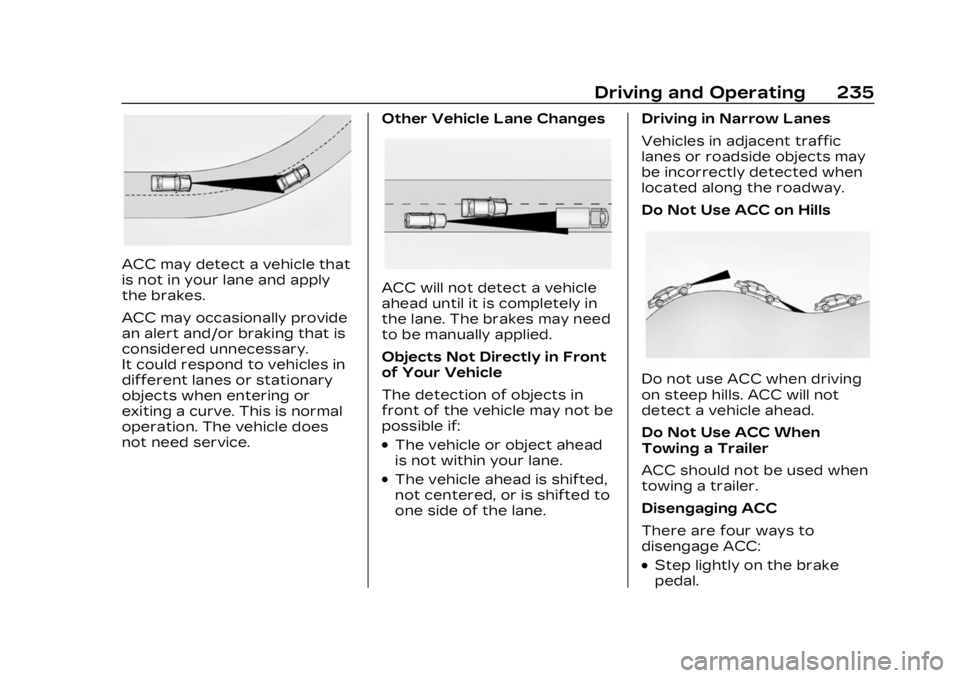
ACC may detect a vehicle that
is not in your lane and apply
the brakes.
ACC may occasionally provide
an alert and/or braking that is
considered unnecessary.
It could respond to vehicles in
different lanes or stationary
objects when entering or
exiting a curve. This is normal
operation. The vehicle does
not need service.Other Vehicle Lane Changes
ACC will not detect a vehicle
ahead until it is completely in
the lane. The brakes may need
to be manually applied.
Objects Not Directly in Front
of Your Vehicle
The detection of objects in
front of the vehicle may not be
possible if:
.The vehicle or object ahead
is not within your lane.
.The vehicle ahead is shifted,
not centered, or is shifted to
one side of the lane.Driving in Narrow Lanes
Vehicles in adjacent traffic
lanes or roadside objects may
be incorrectly detected when
located along the roadway.
Do Not Use ACC on Hills
Do not use ACC when driving
on steep hills. ACC will not
detect a vehicle ahead.
Do Not Use ACC When
Towing a Trailer
ACC should not be used when
towing a trailer.
Disengaging ACC
There are four ways to
disengage ACC:
.Step lightly on the brake
pedal.
Page 240 of 424
Cadillac Lyriq Owner Manual (GMNA-Localizing-U.S./Canada-15644413) -
2023 - CRC - 2/23/22
Driving and Operating 239
Warning (Continued)
.Never remove your hands
from the steering wheel
when Super Cruise is not
operating.
.Always make sure traffic
conditions are safe before
using Super Cruise.
.Always keep the entire
vehicle and the sensors
clean. Sensors are on the
front, sides, and rear of
the vehicle.
.Always observe posted
speed limits. Only use
Super Cruise at or below
the posted speed limit.
Super Cruise should not be
used in complex or uncertain
driving conditions, including:
.Not in construction zones.
.Not when approaching or
exiting toll plazas. (Continued)
Warning (Continued)
.Not when approaching an
intersection that is
controlled with a traffic
light, stop sign, or other
traffic control device.
.Not when lane markings
are not present or cannot
be detected. For example,
there is too much glare,
weather conditions are
poor, or lanes are poorly
marked.
.Not on slippery or icy
roads.
.Not in adverse weather
conditions, including rain,
sleet, fog, ice, or snow.
.Not on winding or hilly
roads.
.Not for city driving.
.Not during heavy or
emergency braking.
.Not on surface streets.(Continued)
Warning (Continued)
.Not on a road shoulder,
service drive, or under an
elevated freeway.
.Not when towing a trailer.
.Not in a highway exit lane.
When Super Cruise is
Available
Super Cruise Indicator
Super Cruise is designed to
operate only when:
.ACC is on. See Adaptive
Cruise Control (Advanced)
0 225.
.Teen Driver is not active.
.The GPS detects the vehicle
is on a compatible highway.
Page 243 of 424
Cadillac Lyriq Owner Manual (GMNA-Localizing-U.S./Canada-15644413) -
2023 - CRC - 2/23/22
242 Driving and Operating
2. Use the turn signal lever toactivate the turn signal in
the direction of the desired
lane change.
3. Return the turn signal lever to the neutral position after
the lane change. See Turn
and Lane-Change Signals
0146.
4. To cancel a lane change, return the turn signal lever
to the neutral position,
move the lever in the
opposite direction of the
lane change, or steer
manually at any time.
Automatic Lane Changes
Super Cruise System may
initiate a single lane change
when enabled through Vehicle
Personalization under
following conditions:
.The Super Cruise System
may initiate an automatic
lane change to the left to
pass a slower moving vehicle
ahead and a subsequent
lane change to right to
return to your original lane.
.Super Cruise System may
initiate an automatic lane
change to left or right when
current lane is ending ahead.
.To cancel a Super Cruise
lane change, move the turn
signal lever or steer manually
at any time..
If Super Cruise detects that
traffic is clear, Super Cruise
will steer the vehicle to
perform the lane change.
A message appears on the
Driver Information Center
(DIC) during the lane change to
provide more information on
the status of the lane change.
Super Cruise Lane Change
functionality is only available
on Super Cruise capable
Divided Roads.
Super Cruise Lane Change
may be disabled when a trailer
or other accessories (e.g. bike
rack, cargo tray, etc.) are
detected.
Do not use Super Cruise Lane
Change when towing a trailer. The Super Cruise Lane
Change feature can be
customized to be Off, On
Demand Lane Change, or On
Demand Lane Change &
Automatic Lane Change
through the vehicle
personalization menu. Touch
the Settings icon on the
infotainment home page.
Select "Vehicle" to display the
list of available options and
select "Super Cruise Lane
Change".
{Warning
Super Cruise Lane Change
may not detect a vehicle in
an adjacent lane. Always
supervise the driving task
and monitor traffic
conditions when using the
Super Cruise Lane Change
feature. Only request a lane
change when traffic
conditions are safe for a
lane change, and always be
ready to manually steer the
(Continued)
Page 248 of 424
Cadillac Lyriq Owner Manual (GMNA-Localizing-U.S./Canada-15644413) -
2023 - CRC - 2/23/22
Driving and Operating 247
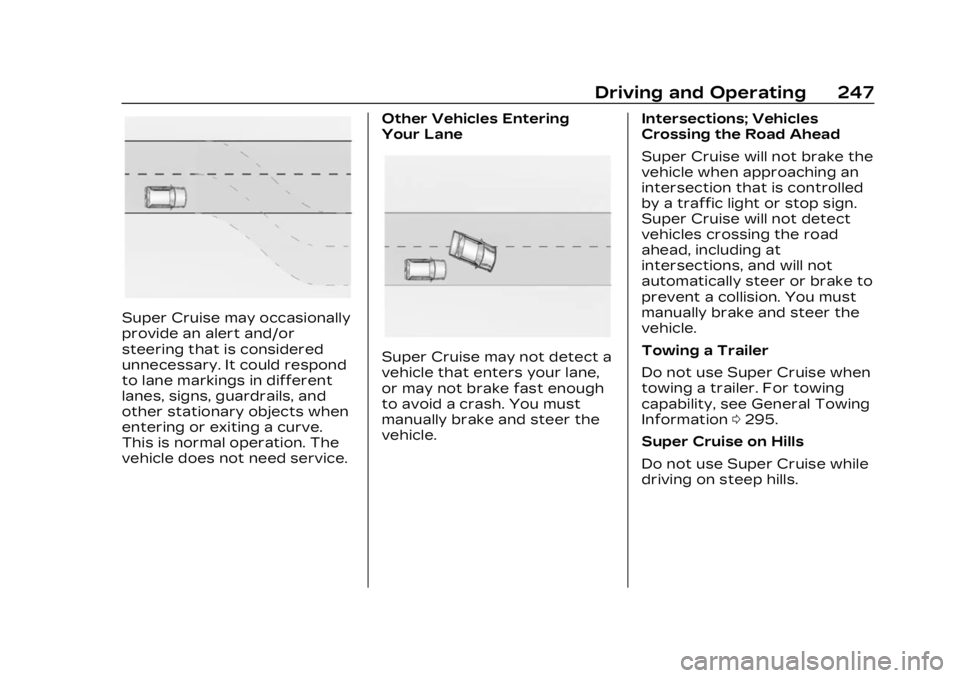
Super Cruise may occasionally
provide an alert and/or
steering that is considered
unnecessary. It could respond
to lane markings in different
lanes, signs, guardrails, and
other stationary objects when
entering or exiting a curve.
This is normal operation. The
vehicle does not need service.Other Vehicles Entering
Your Lane
Super Cruise may not detect a
vehicle that enters your lane,
or may not brake fast enough
to avoid a crash. You must
manually brake and steer the
vehicle.
Intersections; Vehicles
Crossing the Road Ahead
Super Cruise will not brake the
vehicle when approaching an
intersection that is controlled
by a traffic light or stop sign.
Super Cruise will not detect
vehicles crossing the road
ahead, including at
intersections, and will not
automatically steer or brake to
prevent a collision. You must
manually brake and steer the
vehicle.
Towing a Trailer
Do not use Super Cruise when
towing a trailer. For towing
capability, see General Towing
Information
0295.
Super Cruise on Hills
Do not use Super Cruise while
driving on steep hills.
Page 263 of 424
Cadillac Lyriq Owner Manual (GMNA-Localizing-U.S./Canada-15644413) -
2023 - CRC - 2/23/22
262 Driving and Operating
icon on the infotainment home
page. Select“Vehicle”to
display the list of available
options and select “Collision/
Detection Systems”.
The
Xbutton is used to turn
on or off the Park Assist,
which also turns on or off the
Backing Warning and Reverse
Automatic Braking (RAB) at
the same time. When the
system is turned off, a system
off message is shown on the
display. This message
disappears after a short
period of time.
Turn off Park Assist when
towing a trailer to prevent
unwanted beeps and when a
bike rack is attached to ensure
proper operation.
When the System Does Not
Seem to Work Properly
If a service message displays,
check the following conditions:
.The sensors may not be
clean. Keep the vehicle's
front and rear bumpers free of mud, dirt, snow, ice, and
slush. For cleaning
instructions, see Exterior
Care
0364.
.The Park Assist sensors may
be covered by frost or ice.
Frost or ice can form around
and behind the sensors and
may not always be seen; this
can occur after washing the
vehicle in cold weather. The
message may not clear until
the frost or ice has melted.
If a service message displays
and the above conditions do
not exist, take the vehicle to
your dealer for repairs.
If the Park Assist System does
not activate due to a
temporary condition, a system
off message is shown on the
display. This can occur under
the following conditions:
.The driver has disabled the
system.
.An object is currently
blocking the rear sensors
(for example, bike rack,
tailgate, trailer hitch, etc.). Once the object is removed,
Park Assist will return to
normal operation.
.The bumper is damaged.
Take the vehicle to your
dealer for repairs.
.Other conditions, such as
vibrations from a
jackhammer or the
compression of air brakes on
a very large truck, are
affecting system
performance.
Automatic Parking
Assist (APA)
Enhanced Automatic
Parking Assist (APA)
If equipped, under certain
conditions APA with Braking
can use sensors based on
sonar technology along the
vehicle’s front, rear and sides
to detect a parking spot, and
automatically park or unpark
the vehicle with some driver
assistance. The vehicle will
automatically maneuver into a
Page 266 of 424
Cadillac Lyriq Owner Manual (GMNA-Localizing-U.S./Canada-15644413) -
2023 - CRC - 2/23/22
Driving and Operating 265
shifted into P (Park). To start
driving away, press the brakes
and shift into D (Drive).
Certain vehicle conditions and
driver interferences may also
cancel automatic parking:
.The driver manually steers
the vehicle.
.The maximum allowed speed
is exceeded.
.There is a failure with the
APA system.
.Electronic stability control or
antilock brakes are
activated.
.The parking brake is applied.
.Driver unbuckles the seat
belt and opens the door.
System Limitations
Automatic Parking Assist has
certain limitations. The system
cannot:
.Continue to operate if the
maneuver speed exceeds
5 km/h (3 mph).
.Detect whether a parking
space is legal or restricted.
.Detect pavement markings
or lines.
.Park the vehicle closely lined
up with the vehicle next to it,
particularly if the spot is
approached at an angle or if
the parking space is angled.
.Park exactly centered in a
very large spot.
.Always detect short curbs.
.Operate while towing any
trailer.
.Function the vehicle is raised
or lowered by air
suspension,if equipped.
When the System Does Not
Seem to Work Properly
If the vehicle does not reverse
into the expected parking
space, the system could be
maneuvering the vehicle into a
previously detected space.
Remote Auto Parking
If equipped, the vehicle can
complete the automatic
parking maneuvers while the
driver authorizes the maneuver via the myCadillac
app on a compatible mobile
phone outside of the vehicle.
The driver can also activate an
automatic parallel or
perpendicular unparking
maneuver via the myCadillac
app. The driver must always
be prepared to cancel the
automatic maneuver if
necessary.
Remote Auto Parking works
the same way and has the
same limitations as the
standard APA feature
described above. The main
difference is that you must
instead exit the vehicle and
use the myCadillac app.
How to Activate Remote
Auto Parking
To activate Remote Auto
Parking, press
Oon the
infotainment screen for the
system to begin searching for
a parking space while driving
forward at no greater than
30 km/h (18 mph). APA
searches for parking spaces
Page 270 of 424

Cadillac Lyriq Owner Manual (GMNA-Localizing-U.S./Canada-15644413) -
2023 - CRC - 2/23/22
Driving and Operating 269
{Warning
Rear Pedestrian Alert does
not automatically brake the
vehicle. It also does not
provide an alert unless it
detects a pedestrian, and it
may not detect all
pedestrians if:
.The pedestrian is not
directly behind the vehicle,
fully visible to the Rear
Vision Camera (RVC),
or standing upright.
.The pedestrian is part of a
group.
.The pedestrian is a child.
.Visibility is poor, including
nighttime conditions, fog,
rain, or snow.
.The RVC is blocked by
dirt, snow, or ice.
.The RVC, taillamps,
or back-up lamps are not
cleaned or in proper
working condition.(Continued)
Warning (Continued)
.The vehicle is not in
R (Reverse).
To help avoid death or injury,
always check for
pedestrians around the
vehicle before backing up.
Be ready to take action and
apply the brakes. See
Defensive Driving 0196.
Keep the RVC, taillamps, and
back-up lamps clean and in
good repair.
Rear Pedestrian Alert can be
set to Off or Alert. To view
available settings for this
feature, touch the Settings
icon on the infotainment home
page. Select “Vehicle”to
display the list of available
options and select “Collision/
Detection Systems”.
If equipped, alerts can be set
to beeps or seat pulses. To
view available settings for this
feature, touch the Settings
icon on the infotainment home page. Select
“Vehicle”to
display the list of available
options and select “Collision/
Detection Systems”.
Rear Cross Traffic
Alert (RCTA) System
If equipped, Rear Cross Traffic
Alert (RCTA) displays a red
warning triangle with a left or
right pointing arrow on the
infotainment display to warn
of traffic coming from the left
or right. This system detects
objects coming from up to
20 m (65 ft) from the left or
right side of the vehicle. When
an object is detected, either
three beeps sound from the
left or right or three Safety
Alert Seat pulses occur on the
left or right side, depending on
the direction of the detected
vehicle.
Use caution while backing up
when towing a trailer, as the
RCTA detection zones that
extend out from the back of
Page 271 of 424
Cadillac Lyriq Owner Manual (GMNA-Localizing-U.S./Canada-15644413) -
2023 - CRC - 2/23/22
270 Driving and Operating
the vehicle do not move
farther back when a trailer is
attached to the vehicle.
Driving With a Trailer
Use caution while backing up
when towing a trailer. The
RCTA feature is automatically
disabled when a trailer is
attached to the vehicle.
Turning the Features On
or Off
The
Xbutton on the center
stack is used to turn on or off
the Front and Rear Park
Assist, and Backing Warning
and Reverse Automatic
Braking (RAB) systems at the
same time. The indicator light
next to the button comes on
when the features are on and
turns off when the features
have been disabled.
RCTA can be turned on or off
using the infotainment system.
To view available settings for
this feature, touch the
Settings icon on the
infotainment home page. Select
“Vehicle” to display the
list of available options and
select “Collision/Detection
Systems”.
Assistance Systems
for Driving
If equipped, when driving the
vehicle in a forward gear,
Forward Collision Alert (FCA),
Lane Departure Warning
(LDW), Lane Keep Assist
(LKA), Side Blind Zone Alert
(SBZA), Lane Change Alert
(LCA), Automatic Emergency
Braking (AEB), and/or the
Front Pedestrian Braking
(FPB) System can help to
avoid a crash or reduce crash
damage.
Forward Collision
Alert (FCA) System
The FCA system may help to
avoid or reduce the harm
caused by front-end crashes.
When approaching a vehicle
ahead too quickly, FCA
provides a red flashing alert on the windshield and rapidly
beeps or pulses the driver
seat. FCA also lights an amber
visual alert if following another
vehicle much too closely.
FCA detects vehicles within a
distance of approximately
110 m (360 ft) and operates at
all speeds.
{Warning
FCA is a warning system and
does not apply the brakes.
When approaching a
slower-moving or stopped
vehicle ahead too rapidly,
or when following a vehicle
too closely, FCA may not
provide a warning with
enough time to help avoid a
crash. It also may not
provide any warning at all.
FCA does not warn of
pedestrians, animals, signs,
guardrails, bridges,
construction barrels,
or other objects. Be ready to
(Continued)
Page 274 of 424
Cadillac Lyriq Owner Manual (GMNA-Localizing-U.S./Canada-15644413) -
2023 - CRC - 2/23/22
Driving and Operating 273
Automatic Emergency
Braking (AEB)
The AEB system may help
avoid or reduce the harm
caused by front-end crashes.
AEB also includes Intelligent
Brake Assist (IBA). When the
system detects a vehicle
ahead in your path that is
traveling in the same direction
that you may be about to
crash into, it can provide a
boost to braking or
automatically brake the
vehicle. This can help avoid or
lessen the severity of crashes
when driving in a forward gear.
Depending on the situation,
the vehicle may automatically
brake moderately or hard. This
automatic emergency braking
can only occur if a vehicle is
detected. This is shown by the
FCA vehicle ahead indicator
being lit. See Forward Collision
Alert (FCA) System0270. The system works when
driving in a forward gear
above 4km/h (2 mph). It can
detect vehicles up to
approximately 60 m (197 ft).
{Warning
AEB is an emergency crash
preparation feature and is
not designed to avoid
crashes. Do not rely on AEB
to brake the vehicle. AEB will
not brake outside of its
operating speed range and
only responds to detected
vehicles.
AEB may not:
.Detect a vehicle ahead on
winding or hilly roads.
.Detect all vehicles,
especially vehicles with a
trailer, tractors, muddy
vehicles, etc.
.Detect a vehicle when
weather limits visibility,
such as in fog, rain,
or snow.
(Continued)
Warning (Continued)
.Detect a vehicle ahead if it
is partially blocked by
pedestrians or other
objects.
Complete attention is
always required while
driving, and you should be
ready to take action and
apply the brakes and/or
steer the vehicle to avoid
crashes.
AEB may slow the vehicle to a
complete stop to try to avoid a
potential crash. If this
happens, AEB may engage the
Electric Parking Brake (EPB)
to hold the vehicle at a stop.
Release the EPB or firmly
press the accelerator pedal.
{Warning
AEB may automatically
brake the vehicle suddenly in
situations where it is
unexpected and undesired. (Continued)
Page 281 of 424
Cadillac Lyriq Owner Manual (GMNA-Localizing-U.S./Canada-15644413) -
2023 - CRC - 2/23/22
280 Driving and Operating
Warning (Continued)
.BZSA performance may
be affected by weather
and road conditions.
.BZSA does not provide
steering assistance to
avoid a vehicle that is in,
or has entered, your lane
of travel.
.BZSA will not prevent a
towed trailer from
crossing into the adjacent
lane. Always monitor the
trailer position while
towing to ensure it is in
the same lane as your
vehicle. BZSA is only
designed to detect when
your vehicle
unintentionally crosses
detected lane lines.
Lane Keep
Assist (LKA)
If equipped, LKA may help
avoid crashes due to
unintentional lane departures.
This system uses a camera todetect lane markings. The LKA
may be ready to assist at
speeds between
80 km/h (50 mph) and 180
km/h (112 mph). LKA may assist
by gently turning the steering
wheel if the vehicle
approaches a detected lane
marking. It may also provide a
Lane Departure Warning
(LDW) alert if the vehicle
crosses a detected lane
marking. This system is not
intended to keep the vehicle
centered in the lane. LKA will
not assist and alert if the turn
signal is active in the direction
of lane departure, or if it
detects that you are
accelerating, braking or
actively steering. LKA can be
overridden by turning the
steering wheel. If the system
detects you are steering
intentionally across a lane
marker, the LDW will not be
given. Do not expect the LDW
to occur when you are
intentionally crossing a lane
marker.
{Warning
The LKA system does not
continuously steer the
vehicle. It may not keep the
vehicle in the lane or give a
Lane Departure Warning
(LDW) alert, even if a lane
marking is detected.
The LKA and LDW systems
may not:
.Provide an alert or enough
steering assist to avoid a
lane departure or crash.
.Detect lane markings
under poor weather or
visibility conditions. This
can occur if the windshield
or headlamps are blocked
by dirt, snow, or ice; if they
are not in proper
condition; or if the sun
shines directly into the
camera.
.Detect road edges.
.Detect lanes on winding or
hilly roads.
(Continued)