check engine CADILLAC SEVILLE 1995 4.G Owner's Guide
[x] Cancel search | Manufacturer: CADILLAC, Model Year: 1995, Model line: SEVILLE, Model: CADILLAC SEVILLE 1995 4.GPages: 410, PDF Size: 19.98 MB
Page 237 of 410
Downloaded from www.Manualslib.com manuals search engine Making Turns
NOTICE:
Making very sharp turns while trailering could cause the trailer
to come in contact with the vehicle. Your vehicle could be
damaged. Avoid making very sharp turns while trailering.
When you’re turning with a trailer, make wider turns than normal. Do this
so your trailer won’t strike soft shoulders, curbs, road signs, trees, or other -
objects. Avoid jerky or sudden maneuvers. Signal well in advance.
Turn Signals When Towing a Trailer
When you tow a trailer, your vehicle has to have a different turn signal
flasher and extra wiring. The green arrows on your instrument panel will
flash whenever you signal a turn or lane change. Properly hooked up, the
trailer lamps will also flash, telling other drivers you’re about to turn,
change lanes or stop.
When towing a trailer, the green arrows on your instrument panel will
flash
for turns even if the bulbs on the trailer are burned out. Thus, you
may think drivers behind
you are seeing your signal when they are not. It’s
important
to check occasionally to be sure the trailer bulbs are still
working.
Driving On Grades
Reduce speed and shift to a lower gear before you start down a long or
steep downgrade. If
you don’t shift down, you might have to use your
brakes
so much that they would get hot and no longer work well.
4-46
Page 239 of 410
Downloaded from www.Manualslib.com manuals search engine Adahtenance When Trailer Towing
Your vehicle will need service more often when you're pulling a trailer.
See the Maintenance Schedule for more
on this. Things that are especially
important in trailer operation are automatic transaxle fluid (don't
overfill), engine oil, belt, cooling system, and brake adjustment. Each
of
these is covered in this manual, and the Index will help you find them
quickly. If you're trailering, it's a good idea to review these sections before
you start your trip.
--
Check periodically to see that all hitch nuts and bolts are tight.
Engine Coding When Trailering
Your cooling system may temporarily overheat during severe operating
conditions such as:
Climbing grades steeper than 4% at ambient temperatures above
90°F (32" C) with a loaded vehicle and trailer.
Stopping after high-speed driving.
Idling for long periods in stop-and-go traffic.
If the ENGINE HOT-A/C COMPRESSOR OFF message appears on the
Driver Information Center, do
not be alarmed. This is a normal function
designed to reduce the load on the engine and cooling system. You can
continue to drive your vehicle.
If the ENGINE COOLANT HOT-IDLE ENGINE message appears on
the Driver Information Center, pull
off to the side of the road as soon as
it is safe to do
so. When the vehicle is at a complete stop, shift the
transaxle selector to PARK
(P) and allow the engine to idle. Do not turn
off the engine or increase engine speed above a normal idle. After several
minutes, resume driving at a reduced speed. Return
to normal driving
after
10 minutes if the ENGINE COOLANT HOT-IDLE ENGINE
message is not displayed.
4-48
Page 244 of 410
Downloaded from www.Manualslib.com manuals search engine TO JUMP START YOUR CADILLAC
1. Check the other vehicle. It must have a 12-volt battery with a negative
ground system.
NOTICE:
If the other system isn’t a 12-volt system with a negative gro\
und,
both vehicles can
be damaged.
2. Get the vehicles close enough so the jumper cables can reach, but be
sure the vehicles aren’t touching each other.
If they are, it could cause
a ground connection you don’t want. You wouldn’t be able to start
your Cadillac and the bad grounding could damage the electrical
systems.
3. Turn off the ignition on both vehicles. Turn off all lamps that aren’t
needed and radios. This
will avoid sparks and help save both batteries,
as well as avoid damage to any of the accessories.
4. Open the hoods and locate the batteries.
Find the positive (+) and negative (-) terminals on each battery.
5 -5
Page 246 of 410
Downloaded from www.Manualslib.com manuals search engine 6. Check that the jumper cables don’t have loose or missing insulation. If
they do, you could get a shock. The vehicles could also be damaged.
Before
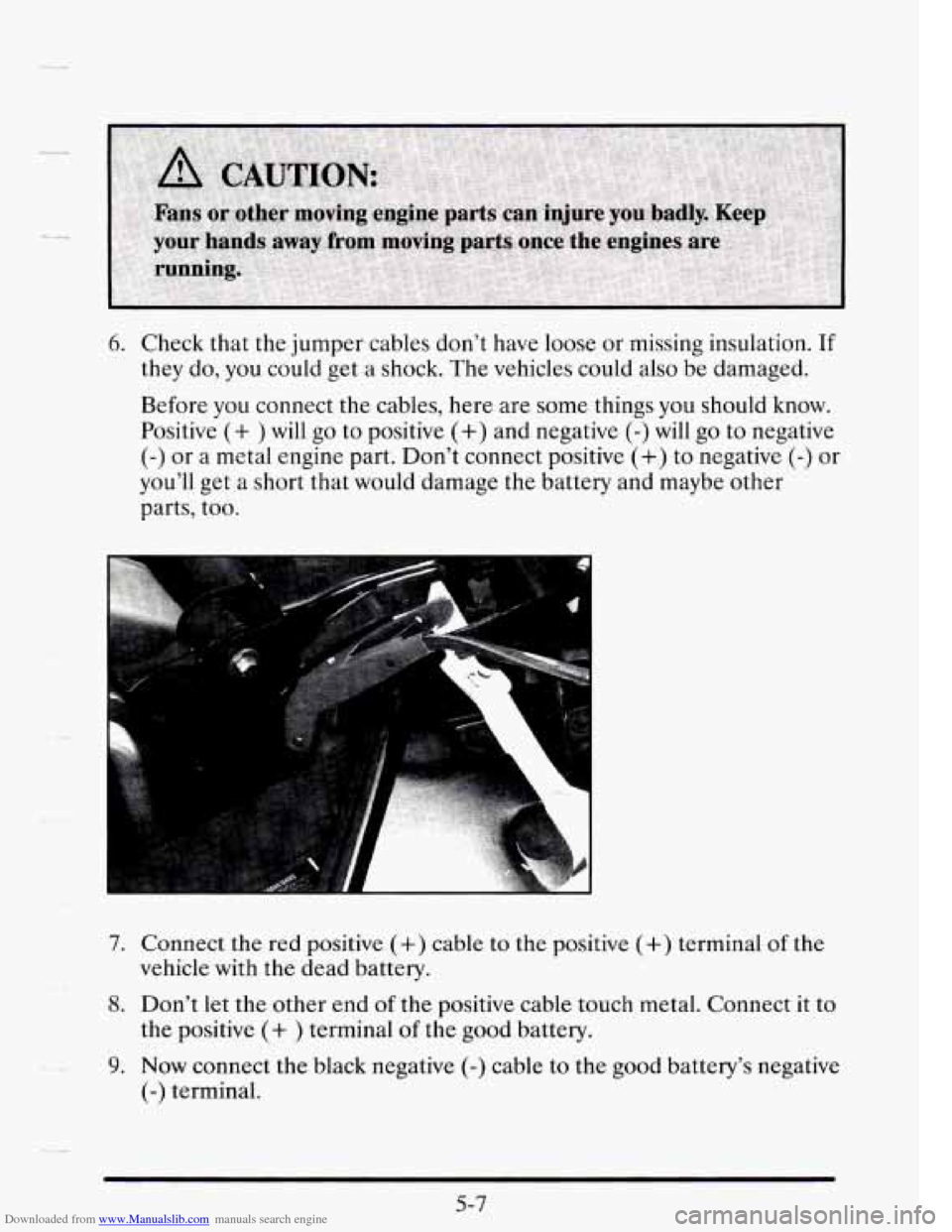
you connect the cables, here are some things you should know.
Positive
(+ ) will go to positive (+) and negative (-) will go to negative
(-) or a metal engine part. Don’t connect positive (+) to negative (-) or
you’ll get a short that would damage the battery and maybe other
parts, too.
7. Connect the red positive (+) cable to the positive (+) terminal of the
8. Don’t let the other end of the positive cable touch metal. Connect it to
vehicle with the dead battery.
the positive
(+ ) terminal of the good battery.
9. Now connect the black negative (-) cable to the good battery’s negative
(-) terminal.
5-7
Page 255 of 410
Downloaded from www.Manualslib.com manuals search engine 13
a
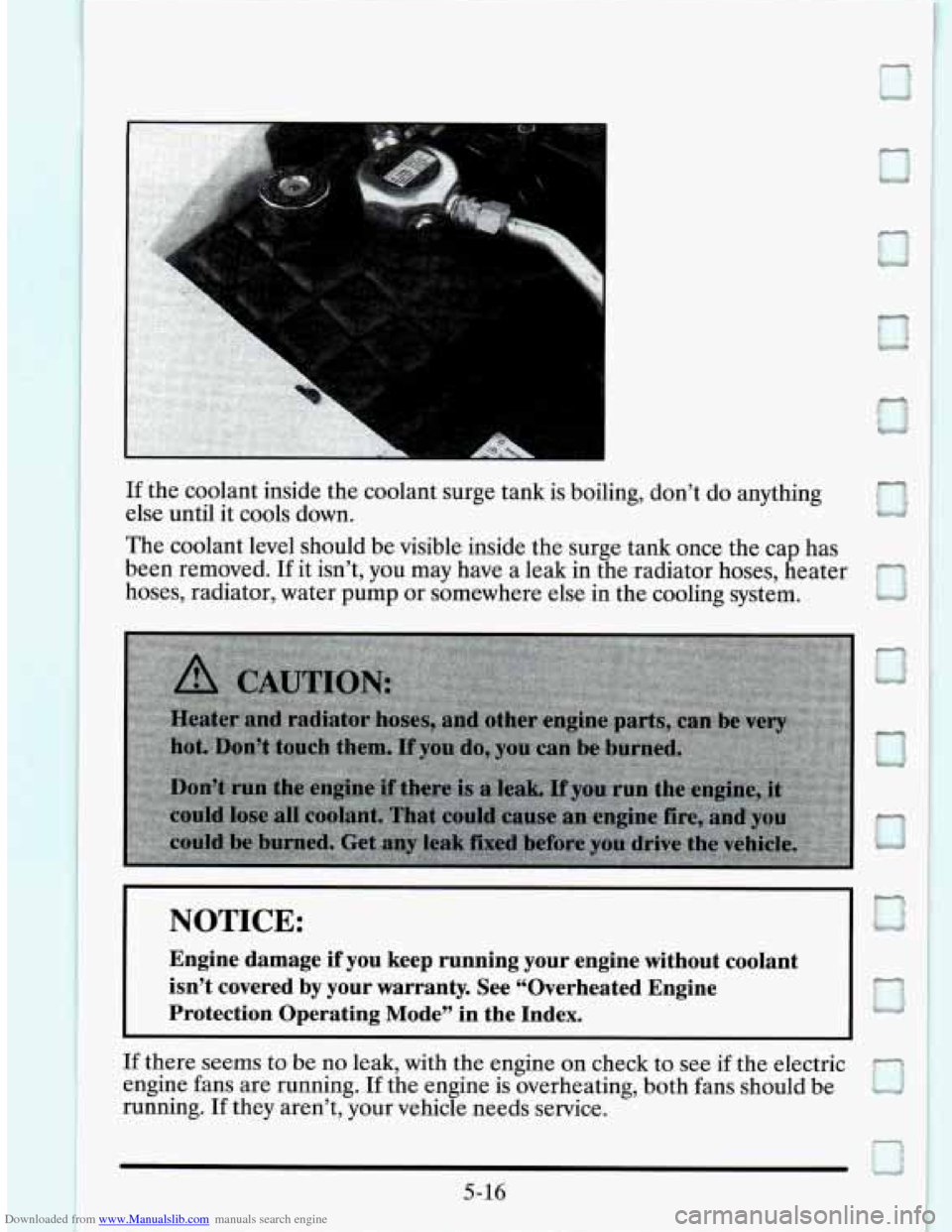
If the coolant inside the coolant surge tank is boiling, don’t do anything
else until it cools down.
The coolant level should be visible inside the surge tank once the cap has
been removed.
If it isn’t, you may have a leak in the radiator hoses, heater
hoses, radiator, water pump or somewhere else in the cooling system.
a
I NOTICE: I R
Engine damage if you keep running your engine without coolant
isn’t covered
by your warranty. See “Overheated Engine
Protection Operating Mode” in
the Index.
If there seems to be no leak, with the engine on check to see if the electric
engine fans are running.
If the engine is overheating, both fans should be
running. If they aren’t, your vehicle needs service.
a
5- 16
Page 270 of 410
Downloaded from www.Manualslib.com manuals search engine COMPACT SPARE TIRE
Although the compact spare was fully inflated when your vehicle was new,
it can lose air after a time. Check the inflation pressure regularly. It
should be
60 psi (420 kPa). After installing the compact spare on your
vehicle, you should stop as soon as possible and make sure your spare tire
is correctly inflated. The compact spare
is made to perform well at posted
speed limits for distances up to
3,000 miles (5 000 km), so you can finish
your trip and have your full-size tire repaired
or replaced where you want.
Of course, it’s best to replace your spare
with a full-size tire as soon as
you can. Your spare will last longer and be
in good shape in case you need
it again.
1 NOTICE:
Don’t take your compact spare through an automatic car wash
with guide rails. The compact spare can get caught on the rails.
That can damage the tire and wheel, and maybe other parts
of
your vehicle.
Don’t use your compact spare on some other vehicle.
And don’t mix your compact spare or wheel with other wheels or tires.
They won’t fit. Keep your spare and its wheel together.
NOTICE:
Tire chains won’t fit your compact spare. Using them will
damage your vehicle and destroy the chains too. Don’t use tire
chains on your compact spare.
5-3 1
Page 272 of 410
Downloaded from www.Manualslib.com manuals search engine Lu
SERVICE AND APPEARANCE CARE
Here you will find information about the care of your Cadillac. This
section begins
with service and fuel information, and then it shows how to
check important fluid and lubricant levels. There is also technical
information about your vehicle, and
a part devoted to its appearance care.
SERWCE
Your Cadillac dealer knows your vehicle best and wants you to be happy
with it. We hope you’ll go to your dealer for all your service needs. You’ll
get genuine GM parts and GM-trained and supported service people.
We hope you’ll want
to keep your GM vehicle all GM. Genuine GM parts
have one
of these marks:
Delco
6-1
Page 275 of 410
Downloaded from www.Manualslib.com manuals search engine Gasolines for Cleaner Air
Your use of gasoline with deposit control additives will help prevent
deposits from forming in your engine and
fuel system. That helps keep
your engine in tune and your emission control system working properly.
It’s good for your vehicle, and you’ll be doing your part for cleaner air.
Many gasolines are now blended with oxygenates. General Motors
recommends that you use gasolines with these blending materials, such as
MTBE and ethanol. By doing
so, you can help clean the air, especially in
those parts
of the country that have high carbon monoxide levels.
In addition, some gasoline suppliers are now producing reformulated
gasolines. These gasolines are specially designed to reduce vehicle
emissions. General Motors recommends that you use reformulated
gasoline.
By doing so, you can help clean the air, especially in those parts
of the country that have high ozone levels.
You should ask your service station operators if their gasolines contain
deposit control additives and oxygenates, and
if they have been
reformulated to reduce vehicle emissions.
FUELS IN FOREIGN COUNTMES
If you plan on driving in another country outside the U.S. or Canada,
unleaded fuel may be hard to find.
Do not use leaded gasoline. If you use
even one tankful, your emission controls won’t work well or at
all. With
continuous use, spark plugs can get fouled, the exhaust system can
corrode, and your engine
oil can deteriorate quickly. Your vehicle’s
oxygen sensor
will be damaged. All of that means costly repairs that
wouldn’t be covered by your warranty.
To check on fuel availability, ask an auto club, or contact a major oil
company that does business in the country where you’ll be driving.
You can also write us at the following address for advice. Just tell us
where you’re going and give your Vehicle Identification Number (VIN).
General Motors Overseas Distribution Corporation,
North American Export Sales
(NAES)
1908 Colonel Sam Drive
Oshawa, Ontario
L1H 8P7
6-4
Page 279 of 410
Downloaded from www.Manualslib.com manuals search engine CHECKING THINGS UNDER THE HOOD
,- -
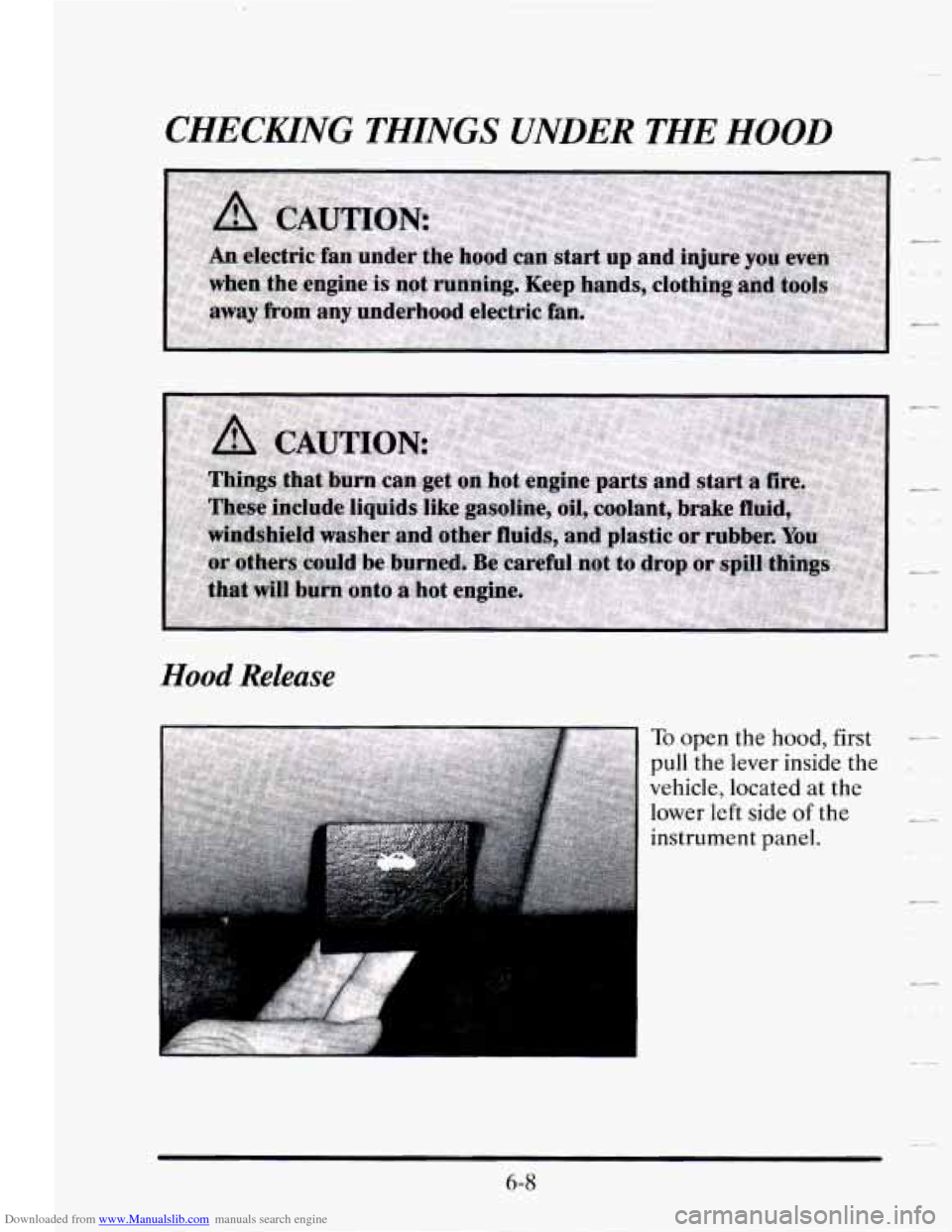
Hood Release
6-8
Page 280 of 410
Downloaded from www.Manualslib.com manuals search engine c
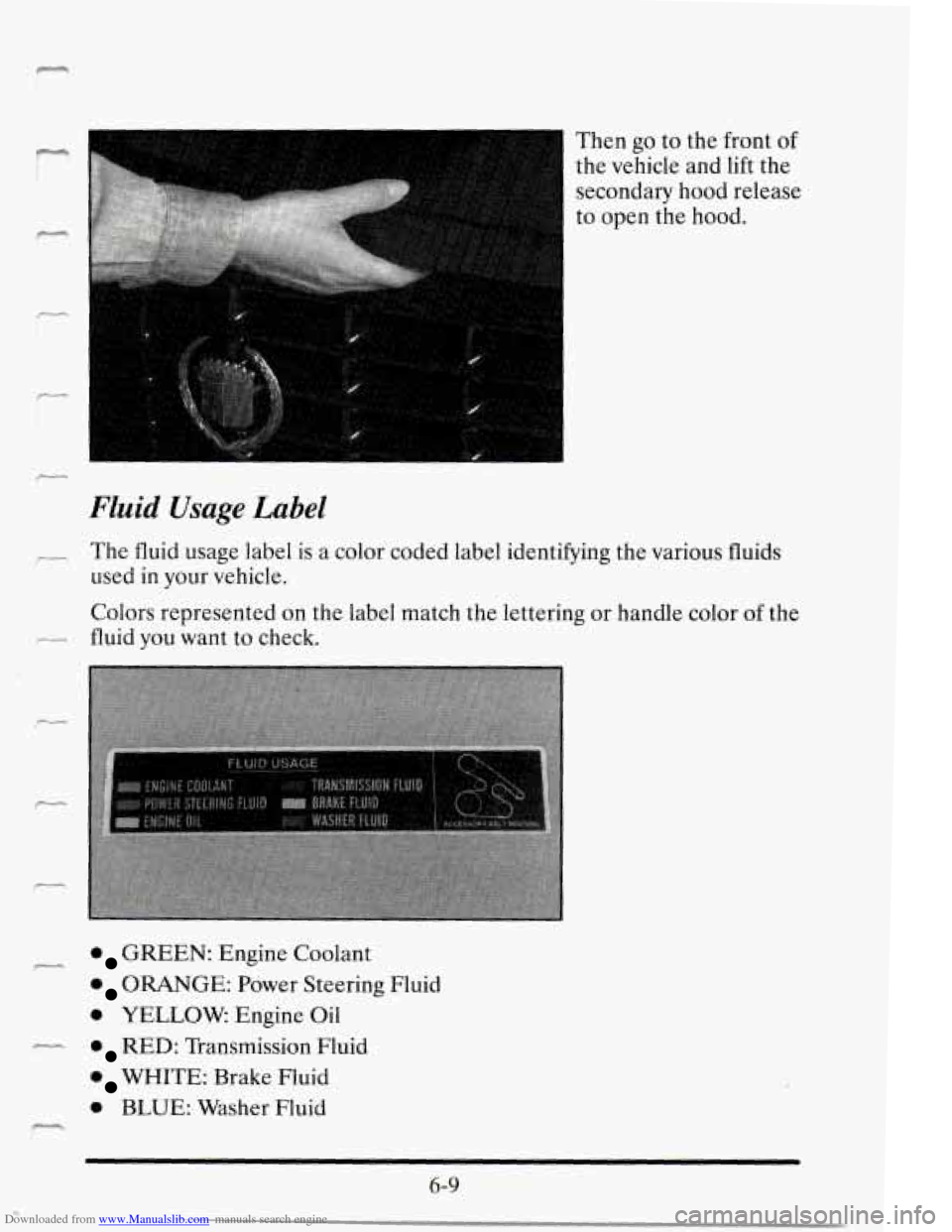
Then go to the front of
the vehicle and lift the
secondary hood release
to open the hood.
Fluid Usage Label
The fluid usage label is a color coded label identifying the various fluids
used in your vehicle.
Colors represented on the label match the lettering or handle color of the
fluid you want to check.
GREEN: Engine Coolant
ORANGE: Power Steering Fluid
0 YELLOW. Engine Oil
RED: Transmission Fluid
WHITE: Brake Fluid
0 BLUE: Washer Fluid
P--+
6-9