clock CADILLAC SEVILLE 1997 4.G User Guide
[x] Cancel search | Manufacturer: CADILLAC, Model Year: 1997, Model line: SEVILLE, Model: CADILLAC SEVILLE 1997 4.GPages: 370, PDF Size: 20.52 MB
Page 174 of 370
Downloaded from www.Manualslib.com manuals search engine c-
c
4. Press and hold one of the six numbered buttons until
you hear a chime.
A preset number will appear on
the display. The sound will mute. When it returns,
release the button. Whenever you press that
numbered button, the station
you set will return.
5. Repeat the steps for each pushbutton.
PRESET SCAN: Press and hold SCAN for two to three
seconds until
PRESET SCAN appears on the display to
listen to each of your preset stations for a few seconds
(factory presets which have not been reprogrammed with
your stations will be ignored). The radio will
go to the first
preset station stored
on your pushbuttons, stop for a few
seconds, then go
on to the next preset station. Press SCAN
again to stop scanning. If a preset station has weak
reception, the radio will not stop at the preset station.
&&$ixxg; $-$kt: 'j.'$'Elfe.
BASS: Press this knob lightly so it extends. Turn the
knob clockwise
to increase and counterclockwise to
decrease bass.
TREB: Press this knob lightly so it extends. Turn the
knob clockwise to increase and counterclockwise to
decrease treble.
If a station is weak or noisy, you may
want
to decrease the treble.
Push these knobs back into their stored positions when
you're
not using them.
BAL: Press this knob lightly so it extends. Turn the
knob clockwise to adjust sound to the right speakers and
counterclockwise
for the left speakers. The middle
position balances the
sound hctvieen thc speakers.
FADE: Press this knob lightly so it c'stt'ncis. Turn the
knob clockwise
to adjust the sound to thc front speakers
and counterclockwise
for the rear spcakcr3. The middle
position balances the
sound httwcten thc spcrkers.
Push these knobs back
into their stored positions when
you're not using them.
With the radio on,'insert
a cassette tape. The tape will
begin playing as
soon as it is inserted.
While the tape is playing, use the
VOL, FADE. BAL,
BASS and TREB controls just as you do for the radio.
Other controls may have different functions when a tape
is inserted. The display will show TAPE with an arrow
to indicate which side of the tape is playing. PLAY will
appear on the display temporarily when a tape is
playing.
The display will then revert back to showing
the time.
Page 175 of 370
Downloaded from www.Manualslib.com manuals search engine If an error occurs while trying to play a cassette tape, it
could be that:
0 The cassette tape is tight and the cassette player
cannot turn the hubs
of the tape. Hold the cassette
tape with the open end down and try turning the right
hub counterclockwise with
a pencil. Flip the tape
over and repeat.
If the hubs do not turn easily, your
cassette tape may be damaged and should not
be
used in the player. Try a new tape to be sure your
player
is working properly.
tape is broken. Try
a new tape.)
0 The cassette tape is broken. (Check to see if your
REV: Press the left arrow to reverse the tape rapidly.
Press it again to return to playing speed. The radio will
play while the tape reverses and
REV will appear on the
display. You may use your station pushbuttons
to tune to
another radio station while
in REV mode.
FF: Press the right arrow to fast forward to another part
of the tape. Press it again to return to playing speed. The
radio will play while the tape advances and
FWD will
appear on the display. You may use your station
pushbuttons
to tune to another radio station while in
FF mode.
SEEK-TUNE: Press the right arrow to seek to the next
selection on the tape. Press the left arrow to search for
the previous selection on the tape (REP will appear
on
the display). Your tape must have at least three seconds
of silence between each selection for SEEK-TUNE to
work. The sound will mute while seeking.
SCAN: Press this button. SCAN will appear on the
display
until the next selection is found and then PLAY
will appear on the display. Use SCAN to listen to
selections for a few seconds. The tape will go to a
selection, stop for a few seconds. then go on to the next
station. Press this button again to stop scanning.
SIDE: Press this button to change the side of the tape
that is playing. (PLAY shows on the display.)
SOURCE: Press this button to switch from radio to
cassette taps play.
If no cassette tape is in the tape
player,
CASS appears on the display and then the radio
station appears briefly. The display then reverts back to
showing the time of day. Press this button again or
BAND
to switch back to the radio.
3-16
Page 176 of 370
Downloaded from www.Manualslib.com manuals search engine r
f
r
f
r
r
r
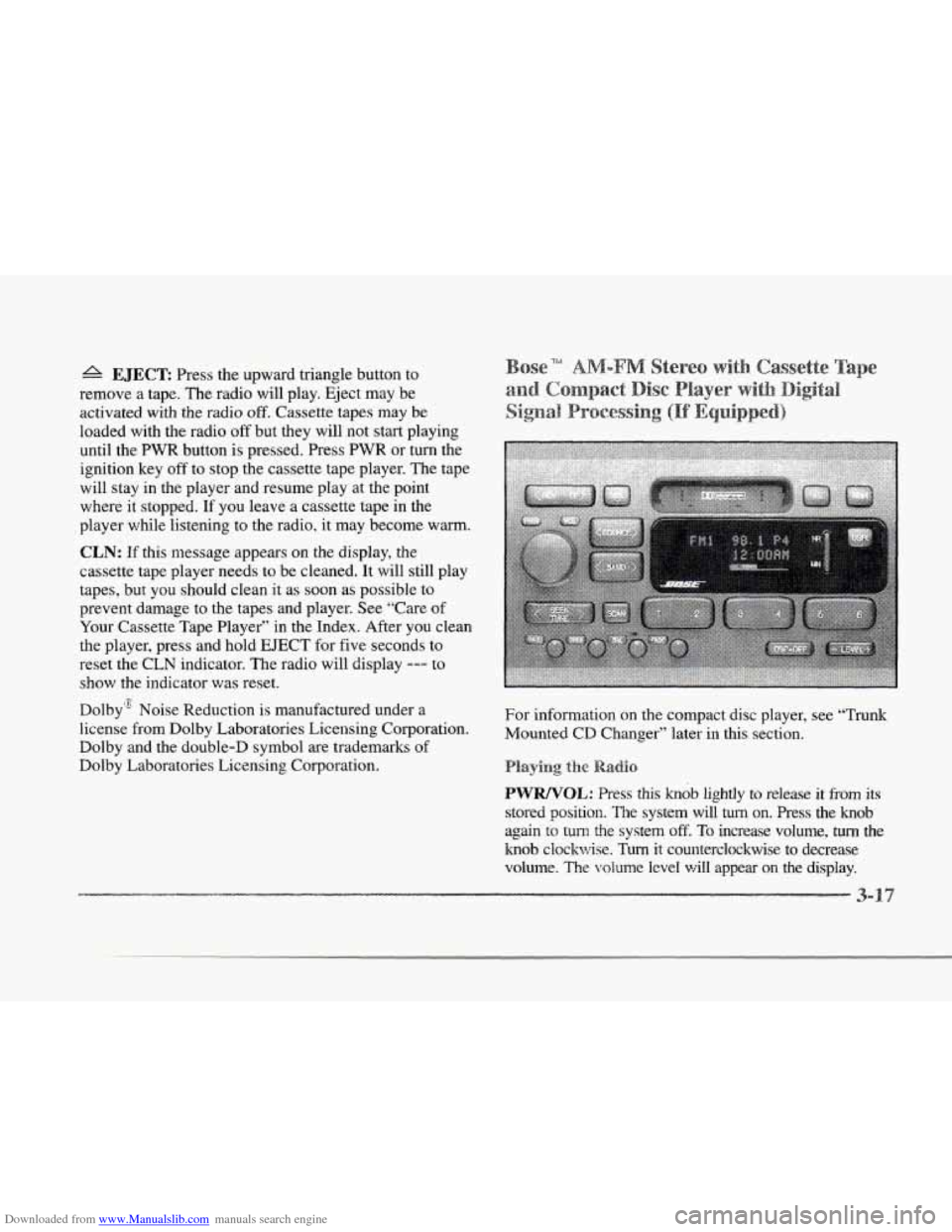
A EJECT Press the upward triangle button to
remove a tape. The radio will play. Eject may be
activated with the radio
off. Cassette tapes may be
loaded with the radio
off but they will not start playing
until the PWR button is pressed.
Press PWR or turn the
ignition key off to stop the cassette tape player. The tape
will stay in the player and resume play
at the point
where it stopped.
If you leave a cassette tape in the
player while listening to the radio, it may become warm.
CLN: If this message appears on the display, the
cassette tape player needs to be cleaned. It will still play
tapes, but you should clean
it as soon as possible to
prevent damage to the tapes and player. See “Care of
Your Cassette Tape Player” in the Index. After you clean
the player, press and hold EJECT for five seconds
to
reset the CLN indicator. The radio will display --- to
show the indicator was reset.
Dolby“ Noise Reduction is manufactured under a
license from Dolby Laboratories Licensing Corporation.
Dolby and the double-D symbol are trademarks of
Dolby Laboratories Licensing Corporation. For information
on the compact disc player, see “Trunk
Mounted
CD Changer” later in this section.
PWRNOL: Press this knob lightly to release it from its
stored position. The system will turn on. Press the knob
again
to turn the system off. To increase volunle, turn the
knob clockwise.
Turn it counterclockwise to decrease
volume. The
volume level will appear on the display.
Page 177 of 370
Downloaded from www.Manualslib.com manuals search engine 3. Tune in the desired station.
BAND: Press this button to select Ah4. FM1 or FM2
and preset stations.
SEEK-TUNE: Press and release this button to seek to the
next higher or lower radio station. Pressing and holding
this button until a chime sounds puts the radio in a tune
mode. In this mode. higher or lower radio stations are
advanced
to in small increments until the SEEK-TUNE
button is released. Tuning stops when you release this
button. If
you press and hold the SEEK-TUNE button
again within five seconds of being in the tune mode,
tuning will continue. Waiting longer than five seconds
places the radio back in the seek mode.
SCAN: Press this button and SCAN will appear on the
display.
Use SCAN to listen to stations for a few
seconds. The radio will
go to a station, stop for a few
seconds, then
go on to the next station. Press this button
again to stop scanning.
PUSHBUTTONS: The six numbered pushbuttons let
you return
to your favorite stations. You can set up to
I8 stations (six AM, six FM1 and six FM2). Just:
1. Turn the radio on.
2. Press BAND to select AM, FMl or FM2.
4. Press and hold one of the six numbered buttons until
you hear a chime.
A preset number will appear on
the display. The sound will mute. When it returns,
release
the button. Whenever you press that
numbered button,
the station you set will return.
5. Repeat the steps for each pushbutton.
PRESET SCAN: Press and hoId SCAN for two to three
seconds
until PRESET SCAN appears on the display to
listen to each of your prcset stations for a few seconds
(factoly presets which have
not been reprogrammed with
your stations will be ignored).
The radio will go to the first
preset station stored
on your pushbuttons, stop for a few
scconds,
then go on to.the next preset station. Press SCAN
again to stop scanning. If a preset station has weak
reception. the radio will not stop at the preset station.
Settirag
the Torre
BASS: Press this knob lightly so it extends. Turn the
knob clockwise to increase and counterclockwise to
decrease bass.
TREB: Press this knob lightly so it extends. Turn the
knob clockwise
to increase and counterclockwise to
decrease treble. If
a station is weak or noisy, you may
want to decrease the treble.
Page 178 of 370
Downloaded from www.Manualslib.com manuals search engine Push these knobs back into their stored positions when
you're not using them.
DSP: The Digital Signal Processing (DSP) feature is
used to produce four audio effects. These include
TALK, DRIVER SEAT, LIVE and AUDITORIUM.
DSP can be used while listening to the radio, the
cassette tape player or the CD player. To activate DSP,
press the
DSP button. Press this button again to go
through the
four effects. To turn the DSP feature off,
press
OFF.
0
c
0
0
TALK: This setting is used when listening to
non-musical material such
as baseball games, talk
shows or news. TALK gives the best clarity of
spoken words. The high and low frequencies are
lowered, the mid-range is increased and the audio is
moved more toward the front speakers.
DRIVER SEAT This setting adjusts the audio to give
the driver the best possible sound qualities.
This has
been done by tailoring the sound
arrival times and
equalization for the driver seat. DFWER SEAT can be
used at any time for
any material. Other passengers in
the vehicle may not perceive the same effect.
LIVE: This setting is used to imitate the sound of a
live performance.
0 AUDITORIUM: This setting is similar to LIVE,
however, more echo is present. The LIVE and
AUDITORIUM settings are best used for music.
LEVEL: Press the plus or minus symbol on this button
to adjust the amount of effect desired when
in DSP
mode. Some experimenting with this button will help
you determine the best sound.
Adjusting the Speakers
BAL: Press this knob lightly so it extends. Turn the
knob clockwise to adjust sound to the right speakers and
counterclockwise for the left speakers. The middle
position balances the sound between the speakers.
FADE: Press this knob lightly so it extends. Turn the
knob clockwise to adjust the sound to the front speakers
and counterclockwise for the rear speakers. The middle
position balances the sound between the speakers.
Push these knobs back into their stored positions when
you're not using them.
Page 179 of 370
Downloaded from www.Manualslib.com manuals search engine With the radio on, insert a cassette tape. The tape will
begin playing as soon as it is inserted.
While the tape is playing, use the
VOL, FADE, BAL,
BASS and TREB controls just as you do for the radio.
Other controls may have different functions when a tape
is inserted. The display will show TAPE with an arrow
to indicate which side of the tape is playing. PLAY will
appear on the display temporarily when
a tape is
playing. The display will then revert back to showing
the time.
If an error occurs while trying to play a cassette tape, it
could be that:
e
0
The cassette tape is tight and the cassette player
cannot turn the hubs
of the tape. Hold the cassette
tape with the open end down and try turning the right
hub counterclockwise with a pencil. Flip the tape
over and repeat.
If the hubs do not turn easily, your
cassette tape may be damaged and should not be
used in the player. Try
a new tape to be sure your
player is working properly.
The cassette tape is broken. (Check to see
if your
tape is broken. Try a new tape.)
REV: Press the left ITO OW to reverse the tape rapidly.
Press
it again to return to playing speed. The radio will
play while the tape reverses and
REV will appear on the
display. You may use your station pushbuttons to tune to
another radio station while in
REV mode.
FF: Press the right arrow to fast forward to another part of
the tape. Press it again to return to playing speed. The
radio will play while the tape advances and
FF will appear
on
the display. You may use your station pushbuttons to
tune
to another radio station while in FF mode.
SEEK-TUNE: Press the right arrow to seek to the next
selection on the tape. Press the left at-row to search for
the previous selection on the tape (REP will appear on
the display). Your tape must have at least three seconds
of silence between each selection for SEEK-TUNE to
work. The sound will mute while seeking.
SCAN: Press this button. SCAN FF will appear on the
display until the next selection is found and then SCAN
PLAY will appear on the display. Use
SCAN to listen to
selections for
a few seconds. The tape will go to a
selection, stop for a few seconds, then go on to the next
selection. Press this button again
to stop scanning.
SIDE: Press this button to change the side of the tape
that
is playing. (PLAY shows on the display.)
I
.4
-2
Page 203 of 370
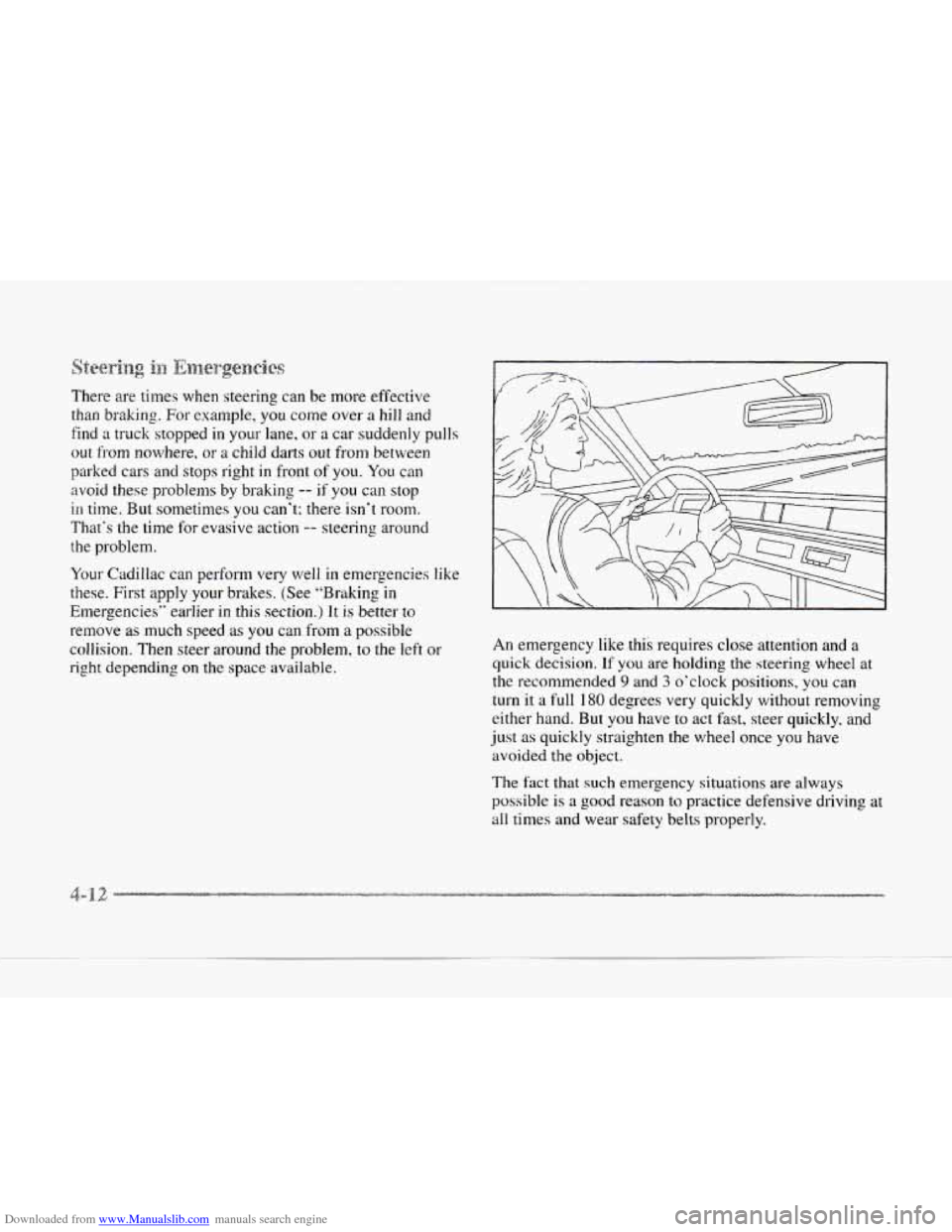
Downloaded from www.Manualslib.com manuals search engine There are times when steering can be more effective
than braking. For example, you come
over a hill and
find
a truck stopped in your lane, or a car suddenly pulls
out fr~1-11 nowhere, or a child darts out from between
parked cars and stops right
in front of you. You can
avoid these problems
by braking -- if you can stop
in time. But sometimes you can’t; there isn’t roonl.
That‘s
the time for evasive action -- steering around
the problem.
Your Cadillac can perform very well in emergencies like
these. First apply your brakes. (See “Braking
in
Emergencies” earlier in this section.) It is better to
remove as much speed as you can from a possible
collision.
Then steer around the problem, to the left or
right depending on the space available.
An emergency like this requires close attention and a
quick decision. If you are holding the steering wheel at
the recommended
9 and 3 o’clock positions, you can
turn it
a full 180 degrees very quickly without removing
either hand. But
you have to act fast, steer quickly, and
just
as quickly straighten the wheel once you have
avoided the object.
The fact that such emergency situations are always
possible is
a good reason to practice defensive driving at
all times and wear safety belts properly.
c
4- 1.2
Page 254 of 370
Downloaded from www.Manualslib.com manuals search engine c
NOTICE:
In cold weather, water can freeze and crack the
engine, radiator, heater core and other
parts. So
use the recommended coolant.
A CAUTION:
You can be burned if you spill coolant on hot
engine parts. Coolant contains ethylene glycol
and it will burn if the engine parts are hot
enough. Don't spill coolant
on a hot engine.
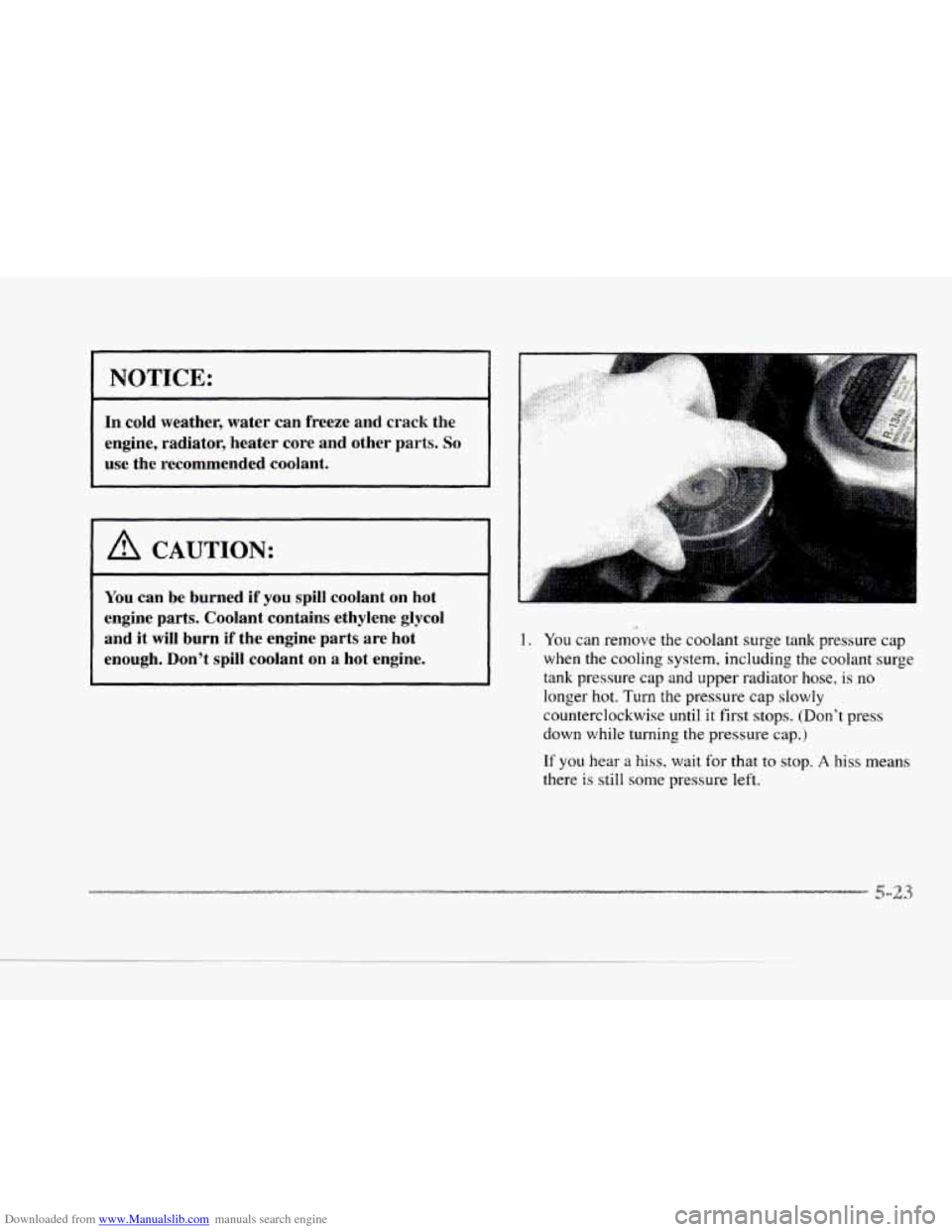
1. You can remove the coolant surge tank pressure cap
when
the cooling system, including the coolant surge
tank pressure cap and upper radiator hose,
is no
longer hot. Turn the pressure cap slowly
counterclockwise until it first stops. (Don't press
down while turning the pressure cap.)
If you hear a hiss, wait for that to stop. A hiss means
there
is still some pressure left.
Page 258 of 370
Downloaded from www.Manualslib.com manuals search engine r
r
r
r
r
r
r
r
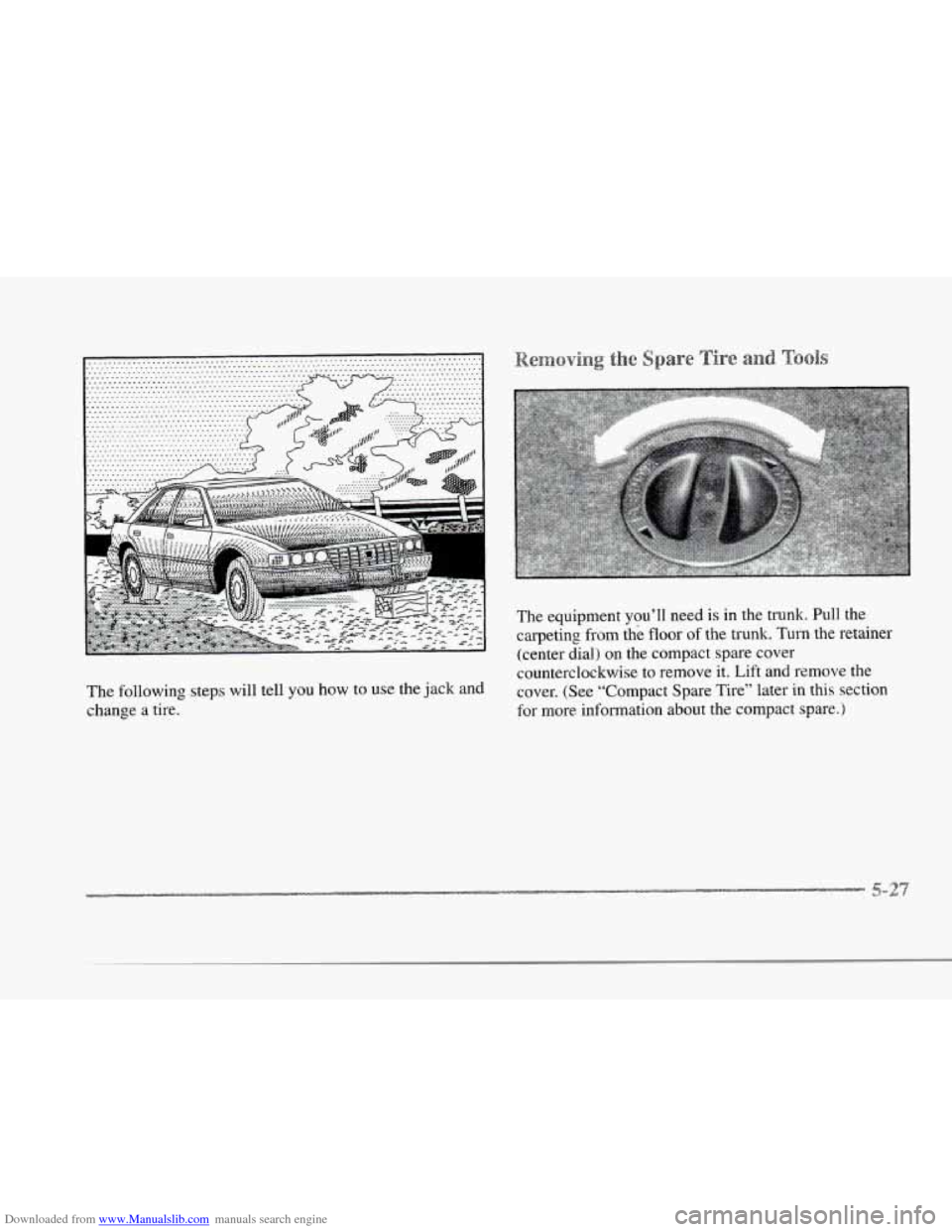
The following steps will tell you how to use the jack and
change a tire.
e s
The equipment you’ll need is in the trunk. Pull the
carpeting from the
floor of the trunk. Turn the retainer
(center dial) on the compact spare cover
counterclockwise to remove it. Lift and remove the
cover. (See “Compact Spare
Tire” later in this section
for
more information about the compact spare.)
Page 259 of 370
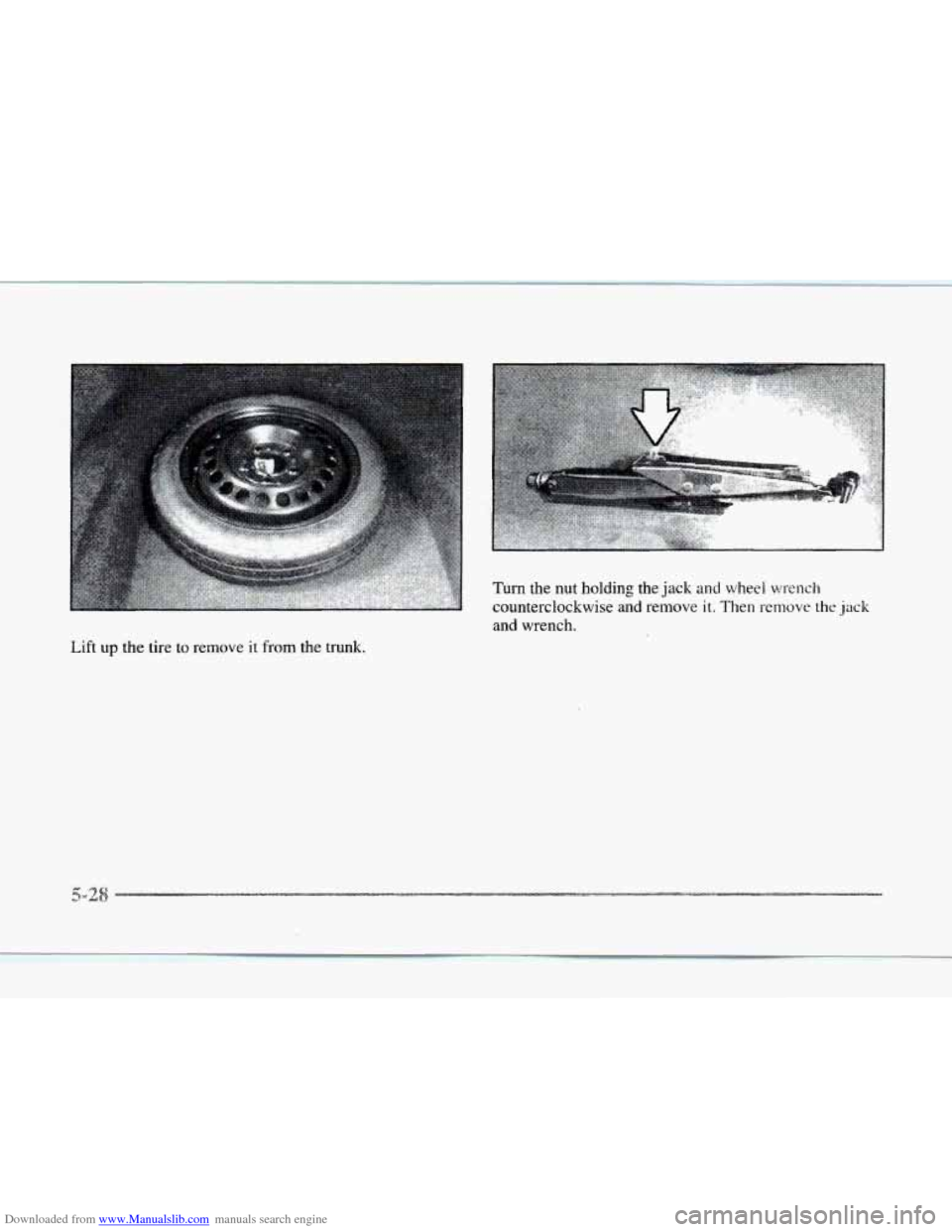
Downloaded from www.Manualslib.com manuals search engine Turn the nut holding the jack and wheel wrench
counterclockwise and remove it. Then remove the jack
and wrench.
Lift
up the tire to remove it from the trunk.