warning CADILLAC SRX 2004 1.G Workshop Manual
[x] Cancel search | Manufacturer: CADILLAC, Model Year: 2004, Model line: SRX, Model: CADILLAC SRX 2004 1.GPages: 468, PDF Size: 2.92 MB
Page 381 of 468
Winter tires with the same speed rating as your original
equipment tires may not be available for H, V, W
and ZR speed rated tires. If you choose snow tires with
a lower speed rating, never exceed the tire’s maximum
speed capability.
If you replace your vehicle’s tires with those not having
a TPC Spec number, the tire pressure monitoring
system may give an inaccurate low-pressure warning.
Non-TPC Spec tires may give a low-pressure warning
that is higher or lower than the proper warning level you
would get with TPC Spec numbered tires.
{CAUTION:
Mixing tires could cause you to lose control
while driving. If you mix tires of different sizes
(other than those originally installed on your
vehicle) or types (radial and bias-belted tires),
the vehicle may not handle properly, and you
could have a crash. Using tires of different
CAUTION: (Continued)
CAUTION: (Continued)
sizes (other than those originally installed on
your vehicle) may also cause damage to your
vehicle. Be sure to use the correct size and
type tires on all wheels. It is alright to drive
with your compact spare temporarily, it was
developed for use on your vehicle. See
Compact Spare Tire on page 5-93.
{CAUTION:
If you use bias-ply tires on your vehicle, the
wheel rim anges could develop cracks after
many miles of driving. A tire and/or wheel
could fail suddenly, causing a crash. Use only
radial-ply tires with the wheels on your vehicle.
5-73
Page 382 of 468

Uniform Tire Quality Grading
Quality grades can be found where applicable on the
tire sidewall between tread shoulder and maximum
section width. For example:
Treadwear 200 Traction AA Temperature A
The following information relates to the system
developed by the United States National Highway
Traffic Safety Administration, which grades tires by
treadwear, traction and temperature performance. (This
applies only to vehicles sold in the United States.)
The grades are molded on the sidewalls of most
passenger car tires. The Uniform Tire Quality Grading
system does not apply to deep tread, winter-type
snow tires, space-saver or temporary use spare tires,
tires with nominal rim diameters of 10 to 12 inches
(25 to 30 cm), or to some limited-production tires.
While the tires available on General Motors passenger
cars and light trucks may vary with respect to these
grades, they must also conform to federal safety
requirements and additional General Motors Tire
Performance Criteria (TPC) standards.
Treadwear
The treadwear grade is a comparative rating based on
the wear rate of the tire when tested under controlled
conditions on a specied government test course.
For example, a tire graded 150 would wear one and
a half (1.5) times as well on the government course as
a tire graded 100. The relative performance of tires
depends upon the actual conditions of their use,
however, and may depart signicantly from the norm
due to variations in driving habits, service practices and
differences in road characteristics and climate.
Traction – AA, A, B, C
The traction grades, from highest to lowest, are AA, A,
B, and C. Those grades represent the tire’s ability
to stop on wet pavement as measured under controlled
conditions on specied government test surfaces of
asphalt and concrete. A tire marked C may have poor
traction performance. Warning: The traction grade
assigned to this tire is based on straight-ahead braking
traction tests, and does not include acceleration,
cornering, hydroplaning, or peak traction characteristics.
5-74
Page 383 of 468
Temperature – A, B, C
The temperature grades are A (the highest), B, and C,
representing the tire’s resistance to the generation
of heat and its ability to dissipate heat when tested
under controlled conditions on a specied indoor
laboratory test wheel. Sustained high temperature can
cause the material of the tire to degenerate and
reduce tire life, and excessive temperature can lead to
sudden tire failure. The grade C corresponds to a
level of performance which all passenger car tires must
meet under the Federal Motor Vehicle Safety Standard
No. 109. Grades B and A represent higher levels of
performance on the laboratory test wheel than the
minimum required by law.
Warning: The temperature grade for this tire is
established for a tire that is properly inated and not
overloaded. Excessive speed, underination, or
excessive loading, either separately or in combination,
can cause heat buildup and possible tire failure.
Wheel Alignment and Tire Balance
The wheels on your vehicle were aligned and balanced
carefully at the factory to give you the longest tire life
and best overall performance.
Scheduled wheel alignment and wheel balancing are
not needed. However, if you notice unusual tire wear or
your vehicle pulling one way or the other, the alignment
may need to be reset. If you notice your vehicle
vibrating when driving on a smooth road, your wheels
may need to be rebalanced.
5-75
Page 387 of 468
Changing a Flat Tire
If a tire goes at, avoid further tire and wheel damage
by driving slowly to a level place. Turn on your
hazard warning ashers.
{CAUTION:
Changing a tire can be dangerous. The vehicle
can slip off the jack and roll over or fall on you
or other people. You and they could be badly
injured or even killed. Find a level place to
change your tire. To help prevent the vehicle
from moving:
1. Set the parking brake rmly.
2. Put the shift lever in PARK (P).
3. Turn off the engine and do not restart
while the vehicle is raised.
4. Do not allow passengers to remain in the
vehicle.
CAUTION: (Continued)
CAUTION: (Continued)
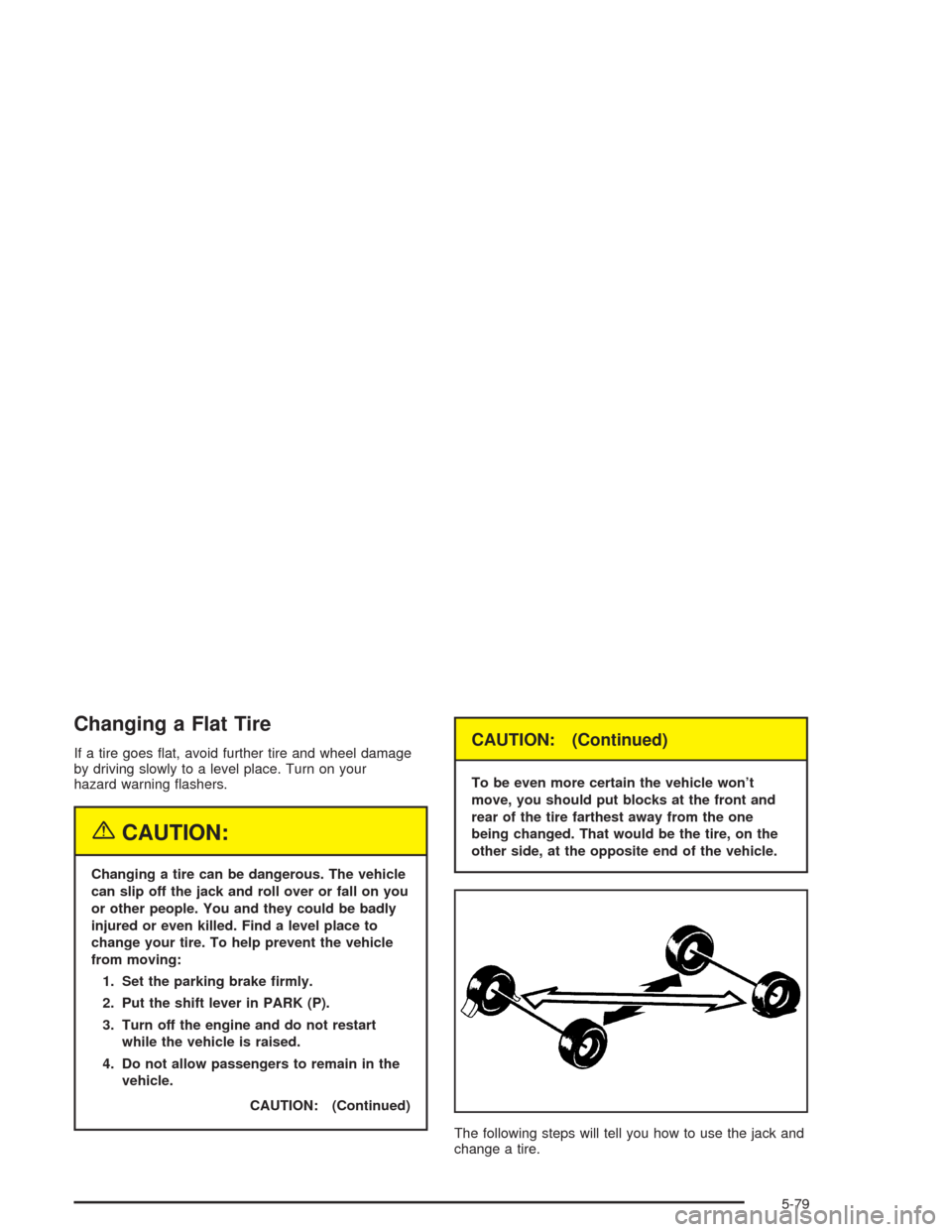
To be even more certain the vehicle won’t
move, you should put blocks at the front and
rear of the tire farthest away from the one
being changed. That would be the tire, on the
other side, at the opposite end of the vehicle.
The following steps will tell you how to use the jack and
change a tire.
5-79
Page 402 of 468
Appearance Care
Remember, cleaning products can be hazardous. Some
are toxic. Others can burst into ames if you strike a
match or get them on a hot part of the vehicle. Some are
dangerous if you breathe their fumes in a closed
space. When you use anything from a container to clean
your vehicle, be sure to follow the manufacturer’s
warnings and instructions. And always open your doors
or windows when you are cleaning the inside.
Never use these to clean your vehicle:
Gasoline
Benzene
Naphtha
Carbon Tetrachloride
Acetone
Paint Thinner
Turpentine
Lacquer Thinner
Nail Polish Remover
They can all be hazardous — some more than
others — and they can all damage your vehicle, too.Do not use any of these unless this manual says you
can. In many uses, these will damage your vehicle:
Alcohol
Laundry Soap
Bleach
Reducing Agents
Cleaning the Inside of Your Vehicle
Use a vacuum cleaner often to get rid of dust and
loose dirt. Wipe vinyl, leather, plastic and painted
surfaces with a clean, damp cloth.
Cleaning Fabric/Carpet
Your dealer has cleaners for the cleaning of fabric
and carpet. They will clean normal spots and stains
very well.
You can get GM-approved cleaning products from your
dealer. SeeVehicle Care/Appearance Materials on
page 5-100.
Here are some cleaning tips:
Always read the instructions on the cleaner label.
Clean up stains as soon as you can — before
they set.
Carefully scrape off any excess stain.
5-94
Page 451 of 468
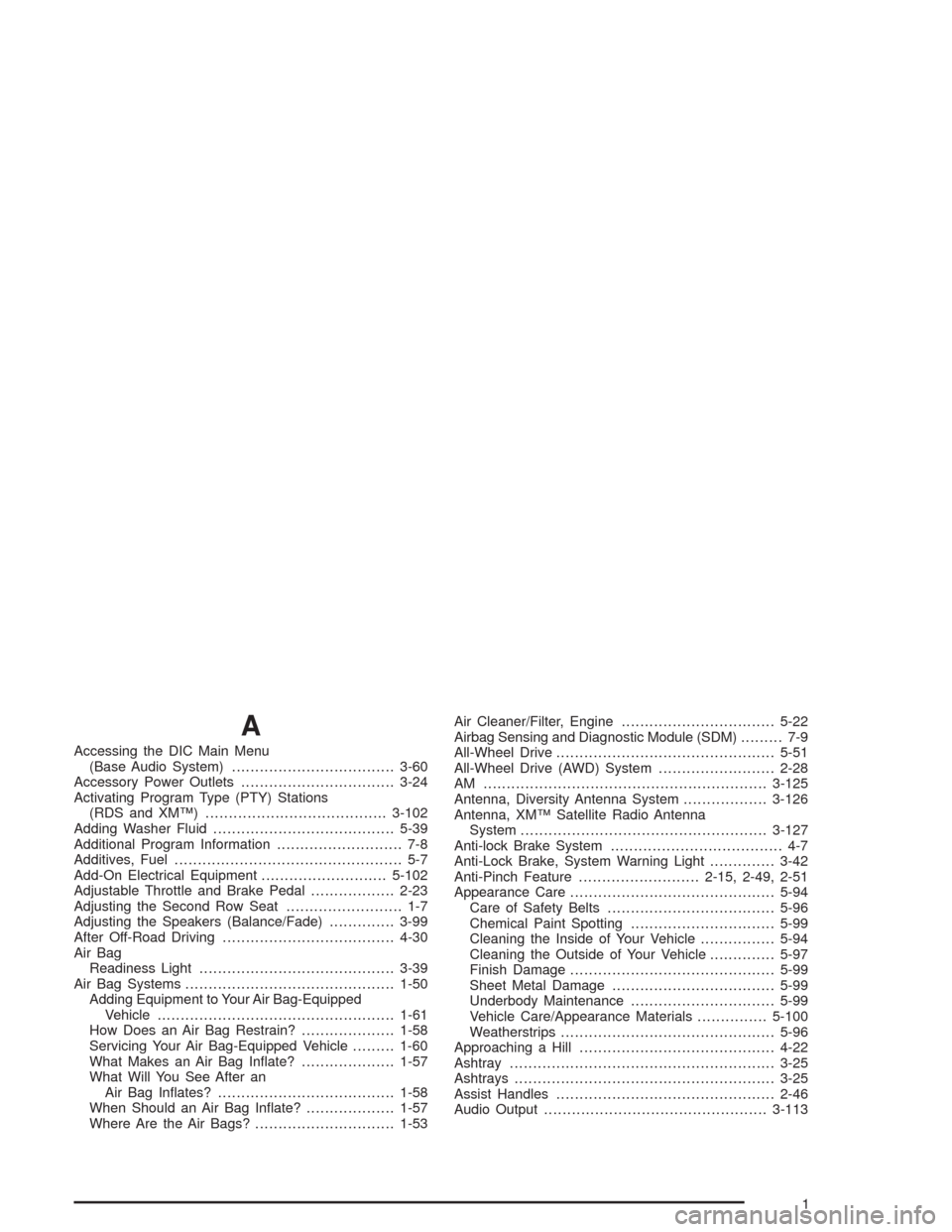
A
Accessing the DIC Main Menu
(Base Audio System)...................................3-60
Accessory Power Outlets.................................3-24
Activating Program Type (PTY) Stations
(RDS and XM™).......................................3-102
Adding Washer Fluid.......................................5-39
Additional Program Information........................... 7-8
Additives, Fuel................................................. 5-7
Add-On Electrical Equipment...........................5-102
Adjustable Throttle and Brake Pedal..................2-23
Adjusting the Second Row Seat......................... 1-7
Adjusting the Speakers (Balance/Fade)..............3-99
After Off-Road Driving.....................................4-30
Air Bag
Readiness Light..........................................3-39
Air Bag Systems.............................................1-50
Adding Equipment to Your Air Bag-Equipped
Vehicle...................................................1-61
How Does an Air Bag Restrain?....................1-58
Servicing Your Air Bag-Equipped Vehicle.........1-60
What Makes an Air Bag Inate?....................1-57
What Will You See After an
Air Bag Inates?......................................1-58
When Should an Air Bag Inate?...................1-57
Where Are the Air Bags?..............................1-53Air Cleaner/Filter, Engine.................................5-22
Airbag Sensing and Diagnostic Module (SDM)......... 7-9
All-Wheel Drive...............................................5-51
All-Wheel Drive (AWD) System.........................2-28
AM .............................................................3-125
Antenna, Diversity Antenna System..................3-126
Antenna, XM™ Satellite Radio Antenna
System.....................................................3-127
Anti-lock Brake System..................................... 4-7
Anti-Lock Brake, System Warning Light..............3-42
Anti-Pinch Feature..........................2-15, 2-49, 2-51
Appearance Care............................................5-94
Care of Safety Belts....................................5-96
Chemical Paint Spotting...............................5-99
Cleaning the Inside of Your Vehicle................5-94
Cleaning the Outside of Your Vehicle..............5-97
Finish Damage............................................5-99
Sheet Metal Damage...................................5-99
Underbody Maintenance...............................5-99
Vehicle Care/Appearance Materials...............5-100
Weatherstrips..............................................5-96
Approaching a Hill..........................................4-22
Ashtray.........................................................3-25
Ashtrays........................................................3-25
Assist Handles...............................................2-46
Audio Output................................................3-113
1
Page 452 of 468

Audio System(s).............................................3-93
Audio Steering Wheel Controls....................3-124
Care of Your CD and DVD Player................3-126
Care of Your CDs and DVDs.......................3-126
Diversity Antenna System............................3-126
Navigation/Radio System.............................3-110
Radio with CD............................................3-94
Setting the Time..........................................3-93
Theft-Deterrent Feature...............................3-123
Understanding Radio Reception...................3-125
XM™ Satellite Radio Antenna System...........3-127
Automatic Transmission
Fluid..........................................................5-24
Operation...................................................2-25
B
Backing Up....................................................4-56
Battery..........................................................5-43
Battery Replacement......................................... 2-7
Battery Saver Active........................................3-64
Battery Voltage High.......................................3-64
Battery Voltage Low........................................3-65
Before Leaving on a Long Trip.........................4-37
Before You Drive...........................................3-110
Before You Go Off-Roading..............................4-17Brake
Panic Assist................................................4-11
Parking......................................................2-29
System Warning Light..................................3-41
Brake Adjustment............................................5-43
Brake Fluid....................................................5-40
Brake Pedal, Throttle.......................................2-23
Brake Pedal Travel.........................................5-43
Brake Wear...................................................5-42
Brakes..........................................................5-40
Braking........................................................... 4-6
Braking in Emergencies..................................... 4-9
Break-In, New Vehicle.....................................2-20
Bulb Replacement...........................................5-54
Back-Up and License Plate Lamps.................5-57
Center High-Mounted Stoplamp (CHMSL)........5-57
Front Turn Signal and Fog Lamps..................5-56
Halogen Bulbs............................................5-54
Headlamps, Sidemarker, and Parking Lamps.....5-55
High Intensity Discharge (HID) Lighting...........5-54
Replacement Bulbs......................................5-58
Sidemarker Lamps.......................................5-57
Taillamps, Turn Signal, Stoplamps and
Sidemarker Lamps...................................5-57
Buying New Tires...........................................5-72
2
Page 454 of 468
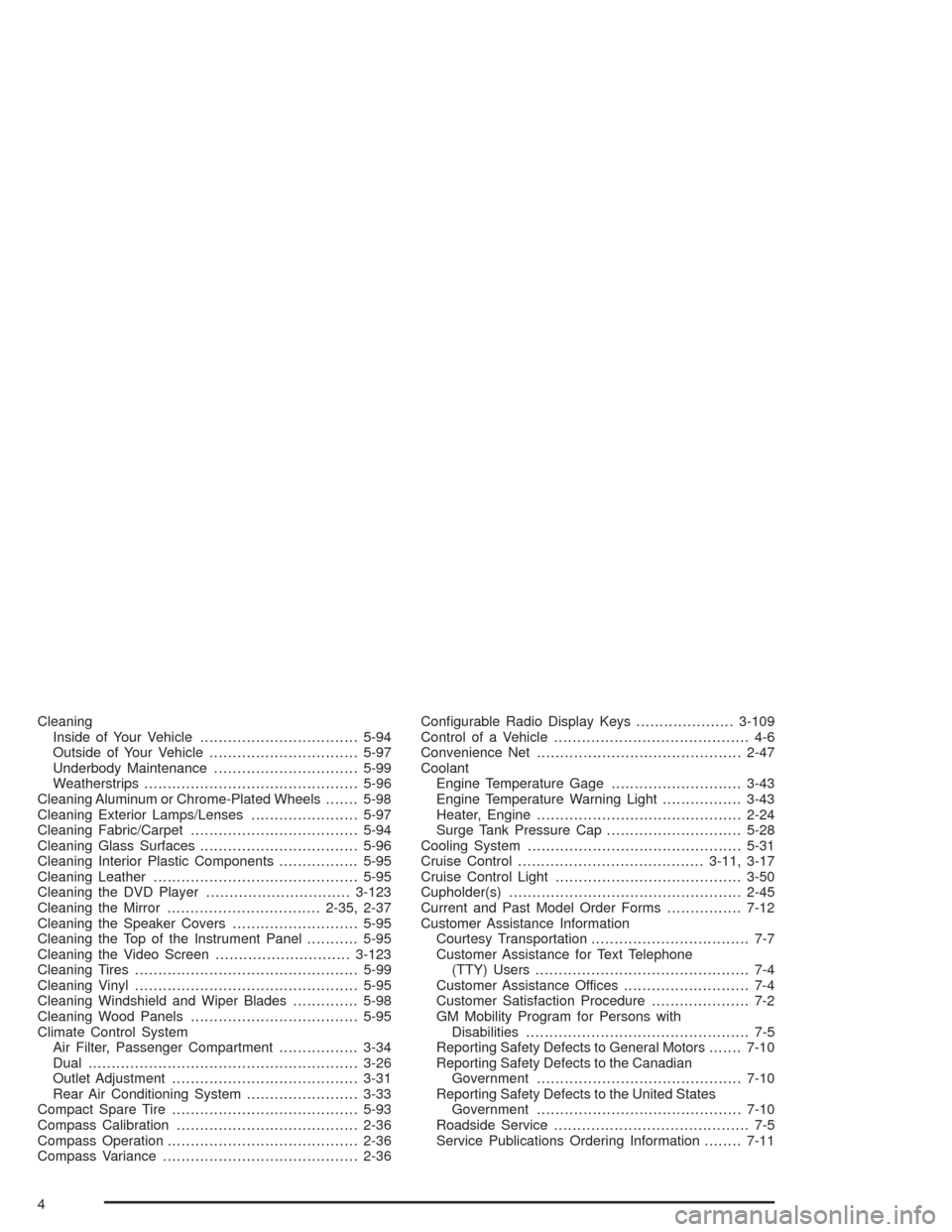
Cleaning
Inside of Your Vehicle..................................5-94
Outside of Your Vehicle................................5-97
Underbody Maintenance...............................5-99
Weatherstrips..............................................5-96
Cleaning Aluminum or Chrome-Plated Wheels.......5-98
Cleaning Exterior Lamps/Lenses.......................5-97
Cleaning Fabric/Carpet....................................5-94
Cleaning Glass Surfaces..................................5-96
Cleaning Interior Plastic Components.................5-95
Cleaning Leather............................................5-95
Cleaning the DVD Player...............................3-123
Cleaning the Mirror.................................2-35, 2-37
Cleaning the Speaker Covers...........................5-95
Cleaning the Top of the Instrument Panel...........5-95
Cleaning the Video Screen.............................3-123
Cleaning Tires................................................5-99
Cleaning Vinyl................................................5-95
Cleaning Windshield and Wiper Blades..............5-98
Cleaning Wood Panels....................................5-95
Climate Control System
Air Filter, Passenger Compartment.................3-34
Dual..........................................................3-26
Outlet Adjustment........................................3-31
Rear Air Conditioning System........................3-33
Compact Spare Tire........................................5-93
Compass Calibration.......................................2-36
Compass Operation.........................................2-36
Compass Variance..........................................2-36Congurable Radio Display Keys.....................3-109
Control of a Vehicle.......................................... 4-6
Convenience Net............................................2-47
Coolant
Engine Temperature Gage............................3-43
Engine Temperature Warning Light.................3-43
Heater, Engine............................................2-24
Surge Tank Pressure Cap.............................5-28
Cooling System..............................................5-31
Cruise Control........................................3-11, 3-17
Cruise Control Light........................................3-50
Cupholder(s)..................................................2-45
Current and Past Model Order Forms................7-12
Customer Assistance Information
Courtesy Transportation.................................. 7-7
Customer Assistance for Text Telephone
(TTY) Users.............................................. 7-4
Customer Assistance Offices........................... 7-4
Customer Satisfaction Procedure..................... 7-2
GM Mobility Program for Persons with
Disabilities................................................ 7-5
Reporting Safety Defects to General Motors.......7-10
Reporting Safety Defects to the Canadian
Government............................................7-10
Reporting Safety Defects to the United States
Government............................................7-10
Roadside Service.......................................... 7-5
Service Publications Ordering Information........7-11
4
Page 455 of 468
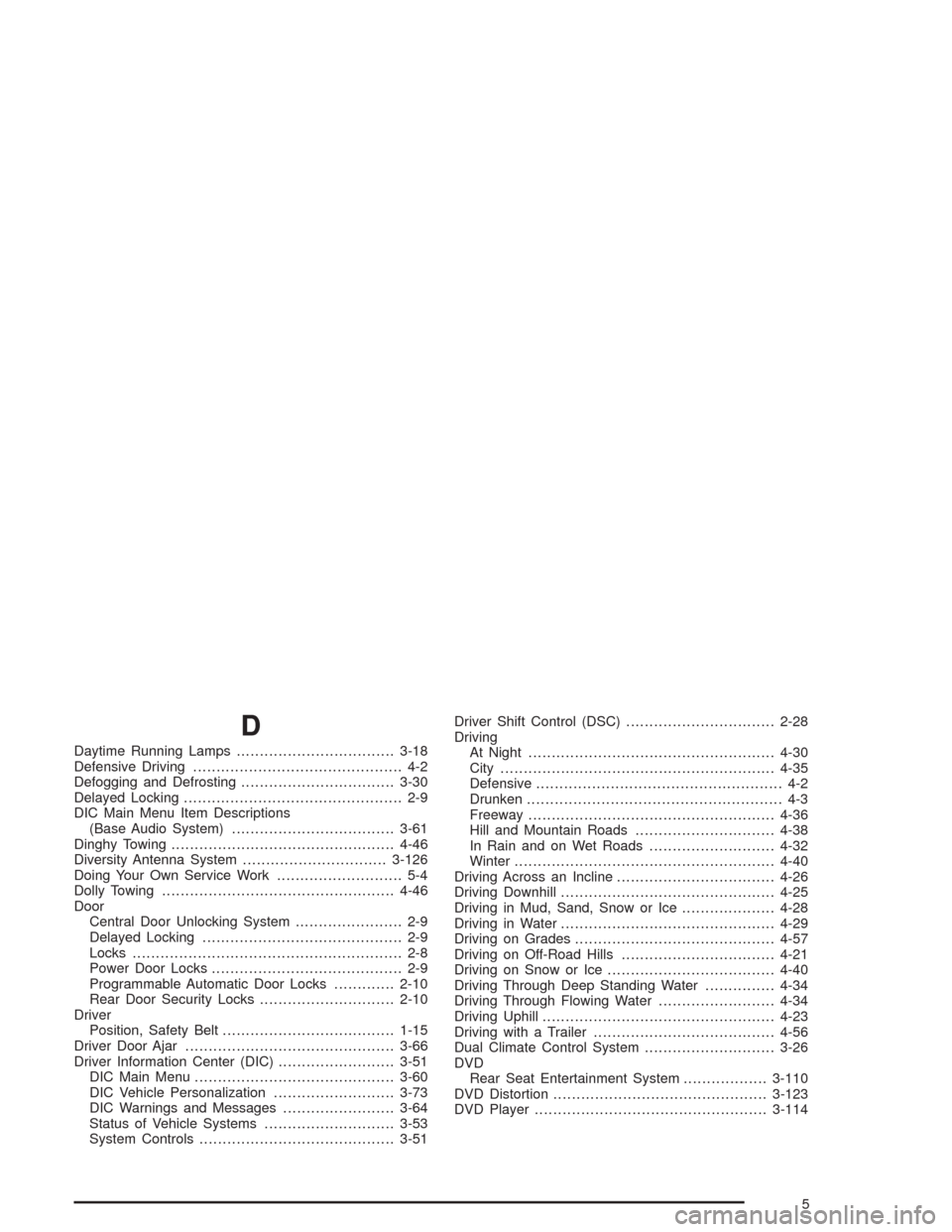
D
Daytime Running Lamps..................................3-18
Defensive Driving............................................. 4-2
Defogging and Defrosting.................................3-30
Delayed Locking............................................... 2-9
DIC Main Menu Item Descriptions
(Base Audio System)...................................3-61
Dinghy Towing................................................4-46
Diversity Antenna System...............................3-126
Doing Your Own Service Work........................... 5-4
Dolly Towing..................................................4-46
Door
Central Door Unlocking System....................... 2-9
Delayed Locking........................................... 2-9
Locks.......................................................... 2-8
Power Door Locks......................................... 2-9
Programmable Automatic Door Locks.............2-10
Rear Door Security Locks.............................2-10
Driver
Position, Safety Belt.....................................1-15
Driver Door Ajar.............................................3-66
Driver Information Center (DIC).........................3-51
DIC Main Menu...........................................3-60
DIC Vehicle Personalization..........................3-73
DIC Warnings and Messages........................3-64
Status of Vehicle Systems............................3-53
System Controls..........................................3-51Driver Shift Control (DSC)................................2-28
Driving
At Night.....................................................4-30
City...........................................................4-35
Defensive..................................................... 4-2
Drunken....................................................... 4-3
Freeway.....................................................4-36
Hill and Mountain Roads..............................4-38
In Rain and on Wet Roads...........................4-32
Winter........................................................4-40
Driving Across an Incline..................................4-26
Driving Downhill..............................................4-25
Driving in Mud, Sand, Snow or Ice....................4-28
Driving in Water..............................................4-29
Driving on Grades...........................................4-57
Driving on Off-Road Hills.................................4-21
Driving on Snow or Ice....................................4-40
Driving Through Deep Standing Water...............4-34
Driving Through Flowing Water.........................4-34
Driving Uphill..................................................4-23
Driving with a Trailer.......................................4-56
Dual Climate Control System............................3-26
DVD
Rear Seat Entertainment System..................3-110
DVD Distortion..............................................3-123
DVD Player..................................................3-114
5
Page 456 of 468

E
Electrical System
Add-On Equipment.....................................5-102
Fuses and Circuit Breakers.........................5-103
Power Windows and Other
Power Options.......................................5-102
Windshield Wiper Fuses.............................5-102
Emissions Inspection and Maintenance
Programs...................................................3-47
Engine
Air Cleaner/Filter.........................................5-22
Battery.......................................................5-43
Check and Service Engine Soon Light............3-44
Coolant......................................................5-25
Coolant Heater............................................2-24
Coolant Temperature Gage...........................3-43
Coolant Temperature Warning Light................3-43
Engine Compartment Overview......................5-12
Exhaust.....................................................2-33
Oil .............................................................5-15
Overheating................................................5-28
Starting......................................................2-23
Engine Coolant Hot – AC (Air Conditioning) Off......3-67
Engine Coolant Hot – Idle Engine.....................3-67
Engine Cooling When Trailer Towing..................4-58
Engine Oil Additives........................................5-19
Engine Overheated – Stop Engine....................3-67
Engine Power Reduced...................................3-67Engine Specications.....................................5-112
Engine Speed Limiter......................................3-39
Entering or Exiting the Third Row Seat................ 1-7
Entering the Personalization Menu.....................3-73
Entry Lighting.................................................3-21
Environmental Concerns..................................4-19
Erasing HomeLink
®Buttons..............................2-44
Event Data Recorders (EDR)............................. 7-9
Exiting the Personalization Menu.......................3-92
Express-Down Window....................................2-14
Express-Up Window........................................2-14
Extender, Safety Belt.......................................1-28
Exterior Lamps...............................................3-18
Exterior Lighting Battery Saver..........................3-20
F
Filter
Engine Air Cleaner......................................5-22
Finding a Station............................................3-96
Finish Care....................................................5-97
Finish Damage...............................................5-99
Flash-To-Pass Feature....................................... 3-9
Flat Tire........................................................5-78
Flat Tire, Changing.........................................5-79
Fluid
Automatic Transmission................................5-24
Power Steering...........................................5-37
Windshield Washer......................................5-38
6