seats CADILLAC XLR 2008 1.G User Guide
[x] Cancel search | Manufacturer: CADILLAC, Model Year: 2008, Model line: XLR, Model: CADILLAC XLR 2008 1.GPages: 470, PDF Size: 8.39 MB
Page 57 of 470
Adding Equipment to Your
Airbag-Equipped Vehicle
Q:Is there anything I might add to or change
about the vehicle that could keep the airbags
from working properly?
A:Yes. If you add things that change your vehicle’s
frame, bumper system, height, front end or side
sheet metal, they may keep the airbag system from
working properly. Changing or moving any parts
of the front seats, safety belts, the airbag sensing
and diagnostic module, steering wheel, instrument
panel, the inside review mirror, front sensors, or
airbag wiring can affect the operation of the airbag
system.
In addition, your vehicle has a passenger sensing
system for the right front passenger’s position,
which includes sensors that are part of the
passenger’s seat. The passenger sensing system
may not operate properly if the original seat trim
is replaced with non-GM covers, upholstery or trim,
or with GM covers, upholstery or trim designed
for a different vehicle. Any object, such as an
aftermarket seat heater or a comfort enhancing pad
or device, installed under or on top of the seatfabric, could also interfere with the operation of the
passenger sensing system. This could either
prevent proper deployment of the passenger
airbag(s) or prevent the passenger sensing system
from properly turning off the passenger airbag(s).
SeePassenger Sensing System on page 1-45.
If you have any questions about this, you should
contact Customer Assistance before you modify
your vehicle. The phone numbers and addresses for
Customer Assistance are in Step Two of the
Customer Satisfaction Procedure in this manual.
SeeCustomer Satisfaction Procedure on
page 8-2.
Q:Because I have a disability, I have to get my
vehicle modied. How can I nd out whether
this will affect my airbag system?
A:If you have questions, call Customer Assistance.
The phone numbers and addresses for Customer
Assistance are in Step Two of the Customer
Satisfaction Procedure in this manual. See
Customer Satisfaction Procedure on page 8-2.
Your dealer/retailer and the service manual have
information about the location of the airbag sensors,
sensing and diagnostic module and airbag wiring.
1-51
Page 112 of 470

Storage Areas
Glove Box
To open, lift the handle up. Use the key to lock
and unlock.
Cupholder(s)
The cupholders are located under a lid in the front
console to the right of the shift lever. Press the
left side of the lid and it will open automatically.
Center Console Storage
There is a center console storage area located between
the seats. To open this storage area, push the latch
button and lift the lid.
There is also an upright center console storage area
between the seatbacks. To open the storage area, press
and release the button near the top so it extends out.
Then, turn the button in either direction to unlatch the lid
and pull the console lid down. After you close the lid,
press the release button back in.
Floor Mats
The driver’s side oor mat is held in place by two snaps
and the passenger’s side is held in place by one.
To remove the oor mats, pull up on the rear of the
mat to disconnect from the snaps. To reinstall the oor
mats, line up the openings in the oor mat over the
snaps and push down into place.
Be sure that the driver’s side oor mat is properly
placed on the oor so that it does not block the
movement of the accelerator pedal.
2-52
Page 164 of 470
The rear window defogger and heated mirrors are
automatically disabled when the retractable hardtop
is moving or down.
Notice:Do not use anything sharp on the inside
of the rear window. If you do, you could cut or
damage the warming grid, and the repairs would
not be covered by your warranty. Do not attach
a temporary vehicle license, tape, a decal or
anything similar to the defogger grid.
Outlet Adjustment
Use the thumbwheel to open or close the outlets.
Operation Tips
Clear away any ice, snow or leaves from the air
inlets at the base of the windshield that may
block the ow of air into your vehicle.
Use of non-GM approved hood deectors may
adversely affect the performance of the system.
Keep the area around the base of the instrument
panel console and air path under the seats
clear of objects to help circulate the air inside
of your vehicle more effectively.
Passenger Compartment Air Filter
The passenger compartment air lter removes certain
particles from the air, including pollen and dust particles.
Reductions in airow, which may occur more often in
dusty areas, indicate that the lter may need to be
replaced early.
The lter should be replaced as part of the routine
scheduled maintenance. SeeScheduled Maintenance
on page 7-4for more information.
To check or replace the air lter, do the following:
1. With the hood open, unlatch and remove the
access panel.
The passenger compartment air lter and access
panel are located on the passenger’s side of
the engine compartment near the battery.
SeeEngine Compartment Overview on page 6-12
for more information on location.
2. Pull the old lter out of the housing.
3. Insert the new lter into the housing.
4. Reinstall the air lter access panel.
3-42
Page 319 of 470
If you put things inside your vehicle — like
suitcases, tools, packages, or anything
else — they will go as fast as the vehicle goes.
If you have to stop or turn quickly, or if there is a
crash, they will keep going.
{CAUTION:
Things you put inside your vehicle can
strike and injure people in a sudden stop
or turn, or in a crash.
Put things in the rear area of your
vehicle. Try to spread the weight
evenly.
Never stack heavier things, like
suitcases, inside the vehicle so that
some of them are above the tops of
the seats.
Do not leave an unsecured child
restraint in your vehicle.
When you carry something inside the
vehicle, secure it whenever you can.
Towing
Towing Your Vehicle
Consult your dealer/retailer or a professional towing
service if you need to have your disabled vehicle towed.
SeeRoadside Service on page 8-7.
Recreational Vehicle Towing
Notice:Dolly towing or dinghy towing your
vehicle may cause damage because of reduced
ground clearance. Always put your vehicle on
a atbed truck.
Your vehicle was neither designed nor intended to be
towed with any of its wheels on the ground. If your
vehicle must be towed, see “Towing Your Vehicle”
earlier in this section.
Towing a Trailer
Your XLR is neither designed nor intended to tow
a trailer.
5-27
Page 376 of 470

Tire Terminology and Denitions
Air Pressure:The amount of air inside the
tire pressing outward on each square inch of the
tire. Air pressure is expressed in pounds per
square inch (psi) or kilopascal (kPa).
Accessory Weight
:This means the combined
weight of optional accessories. Some examples of
optional accessories are, automatic transmission,
power steering, power brakes, power windows,
power seats, and air conditioning.
Aspect Ratio
:The relationship of a tire’s height
to its width.
Belt
:A rubber coated layer of cords that is located
between the plies and the tread. Cords may be
made from steel or other reinforcing materials.
Bead
:The tire bead contains steel wires wrapped
by steel cords that hold the tire onto the rim.
Bias Ply Tire
:A pneumatic tire in which the plies
are laid at alternate angles less than 90 degrees
to the centerline of the tread.
Cold Tire Pressure
:The amount of air pressure in
a tire, measured in pounds per square inch (psi) or
kilopascals (kPa) before a tire has built up heat
from driving. SeeInflation - Tire Pressure on
page 6-60.Curb Weight
:The weight of a motor vehicle with
standard and optional equipment including the
maximum capacity of fuel, oil, and coolant,
but without passengers and cargo.
DOT Markings
:A code molded into the sidewall
of a tire signifying that the tire is in compliance
with the U.S. Department of Transportation (DOT)
motor vehicle safety standards. The DOT code
includes the Tire Identication Number (TIN),
an alphanumeric designator which can also identify
the tire manufacturer, production plant, brand,
and date of production.
GVWR
:Gross Vehicle Weight Rating. SeeLoading
Your Vehicle on page 5-22.
GAWR FRT
:Gross Axle Weight Rating for the
front axle. SeeLoading Your Vehicle on page 5-22.
GAWR RR
:Gross Axle Weight Rating for the rear
axle. SeeLoading Your Vehicle on page 5-22.
Intended Outboard Sidewall
:The side of
an asymmetrical tire, that must always face
outward when mounted on a vehicle.
Kilopascal (kPa)
:The metric unit for air pressure.
Light Truck (LT-Metric) Tire
:A tire used on
light duty trucks and some multipurpose passenger
vehicles.
6-56
Page 412 of 470

Fuses Usage
FUSE PULLER Fuse Puller
REVERSE
LAMPReverse Lamp
RUN/CRANK Starter/Crank
PRK/BRK
SOL AParking Brake Solenoid A
REVERSE
LAMPSReverse Lamps
BTSI SOL/
COL LOCKBTSI Solenoid, Column Lock
EMPTY Not Used
EMPTY Not Used
GMLAN
DEVICESGMLAN Devices
RPA/H/C
SEAT/WPR
RELAYSRear Park Aid, Heated/Cooled
Seats, Windshield Wiper Relays
DR LOCKS Door Locks
ECM Engine Control Module
INTERIOR
LIGHTSInterior LightsFuses Usage
SDM/PSIR SW Airbags
EMPTY Not Used
ONSTAR OnStar
®
ACCA/DRIV
DR SWAdaptive Cruise Control (ACC),
Driver Door Switch
TILT/TELE
SW/MEM SEAT
MOD/TOP SWPower Tilt Wheel, Telescopic
Steering Column, Memory Seat,
Driver Seat Switch, Retractable
Hardtop Switch
IGN SW/INTR
SNSRIgnition Switch, Intrusion Sensor
STOP LAMP Stop Lamp
ISRVM/HVACInside Rearview Mirror, Climate
Control System, Column Lock,
Power Sounder
CLSTR/HUDInstrument Panel Cluster, Head-Up
Display (HUD)
RADIO/
S-BAND/VICSRadio, S-Band, CD Changer
TUTD SW/
STRG COL SWTap-Up/Tap-Down Switch
HVAC/PWR
SNDClimate Control System, Power
Sounder
6-92
Page 413 of 470
Fuses Usage
REAR
FOG/ALDLRear Fog Lamps, Diagnostic Link
Connector
PWR FLDG
MIR-EXT/RETPower Folding Mirror
DECK LID
CLOSE/
PRK/BRK BTrunk Close Button, Parking Brake
Solenoid B
PWR SEAT Power Seats
DR CNTRLS Door Controls
RUN/ACSRY
PWRRun, Accessory Power
EMPTY Not Used
EMPTY Not Used
WPR DWELL Rainsense™
STR WHL
DIMMINGSteering Wheel Control Button
Lights
PWR LUMBAR
LH/RHPower Lumbar
HTD/SEAT RH Passenger Side Heated Seat
HTD/SEAT LH Driver Side Heated SeatFuses Usage
COLUMN
LK MDL
(EUROPE)Not Used
FOLDING
TOP/TRUNK
LATCHRetractable Hardtop, Trunk Latch
AUX PWR Auxiliary Power
CIGAR LTR Cigar Lighter
Relays Usage
PRK/BRK
HOLDPark Brake Hold
PRK/BRK
RELEASEPark Brake Release
F/MIR
RETRACT
(EXPORT)Not Used
FOG RR
(EUROPE)Not Used
F/MIR EXTEND
(EXPORT)Not Used
FUEL DR Fuel Door
6-93
Page 459 of 470
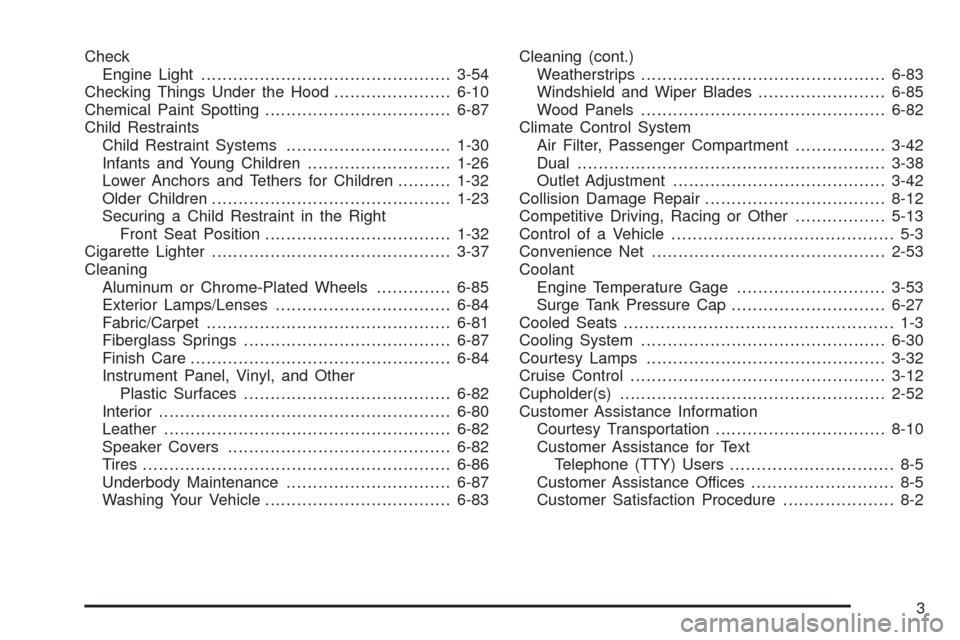
Check
Engine Light...............................................3-54
Checking Things Under the Hood......................6-10
Chemical Paint Spotting...................................6-87
Child Restraints
Child Restraint Systems...............................1-30
Infants and Young Children...........................1-26
Lower Anchors and Tethers for Children..........1-32
Older Children.............................................1-23
Securing a Child Restraint in the Right
Front Seat Position...................................1-32
Cigarette Lighter.............................................3-37
Cleaning
Aluminum or Chrome-Plated Wheels..............6-85
Exterior Lamps/Lenses.................................6-84
Fabric/Carpet..............................................6-81
Fiberglass Springs.......................................6-87
Finish Care.................................................6-84
Instrument Panel, Vinyl, and Other
Plastic Surfaces.......................................6-82
Interior.......................................................6-80
Leather......................................................6-82
Speaker Covers..........................................6-82
Tires..........................................................6-86
Underbody Maintenance...............................6-87
Washing Your Vehicle...................................6-83Cleaning (cont.)
Weatherstrips..............................................6-83
Windshield and Wiper Blades........................6-85
Wood Panels..............................................6-82
Climate Control System
Air Filter, Passenger Compartment.................3-42
Dual..........................................................3-38
Outlet Adjustment........................................3-42
Collision Damage Repair..................................8-12
Competitive Driving, Racing or Other.................5-13
Control of a Vehicle.......................................... 5-3
Convenience Net............................................2-53
Coolant
Engine Temperature Gage
............................3-53
Surge Tank Pressure Cap.............................6-27
Cooled Seats................................................... 1-3
Cooling System..............................................6-30
Courtesy Lamps.............................................3-32
Cruise Control................................................3-12
Cupholder(s)..................................................2-52
Customer Assistance Information
Courtesy Transportation................................8-10
Customer Assistance for Text
Telephone (TTY) Users............................... 8-5
Customer Assistance Offices........................... 8-5
Customer Satisfaction Procedure..................... 8-2
3
Page 462 of 470

G
Gage
Engine Coolant Temperature.........................3-53
Engine Oil Pressure.....................................3-57
Fuel..........................................................3-59
Speedometer..............................................3-45
Tachometer.................................................3-45
Voltmeter Gage...........................................3-50
Garage Door Opener.......................................2-44
Gasoline
Octane........................................................ 6-5
Specications............................................... 6-5
Getting Started
Getting Started, Navigation............................. 4-4
Global Positioning System (GPS)......................4-50
Glove Box.....................................................2-52
GM Mobility Reimbursement Program.................. 8-7
H
Hazard Warning Flashers................................... 3-6
Headlamp
Aiming.......................................................6-47
Vertical Aiming............................................6-48Headlamps
Adaptive Forward Lighting System.................3-30
Bulb Replacement.......................................6-50
Daytime Running Lamps...............................3-29
Exterior Lamps............................................3-28
Flash-to-Pass............................................... 3-9
High/Low Beam Changer................................ 3-9
On Reminder..............................................3-29
Washer......................................................3-12
Wiper Activated...........................................3-29
Head-Up Display (HUD)...................................3-33
Heated Seats................................................... 1-3
Heated Steering Wheel..................................... 3-7
Heater...........................................................3-38
Highbeam On Light.........................................3-58
Highway Hypnosis...........................................5-16
Hill and Mountain Roads..................................5-16
Hood
Checking Things Under................................6-10
Release.....................................................6-11
Horn............................................................... 3-6
How to Wear Safety Belts Properly...................1-11
6
Page 467 of 470

Rearview Mirror, Automatic Dimming
with OnStar®..............................................2-36
Reclining Seatbacks, Power............................... 1-4
Recommended Fluids and Lubricants.................7-11
Recreational Vehicle Towing.............................5-27
Remote, Keyless Access System................2-5, 4-50
Replacement, Windshield.................................6-50
Reporting Safety Defects
Canadian Government..................................8-15
General Motors...........................................8-16
United States Government............................8-15
Restraint System Check
Checking the Restraint Systems....................1-52
Replacing Restraint System Parts
After a Crash..........................................1-53
Retained Accessory Power (RAP)......................2-24
Retractable Hardtop........................................2-54
Lowering....................................................2-54
Raising......................................................2-55
Roadside
Service........................................................ 8-7
Rocking Your Vehicle to Get it Out....................5-22
Route Preference............................................4-37
Routing, Engine Drive Belt...............................7-14
Run-Flat Tires................................................6-58
Running the Engine While Parked.....................2-35S
Safety Belt
Reminder Light............................................3-46
Safety Belts
Care of......................................................6-83
How to Wear Safety Belts Properly................1-11
Lap-Shoulder Belt........................................1-20
Safety Belt Extender....................................1-23
Safety Belt Use During Pregnancy.................1-22
Safety Belts Are for Everyone......................... 1-6
Safety Warnings and Symbols.............................. iv
Scheduled Maintenance..................................... 7-4
Seats
Heated and Cooled Seats.............................. 1-3
Memory, Mirrors............................................ 1-3
Power Lumbar.............................................. 1-2
Power Reclining Seatbacks............................. 1-4
Power Seats................................................. 1-2
Securing a Child Restraint
Right Front Seat Position..............................1-32
Security Light.................................................3-58
Service........................................................... 6-3
Accessories and Modications......................... 6-3
Adding Equipment to the Outside
of Your Vehicle.......................................... 6-4
11