lock CADILLAC XLR 2008 1.G Manual PDF
[x] Cancel search | Manufacturer: CADILLAC, Model Year: 2008, Model line: XLR, Model: CADILLAC XLR 2008 1.GPages: 470, PDF Size: 8.39 MB
Page 335 of 470

A. Battery. SeeBattery on page 6-40.
B. Passenger Compartment Air Filter. SeePassenger
Compartment Air Filter on page 3-42.
C. Underhood Fuse Block. SeeUnderhood Fuse Block
on page 6-94.
D. Power Steering Fluid. SeePower Steering Fluid on
page 6-35.
E. Engine Air Cleaner/Filter. SeeEngine Air
Cleaner/Filter on page 6-22.
F. Engine Oil Fill Cap. See “When to Add Engine Oil”
underEngine Oil on page 6-16.G. Engine Oil Dipstick. See “Checking Engine Oil”
underEngine Oil on page 6-16.
H. Brake Master Cylinder Reservoir. See “Brake Fluid”
underBrakes on page 6-37.
I. Engine Coolant Surge Tank and Pressure Cap.
SeeCoolant Surge Tank Pressure Cap on
page 6-27.
J. Windshield Washer Fluid Reservoir. See “Adding
Washer Fluid” underWindshield Washer Fluid
on page 6-36.
6-15
Page 347 of 470

Adding Coolant
If you need more coolant, add the proper DEX-COOL®
coolant mixture at the surge tank, but only when the
engine is cool.
{CAUTION:
You can be burned if you spill coolant on hot
engine parts. Coolant contains ethylene glycol,
and it will burn if the engine parts are hot
enough. Do not spill coolant on a hot engine.
When replacing the pressure cap, press down and
turn it clockwise until you hear a clicking sound.
Make sure the cap is hand-tight and fully seated.
Coolant Surge Tank Pressure Cap
Notice:If the pressure cap is not tightly installed,
coolant loss and possible engine damage may
occur. Be sure the cap is properly and tightly
secured.
The coolant surge tank pressure cap must be fully
installed on the coolant surge tank. SeeEngine
Compartment Overview on page 6-12for more
information on location.
Engine Overheating
You will nd a COOLANT OVER TEMP message or an
ENGINE HOT, STOP ENGINE message displayed in
the Driver Information Center (DIC). SeeDIC Warnings
and Messages on page 3-63. You will also hear a
chime.
There is also an engine coolant temperature gage on
the instrument panel cluster. SeeEngine Coolant
Temperature Gage on page 3-53.
6-27
Page 353 of 470

Notice:In cold weather, water can freeze and crack
the engine, radiator, heater core and other parts.
Use the recommended coolant and the proper
coolant mixture.
{CAUTION:
You can be burned if you spill coolant on hot
engine parts. Coolant contains ethylene glycol
and it will burn if the engine parts are hot
enough. Do not spill coolant on a hot engine.
1. You can remove the coolant surge tank pressure
cap when the cooling system, including the coolant
surge tank pressure cap and upper radiator hose,
is no longer hot. Turn the pressure cap slowly
counterclockwise.
If you hear a hiss, wait for that to stop. A hiss means
there is still some pressure left.
2. Then keep turning the cap and remove it.
6-33
Page 360 of 470

Battery
Your vehicle has a maintenance free battery. When it is
time for a new battery, see your dealer/retailer for
one that has the replacement number shown on the
original battery’s label.
For battery replacement, see your dealer/retailer or the
service manual. To purchase a service manual, see
Service Publications Ordering Information on page 8-16.
Warning:Battery posts, terminals, and related
accessories contain lead and lead compounds,
chemicals known to the State of California to cause
cancer and reproductive harm. Wash hands after
handling.
Vehicle Storage
{CAUTION:
Batteries have acid that can burn you and gas
that can explode. You can be badly hurt if
you are not careful. SeeJump Starting on
page 6-41for tips on working around a battery
without getting hurt.Infrequent Usage: If you drive your vehicle infrequently,
remove the black, negative (−) cable from the battery.
This will help keep the battery from running down.
See “Power Window Initialization” inPower Windows
on page 2-17.
Extended Storage: For extended storage of your vehicle,
remove the black, negative (−) cable from the battery or
use a battery trickle charger. This will help maintain the
charge of the battery over an extended period of time.
You must close all doors and the trunk before
reconnecting the battery. After reconnecting the battery,
you must press the unlock button on the keyless
access transmitter. Failure to follow this procedure could
result in the alarm sounding. Pressing unlock on the
keyless access transmitter will stop the alarm.
6-40
Page 388 of 470
{CAUTION:
If you use bias-ply tires on your vehicle,
the wheel rim anges could develop
cracks after many miles of driving. A tire
and/or wheel could fail suddenly, causing
a crash. Use only radial-ply tires with the
wheels on your vehicle.
If you must replace your vehicle’s tires with those that
do not have a TPC Spec number, make sure they
are the same size, load range, speed rating, and
construction type (radial and bias-belted tires) as your
vehicle’s original tires.
Vehicles that have a tire pressure monitoring system
could give an inaccurate low-pressure warning if
non-TPC Spec rated tires are installed on it. Non-TPC
Spec rated tires may give a low-pressure warning that is
higher or lower than the proper warning level you
would get with TPC Spec rated tires. SeeTire Pressure
Monitor System on page 6-61.
Your vehicle’s original equipment tires are listed on the
Tire and Loading Information label. SeeLoading
Your Vehicle on page 5-22, for more information about
the Tire and Loading Information label and its location
on your vehicle.
Different Size Tires and Wheels
If you add wheels or tires that are a different size than
your original equipment wheels and tires, this may
affect the way your vehicle performs, including its
braking, ride and handling characteristics, stability, and
resistance to rollover. Additionally, if your vehicle
has electronic systems such as, anti-lock brakes,
traction control, and electronic stability control, the
performance of these systems can be affected.
{CAUTION:
If you add different sized wheels, your vehicle
may not provide an acceptable level of
performance and safety if tires not
recommended for those wheels are selected.
You may increase the chance that you will
crash and suffer serious injury. Only use GM
specic wheel and tire systems developed for
your vehicle, and have them properly installed
by a GM certied technician.
SeeBuying New Tires on page 6-67andAccessories
and Modifications on page 6-3for additional information.
6-68
Page 394 of 470

Lifting Your Vehicle
{CAUTION:
Lifting a vehicle can cause an injury.
The vehicle can slip off the jack and roll over
you or other people. You and they could be
badly injured. Find a level place to lift your
vehicle. To help prevent the vehicle from
moving:
1. Set the parking brake rmly.
2. Put an automatic transmission shift lever
in PARK (P).
3. Turn off the engine.
To be even more certain the vehicle won’t move,
you can put blocks in front of and behind the
wheels.
{CAUTION:
Getting under a vehicle when it is jacked up is
dangerous. If the vehicle slips off the jack,
you could be badly injured or killed. Never get
under a vehicle when it is supported only by
a jack.
{CAUTION:
Raising your vehicle with the jack improperly
positioned can damage the vehicle or the
vehicle may fall and cause your or others
injury.
6-74
Page 395 of 470

If you ever use a jack to lift your vehicle, follow the
instructions that came with the jack, and be sure to use
the correct lifting points to avoid damaging your vehicle.
Notice:Lifting your vehicle improperly can
damage your vehicle and result in costly repairs not
covered by your warranty. To lift your vehicle
properly, follow the advice in this part.
To help prevent vehicle damage:
Be sure to place a block or pad between the
jack and the vehicle.
Make sure the jack you are using spans at least
two crossmember ribs.
Lift only in the areas shown in the following
pictures.
For additional information, see your GM dealer and
the Cadillac XLR service manual.
Lifting From the Front
The front lifting points can be accessed from either side
of your vehicle, behind the front tires.
6-75
Page 396 of 470

1. Locate the front lifting points (A), according to the
illustration shown.
2. Be sure to place a block or pad between the jack
and the vehicle.3. Lift the vehicle with the jack, making sure the jack
spans at least two of the crossmember ribs (B).
6-76
Page 397 of 470
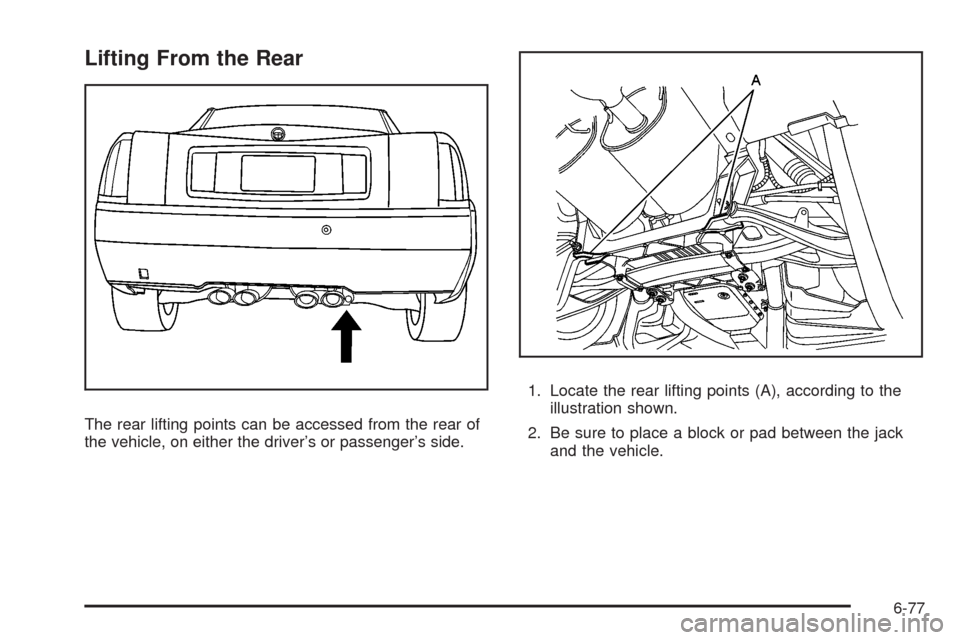
Lifting From the Rear
The rear lifting points can be accessed from the rear of
the vehicle, on either the driver’s or passenger’s side.1. Locate the rear lifting points (A), according to the
illustration shown.
2. Be sure to place a block or pad between the jack
and the vehicle.
6-77
Page 410 of 470

Windshield Wiper Fuses
The windshield wiper motor is protected by an internal
circuit breaker. If the wiper motor overheats due to
heavy snow, the wipers will stop until the motor cools
and will then restart.
A fuse powers the wiper motor. If the fuse blows, there
is an electrical problem. Be sure to have it xed.
Power Windows and Other Power
Options
Circuit breakers in the fuse block protect the power
windows and other power accessories. When the current
load is too heavy, the circuit breaker opens and closes,
protecting the circuit until the problem is xed or
goes away.
Fuses and Circuit Breakers
The wiring circuits in your vehicle are protected from
short circuits by a combination of fuses and circuit
breakers. This greatly reduces the chance of res
caused by electrical problems.Look at the silver-colored band inside the fuse. If the
band is broken or melted, replace the fuse. Be sure you
replace a bad fuse with a new one of the identical
size and rating.
If you ever have a problem on the road and don’t have
a spare fuse, you can borrow one that has the same
amperage. Just pick some feature of your vehicle
that you can get along without — like the radio or
cigarette lighter — and use its fuse, if it is the correct
amperage. Replace it as soon as you can.
Instrument Panel Fuse Block
The panel fuse block is located on the passenger side
of the vehicle, under the instrument panel and under the
toe-board.
Remove the carpet and toe-board covering to access
the fuse block by pulling at the top of each corner
of the panel. Then turn the fuse block door knob
counterclockwise and pull the door to access the fuses.
6-90