instrument cluster CADILLAC XLR 2008 1.G Owners Manual
[x] Cancel search | Manufacturer: CADILLAC, Model Year: 2008, Model line: XLR, Model: CADILLAC XLR 2008 1.GPages: 470, PDF Size: 8.39 MB
Page 44 of 470

{CAUTION:
Airbags plus lap-shoulder belts offer the best
protection for adults, but not for young
children and infants. Neither the vehicle’s
safety belt system nor its airbag system is
designed for them. Young children and infants
need the protection that a child restraint
system can provide. Always secure children
properly in your vehicle. To read how, see
Older Children on page 1-23orInfants and
Young Children on page 1-26.There is an airbag
readiness light on the
instrument panel cluster,
which shows the airbag
symbol.
The system checks the airbag electrical system for
malfunctions. The light tells you if there is an electrical
problem. SeeAirbag Readiness Light on page 3-46
for more information.
1-38
Page 55 of 470

Safety belts help keep the passenger in position on the
seat during vehicle maneuvers and braking, which
helps the passenger sensing system maintain the
passenger airbag status. See “Safety Belts” and
“Child Restraints” in the Index for additional information
about the importance of proper restraint use.If you ever pull the shoulder portion of the belt out all
the way, you will engage the child restraint locking
feature. This may unintentionally cause the passenger
sensing system to turn the airbag(s) off for some
adult size occupants. If this happens, just let the belt go
back all the way and start again.
{CAUTION:
If the airbag readiness light in the instrument
panel cluster ever comes on and stays on, it
means that something may be wrong with the
airbag system. If this ever happens, have the
vehicle serviced promptly, because an
adult-size person sitting in the right front
passenger’s seat may not have the protection
of the airbag(s). SeeAirbag Readiness Light
on page 3-46for more on this, including
important safety information.
1-49
Page 90 of 470

Some automatic downshifts can occur to maintain
minimum engine speed. This only happens if the vehicle
is left in too high of a gear for the vehicle’s speed.
For example, if you have been driving in sixth gear
range and come to a stop without manually
downshifting, the transmission automatically downshifts
to rst gear and displays rst gear on the HUD. As
you begin to drive and accelerate, the transmission
remains in rst gear until the driver selects an upshift.
DSC can be used while using cruise control, but
transmission shifting is different while the cruise control
is on. This is not a malfunction and is necessary to
let proper operation of the cruise control.
To return to fully automatic operation, move the shift
lever to the right and back into DRIVE (D).
When accelerating your vehicle from a stop in snowy
and icy conditions, you may want to shift into second
gear. A higher gear lets you gain more traction on
slippery surfaces.
In higher gears, on the XLR only, an automatic downshift
occurs if you press the accelerator pedal to the oor.
This feature provides adequate acceleration capabilities
if you forget to downshift manually. Tap the shifter
forward and the vehicle upshifts.Parking Brake
The parking brake pedal is
located to the left of the
regular brake pedal,
near the driver’s door.
To set the parking brake, hold the regular brake pedal
down with your right foot and push the parking brake
pedal down with your left foot.
If the ignition is on, the parking brake indicator light
on the instrument panel cluster should come on.
If it does not, you need to have your vehicle serviced.
2-30
Page 123 of 470
Instrument Panel Overview...............................3-4
Hazard Warning Flashers................................3-6
Other Warning Devices...................................3-6
Horn.............................................................3-6
Power Tilt Wheel and Telescopic
Steering Column.........................................3-7
Heated Steering Wheel...................................3-7
Turn Signal/Multifunction Lever.........................3-8
Turn and Lane-Change Signals........................3-8
Headlamp High/Low-Beam Changer..................3-9
Flash-to-Pass.................................................3-9
Windshield Wipers........................................3-10
Rainsense™ Wipers......................................3-11
Windshield Washer.......................................3-12
Headlamp Washer........................................3-12
Cruise Control..............................................3-12
Adaptive Cruise Control.................................3-15
Exterior Lamps.............................................3-28
Wiper Activated Headlamps............................3-29
Headlamps on Reminder................................3-29
Daytime Running Lamps (DRL).......................3-29
Adaptive Forward Lighting System...................3-30
Fog Lamps..................................................3-30Twilight Sentinel®..........................................3-31
Exterior Lighting Battery Saver........................3-32
Instrument Panel Brightness...........................3-32
Courtesy Lamps...........................................3-32
Entry/Exit Lighting.........................................3-32
Reading Lamps............................................3-32
Battery Run-Down Protection..........................3-33
Head-Up Display (HUD).................................3-33
Accessory Power Outlet(s).............................3-36
Ashtray(s) and Cigarette Lighter......................3-37
Climate Controls............................................3-38
Dual Climate Control System..........................3-38
Outlet Adjustment.........................................3-42
Passenger Compartment Air Filter...................3-42
Warning Lights, Gages, and Indicators............3-43
Instrument Panel Cluster................................3-44
Speedometer and Odometer...........................3-45
Trip Odometer..............................................3-45
Tachometer.................................................3-45
Safety Belt Reminders...................................3-46
Airbag Readiness Light..................................3-46
Passenger Airbag Status Indicator...................3-47
Charging System Light..................................3-49
Section 3 Instrument Panel
3-1
Page 127 of 470
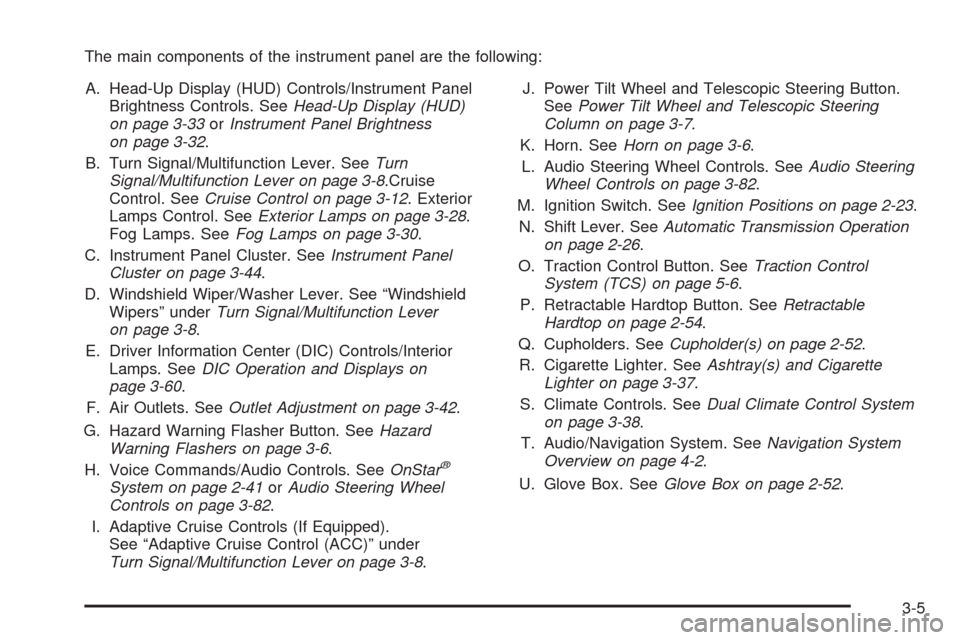
The main components of the instrument panel are the following:
A. Head-Up Display (HUD) Controls/Instrument Panel
Brightness Controls. SeeHead-Up Display (HUD)
on page 3-33orInstrument Panel Brightness
on page 3-32.
B. Turn Signal/Multifunction Lever. SeeTurn
Signal/Multifunction Lever on page 3-8.Cruise
Control. SeeCruise Control on page 3-12. Exterior
Lamps Control. SeeExterior Lamps on page 3-28.
Fog Lamps. SeeFog Lamps on page 3-30.
C. Instrument Panel Cluster. SeeInstrument Panel
Cluster on page 3-44.
D. Windshield Wiper/Washer Lever. See “Windshield
Wipers” underTurn Signal/Multifunction Lever
on page 3-8.
E. Driver Information Center (DIC) Controls/Interior
Lamps. SeeDIC Operation and Displays on
page 3-60.
F. Air Outlets. SeeOutlet Adjustment on page 3-42.
G. Hazard Warning Flasher Button. SeeHazard
Warning Flashers on page 3-6.
H. Voice Commands/Audio Controls. SeeOnStar
®
System on page 2-41orAudio Steering Wheel
Controls on page 3-82.
I. Adaptive Cruise Controls (If Equipped).
See “Adaptive Cruise Control (ACC)” under
Turn Signal/Multifunction Lever on page 3-8.J. Power Tilt Wheel and Telescopic Steering Button.
SeePower Tilt Wheel and Telescopic Steering
Column on page 3-7.
K. Horn. SeeHorn on page 3-6.
L. Audio Steering Wheel Controls. SeeAudio Steering
Wheel Controls on page 3-82.
M. Ignition Switch. SeeIgnition Positions on page 2-23.
N. Shift Lever. SeeAutomatic Transmission Operation
on page 2-26.
O. Traction Control Button. SeeTraction Control
System (TCS) on page 5-6.
P. Retractable Hardtop Button. SeeRetractable
Hardtop on page 2-54.
Q. Cupholders. SeeCupholder(s) on page 2-52.
R. Cigarette Lighter. SeeAshtray(s) and Cigarette
Lighter on page 3-37.
S. Climate Controls. SeeDual Climate Control System
on page 3-38.
T. Audio/Navigation System. SeeNavigation System
Overview on page 4-2.
U. Glove Box. SeeGlove Box on page 2-52.
3-5
Page 130 of 470

Turn Signal/Multifunction Lever
The lever on the left side of the steering column
includes the following:
GTurn and Lane-Change Signals. SeeTurn
and Lane-Change Signals on page 3-8.
3Headlamp High/Low-Beam Changer. See
Headlamp High/Low-Beam Changer on page 3-9.
-Fog Lamps. SeeFog Lamps on page 3-30.
Flash-to-Pass Feature. SeeFlash-to-Pass on
page 3-9.
ICruise Control. SeeCruise Control on
page 3-12.
PExterior Lamps Control. SeeExterior Lamps
on page 3-28.
Turn and Lane-Change Signals
The turn signal has two upward (for right) and two
downward (for left) positions. These positions allow you
to signal a turn or a lane change.
To signal a turn, move the multifunction lever all the
way up or down. When the turn is nished, the lever will
return automatically.
An arrow on the instrument
panel cluster will ash in
the direction of the
turn or lane change.
To signal a lane change, just raise or lower the lever
until the arrow starts to ash. Hold it there until you
complete your lane change. The lever will return by itself
when you release it.
If you signal a turn or a lane change and the arrows
ash faster than normal, a signal bulb may be burned
out. Other drivers will not see the turn signal.
Replace burned-out bulbs to help avoid possible
accidents. If the arrows do not go on at all when you
signal a turn, check the fuses and check for burned-out
bulbs. SeeFuses and Circuit Breakers on page 6-90.
3-8
Page 131 of 470
Turn Signal on Chime
A chime will remind you if you leave the turn signal on
for more than 3/4 mile (1.2 km) of driving.
If you need to leave the turn signal on for more than
3/4 mile (1.2 km), turn off the signal and then turn
it back on.
Headlamp High/Low-Beam Changer
To change the headlamps from low beam to high,
push the turn signal lever all the way forward.
When the high beams
are on, this light on the
instrument panel cluster
will also be on.
To change the headlamps from high to low, pull the
lever rearward.
Flash-to-Pass
This feature lets you use the high-beam headlamps
to signal the driver in front of you that you want to pass.
Pull and hold the turn signal lever toward you to use.
When you do, the following will occur:
If the low-beam headlamps are on, the high-beam
headlamps will turn on. They will stay on as long
as you hold the lever there. Release the lever
to turn them off.
If the headlamps are on high-beam, they will switch
to low-beam. To return to high beam, push the
lever away from you.
3-9
Page 135 of 470

With cruise control, you can maintain a speed of about
25 mph (40 km/h) or more without keeping your foot
on the accelerator. This can really help on long
trips. Cruise control does not work at speeds below
about 25 mph (40 km/h).
Cruise control will not work if the parking brake is set,
or if the master cylinder brake uid level is low.
{CAUTION:
Cruise control can be dangerous where you
cannot drive safely at a steady speed. So, do
not use your cruise control on winding roads
or in heavy traffic.
Cruise control can be dangerous on slippery
roads. On such roads, fast changes in tire
traction can cause excessive wheel slip, and
you could lose control. Do not use cruise
control on slippery roads.
If your vehicle has the traction control system and it
begins to limit wheel spin while cruise control is on,
the cruise control will automatically disengage.
SeeTraction Control System (TCS) on page 5-6.
When road conditions allow you to safely use it
again, you may turn cruise control back on.
Setting Cruise Control
{CAUTION:
If you leave your cruise control on when you
are not using cruise, you might hit a button
and go into cruise when you do not want to.
You could be startled and even lose control.
Keep the cruise control switch off until you
want to use cruise control.
1. Move the cruise control switch to on.
2. Get up to the speed desired.
3. Press the set button at the end of the lever
and release it.
4. Take your foot off the accelerator pedal.
The cruise symbol on the
instrument panel cluster
will be lit when the
cruise control is engaged.
3-13
Page 151 of 470

Wiper Activated Headlamps
This feature activates the headlamps and parking
lamps after the windshield wipers have been in use for
approximately six seconds and the multifunction lever is
in the AUTO position. SeeExterior Lamps on page 3-28.
When the exterior lamp control has been turned off or is
in the parking lamp position and the wiper control is
on delay, low speed or high speed, the HEADLAMPS
SUGGESTED message will appear on the Driver
Information Center (DIC).
When the ignition is turned off, the wiper-activated
headlamps will immediately turn off.
Headlamps on Reminder
A warning chime will sound if the exterior lamp control
is left on in either the headlamp or parking lamp position
and the driver’s door is opened with the ignition off.
Daytime Running Lamps (DRL)
Daytime Running Lamps (DRL) can make it easier for
others to see the front of your vehicle during the
day. DRL can be helpful in many different driving
conditions, but they can be especially helpful in the short
periods after dawn and before sunset. Fully functional
DRL are required on all vehicles rst sold in Canada.The DRL system makes the front turn signal lamps
come on when the following conditions are met:
It is still daylight and the ignition is on.
The exterior lamp control is in the off position.
The transmission is not in PARK (P).
When DRL are on, only the front turn signal lamps are
on. No other exterior lamps such as the parking lamps,
taillamps, etc. are on when the DRL are used. Your
instrument panel is not be lit up either.
When it is dark enough outside, the front turn signal
lamps turn off and normal low-beam headlamps turn on.
When it is bright enough outside, the regular lamps go off,
and the front turn signal lamps take over. If you start your
vehicle in a dark garage, the automatic headlamp system
comes on immediately. Once you leave the garage, it
takes about one minute for the automatic headlamp
system to change to DRL if it is light outside. During that
delay, the instrument panel cluster might not be as bright
as usual. Make sure the instrument panel brightness
knob is in the full bright position. SeeInstrument Panel
Brightness on page 3-32for more information.
If it is dark enough outside and the exterior lamp control
is off, a HEADLAMPS SUGGESTED message displays
on the Driver’s Information Center (DIC). This message
informs the driver that turning on the exterior lamps is
recommended. SeeDIC Warnings and Messages on
page 3-63.
3-29
Page 152 of 470

Turn the exterior lamp control off a second time,
or turn on the headlamps to turn off the HEADLAMPS
SUGGESTED message in the DIC. If the parking
lamps or the fog lamps were turned on instead, the
HEADLAMPS SUGGESTED message continues
to display.
As with any vehicle, you should turn on the regular
headlamp system when needed.
Adaptive Forward Lighting System
The Adaptive Forward Lighting System (AFS) swivels
the headlamps horizontally to provide greater road
illumination while turning. AFS will operate when the
vehicle speed is greater than 2 mph (3 km/h). AFS will
not operate when the transmission is in REVERSE (R).
AFS is not immediately operable after starting the
vehicle; driving a short distance is required to calibrate
the AFS. To enable AFS, set the exterior lamp switch
on the multifunction lever to the AUTO position. Moving
the switch out of the AUTO position will deactivate the
system. SeeExterior Lamps on page 3-28.
Fog Lamps
Use fog lamps for better vision in foggy or misty
conditions.
The fog lamps control is located on the multifunction
lever next to the exterior lamp control.
-(Fog Lamps):Turning the band to this position will
turn the fog lamps on.
When you turn the fog lamps on, the fog lamp light will
appear on the instrument panel cluster to indicate
that the fog lamps and the parking lamps are on.
If you turn the high-beam headlamps on, the fog lamps
will turn off. They will turn on again when you switch
to low-beam headlamps.
The ignition must be on for the fog lamps to operate.
The fog lamps will turn off when the ignition is turned off.
Some localities have laws that require the headlamps
to be on along with the fog lamps.
3-30