light CADILLAC XLR 2009 1.G Owners Manual
[x] Cancel search | Manufacturer: CADILLAC, Model Year: 2009, Model line: XLR, Model: CADILLAC XLR 2009 1.GPages: 462, PDF Size: 3.72 MB
Page 384 of 462

Uniform Tire Quality Grading
Quality grades can be found where applicable on
the tire sidewall between tread shoulder and
maximum section width. For example:
Treadwear 200 Traction AA
Temperature A
The following information relates to the system
developed by the United States National Highway
Traffic Safety Administration (NHTSA), which
grades tires by treadwear, traction, and
temperature performance. This applies only to
vehicles sold in the United States. The grades are
molded on the sidewalls of most passenger car
tires. The Uniform Tire Quality Grading (UTQG)
system does not apply to deep tread, winter-type
snow tires, space-saver, or temporary use spare
tires, tires with nominal rim diameters of
10 to 12 inches (25 to 30 cm), or to some
limited-production tires.
While the tires available on General Motors
passenger cars and light trucks may vary with
respect to these grades, they must also conform
to federal safety requirements and additional
General Motors Tire Performance Criteria (TPC)
standards.
Treadwear
The treadwear grade is a comparative rating based
on the wear rate of the tire when tested under
controlled conditions on a specied government
test course. For example, a tire graded 150 would
wear one and a half (1.5) times as well on the
government course as a tire graded 100. The
relative performance of tires depends upon the
actual conditions of their use, however, and may
depart signicantly from the norm due to variations
in driving habits, service practices, and differences
in road characteristics and climate.
Traction – AA, A, B, C
The traction grades, from highest to lowest, are AA,
A, B, and C. Those grades represent the tire’s
ability to stop on wet pavement as measured under
controlled conditions on specied government test
surfaces of asphalt and concrete. A tire marked C
may have poor traction performance.
6-64
Page 394 of 462

Appearance Care
Interior Cleaning
Your vehicle’s interior will continue to look its best if it is
cleaned often. Although not always visible, dust and
dirt can accumulate on your upholstery. Dirt can damage
carpet, fabric, leather, and plastic surfaces. Regular
vacuuming is recommended to remove particles
from your upholstery. It is important to keep your
upholstery from becoming and remaining heavily soiled.
Soils should be removed as quickly as possible. Your
vehicle’s interior may experience extremes of heat
that could cause stains to set rapidly.
Lighter colored interiors may require more frequent
cleaning. Use care because newspapers and garments
that transfer color to your home furnishings may also
transfer color to your vehicle’s interior.
When cleaning your vehicle’s interior, only use cleaners
specically designed for the surfaces being cleaned.
Permanent damage may result from using cleaners on
surfaces for which they were not intended. Use glass
cleaner only on glass. Remove any accidental over-spray
from other surfaces immediately. To prevent over-spray,
apply cleaner directly to the cleaning cloth.Notice:If you use abrasive cleaners when cleaning
glass surfaces on your vehicle, you could scratch
the glass and/or cause damage to the rear window
defogger. When cleaning the glass on your
vehicle, use only a soft cloth and glass cleaner.
Many cleaners contain solvents that may become
concentrated in your vehicle’s breathing space. Before
using cleaners, read and adhere to all safety
instructions on the label. While cleaning your vehicle’s
interior, maintain adequate ventilation by opening
your vehicle’s doors and windows.
Dust may be removed from small buttons and knobs
using a small brush with soft bristles.
Your dealer/retailer has a product for cleaning your
vehicle’s glass. Should it become necessary, you can
also obtain a product from your dealer/retailer to remove
odors from your vehicle’s upholstery.
Do not clean your vehicle using:
A knife or any other sharp object to remove a soil
from any interior surface.
A stiff brush. It can cause damage to your vehicle’s
interior surfaces.
Heavy pressure or aggressive rubbing with a
cleaning cloth. Use of heavy pressure can damage
your interior and does not improve the effectiveness
of soil removal.
6-74
Page 397 of 462
Weatherstrips
Silicone grease on weatherstrips will make them last
longer, seal better, and not stick or squeak. Apply
silicone grease with a clean cloth. During very cold,
damp weather frequent application may be required. See
Recommended Fluids and Lubricants on page 7-11.
Washing Your Vehicle
The best way to preserve your vehicle’s nish is to keep
it clean by washing it often.
Notice:Certain cleaners contain chemicals that can
damage the emblems or nameplates on your vehicle.
Check the cleaning product label. If it states that it
should not be used on plastic parts, do not use it on
your vehicle or damage may occur and it would not
be covered by the warranty.
Do not wash the vehicle in direct sunlight. Use a car
washing soap. Do not use cleaning agents that are
petroleum based or that contain acid or abrasives, as
they can damage the paint, metal or plastic on your
vehicle. Approved cleaning products can be obtained
from your dealer/retailer. Follow all manufacturers’
directions regarding correct product usage, necessary
safety precautions and appropriate disposal of any
vehicle care product.Rinse the vehicle well, before washing and after to
remove all cleaning agents completely. If they are
allowed to dry on the surface, they could stain.
Dry the nish with a soft, clean chamois or an all-cotton
towel to avoid surface scratches and water spotting.
Notice:If you drive the vehicle through an
automatic car wash that does not have enough
clearance for the wide rear tires and wheels, you
could damage the vehicle. Verify with the manager
of the car wash that the vehicle will t before
entering the car wash or use a touchless car wash.
High pressure car washes may cause water to enter the
vehicle. Avoid using high pressure washes closer than
12 inches (30 cm) to the surface of the vehicle. Use of
power washers exceeding 1,200 psi (8 274 kPa) can
result in damage or removal of paint and decals.
Cleaning Exterior Lamps/Lenses
Use only lukewarm or cold water, a soft cloth and a car
washing soap to clean exterior lamps and lenses. Follow
instructions underWashing Your Vehicle on page 6-77.
6-77
Page 404 of 462
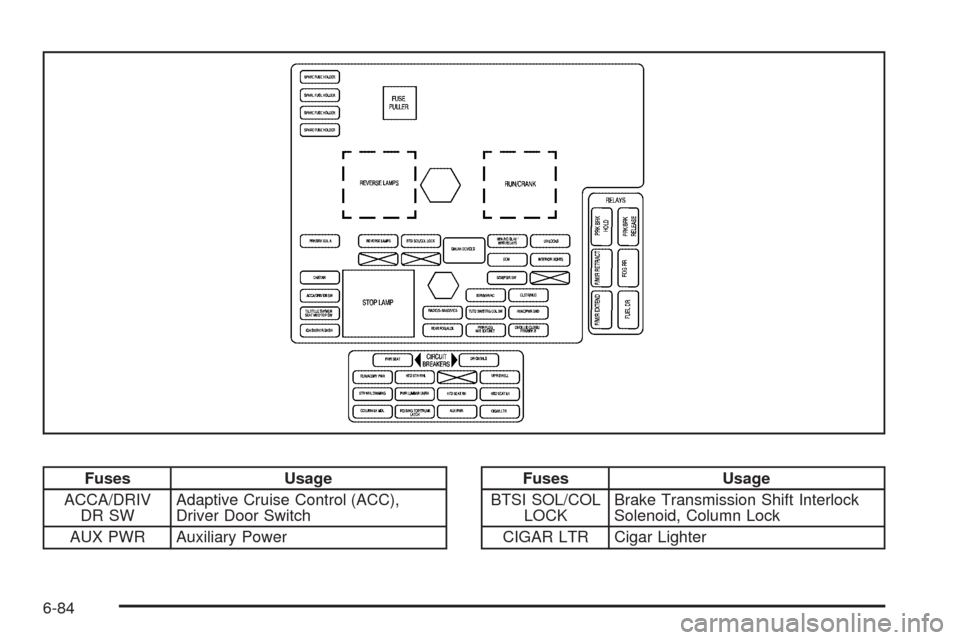
Fuses Usage
ACCA/DRIV
DR SWAdaptive Cruise Control (ACC),
Driver Door Switch
AUX PWR Auxiliary PowerFuses Usage
BTSI SOL/COL
LOCKBrake Transmission Shift Interlock
Solenoid, Column Lock
CIGAR LTR Cigar Lighter
6-84
Page 405 of 462
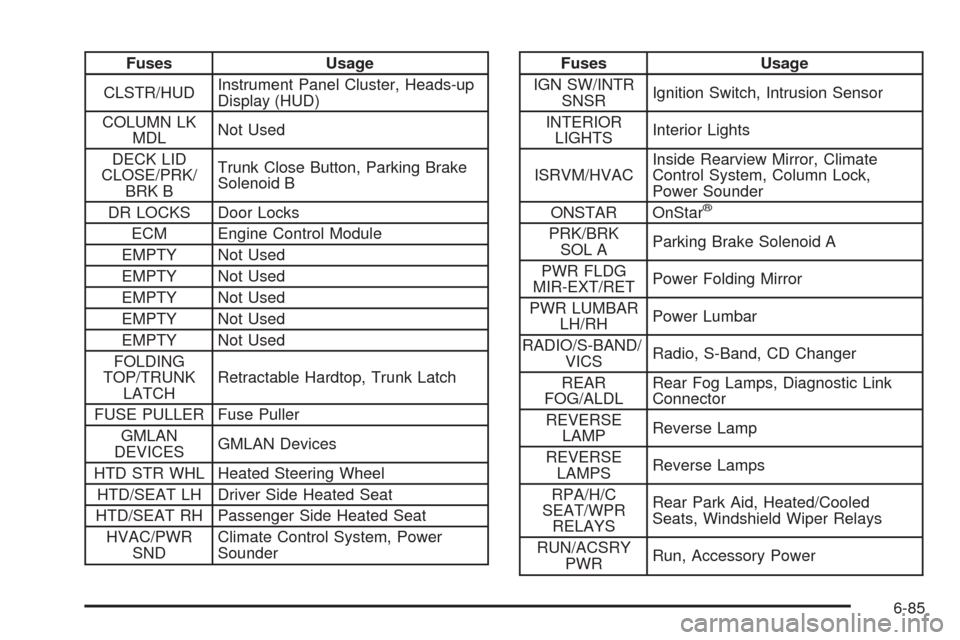
Fuses Usage
CLSTR/HUDInstrument Panel Cluster, Heads-up
Display (HUD)
COLUMN LK
MDLNot Used
DECK LID
CLOSE/PRK/
BRK BTrunk Close Button, Parking Brake
Solenoid B
DR LOCKS Door Locks
ECM Engine Control Module
EMPTY Not Used
EMPTY Not Used
EMPTY Not Used
EMPTY Not Used
EMPTY Not Used
FOLDING
TOP/TRUNK
LATCHRetractable Hardtop, Trunk Latch
FUSE PULLER Fuse Puller
GMLAN
DEVICESGMLAN Devices
HTD STR WHL Heated Steering Wheel
HTD/SEAT LH Driver Side Heated Seat
HTD/SEAT RH Passenger Side Heated Seat
HVAC/PWR
SNDClimate Control System, Power
SounderFuses Usage
IGN SW/INTR
SNSRIgnition Switch, Intrusion Sensor
INTERIOR
LIGHTSInterior Lights
ISRVM/HVACInside Rearview Mirror, Climate
Control System, Column Lock,
Power Sounder
ONSTAR OnStar
®
PRK/BRK
SOL AParking Brake Solenoid A
PWR FLDG
MIR-EXT/RETPower Folding Mirror
PWR LUMBAR
LH/RHPower Lumbar
RADIO/S-BAND/
VICSRadio, S-Band, CD Changer
REAR
FOG/ALDLRear Fog Lamps, Diagnostic Link
Connector
REVERSE
LAMPReverse Lamp
REVERSE
LAMPSReverse Lamps
RPA/H/C
SEAT/WPR
RELAYSRear Park Aid, Heated/Cooled
Seats, Windshield Wiper Relays
RUN/ACSRY
PWRRun, Accessory Power
6-85
Page 406 of 462
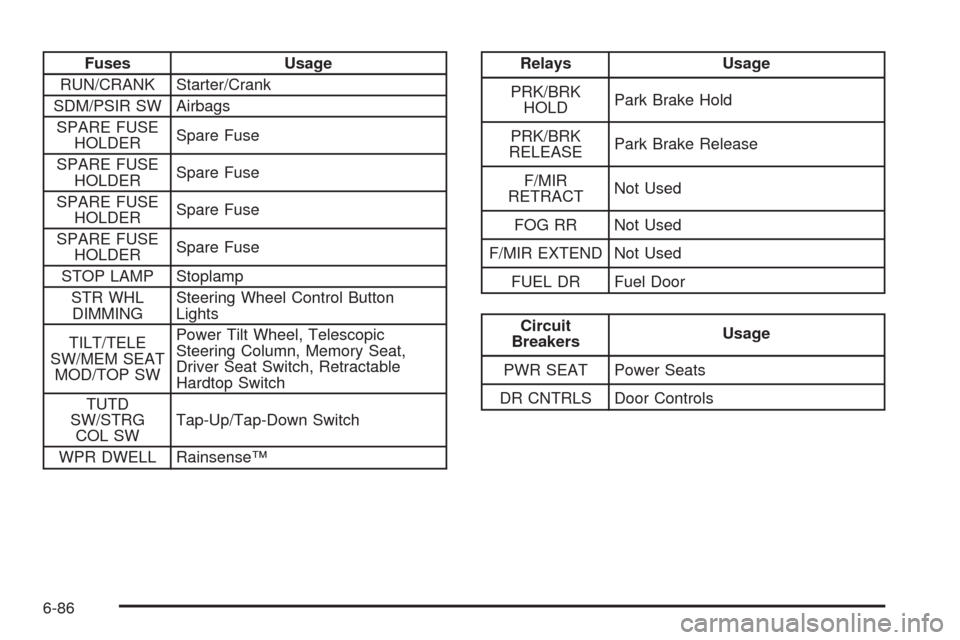
Fuses Usage
RUN/CRANK Starter/Crank
SDM/PSIR SW Airbags
SPARE FUSE
HOLDERSpare Fuse
SPARE FUSE
HOLDERSpare Fuse
SPARE FUSE
HOLDERSpare Fuse
SPARE FUSE
HOLDERSpare Fuse
STOP LAMP Stoplamp
STR WHL
DIMMINGSteering Wheel Control Button
Lights
TILT/TELE
SW/MEM SEAT
MOD/TOP SWPower Tilt Wheel, Telescopic
Steering Column, Memory Seat,
Driver Seat Switch, Retractable
Hardtop Switch
TUTD
SW/STRG
COL SWTap-Up/Tap-Down Switch
WPR DWELL Rainsense™Relays Usage
PRK/BRK
HOLDPark Brake Hold
PRK/BRK
RELEASEPark Brake Release
F/MIR
RETRACTNot Used
FOG RR Not Used
F/MIR EXTEND Not Used
FUEL DR Fuel Door
Circuit
BreakersUsage
PWR SEAT Power Seats
DR CNTRLS Door Controls
6-86
Page 407 of 462
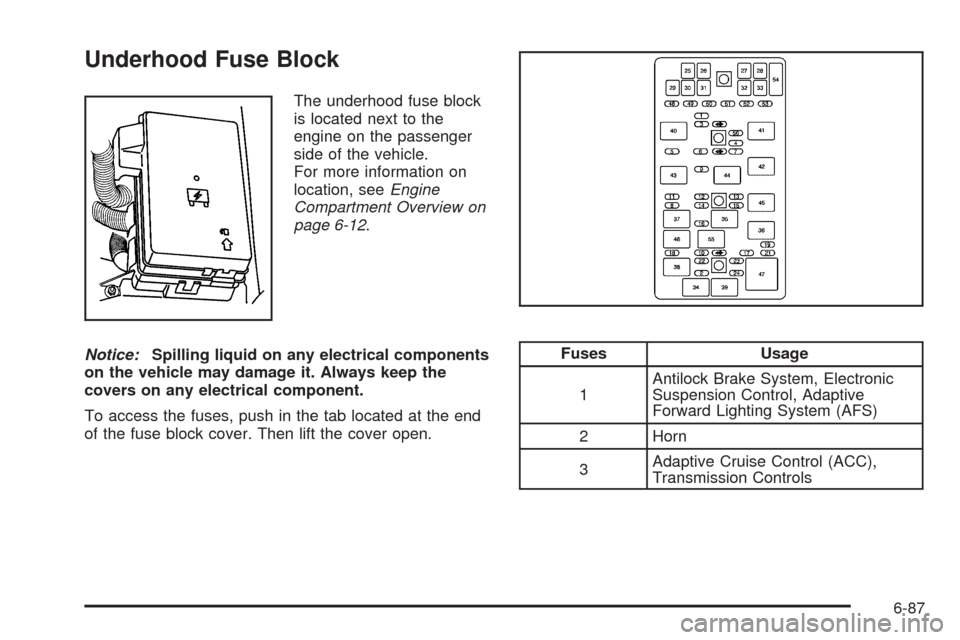
Underhood Fuse Block
The underhood fuse block
is located next to the
engine on the passenger
side of the vehicle.
For more information on
location, seeEngine
Compartment Overview on
page 6-12.
Notice:Spilling liquid on any electrical components
on the vehicle may damage it. Always keep the
covers on any electrical component.
To access the fuses, push in the tab located at the end
of the fuse block cover. Then lift the cover open.
Fuses Usage
1Antilock Brake System, Electronic
Suspension Control, Adaptive
Forward Lighting System (AFS)
2 Horn
3Adaptive Cruise Control (ACC),
Transmission Controls
6-87
Page 408 of 462
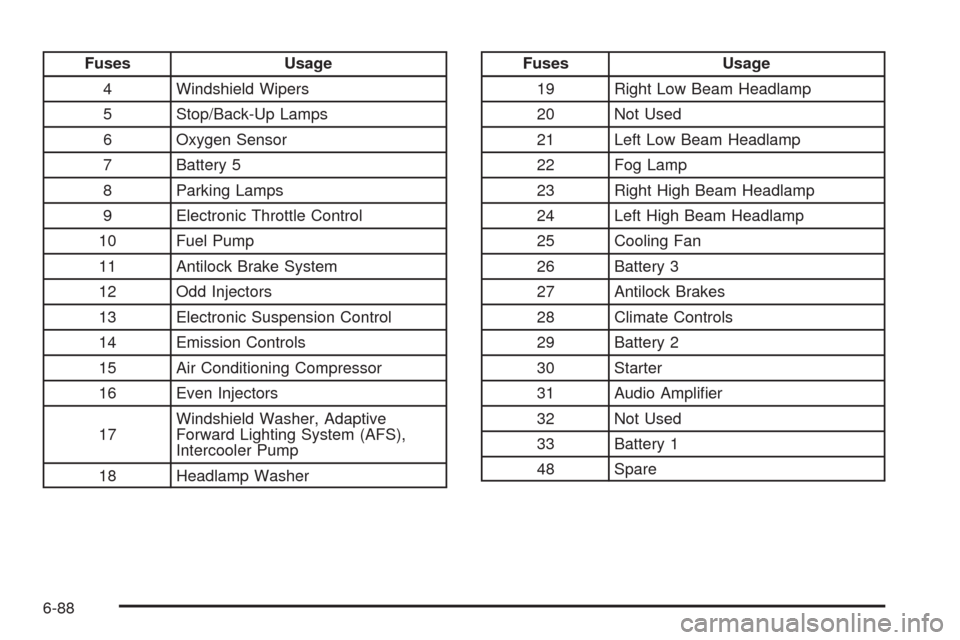
Fuses Usage
4 Windshield Wipers
5 Stop/Back-Up Lamps
6 Oxygen Sensor
7 Battery 5
8 Parking Lamps
9 Electronic Throttle Control
10 Fuel Pump
11 Antilock Brake System
12 Odd Injectors
13 Electronic Suspension Control
14 Emission Controls
15 Air Conditioning Compressor
16 Even Injectors
17Windshield Washer, Adaptive
Forward Lighting System (AFS),
Intercooler Pump
18 Headlamp WasherFuses Usage
19 Right Low Beam Headlamp
20 Not Used
21 Left Low Beam Headlamp
22 Fog Lamp
23 Right High Beam Headlamp
24 Left High Beam Headlamp
25 Cooling Fan
26 Battery 3
27 Antilock Brakes
28 Climate Controls
29 Battery 2
30 Starter
31 Audio Amplier
32 Not Used
33 Battery 1
48 Spare
6-88
Page 419 of 462
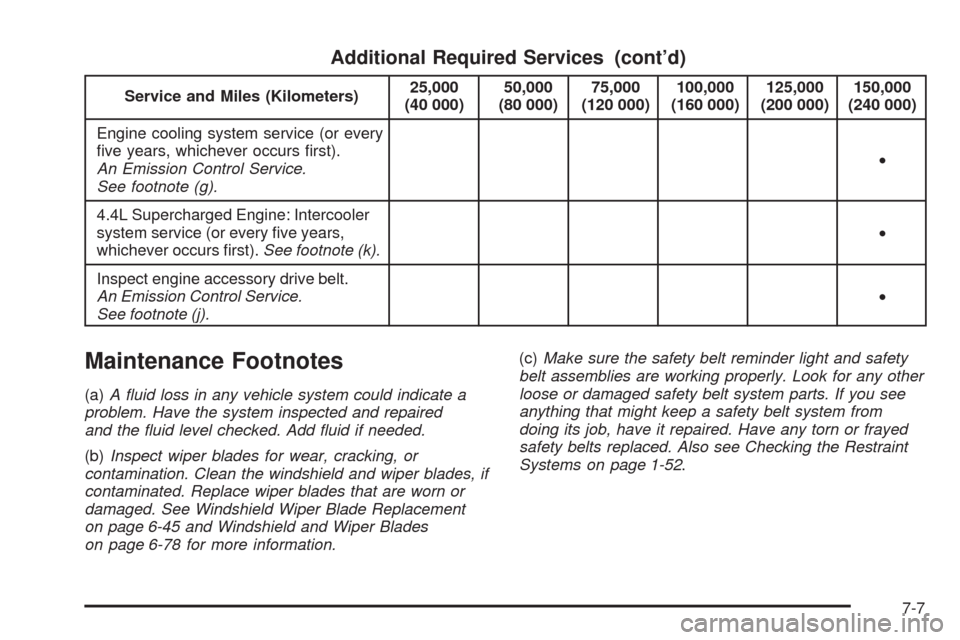
Additional Required Services (cont’d)
Service and Miles (Kilometers)25,000
(40 000)50,000
(80 000)75,000
(120 000)100,000
(160 000)125,000
(200 000)150,000
(240 000)
Engine cooling system service (or every
ve years, whichever occurs rst).
An Emission Control Service.
See footnote (g).•
4.4L Supercharged Engine: Intercooler
system service (or every ve years,
whichever occurs rst).See footnote (k).•
Inspect engine accessory drive belt.
An Emission Control Service.
See footnote (j).•
Maintenance Footnotes
(a)A fluid loss in any vehicle system could indicate a
problem. Have the system inspected and repaired
and the fluid level checked. Add fluid if needed.
(b)Inspect wiper blades for wear, cracking, or
contamination. Clean the windshield and wiper blades, if
contaminated. Replace wiper blades that are worn or
damaged. See Windshield Wiper Blade Replacement
on page 6-45 and Windshield and Wiper Blades
on page 6-78 for more information.(c)Make sure the safety belt reminder light and safety
belt assemblies are working properly. Look for any other
loose or damaged safety belt system parts. If you see
anything that might keep a safety belt system from
doing its job, have it repaired. Have any torn or frayed
safety belts replaced. Also see Checking the Restraint
Systems on page 1-52.
7-7
Page 449 of 462
A
Accessories and Modications............................ 6-3
Accessory Power Outlets.................................3-34
Adaptive Cruise Control...................................3-14
Adaptive Forward Lighting System.....................3-28
Adding Equipment to Your Airbag-Equipped
Vehicle.......................................................1-50
Additives, Fuel................................................. 6-6
Add-On Electrical Equipment............................6-82
Air Cleaner/Filter, Engine.................................6-20
Air Conditioning..............................................3-36
Airbag
Passenger Status Indicator...........................3-45
Readiness Light..........................................3-44
Airbag System................................................1-38
Adding Equipment to Your Airbag-Equipped
Vehicle...................................................1-50
How Does an Airbag Restrain?......................1-43
Passenger Sensing System...........................1-45
Servicing Your Airbag-Equipped Vehicle..........1-50
What Makes an Airbag Inate?......................1-43
What Will You See After an Airbag Inates?....1-44
When Should an Airbag Inate?....................1-42
Where Are the Airbags?...............................1-40
Antenna, Diversity Antenna System...................3-91Antenna, XM™ Satellite Radio Antenna
System......................................................3-91
Antilock Brake System (ABS)............................. 5-5
Antilock Brake, System Warning Light................3-48
Appearance Care
Aluminum or Chrome-Plated Wheels..............6-79
Care of Safety Belts....................................6-76
Chemical Paint Spotting...............................6-81
Cleaning Exterior Lamps/Lenses....................6-77
Fabric/Carpet..............................................6-75
Fiberglass Springs.......................................6-81
Finish Care.................................................6-78
Finish Damage............................................6-80
Instrument Panel, Vinyl, and Other Plastic
Surfaces.................................................
6-76
Interior Cleaning..........................................6-74
Leather......................................................6-75
Sheet Metal Damage...................................6-80
Speaker Covers..........................................6-76
Tires..........................................................6-80
Underbody Maintenance...............................6-80
Washing Your Vehicle...................................6-77
Weatherstrips..............................................6-77
Windshield and Wiper Blades........................6-78
Wood Panels..............................................6-76
Appointments, Scheduling Service.....................8-10
1