spark CHERY TIGGO 2009 Service User Guide
[x] Cancel search | Manufacturer: CHERY, Model Year: 2009, Model line: TIGGO, Model: CHERY TIGGO 2009Pages: 1903, PDF Size: 33.38 MB
Page 123 of 1903
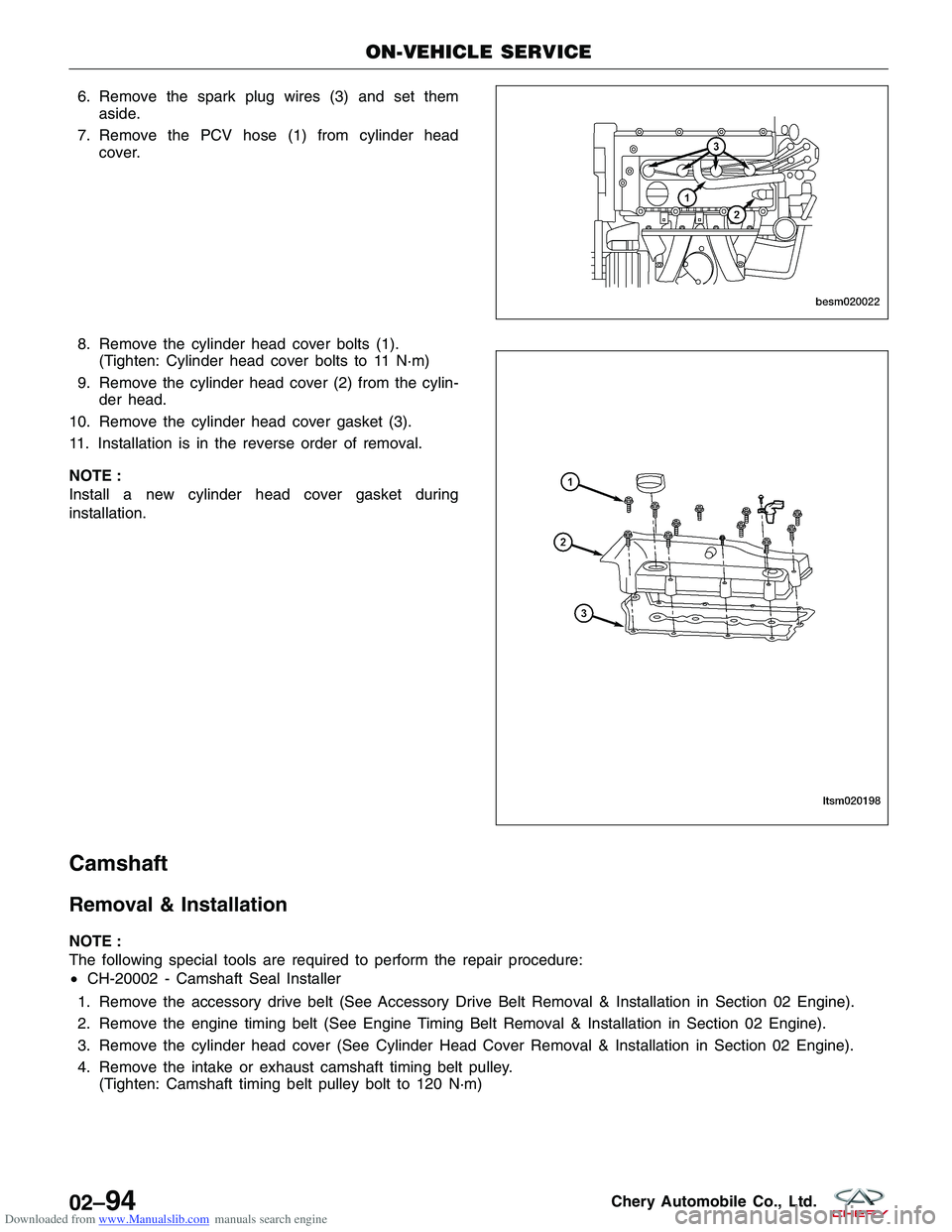
Downloaded from www.Manualslib.com manuals search engine 6. Remove the spark plug wires (3) and set themaside.
7. Remove the PCV hose (1) from cylinder head cover.
8. Remove the cylinder head cover bolts (1). (Tighten: Cylinder head cover bolts to 11 N·m)
9. Remove the cylinder head cover (2) from the cylin- der head.
10. Remove the cylinder head cover gasket (3).
11. Installation is in the reverse order of removal.
NOTE :
Install a new cylinder head cover gasket during
installation.
Camshaft
Removal & Installation
NOTE :
The following special tools are required to perform the repair procedure:
• CH-20002 - Camshaft Seal Installer
1. Remove the accessory drive belt (See Accessory Drive Belt Removal & Installation in Section 02 Engine).
2. Remove the engine timing belt (See Engine Timing Belt Removal & Installation in Section 02 Engine).
3. Remove the cylinder head cover (See Cylinder Head Cover Removal & Installation in Section 02 Engine).
4. Remove the intake or exhaust camshaft timing belt pulley. (Tighten: Camshaft timing belt pulley bolt to 120 N·m)
ON-VEHICLE SERVICE
BESM020022
LTSM020198
02–94Chery Automobile Co., Ltd.
Page 166 of 1903
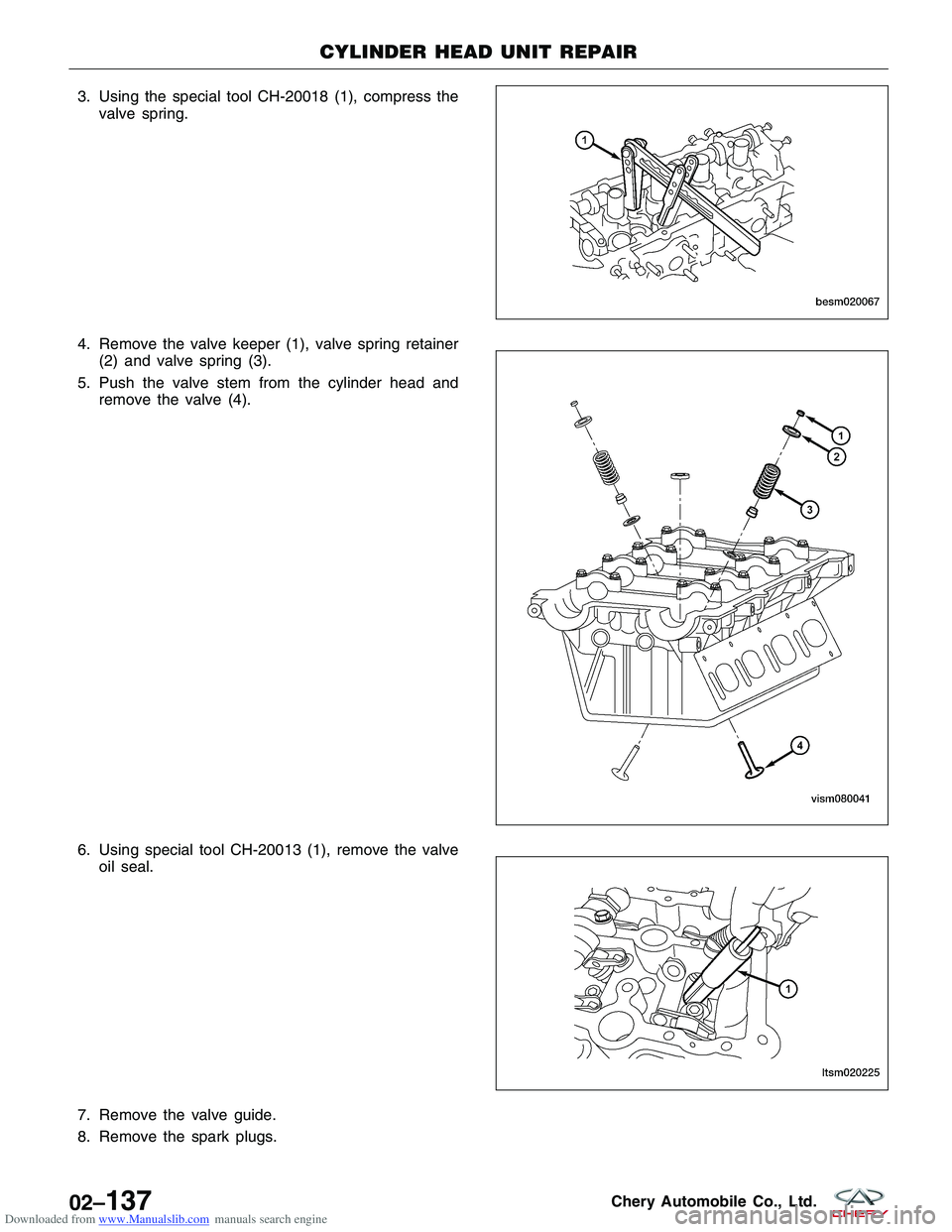
Downloaded from www.Manualslib.com manuals search engine 3. Using the special tool CH-20018 (1), compress thevalve spring.
4. Remove the valve keeper (1), valve spring retainer (2) and valve spring (3).
5. Push the valve stem from the cylinder head and remove the valve (4).
6. Using special tool CH-20013 (1), remove the valve oil seal.
7. Remove the valve guide.
8. Remove the spark plugs.
CYLINDER HEAD UNIT REPAIR
BESM020067
VISM080041
LTSM020225
02–137Chery Automobile Co., Ltd.
Page 182 of 1903
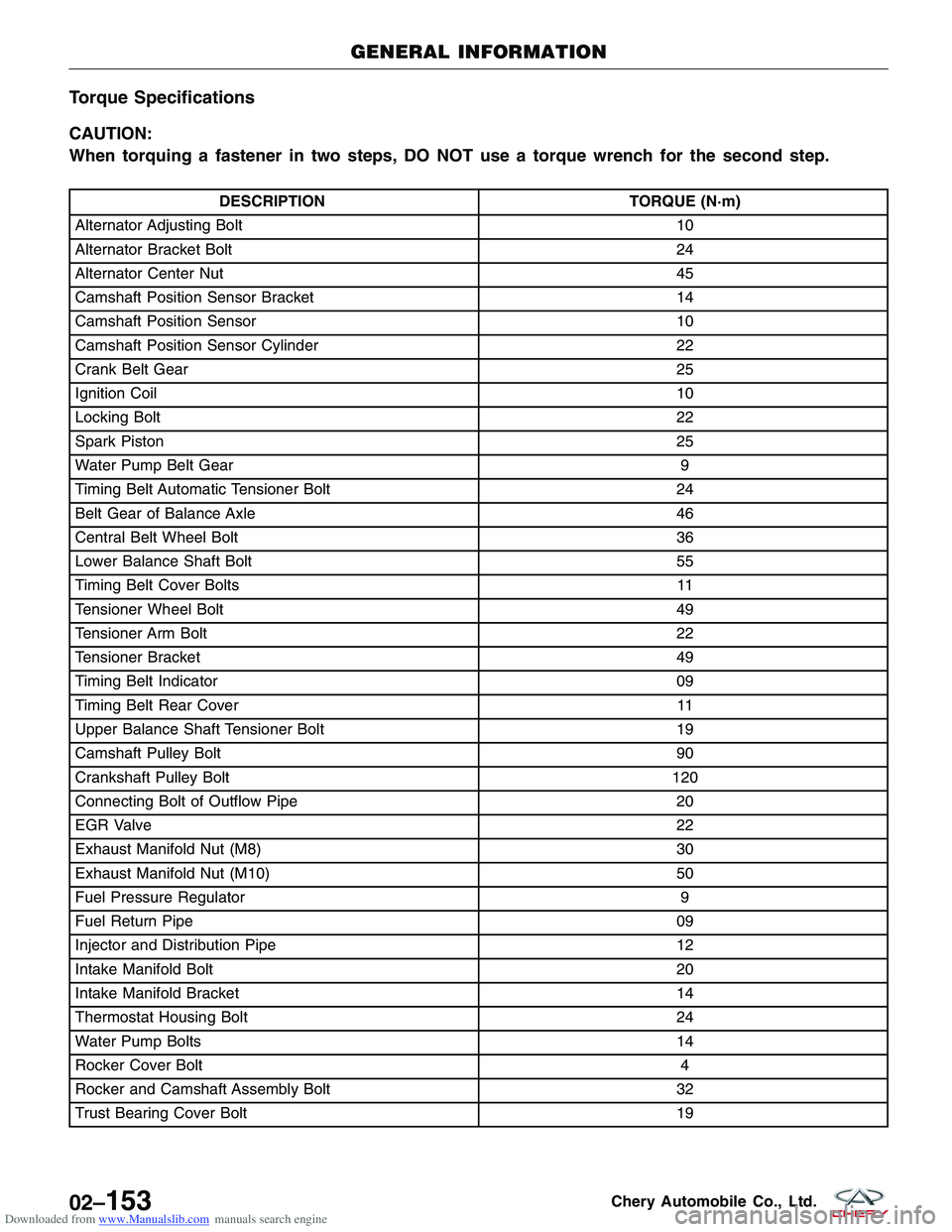
Downloaded from www.Manualslib.com manuals search engine Torque Specifications
CAUTION:
When torquing a fastener in two steps, DO NOT use a torque wrench for the second step.
DESCRIPTIONTORQUE (N·m)
Alternator Adjusting Bolt 10
Alternator Bracket Bolt 24
Alternator Center Nut 45
Camshaft Position Sensor Bracket 14
Camshaft Position Sensor 10
Camshaft Position Sensor Cylinder 22
Crank Belt Gear 25
Ignition Coil 10
Locking Bolt 22
Spark Piston 25
Water Pump Belt Gear 9
Timing Belt Automatic Tensioner Bolt 24
Belt Gear of Balance Axle 46
Central Belt Wheel Bolt 36
Lower Balance Shaft Bolt 55
Timing Belt Cover Bolts 11
Tensioner Wheel Bolt 49
Tensioner Arm Bolt 22
Tensioner Bracket 49
Timing Belt Indicator 09
Timing Belt Rear Cover 11
Upper Balance Shaft Tensioner Bolt 19
Camshaft Pulley Bolt 90
Crankshaft Pulley Bolt 120
Connecting Bolt of Outflow Pipe 20
EGR Valve 22
Exhaust Manifold Nut (M8) 30
Exhaust Manifold Nut (M10) 50
Fuel Pressure Regulator 9
Fuel Return Pipe 09
Injector and Distribution Pipe 12
Intake Manifold Bolt 20
Intake Manifold Bracket 14
Thermostat Housing Bolt 24
Water Pump Bolts 14
Rocker Cover Bolt 4
Rocker and Camshaft Assembly Bolt 32
Trust Bearing Cover Bolt 19
GENERAL INFORMATION
02–153Chery Automobile Co., Ltd.
Page 192 of 1903
Downloaded from www.Manualslib.com manuals search engine DIAGNOSIS & TESTING
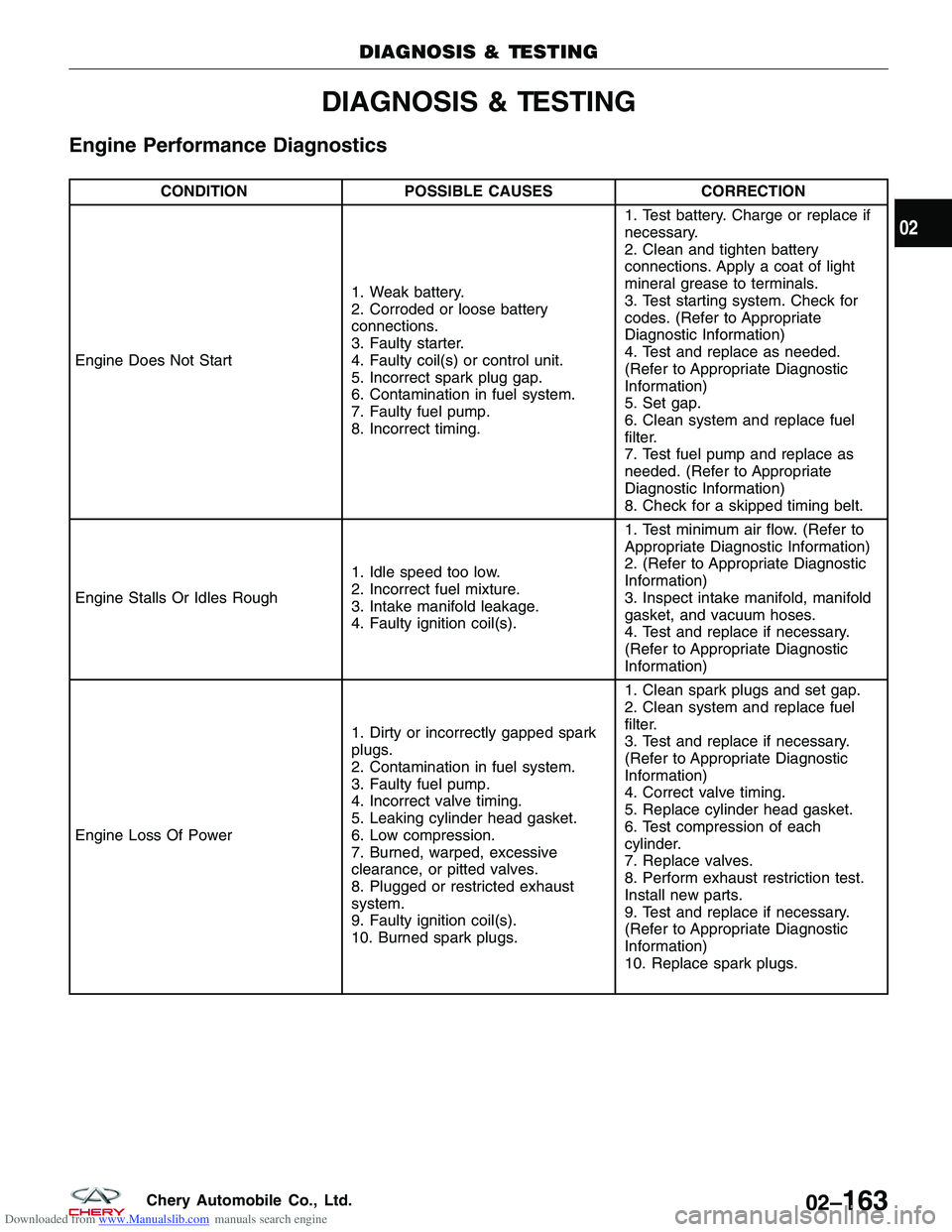
Engine Performance Diagnostics
CONDITIONPOSSIBLE CAUSES CORRECTION
Engine Does Not Start 1. Weak battery.
2. Corroded or loose battery
connections.
3. Faulty starter.
4. Faulty coil(s) or control unit.
5. Incorrect spark plug gap.
6. Contamination in fuel system.
7. Faulty fuel pump.
8. Incorrect timing.1. Test battery. Charge or replace if
necessary.
2. Clean and tighten battery
connections. Apply a coat of light
mineral grease to terminals.
3. Test starting system. Check for
codes. (Refer to Appropriate
Diagnostic Information)
4. Test and replace as needed.
(Refer to Appropriate Diagnostic
Information)
5. Set gap.
6. Clean system and replace fuel
filter.
7. Test fuel pump and replace as
needed. (Refer to Appropriate
Diagnostic Information)
8. Check for a skipped timing belt.
Engine Stalls Or Idles Rough 1. Idle speed too low.
2. Incorrect fuel mixture.
3. Intake manifold leakage.
4. Faulty ignition coil(s).1. Test minimum air flow. (Refer to
Appropriate Diagnostic Information)
2. (Refer to Appropriate Diagnostic
Information)
3. Inspect intake manifold, manifold
gasket, and vacuum hoses.
4. Test and replace if necessary.
(Refer to Appropriate Diagnostic
Information)
Engine Loss Of Power 1. Dirty or incorrectly gapped spark
plugs.
2. Contamination in fuel system.
3. Faulty fuel pump.
4. Incorrect valve timing.
5. Leaking cylinder head gasket.
6. Low compression.
7. Burned, warped, excessive
clearance, or pitted valves.
8. Plugged or restricted exhaust
system.
9. Faulty ignition coil(s).
10. Burned spark plugs.1. Clean spark plugs and set gap.
2. Clean system and replace fuel
filter.
3. Test and replace if necessary.
(Refer to Appropriate Diagnostic
Information)
4. Correct valve timing.
5. Replace cylinder head gasket.
6. Test compression of each
cylinder.
7. Replace valves.
8. Perform exhaust restriction test.
Install new parts.
9. Test and replace if necessary.
(Refer to Appropriate Diagnostic
Information)
10. Replace spark plugs.
DIAGNOSIS & TESTING
02
02–163Chery Automobile Co., Ltd.
Page 193 of 1903
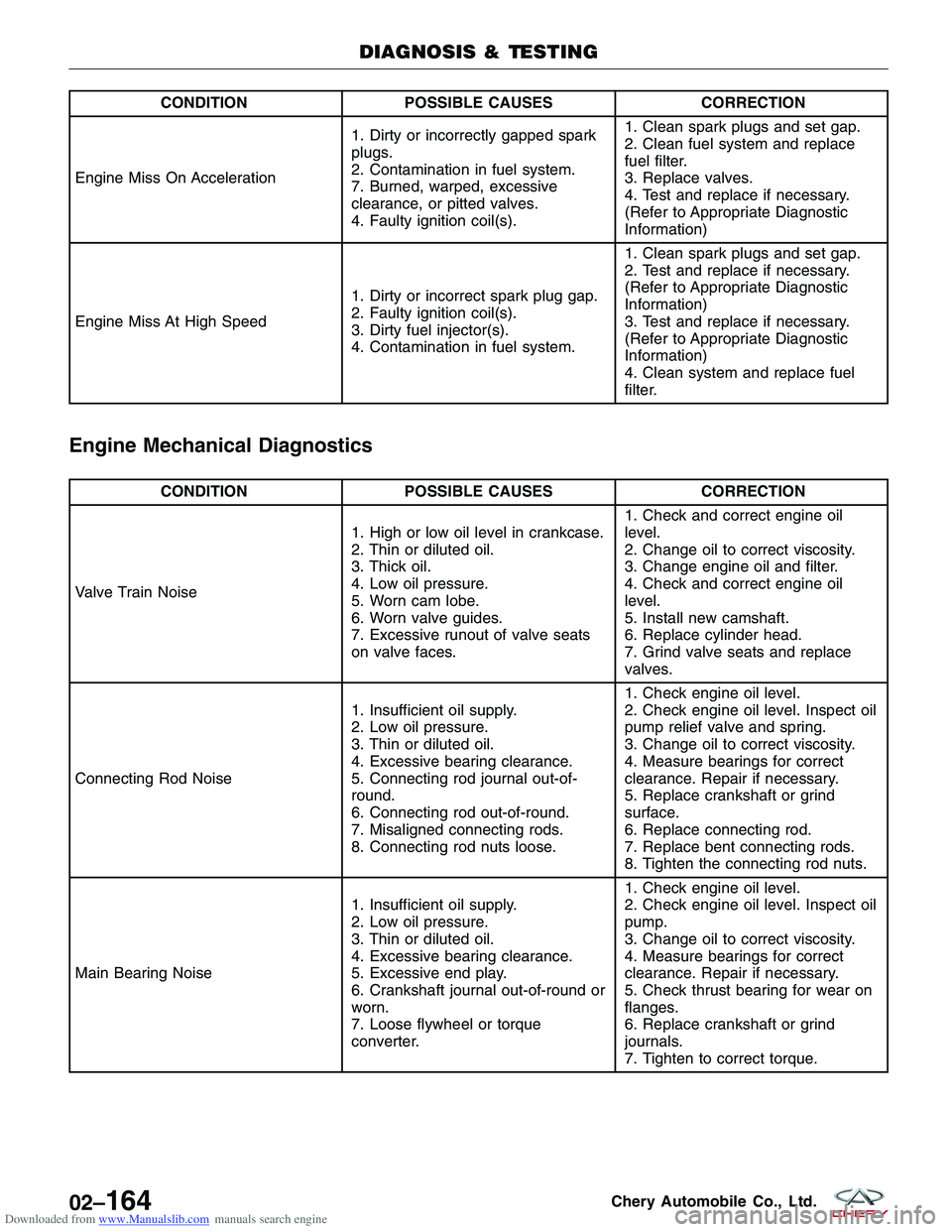
Downloaded from www.Manualslib.com manuals search engine CONDITIONPOSSIBLE CAUSES CORRECTION
Engine Miss On Acceleration 1. Dirty or incorrectly gapped spark
plugs.
2. Contamination in fuel system.
7. Burned, warped, excessive
clearance, or pitted valves.
4. Faulty ignition coil(s).1. Clean spark plugs and set gap.
2. Clean fuel system and replace
fuel filter.
3. Replace valves.
4. Test and replace if necessary.
(Refer to Appropriate Diagnostic
Information)
Engine Miss At High Speed 1. Dirty or incorrect spark plug gap.
2. Faulty ignition coil(s).
3. Dirty fuel injector(s).
4. Contamination in fuel system.1. Clean spark plugs and set gap.
2. Test and replace if necessary.
(Refer to Appropriate Diagnostic
Information)
3. Test and replace if necessary.
(Refer to Appropriate Diagnostic
Information)
4. Clean system and replace fuel
filter.
Engine Mechanical Diagnostics
CONDITION
POSSIBLE CAUSES CORRECTION
Valve Train Noise 1. High or low oil level in crankcase.
2. Thin or diluted oil.
3. Thick oil.
4. Low oil pressure.
5. Worn cam lobe.
6. Worn valve guides.
7. Excessive runout of valve seats
on valve faces.1. Check and correct engine oil
level.
2. Change oil to correct viscosity.
3. Change engine oil and filter.
4. Check and correct engine oil
level.
5. Install new camshaft.
6. Replace cylinder head.
7. Grind valve seats and replace
valves.
Connecting Rod Noise 1. Insufficient oil supply.
2. Low oil pressure.
3. Thin or diluted oil.
4. Excessive bearing clearance.
5. Connecting rod journal out-of-
round.
6. Connecting rod out-of-round.
7. Misaligned connecting rods.
8. Connecting rod nuts loose.1. Check engine oil level.
2. Check engine oil level. Inspect oil
pump relief valve and spring.
3. Change oil to correct viscosity.
4. Measure bearings for correct
clearance. Repair if necessary.
5. Replace crankshaft or grind
surface.
6. Replace connecting rod.
7. Replace bent connecting rods.
8. Tighten the connecting rod nuts.
Main Bearing Noise 1. Insufficient oil supply.
2. Low oil pressure.
3. Thin or diluted oil.
4. Excessive bearing clearance.
5. Excessive end play.
6. Crankshaft journal out-of-round or
worn.
7. Loose flywheel or torque
converter.1. Check engine oil level.
2. Check engine oil level. Inspect oil
pump.
3. Change oil to correct viscosity.
4. Measure bearings for correct
clearance. Repair if necessary.
5. Check thrust bearing for wear on
flanges.
6. Replace crankshaft or grind
journals.
7. Tighten to correct torque.
DIAGNOSIS & TESTING
02–164Chery Automobile Co., Ltd.
Page 194 of 1903
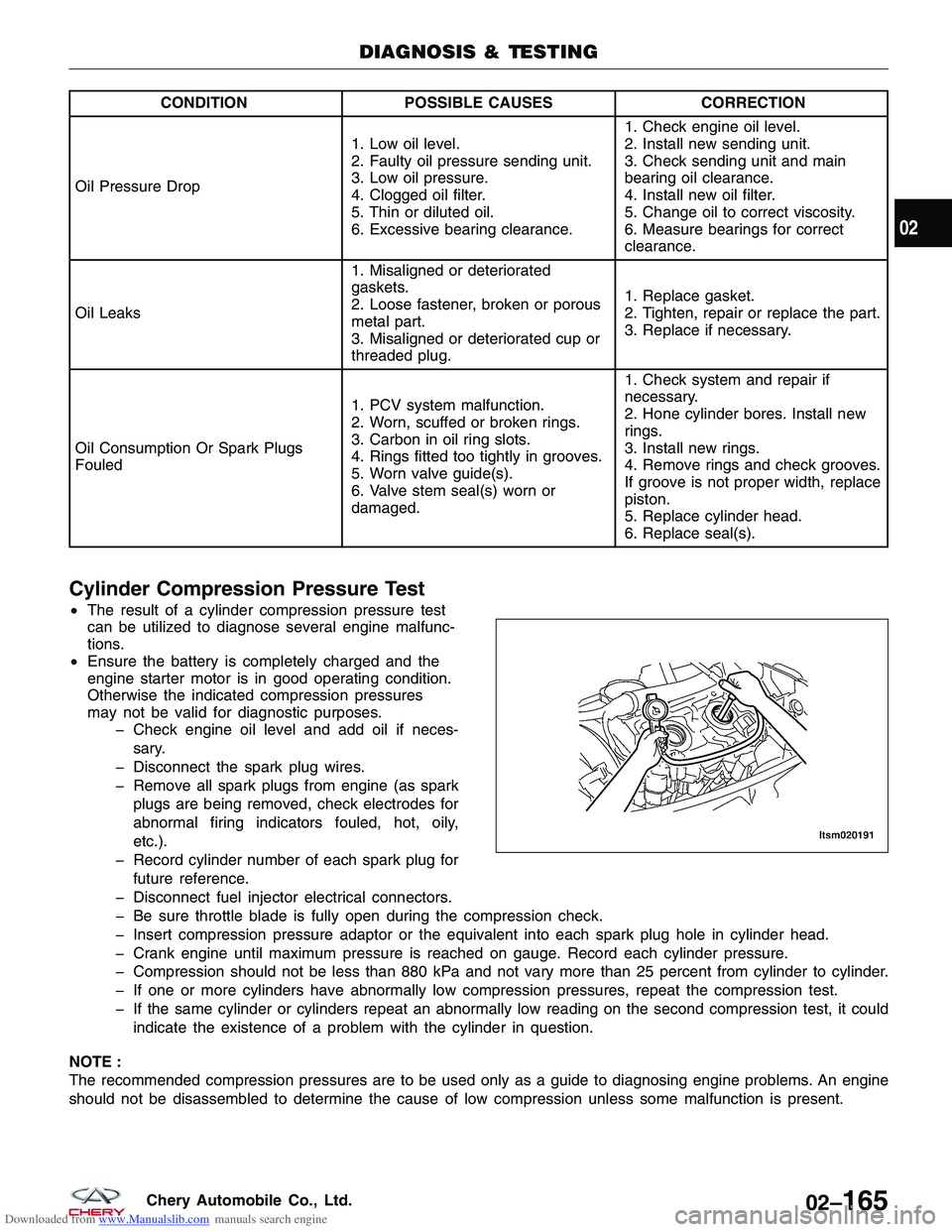
Downloaded from www.Manualslib.com manuals search engine CONDITIONPOSSIBLE CAUSES CORRECTION
Oil Pressure Drop 1. Low oil level.
2. Faulty oil pressure sending unit.
3. Low oil pressure.
4. Clogged oil filter.
5. Thin or diluted oil.
6. Excessive bearing clearance.1. Check engine oil level.
2. Install new sending unit.
3. Check sending unit and main
bearing oil clearance.
4. Install new oil filter.
5. Change oil to correct viscosity.
6. Measure bearings for correct
clearance.
Oil Leaks 1. Misaligned or deteriorated
gaskets.
2. Loose fastener, broken or porous
metal part.
3. Misaligned or deteriorated cup or
threaded plug.1. Replace gasket.
2. Tighten, repair or replace the part.
3. Replace if necessary.
Oil Consumption Or Spark Plugs
Fouled 1. PCV system malfunction.
2. Worn, scuffed or broken rings.
3. Carbon in oil ring slots.
4. Rings fitted too tightly in grooves.
5. Worn valve guide(s).
6. Valve stem seal(s) worn or
damaged.1. Check system and repair if
necessary.
2. Hone cylinder bores. Install new
rings.
3. Install new rings.
4. Remove rings and check grooves.
If groove is not proper width, replace
piston.
5. Replace cylinder head.
6. Replace seal(s).
Cylinder Compression Pressure Test
•
The result of a cylinder compression pressure test
can be utilized to diagnose several engine malfunc-
tions.
• Ensure the battery is completely charged and the
engine starter motor is in good operating condition.
Otherwise the indicated compression pressures
may not be valid for diagnostic purposes.
Check engine oil level and add oil if neces-
sary.
Disconnect the spark plug wires.
Remove all spark plugs from engine (as spark plugs are being removed, check electrodes for
abnormal firing indicators fouled, hot, oily,
etc.).
Record cylinder number of each spark plug for future reference.
Disconnect fuel injector electrical connectors.
Be sure throttle blade is fully open during the compression check.
Insert compression pressure adaptor or the equivalent into each spark plug hole in cylinder head.
Crank engine until maximum pressure is reached on gauge. Record each cylinder pressure.
Compression should not be less than 880 kPa and not vary more than 25 percent from cylinder to cylinder.
If one or more cylinders have abnormally low compression pressures, repeat the compression test.
If the same cylinder or cylinders repeat an abnormally low reading on the second compression test, it could indicate the existence of a problem with the cylinder in question.
NOTE :
The recommended compression pressures are to be used only as a guide to diagnosing engine problems. An engine
should not be disassembled to determine the cause of low compression unless some malfunction is present.
DIAGNOSIS & TESTING
LTSM020191
02
02–165Chery Automobile Co., Ltd.
Page 199 of 1903
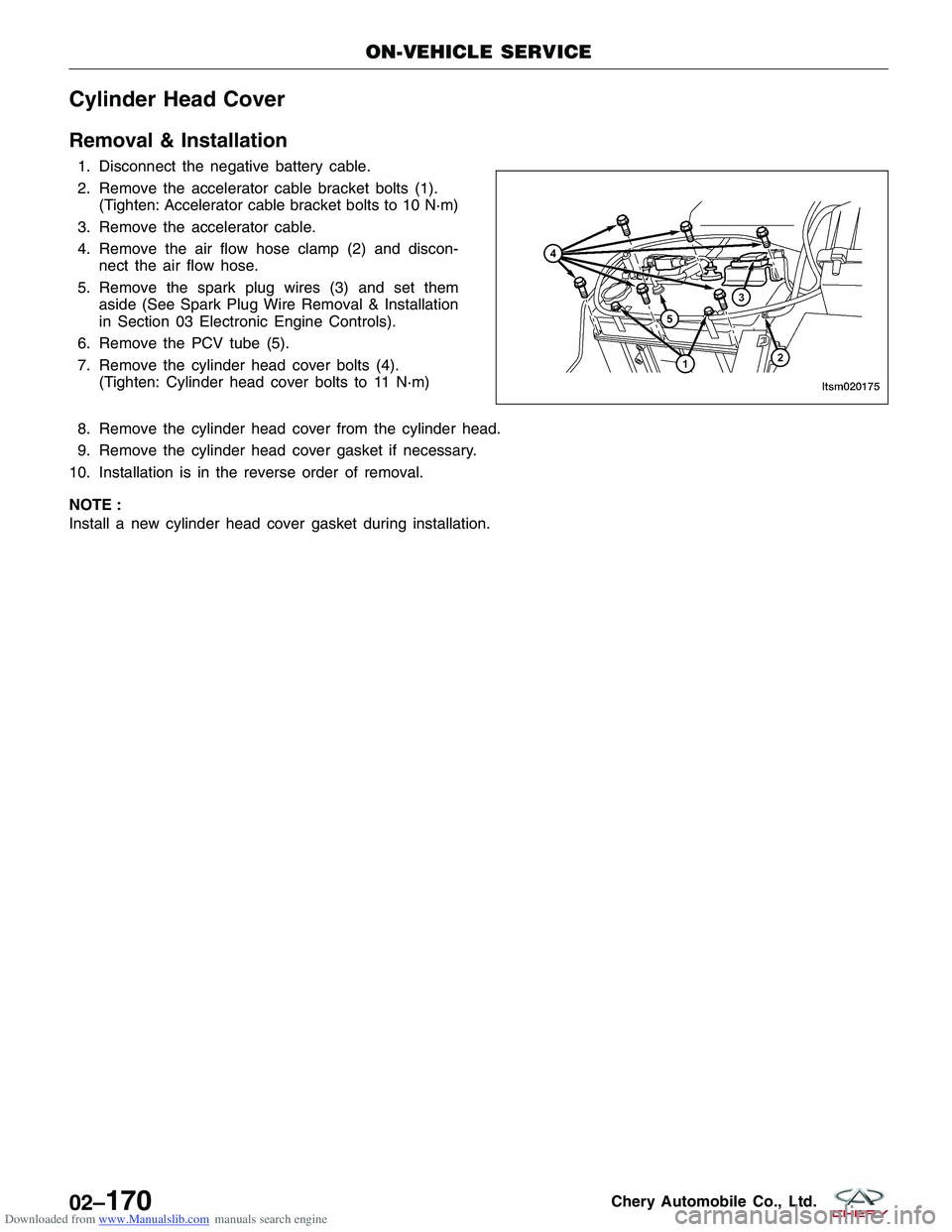
Downloaded from www.Manualslib.com manuals search engine Cylinder Head Cover
Removal & Installation
1. Disconnect the negative battery cable.
2. Remove the accelerator cable bracket bolts (1).(Tighten: Accelerator cable bracket bolts to 10 N·m)
3. Remove the accelerator cable.
4. Remove the air flow hose clamp (2) and discon- nect the air flow hose.
5. Remove the spark plug wires (3) and set them aside (See Spark Plug Wire Removal & Installation
in Section 03 Electronic Engine Controls).
6. Remove the PCV tube (5).
7. Remove the cylinder head cover bolts (4). (Tighten: Cylinder head cover bolts to 11 N·m)
8. Remove the cylinder head cover from the cylinder head.
9. Remove the cylinder head cover gasket if necessary.
10. Installation is in the reverse order of removal.
NOTE :
Install a new cylinder head cover gasket during installation.
ON-VEHICLE SERVICE
LTSM020175
02–170Chery Automobile Co., Ltd.
Page 271 of 1903
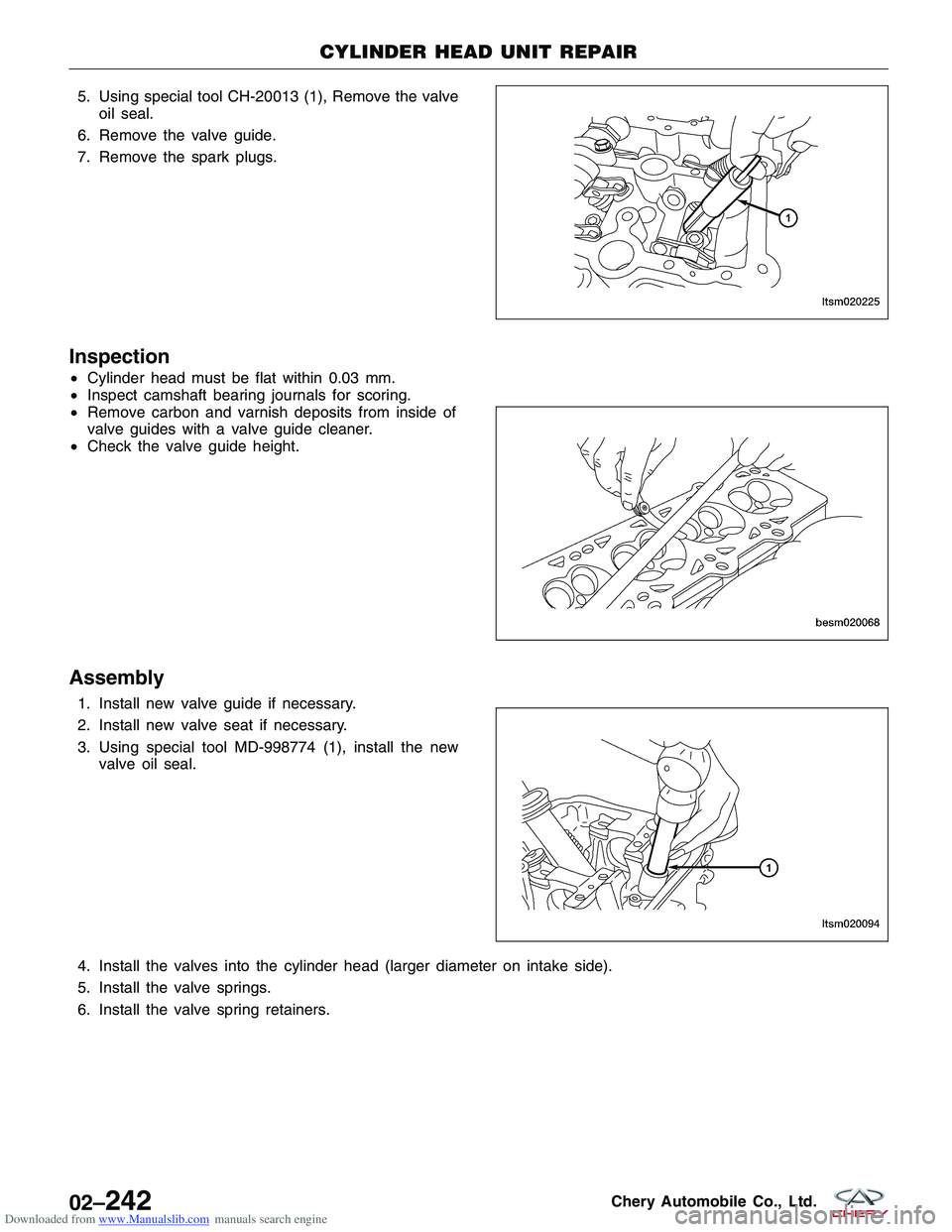
Downloaded from www.Manualslib.com manuals search engine 5. Using special tool CH-20013 (1), Remove the valveoil seal.
6. Remove the valve guide.
7. Remove the spark plugs.
Inspection
• Cylinder head must be flat within 0.03 mm.
• Inspect camshaft bearing journals for scoring.
• Remove carbon and varnish deposits from inside of
valve guides with a valve guide cleaner.
• Check the valve guide height.
Assembly
1. Install new valve guide if necessary.
2. Install new valve seat if necessary.
3. Using special tool MD-998774 (1), install the new
valve oil seal.
4. Install the valves into the cylinder head (larger diameter on intake side).
5. Install the valve springs.
6. Install the valve spring retainers.
CYLINDER HEAD UNIT REPAIR
LTSM020225
BESM020068 LTSM020094
02–242Chery Automobile Co., Ltd.
Page 288 of 1903
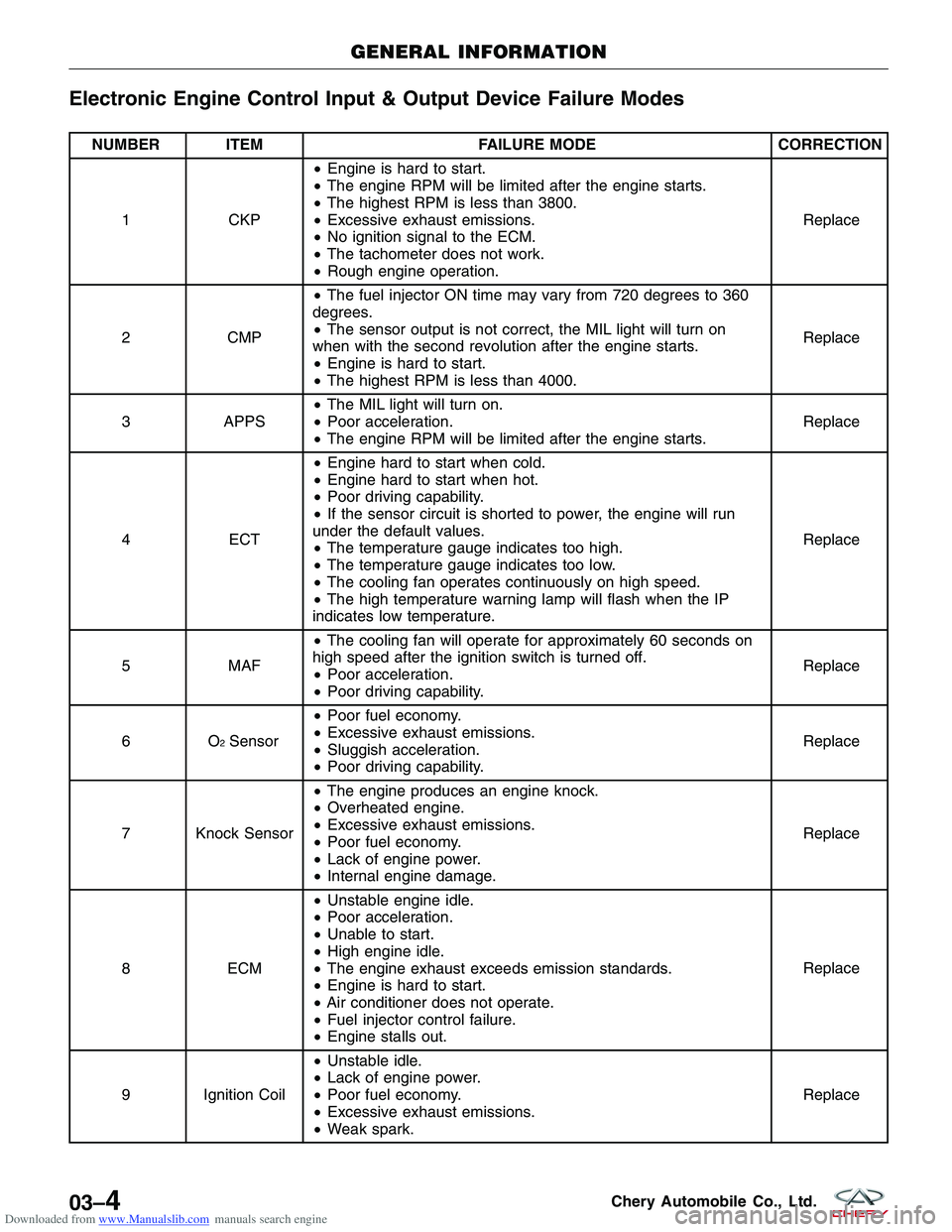
Downloaded from www.Manualslib.com manuals search engine Electronic Engine Control Input & Output Device Failure Modes
NUMBER ITEMFAILURE MODECORRECTION
1 CKP•
Engine is hard to start.
• The engine RPM will be limited after the engine starts.
• The highest RPM is less than 3800.
• Excessive exhaust emissions.
• No ignition signal to the ECM.
• The tachometer does not work.
• Rough engine operation. Replace
2 CMP•
The fuel injector ON time may vary from 720 degrees to 360
degrees.
• The sensor output is not correct, the MIL light will turn on
when with the second revolution after the engine starts.
• Engine is hard to start.
• The highest RPM is less than 4000. Replace
3 APPS•
The MIL light will turn on.
• Poor acceleration.
• The engine RPM will be limited after the engine starts. Replace
4 ECT•
Engine hard to start when cold.
• Engine hard to start when hot.
• Poor driving capability.
• If the sensor circuit is shorted to power, the engine will run
under the default values.
• The temperature gauge indicates too high.
• The temperature gauge indicates too low.
• The cooling fan operates continuously on high speed.
• The high temperature warning lamp will flash when the IP
indicates low temperature. Replace
5 MAF•
The cooling fan will operate for approximately 60 seconds on
high speed after the ignition switch is turned off.
• Poor acceleration.
• Poor driving capability. Replace
6 O2 Sensor •
Poor fuel economy.
• Excessive exhaust emissions.
• Sluggish acceleration.
• Poor driving capability. Replace
7 Knock Sensor •
The engine produces an engine knock.
• Overheated engine.
• Excessive exhaust emissions.
• Poor fuel economy.
• Lack of engine power.
• Internal engine damage. Replace
8 ECM•
Unstable engine idle.
• Poor acceleration.
• Unable to start.
• High engine idle.
• The engine exhaust exceeds emission standards.
• Engine is hard to start.
• Air conditioner does not operate.
• Fuel injector control failure.
• Engine stalls out. Replace
9 Ignition Coil •
Unstable idle.
• Lack of engine power.
• Poor fuel economy
.
• Excessive exhaust emissions.
• Weak spark. Replace
GENERAL INFORMATION
03–4Chery Automobile Co., Ltd.
Page 514 of 1903
Downloaded from www.Manualslib.com manuals search engine Electronic Engine Control Input & Output Device Failure Modes
NUMBER ITEMFAILURE MODECORRECTION
1 CKP•
Engine is hard to start.
• The engine RPM will be limited after the engine starts.
• The highest RPM is less than 3800.
• Excessive exhaust emissions.
• No ignition signal to the ECM.
• The tachometer does not work.
• Rough engine operation. Replace
2 CMP•
The fuel injector ON time may vary from 720 degrees to 360
degrees.
• The sensor output is not correct, the MIL light will turn on
when with the second revolution after the engine starts.
• Engine is hard to start.
• The highest RPM is less than 4000. Replace
3 APPS•
The MIL light will turn on.
• Poor acceleration.
• The engine RPM will be limited after the engine starts. Replace
4 ECT•
Engine hard to start when cold.
• Engine hard to start when hot.
• Poor driving capability.
• If the sensor circuit is shorted to power, the engine will run
under the default values.
• The temperature gauge indicates too high.
• The temperature gauge indicates too low.
• The cooling fan operates continuously on high speed.
• The high temperature warning lamp will flash when the IP
indicates low temperature. Replace
5 MAF•
The cooling fan will operate for approximately 60 seconds on
high speed after the ignition switch is turned off.
• Poor acceleration.
• Poor driving capability. Replace
6O
2Senser •
Poor fuel economy.
• Excessive exhaust emissions.
• Sluggish acceleration.
• Poor driving capability. Replace
7 Knock Sensor •
The engine produces an engine knock.
• Overheated engine.
• Excessive exhaust emissions.
• Poor fuel economy.
• Lack of engine power.
• Internal engine damage. Replace
8 ECM•
Unstable engine idle.
• Poor acceleration.
• Unable to start.
• High engine idle.
• The engine exhaust exceeds emission standards.
• Engine is hard to start.
• Air conditioner does not operate.
• Fuel injector control failure.
• Engine stalls out. Replace
9 Ignition Coil •
Unstable idle.
• Lack of engine power.
• Poor fuel economy.
• Excessive exhaust emissions.
• Weak spark. Replace
GENERAL INFORMATION
03–230Chery Automobile Co., Ltd.