ABS CHERY TIGGO 2009 Service Owner's Guide
[x] Cancel search | Manufacturer: CHERY, Model Year: 2009, Model line: TIGGO, Model: CHERY TIGGO 2009Pages: 1903, PDF Size: 33.38 MB
Page 1292 of 1903
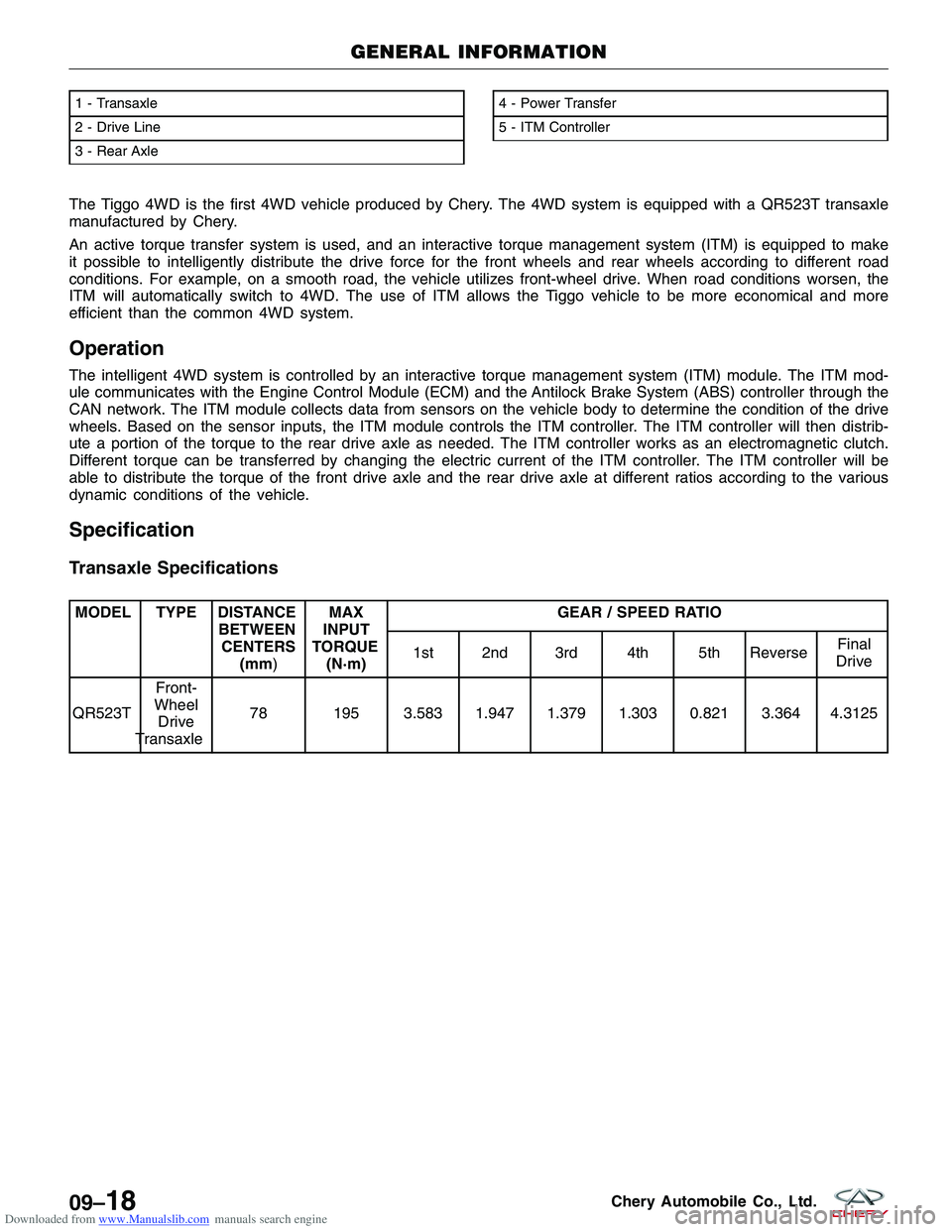
Downloaded from www.Manualslib.com manuals search engine The Tiggo 4WD is the first 4WD vehicle produced by Chery. The 4WD system is equipped with a QR523T transaxle
manufactured by Chery.
An active torque transfer system is used, and an interactive torque management system (ITM) is equipped to make
it possible to intelligently distribute the drive force for the front wheels and rear wheels according to different road
conditions. For example, on a smooth road, the vehicle utilizes front-wheel drive. When road conditions worsen, the
ITM will automatically switch to 4WD. The use of ITM allows the Tiggo vehicle to be more economical and more
efficient than the common 4WD system.
Operation
The intelligent 4WD system is controlled by an interactive torque management system (ITM) module. The ITM mod-
ule communicates with the Engine Control Module (ECM) and the Antilock Brake System (ABS) controller through the
CAN network. The ITM module collects data from sensors on the vehicle body to determine the condition of the drive
wheels. Based on the sensor inputs, the ITM module controls the ITM controller. The ITM controller will then distrib-
ute a portion of the torque to the rear drive axle as needed. The ITM controller works as an electromagnetic clutch.
Different torque can be transferred by changing the electric current of the ITM controller. The ITM controller will be
able to distribute the torque of the front drive axle and the rear drive axle at different ratios according to the various
dynamic conditions of the vehicle.
Specification
Transaxle Specifications
MODEL TYPE DISTANCEBETWEENCENTERS (mm) MAX
INPUT
TORQUE (N·m) GEAR / SPEED RATIO
1st 2nd 3rd 4th 5th Reverse Final
Drive
QR523T Front-
Wheel Drive
Transaxle 78 195 3.583 1.947 1.379 1.303 0.821 3.364 4.3125
1 - Transaxle
2 - Drive Line
3 - Rear Axle4 - Power Transfer
5 - ITM Controller
GENERAL INFORMATION
LTSM160027
09–18Chery Automobile Co., Ltd.
Page 1297 of 1903
Downloaded from www.Manualslib.com manuals search engine Interactive Torque Management (ITM) Control Module
Description
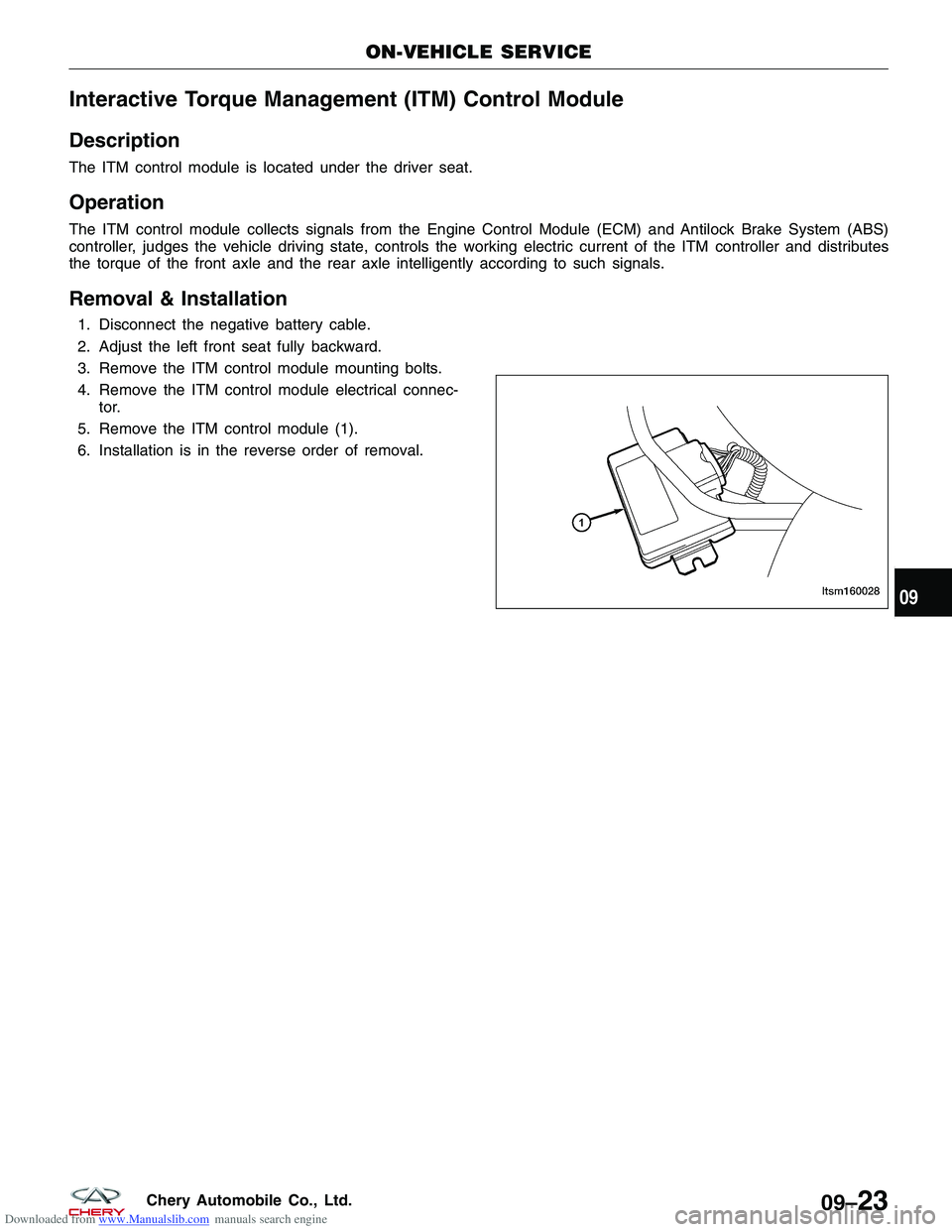
The ITM control module is located under the driver seat.
Operation
The ITM control module collects signals from the Engine Control Module (ECM) and Antilock Brake System (ABS)
controller, judges the vehicle driving state, controls the working electric current of the ITM controller and distributes
the torque of the front axle and the rear axle intelligently according to such signals.
Removal & Installation
1. Disconnect the negative battery cable.
2. Adjust the left front seat fully backward.
3. Remove the ITM control module mounting bolts.
4. Remove the ITM control module electrical connec-tor.
5. Remove the ITM control module (1).
6. Installation is in the reverse order of removal.
ON-VEHICLE SERVICE
LTSM16002809
09–23Chery Automobile Co., Ltd.
Page 1303 of 1903
Downloaded from www.Manualslib.com manuals search engine GENERAL INFORMATION
Description
The front suspension system incorporates a strut assembly that takes the place of the upper control arm and upper
ball joint. The strut carries out the function of a shock absorber and is encompassed by a coil spring. The strut
assembly supports the weight of the vehicle and is also the pivot point for the steering knuckle. This system uses a
lower control arm and ball joint for the lower pivot point of the steering knuckle.
10–2Chery Automobile Co., Ltd.
Page 1305 of 1903
Downloaded from www.Manualslib.com manuals search engine WARNING!
Do not remove the strut rod nut while the strut assembly is installed in the vehicle, or before the coil spring is
compressed with a spring compressor. The spring is held under high pressure and must be compressed before
the strut rod nut can be removed.
CAUTION:
At no time when servicing a vehicle can a sheet metal screw, bolt, or other metal fastener be
installed in the shock tower to replace the original plastic clamp. It may come in contact with the
strut or coil spring.
CAUTION:
The wheel bearing will be damaged if the vehicle is rolled with the axle shaft hub nut loose.
Operation
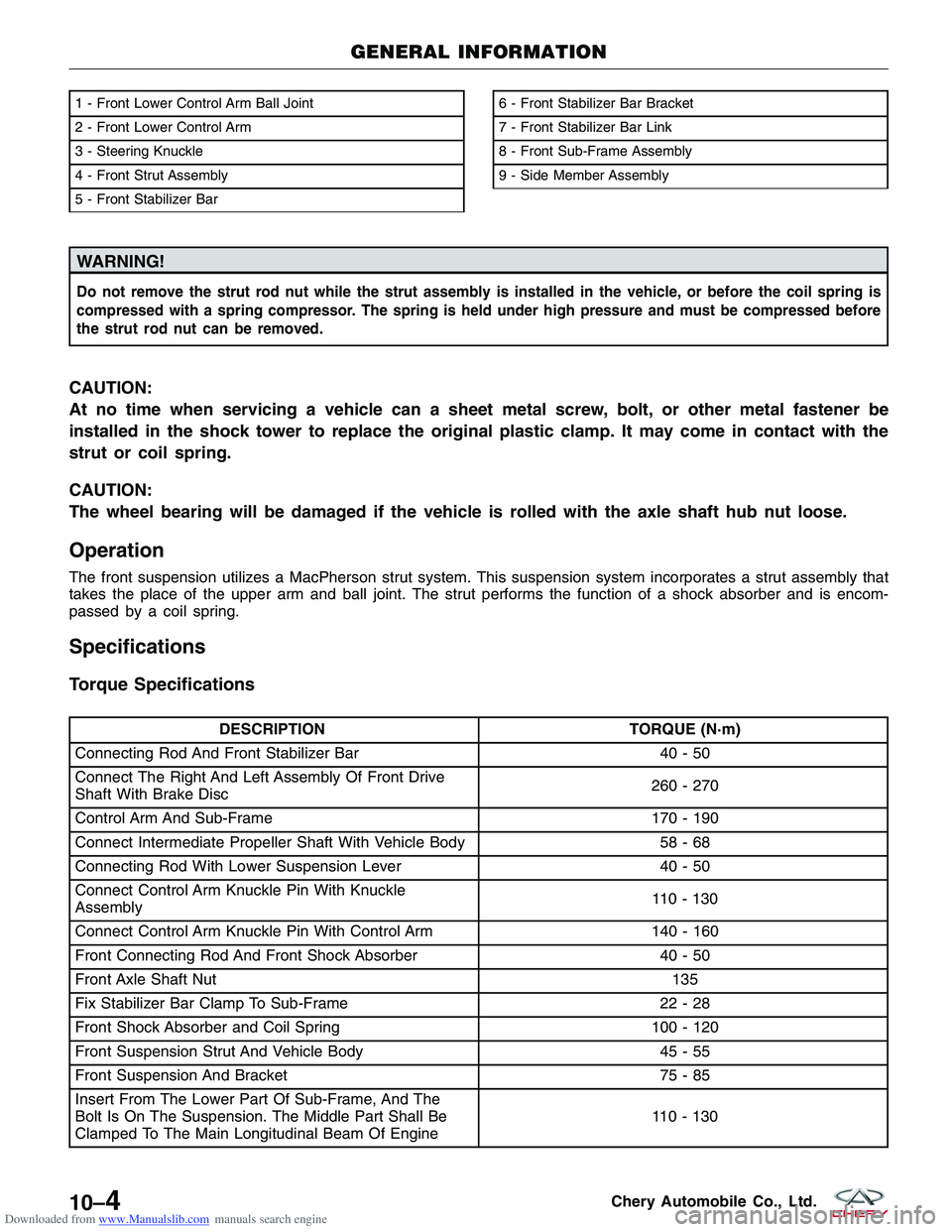
The front suspension utilizes a MacPherson strut system. This suspension system incorporates a strut assembly that
takes the place of the upper arm and ball joint. The strut performs the function of a shock absorber and is encom-
passed by a coil spring.
Specifications
Torque Specifications
DESCRIPTIONTORQUE (N·m)
Connecting Rod And Front Stabilizer Bar 40 - 50
Connect The Right And Left Assembly Of Front Drive
Shaft With Brake Disc 260 - 270
Control Arm And Sub-Frame 170 - 190
Connect Intermediate Propeller Shaft With Vehicle Body 58 - 68
Connecting Rod With Lower Suspension Lever 40 - 50
Connect Control Arm Knuckle Pin With Knuckle
Assembly 110 - 130
Connect Control Arm Knuckle Pin With Control Arm 140 - 160
Front Connecting Rod And Front Shock Absorber 40 - 50
Front Axle Shaft Nut 135
Fix Stabilizer Bar Clamp To Sub-Frame 22 - 28
Front Shock Absorber and Coil Spring 100 - 120
Front Suspension Strut And Vehicle Body 45 - 55
Front Suspension And Bracket 75 - 85
Insert From The Lower Part Of Sub-Frame, And The
Bolt Is On The Suspension. The Middle Part Shall Be
Clamped To The Main Longitudinal Beam Of Engine 110 - 130
1 - Front Lower Control Arm Ball Joint
2 - Front Lower Control Arm
3 - Steering Knuckle
4 - Front Strut Assembly
5 - Front Stabilizer Bar6 - Front Stabilizer Bar Bracket
7 - Front Stabilizer Bar Link
8 - Front Sub-Frame Assembly
9 - Side Member Assembly
GENERAL INFORMATION
LTSM100008
10–4Chery Automobile Co., Ltd.
Page 1314 of 1903
Downloaded from www.Manualslib.com manuals search engine Front Strut Assembly
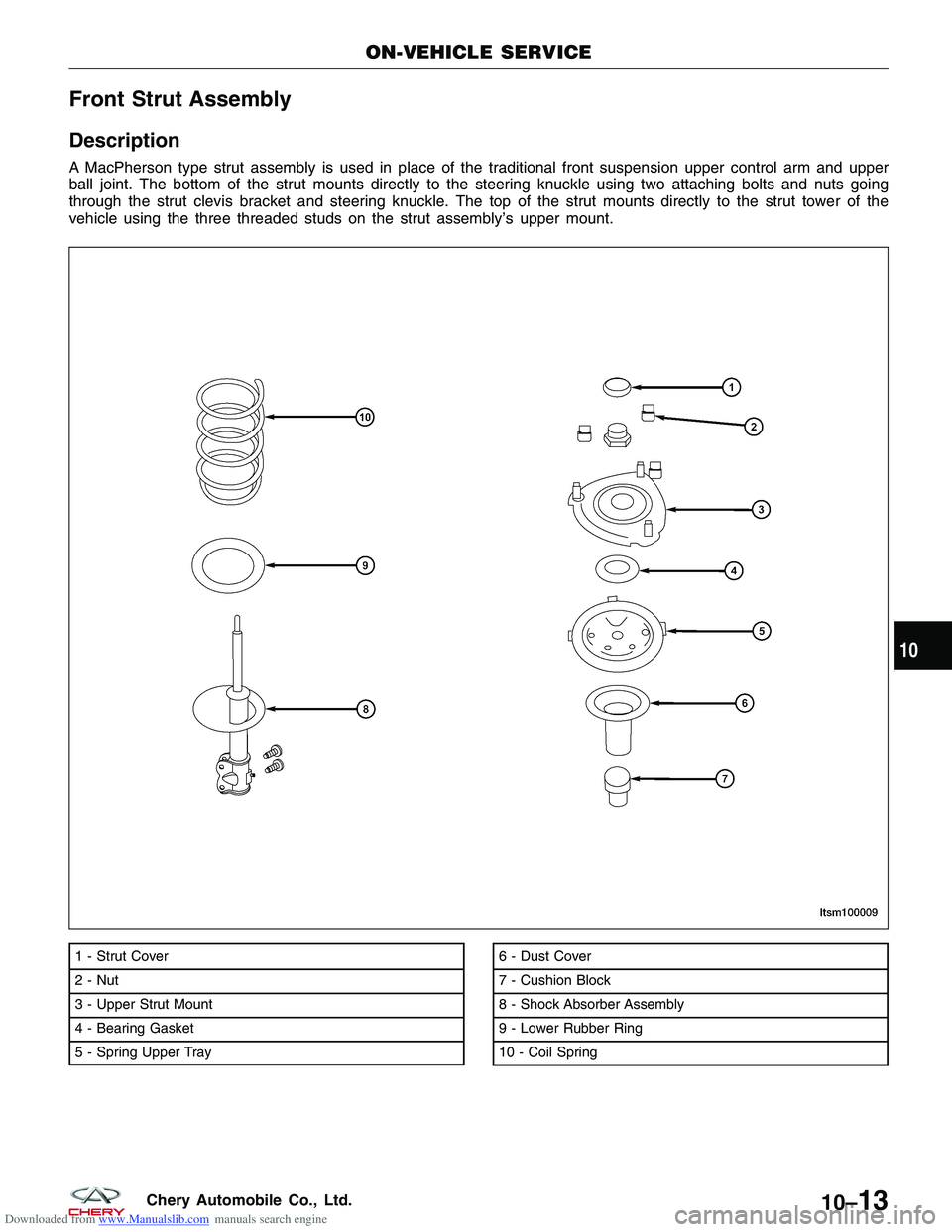
Description
A MacPherson type strut assembly is used in place of the traditional front suspension upper control arm and upper
ball joint. The bottom of the strut mounts directly to the steering knuckle using two attaching bolts and nuts going
through the strut clevis bracket and steering knuckle. The top of the strut mounts directly to the strut tower of the
vehicle using the three threaded studs on the strut assembly’s upper mount.
1 - Strut Cover
2 - Nut
3 - Upper Strut Mount
4 - Bearing Gasket
5 - Spring Upper Tray6 - Dust Cover
7 - Cushion Block
8 - Shock Absorber Assembly
9 - Lower Rubber Ring
10 - Coil Spring
ON-VEHICLE SERVICE
LTSM100009
10
10–13Chery Automobile Co., Ltd.
Page 1315 of 1903
Downloaded from www.Manualslib.com manuals search engine Operation
The strut assembly cushions the ride of the vehicle, controlling vibration, jounce and rebound of the suspension. The
coil spring controls ride quality and maintains proper ride height. The spring isolators isolate the coil spring at the top
and bottom from coming into metal-to-metal contact with the upper mounting seat and the strut. The strut dampens
jounce and rebound motions of the coil spring and suspension.
Diagnosis & Testing
Before removing the front strut, perform the following to test the front strut functionality:
•Adjust the tire pressure to all tires to proper specifications.
• Push and shake the front of the vehicle three or four times with identical force every time
• During the pushing and recoiling, the resistance and recoil times of the vehicle should be equal.
• If the strut (shock absorber) functions properly, the vehicle will recoil several times and then stop recoiling after
the pushing force is removed.
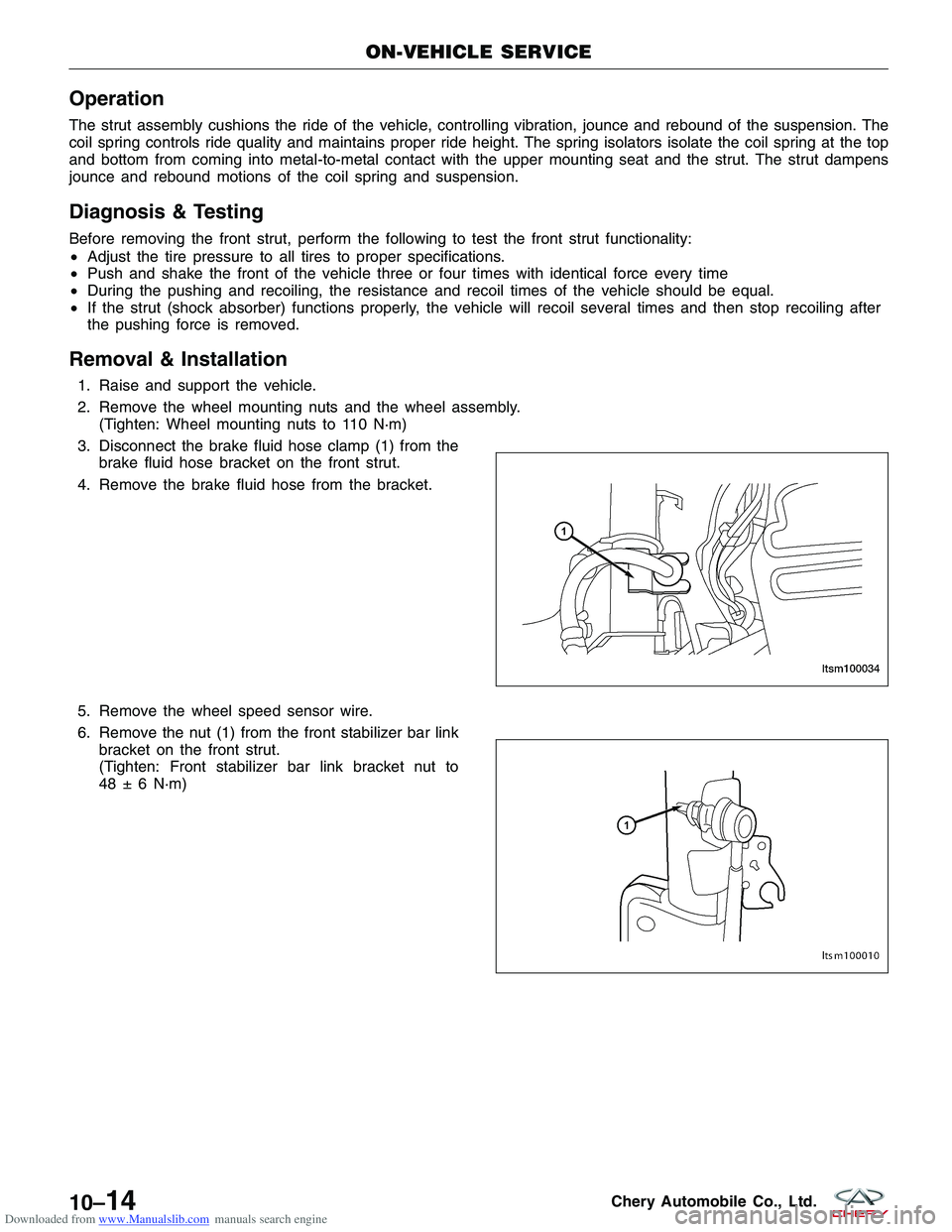
Removal & Installation
1. Raise and support the vehicle.
2. Remove the wheel mounting nuts and the wheel assembly.
(Tighten: Wheel mounting nuts to 110 N·m)
3. Disconnect the brake fluid hose clamp (1) from the brake fluid hose bracket on the front strut.
4. Remove the brake fluid hose from the bracket.
5. Remove the wheel speed sensor wire.
6. Remove the nut (1) from the front stabilizer bar link bracket on the front strut.
(Tighten: Front stabilizer bar link bracket nut to
48 ± 6 N·m)
ON-VEHICLE SERVICE
LTSM100034
LTSM100010
10–14Chery Automobile Co., Ltd.
Page 1317 of 1903
Downloaded from www.Manualslib.com manuals search engine Front Coil Spring
Description
A coil-over front strut assembly supports each front coil spring. The top of the strut assembly mounts to the strut
tower.
Operation
Coil springs are designed to store energy and subsequently release it and to absorb shock and maintain a force
between contacting surfaces. Coil springs are rated for specific vehicle applications.
NOTE :
Each component is serviced by removing the strut assembly from the vehicle and disassembling it. Coil springs are
rated separately for each corner or side of the vehicle depending on optional equipment and type of vehicle service.
If a coil spring requires replacement, be sure that it is replaced with a spring meeting the correct load rating for the
vehicle and its specific options.
Removal & Installation
CAUTION:
At no time when servicing a vehicle can a sheet metal screw, bolt or other metal fastener be
installed into the strut tower to take the place of an original plastic clamp. Also, do not drill holes
into the front strut tower for the installation of any metal fasteners into the strut tower area indi-
cated.
1. Raise and support the vehicle.
2. Remove the front strut assembly (See Front Strut Removal & Installation in Section 10 Suspension).
WARNING!
Do not remove the strut rod nut before the coil spring is properly compressed. The coil spring is held under
pressure. The coil spring must be compressed, removing spring tension from the upper mount and bearing,
before the strut rod nut is removed.
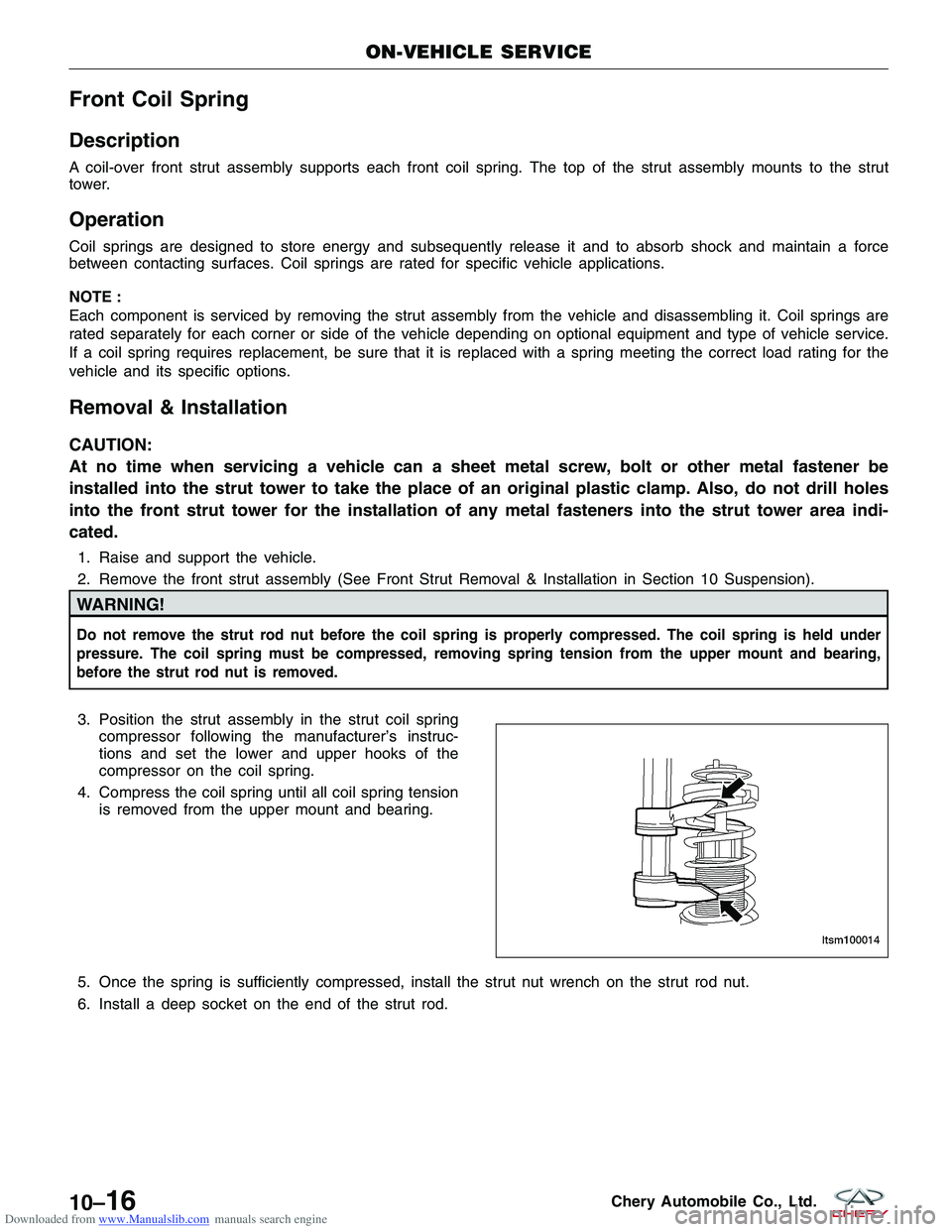
3. Position the strut assembly in the strut coil springcompressor following the manufacturer’s instruc-
tions and set the lower and upper hooks of the
compressor on the coil spring.
4. Compress the coil spring until all coil spring tension is removed from the upper mount and bearing.
5. Once the spring is sufficiently compressed, install the strut nut wrench on the strut rod nut.
6. Install a deep socket on the end of the strut rod.
ON-VEHICLE SERVICE
LTSM100014
10–16Chery Automobile Co., Ltd.
Page 1326 of 1903
Downloaded from www.Manualslib.com manuals search engine REAR SUSPENSION
GENERAL INFORMATION10-26
Description 10-26
Operation 10-27
Specifications 10-28
DIAGNOSIS & TESTING10-29
Vehicle Inspection 10-29
Vibration At High Speed 10-29
ON-VEHICLE SERVICE10-30
Rear Lower Control Arm 10-30
Removal & Installation 10-30
Rear Upper Control Arm 10-31
Removal & Installation 10-31 Rear Stabilizer Bar Link
10-32
Removal & Installation 10-32
Rear Shock Absorber 10-32
Description 10-32
Operation 10-32
Removal & Installation 10-32
Rear Shock Absorber Inspection 10-33
Rear Coil Spring 10-33
Description 10-33
Operation 10-34
Removal & Installation 10-34
Rear Trailing Arm Assembly 10-35
Removal & Installation 10-35
10
10–25Chery Automobile Co., Ltd.
Page 1329 of 1903
Downloaded from www.Manualslib.com manuals search engine Specifications
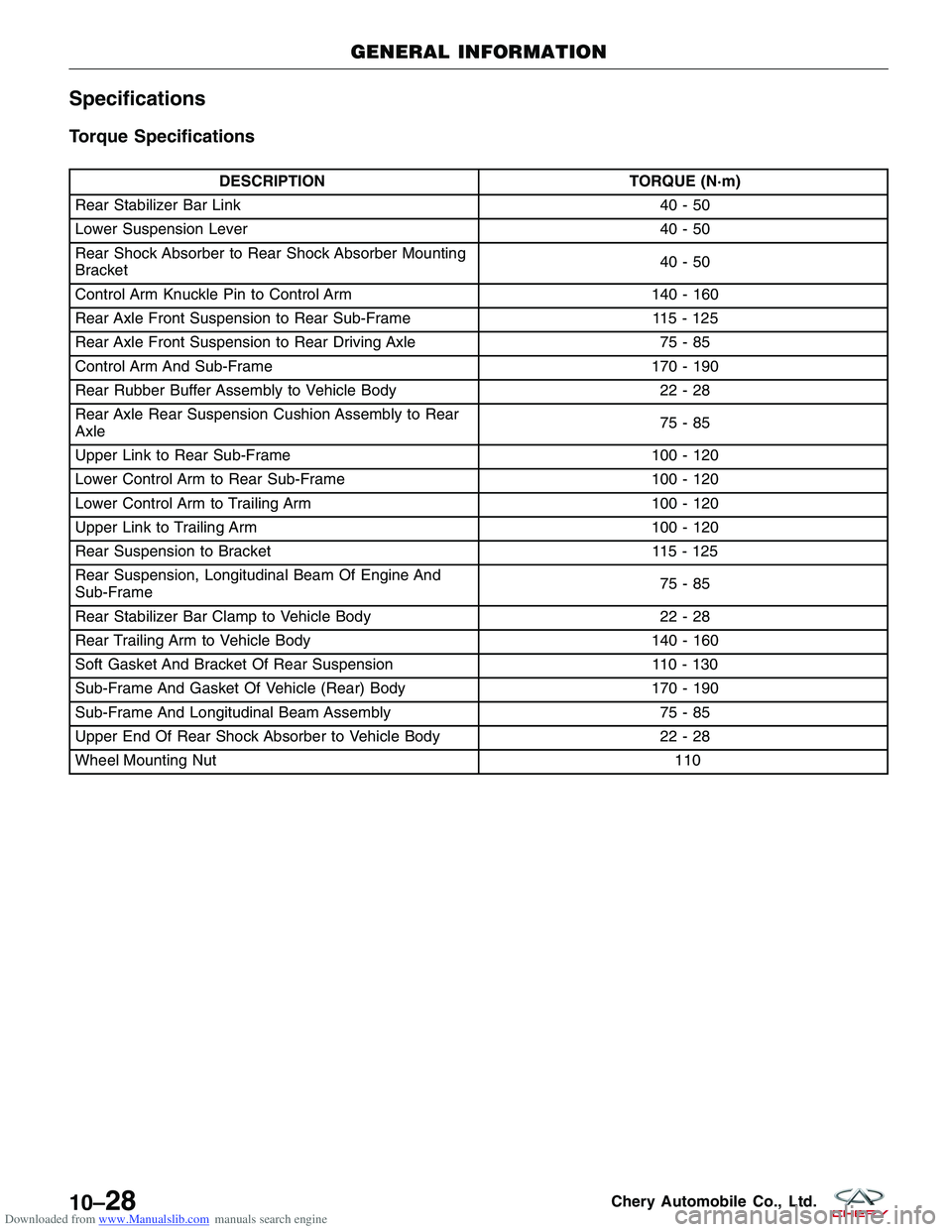
Torque Specifications
DESCRIPTIONTORQUE (N·m)
Rear Stabilizer Bar Link 40 - 50
Lower Suspension Lever 40 - 50
Rear Shock Absorber to Rear Shock Absorber Mounting
Bracket 40-50
Control Arm Knuckle Pin to Control Arm 140 - 160
Rear Axle Front Suspension to Rear Sub-Frame 115 - 125
Rear Axle Front Suspension to Rear Driving Axle 75 - 85
Control Arm And Sub-Frame 170 - 190
Rear Rubber Buffer Assembly to Vehicle Body 22 - 28
Rear Axle Rear Suspension Cushion Assembly to Rear
Axle 75-85
Upper Link to Rear Sub-Frame 100 - 120
Lower Control Arm to Rear Sub-Frame 100 - 120
Lower Control Arm to Trailing Arm 100 - 120
Upper Link to Trailing Arm 100 - 120
Rear Suspension to Bracket 115 - 125
Rear Suspension, Longitudinal Beam Of Engine And
Sub-Frame 75-85
Rear Stabilizer Bar Clamp to Vehicle Body 22 - 28
Rear Trailing Arm to Vehicle Body 140 - 160
Soft Gasket And Bracket Of Rear Suspension 110 - 130
Sub-Frame And Gasket Of Vehicle (Rear) Body 170 - 190
Sub-Frame And Longitudinal Beam Assembly 75 - 85
Upper End Of Rear Shock Absorber to Vehicle Body 22 - 28
Wheel Mounting Nut \
11
0
GENERAL INFORMATION
10–28Chery Automobile Co., Ltd.
Page 1333 of 1903
Downloaded from www.Manualslib.com manuals search engine Rear Stabilizer Bar Link
Removal & Installation
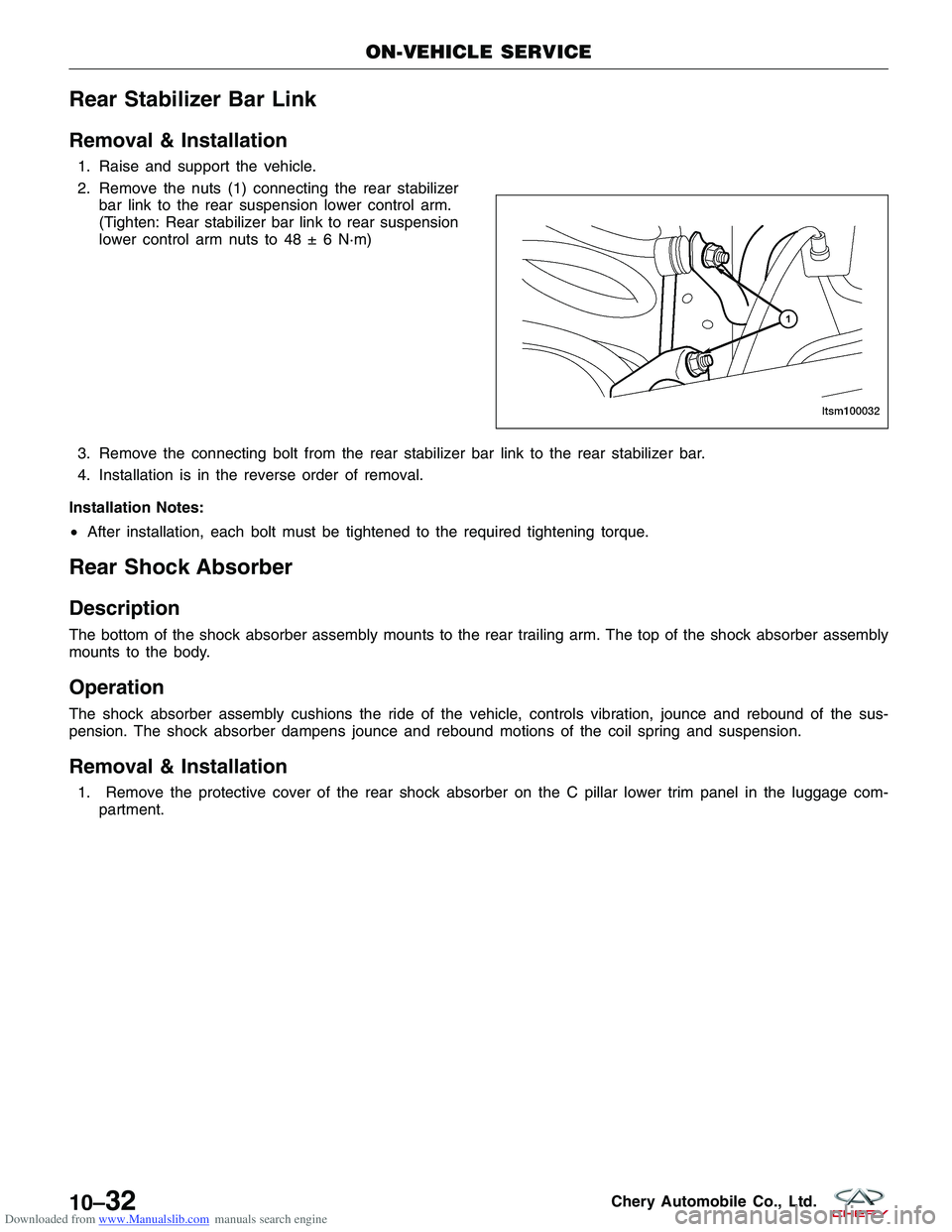
1. Raise and support the vehicle.
2. Remove the nuts (1) connecting the rear stabilizerbar link to the rear suspension lower control arm.
(Tighten: Rear stabilizer bar link to rear suspension
lower control arm nuts to 48 ± 6 N·m)
3. Remove the connecting bolt from the rear stabilizer bar link to the rear stabilizer bar.
4. Installation is in the reverse order of removal.
Installation Notes:
• After installation, each bolt must be tightened to the required tightening torque.
Rear Shock Absorber
Description
The bottom of the shock absorber assembly mounts to the rear trailing arm. The top of the shock absorber assembly
mounts to the body.
Operation
The shock absorber assembly cushions the ride of the vehicle, controls vibration, jounce and rebound of the sus-
pension. The shock absorber dampens jounce and rebound motions of the coil spring and suspension.
Removal & Installation
1. Remove the protective cover of the rear shock absorber on the C pillar lower trim panel in the luggage com-
partment.
ON-VEHICLE SERVICE
LTSM100032
10–32Chery Automobile Co., Ltd.