ABS CHERY TIGGO 2009 Service Owner's Manual
[x] Cancel search | Manufacturer: CHERY, Model Year: 2009, Model line: TIGGO, Model: CHERY TIGGO 2009Pages: 1903, PDF Size: 33.38 MB
Page 406 of 1903
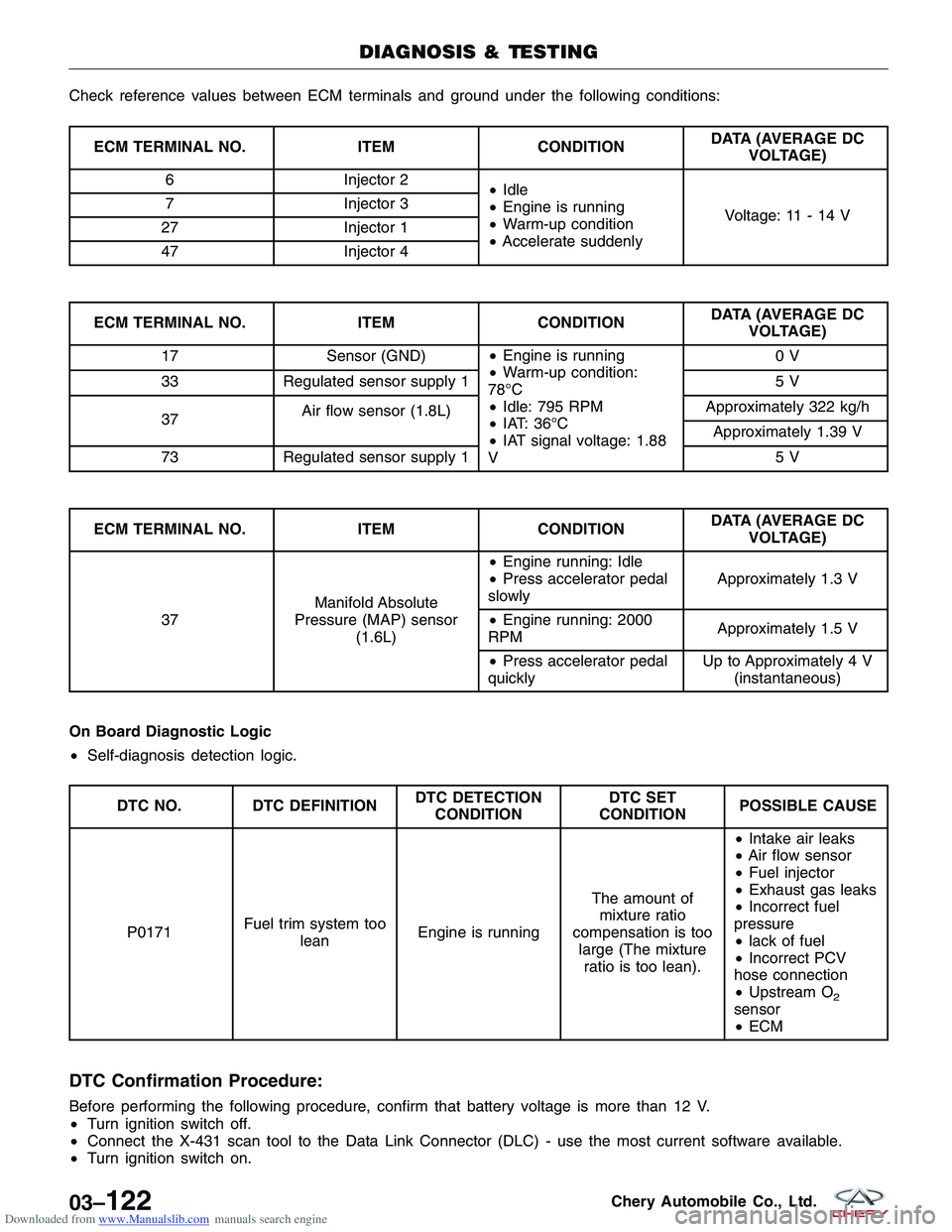
Downloaded from www.Manualslib.com manuals search engine Check reference values between ECM terminals and ground under the following conditions:
ECM TERMINAL NO.ITEMCONDITIONDATA (AVERAGE DC
VOLTAGE)
6 Injector 2
•Idle
• Engine is running
• Warm-up condition
• Accelerate suddenly Voltage: 11 - 14 V
7
Injector 3
27 Injector 1
47 Injector 4
ECM TERMINAL NO. ITEMCONDITIONDATA (AVERAGE DC
VOLTAGE)
17 Sensor (GND)•
Engine is running
• Warm-up condition:
78°C
• Idle: 795 RPM
• IAT: 36°C
• IAT signal voltage: 1.88
V 0V
33 Regulated sensor supply 1 5 V
37 Air flow sensor (1.8L)
Approximately 322 kg/h
Approximately 1.39 V
73 Regulated sensor supply 1 5 V
ECM TERMINAL NO.ITEMCONDITIONDATA (AVERAGE DC
VOLTAGE)
37 Manifold Absolute
Pressure (MAP) sensor (1.6L) •
Engine running: Idle
• Press accelerator pedal
slowly Approximately 1.3 V
• Engine running: 2000
RPM Approximately 1.5 V
• Press accelerator pedal
quickly Up to Approximately 4 V
(instantaneous)
On Board Diagnostic Logic
• Self-diagnosis detection logic.
DTC NO. DTC DEFINITION DTC DETECTION
CONDITION DTC SET
CONDITION POSSIBLE CAUSE
P0171 Fuel trim system too
lean Engine is running The amount of
mixture ratio
compensation is too large (The mixtureratio is too lean). •
Intake air leaks
• Air flow sensor
• Fuel injector
• Exhaust gas leaks
• Incorrect fuel
pressure
• lack of fuel
• Incorrect PCV
hose connection
• Upstream O
2sensor
•ECM
DTC Confirmation Procedure:
Before performing the following procedure, confirm that battery voltage is more than 12 V.
• Turn ignition switch off.
• Connect the X-431 scan tool to the Data Link Connector (DLC) - use the most current software available.
• Turn ignition switch on.
DIAGNOSIS & TESTING
03–122Chery Automobile Co., Ltd.
Page 419 of 1903

Downloaded from www.Manualslib.com manuals search engine Check reference values between ECM terminals and ground under the following conditions:
ECM TERMINAL NO.ITEMCONDITIONDATA (AVERAGE DC
VOLTAGE)
6 Injector 2
•Engine is running
• Warm-up condition
• Idle
• Accelerate suddenly Voltage: 11 - 14 V
7
Injector 3
27 Injector 1
47 Injector 4
ECM TERMINAL NO. ITEMCONDITIONDATA (AVERAGE DC
VOLTAGE)
17 Sensor (GND)
•Engine is running
• Warm-up condition:
78°C
• Idle: 795 RPM
• IAT: 36°C
• IAT signal: 1.88 V 0V
33 Regulated sensor supply 1 5 V
37 Air flow sensor (1.8L) 322 kg/h
1.39 V
73 Regulated sensor supply 1 5 V
ECM TERMINAL NO.ITEMCONDITIONDATA (AVERAGE DC
VOLTAGE)
37 Manifold Absolute
Pressure (MAP) sensor (1.6L) •
Engine running: Idle
• Press accelerator pedal
slowly Approximately 1.3 V
• Engine running: 2000
RPM Approximately 1.5 V
• Press accelerator pedal
quickly Up to approximately 4 V
(instantaneous)
On Board Diagnostic Logic
• Self-diagnosis detection logic.
DTC NO. DTC DEFINITION DTC DETECTION
CONDITION DTC SET
CONDITION POSSIBLE CAUSE
P0172 Fuel trim system too
rich Engine is running The amount of
mixture ratio
compensation is too
large (The mixture
ratio is too rich) •
Air flow sensor
• Manifold Absolute
Pressure (MAP)
sensor
• Fuel injector
• Exhaust gas leaks
• Incorrect fuel
pressure
• Upstream O
2sensor
•ECM
DTC Confirmation Procedure:
Before performing the following procedure, confirm that battery voltage is more than 12 V.
• Turn ignition switch off.
• Connect the X-431 scan tool to the Data Link Connector (DLC) - use the most current software available.
• Turn ignition switch on.
• With the scan tool, record and erase stored DTCs in the ECM.
DIAGNOSIS & TESTING
03
03–135Chery Automobile Co., Ltd.
Page 506 of 1903

Downloaded from www.Manualslib.com manuals search engine Operation
The accelerator sensor monitors the road conditions. It sends a signal to the ECM, the ECM determines if a possible
misfire condition exists.
Removal & Installation
1. Disconnect the negative battery cable.
2. Disconnect the accelerator sensor electrical con-nector.
3. Remove the accelerator sensor (1).
4. Installation is in the reverse order of removal.
Manifold Absolute Pressure Sensor - 1.6L
Description
The Manifold Absolute Pressure (MAP) sensor, is mounted to the front of the engine on the intake manifold.
Operation
The MAP sensor monitors the pressure in the intake manifold. The pressure in the manifold moves a diaphragm
connected to resistors which alter their resistance values. The output voltage of the MAP sensor signals the ECM
about the pressure in the intake manifold.
Removal & Installation
1. Disconnect the negative battery cable.
ON-VEHICLE SERVICE
LTSM030030
03–222Chery Automobile Co., Ltd.
Page 537 of 1903
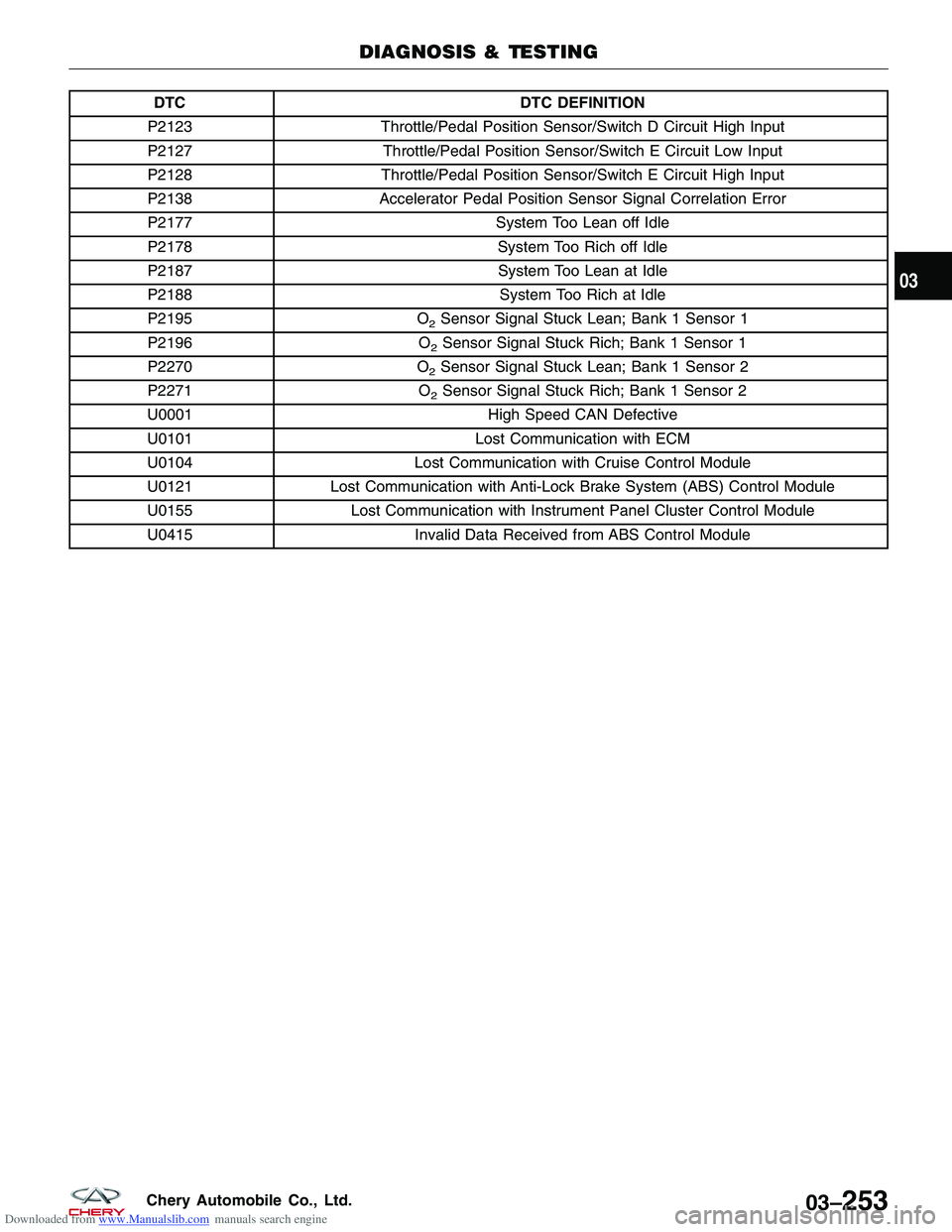
Downloaded from www.Manualslib.com manuals search engine DTCDTC DEFINITION
P2123 Throttle/Pedal Position Sensor/Switch D Circuit High Input
P2127 Throttle/Pedal Position Sensor/Switch E Circuit Low Input
P2128 Throttle/Pedal Position Sensor/Switch E Circuit High Input
P2138 Accelerator Pedal Position Sensor Signal Correlation Error
P2177 System Too Lean off Idle
P2178 System Too Rich off Idle
P2187 System Too Lean at Idle
P2188 System Too Rich at Idle
P2195 O
2Sensor Signal Stuck Lean; Bank 1 Sensor 1
P2196 O
2Sensor Signal Stuck Rich; Bank 1 Sensor 1
P2270 O
2Sensor Signal Stuck Lean; Bank 1 Sensor 2
P2271 O
2Sensor Signal Stuck Rich; Bank 1 Sensor 2
U0001 High Speed CAN Defective
U0101 Lost Communication with ECM
U0104 Lost Communication with Cruise Control Module
U0121 Lost Communication with Anti-Lock Brake System (ABS) Control Module
U0155 Lost Communication with Instrument Panel Cluster Control Module
U0415 Invalid Data Received from ABS Control Module
DIAGNOSIS & TESTING
03
03–253Chery Automobile Co., Ltd.
Page 869 of 1903
Downloaded from www.Manualslib.com manuals search engine trols the frequency when the canister control valve operates in order to accommodate the vapor volume for each
cylinder.
Removal & Installation
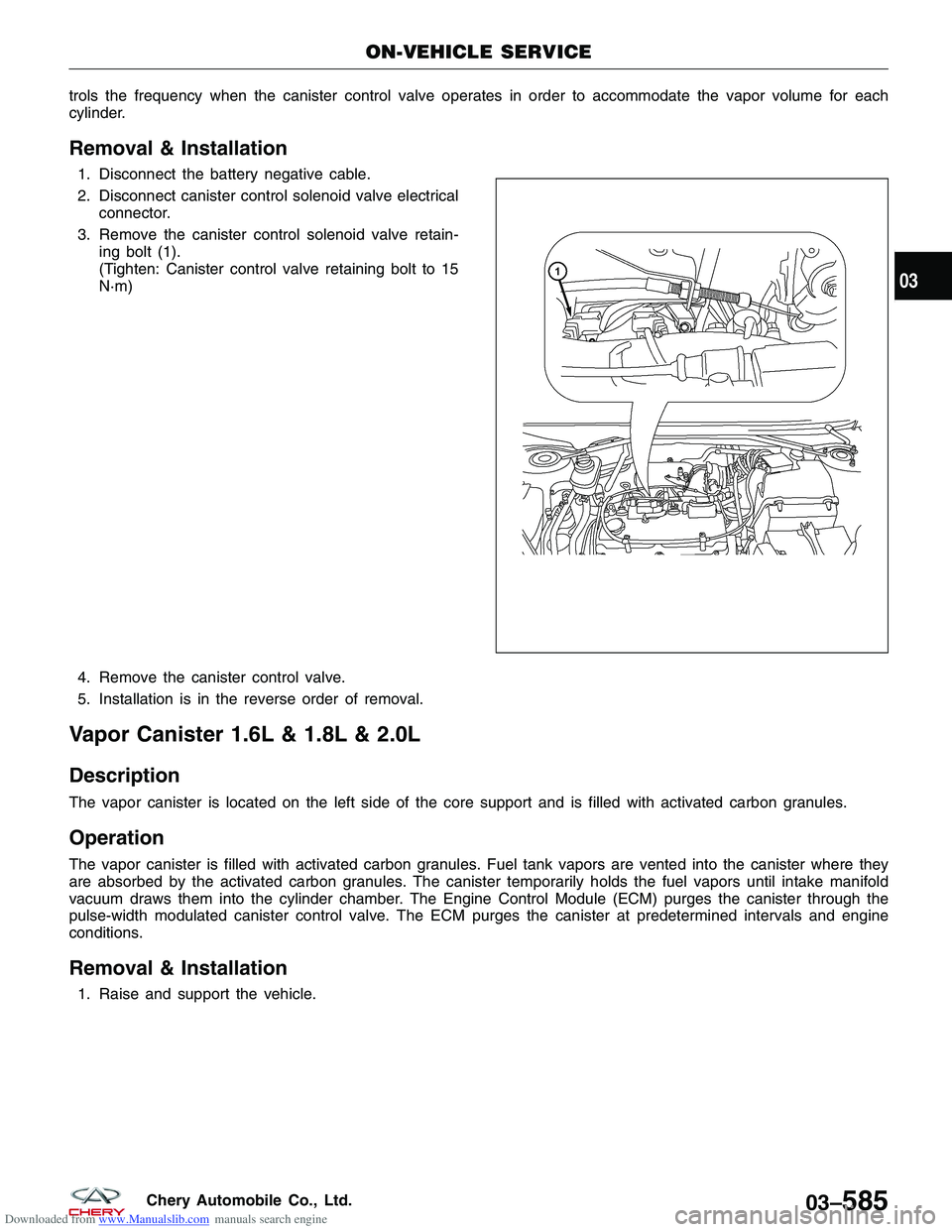
1. Disconnect the battery negative cable.
2. Disconnect canister control solenoid valve electricalconnector.
3. Remove the canister control solenoid valve retain- ing bolt (1).
(Tighten: Canister control valve retaining bolt to 15
N·m)
4. Remove the canister control valve.
5. Installation is in the reverse order of removal.
Vapor Canister 1.6L & 1.8L & 2.0L
Description
The vapor canister is located on the left side of the core support and is filled with activated carbon granules.
Operation
The vapor canister is filled with activated carbon granules. Fuel tank vapors are vented into the canister where they
are absorbed by the activated carbon granules. The canister temporarily holds the fuel vapors until intake manifold
vacuum draws them into the cylinder chamber. The Engine Control Module (ECM) purges the canister through the
pulse-width modulated canister control valve. The ECM purges the canister at predetermined intervals and engine
conditions.
Removal & Installation
1. Raise and support the vehicle.
ON-VEHICLE SERVICE
LTSM030014
03
03–585Chery Automobile Co., Ltd.
Page 870 of 1903
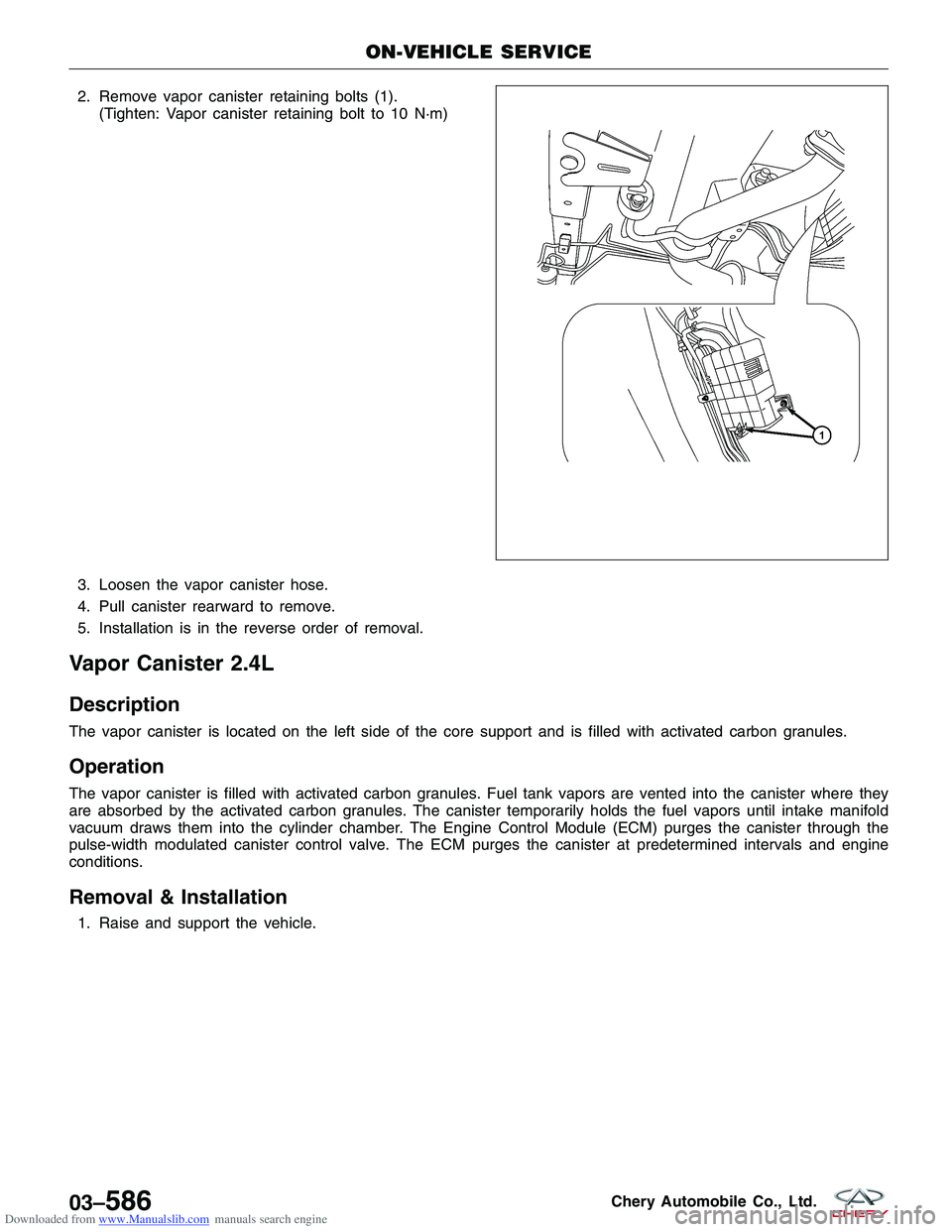
Downloaded from www.Manualslib.com manuals search engine 2. Remove vapor canister retaining bolts (1).(Tighten: Vapor canister retaining bolt to 10 N·m)
3. Loosen the vapor canister hose.
4. Pull canister rearward to remove.
5. Installation is in the reverse order of removal.
Vapor Canister 2.4L
Description
The vapor canister is located on the left side of the core support and is filled with activated carbon granules.
Operation
The vapor canister is filled with activated carbon granules. Fuel tank vapors are vented into the canister where they
are absorbed by the activated carbon granules. The canister temporarily holds the fuel vapors until intake manifold
vacuum draws them into the cylinder chamber. The Engine Control Module (ECM) purges the canister through the
pulse-width modulated canister control valve. The ECM purges the canister at predetermined intervals and engine
conditions.
Removal & Installation
1. Raise and support the vehicle.
ON-VEHICLE SERVICE
LTSM030041
03–586Chery Automobile Co., Ltd.
Page 1277 of 1903
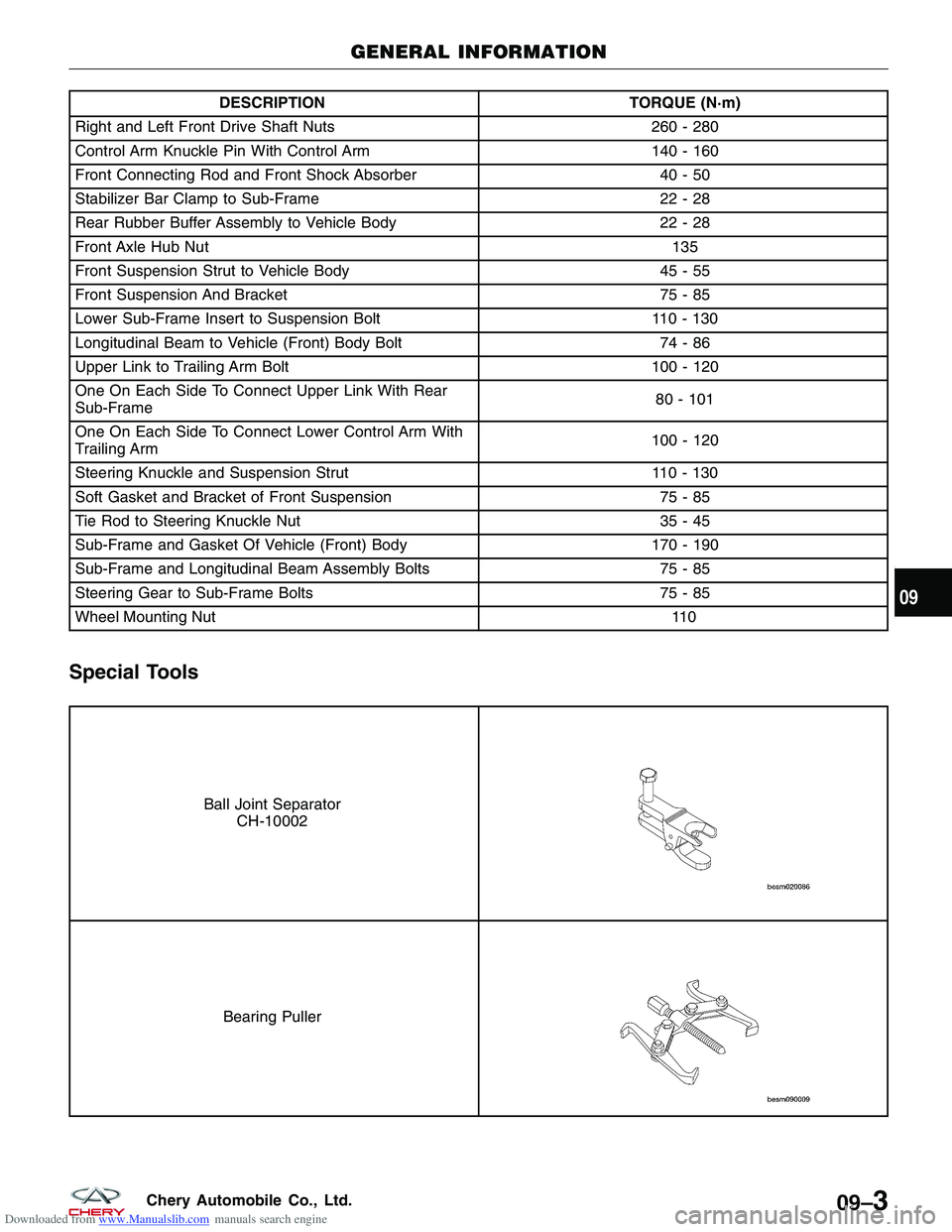
Downloaded from www.Manualslib.com manuals search engine DESCRIPTIONTORQUE (N·m)
Right and Left Front Drive Shaft Nuts 260 - 280
Control Arm Knuckle Pin With Control Arm 140 - 160
Front Connecting Rod and Front Shock Absorber 40 - 50
Stabilizer Bar Clamp to Sub-Frame 22 - 28
Rear Rubber Buffer Assembly to Vehicle Body 22 - 28
Front Axle Hub Nut 135
Front Suspension Strut to Vehicle Body 45 - 55
Front Suspension And Bracket 75 - 85
Lower Sub-Frame Insert to Suspension Bolt 110 - 130
Longitudinal Beam to Vehicle (Front) Body Bolt 74 - 86
Upper Link to Trailing Arm Bolt 100 - 120
One On Each Side To Connect Upper Link With Rear
Sub-Frame 80 - 101
One On Each Side To Connect Lower Control Arm With
Trailing Arm 100 - 120
Steering Knuckle and Suspension Strut 110 - 130
Soft Gasket and Bracket of Front Suspension 75 - 85
Tie Rod to Steering Knuckle Nut 35 - 45
Sub-Frame and Gasket Of Vehicle (Front) Body 170 - 190
Sub-Frame and Longitudinal Beam Assembly Bolts 75 - 85
Steering Gear to Sub-Frame Bolts 75 - 85
Wheel Mounting Nut \
\
11 0
Special Tools
Ball Joint Separator CH-10002
Bearing Puller
GENERAL INFORMATION
09
09–3Chery Automobile Co., Ltd.
Page 1283 of 1903
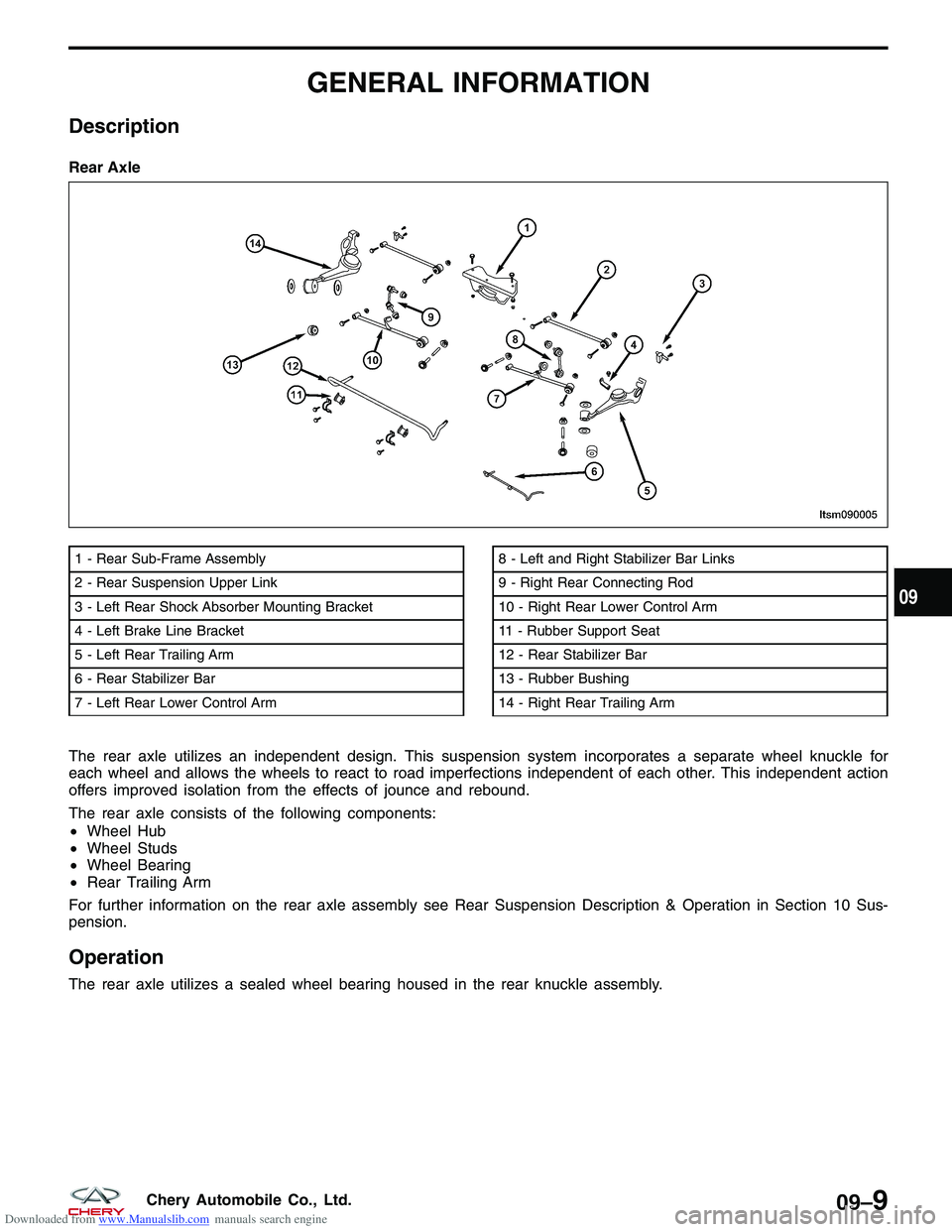
Downloaded from www.Manualslib.com manuals search engine GENERAL INFORMATION
Description
The rear axle utilizes an independent design. This suspension system incorporates a separate wheel knuckle for
each wheel and allows the wheels to react to road imperfections independent of each other. This independent action
offers improved isolation from the effects of jounce and rebound.
The rear axle consists of the following components:
•Wheel Hub
• Wheel Studs
• Wheel Bearing
• Rear Trailing Arm
For further information on the rear axle assembly see Rear Suspension Description & Operation in Section 10 Sus-
pension.
Operation
The rear axle utilizes a sealed wheel bearing housed in the rear knuckle assembly. Rear Axle
1 - Rear Sub-Frame Assembly
2 - Rear Suspension Upper Link
3 - Left Rear Shock Absorber Mounting Bracket
4 - Left Brake Line Bracket
5 - Left Rear Trailing Arm
6 - Rear Stabilizer Bar
7 - Left Rear Lower Control Arm8 - Left and Right Stabilizer Bar Links
9 - Right Rear Connecting Rod
10 - Right Rear Lower Control Arm
11 - Rubber Support Seat
12 - Rear Stabilizer Bar
13 - Rubber Bushing
14 - Right Rear Trailing Arm
LTSM090005
09
09–9Chery Automobile Co., Ltd.
Page 1284 of 1903
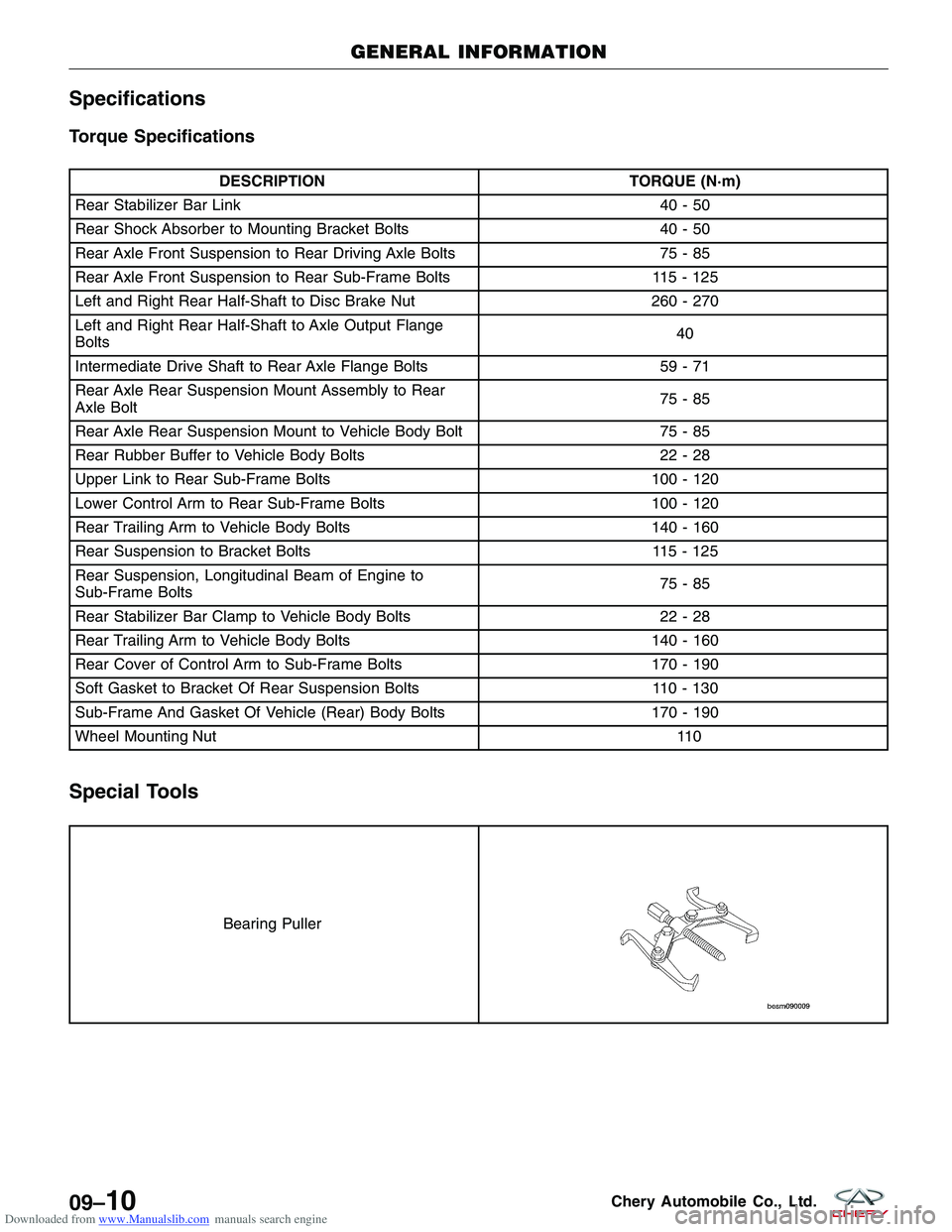
Downloaded from www.Manualslib.com manuals search engine Specifications
Torque Specifications
DESCRIPTIONTORQUE (N·m)
Rear Stabilizer Bar Link 40 - 50
Rear Shock Absorber to Mounting Bracket Bolts 40 - 50
Rear Axle Front Suspension to Rear Driving Axle Bolts 75 - 85
Rear Axle Front Suspension to Rear Sub-Frame Bolts 115 - 125
Left and Right Rear Half-Shaft to Disc Brake Nut 260 - 270
Left and Right Rear Half-Shaft to Axle Output Flange
Bolts 40
Intermediate Drive Shaft to Rear Axle Flange Bolts 59 - 71
Rear Axle Rear Suspension Mount Assembly to Rear
Axle Bolt 75-85
Rear Axle Rear Suspension Mount to Vehicle Body Bolt 75 - 85
Rear Rubber Buffer to Vehicle Body Bolts 22 - 28
Upper Link to Rear Sub-Frame Bolts 100 - 120
Lower Control Arm to Rear Sub-Frame Bolts 100 - 120
Rear Trailing Arm to Vehicle Body Bolts 140 - 160
Rear Suspension to Bracket Bolts 115 - 125
Rear Suspension, Longitudinal Beam of Engine to
Sub-Frame Bolts 75-85
Rear Stabilizer Bar Clamp to Vehicle Body Bolts 22 - 28
Rear Trailing Arm to Vehicle Body Bolts 140 - 160
Rear Cover of Control Arm to Sub-Frame Bolts 170 - 190
Soft Gasket to Bracket Of Rear Suspension Bolts 110 - 130
Sub-Frame And Gasket Of Vehicle (Rear) Body Bolts 170 - 190
Wheel Mounting Nut \
\
11 0
Special Tools
Bearing Puller
GENERAL INFORMATION
09–10Chery Automobile Co., Ltd.
Page 1286 of 1903
Downloaded from www.Manualslib.com manuals search engine ON-VEHICLE SERVICE
Rear Hub and Bearing
Removal & Installation
1. Raise and support the vehicle.
2. Remove the wheel mounting nuts and the tire and wheel assembly.(Tighten: Wheel mounting nuts to 110 N·m)
3. Disconnect the ABS wheel speed sensor electrical connector.
4. While an assistant applies the brakes (to keep the hub from rotating), remove the hub nut from the axle half shaft.
(Tighten: Hub nut to 135 N·m)
5. Remove the rear brake rotor (See Rear Brake Rotor Removal & Installation in Section 12 Brakes).
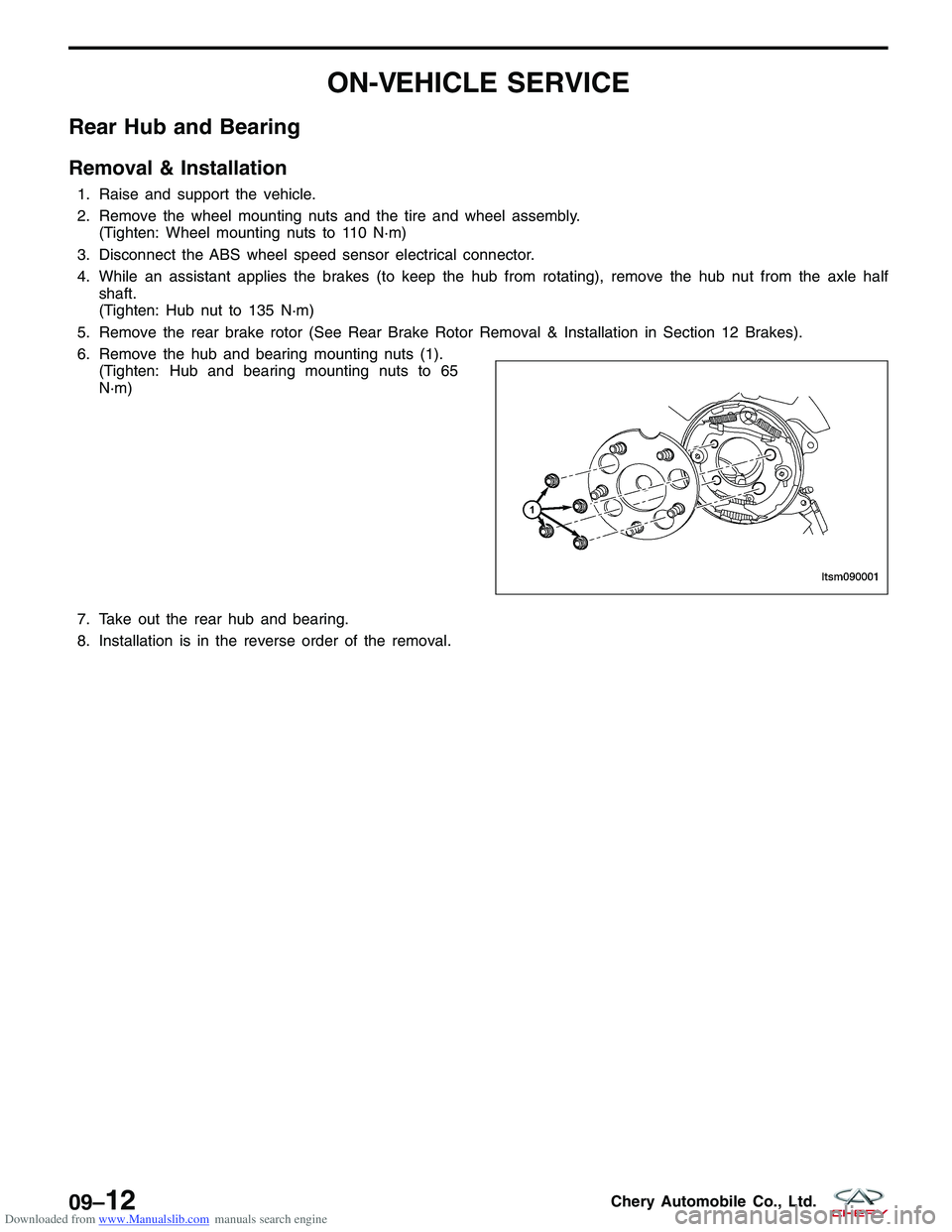
6. Remove the hub and bearing mounting nuts (1). (Tighten: Hub and bearing mounting nuts to 65
N·m)
7. Take out the rear hub and bearing.
8. Installation is in the reverse order of the removal.
LTSM090001
09–12Chery Automobile Co., Ltd.