torque CHERY TIGGO 2009 Service Owner's Guide
[x] Cancel search | Manufacturer: CHERY, Model Year: 2009, Model line: TIGGO, Model: CHERY TIGGO 2009Pages: 1903, PDF Size: 33.38 MB
Page 180 of 1903
Downloaded from www.Manualslib.com manuals search engine GENERAL INFORMATION
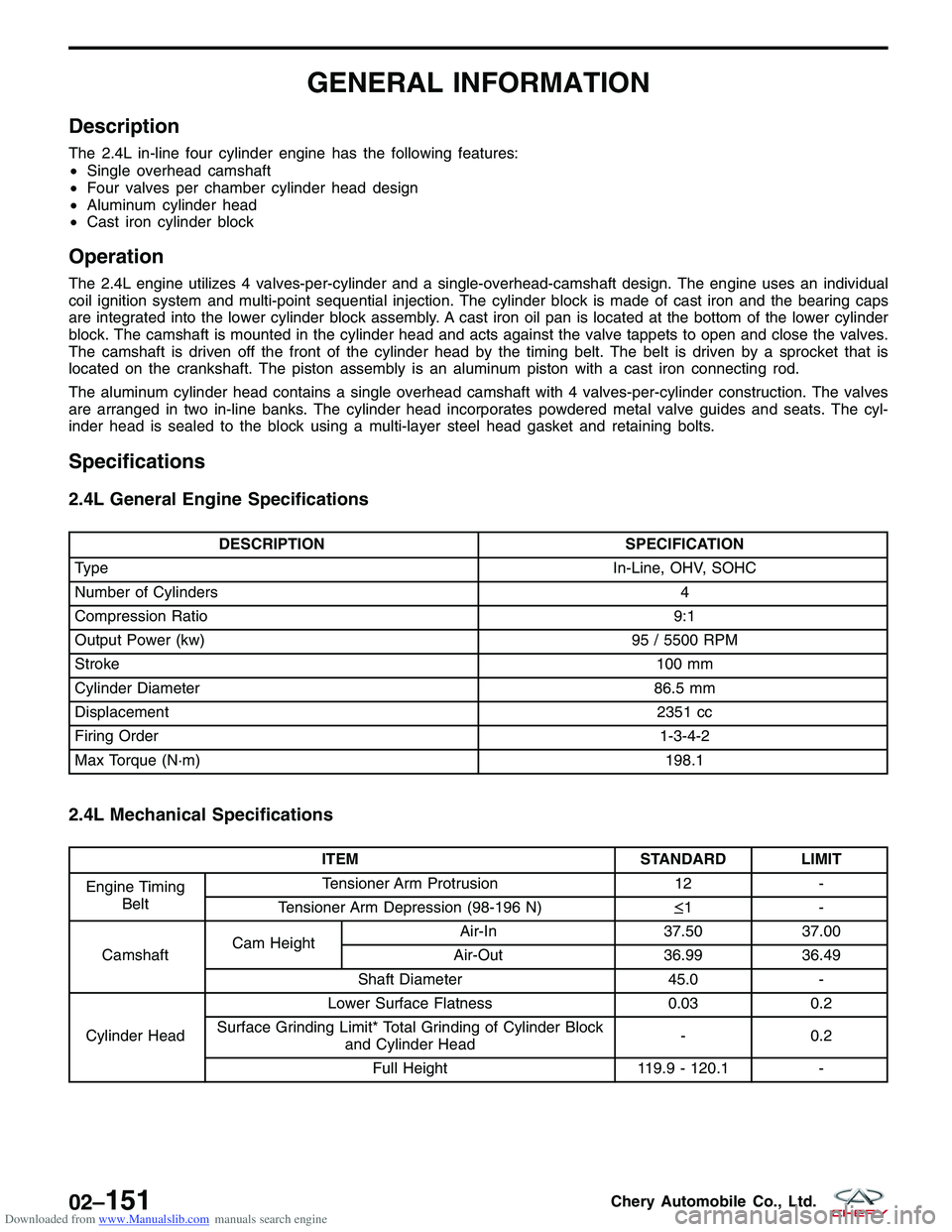
Description
The 2.4L in-line four cylinder engine has the following features:
•Single overhead camshaft
• Four valves per chamber cylinder head design
• Aluminum cylinder head
• Cast iron cylinder block
Operation
The 2.4L engine utilizes 4 valves-per-cylinder and a single-overhead-camshaft design. The engine uses an individual
coil ignition system and multi-point sequential injection. The cylinder block is made of cast iron and the bearing caps
are integrated into the lower cylinder block assembly. A cast iron oil pan is located at the bottom of the lower cylinder
block. The camshaft is mounted in the cylinder head and acts against the valve tappets to open and close the valves.
The camshaft is driven off the front of the cylinder head by the timing belt. The belt is driven by a sprocket that is
located on the crankshaft. The piston assembly is an aluminum piston with a cast iron connecting rod.
The aluminum cylinder head contains a single overhead camshaft with 4 valves-per-cylinder construction. The valves
are arranged in two in-line banks. The cylinder head incorporates powdered metal valve guides and seats. The cyl-
inder head is sealed to the block using a multi-layer steel head gasket and retaining bolts.
Specifications
2.4L General Engine Specifications
DESCRIPTION SPECIFICATION
Type In-Line, OHV, SOHC
Number of Cylinders 4
Compression Ratio 9:1
Output Power (kw) 95 / 5500 RPM
Stroke 100 mm
Cylinder Diameter 86.5 mm
Displacement 2351 cc
Firing Order 1-3-4-2
Max Torque (N·m) 198.1
2.4L Mechanical Specifications
ITEMSTANDARD LIMIT
Engine Timing Belt Tensioner Arm Protrusion
12-
Tensioner Arm Depression (98-196 N) ≤1-
Camshaft Cam Height Air-In
37.5037.00
Air-Out 36.9936.49
Shaft Diameter 45.0-
Cylinder Head Lower Surface Flatness
0.030.2
Surface Grinding Limit* Total Grinding of Cylinder Block and Cylinder Head -
0.2
Full Height 119.9 - 120.1-
02–151Chery Automobile Co., Ltd.
Page 182 of 1903
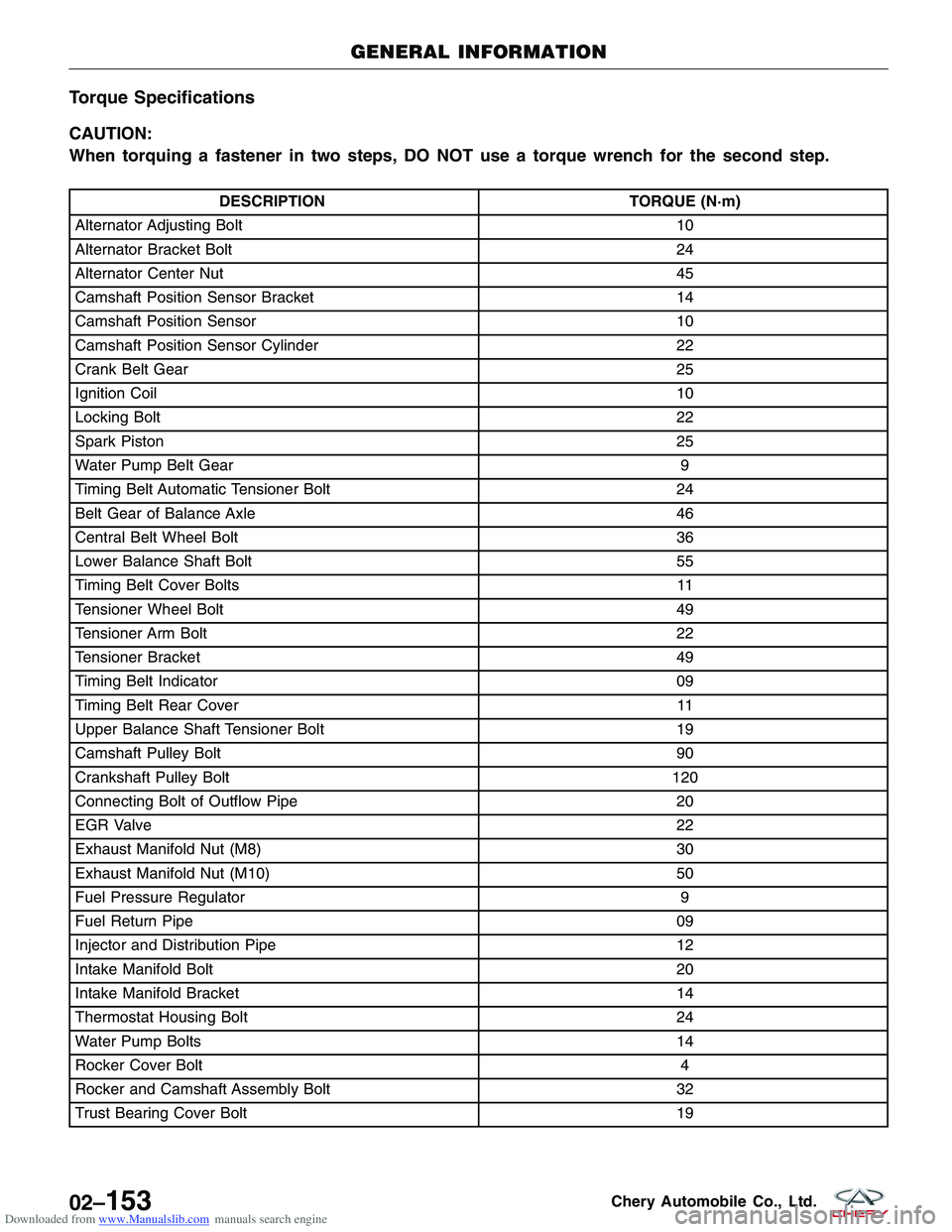
Downloaded from www.Manualslib.com manuals search engine Torque Specifications
CAUTION:
When torquing a fastener in two steps, DO NOT use a torque wrench for the second step.
DESCRIPTIONTORQUE (N·m)
Alternator Adjusting Bolt 10
Alternator Bracket Bolt 24
Alternator Center Nut 45
Camshaft Position Sensor Bracket 14
Camshaft Position Sensor 10
Camshaft Position Sensor Cylinder 22
Crank Belt Gear 25
Ignition Coil 10
Locking Bolt 22
Spark Piston 25
Water Pump Belt Gear 9
Timing Belt Automatic Tensioner Bolt 24
Belt Gear of Balance Axle 46
Central Belt Wheel Bolt 36
Lower Balance Shaft Bolt 55
Timing Belt Cover Bolts 11
Tensioner Wheel Bolt 49
Tensioner Arm Bolt 22
Tensioner Bracket 49
Timing Belt Indicator 09
Timing Belt Rear Cover 11
Upper Balance Shaft Tensioner Bolt 19
Camshaft Pulley Bolt 90
Crankshaft Pulley Bolt 120
Connecting Bolt of Outflow Pipe 20
EGR Valve 22
Exhaust Manifold Nut (M8) 30
Exhaust Manifold Nut (M10) 50
Fuel Pressure Regulator 9
Fuel Return Pipe 09
Injector and Distribution Pipe 12
Intake Manifold Bolt 20
Intake Manifold Bracket 14
Thermostat Housing Bolt 24
Water Pump Bolts 14
Rocker Cover Bolt 4
Rocker and Camshaft Assembly Bolt 32
Trust Bearing Cover Bolt 19
GENERAL INFORMATION
02–153Chery Automobile Co., Ltd.
Page 183 of 1903
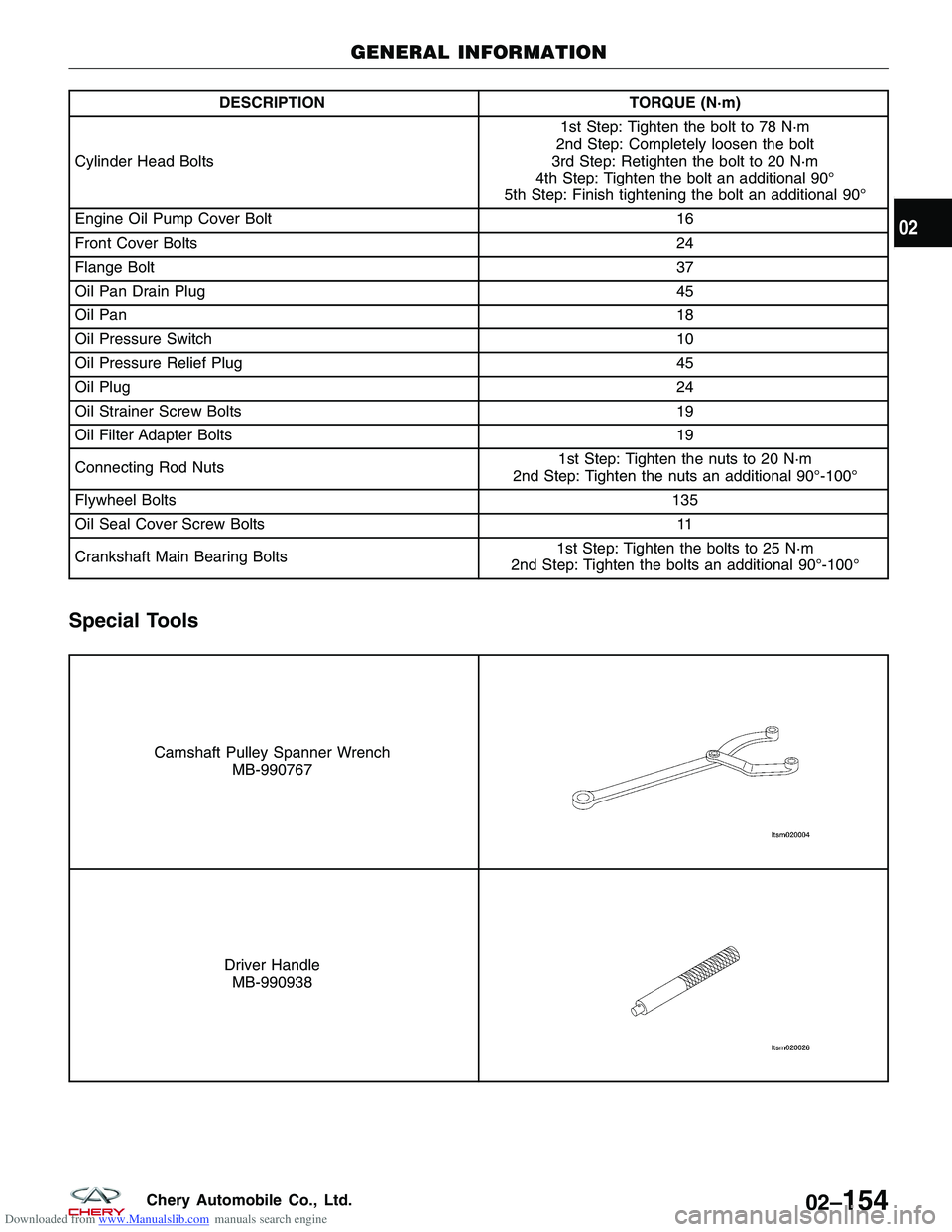
Downloaded from www.Manualslib.com manuals search engine DESCRIPTIONTORQUE (N·m)
Cylinder Head Bolts 1st Step: Tighten the bolt to 78 N·m
2nd Step: Completely loosen the bolt
3rd Step: Retighten the bolt to 20 N·m
4th Step: Tighten the bolt an additional 90°
5th Step: Finish tightening the bolt an additional 90°
Engine Oil Pump Cover Bolt 16
Front Cover Bolts 24
Flange Bolt 37
Oil Pan Drain Plug 45
Oil Pan 18
Oil Pressure Switch 10
Oil Pressure Relief Plug 45
Oil Plug 24
Oil Strainer Screw Bolts 19
Oil Filter Adapter Bolts 19
Connecting Rod Nuts 1st Step: Tighten the nuts to 20 N·m
2nd Step: Tighten the nuts an additional 90°-100°
Flywheel Bolts 135
Oil Seal Cover Screw Bolts 11
Crankshaft Main Bearing Bolts 1st Step: Tighten the bolts to 25 N·m
2nd Step: Tighten the bolts an additional 90°-100°
Special Tools
Camshaft Pulley Spanner Wrench MB-990767
Driver HandleMB-990938
GENERAL INFORMATION
02
02–154Chery Automobile Co., Ltd.
Page 193 of 1903
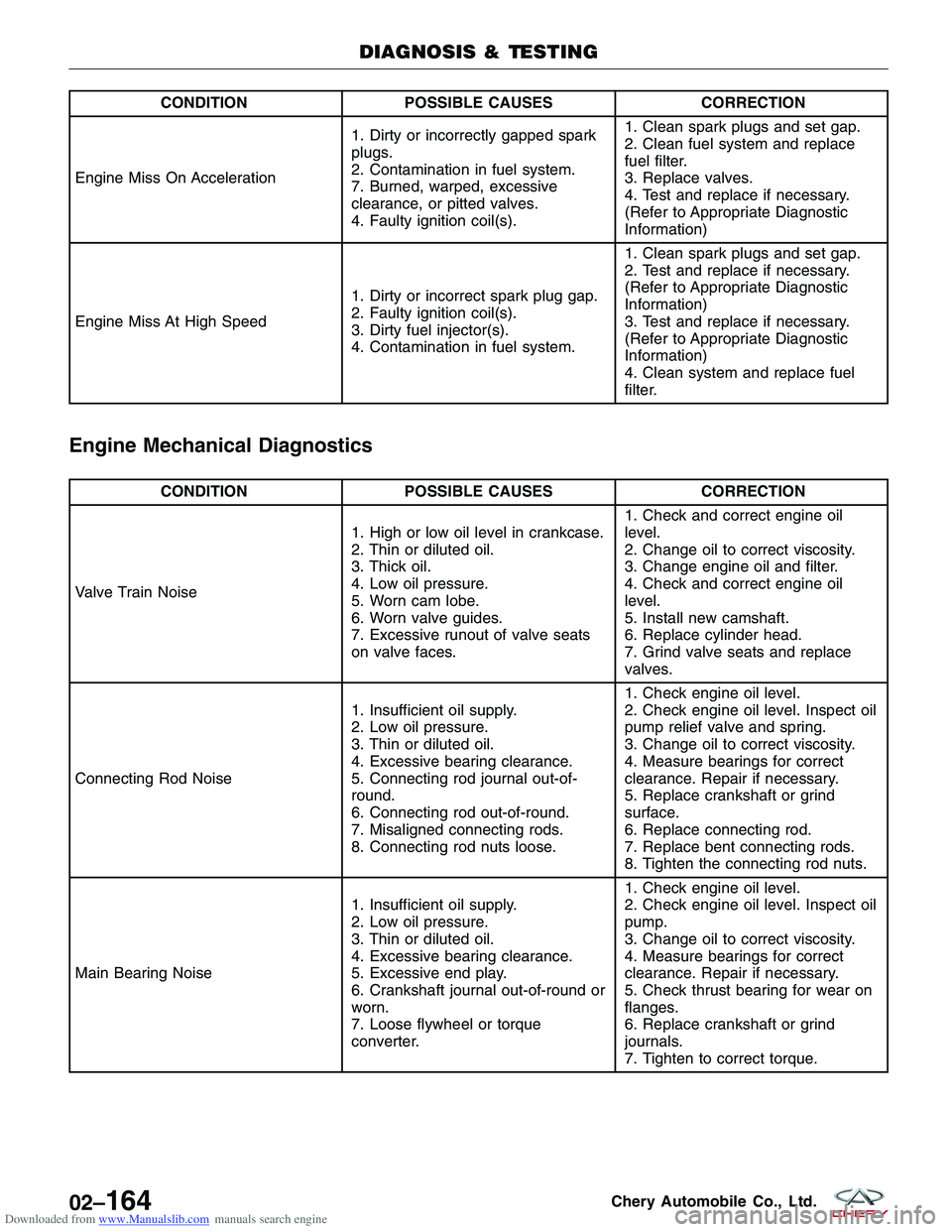
Downloaded from www.Manualslib.com manuals search engine CONDITIONPOSSIBLE CAUSES CORRECTION
Engine Miss On Acceleration 1. Dirty or incorrectly gapped spark
plugs.
2. Contamination in fuel system.
7. Burned, warped, excessive
clearance, or pitted valves.
4. Faulty ignition coil(s).1. Clean spark plugs and set gap.
2. Clean fuel system and replace
fuel filter.
3. Replace valves.
4. Test and replace if necessary.
(Refer to Appropriate Diagnostic
Information)
Engine Miss At High Speed 1. Dirty or incorrect spark plug gap.
2. Faulty ignition coil(s).
3. Dirty fuel injector(s).
4. Contamination in fuel system.1. Clean spark plugs and set gap.
2. Test and replace if necessary.
(Refer to Appropriate Diagnostic
Information)
3. Test and replace if necessary.
(Refer to Appropriate Diagnostic
Information)
4. Clean system and replace fuel
filter.
Engine Mechanical Diagnostics
CONDITION
POSSIBLE CAUSES CORRECTION
Valve Train Noise 1. High or low oil level in crankcase.
2. Thin or diluted oil.
3. Thick oil.
4. Low oil pressure.
5. Worn cam lobe.
6. Worn valve guides.
7. Excessive runout of valve seats
on valve faces.1. Check and correct engine oil
level.
2. Change oil to correct viscosity.
3. Change engine oil and filter.
4. Check and correct engine oil
level.
5. Install new camshaft.
6. Replace cylinder head.
7. Grind valve seats and replace
valves.
Connecting Rod Noise 1. Insufficient oil supply.
2. Low oil pressure.
3. Thin or diluted oil.
4. Excessive bearing clearance.
5. Connecting rod journal out-of-
round.
6. Connecting rod out-of-round.
7. Misaligned connecting rods.
8. Connecting rod nuts loose.1. Check engine oil level.
2. Check engine oil level. Inspect oil
pump relief valve and spring.
3. Change oil to correct viscosity.
4. Measure bearings for correct
clearance. Repair if necessary.
5. Replace crankshaft or grind
surface.
6. Replace connecting rod.
7. Replace bent connecting rods.
8. Tighten the connecting rod nuts.
Main Bearing Noise 1. Insufficient oil supply.
2. Low oil pressure.
3. Thin or diluted oil.
4. Excessive bearing clearance.
5. Excessive end play.
6. Crankshaft journal out-of-round or
worn.
7. Loose flywheel or torque
converter.1. Check engine oil level.
2. Check engine oil level. Inspect oil
pump.
3. Change oil to correct viscosity.
4. Measure bearings for correct
clearance. Repair if necessary.
5. Check thrust bearing for wear on
flanges.
6. Replace crankshaft or grind
journals.
7. Tighten to correct torque.
DIAGNOSIS & TESTING
02–164Chery Automobile Co., Ltd.
Page 205 of 1903
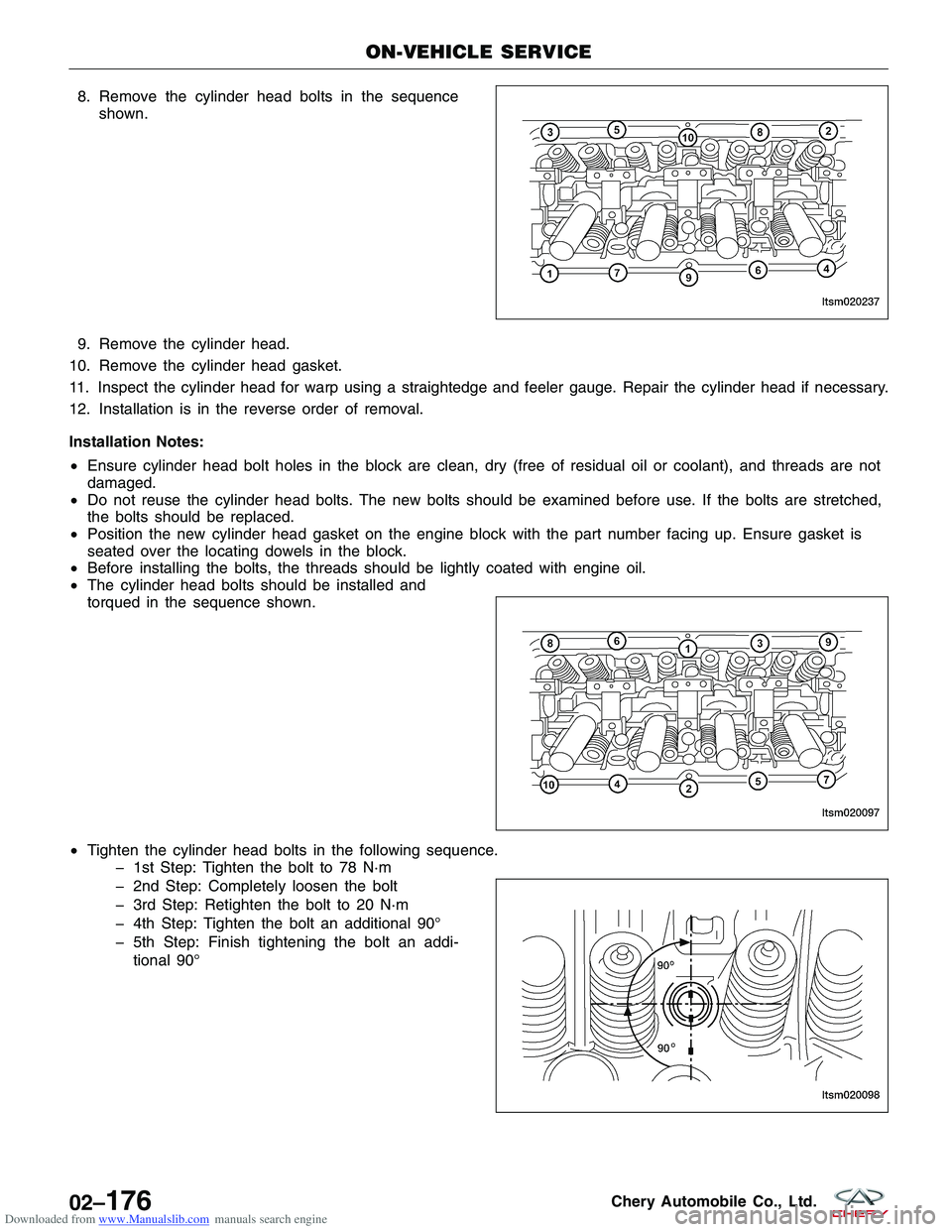
Downloaded from www.Manualslib.com manuals search engine 8. Remove the cylinder head bolts in the sequenceshown.
9. Remove the cylinder head.
10. Remove the cylinder head gasket.
11. Inspect the cylinder head for warp using a straightedge and feeler gauge. Repair the cylinder head if necessary.
12. Installation is in the reverse order of removal.
Installation Notes:
• Ensure cylinder head bolt holes in the block are clean, dry (free of residual oil or coolant), and threads are not
damaged.
• Do not reuse the cylinder head bolts. The new bolts should be examined before use. If the bolts are stretched,
the bolts should be replaced.
• Position the new cylinder head gasket on the engine block with the part number facing up. Ensure gasket is
seated over the locating dowels in the block.
• Before installing the bolts, the threads should be lightly coated with engine oil.
• The cylinder head bolts should be installed and
torqued in the sequence shown.
• Tighten the cylinder head bolts in the following sequence.
1st Step: Tighten the bolt to 78 N·m
2nd Step: Completely loosen the bolt
3rd Step: Retighten the bolt to 20 N·m
4th Step: Tighten the bolt an additional 90°
5th Step: Finish tightening the bolt an addi-
tional 90°
ON-VEHICLE SERVICE
LTSM020237
LTSM020097
LTSM020098
02–176Chery Automobile Co., Ltd.
Page 223 of 1903
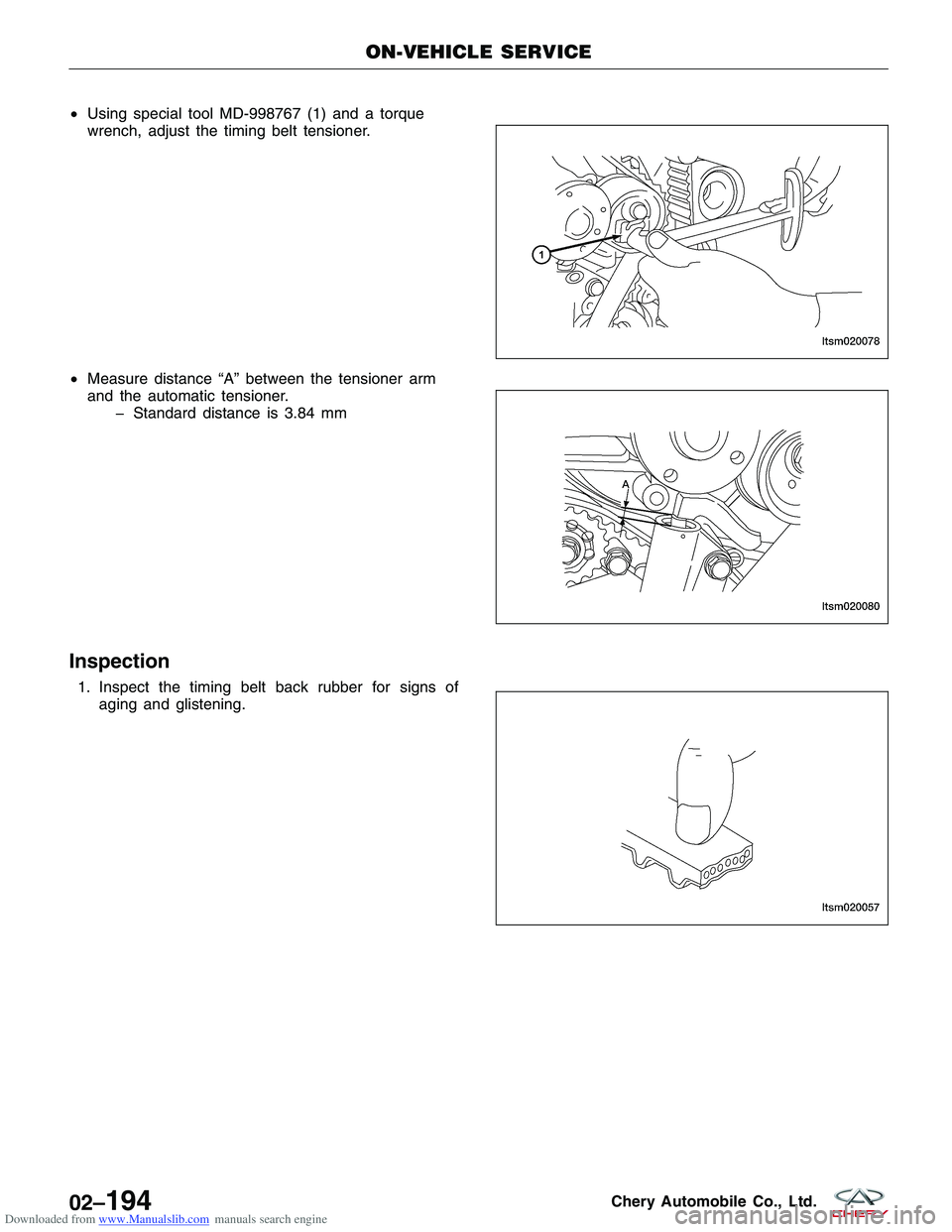
Downloaded from www.Manualslib.com manuals search engine •Using special tool MD-998767 (1) and a torque
wrench, adjust the timing belt tensioner.
• Measure distance “A” between the tensioner arm
and the automatic tensioner.
Standard distance is 3.84 mm
Inspection
1. Inspect the timing belt back rubber for signs ofaging and glistening.
ON-VEHICLE SERVICE
LTSM020078
LTSM020080
LTSM020057
02–194Chery Automobile Co., Ltd.
Page 243 of 1903
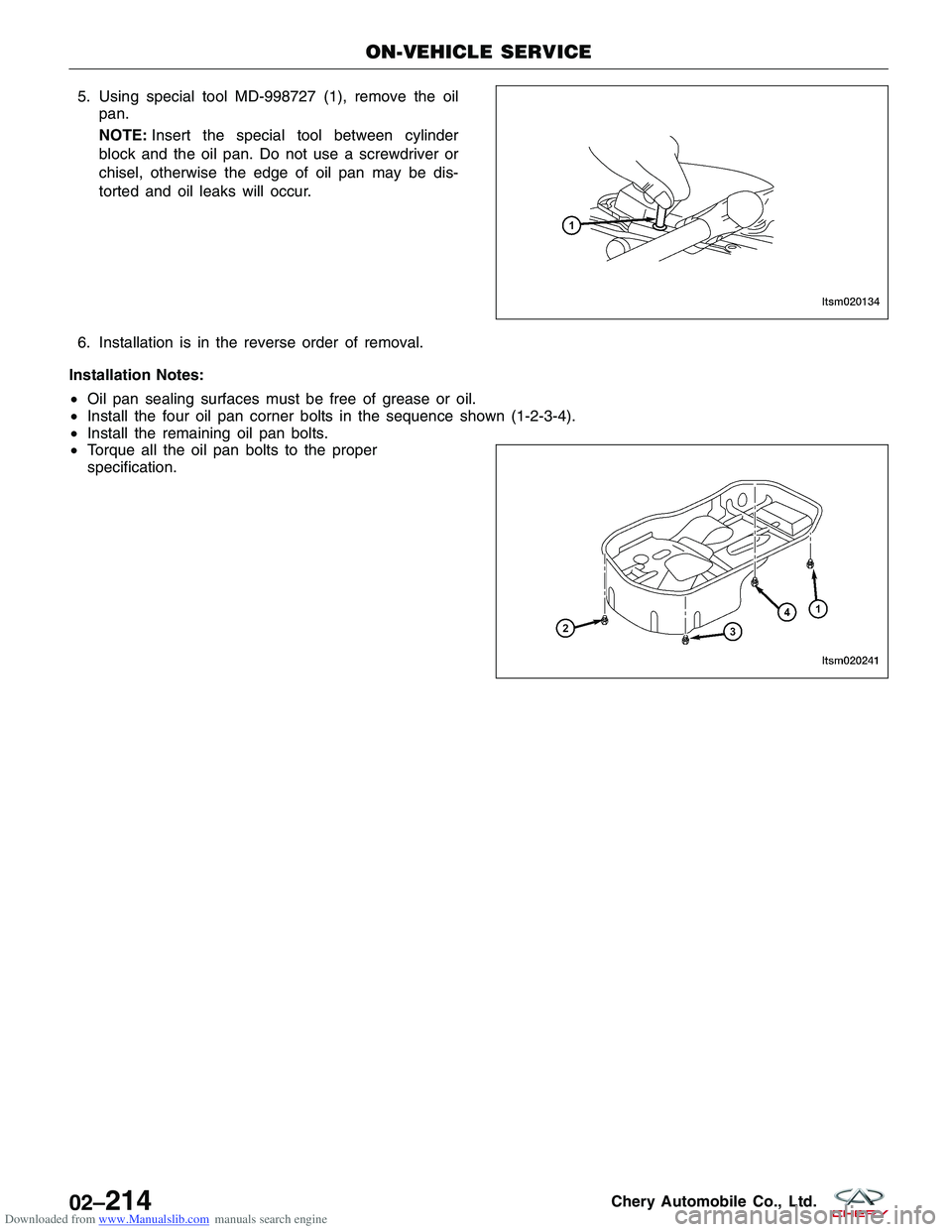
Downloaded from www.Manualslib.com manuals search engine 5. Using special tool MD-998727 (1), remove the oilpan.
NOTE: Insert the special tool between cylinder
block and the oil pan. Do not use a screwdriver or
chisel, otherwise the edge of oil pan may be dis-
torted and oil leaks will occur.
6. Installation is in the reverse order of removal.
Installation Notes:
• Oil pan sealing surfaces must be free of grease or oil.
• Install the four oil pan corner bolts in the sequence shown (1-2-3-4).
• Install the remaining oil pan bolts.
• Torque all the oil pan bolts to the proper
specification.
ON-VEHICLE SERVICE
LTSM020134
LTSM020241
02–214Chery Automobile Co., Ltd.
Page 246 of 1903
Downloaded from www.Manualslib.com manuals search engine ENGINE UNIT REPAIR
Engine Block
Specifications
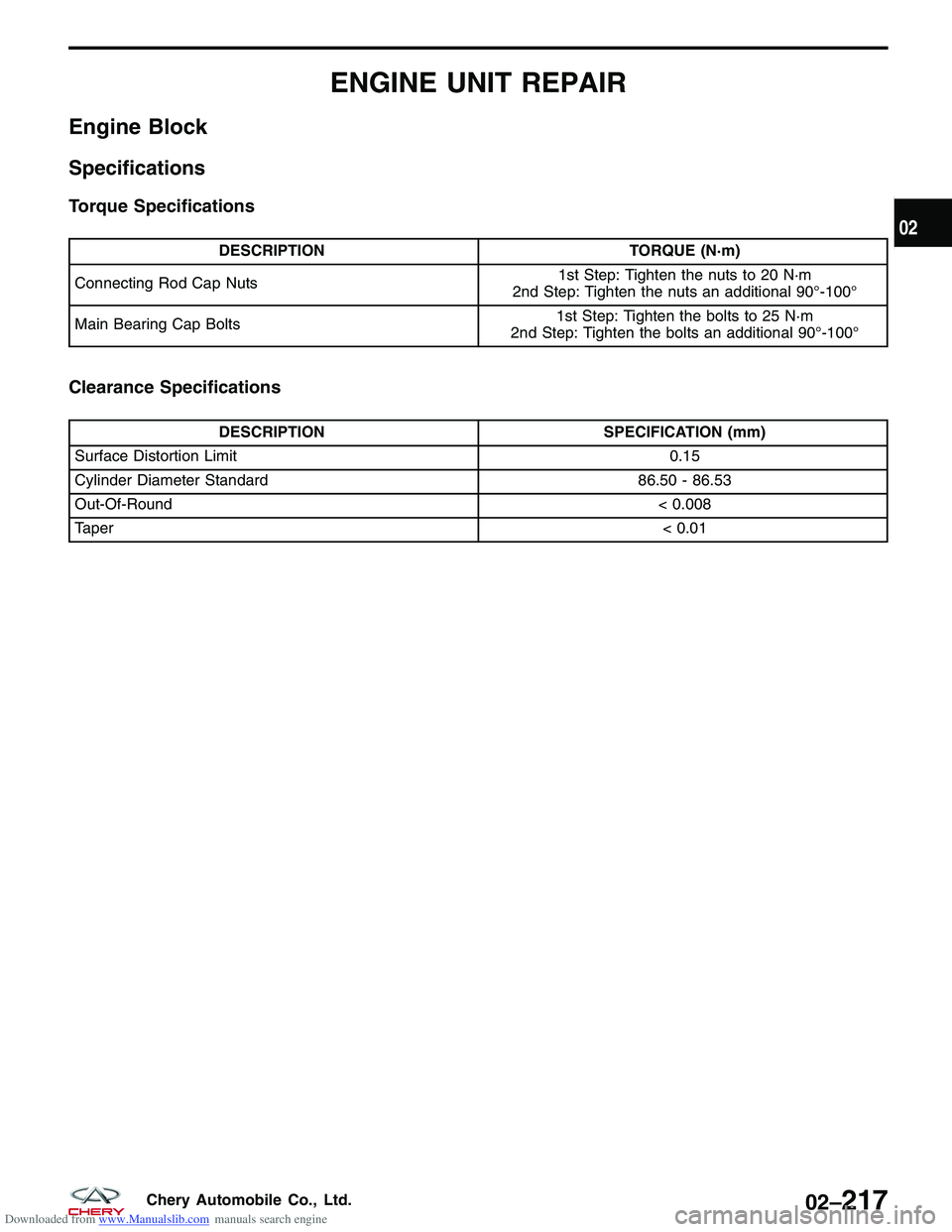
Torque Specifications
DESCRIPTIONTORQUE (N·m)
Connecting Rod Cap Nuts 1st Step: Tighten the nuts to 20 N·m
2nd Step: Tighten the nuts an additional 90°-100°
Main Bearing Cap Bolts 1st Step: Tighten the bolts to 25 N·m
2nd Step: Tighten the bolts an additional 90°-100°
Clearance Specifications
DESCRIPTION SPECIFICATION (mm)
Surface Distortion Limit 0.15
Cylinder Diameter Standard 86.50 - 86.53
Out-Of-Round < 0.008
Taper < 0.01
02
02–217Chery Automobile Co., Ltd.
Page 258 of 1903
Downloaded from www.Manualslib.com manuals search engine Connecting Rods
Specifications
Torque Specifications
DESCRIPTIONTORQUE (N·m)
Connecting Rod Nuts 1st Step: Tighten the nuts to 20 N·m
2nd Step: Tighten the nuts an additional 90°-100°
Clearance Specifications
DESCRIPTION SPECIFICATION (mm)
Connecting Rod Radial Clearance 0.016 - 0.051
Connecting Rod Axial Clearance 0.002 - 0.013
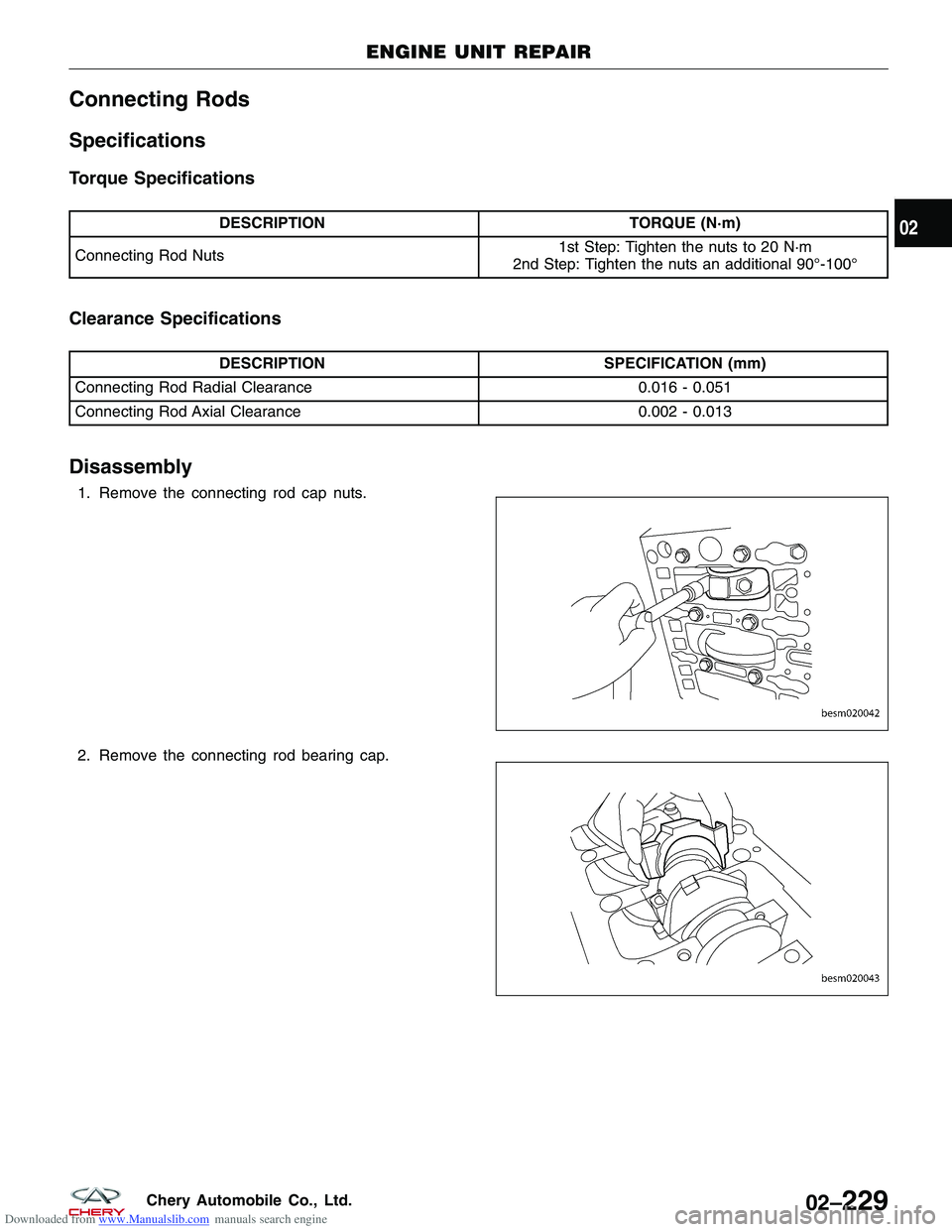
Disassembly
1. Remove the connecting rod cap nuts.
2. Remove the connecting rod bearing cap.
ENGINE UNIT REPAIR
BESM020042
BESM020043
02
02–229Chery Automobile Co., Ltd.
Page 259 of 1903
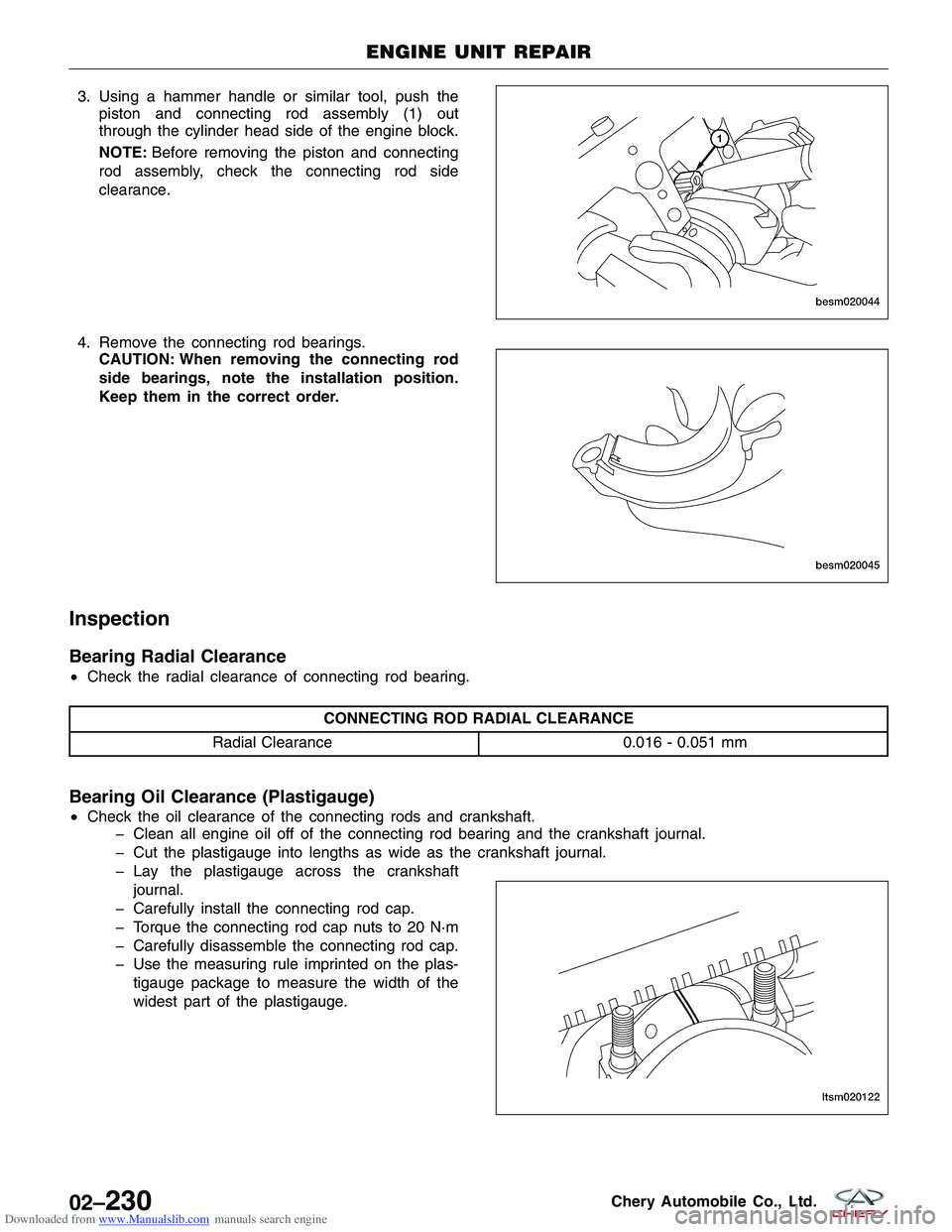
Downloaded from www.Manualslib.com manuals search engine 3. Using a hammer handle or similar tool, push thepiston and connecting rod assembly (1) out
through the cylinder head side of the engine block.
NOTE: Before removing the piston and connecting
rod assembly, check the connecting rod side
clearance.
4. Remove the connecting rod bearings. CAUTION: When removing the connecting rod
side bearings, note the installation position.
Keep them in the correct order.
Inspection
Bearing Radial Clearance
•Check the radial clearance of connecting rod bearing.
CONNECTING ROD RADIAL CLEARANCE
Radial Clearance 0.016 - 0.051 mm
Bearing Oil Clearance (Plastigauge)
•Check the oil clearance of the connecting rods and crankshaft.
Clean all engine oil off of the connecting rod bearing and the crankshaft journal.
Cut the plastigauge into lengths as wide as the crankshaft journal.
Lay the plastigauge across the crankshaft
journal.
Carefully install the connecting rod cap.
Torque the connecting rod cap nuts to 20 N·m
Carefully disassemble the connecting rod cap.
Use the measuring rule imprinted on the plas- tigauge package to measure the width of the
widest part of the plastigauge.
ENGINE UNIT REPAIR
BESM020044
BESM020045
LTSM020122
02–230Chery Automobile Co., Ltd.