Oil motor CHERY TIGGO 2009 Service Repair Manual
[x] Cancel search | Manufacturer: CHERY, Model Year: 2009, Model line: TIGGO, Model: CHERY TIGGO 2009Pages: 1903, PDF Size: 33.38 MB
Page 14 of 1903
Downloaded from www.Manualslib.com manuals search engine INTERNATIONAL SYMBOLS
International Symbols
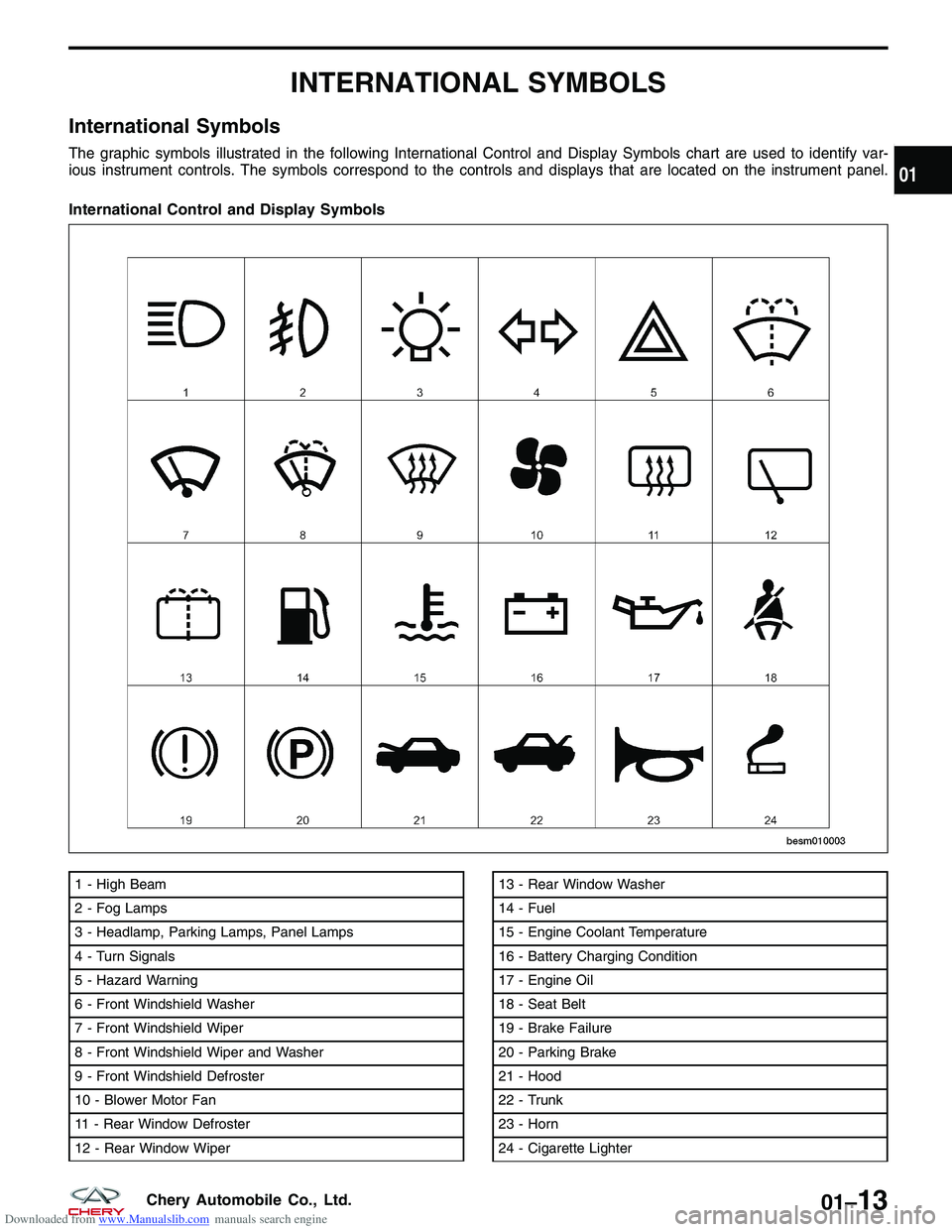
The graphic symbols illustrated in the following International Control and Display Symbols chart are used to identify var-
ious instrument controls. The symbols correspond to the controls and displays that are located on the instrument panel.
International Control and Display Symbols
1 - High Beam
2 - Fog Lamps
3 - Headlamp, Parking Lamps, Panel Lamps
4 - Turn Signals
5 - Hazard Warning
6 - Front Windshield Washer
7 - Front Windshield Wiper
8 - Front Windshield Wiper and Washer
9 - Front Windshield Defroster
10 - Blower Motor Fan
11 - Rear Window Defroster
12 - Rear Window Wiper13 - Rear Window Washer
14 - Fuel
15 - Engine Coolant Temperature
16 - Battery Charging Condition
17 - Engine Oil
18 - Seat Belt
19 - Brake Failure
20 - Parking Brake
21 - Hood
22 - Trunk
23 - Horn
24 - Cigarette Lighter
BESM010003
01
01–13Chery Automobile Co., Ltd.
Page 26 of 1903
Downloaded from www.Manualslib.com manuals search engine HOW TO LOCATE ELECTRICAL SCHEMATICS IN THESERVICE MANUAL
Electrical Schematic Index
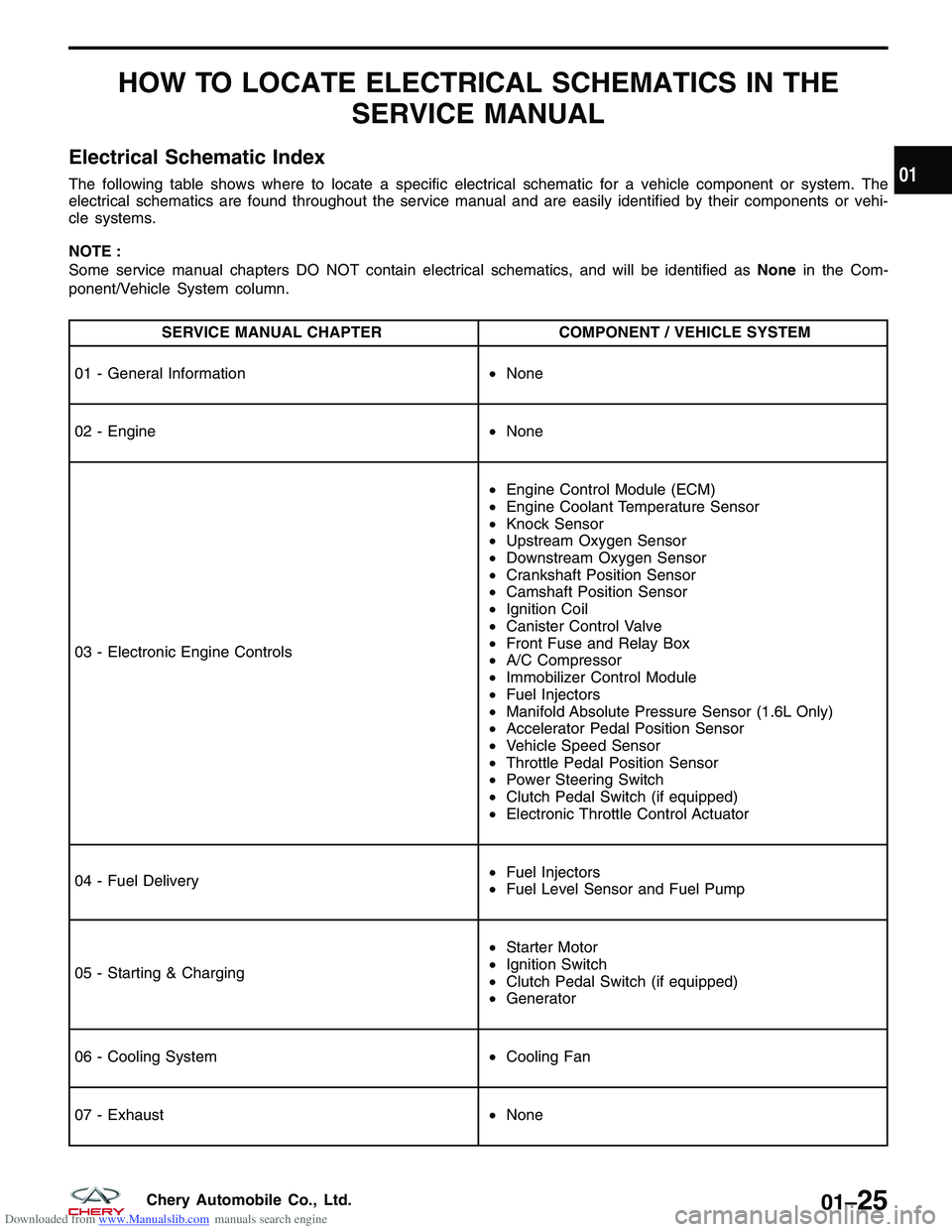
The following table shows where to locate a specific electrical schematic for a vehicle component or system. The
electrical schematics are found throughout the service manual and are easily identified by their components or vehi-
cle systems.
NOTE :
Some service manual chapters DO NOT contain electrical schematics, and will be identified as Nonein the Com-
ponent/Vehicle System column.
SERVICE MANUAL CHAPTER COMPONENT / VEHICLE SYSTEM
01 - General Information •None
02 - Engine •None
03 - Electronic Engine Controls •
Engine Control Module (ECM)
• Engine Coolant Temperature Sensor
• Knock Sensor
• Upstream Oxygen Sensor
• Downstream Oxygen Sensor
• Crankshaft Position Sensor
• Camshaft Position Sensor
• Ignition Coil
• Canister Control Valve
• Front Fuse and Relay Box
• A/C Compressor
• Immobilizer Control Module
• Fuel Injectors
• Manifold Absolute Pressure Sensor (1.6L Only)
• Accelerator Pedal Position Sensor
• Vehicle Speed Sensor
• Throttle Pedal Position Sensor
• Power Steering Switch
• Clutch Pedal Switch (if equipped)
• Electronic Throttle Control Actuator
04 - Fuel Delivery •
Fuel Injectors
• Fuel Level Sensor and Fuel Pump
05 - Starting & Charging •
Starter Motor
• Ignition Switch
• Clutch Pedal Switch (if equipped)
• Generator
06 - Cooling System •Cooling Fan
07 - Exhaust •None
01
01–25Chery Automobile Co., Ltd.
Page 28 of 1903
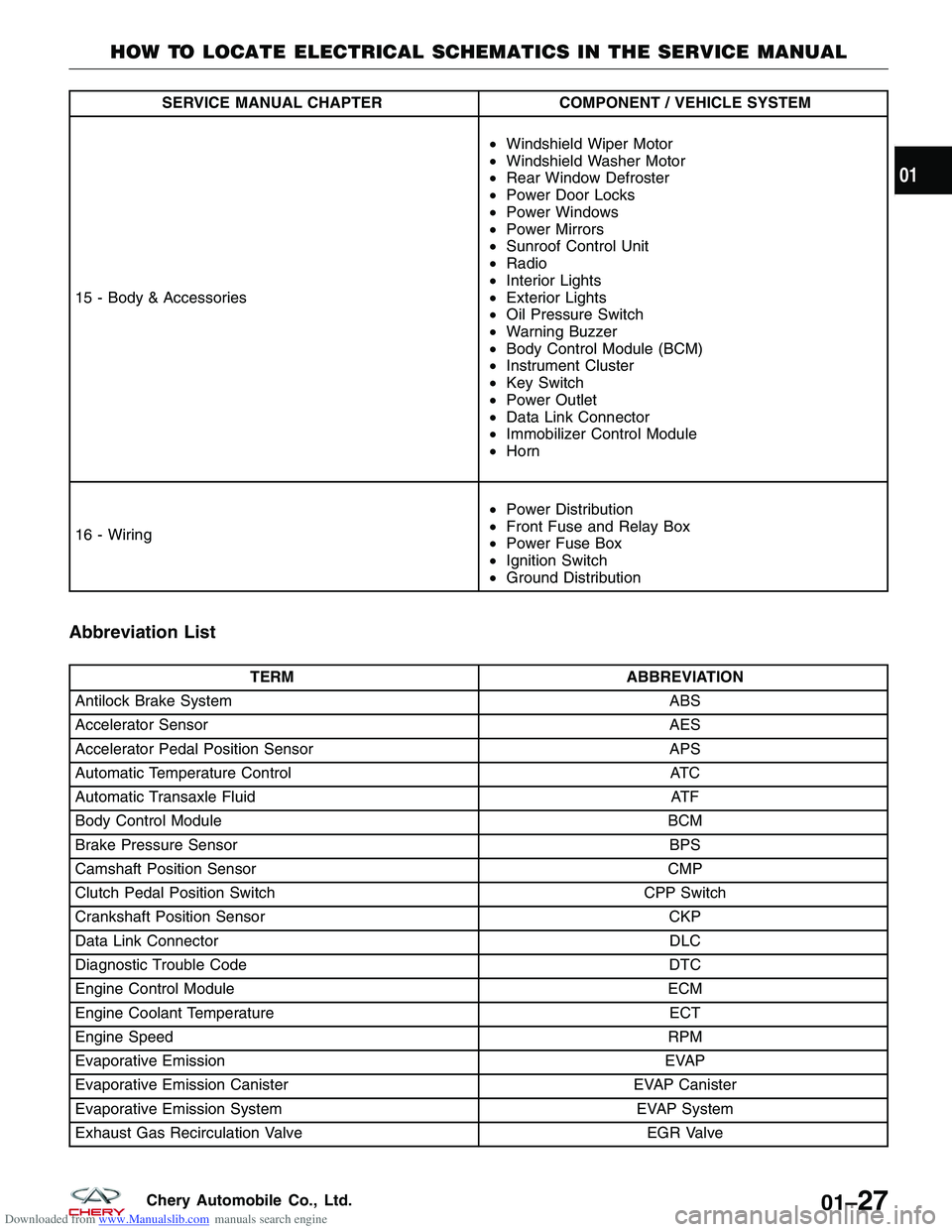
Downloaded from www.Manualslib.com manuals search engine SERVICE MANUAL CHAPTERCOMPONENT / VEHICLE SYSTEM
15 - Body & Accessories •
Windshield Wiper Motor
• Windshield Washer Motor
• Rear Window Defroster
• Power Door Locks
• Power Windows
• Power Mirrors
• Sunroof Control Unit
• Radio
• Interior Lights
• Exterior Lights
• Oil Pressure Switch
• Warning Buzzer
• Body Control Module (BCM)
• Instrument Cluster
• Key Switch
• Power Outlet
• Data Link Connector
• Immobilizer Control Module
• Horn
16 - Wiring •
Power Distribution
• Front Fuse and Relay Box
• Power Fuse Box
• Ignition Switch
• Ground Distribution
Abbreviation List
TERM ABBREVIATION
Antilock Brake System ABS
Accelerator Sensor AES
Accelerator Pedal Position Sensor APS
Automatic Temperature Control ATC
Automatic Transaxle Fluid ATF
Body Control Module BCM
Brake Pressure Sensor BPS
Camshaft Position Sensor CMP
Clutch Pedal Position Switch CPP Switch
Crankshaft Position Sensor CKP
Data Link Connector DLC
Diagnostic Trouble Code DTC
Engine Control Module ECM
Engine Coolant Temperature ECT
Engine Speed RPM
Evaporative Emission EVAP
Evaporative Emission Canister EVAP Canister
Evaporative Emission System EVAP System
Exhaust Gas Recirculation Valve EGR Valve
HOW TO LOCATE ELECTRICAL SCHEMATICS IN THE SERVICE MANUAL
01
01–27Chery Automobile Co., Ltd.
Page 45 of 1903
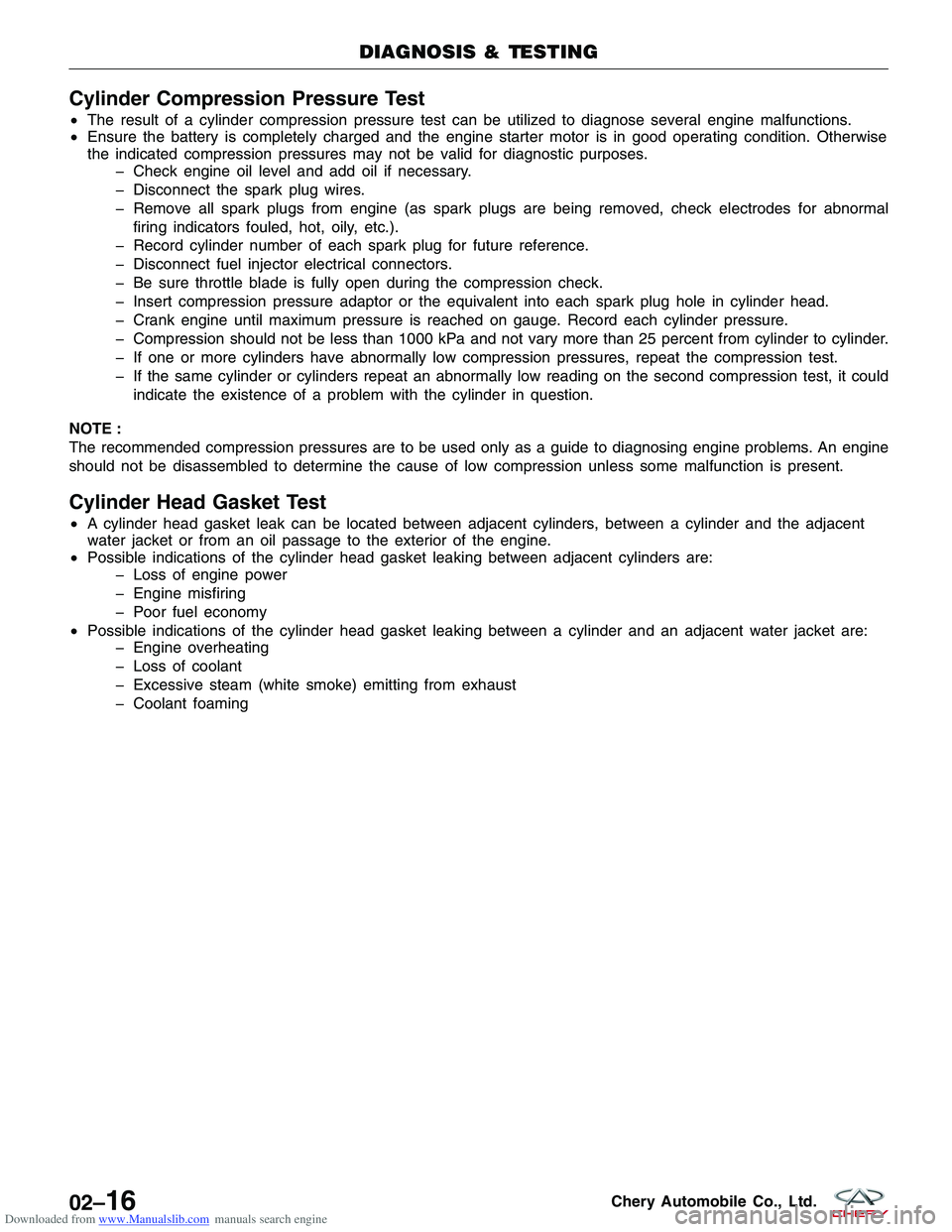
Downloaded from www.Manualslib.com manuals search engine Cylinder Compression Pressure Test
•The result of a cylinder compression pressure test can be utilized to diagnose several engine malfunctions.
• Ensure the battery is completely charged and the engine starter motor is in good operating condition. Otherwise
the indicated compression pressures may not be valid for diagnostic purposes.
Check engine oil level and add oil if necessary.
Disconnect the spark plug wires.
Remove all spark plugs from engine (as spark plugs are being removed, check electrodes for abnormal
firing indicators fouled, hot, oily, etc.).
Record cylinder number of each spark plug for future reference.
Disconnect fuel injector electrical connectors.
Be sure throttle blade is fully open during the compression check.
Insert compression pressure adaptor or the equivalent into each spark plug hole in cylinder head.
Crank engine until maximum pressure is reached on gauge. Record each cylinder pressure.
Compression should not be less than 1000 kPa and not vary more than 25 percent from cylinder to cylinder.
If one or more cylinders have abnormally low compression pressures, repeat the compression test.
If the same cylinder or cylinders repeat an abnormally low reading on the second compression test, it could indicate the existence of a problem with the cylinder in question.
NOTE :
The recommended compression pressures are to be used only as a guide to diagnosing engine problems. An engine
should not be disassembled to determine the cause of low compression unless some malfunction is present.
Cylinder Head Gasket Test
• A cylinder head gasket leak can be located between adjacent cylinders, between a cylinder and the adjacent
water jacket or from an oil passage to the exterior of the engine.
• Possible indications of the cylinder head gasket leaking between adjacent cylinders are:
Loss of engine power
Engine misfiring
Poor fuel economy
• Possible indications of the cylinder head gasket leaking between a cylinder and an adjacent water jacket are:
Engine overheating
Loss of coolant
Excessive steam (white smoke) emitting from exhaust
Coolant foaming
DIAGNOSIS & TESTING
02–16Chery Automobile Co., Ltd.
Page 119 of 1903
Downloaded from www.Manualslib.com manuals search engine Cylinder Compression Pressure Test
•The result of a cylinder compression pressure test can be utilized to diagnose several engine malfunctions.
• Ensure the battery is completely charged and the engine starter motor is in good operating condition. Otherwise
the indicated compression pressures may not be valid for diagnostic purposes.
Check engine oil level and add oil if necessary.
Disconnect the spark plug wires.
Remove all spark plugs from engine (as spark plugs are being removed, check electrodes for abnormal
firing indicators fouled, hot, oily, etc.).
Record cylinder number of each spark plug for future reference.
Disconnect fuel injector electrical connectors.
Be sure throttle blade is fully open during the compression check.
Insert compression pressure adaptor or the equivalent into each spark plug hole in cylinder head.
Crank engine until maximum pressure is reached on gauge. Record each cylinder pressure.
Compression should not be less than 1000 kPa and not vary more than 25 percent from cylinder to cylinder.
If one or more cylinders have abnormally low compression pressures, repeat the compression test.
If the same cylinder or cylinders repeat an abnormally low reading on the second compression test, it could indicate the existence of a problem with the cylinder in question.
NOTE :
The recommended compression pressures are to be used only as a guide to diagnosing engine problems. An engine
should not be disassembled to determine the cause of low compression unless some malfunction is present.
Cylinder Head Gasket Test
• A cylinder head gasket leak can be located between adjacent cylinders, between a cylinder and the adjacent
water jacket or from an oil passage to the exterior of the engine.
• Possible indications of the cylinder head gasket leaking between adjacent cylinders are:
Loss of engine power
Engine misfiring
Poor fuel economy
• Possible indications of the cylinder head gasket leaking between a cylinder and an adjacent water jacket are:
Engine overheating
Loss of coolant
Excessive steam (white smoke) emitting from exhaust
Coolant foaming
DIAGNOSIS & TESTING
02–90Chery Automobile Co., Ltd.
Page 194 of 1903
Downloaded from www.Manualslib.com manuals search engine CONDITIONPOSSIBLE CAUSES CORRECTION
Oil Pressure Drop 1. Low oil level.
2. Faulty oil pressure sending unit.
3. Low oil pressure.
4. Clogged oil filter.
5. Thin or diluted oil.
6. Excessive bearing clearance.1. Check engine oil level.
2. Install new sending unit.
3. Check sending unit and main
bearing oil clearance.
4. Install new oil filter.
5. Change oil to correct viscosity.
6. Measure bearings for correct
clearance.
Oil Leaks 1. Misaligned or deteriorated
gaskets.
2. Loose fastener, broken or porous
metal part.
3. Misaligned or deteriorated cup or
threaded plug.1. Replace gasket.
2. Tighten, repair or replace the part.
3. Replace if necessary.
Oil Consumption Or Spark Plugs
Fouled 1. PCV system malfunction.
2. Worn, scuffed or broken rings.
3. Carbon in oil ring slots.
4. Rings fitted too tightly in grooves.
5. Worn valve guide(s).
6. Valve stem seal(s) worn or
damaged.1. Check system and repair if
necessary.
2. Hone cylinder bores. Install new
rings.
3. Install new rings.
4. Remove rings and check grooves.
If groove is not proper width, replace
piston.
5. Replace cylinder head.
6. Replace seal(s).
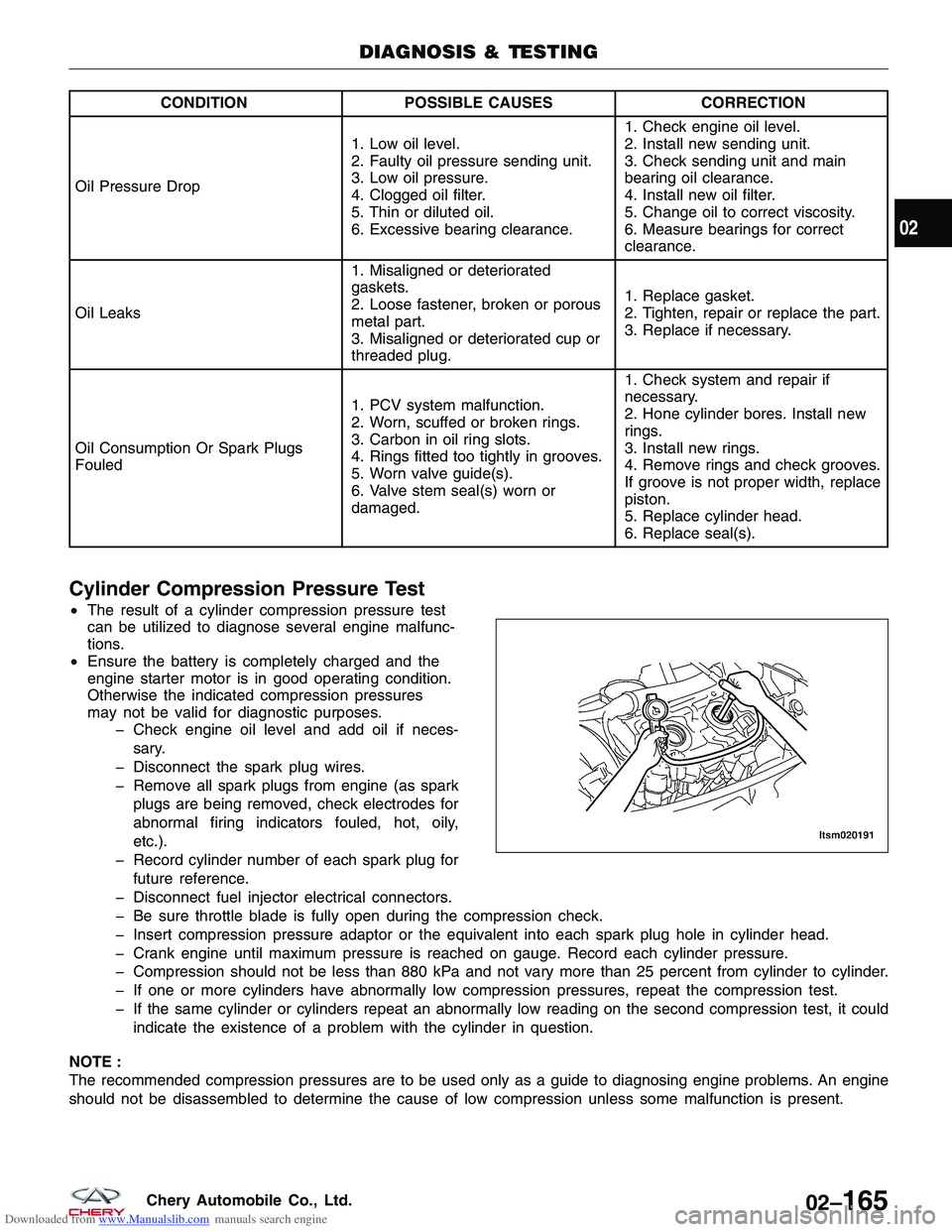
Cylinder Compression Pressure Test
•
The result of a cylinder compression pressure test
can be utilized to diagnose several engine malfunc-
tions.
• Ensure the battery is completely charged and the
engine starter motor is in good operating condition.
Otherwise the indicated compression pressures
may not be valid for diagnostic purposes.
Check engine oil level and add oil if neces-
sary.
Disconnect the spark plug wires.
Remove all spark plugs from engine (as spark plugs are being removed, check electrodes for
abnormal firing indicators fouled, hot, oily,
etc.).
Record cylinder number of each spark plug for future reference.
Disconnect fuel injector electrical connectors.
Be sure throttle blade is fully open during the compression check.
Insert compression pressure adaptor or the equivalent into each spark plug hole in cylinder head.
Crank engine until maximum pressure is reached on gauge. Record each cylinder pressure.
Compression should not be less than 880 kPa and not vary more than 25 percent from cylinder to cylinder.
If one or more cylinders have abnormally low compression pressures, repeat the compression test.
If the same cylinder or cylinders repeat an abnormally low reading on the second compression test, it could indicate the existence of a problem with the cylinder in question.
NOTE :
The recommended compression pressures are to be used only as a guide to diagnosing engine problems. An engine
should not be disassembled to determine the cause of low compression unless some malfunction is present.
DIAGNOSIS & TESTING
LTSM020191
02
02–165Chery Automobile Co., Ltd.
Page 213 of 1903
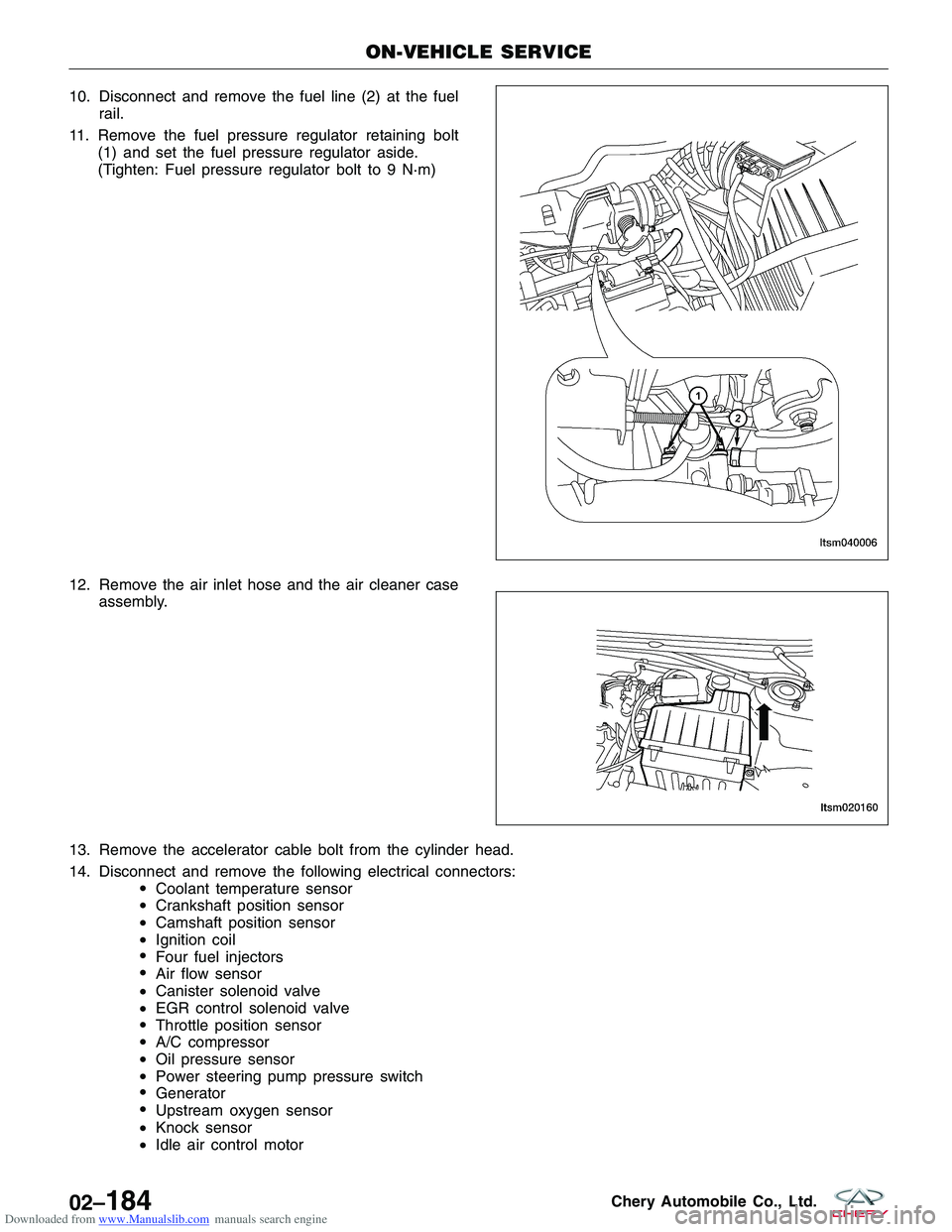
Downloaded from www.Manualslib.com manuals search engine 10.Disconnectandremovethefuelline(2)atthefuel
rail.
11.Removethefuelpressureregulatorretainingbolt
(1)andsetthefuelpressureregulatoraside.
(Tighten:Fuelpressureregulatorboltto9N·m)
12.Removetheairinlethoseandtheaircleanercase
assembly.
13.Removetheacceleratorcableboltfromthecylinderhead.
14.Disconnectandremovethefollowingelectricalconnectors:
Coolanttemperaturesensor
Crankshaftpositionsensor
Camshaftpositionsensor
Ignitioncoil
Fourfuelinjectors
Airflowsensor
Canistersolenoidvalve
EGRcontrolsolenoidvalve
Throttlepositionsensor
A/Ccompressor
Oilpressuresensor
Powersteeringpumppressureswitch
Generator
Upstreamoxygensensor
Knocksensor
Idleaircontrolmotor
ON-VEHICLESERVICE
LTSM040006
LTSM020160
02–184CheryAutomobileCo.,Ltd.
Page 903 of 1903
Downloaded from www.Manualslib.com manuals search engine DIAGNOSIS AND TESTING
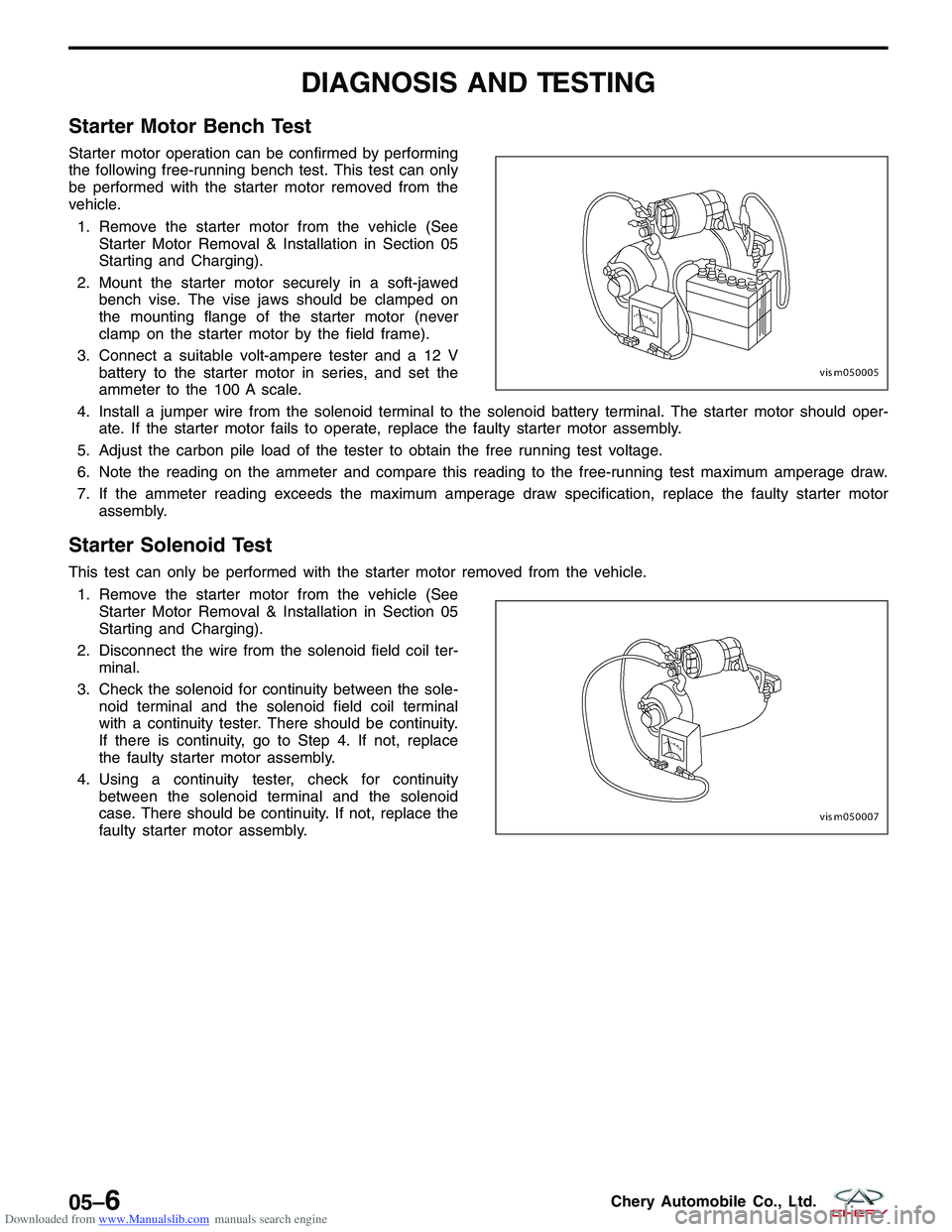
Starter Motor Bench Test
Starter motor operation can be confirmed by performing
the following free-running bench test. This test can only
be performed with the starter motor removed from the
vehicle.1. Remove the starter motor from the vehicle (See Starter Motor Removal & Installation in Section 05
Starting and Charging).
2. Mount the starter motor securely in a soft-jawed bench vise. The vise jaws should be clamped on
the mounting flange of the starter motor (never
clamp on the starter motor by the field frame).
3. Connect a suitable volt-ampere tester and a 12 V battery to the starter motor in series, and set the
ammeter to the 100 A scale.
4. Install a jumper wire from the solenoid terminal to the solenoid battery terminal. The starter motor should oper- ate. If the starter motor fails to operate, replace the faulty starter motor assembly.
5. Adjust the carbon pile load of the tester to obtain the free running test voltage.
6. Note the reading on the ammeter and compare this reading to the free-running test maximum amperage draw.
7. If the ammeter reading exceeds the maximum amperage draw specification, replace the faulty starter motor assembly.
Starter Solenoid Test
This test can only be performed with the starter motor removed from the vehicle.
1. Remove the starter motor from the vehicle (See Starter Motor Removal & Installation in Section 05
Starting and Charging).
2. Disconnect the wire from the solenoid field coil ter- minal.
3. Check the solenoid for continuity between the sole- noid terminal and the solenoid field coil terminal
with a continuity tester. There should be continuity.
If there is continuity, go to Step 4. If not, replace
the faulty starter motor assembly.
4. Using a continuity tester, check for continuity between the solenoid terminal and the solenoid
case. There should be continuity. If not, replace the
faulty starter motor assembly.
VISM050005
VISM050007
05–6Chery Automobile Co., Ltd.
Page 906 of 1903
Downloaded from www.Manualslib.com manuals search engine Battery Tray
Removal & Installation
1. Disconnect the negative battery cable.
2. Disconnect the positive battery cable.
3. Remove the battery hold down.
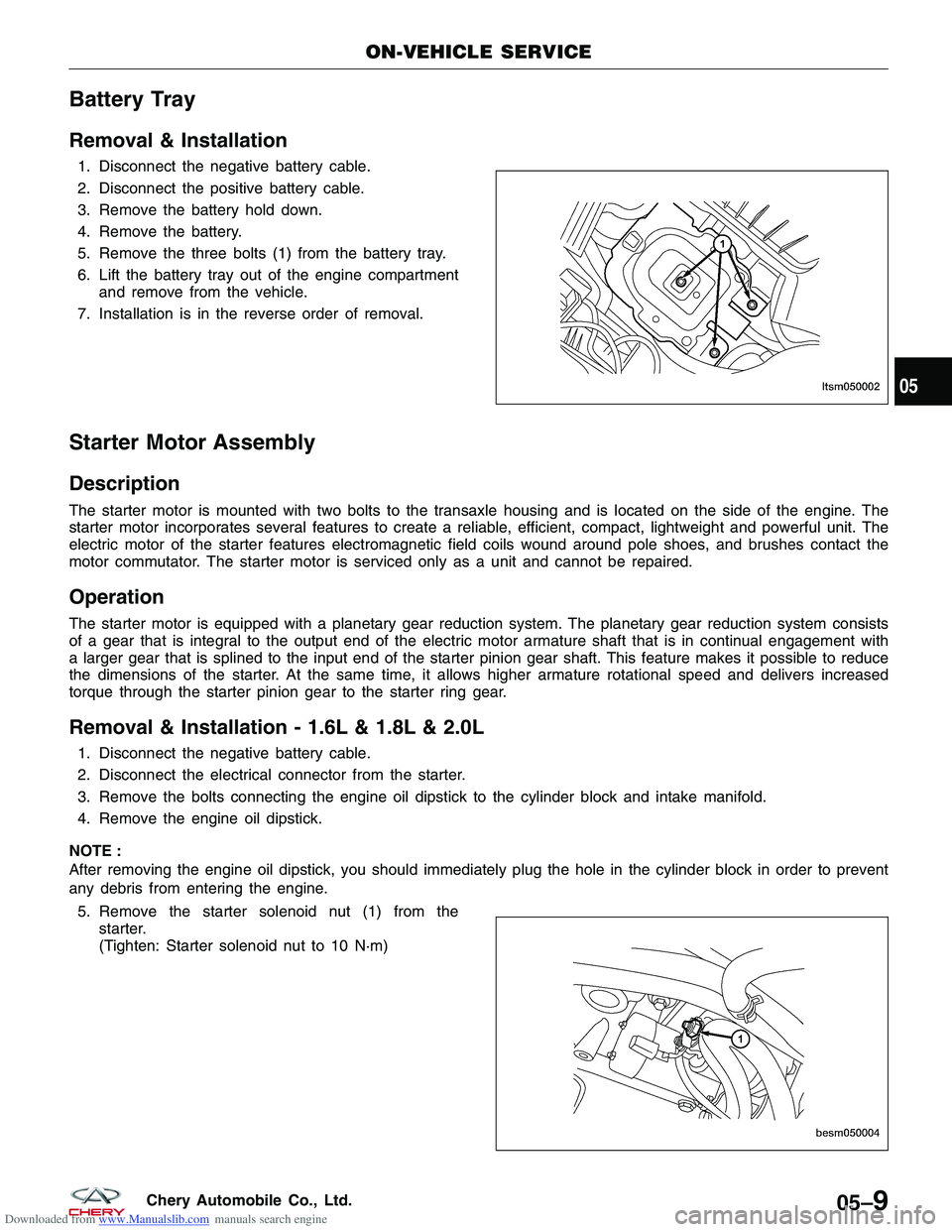
4. Remove the battery.
5. Remove the three bolts (1) from the battery tray.
6. Lift the battery tray out of the engine compartmentand remove from the vehicle.
7. Installation is in the reverse order of removal.
Starter Motor Assembly
Description
The starter motor is mounted with two bolts to the transaxle housing and is located on the side of the engine. The
starter motor incorporates several features to create a reliable, efficient, compact, lightweight and powerful unit. The
electric motor of the starter features electromagnetic field coils wound around pole shoes, and brushes contact the
motor commutator. The starter motor is serviced only as a unit and cannot be repaired.
Operation
The starter motor is equipped with a planetary gear reduction system. The planetary gear reduction system consists
of a gear that is integral to the output end of the electric motor armature shaft that is in continual engagement with
a larger gear that is splined to the input end of the starter pinion gear shaft. This feature makes it possible to reduce
the dimensions of the starter. At the same time, it allows higher armature rotational speed and delivers increased
torque through the starter pinion gear to the starter ring gear.
Removal & Installation - 1.6L & 1.8L & 2.0L
1. Disconnect the negative battery cable.
2. Disconnect the electrical connector from the starter.
3. Remove the bolts connecting the engine oil dipstick to the cylinder block and intake manifold.
4. Remove the engine oil dipstick.
NOTE :
After removing the engine oil dipstick, you should immediately plug the hole in the cylinder block in order to prevent
any debris from entering the engine. 5. Remove the starter solenoid nut (1) from the starter.
(Tighten: Starter solenoid nut to 10 N·m)
ON-VEHICLE SERVICE
LTSM050002
BESM050004
05
05–9Chery Automobile Co., Ltd.
Page 1398 of 1903
Downloaded from www.Manualslib.com manuals search engine Rear Disc Brake
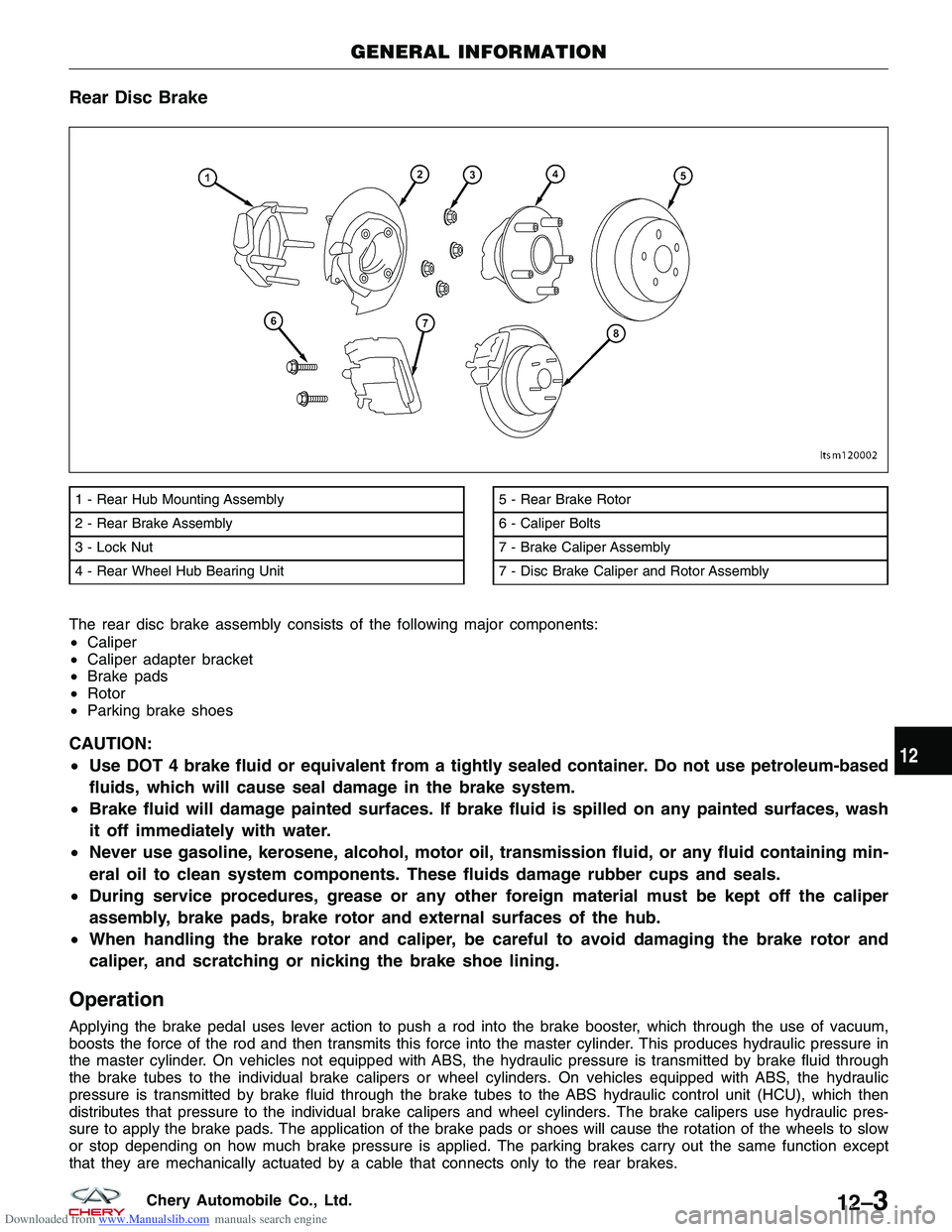
The rear disc brake assembly consists of the following major components:
•Caliper
• Caliper adapter bracket
• Brake pads
• Rotor
• Parking brake shoes
CAUTION:
•Use DOT 4 brake fluid or equivalent from a tightly sealed container. Do not use petroleum-based
fluids, which will cause seal damage in the brake system.
• Brake fluid will damage painted surfaces. If brake fluid is spilled on any painted surfaces, wash
it off immediately with water.
• Never use gasoline, kerosene, alcohol, motor oil, transmission fluid, or any fluid containing min-
eral oil to clean system components. These fluids damage rubber cups and seals.
• During service procedures, grease or any other foreign material must be kept off the caliper
assembly, brake pads, brake rotor and external surfaces of the hub.
• When handling the brake rotor and caliper, be careful to avoid damaging the brake rotor and
caliper, and scratching or nicking the brake shoe lining.
Operation
Applying the brake pedal uses lever action to push a rod into the brake booster, which through the use of vacuum,
boosts the force of the rod and then transmits this force into the master cylinder. This produces hydraulic pressure in
the master cylinder. On vehicles not equipped with ABS, the hydraulic pressure is transmitted by brake fluid through
the brake tubes to the individual brake calipers or wheel cylinders. On vehicles equipped with ABS, the hydraulic
pressure is transmitted by brake fluid through the brake tubes to the ABS hydraulic control unit (HCU), which then
distributes that pressure to the individual brake calipers and wheel cylinders. The brake calipers use hydraulic pres-
sure to apply the brake pads. The application of the brake pads or shoes will cause the rotation of the wheels to slow
or stop depending on how much brake pressure is applied. The parking brakes carry out the same function except
that they are mechanically actuated by a cable that connects only to the rear brakes.
1 - Rear Hub Mounting Assembly
2 - Rear Brake Assembly
3 - Lock Nut
4 - Rear Wheel Hub Bearing Unit5 - Rear Brake Rotor
6 - Caliper Bolts
7 - Brake Caliper Assembly
7 - Disc Brake Caliper and Rotor Assembly
GENERAL INFORMATION
LTSM120002
12
12–3Chery Automobile Co., Ltd.