lock CHEVROLET ASTRO 1998 2.G Owner's Guide
[x] Cancel search | Manufacturer: CHEVROLET, Model Year: 1998, Model line: ASTRO, Model: CHEVROLET ASTRO 1998 2.GPages: 414, PDF Size: 21.46 MB
Page 110 of 414
Downloaded from www.Manualslib.com manuals search engine Shifting Out of PARK (P)
Your vehicle has a brake-transmission shift interlock.
You have
to fully apply your regular brake before you
can shift from PARK (P) when the ignition is in the
RUN position. See "Automatic Transmission" in
the Index.
If you cannot shift out of PARK (P), ease pressure on
the shift lever
-- push the shift lever all the way into
PARK
(P) as you maintain brake application. Then
move the shift lever into the gear you want.
If you ever hold the brake pedal down but still can't
shift out of PARK
(P), try this:
1. Turn the key to OFF.
2. Apply and hold the brake until the end of Step 4.
3. Shift to NEUTRAL (N).
4. Start the vehicle and then shift to the drive gear
you want.
5. Have the vehicle fixed as soon as you can.
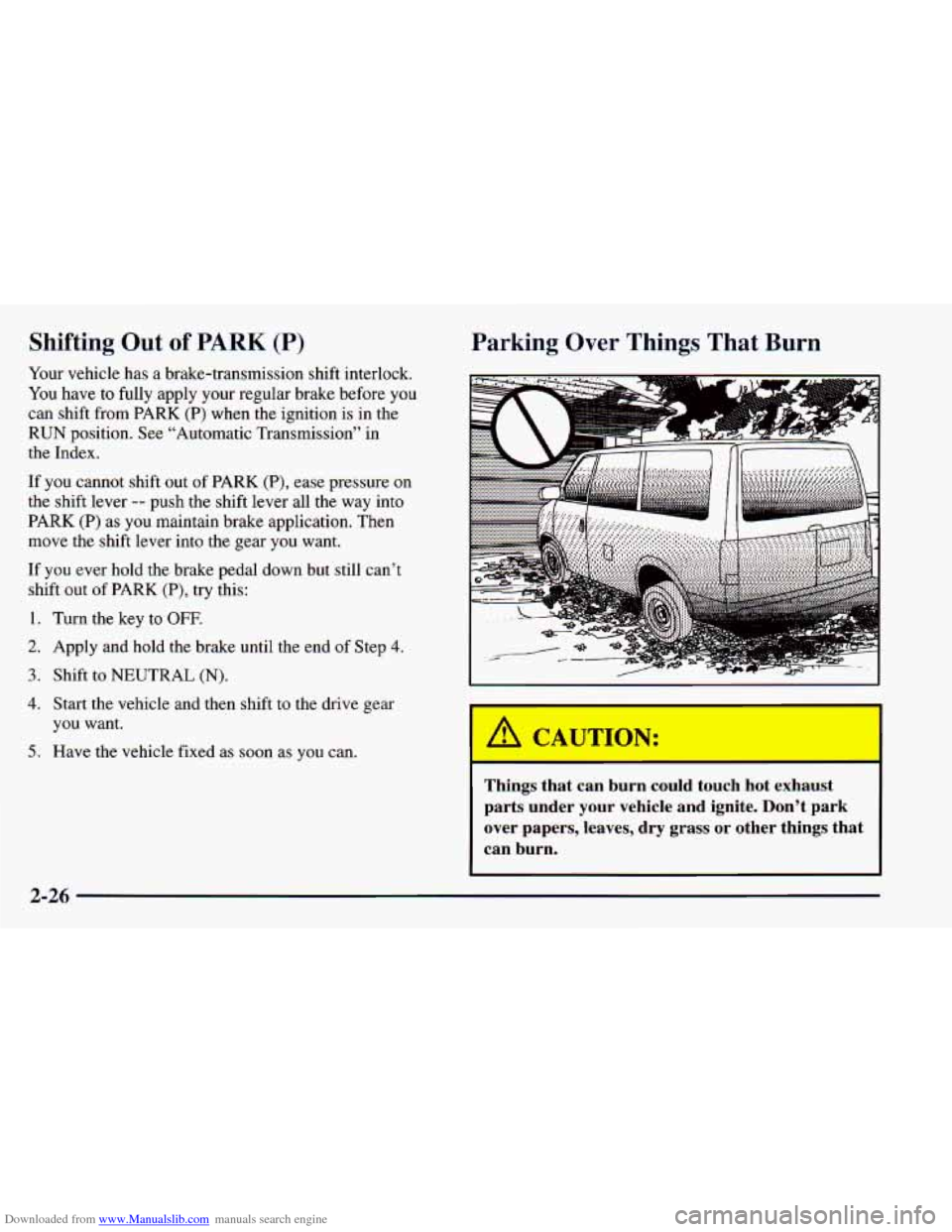
Parking Over Things That Burn
I A CAUTION:
Y
Things that can burn could touch hot exhaust
parts under your vehicle and ignite. Don't park
over papers, leaves, dry grass or other things that
can burn.
2-26
Page 112 of 414
Downloaded from www.Manualslib.com manuals search engine A CAUTION:
It can be dangerous to get out of your vehicle if
the shift lever is not fully in
PARK (P) with the
parking brake firmly set. Your vehicle can roll.
Don’t leave your vehicle when the engine is
running unless you have to. If you’ve left the
engine running, the vehicle can move suddenly.
You or others could be injured. To be sure your
vehicle won’t move, even when you’re on
fairly
level ground, always set your parking brake and
move the shift lever to
PARK (P).
Locking Rear Axle (Option)
If you have this feature, your locking rear axle can give
you additional traction on snow, mud, ice, sand or
gravel. It works like a standard axle most of the time,
but when one
of the rear wheels has no traction and the
other does, this feature will allow the wheel with
traction to move
the vehicle.
All-Wheel Drive (Option)
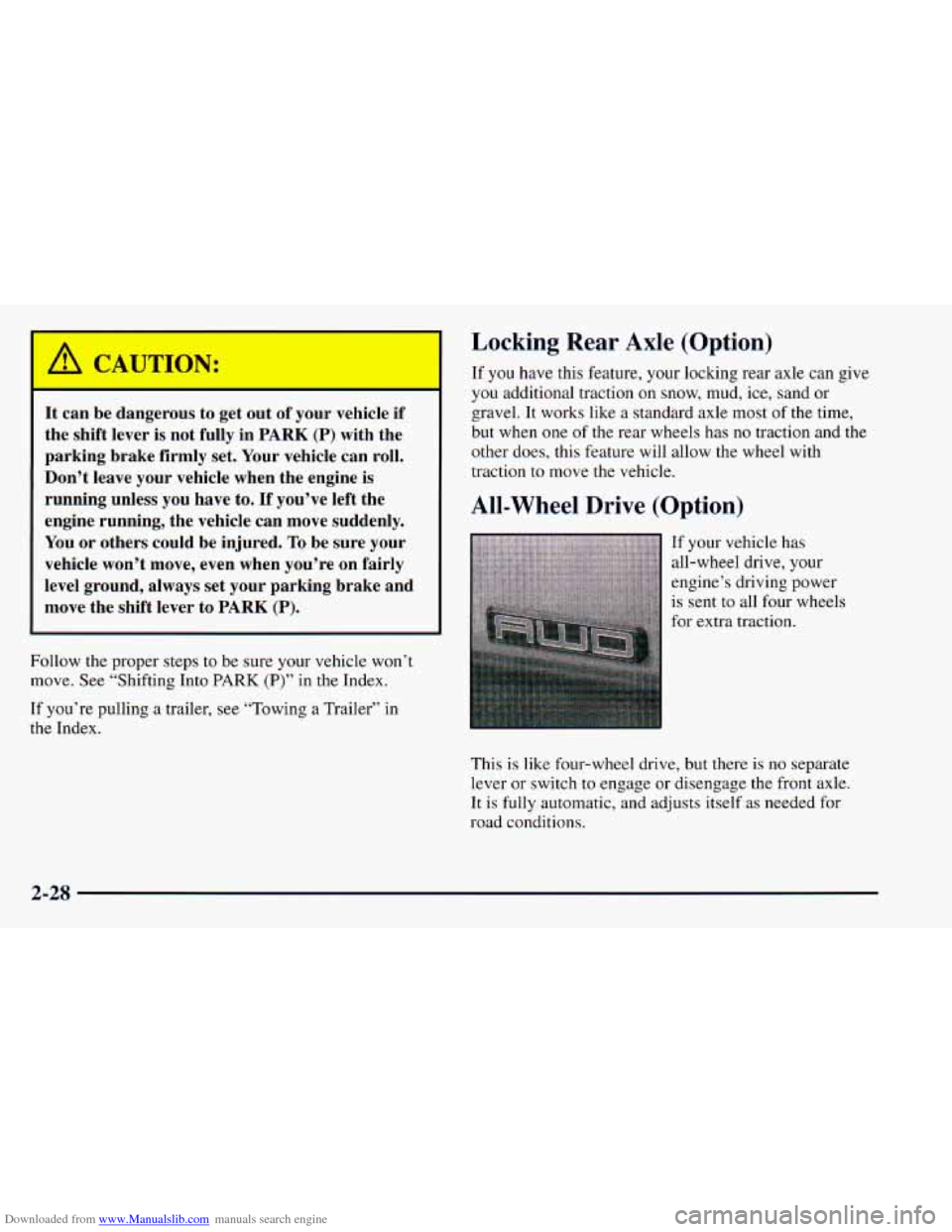
If your vehicle has
all-wheel drive, your
engine’s driving power
is sent to all four wheels
for extra traction.
Follow
the proper steps to be sure your vehicle won’t
move. See “Shifting Into
PARK (P)” in the Index.
If you’re pulling a trailer, see “Towing a Trailer’’ in
the Index.
This is like four-wheel drive, but there
is no separate
lever or switch
to engage or disengage the front axle.
It is fully automatic, and adjusts itself as needed for
road conditions.
2-2s
Page 114 of 414
Downloaded from www.Manualslib.com manuals search engine ~r-
It can be dangerous to drive with the rear
swing-out windows, rear hatch or rear doors
open because carbon monoxide (CO) gas can come into your vehicle. You can’t see or smell
CO. It can cause unconsciousness and even death.
If you must drive with the rear swing-out
windows, rear hatch or rear doors open or if
electrical wiring or other cable connections must
pass through the
seal between the body and the
rear swing-out windows, rear hatch or
rear doors:
Make sure all windows are shut.
lbrn the fan on your heating or cooling
system to its highest speed with the setting
on anything but
MAX A/C. That will force
outside
air into your vehicle. See “Comfort
Controls” in the Index.
instrument panel, open them all the way.
If you have air outlets on or under the
See “Engine Exhaust” in the Index.
Horn
To sound the horn, press the horn symbols on the
steering wheel.
Tilt Wheel (If Fqllipped]
A tilt steering wheel allows you to adjust the steering
wheel before
you drive.
You can also raise it to the highest level to give your
legs more room when you exit and enter the vehicle.
To tilt the wheel, hold the steering wheel and pull the
lever. Move
the steering wheel to a comfortable level,
then release the lever
to lock the wheel in place.
2-30
Page 117 of 414
Downloaded from www.Manualslib.com manuals search engine Windshield Washer
At the top of the multifunction lever, there’s a paddle
marked with the windshield washer symbol and
PUSH. To spray washer fluid on the windshield,
press the paddle.
I / CAUTION:
In freezing weather, don’t use your washer until
the windshield
is warmed. Otherwise the washer
fluid can form ice on the windshield, blocking
your vision.
The wipers will clear the window and then either stop or
return to your preset speed.
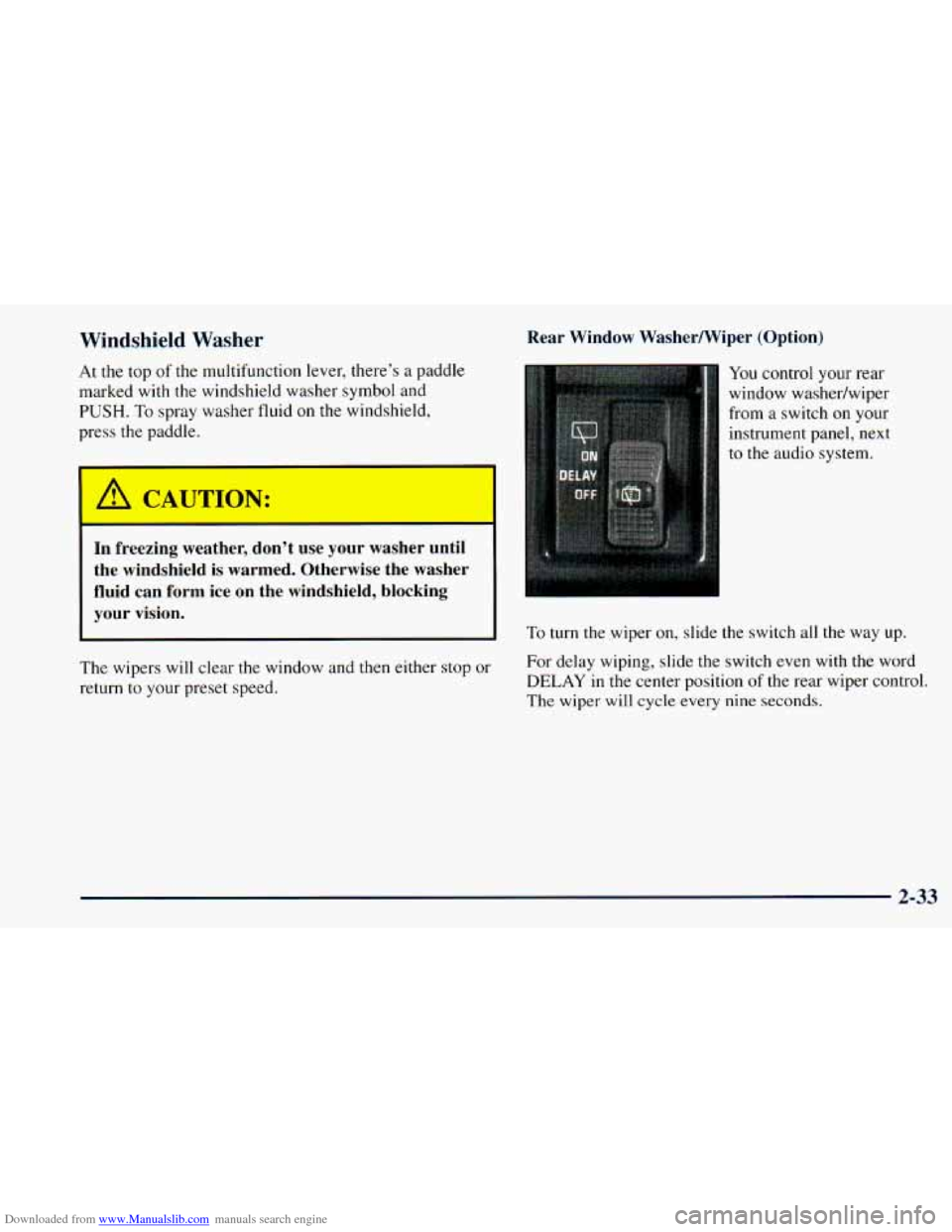
Rear Window WasherNViper (Option)
You control your rear
window washedwiper
from
a switch on your
instrument panel, next
to the audio system.
To turn the wiper on, slide the switch all the way up.
For delay wiping, slide the switch even with the word
DELAY in the center position of the rear wiper control.
The wiper will cycle every nine seconds.
2-33
Page 121 of 414
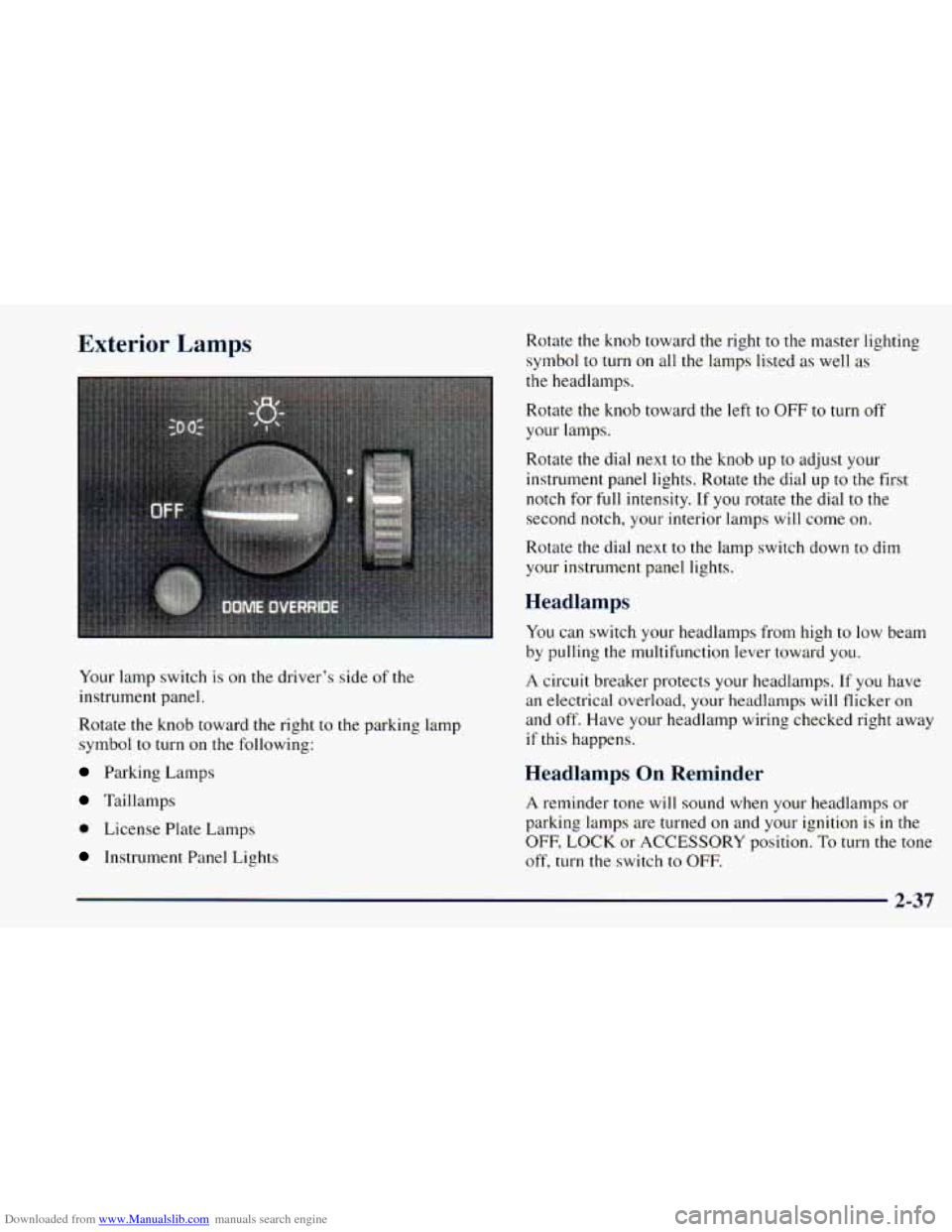
Downloaded from www.Manualslib.com manuals search engine Exterior Lamps
Your lamp switch is on the driver’s side of the
instrument panel.
Rotate the knob toward the right to
the parking lamp
symbol
to turn on the following:
Parking Lamps
Taillamps
0 License Plate Lamps
Instrument Panel Lights Rotate
the knob toward the right to the master lighting
symbol to turn on all
the lamps listed as well as
the headlamps.
Rotate the knob toward the left to
OFF to turn off
your lamps.
Rotate the dial next
to the knob up to adjust your
instrument panel lights. Rotate the dial up to
the first
notch for
full intensity. If you rotate the dial to the
second notch,
your interior lamps will come on.
Rotate
the dial next to the lamp switch down to dim
your instrument panel lights.
Headlamps
You can switch your headlamps from high to low beam
by pulling
the multifunction lever toward you.
A circuit breaker protects your headlamps. If you have
an electrical overload, your headlamps
will flicker on
and off. Have your headlamp wiring checked right away
if this happens.
Headlamps On Reminder
A reminder tone will sound when your headlamps or
parking lamps are turned
on and your ignition is in the
OFF, LOCK or ACCESSORY position. To turn the tone
off, turn
the switch to OFF.
2-37
Page 133 of 414
Downloaded from www.Manualslib.com manuals search engine NOTICE:
When using the cigarette lighter as an accessory
power outlet, maximum electrical load must not
exceed
20 amps. Always turn off any electrical
equipment when not in use. Leaving electrical
equipment on for extended periods will drain
your battery.
The front ashtray is just above the passenger’s side
front cupholder.
To remove the front ashtray, open it and gently pull it
slightly past its stop.
To remove the ashtray on the sliding door, open it, press
down
on the inside tab and pull out.
You may have another ashtray
on the driver’s sidewall.
Press
the right side to turn the ashtray around for use. To
remove the ashtray, open it and gently pull it off
the hinge.
I NOTICE:
Don’t put papers and other things that burn into
your ashtrays.
If you do, cigarettes or other
smoking materials could set them on fire,
causing damage.
Sun Visors
To block out glare, you can swing down the visors. You
can
also swing them from side to side. Your visors may
have an extension that can be pulled out for additional
glare protection and
a strap for holdinp small items,
such as maps.
Visor Vanity Mirror (If Equipped)
Some visors have mirrors built in, with or without
lamps. Just lift the mirror cover
on each visor to turn the
lamps on,
if you have them.
Lighted mirrors also have an intensity switch to make
the mirror lamps brighter or dimmer.
2-49
Page 145 of 414
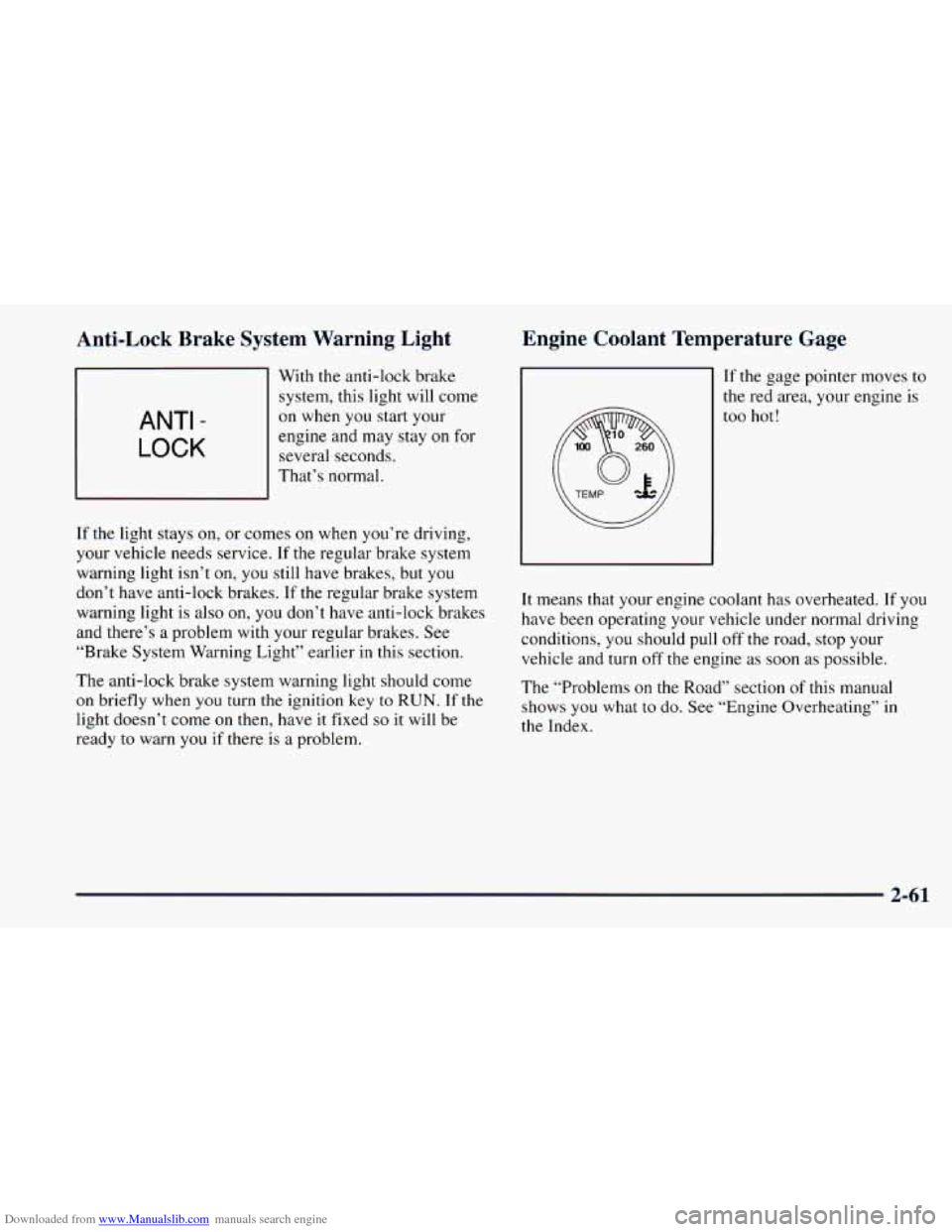
Downloaded from www.Manualslib.com manuals search engine Anti-Lock Brake System Warning Light
ANTI -
LOCK
With the anti-lock brake
system, this light will come
on when
you start your
engine and may stay
on for
several seconds.
That’s normal.
If the light stays on, or comes on when you’re driving,
your vehicle needs service.
If the regular brake system
warning light isn’t on,
you still have brakes, but you
don’t have anti-lock brakes.
If the regular brake system
warning light is also on, you don’t have anti-lock brakes
and there’s a problem with your regular brakes. See
“Brake System Warning Light’’ earlier in this section.
The anti-lock brake system warning light should come
on briefly when you turn the ignition key to RUN. If the
light doesn’t come on then, have
it fixed so it will be
ready to warn
you if there is a problem.
Engine Coolant Temperature Gage
If the gage pointer moves to
the red area, your engine
is
too hot!
It means that your engine coolant has overheated. If you
have been operating your vehicle under normal driving
conditions,
you should pull off the road, stop your
vehicle and turn off the engine as soon as possible.
The “Problems on the Road” section of this manual
shows
you what to do. See “Engine Overheating” in
the Index.
2-61
Page 149 of 414
Downloaded from www.Manualslib.com manuals search engine A CAUTION:
Don’t keep driving if the oil pressure is low. If
you do, your engine can become so hot that it
catches fire. You or others could be burned.
Check your oil as soon as possible and have your
vehicle serviced.
NOTICE:
Damage to your engine from neglected oil
problems can be costly and is not covered by
your warranty.
Security Light
This light will come on
briefly when you turn the
The light will stay on until the engine starts.
If the light
flashes, the Passlock” System has entered a tamper
mode.
If the vehicle fails to start, see “Passlock” in
the Index.
If the light comes on continuously while driving and
stays on, there may be a problem with the Passlock
System. Your vehicle will not be protected by Passlock,
and you should see your
GM dealer.
2-65
Page 153 of 414
Downloaded from www.Manualslib.com manuals search engine Section 3 Comfort Controls and Audio Systems
In this section, you’ll find out how to operate the comfort control and audio systems offered with your vehicle. Be
sure
to read about the particular systems supplied with your vehicle.
3-2
3-2 3-3
3 -4
3-5 3-5
3-6
3
-6
3-6
3-8
3-9
3-9
3 -9
3-9 Comfort Controls
Heating/Air Conditioning System
Heating System
Rear Heating System (Option)
Rear Air Conditioning System (Option)
Air Conditioning
Heating
Defrosting
Ventilation System
Rear Window Defogger (Option)
Audio Systems
Setting the Clock for Systems without
Automatic Tone Control
Setting the Clock for Systems with
Automatic Tone Control
4M-FM Stereo 3-1
1
3-13
3-18
3- 19
3-24
3-26 3-28
3-28 3-29
3-30
3-30
3-30 AM-FM
Stereo with Cassette Tape Player
(If Equipped)
AM-FM Stereo with Cassette Tape and
Automatic Tone Control (If Equipped)
Rear Seat Audio
(If Equipped)
AM-FM Stereo with Compact Disc Player
and Automatic Tone Control (If Equipped)
Remote Compact Disc Player (If Equipped)
Theft-Deterrent Feature (If Equipped)
Understanding Radio Reception
Tips About Your Audio System
Care of Your Cassette Tape Player
Care
of Your Compact Discs
Care of Your Compact Disc Player
Fixed Mast Antenna
3-1
Page 161 of 414
Downloaded from www.Manualslib.com manuals search engine Audio Systems AM-FM Stereo
Press SET. Within five seconds, press and hold the
SEEK right arrow until the correct minute appears on
the display. Press and hold the SEEK left arrow until the
correct hour appears
on the display.
Setting the Clock for Systems with
Automatic Tone Control
Press and hold HR until the correct hour appears on the
display. Press and hold MN until the correct minute
appears
on the display. To display the clock with the
ignition
off, press RECALL or HR/MN and the time
will be displayed
for a few seconds. There is an initial
two-second delay before the clock goes into the
time-set mode.
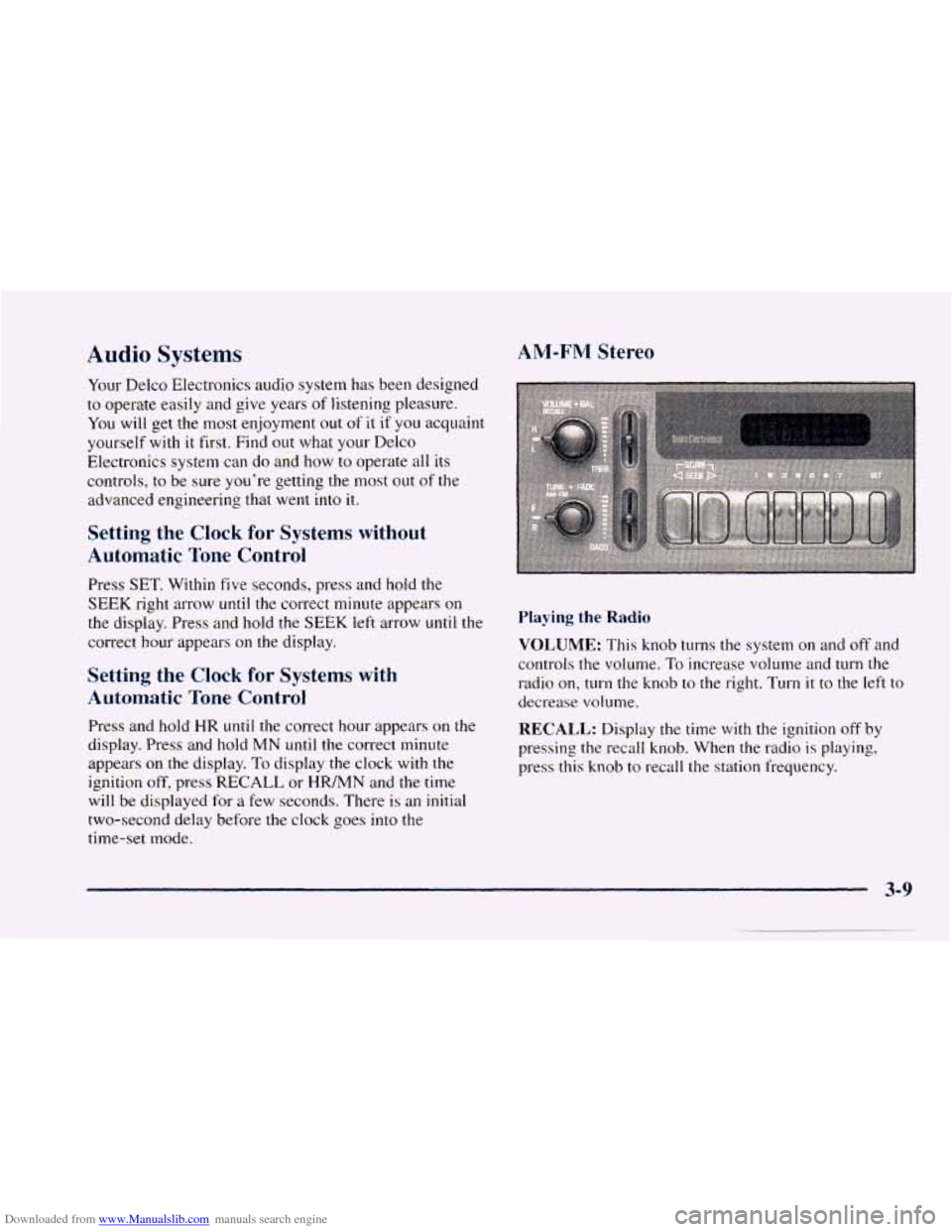
Playing the Radio
VOLUME: This knob turns the system on and off and
controls the volume.
To increase volume and turn the
radio on, turn the knob to the right. Turn it to the left to
decrease volume.
RECALL: Display the time with the ignition off by
pressing the recall knob. When the radio is playing,
press this knob
to recall the station frequency.
3-9