lock CHEVROLET ASTRO 1998 2.G Service Manual
[x] Cancel search | Manufacturer: CHEVROLET, Model Year: 1998, Model line: ASTRO, Model: CHEVROLET ASTRO 1998 2.GPages: 414, PDF Size: 21.46 MB
Page 178 of 414
Downloaded from www.Manualslib.com manuals search engine Theft-Deterrent Feature (If Equipped)
THEFTLOCK@ is designed to discourage theft of your
radio. It works
by using a secret code to disable all radio
functions whenever battery power is removed. Your
audio system is equipped with THEFTLOCK if
THEFTLOCK
is displayed on the front of the radio.
The THEFTLOCK feature for the radio may be used or
ignored.
If ignored, the system plays normally and the
radio is not protected by
the feature. If THEFTLOCK is
activated, your radio will not operate if stolen.
When THEFTLOCK is activated, the radio will display
LOC to indicate a locked condition anytime battery
power has been interrupted. If your battery loses power for any reason,
you must unlock the radio with the secret
code before it will operate.
Activating the Theft-Deterrent Feature
The instructions which follow explain how to enter your
secret code to activate the THEFTLOCK system. It is
recommended that
you read through all nine steps
before starting the procedure.
NOTE: If you allow more than
15 seconds to elapse
between any steps, the radio automatically reverts to
time and you must start the procedure over at Step
4.
1. Write down any three or four-digit number from
000 to 1999 and keep it in a safe place separate from
the vehicle.
2. Turn the ignition to ACCESSORY or RUN.
3. Turn the radio off.
4. Press the I and 4 buttons together. Hold them down
until
--- shows on the display. Next you will use the
secret code number which
you have written down.
5. Press MN and 000 will appear on the display.
6. Press MN again to make the last two digits agree
with your code.
7. Press HR to make the first one or two digits agree
with your code.
8. Press AM-FM after you have confirmed that the
code matches the secret code
you have written down.
The display
will show REP to let you know that you
need to repeat Steps 5 through 7 to confirm your
secret code.
9. Press AM-FM and this time the display will show
SEC to let you know that your radio is secure. The
indicator by the volume control will begin flashing
when the ignition is turned
off.
3-26
Page 179 of 414
Downloaded from www.Manualslib.com manuals search engine Unlocking the Theft-Deterrent Feature After a Power
Loss
Enter your secret code as follows; pause no more than
15 seconds between steps:
1. LOC appears when the ignition is on.
2. Press MN and 000 will appear on the display.
3. Press MN again to make the last two digits agree
I with your code.
7 3 4. Press HR to make the first one or two digits agree
I with your code.
5. Press AM-FM after you have confirmed that the
code matches the secret code you have written down.
The display will show SEC, indicating the radio is
now operable and secure.
If you enter the wrong code eight times, INOP will
appear on the display. You will have to
wait an hour
with the ignition on before you can try again. When you
try again, you will only have three chances to enter the
correct code before INOP appears.
Disabling the Theft-Deterrent Feature
Enter your secret code as follows; pause no more than
15 seconds between steps:
1. Turn the ignition to ACCESSORY or RUN.
2. Turn the radio off.
3. Press the 1 and 4 buttons together. Hold them down
4. Press MN and 000 will appear on the display.
5. Press MN again to make the last two digits agree
6. Press HR to make the first one or two digits agree
7. Press AM-FM after you have confirmed that the
until
SEC shows on the display.
with your code.
with your code.
code matches the secret code you have written down.
The display will show
---, indicating that the radio is
no longer secured.
If the code entered is incorrect,
SEC will appear on the
display. The radio will remain secured until the correct
code is entered.
When battery power is removed and later applied to a
secured radio, the radio won’t turn
on and LOC will
appear on the display.
To unlock a secured radio, see “Unlocking the
Theft-Deterrent Feature After a Power
Loss” earlier
in this section.
Page 191 of 414
Downloaded from www.Manualslib.com manuals search engine Anti-Lock Brakes (ABS)
Your vehicle has anti-lock brakes (ABS). ABS is an
advanced electronic braking system that will help
prevent
a braking skid.
When you start your engine and begin to drive away,
your anti-lock brake system will check itself. You may
hear
a momentary motor or clicking noise while this test
is going on. This is normal.
If there’s a problem with the
anti-lock brake system, this
warning light will stay on.
See “Anti-Lock Brake
System Warning Light” in
the Index.
ANTI -
LOCK
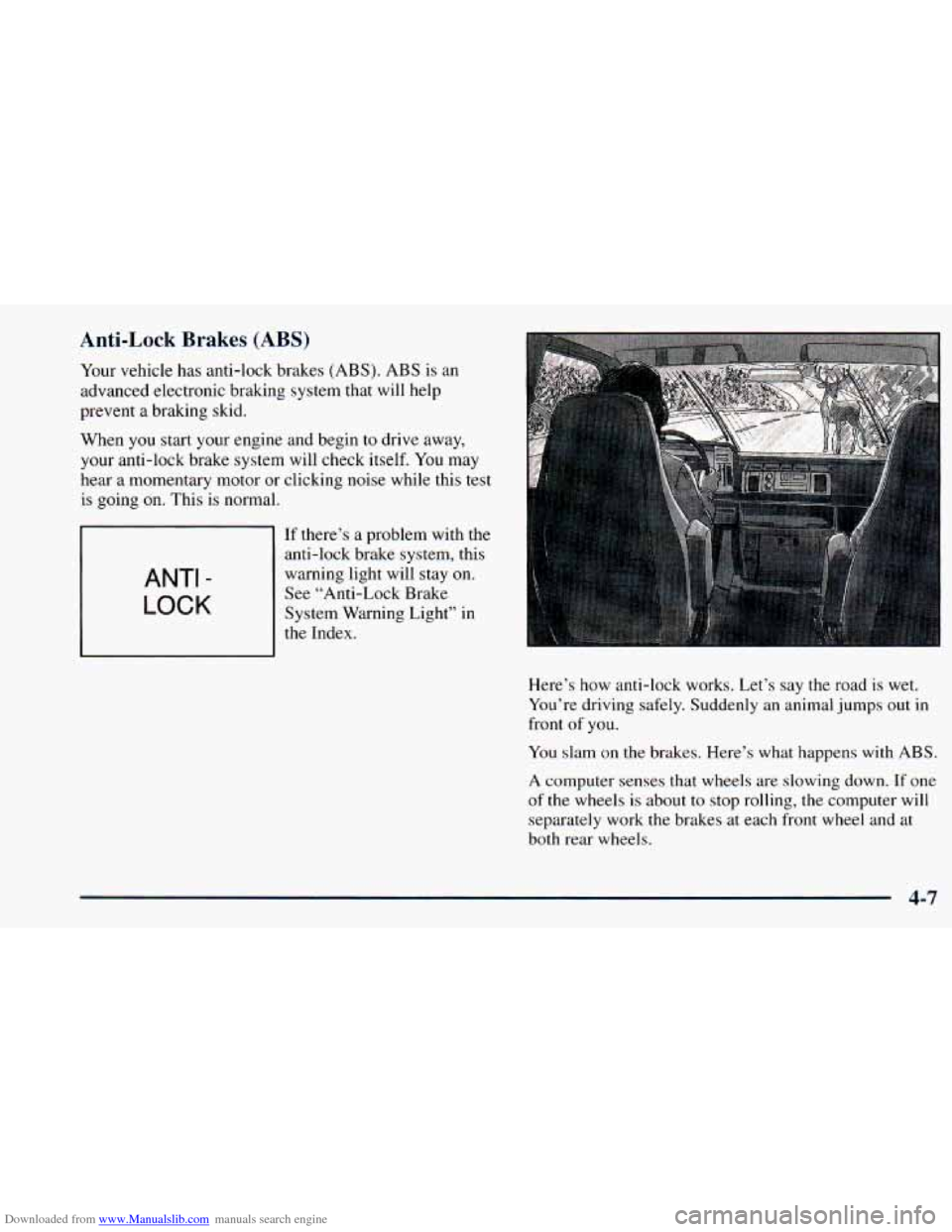
Here’s how anti-lock works. Let’s say the road is wet.
You’re driving safely. Suddenly an animal jumps out in
front
of you.
You slam on the brakes. Here’s what happens with ABS.
A computer senses that wheels are slowing down. If one
of the wheels is about to stop rolling, the computer will
separately work the brakes at each front wheel and at
both rear wheels.
4-7
Page 192 of 414
Downloaded from www.Manualslib.com manuals search engine The anti-lock system can change the brake pressure
faster
than any driver could. The computer is
programmed
to make the most of available tire and
road conditions.
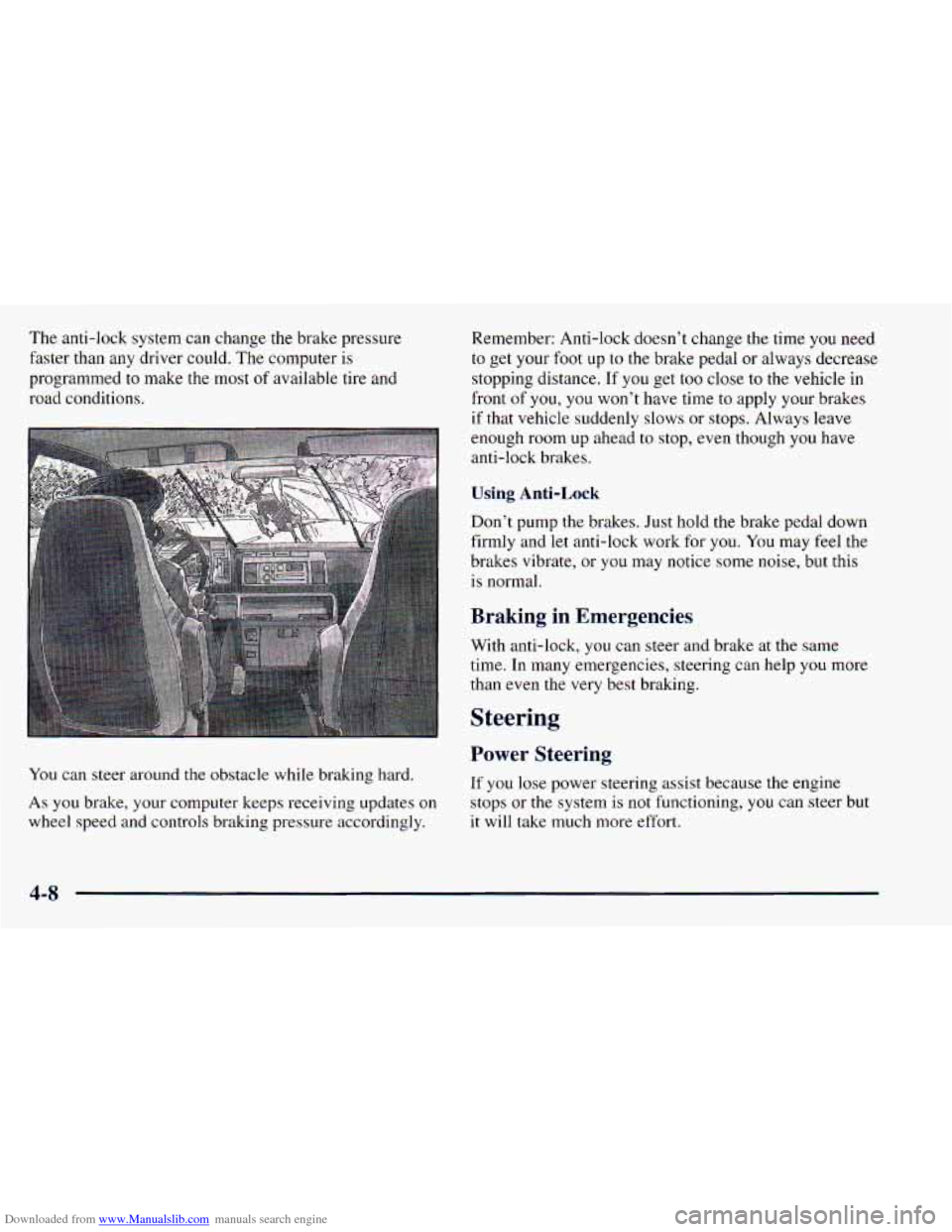
You can steer around the obstacle while braking hard.
As you brake, your computer keeps receiving updates on
wheel speed and controls braking pressure accordingly. Remember: Anti-lock doesn’t
change the time you need
to get your
foot up to the brake pedal or always decrease
stopping distance.
If you get too close to the vehicle in
front of you,
you won’t have time to apply your brakes
if
that vehicle suddenly slows or stops. Always leave
enough room up ahead to stop, even though you have
anti-lock brakes.
Using Anti-Lock
Don’t pump the brakes. Just hold the brake pedal down
firmly and let anti-lock work for
you. You may feel the
brakes vibrate, or you may notice some noise, but this
is normal.
Braking in Emergencies
With anti-lock, you can steer and brake at the same
time. In many emergencies, steering can help you more
than even the very best braking.
Steering
Power Steering
If you lose power steering assist because the engine
stops or the system is not functioning, you can steer but
it will take much more effort.
4-8
Page 194 of 414
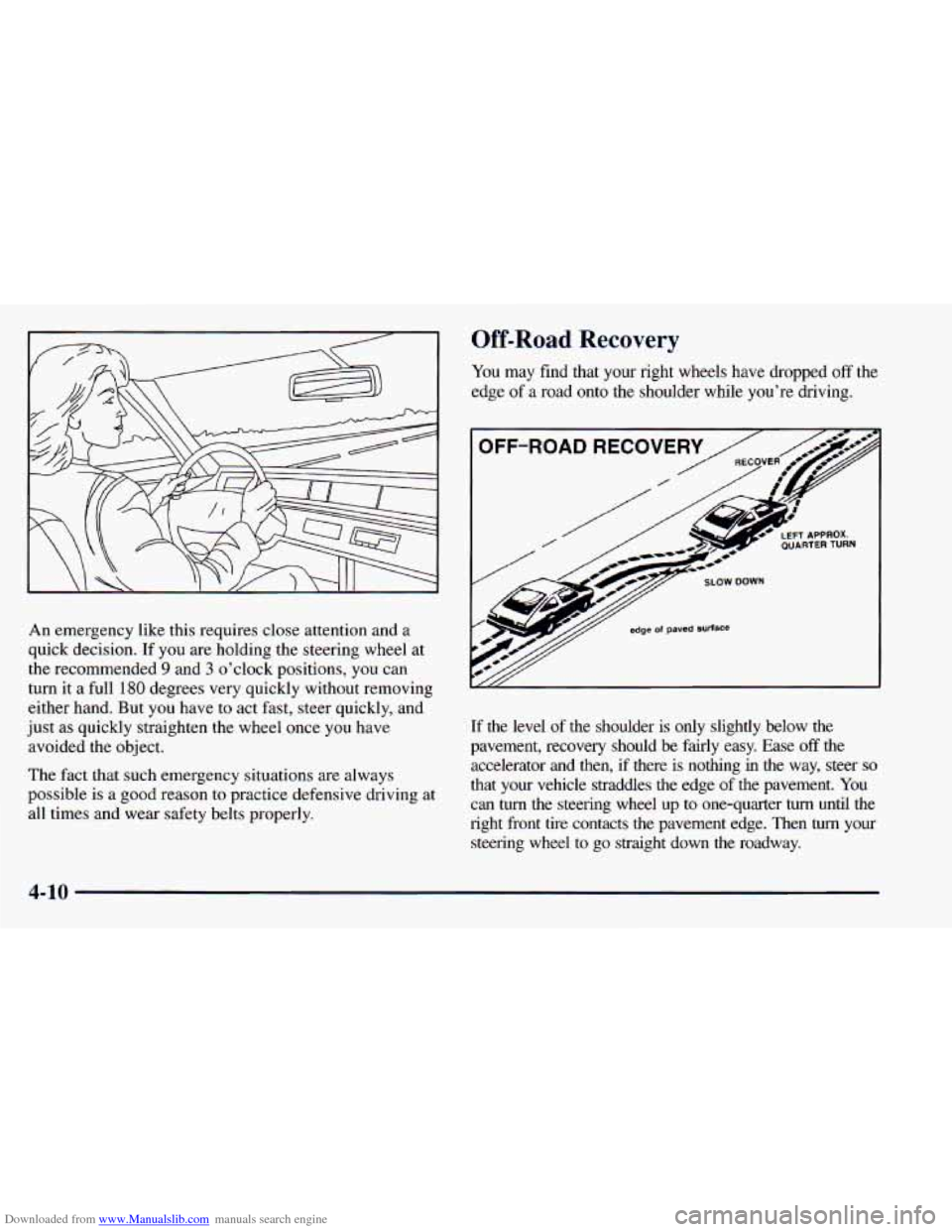
Downloaded from www.Manualslib.com manuals search engine An emergency like this requires close attention and a
quick decision. If you are holding the steering wheel at
the recommended
9 and 3 o’clock positions, you can
turn it a full
180 degrees very quickly without removing
either hand. But you have to act fast, steer quickly, and
just as quickly straighten the wheel once you have
avoided the object.
Off-Road Recovery
You may find that your right wheels have dropped off the
edge
of a road onto the shoulder while you’re driving.
If the level
of the shoulder is only slightly below the
pavement, recovery should
be fairly easy. Ease off the
The fact that such emergency situations are always
possible is a good reason to practice defensive driving at
all times and wear safety belts properly. accelerator and then,
if there is nothing in the way, steer
so
that your vehicle straddles the edge of the pavement. You
can turn the steering wheel up to one-quarter turn until the
right front tire contacts the pavement edge. Then turn your steering wheel to
go straight down the roadway.
4-10
Page 197 of 414
Downloaded from www.Manualslib.com manuals search engine While driving on a surface with reduced traction, try
your best
to avoid sudden steering, acceleration or
braking (including engine braking by shifting to
a lower
gear). Any sudden changes could cause the tires to slide.
You may not realize the surface
is slippery until your
vehicle is sludding. Learn to recognize warning
clues
-- such as enough water, ice or packed snow on
the road
to make a “mirrored surface’’ -- and slow down
when you have any doubt.
Remember: Any anti-lock brake system (ABS) helps
avoid only the braking skid.
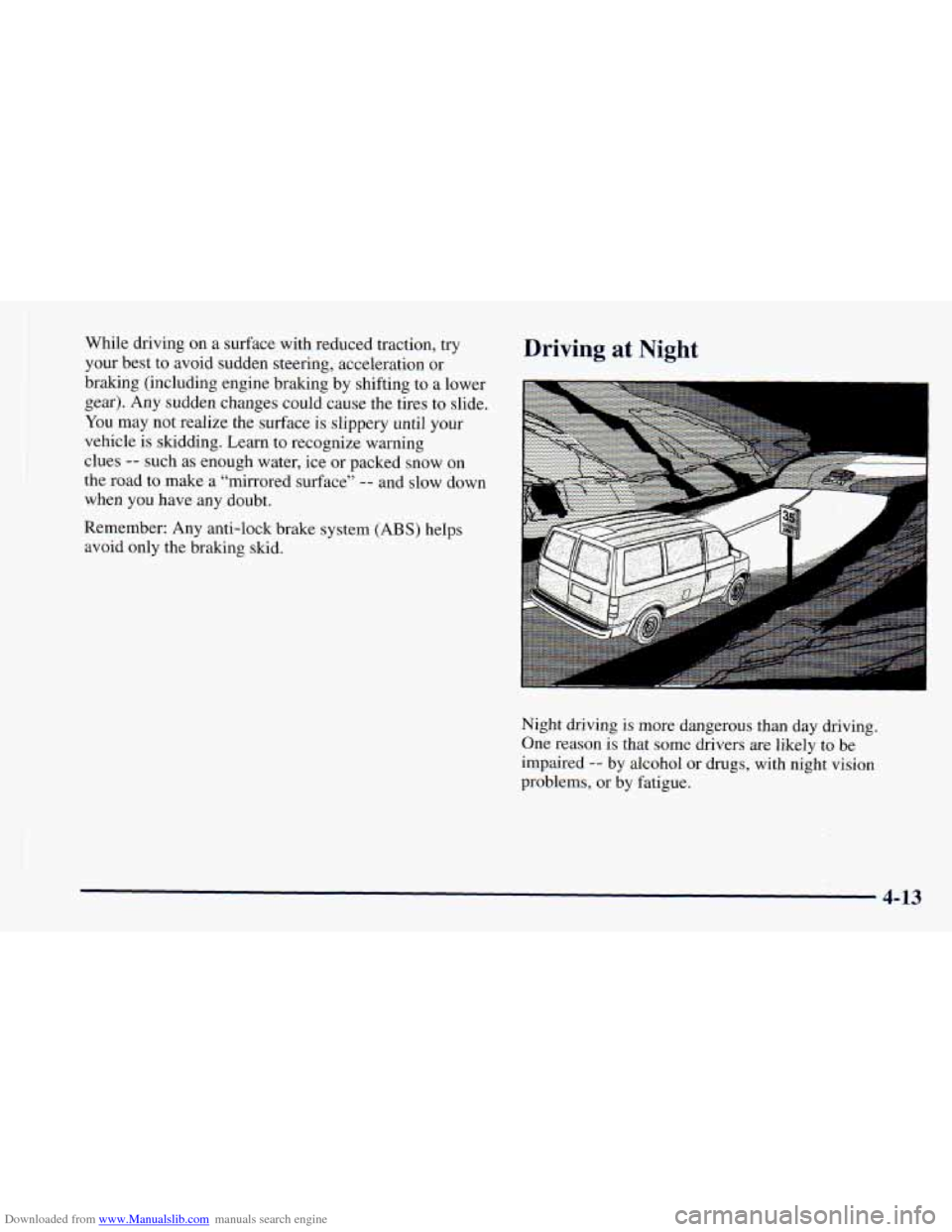
Driving at Night
Night driving is more dangerous than day driving.
One reason is that some drivers are likely to be
impaired
-- by alcohol or drugs, with night vision
problems, or by fatigue.
4-13
Page 208 of 414
Downloaded from www.Manualslib.com manuals search engine Whatever the condition -- smooth ice, packed, blowing
or
loose snow -- drive with caution.
Accelerate gently. Try not
to break the fragile traction. If
you accelerate too fast, the drive wheels will spin and
polish the surface under the tires even more.
Your anti-lock brakes improve your vehicle’s stability
when
you make a hard stop on a slippery road. Even
though you have an anti-lock braking system, you’ll
want to begin stopping sooner than you would on dry
pavement. See “Anti-Lock” in the Index.
Allow greater following distance on any
Watch for slippery spots. The road might be fine
until you hit a spot that’s covered with ice. On an
otherwise clear road, ice patches may appear in
shaded areas where
the sun can’t reach: around
clumps of trees, behind buildings or under bridges.
Sometimes the surface of a curve or an overpass may
remain icy when the surrounding roads are clear.
If
you see a patch of ice ahead of you, brake before you
are
on it. Try not to brake while you’re actually on
the ice, and avoid sudden steering maneuvers. slippery road.
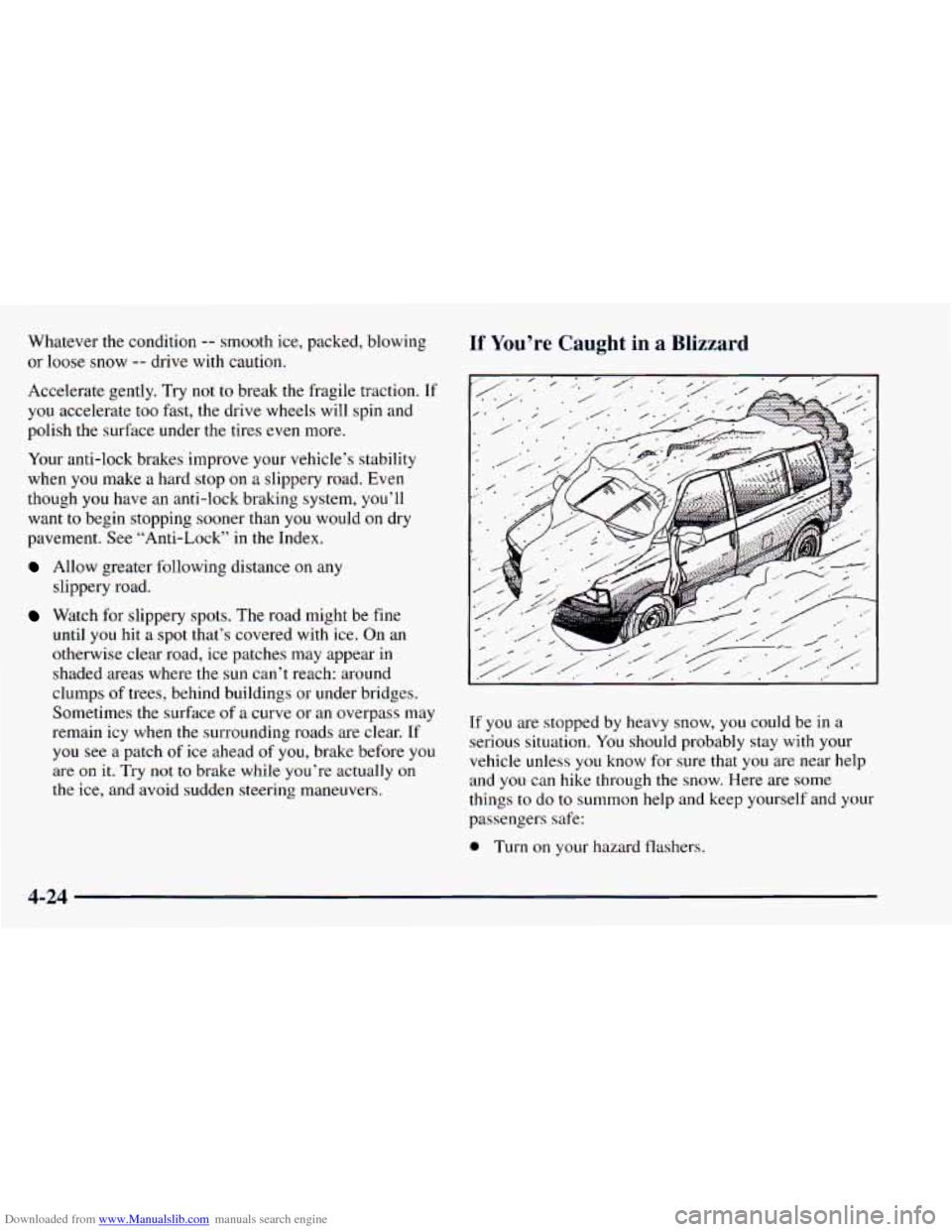
If You’re Caught in a Blizzard
If you are
stopped by heavy snow, you could be in a
serious situation.
You should probably stay with your
vehicle unless you know for sure that you are near help
and you can
hike through the snow. Here are some
things
to do to summon help and keep yourself and your
passengers safe:
0 Turn on your hazard flashers.
4-24
Page 209 of 414
Downloaded from www.Manualslib.com manuals search engine Tie a red cloth to your vehicle to alert police that
you’ve been stopped by the snow.
Put on extra clothing or wrap a blanket around you.
If you have no blankets or extra clothing, make body
insulators from newspapers, burlap bags, rags, floor
mats
-- anything you can wrap around yourself or
tuck under your clothing
to keep warm.
Sr Y can trap exha. ler your vehicle.
~ This can cause deadly 60 (carbon monoxide) gas
to get inside. CO could overcome you and kill
you.
You can’t see it or smell it, so you might not
know
it is in your vehicle. Clear away snow from
around the base of your vehicle, especially any
~ that is blocking your exhaust pipe. And check
around again from time to time to be sure snow
doesn’t collect there.
Open a window just
a little on the side of the
vehicle that’s
away from the wind. This will help
~ keep CO out.
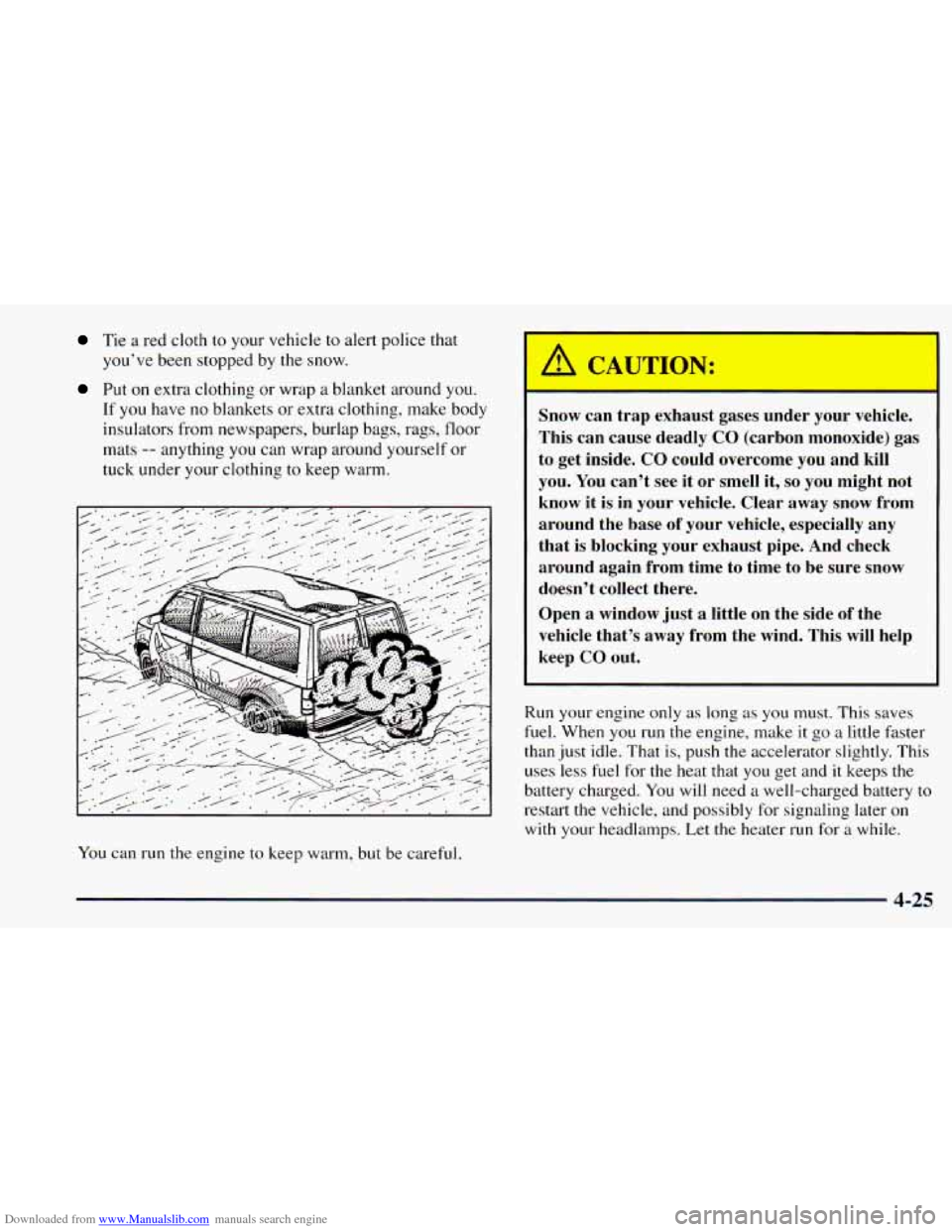
Run your engine only as long as you must. This saves
fuel. When you run
the engine, make it go a little faster
than just idle. That is, push the accelerator slightly. This
uses less fuel for the heat that you get and it keeps the
battery charged. You will need a well-charged battery
to
restart the vehicle, and possibly for signaling later on
with your headlamps. Let
the heater run for a while.
You can run the engine to keep warm, but be careful.
4-25
Page 228 of 414
Downloaded from www.Manualslib.com manuals search engine 9.
10.
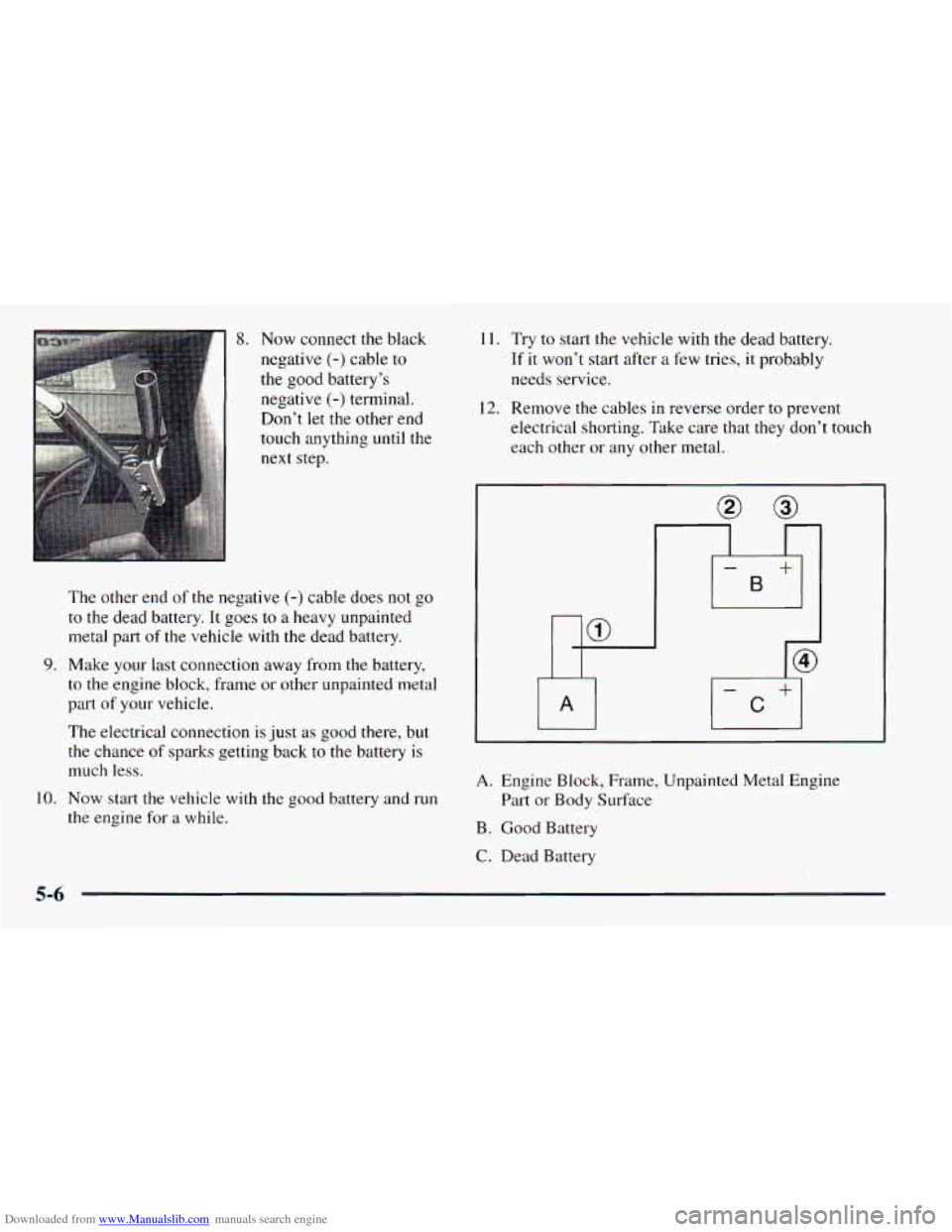
8. Now connect the black
negative
(-) cable to
the good battery’s
negative
(-) terminal.
Don’t
let the other end
touch anything until the
next step.
11. Try to start the vehicle with the dead battery.
If it won’t start after a few tries, it probably
needs service.
12. Remove the cables in reverse order to prevent
electrical shorting. Take care that they don’t touch
each other or any other metal.
The other end of the negative
(-) cable does not go
to the dead battery. It goes to a heavy unpainted
metal part
of the vehicle with the dead battery.
Make your last connection away from the battery,
to the engine block, frame or other unpainted metal
part of your vehicle.
The electrical connection is just
as good there, but
the chance
of sparks getting back to the battery is
much less.
Now start the vehicle with the good battery and run
the engine
for a while.
1Al
A. Engine Block, Frame, Unpainted Metal Engine
B. Good Battery
C. Dead Battery
Part
or Body
Surface
J
5-6
Page 230 of 414
Downloaded from www.Manualslib.com manuals search engine A CAUTION:
A vehicle can fall from a car carrier if it isn’t
adequately secured. This can cause
a collision,
serious personal injury and vehicle damage. The
vehicle should be tightly secured with chains or
steel cables before
it is transported.
Don’t use substitutes (ropes, leather straps,
canvas webbing, etc.) that can be cut by sharp
edges underneath the towed vehicle.
When your vehicle is being towed, have the ignition
key in the
OFF position. The steering wheel should
be clamped in a straight-ahead position, with a
clamping device designed for towing service. Do not
use the vehicle’s steering column lock for this. The
transmission should be in NEUTRAL
(N) and the
parking brake released.
I I
If your vehicle has the all-wheel-drive option, it can
only be towed with all four wheels
off the ground.
A dolly must be used under the unraised wheels
when towing or the vehicle must be transported on a
flat bed carrier.
Don’t have your vehicle towed with the wheels in
contact with the ground
if it has all-wheel drive. If
a vehicle with all-wheel drive must be towed with
sling-type or wheel-lift equipment, then either the
front or rear wheels must be supported on a dolly.
NOTICE:
If your vehicle has all-wheel drive, do not have
it towed with the wheels in contact with the
ground or vehicle damage may occur.
A dolly
must be used under the unraised wheels when
towing or the vehicle must be transported
on a
flat bed carrier.
5-8