lock CHEVROLET ASTRO 1998 2.G Workshop Manual
[x] Cancel search | Manufacturer: CHEVROLET, Model Year: 1998, Model line: ASTRO, Model: CHEVROLET ASTRO 1998 2.GPages: 414, PDF Size: 21.46 MB
Page 241 of 414
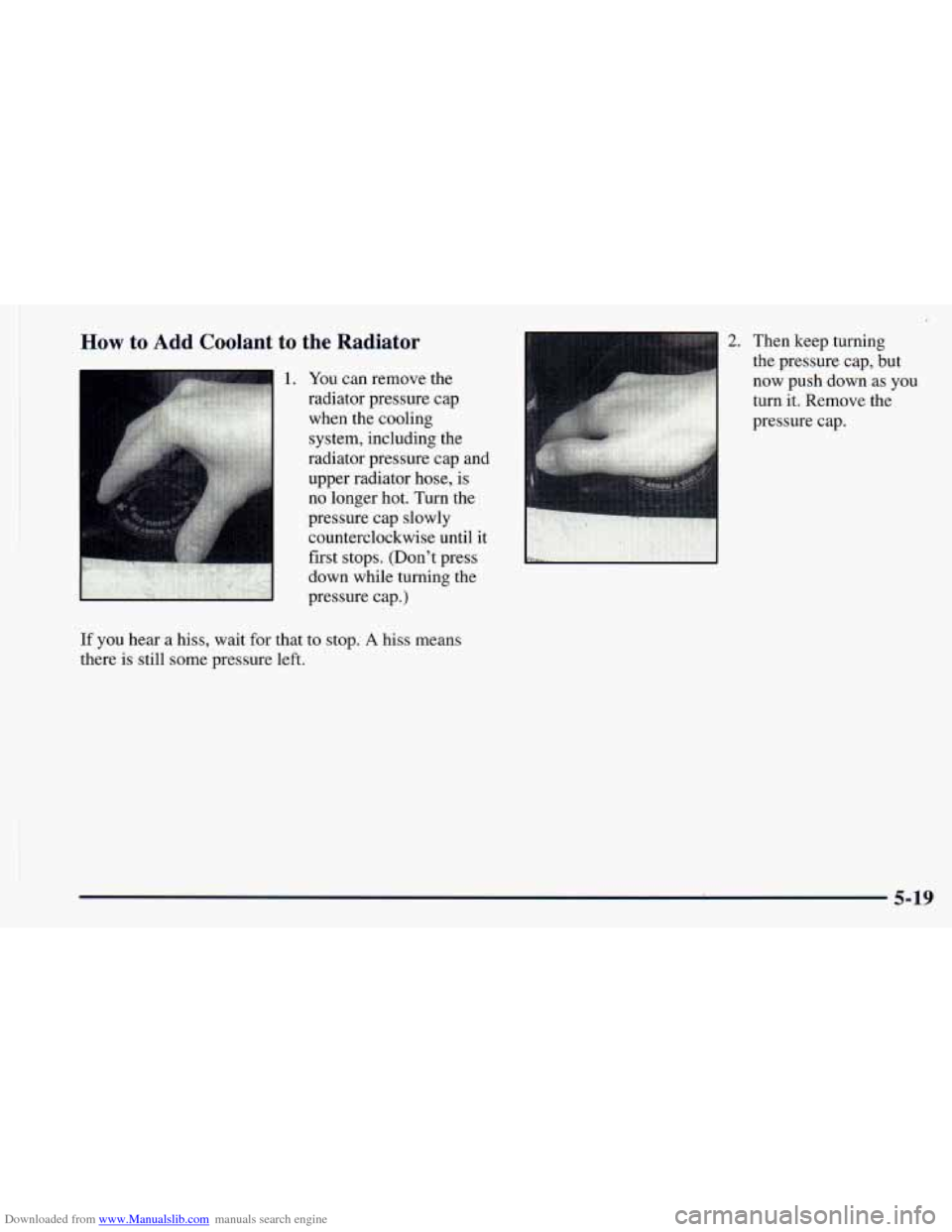
Downloaded from www.Manualslib.com manuals search engine How to Add Coolant to the Radiator
1.
I
You can remove the
radiator pressure cap
when the cooling system, including the
radiator pressure cap and
upper radiator hose, is
no longer hot. Turn the
pressure cap slowly
counterclockwise until it
first stops. (Don’t press down while turning the
pressure cap.)
2.
If you hear a hiss, wait for that to stop. A hiss means
there is still some pressure left. Then keep turning
the pressure cap, but now push down as you
turn
it. Remove the
pressure cap.
1 I
I 5-19
Page 245 of 414
Downloaded from www.Manualslib.com manuals search engine Changing a Flat Tire
If a tire goes flat, avoid further tire and wheel damage
by driving slowly to a level place. Turn on your hazard
warning flashers.
/! C! UTION:
Changing a tire can cause an injury. The vehicle
can slip
off the jack and roll over you or other
people. You and they could be badly injured.
Find
a level place to change your tire. To help
prevent the vehicle from moving:
1. Set the parking brake firmly.
2. Put the shift lever in PARK (P).
3. Turn off the engine.
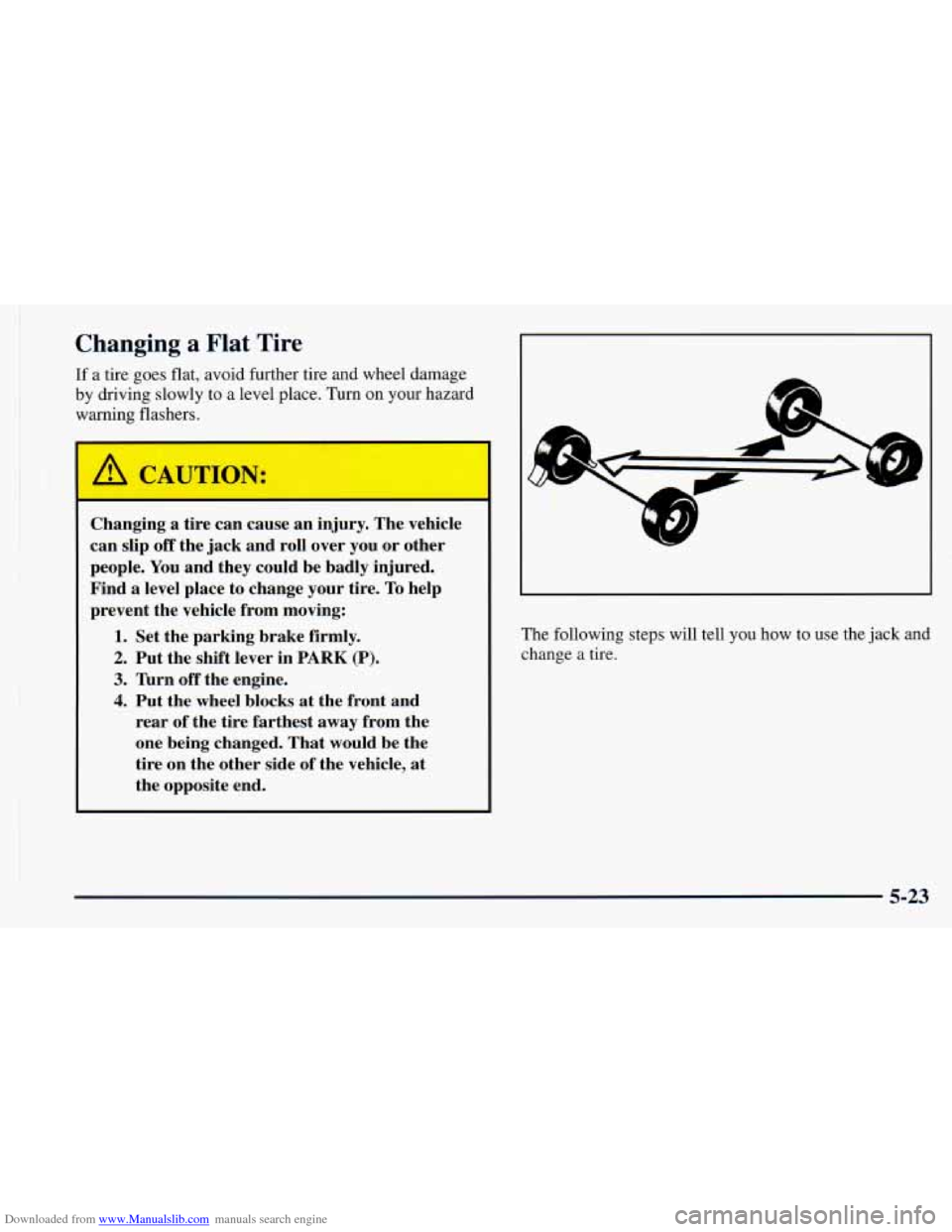
4. Put the wheel blocks at the front and
rear of the tire farthest away from the
one being changed. That would be the
tire on the other side of the vehicle, at
the opposite end. The
following steps will tell
you how to use the jack and
change a tire.
5-23
Page 246 of 414
Downloaded from www.Manualslib.com manuals search engine Removing the Spare Tire and Tools
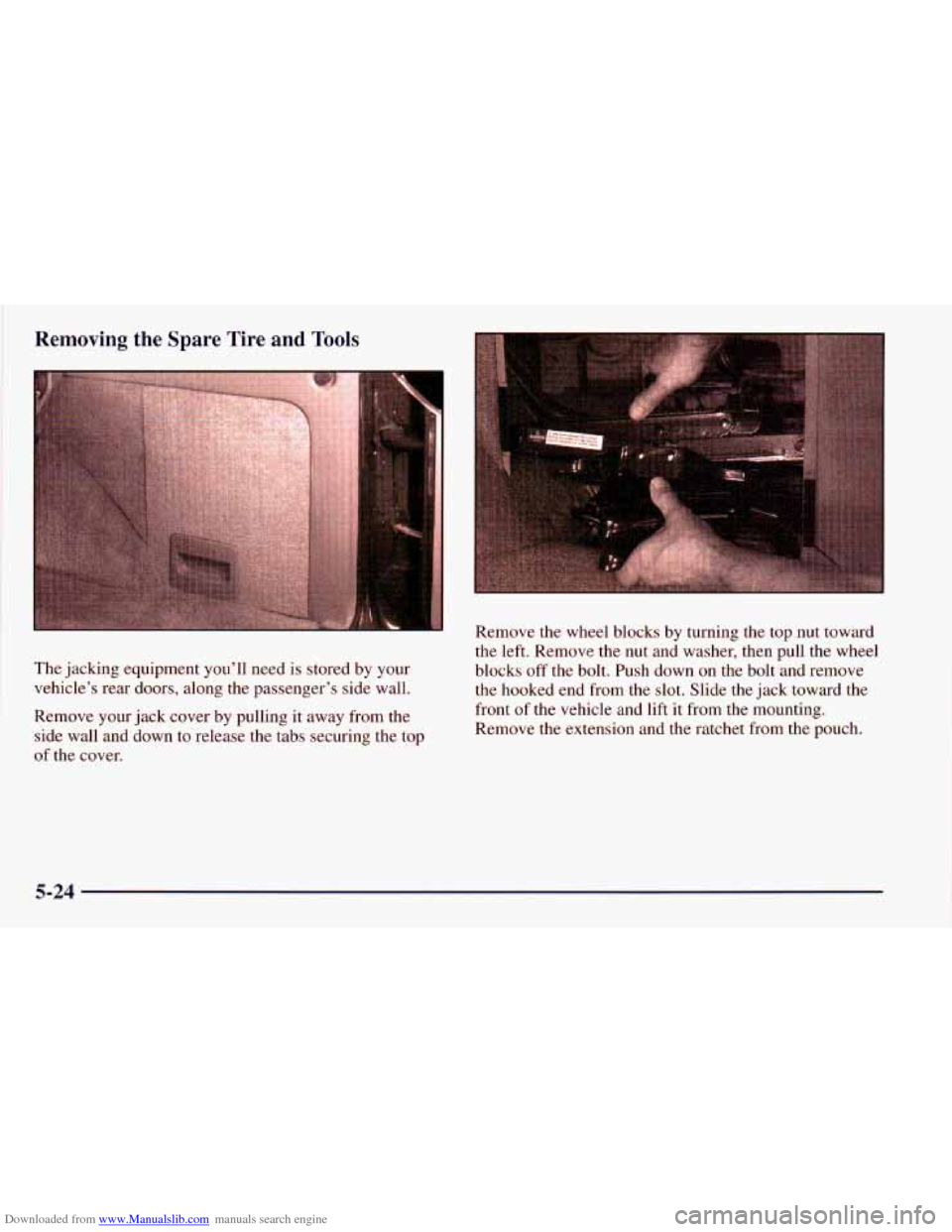
The jacking equipment you'll need is stored by your
vehicle's rear doors, along the passenger's side wall.
Remove your jack cover by pulling it away from the
side wall and down to release the tabs securing the top
of the cover. Remove
the wheel blocks by turning the top nut toward
the left. Remove the nut and washer, then pull the wheel
blocks off the bolt. Push down on the bolt and remove
the hooked end from the slot. Slide the jack toward the
front of the vehicle and lift it from the mounting.
Remove the extension and the ratchet from the pouch.
5-24
Page 249 of 414
Downloaded from www.Manualslib.com manuals search engine r-- -
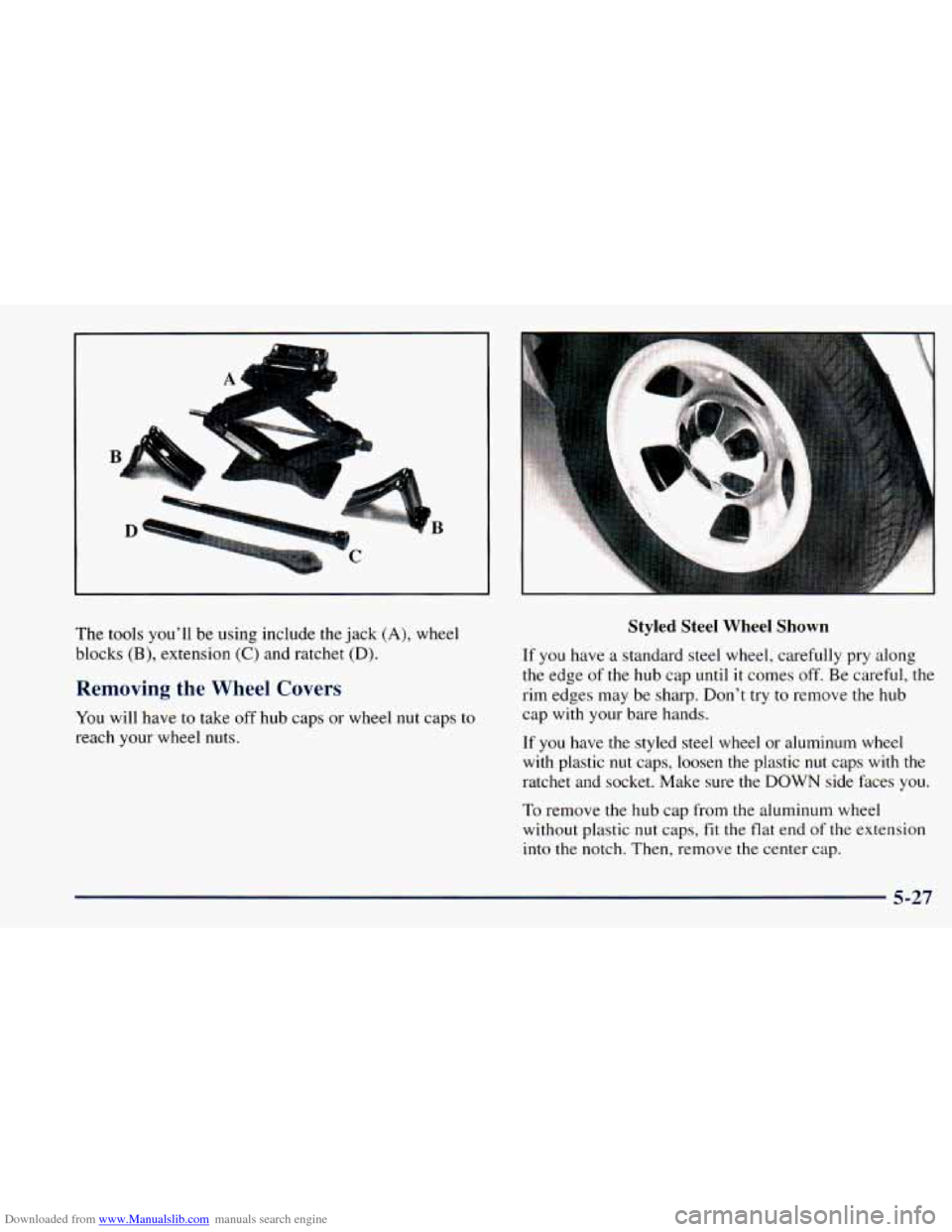
The tools you'll be using include the jack (A), wheel
blocks
(B), extension (C) and ratchet (D).
Removing the Wheel Covers
You will have to take off hub caps or wheel nut caps to
reach your wheel nuts.
I
Styled Steel Wheel Shown
If you have a standard steel wheel, carefully pry along
the edge
of the hub cap until it comes off. Be careful, the
rim edges may be sharp. Don't try to remove the hub
cap with your bare hands.
If you have the styled steel wheel or aluminum wheel
with plastic nut caps, loosen the plastic nut caps with the
ratchet and socket. Make sure the
DOWN side faces you.
To remove the hub cap from the aluminum wheel
without plastic
nut caps, fit the flat end of the extension
into the notch. Then, remove the center cap.
5-27
Page 250 of 414
Downloaded from www.Manualslib.com manuals search engine Removing the Flat Tire and Installing the
Spare Tire
. . . . . . . ..
I
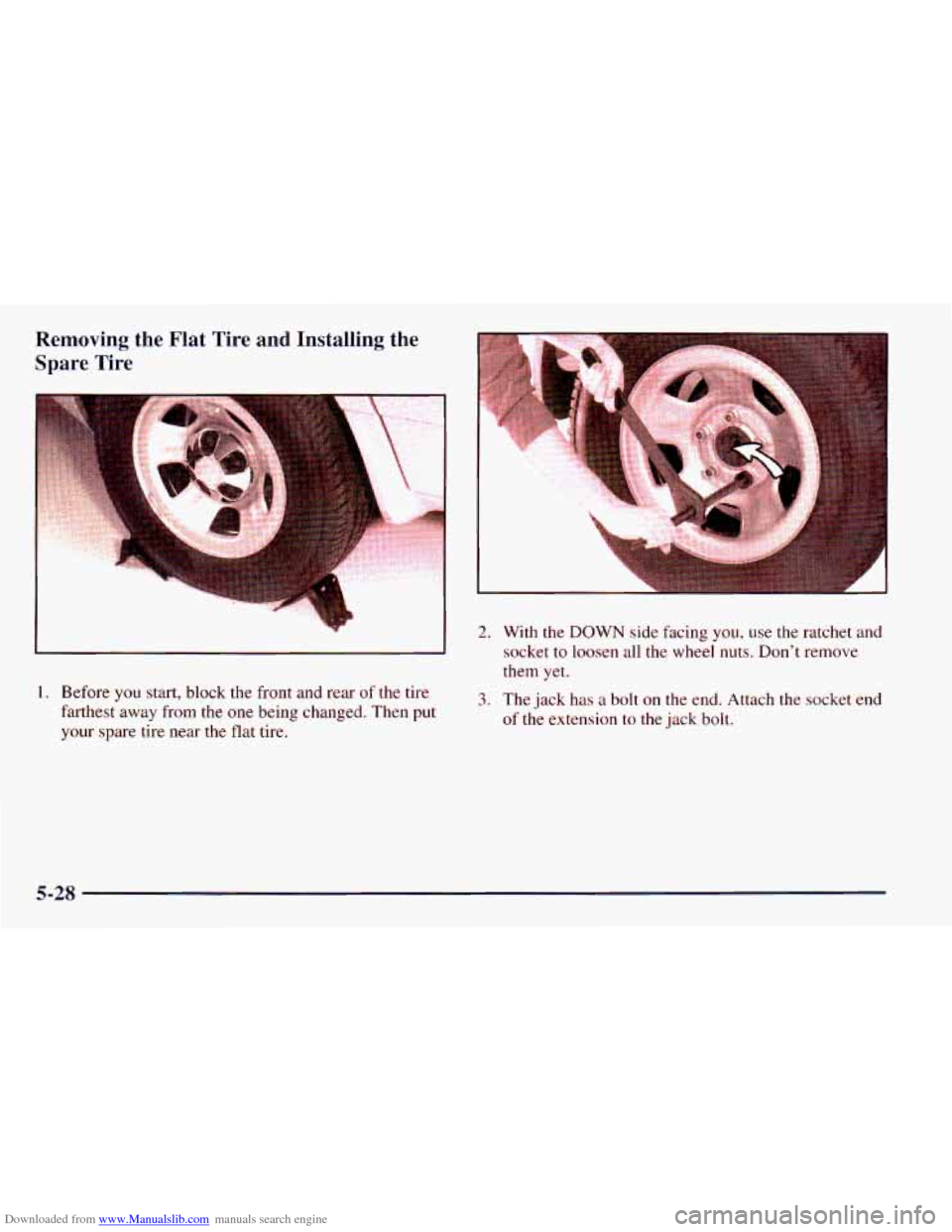
1. Before you start, block the front and rear of the tire
farthest away from the one being changed. Then put
your spare tire near the flat tire.
2. With the DOWN side facing you, use the ratchet and
socket
to loosen all the wheel nuts. Don’t remove
them yet.
3. The jack has a bolt on the end. Attach the socket end
of the extension
to the jack bolt.
5-28
Page 256 of 414
Downloaded from www.Manualslib.com manuals search engine NOTICE:
Improperly tightened wheel nuts can lead to
brake pulsation and rotor damage.
To avoid
expensive brake repairs, evenly tighten the wheel
nuts in the proper sequence and to the proper
torque specification.
13. Remove the wheel blocks.
I NOTICE:
Wheel covers won’t fit on your compact spare. If
you try to put a wheel cover on your compact
spare, you could damage the cover or the spare.
Storing a Flat or Spare Tire and Tools
I
A CdJTdN:
Storing a jack, a tire or other equipment in the
passenger compartment
of the vehicle could
cause injury. In a sudden stop or collision, loose
equipment could strike someone. Store all these
in the proper place.
1. Put the flat tire on the ground at the rear of the
vehicle, with the valve stem pointed down.
2. Tilt the retainer plate downward and through the
wheel opening. Make sure it is fully seated across the
underside
of the wheel. Attach the ratchet, with the
UP side facing you, to the extension.
5-34
Page 257 of 414
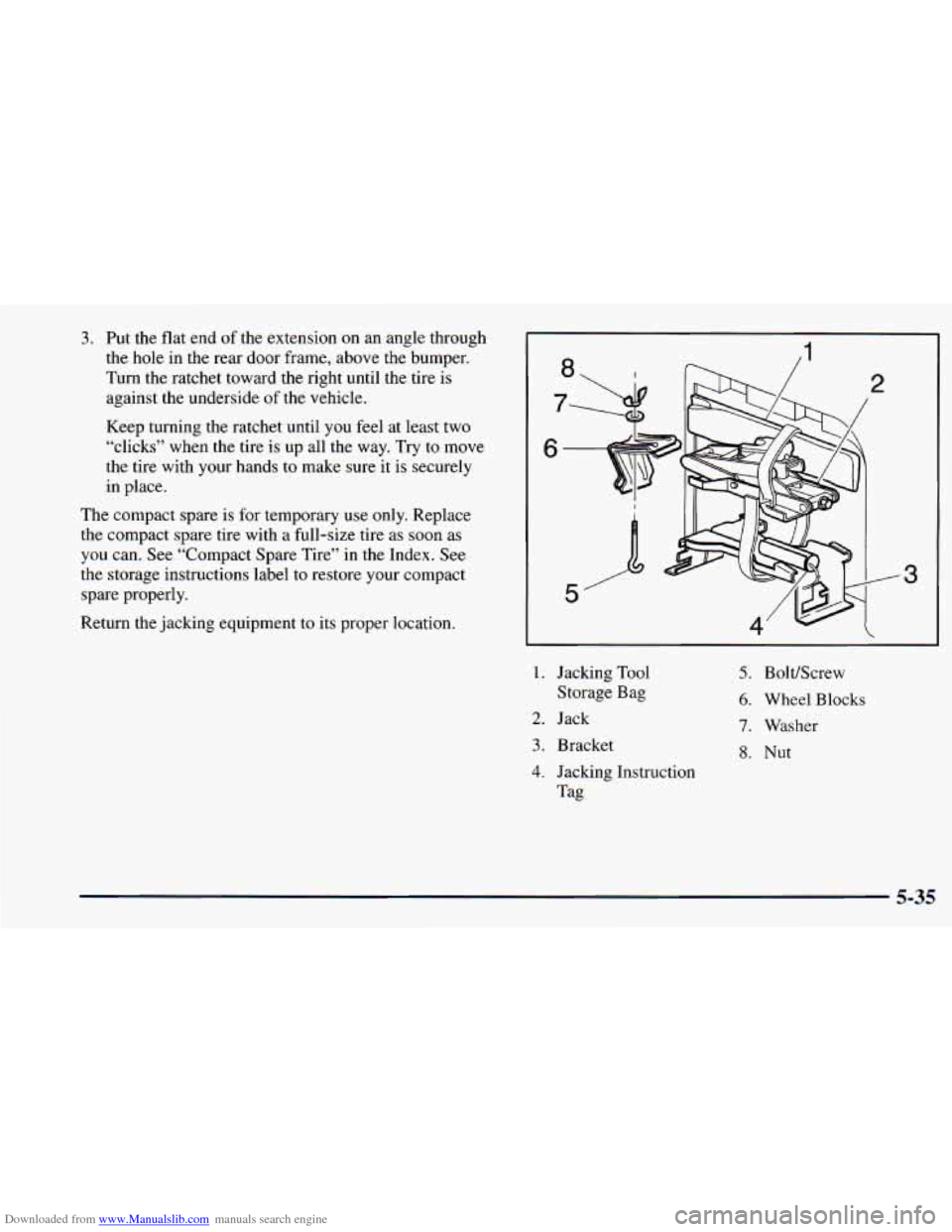
Downloaded from www.Manualslib.com manuals search engine 3. Put the flat end of the extension on an angle through
the hole in the rear door frame, above the bumper.
Turn the ratchet toward the right until the tire is
against the underside of the vehicle.
Keep turning the ratchet until you feel at least two
“clicks” when the tire is up all the way. Try to move
the tire with your hands to make sure it is securely
in place.
The compact spare is for temporary use only. Replace
the compact spare tire with a full-size tire as soon as
you can. See “Compact Spare Tire” in the Index. See
the storage instructions label to restore your compact
spare properly.
Return the jacking equipment to its proper location.
1. Jacking Tool
Storage Bag
2. Jack
3. Bracket
3
5. Bolt/Screw
6. Wheel Blocks
7. Washer
8. Nut
4. Jacking Instruction
Tag
5-35
Page 268 of 414
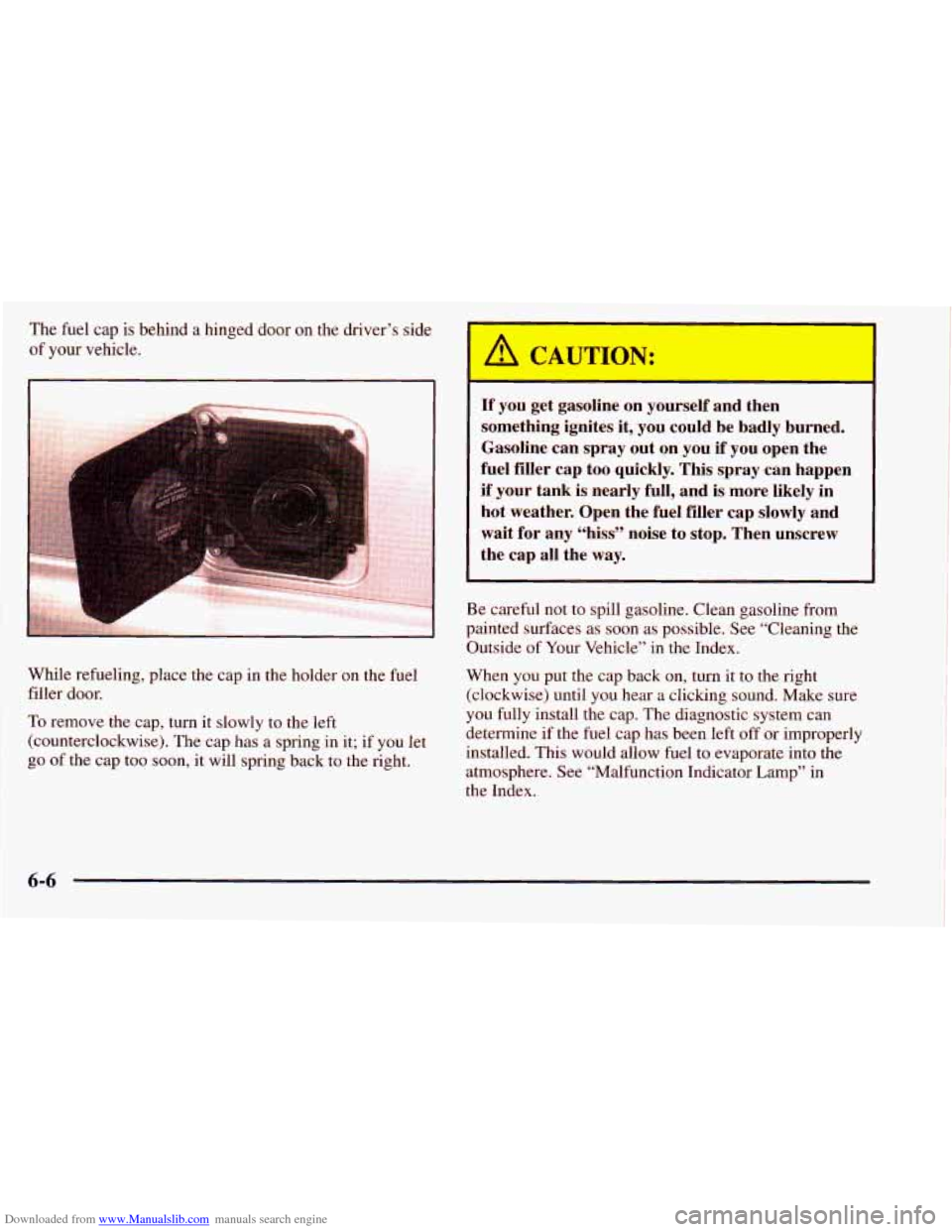
Downloaded from www.Manualslib.com manuals search engine The fuel cap is behind a hinged door on the driver’s side
of your vehicle.
While refueling, place the cap in the holder on the fuel
filler door.
To remove the cap, turn it slowly to the left
(counterclockwise). The cap has a spring in it;
if you let
go of the cap too soon,
it will spring back to the right.
1
A CAUTION:
If you get gasoline on yourself and then
something ignites it, you could be badly burned.
Gasoline can spray out on you if you open the
fuel filler cap too quickly. This spray can happen
if your tank is nearly full, and is more likely in
hot weather. Open the fuel filler cap slowly and
wait for any (‘hiss” noise to stop. Then unscrew
the cap all the way.
Be careful not to spill gasoline. Clean gasoline from
painted surfaces as soon as possible. See “Cleaning the
Outside of Your Vehicle” in the Index.
When you put the cap back on, turn it to the right
(clockwise) until you hear a clicking sound. Make sure
you fully install the cap. The diagnostic system can
determine
if the fuel cap has been left off or improperly
installed. This would allow fuel to evaporate into the
atmosphere. See “Malfunction Indicator Lamp” in
the Index.
Page 284 of 414
Downloaded from www.Manualslib.com manuals search engine I
Then, without shutting off the engine, follow these steps:
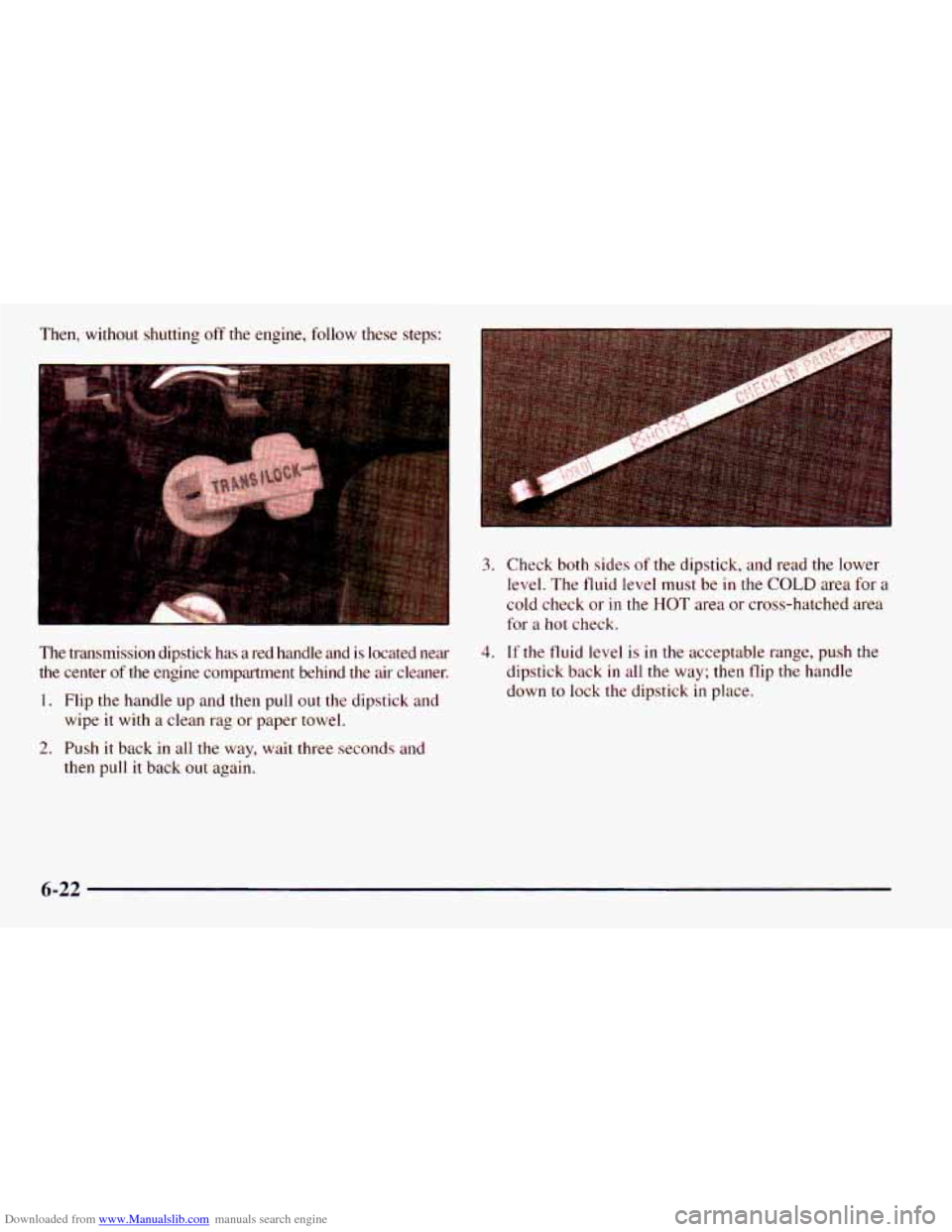
The transmission dipstick has a red handle and
is located near
the center of the engine compartment behind the air cleaner.
1. Flip the handle up and then pull out the dipstick and
wipe it with a clean rag or paper towel.
then pull it back out again.
2. Push it back in all the way, wait three seconds and
3. Check both sides of the dipstick, and read the lower
level. The fluid level must be in the
COLD area for a
cold check or in the
HOT area or cross-hatched area
for a hot check.
4. If the fluid level is in the acceptable range, push the
dipstick back
in all the way; then flip the handle
down to lock the dipstick in place.
6-22
Page 285 of 414
Downloaded from www.Manualslib.com manuals search engine How to Add Fluid
Refer to the Maintenance Schedule to determine what
kind of transmission fluid to use. See “Recommended
Fluids and Lubricants” in the Index.
Add fluid
only after checking the transmission fluid
while it is hot. (A cold check is used
only as a
reference.) If the fluid level is low, add only enough of
the proper fluid to bring the level up to the HOT area for
a hot check. It doesn’t take much fluid, generally less
than one pint
(0.5 L). Don’t overji11.
NOTICE:
We recommend you use only fluid labeled
DEXRON@-111, because fluid with that label is
made especially for your automatic transmission.
Damage caused by fluid other than DEXRON-I11
is not covered by your new vehicle warranty.
After adding fluid, recheck the fluid level as
described under “How
to Check.”
When the correct fluid level is obtained, push the
dipstick back in
all the way; then flip the handle
down to lock the dipstick in place.
All-Wheel Drive
If you have an all-wheel-drive vehicle, be sure to
perform
the lubricant checks described in this section.
However, they have two additional systems that
need lubrication.
Transfer Case
When to Check Lubricant
Refer to the Maintenance Schedule to determine how
often to check
the lubricant. See “Periodic Maintenance
Inspections” in the Index.
6-23