lock CHEVROLET ASTRO 1998 2.G Repair Manual
[x] Cancel search | Manufacturer: CHEVROLET, Model Year: 1998, Model line: ASTRO, Model: CHEVROLET ASTRO 1998 2.GPages: 414, PDF Size: 21.46 MB
Page 302 of 414
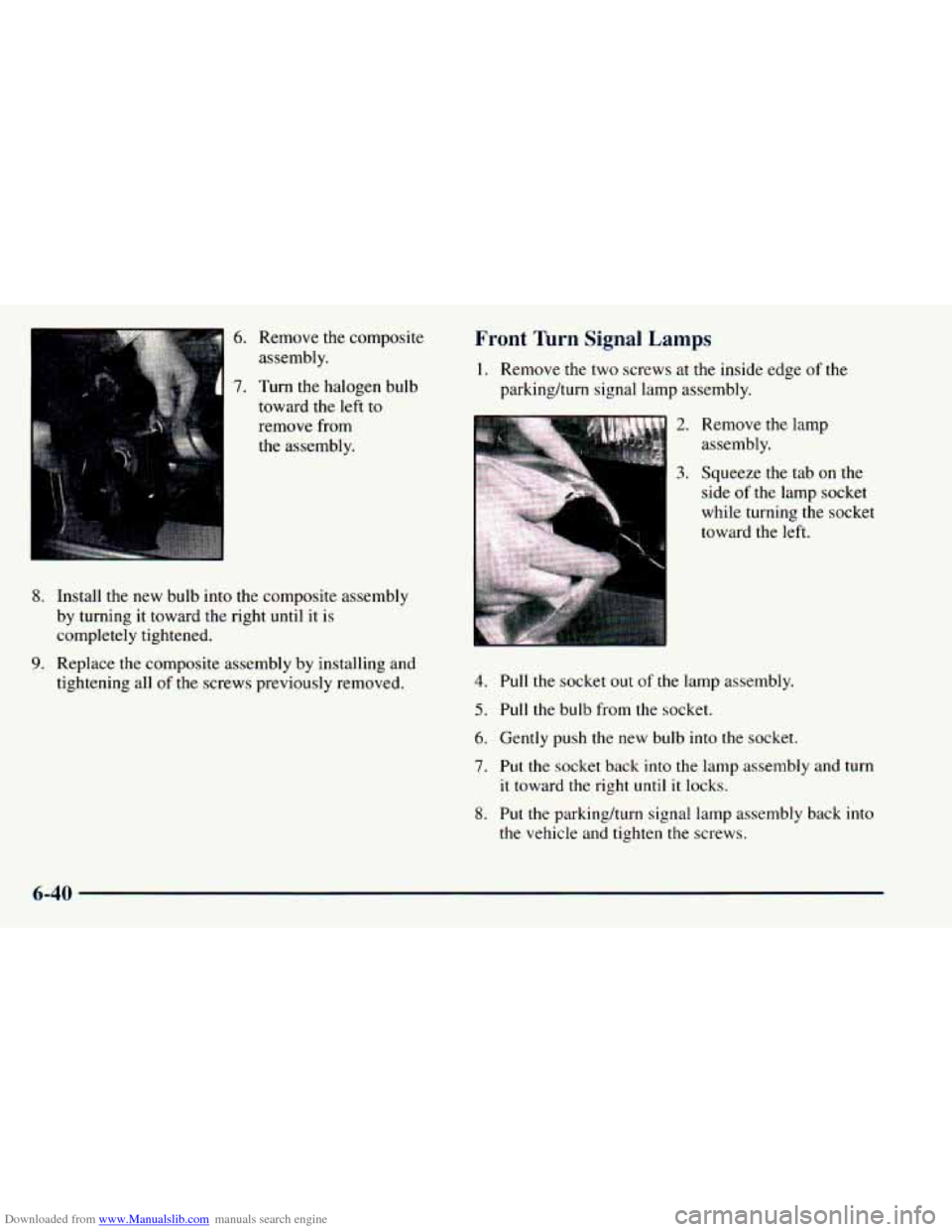
Downloaded from www.Manualslib.com manuals search engine 6. Remove the composite
assembly.
7. Turn the halogen bulb
toward the left
to
remove from
the assembly.
8. Install the new bulb into the composite assembly
by turning it toward the right until it is
completely tightened.
tightening all
of the screws previously removed.
9. Replace the composite assembly by installing and
Front Turn Signal Lamps
1. Remove the two screws at the inside edge of the
parkingkurn signal lamp assembly.
4.
5.
6.
7.
8.
.. .
2.
3.
Remove the lamp
assembly.
Squeeze the tab
on the
side of the lamp socket
while turning the socket
toward
the left.
Pull the socket out
of the lamp assembly.
Pull the bulb from the socket.
Gently push the new bulb into the socket.
Put the socket back into the lamp assembly and turn
it toward the right until it locks.
Put
the parkinghrn signal lamp assembly back into
the vehicle and tighten the screws.
6-40
Page 304 of 414
Downloaded from www.Manualslib.com manuals search engine 5. Reverse Steps 1 through 4 to reinstall the taillamp.
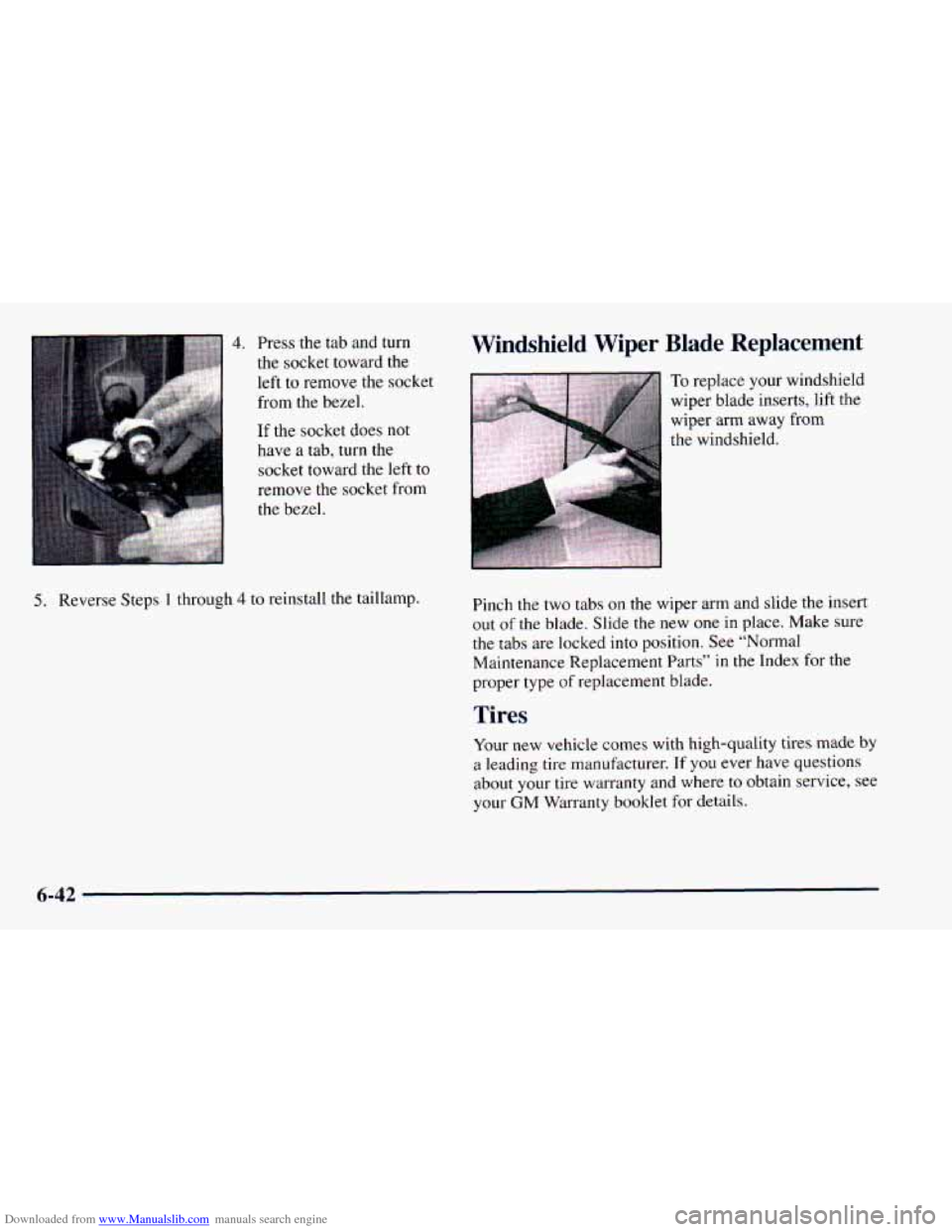
Pinch the two tabs on the wiper arm and slide the insert
out
of the blade, Slide the new one in place. Make sure
the tabs are locked into position. See “Normal
Maintenance Replacement Parts”
in the Index for the
proper type
of replacement blade.
Tires
Your new vehicle comes with high-quality tires made by
a leading tire manufacturer. If you ever have questions
about your tire warranty and where
to obtain service, see
your
GM Warranty booklet for details.
6-42
Page 323 of 414
Downloaded from www.Manualslib.com manuals search engine 11
Fuses and Circuit Breakers
The wiring circuits in your vehicle are protected from
short circuits by a combination of fuses, circuit breakers
and fusible thermal links. This greatly reduces the
chance of fires caused by electrical problems.
Look at the silver-colored band inside the fuse. If the
band is broken or melted, replace the fuse. Be sure you
replace a bad fuse with a new one of the identical size
and rating.
Spare fuses and a fuse puller are located in the
underhood electrical center.
You can remove fuses with
the fuse puller. Remember to replace any of the spare
fuses you use,
so you will have some if you ever need
them again.
If you ever have a problem on the road and don’t have a
spare fuse, you can borrow one that has the same
amperage. Just pick some feature of your vehicle that
you can get along without
-- like the radio or cigarette
lighter
-- and use its fuse, if it is the correct amperage.
Replace
it as soon as you can.
There are two fuse blocks in your vehicle: one is inside
the vehicle and one is in the engine compartment.
Instrument Panel Fuse Block
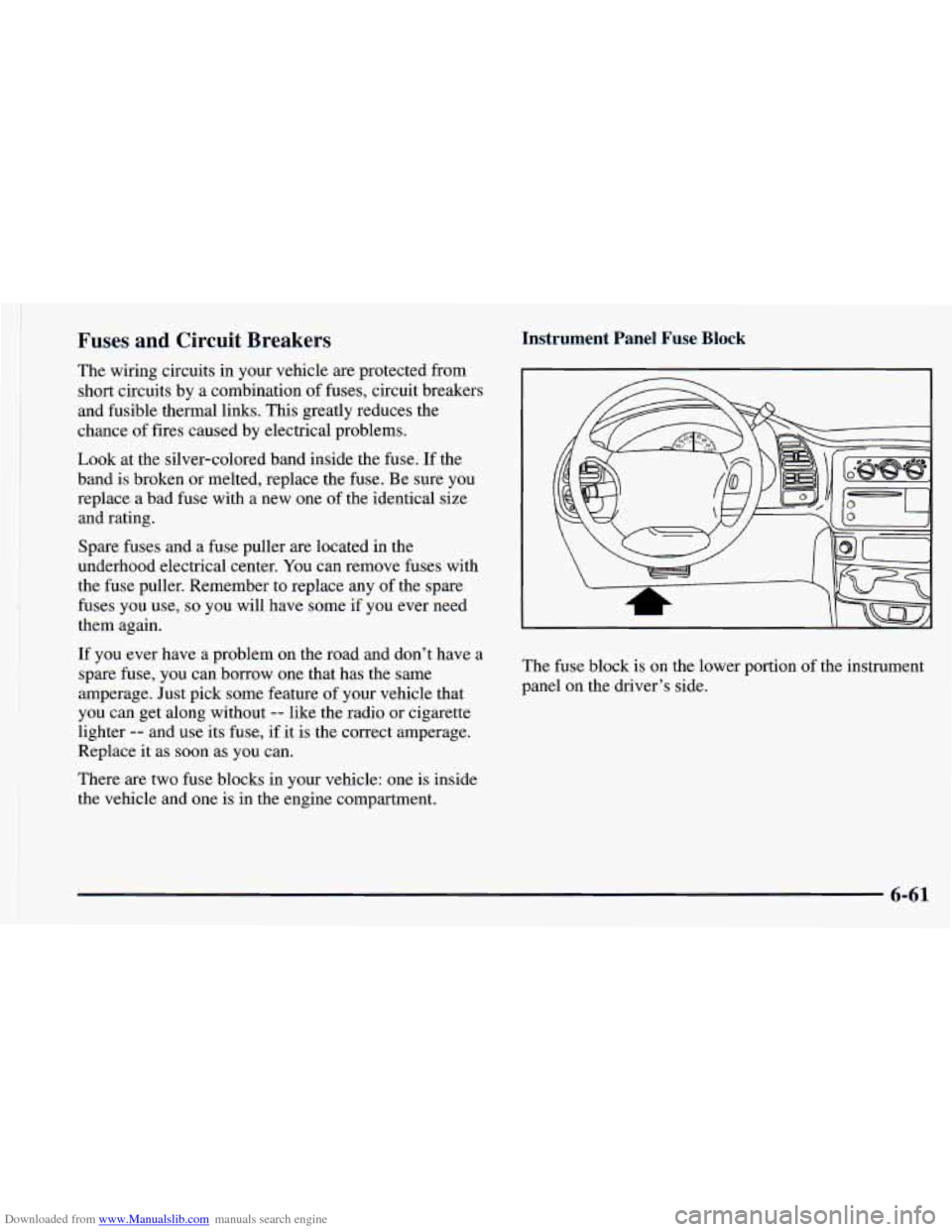
The fuse block is on the lower portion of the instrument
panel on the driver’s side.
6-61
Page 325 of 414
Downloaded from www.Manualslib.com manuals search engine FuseKircuit Breaker Usage
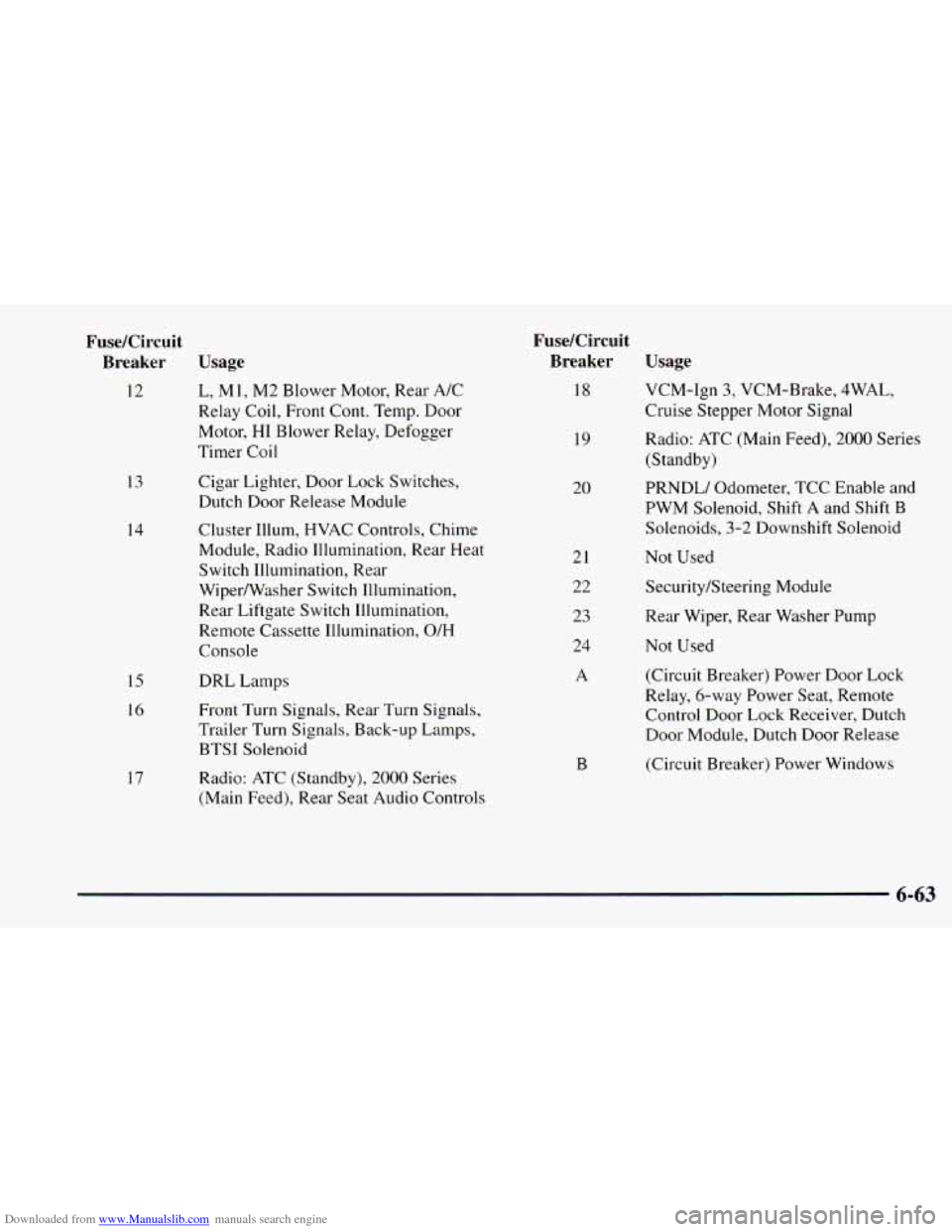
12
13
14
15
16
17
L, M 1, M2 Blower Motor, Rear A/C
Relay Coil, Front Cont. Temp. Door
Motor,
HI Blower Relay, Defogger
Timer Coil
Cigar Lighter, Door Lock Switches,
Dutch Door Release Module
Cluster Illum, HVAC Controls, Chime
Module, Radio Illumination, Rear Heat
Switch Illumination, Rear
Wiper/Washer Switch Illumination,
Rear Liftgate Switch Illumination,
Remote Cassette Illumination, O/H
Console
DRL Lamps
Front Turn Signals, Rear Turn Signals,
Trailer Turn Signals, Back-up Lamps,
BTSI Solenoid
Radio: ATC (Standby), 2000 Series
(Main Feed), Rear Seat Audio Controls 19
20
FuseKircuit
Breaker Usage
18 VCM-Ign 3, VCM-Brake, LCWAL,
Cruise Stepper Motor Signal
Radio: ATC (Main Feed),
2000 Series
(Standby)
PRNDL/ Odometer, TCC Enable and
PWM Solenoid, Shift A and Shift B
Solenoids, 3-2 Downshift Solenoid
21
22
23
24
A
B Not Used
Security/Steering Module
Rear Wiper, Rear Washer Pump
Not Used (Circuit Breaker) Power Door
Lock
Relay, 6-way Power Seat, Remote
Control Door Lock Receiver, Dutch
Door Module, Dutch Door Release
(Circuit Breaker) Power Windows
6-63
Page 326 of 414
Downloaded from www.Manualslib.com manuals search engine Underhood Electrical Center
c
SThRTER ENABLE ENABLE =CLAY
(,,,) (-) (COLI-
I
I
[ LIGHTING 1
(7)
(T)
(-)
(-)
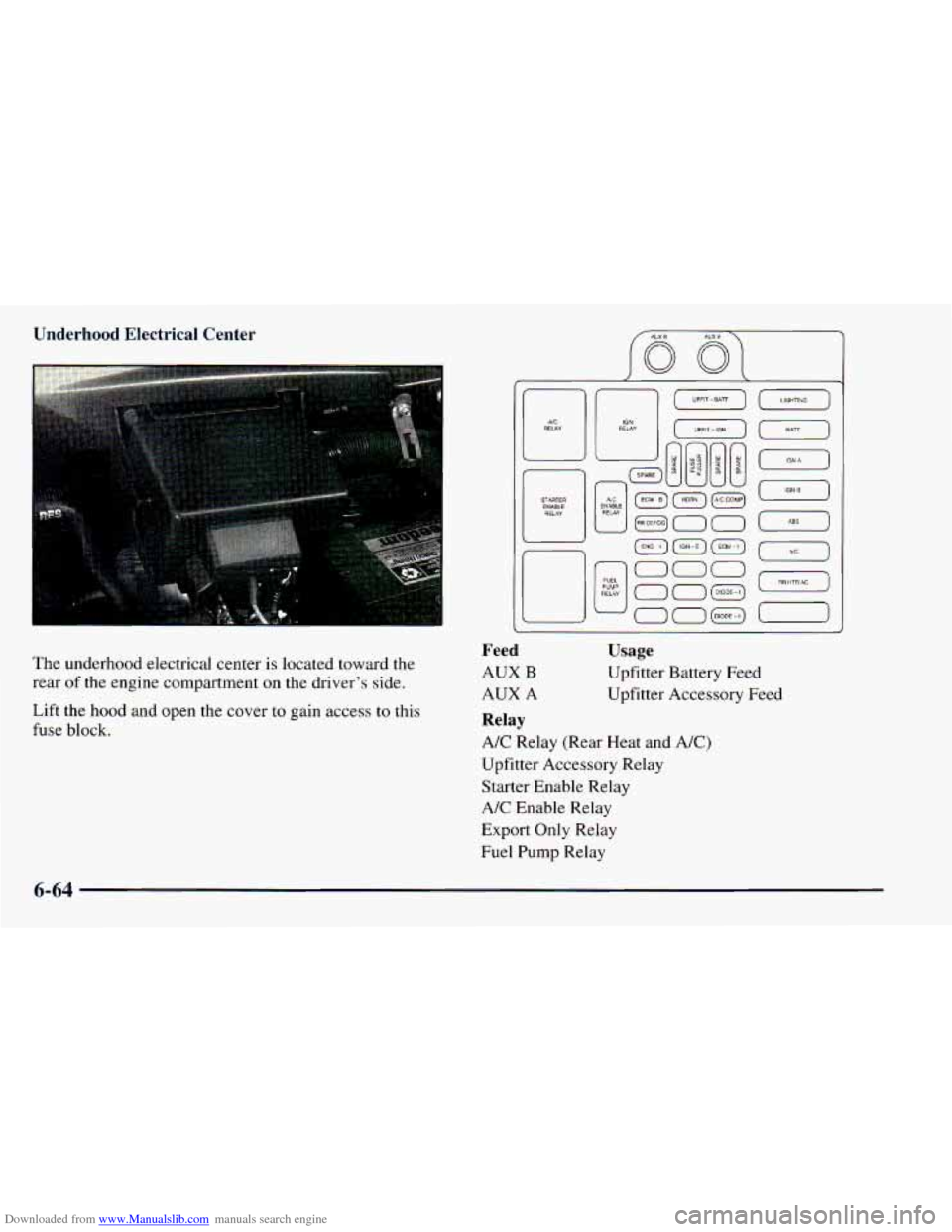
The underhood electrical center is located toward the
rear
of the engine compartment on the driver’s side.
Lift the hood and open
the cover to gain access to this
fuse block.
Feed Usage
AUX B Upfitter Battery Feed
AUX A Upfitter Accessory Feed
Relay
A/C Relay (Rear Heat and A/C)
Upfitter Accessory Relay
Starter Enable Relay
A/C Enable Relay
Export Only Relay
Fuel Pump Relay
6-64
Page 330 of 414
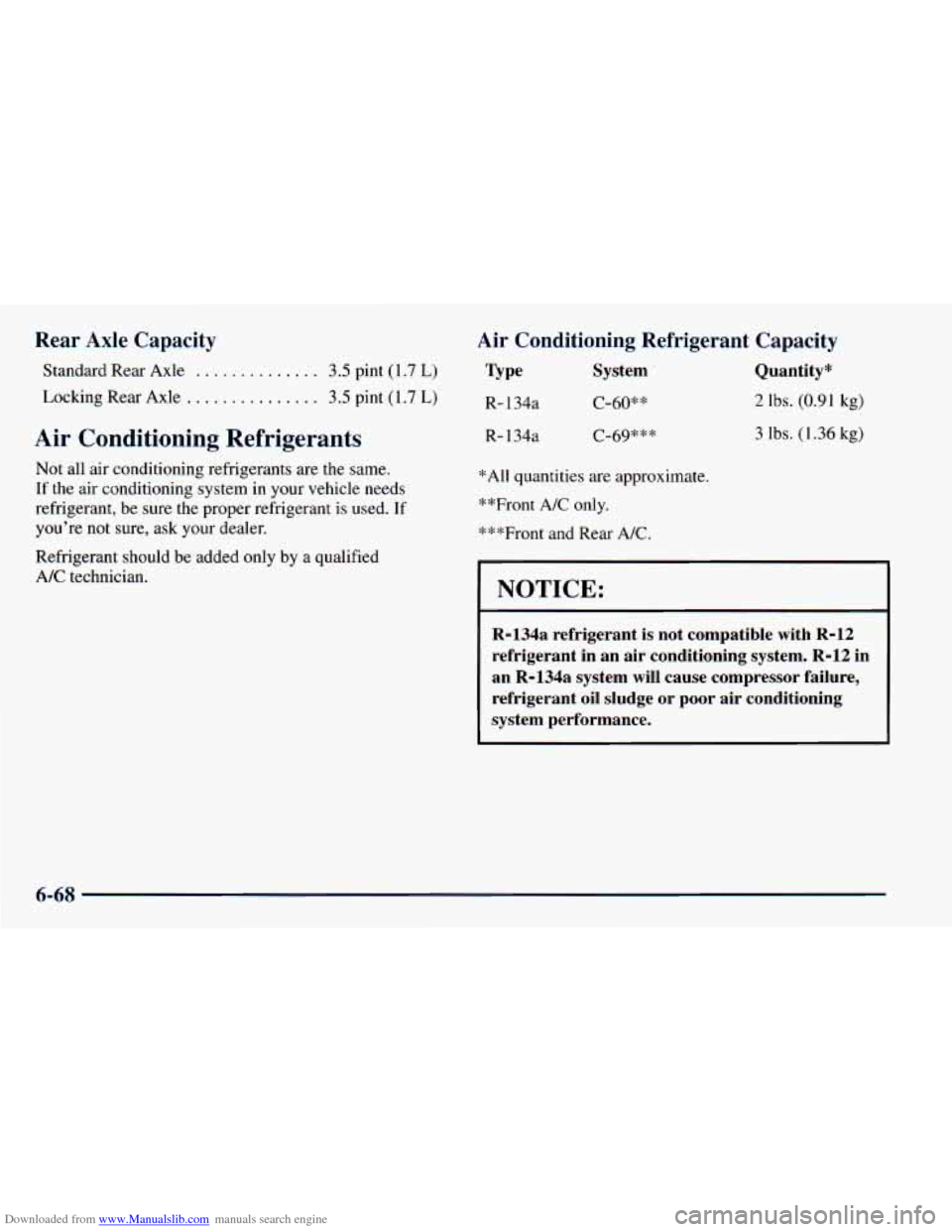
Downloaded from www.Manualslib.com manuals search engine Rear Axle Capacity
Standard Rear Axle . . . . . . . . . . . . . . 3.5 pint (1.7 L)
Locking Rear Axle . . . . . . . . . . . 3.5 pint (1.7 L)
Air Conditioning Refrigerants
Not all air conditioning refrigerants are the same.
If the air conditioning system in your vehicle needs
refrigerant, be sure the proper refrigerant is used. If
you’re not sure, ask your dealer.
Refrigerant should be added only by a qualified
NC technician.
Air Conditioning Refrigerant Capacity
mPe
R- 134a
R- 134a
System
C-60**
C-69***
*All quantities are approximate.
**Front
A/C only.
***Front and Rear A/C.
Quantity*
2 lbs. (0.91 kg)
3 lbs,
(1.36 kg)
NOTICE:
R-134a refrigerant is not compatible with R-12
refrigerant in an air conditioning system. R-12 in
an R-134a system
will cause compressor failure,
refrigerant oil sludge
or poor air conditioning
system performance.
6-68
Page 342 of 414
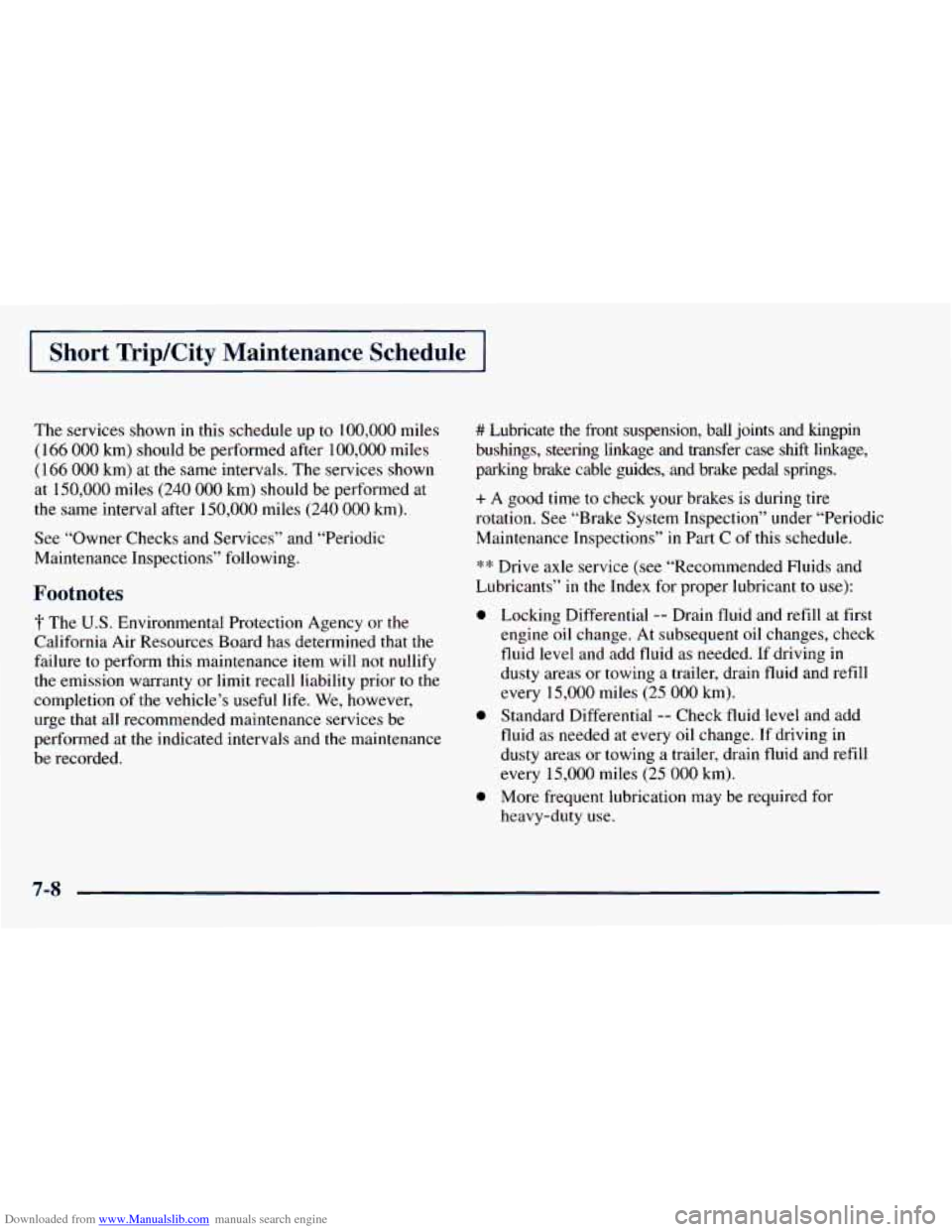
Downloaded from www.Manualslib.com manuals search engine Short TripKity Maintenance Schedule
The services shown in this schedule up to 100,000 miles
(166 000 km) should be performed after 100,000 miles
(166 000 km) at the same intervals. The services shown
at 150,000 miles
(240 000 km) should be performed at
the same interval after 150,000 miles (240 000 km).
See “Owner Checks and Services’’ and “Periodic
Maintenance Inspections” following.
Footnotes
The U.S. Envlronmental Protection Agency or the
California Air Resources Board has determined that the
failure to perform this maintenance item will
not nullify
the emission warranty or limit recall liability prior to the
completion
of the vehicle’s useful life. We, however,
urge that all recommended maintenance services be
performed at the indicated intervals and the maintenance
be recorded.
# Lubricate the front suspension, ball joints and kingpin
bushings, steering linkage and transfer case shift linkage,
parking brake cable guides, and brake pedal springs.
+ A good time to check your brakes is during tire
rotation. See “Brake System Inspection” under “Periodic
Maintenance Inspections” in Part
C of this schedule.
** Drive axle service (see “Recommended Fluids and
Lubricants”
in the Index for proper lubricant to use):
0
0
0
Locking Differential -- Drain fluid and refill at first
engine oil change. At subsequent oil changes, check
fluid level and add fluid as needed. If driving
in
dusty areas or towing a trailer, drain fluid and refill
every 15,000 miles
(25 000 km).
Standard Differential
-- Check fluid level and add
fluid as needed at every oil change. If driving in
dusty areas or towing a trailer, drain fluid and refill
every 15,000 miles
(25 000 km).
More frequent lubrication may be required for
heavy-duty use.
7-8
Page 363 of 414
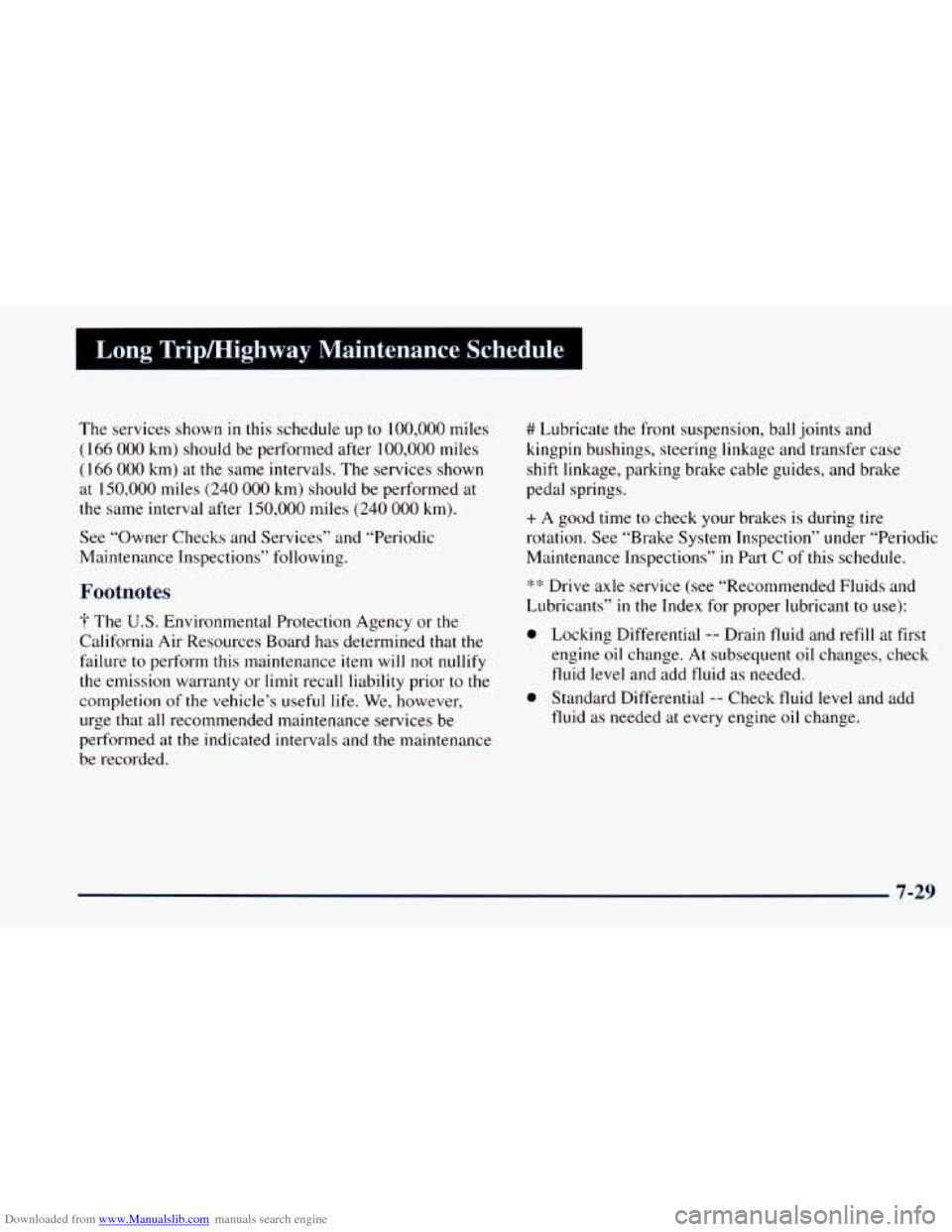
Downloaded from www.Manualslib.com manuals search engine Long TripMighway Maintenance Schedule
The services shown in this schedule up to 100,000 miles
(166 000 km) should be performed after 100,000 miles
(166 000 km) at the same intervals. The services shown
at
150,000 miles (240 000 km) should be performed at
the same interval after
150,000 miles (240 000 km).
See “Owner Checks and Services” and “Periodic
Maintenance Inspections” following.
Footnotes
The U.S. Environmental Protection Agency or the
California Air Resources Board has determined that the
failure to perform this maintenance item will
not nullify
the emission warranty or limit recall liability prior to the
completion
of the vehicle’s useful life. We, however,
urge that all recommended maintenance services be
performed at
the indicated intervals and the maintenance
be recorded.
## Lubricate the front suspension, ball joints and
kingpin bushings, steering linkage and transfer case
shift linkage, parking brake cable guides, and brake
pedal springs.
+ A good time to check your brakes is during tire
rotation. See “Brake System Inspection” under “Periodic
Maintenance Inspections”
in Part C of this schedule.
#’* Drive axle service (see “Recommended Fluids and
Lubricants”
in the Index for proper lubricant to use):
0 Locking Differential -- Drain fluid and refill at first
engine
oil change. At subsequent oil changes, check
fluid
level and add fluid as needed.
fluid as needed at every engine oil change.
0 Standard Differential -- Check fluid level and add
7-29
Page 376 of 414
Downloaded from www.Manualslib.com manuals search engine At Least Twice a Year Automatic lkansmission Check
Restraint System Check
Make sure the safety belt reminder light and all your
belts, buckles, latch plates, retractors and anchorages are
working properly. If your vehicle has a built-in child
restraint, also periodically make sure the harness straps,
latch plates, buckle, clip, retractors and anchorages are
working properly. Look for any other loose or damaged
safety belt and built-in child restraint system parts. If
you see anything that might keep a safety belt or built-in
child restraint system from doing its
job, have it
repaired. Have any torn or frayed safety belts or harness
straps replaced.
Also look for
any opened or broken air bag coverings,
and have them repaired or replaced. (The air bag system
does
not need regular maintenance.)
Wiper Blade Check
Inspect wiper blades for wear or cracking. Replace blade
inserts that appear worn or damaged or that streak or
miss areas
of the windshield. Also see “Wiper Blades,
Cleaning” in the Index. Check the transmission fluid
level; add if needed.
See
“Automatic Transmission’’ in the Index. A fluid loss
may indicate a problem. Check the system and repair
if needed.
At Least Once a Year
Key Lock Cylinders Service
Lubricate the key lock cylinders with the lubricant
specified in Part
D.
Body Lubrication Service
Lubricate all body door hinges, the body hood, fuel
door and rear compartment hinges, latches and locks
including interior glove box and console doors, and any
moving seat hardware. Lubricate the hood safety lever
pivot and prop rod pivot. Part
D tells you what to use.
More frequent lubrication may be required when
exposed to a corrosive environment.
7-42
Page 377 of 414
Downloaded from www.Manualslib.com manuals search engine Starter Switch Check
I A CAUTION: I
When you are doing this check, the vehicle could
move suddenly.
If it does, you or others could be
injured. Follow the steps below.
1. Before you start, be sure you have enough room
around the vehicle.
2. Firmly apply both the parking brake (see “Parking
Brake” in the Index if necessary) and the
regular brake.
NOTE: Do not use the accelerator pedal, and be
ready to turn off the engine immediately
if it starts.
3. Try to start the engine in each gear. The starter
should work only
in PARK (P) or NEUTRAL (N).
If the starter works in any other position, your
vehicle needs service.
Brake-Transmission Shift Interlock (BTSI) Check
A CAUTION:
When you are doing this check, the vehicle could
move suddenly.
If it does, you or others could be
injured. Follow the steps below.
1. Before you start, be sure you have enough
room around the vehicle. It should be parked
on a level surface.
2.
3.
Firmly apply the parking brake (see “Parking Brake”
in the Index if necessary).
NOTE: Be ready to apply the regular brake
immediately if the vehicle begins to move.
With the engine
off, turn the key to the RUN position,
but don’t start
the engine. Without applying the regular
brake,
try to move the shift lever out of PARK (P) with
normal effort. If the shift lever moves out of
PARK (P), your vehicle’s
BTSI needs service.
7-43