Section 5 CHEVROLET ASTRO CARGO VAN 1995 2.G Owner's Manual
[x] Cancel search | Manufacturer: CHEVROLET, Model Year: 1995, Model line: ASTRO CARGO VAN, Model: CHEVROLET ASTRO CARGO VAN 1995 2.GPages: 342, PDF Size: 17.57 MB
Page 148 of 342
Downloaded from www.Manualslib.com manuals search engine 0
0
0
0
0
0 0
0
Watch for traffic signs, pavement markings, and lines. If you can see a
sign up ahead that might indicate a turn or an intersection, delay your
pass.
A broken center line usually indicates it’s all right to pass
(providing the road ahead is clear). Never cross a solid line on your
side of the lane or a double solid line, even if the road seems empty
of
approaching traffic.
Do not get too close to the vehicle you want to pass while you’re
awaiting
an opportunity. For one thing, following too closely reduces
your
area of vision, especially if you’re following a larger vehicle.
Also, you won’t have adequate space if the vehicle ahead suddenly
slows or stops. Keep back a reasonable distance.
When it looks like a chance
to pass is coming up, start to accelerate but
stay in the right lane and don’t get too close. Time your move
so you
will be increasing speed as the time comes to move into the other lane.
If the way is clear to pass, you will have a “running start” that more
than makes up for the distance you would lose by dropping back. And
if something happens
to cause you to cancel your pass, you need only
slow down and drop back again and wait for another opportunity.
If other cars are lined up to pass a slow vehicle, wait your turn. But
take care that someone isn’t trying to pass
you as you pull out to pass
the slow vehicle. Remember
to glance over your shoulder and check
the blind spot.
Check your mirrors, glance over your shoulder, and start your left lane
change signal before moving out of the right lane
to pass. When you
are far enough ahead of the passed vehicle to see its front in your inside
mirror, activate your right lane change signal and move back into the
right lane. (Remember that your right outside mirror is convex. The
vehicle you just passed may seem to be farther away from
you than it
really is.)
Try not to pass more than one vehicle at a time on two-lane roads.
Reconsider before passing
the next vehicle.
Don’t overtake a slowly moving vehicle too rapidly. Even though the
brake lights are not flashing, it may be slowing down or starting
to turn.
If you’re being passed, make it easy for the following driver to get
ahead of you. Perham vou
can ease a little to the ripht.
4-10
Page 153 of 342
Downloaded from www.Manualslib.com manuals search engine Some Other Rainy Weather Tips
Turn on your low-beam headlamps - not just your parking lamps -
0 Besides slowing down, allow some extra following distance. And be
to help make you more visible to others.
especially careful when you pass another vehicle. Allow yourself more
clear room ahead, and be prepared to have your view restricted by road
spray.
Have good tires with proper tread depth. (See “Tires” in the Index.)
City Driving
a
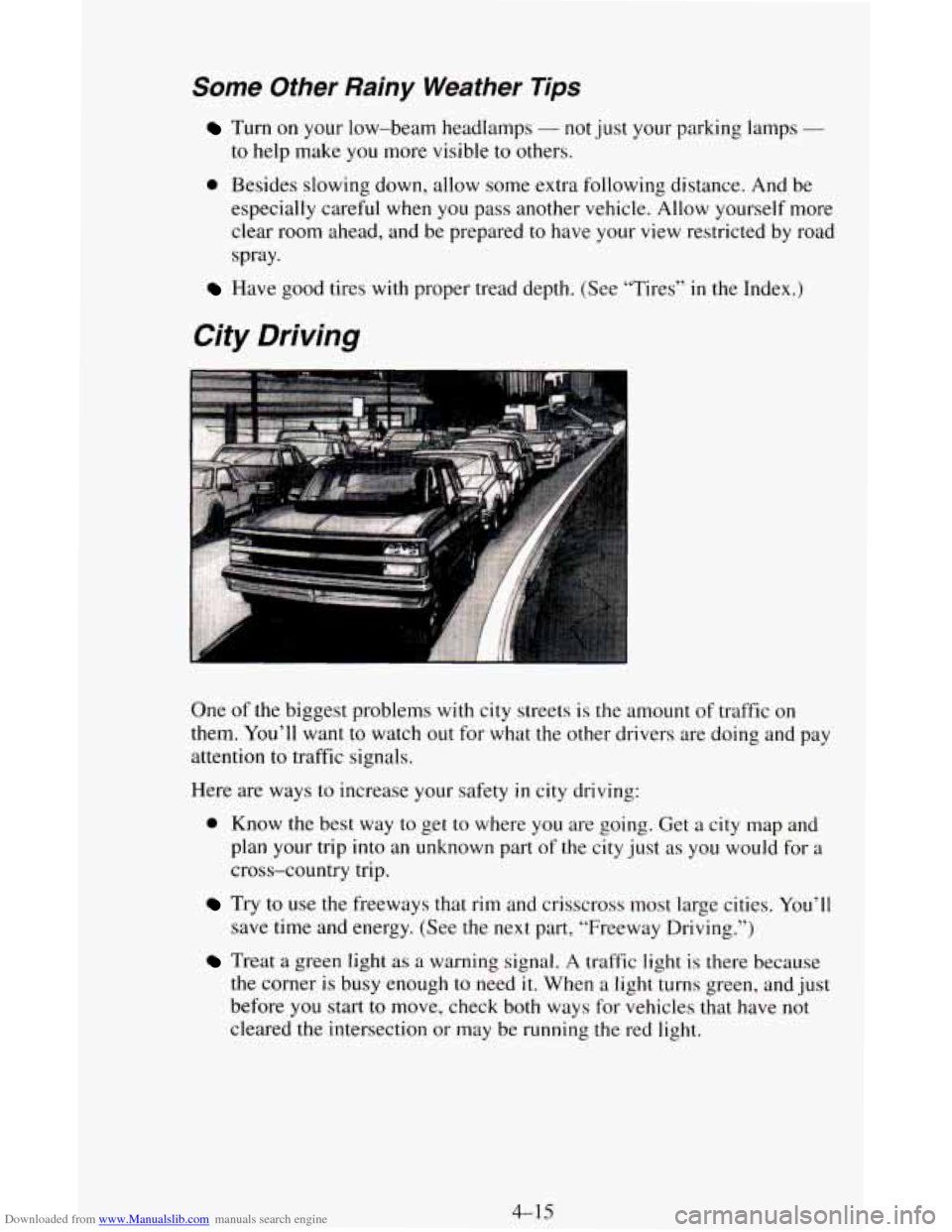
One of the biggest problems with city streets is the amount of traffic on
them. You’ll want to watch out for what the other drivers are doing and pay
attention
to traffic signals.
Here are ways to increase your safety
in city driving:
0 Know the best way to get to where you are going. Get a city map and
plan your trip into an unknown part
of the city just as you would for a
cross-country trip.
save time and energy. (See the next part, “Freeway Driving.”)
Treat a green light as a warning signal. A traffic light is there because
the corner is busy enough to need
it. When a light turns green, and just
before
you start to move, check both ways for vehicles that have not
cleared the intersection or may be running
the red light.
Try to use the freeways that rim and crisscross most large cities. You’ll
4-15
Page 164 of 342

Downloaded from www.Manualslib.com manuals search engine Towing a Trailer
NOTICE:
Pulling a trailer improperly can damage your vehicle and result\
in costly repairs not covered
by your warranty. To pull a trailer
correctly, follow the advice in this part, and see your
GM dealer
for important information about towing a trailer with your
vehicle.
Most vehicles are ready for some trailer towing. If yours was built with
trailering options, as many are, it’s ready for heavier trailers. But trailering
is different than just driving your vehicle by itself. Trailering means changes
in handling, durability, and fuel economy. Successful, safe trailering takes
correct equipment, and it has to be used properly.
That’s the reason for this part. In it are many time-tested, important
trailering tips and safety rules. Many of these are important for your safety
and that
of your passengers. So please read this section carefully before you
pull a trailer.
&!You Do Decide To Pull A Trailer
If you do, here are some important points.
There are many different laws, including speed limit restrictions,
having to do with trailering. Make sure your rig will be legal, not only
where you live but also where you’ll be driving.
A good source for this
information can be state or provincial police.
Consider using a sway control if your trailer will weigh 2,000 pounds
(900 kg) or less. You should always use a sway control if your trailer
will weigh more than
2,000 pounds (900 kg). You can ask a hitch
dealer about sway controls.
4-26
Page 171 of 342
Downloaded from www.Manualslib.com manuals search engine Maintenance When Trailer Towing
Your vehicle will need service more often when you’re pulling a trailer. See
the Maintenance Schedule for more
on this. Things that are especially
important in trailer operation are automatic transmission fluid (don’t
overfill), engine oil, axle lubricant, belt, cooling system, and brake
adjustment. Each of these is covered in this manual, and the Index will help
you find them quickly. If you’re trailering, it’s a good idea to review these
sections before you start your trip.
Check periodically to see that all hitch nuts and bolts are tight.
Trailer Lighting Systems Wiring
See “Trailer Wiring Harness” in the Index.
4-33
Page 209 of 342
Downloaded from www.Manualslib.com manuals search engine Service & Appearance Care
Section
Here you will find information about the care of your vehicle. This section
begins with service and fuel information, and then it shows how to check
important fluid and lubricant levels. There is also technical information
about your vehicle, and a part devoted to its appearance care.
Service
Your GM dealer knows your vehicle best and wants you to be happy with it.
We hope you’ll
go to your dealer for all your service needs. You’ll get
genuine GM parts and GM-trained and supported service people.
We hope you’ll want to keep your GM vehicle all GM. Genuine
GM parts
have one
of these marks:
Doing Your Own Service Work
If you want to do some of your own service work, you’ll want to get the
proper GM Service Manual.
It tells you much more about how to service
your vehicle than this manual can.
To order the proper service manual, see
“Service Publications’’
in the Index.
6-1
Page 229 of 342
Downloaded from www.Manualslib.com manuals search engine A//- Wheel Drive
If you have an all-wheel-drive vehicle, be sure to perform the lubricant
checks described in this section. However, they have two additional systems
that need lubrication.
Transfer Case
When to Check Lubricant
Refer to the Maintenance Schedule to determine how often to check the
lubricant. See “Periodic Maintenance Inspections’’ in the Index.
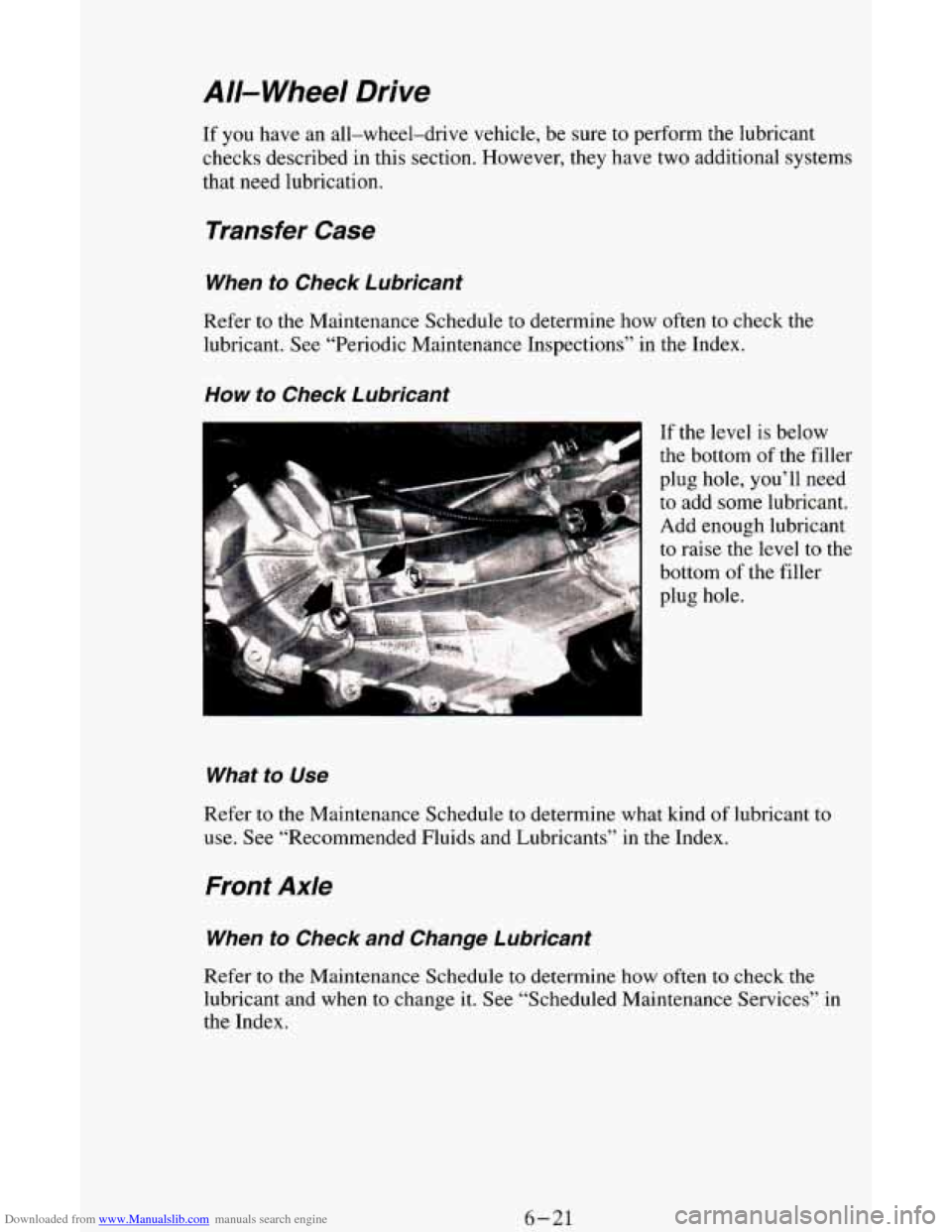
How to Check Lubricant
If the level is below
the bottom
of the filler
plug hole, you’ll need
to add some lubricant.
Add enough lubricant
to raise the level
to the
bottom
of the filler
plug hole.
What to Use
Refer to the Maintenance Schedule to determine what kind of lubricant to
use. See “Recommended Fluids and Lubricants” in the Index.
Front Axle
When to Check and Change Lubricant
Refer to the Maintenance Schedule to determine how often to check the
lubricant and when to change it.
See “Scheduled Maintenance Services’’ in
the Index.
6-21
Page 240 of 342
Downloaded from www.Manualslib.com manuals search engine Replacing Brake System Parts
The braking system on a modern vehicle is complex. Its many parts have to
be of top quality and work well together if the vehicle is to have really good
braking. Vehicles we design and test have topquality
GM brake parts in
them, as your vehicle does when it is new. When you replace parts of your
braking system
- for example, when your brake linings wear down and
you have to have
new ones put in - be sure you get new genuine GM
replacement parts. If you don’t, your brakes may no longer work properly.
For example, if someone puts in brake linings that are wrong for your
vehicle, the balance between your front and rear brakes can change
- for
the worse. The braking performance you’ve come to expect can change in
many other ways if someone puts in the wrong replacement brake parts.
Hydro-Boost Brake System
The power steering pump also powers the Hydro-Boost. Refer to “Power
Steering Fluid” in this section when checking the fluid level or adding fluid.
Battery
Every new vehicle has a Delco Freedom’ battery. You never have to add
water to one of these. When it’s time for a new battery, we recommend
a
Delco Freedom’ battery. Get one that has the replacement number shown
on the original battery’s label.
Vehicle Storage
If you’re not going to drive your vehicle for 25 days or more, take off the
black, negative (-) cable from the battery. This will help keep your battery
from running down.
Contact your dealer
to learn how to prepare your vehicle for longer storage
periods.
6-32
Page 251 of 342
Downloaded from www.Manualslib.com manuals search engine Tire lnspection and Rotation
Tires should be inspected every 6,000 to 8,000 miles ( 10 000 to 13 000 km)
for any signs of unusual wear. If unusual wear
is present, rotate your tires as
soon
as possible and check wheel alignment. Also check for damaged tires
or wheels. See “When It’s Time for New Tires” and “Wheel Replacement”
later
in this section for more information.
The purpose
of regular rotation is to achieve more uniform wear for all tires
on the vehicle. The first rotation is the most important. See “Scheduled
Maintenance Services”
in the Index for scheduled rotation intervals.
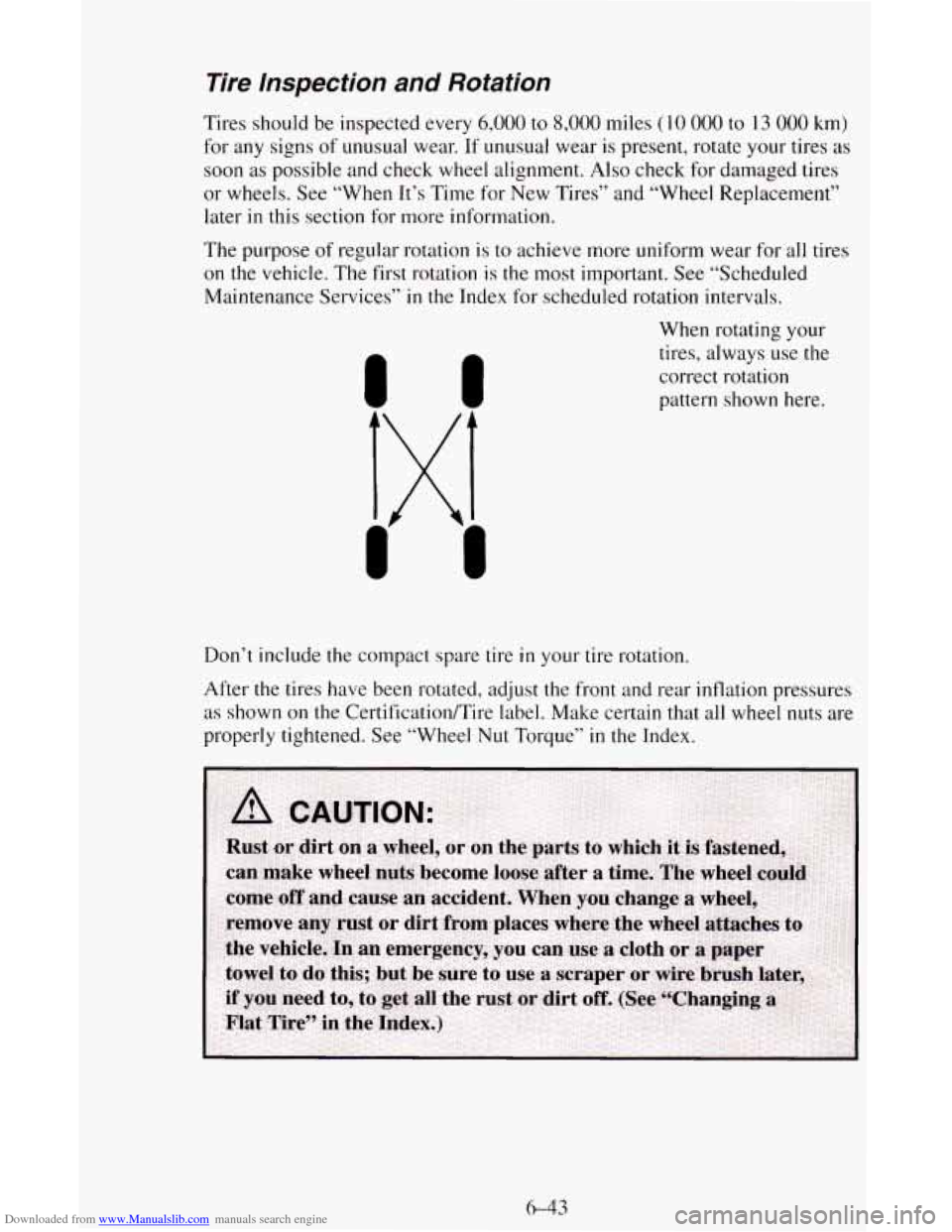
When rotating your tires, always use
the
correct rotation
pattern shown here.
Don’t include the compact spare tire
in your tire rotation.
After the tires have been rotated, adjust the front and rear inflation pressures
as shown on
the Certification/Tire label. Make certain that all wheel nuts are
properly tightened. See “Wheel
Nut Torque” in the Index.
6-43
Page 257 of 342
Downloaded from www.Manualslib.com manuals search engine Don’t use any of these unless this manual says you can. In many uses, these
will damage your vehicle:
0 Alcohol
Laundry Soap
Bleach
0 Reducing Agents
Cleaning the Inside of Your Vehicle
Use a vacuum cleaner often to get rid of dust and loose dirt. Wipe vinyl or
leather with a clean, damp cloth.
Your GM dealer has two GM cleaners, a solvent-type spot lifter and a
foam-type powdered cleaner. They will clean normal spots and stains very
well. Do not use them on vinyl or leather.
Here are some cleaning tips:
0 Always read the instructions on the cleaner label.
Clean up stains as soon as you can - before they set.
0 Use a clean cloth or sponge, and change to a clean area often. A soft
Use solvent-type cleaners in a well-ventilated area only. If you use
brush may be used
if stains are stubborn.
them, don’t saturate the stained area.
0 If a ring forms after spot cleaning, clean the entire area immediately or
it will set.
Using Foam-Type CIeaner on Fabric
0 Vacuum and brush the area to remove any loose dirt.
0 Always clean a whole trim panel or section. Mask surrounding trim
along stitch or welt lines.
0 Mix Multi-Purpose Powdered Cleaner following the directions on the
container label.
Use suds only and apply with a clean sponge.
0 Don’t saturate the material.
Don’t rub it roughly.
As soon as you’ve cleaned the section, use a sponge to remove the
suds.
6-49
Page 258 of 342
Downloaded from www.Manualslib.com manuals search engine Rinse the section with a clean, wet sponge.
Wipe off what’s left with a slightly damp paper towel or cloth.
Then dry it immediately with a blow dryer or a heat lamp.
NOTICE:
Be careful. A blow dryer may scorch the fabric.
Wipe with a clean cloth.
Using Solvent-Type Cleaner on Fabric
First, see if you have to use solvent-type cleaner at all. Some spots and
stains will clean off better
with just water and mild soap.
If you need to
use a solvent:
Gently scrape excess soil from the trim material with a clean, dull knife or
scraper. Use
very little cleaner, light pressure and clean cloths (preferably
cheesecloth). Cleaning should start at the outside
of the stain, “feathering”
toward the center. Keep changing
to a clean section of the cloth.
blow dryer to help prevent a cleaning ring. (See the previous NOTICE.)
0 When you clean a stain from fabric, immediately dry the area with a
Fabric Protection
Your vehicle has upholstery that has been treated with Scotchgard” Fabric
Protector,
a 3M product. Scotchgard“ protects fabrics by repelling oil and
water, which are the carriers of most stains. Even with this protection, you
still need to clean your upholstery often to keep it looking new.
Further information on cleaning is available by calling 1-800-433-3296
(in
Minnesota, 1-800-642-6 167).
Special Cleaning Problems
Greasy or Oily Stains
Stains caused by grease, oil, butter, margarine, shoe polish, coffee with
cream, chewing gum, cosmetic creams, vegetable oils, wax crayon, tar and
asphalt can be removed as follows:
Carefully scrape off excess stain.
Follow the solvent-type instructions described earlier.
Shoe polish, wax crayon, tar and asphalt will stain if left on a vehicle
seat fabric. They should be removed as soon
as possible. Be careful,
because the cleaner will dissolve them and may cause them to spread.
4-50