light CHEVROLET ASTRO PASSENGER 1994 1.G Owners Manual
[x] Cancel search | Manufacturer: CHEVROLET, Model Year: 1994, Model line: ASTRO PASSENGER, Model: CHEVROLET ASTRO PASSENGER 1994 1.GPages: 340, PDF Size: 16.86 MB
Page 10 of 340
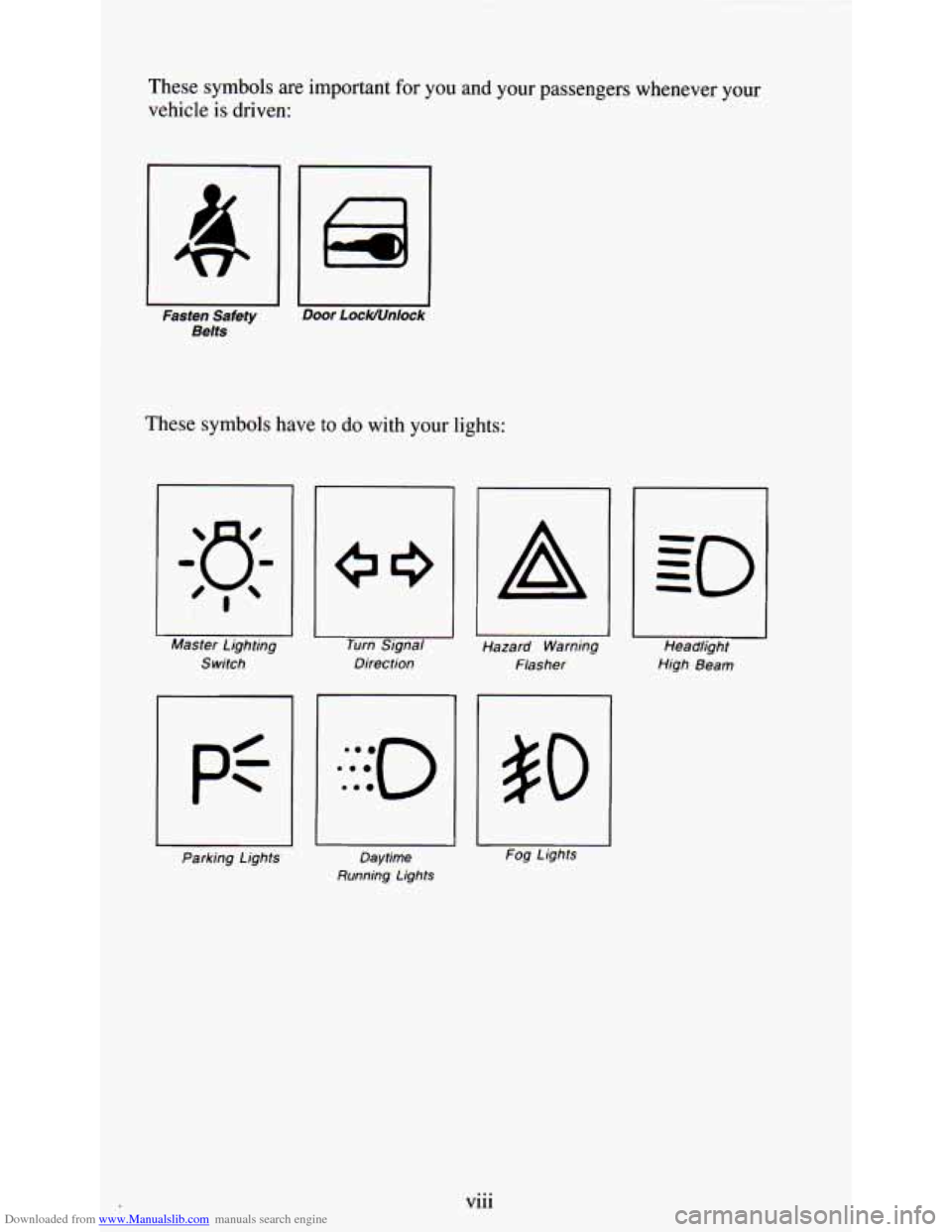
Downloaded from www.Manualslib.com manuals search engine These symbols are important for you and your passengers whenever your
vehicle
is driven:
I Fasten Safety Door LocWUnlock
Belts
These symbols have to do with your lights:
I Master Lighting
S wifc h
Parking Lights
I Turn Signal
Direction
Daytime
Running Lights
A
Hazard Warning
Flasher
1 Fog Lights Headlight
High Beam
viii
Page 11 of 340
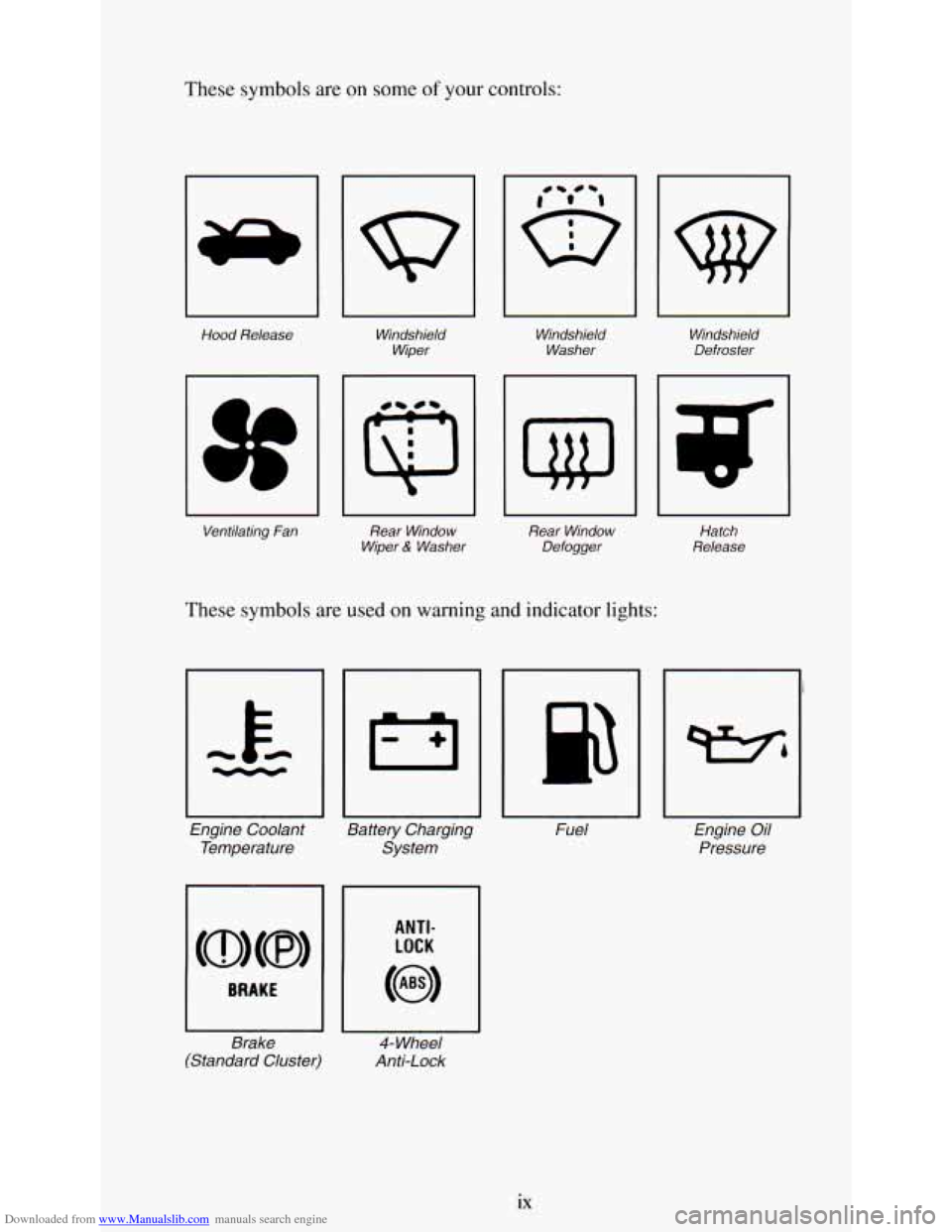
Downloaded from www.Manualslib.com manuals search engine These symbols are on some of your controls:
Hood Release
Ventilating
Fan
Windshield Wiper
Q
Rear Window
Wiper
& Washer
w
Windshield
Washer
I I
Rear Window Defogger
w
These symbols are used on warning and indicator lights:
Engine Coolant
Temperature Battery Charging
System
Brake
(Standard Cluster
ANTI-
LOCK
4- Wheel
Anti-Lock
Windshield Defroster
Hatch
Release
II
Fuel Engine Oil
Pressure
ix
Page 12 of 340
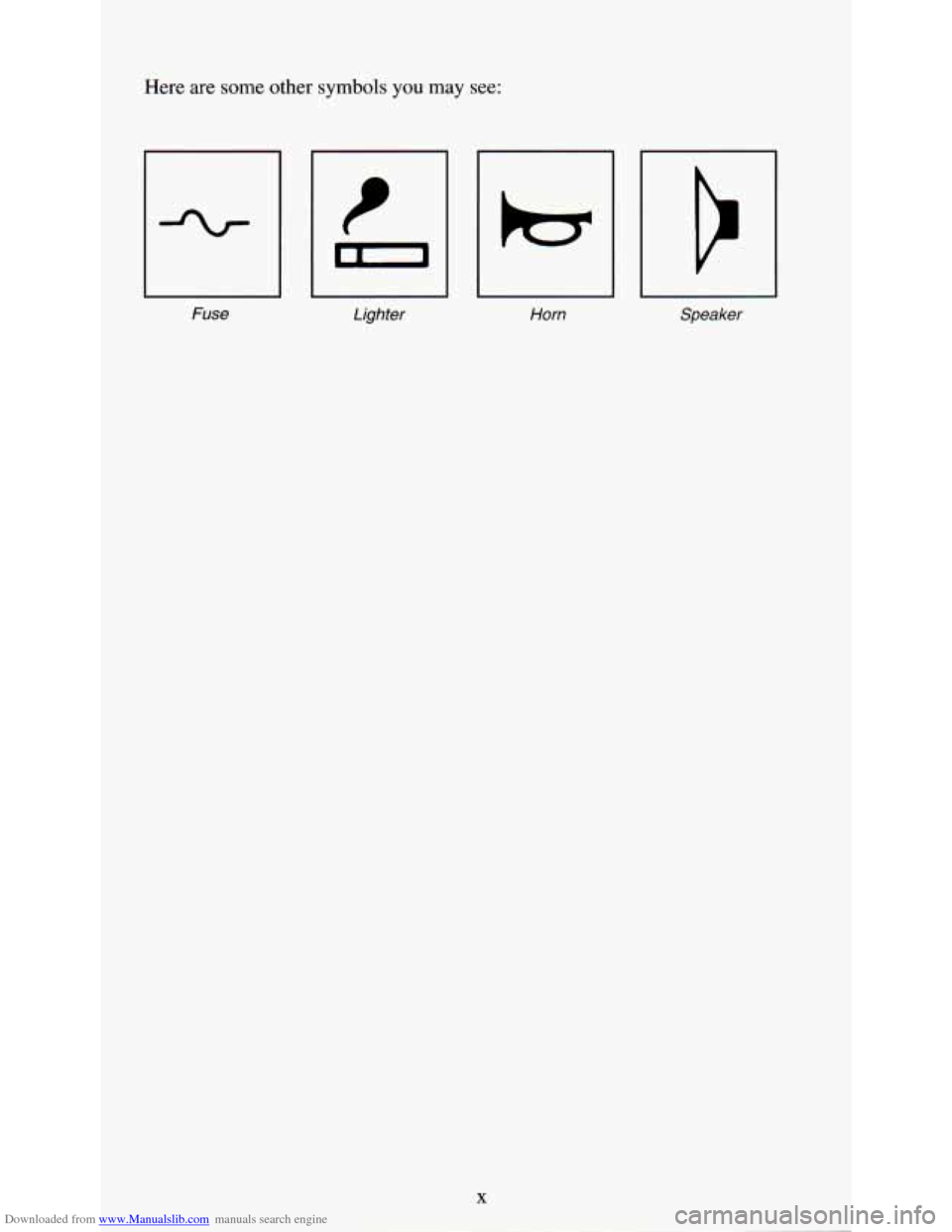
Downloaded from www.Manualslib.com manuals search engine Here are some other symbols you may see:
Fuse Lighter Horn
Speaker
X
Page 13 of 340
Downloaded from www.Manualslib.com manuals search engine Seats and Safety Belts
Section
Here you’ll find information about the seats in your vehicle and how to use
your safety belts properly
. You can also learn about some things you should
not do with safety belts .
Seats and Seat Controls .................................... 1-2
Frontseats
............................................. 1-2
Rear Seats
............................ , .. ....... 1-5
Head Restraints
...................... ........ 1-10
Why Safety Belts Work
.................................. 1-12
Safety Belt Reminder Light
............................. 1-16
How to Wear Safety Belts Properly ............................ 1-16
Adults .......................... .. ............. 1-16
Driver Position
............. ..................... 1-17
Lap-Shoulder Belt
.................................... 1-17
Driver’s Facial Air Bag System
............................ 1-25
Right Front Passenger Position
............................. 1-30
Rear Seat Outside Passenger Positions
....................... 1-31
Center Passenger Positions
................................ 1-34
LapBelt
............................................ 1-34
Children
................................................. 1-35
Smaller Children and Babies
.............................. 1-36
Child Restraints
........................................ 1-37
Larger Children
............. ......................... 1-44
Safety Belt Extender
....................................... 1-46
Checking Your Restraint Systems
............................. 1-47
Replacing Safety Belts After a Crash
.......................... 1-47
Safety
Belts: They’re for Everyone
....... ................. 1-11
Questions Many People Ask About Safety Belts
............. 1-15
Safety Belt Use During Pregnancy
.......................... 1-29
1-1
Page 23 of 340
Downloaded from www.Manualslib.com manuals search engine Safety Belts: They’re For Everyone
This part of the manual tells you how to use safety belts properly. It also
tells you some things you should not do with safety belts.
And it explains the Supplemental Inflatable Restraint,
or “air bag” system.
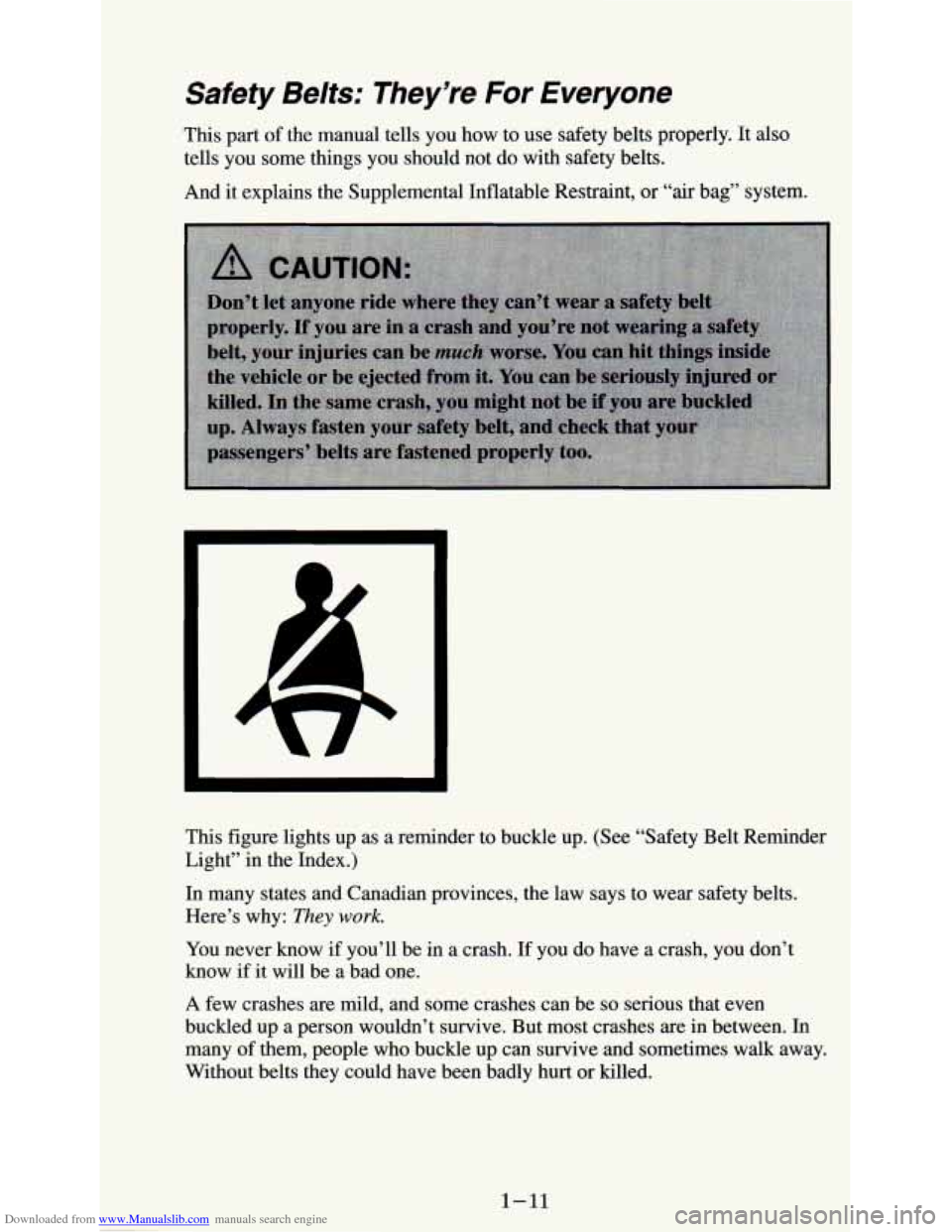
This figure lights up as a reminder to buckle up. (See “Safety Belt Reminder
Light” in the Index.)
In many states and Canadian provinces, the law says to wear safety belts.
Here’s why:
They work.
You never know if you’ll be in a crash. If you do have a crash, you don’t
know
if it will be a bad one.
A few crashes are mild, and some crashes can be
so serious that even
buckled up a person wouldn’t survive. But most crashes are in between.
In
many of them, people who buckle up can survive and sometimes walk away.
Without belts they could have been badly hurt or killed.
1-11
Page 28 of 340
Downloaded from www.Manualslib.com manuals search engine a good driver doesn’t protect you from things beyond your control.
such as bad drivers.
Most accidents occur within
25 miles (40 km) of home. And the
greatest number of serious injuries and deaths occur at speeds
of less
than
40 mph (65 km/h).
Safety belts are for everyone.
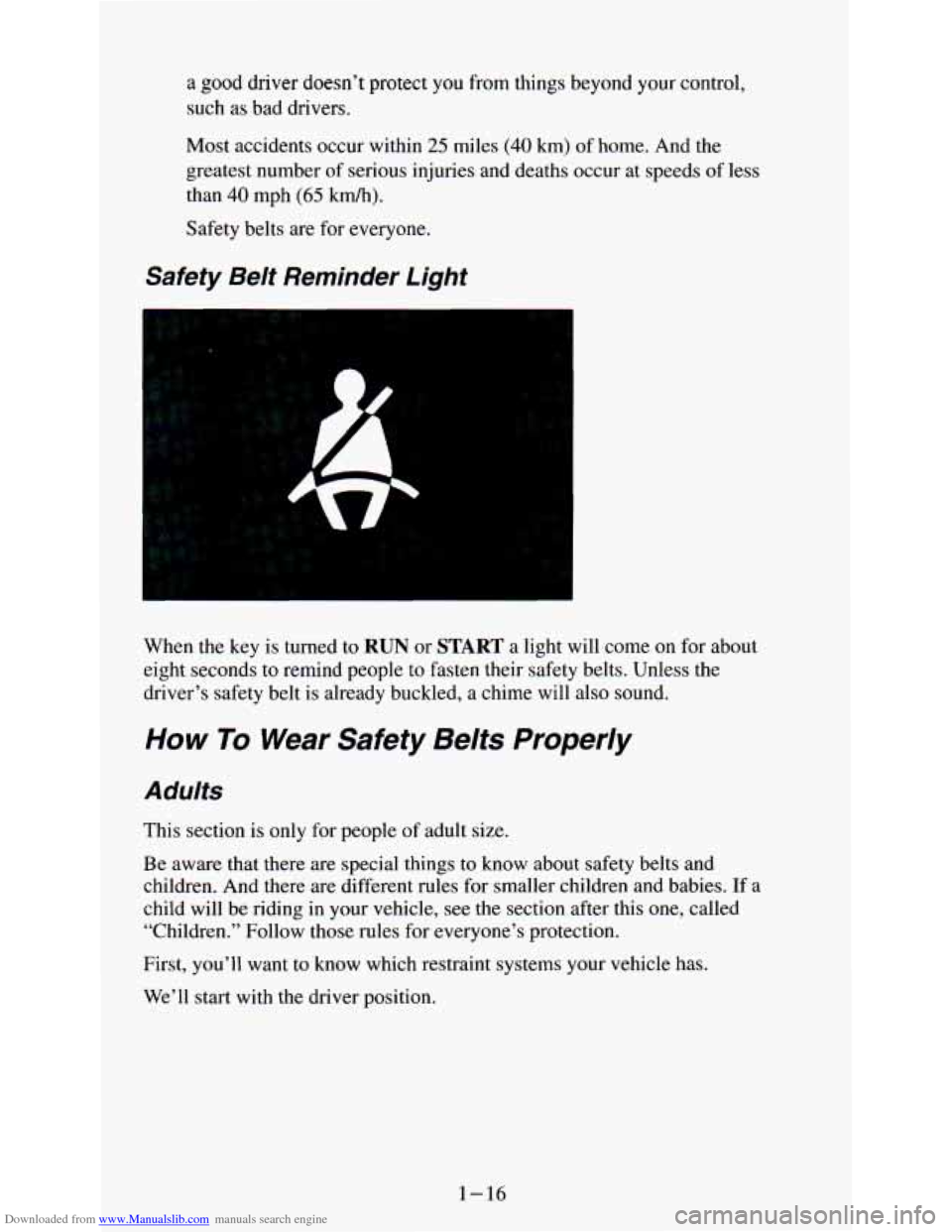
Safety Belt Reminder Light
When the key is turned to RUN or START a light will come on for about
eight seconds to remind people
to fasten their safety belts. Unless the
driver’s safety belt
is already buckled, a chime will also sound.
How To Wear Safety Belts Properly
Adults
This section is only for people of adult size.
Be aware that there are special things to know about safety belts and
children. And there are different rules for smaller children and babies.
If a
child will be riding in your vehicle, see the section after this one, called
“Children.” Follow those rules for everyone’s protection.
First, you’ll want to know which restraint systems your vehicle has.
We’ll start with the driver position.
1-16
Page 38 of 340
Downloaded from www.Manualslib.com manuals search engine Air Bag System Light
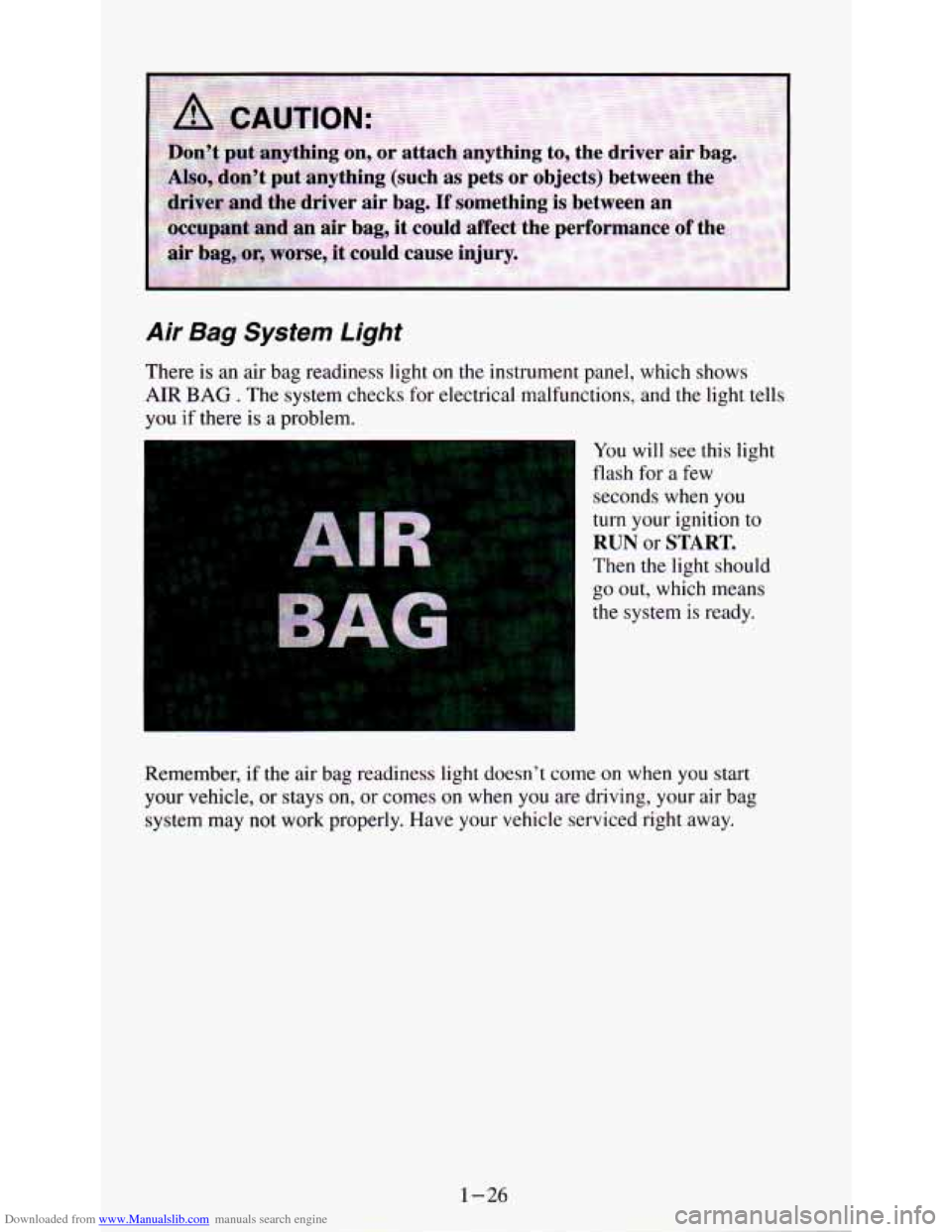
There is an air bag readiness light on the instrument panel, which shows
AIR BAG . The system checks for electrical malfunctions, and the light tells
you if there is a problem.
You
will see this light
flash for a few
seconds when
you
turn your ignition to
RUN or START.
Then the light should
go out, which means
the system is ready.
Remember, if the air bag readiness light doesn’t come on when
you start
your vehicle, or stays on,
or comes on when you are driving, your air bag
system may
not work properly. Have your vehicle serviced right away.
1-26
Page 62 of 340
Downloaded from www.Manualslib.com manuals search engine All-Wheel Drive (Option) .................. ............... 2-26
Windows
................................................ 2-26
Horn
.................................................... 2-29
Tilt Wheel (Option)
........................................ 2-29
Turn SignaVMultifunction Lever
.............................. 2-30
Turn Signal and Lane Change Indicator
...................... 2-30
Headlight High-Low Beam
............................... 2-32
Windshield Wipers
.................................... 2-32
Windshield Washer
...................................... 2-33
Rear Window WiperNasher
.............................. 2-34
Cruise Control
........................................ 2-35
Lights
................................................. 241
Mirrors
.................................................. 245
SunVisors
............................................. 247
Cigarette LighterlAshtrays
................................... 248
Assist Handles
............................................ 249
Storage Compartments
...................................... 2-50
Instrument Cluster
......................................... 2-51
Warning Lights, Gages and Indicators
....................... 2-55
Indicator Lights
....................................... 2-57
Gages
................................................ 2-61
Luggagecarrier
........................................... 2-65
Trailer Wiring Harness
... ......... ~~ . . 2-66
2-2
Page 72 of 340
Downloaded from www.Manualslib.com manuals search engine Key in the Ignition
If you walk away from your vehicle with the keys inside, it’s an easy target
for joy riders or professional thieves
- so don’t do it.
When you park your vehicle and open the driver’s door, you’ll hear
a chime
reminding you to remove your key from the ignition and take it with you.
Always do this. Your steering wheel
will be locked, and so will your
ignition and transmission. And remember to lock the doors.
Parking at Night
Park in a lighted spot, close all windows and lock your vehicle. Remember
to keep your valuables out
of sight. Put them in a storage area, or take them
with you.
Parking Lots
If you park in a lot where someone will be watching your vehicle, it’s best
to lock
it up and take your keys. But what if you have to leave your ignition
key? What
if you have to leave something valuable in your vehicle?
Put your valuables in a storage area out of sight.
Lock all the doors except the driver’s.
Then take the door key with you.
New Vehicle “Break-In ”
NOTICE:
Your modern vehicle doesn’t need an elaborate “break-in.” But
it will perform better in the long run if you follow these
guidelines:
0 Keep your speed at 55 mph (88 km/h) or less for the first
500 miles (804 km).
Don’t drive at any one speed - fast or slow - for the first
500 miles (804 km). Don’t make full-throttle starts.
0 Avoid making hard stops for the first 200 miles (322 km) or
so. During this time your new brake linings aren’t yet broken
in. Hard stops with new linings can mean premature wear and
earlier replacement. Follow this “breaking-in” guideline
every time you get new brake linings.
2-12
Page 80 of 340
Downloaded from www.Manualslib.com manuals search engine Locking Rear Axle
If you have this feature, your rear axle can give you additional traction on
snow, mud, ice, sand or gravel. It works like a standard axle most of the
time, but when
one of the rear wheels has no traction and the other does, the
locking feature will allow the wheel with traction
to move the vehicle.
Parking Brake
To Set the Parking Brake:
I
I
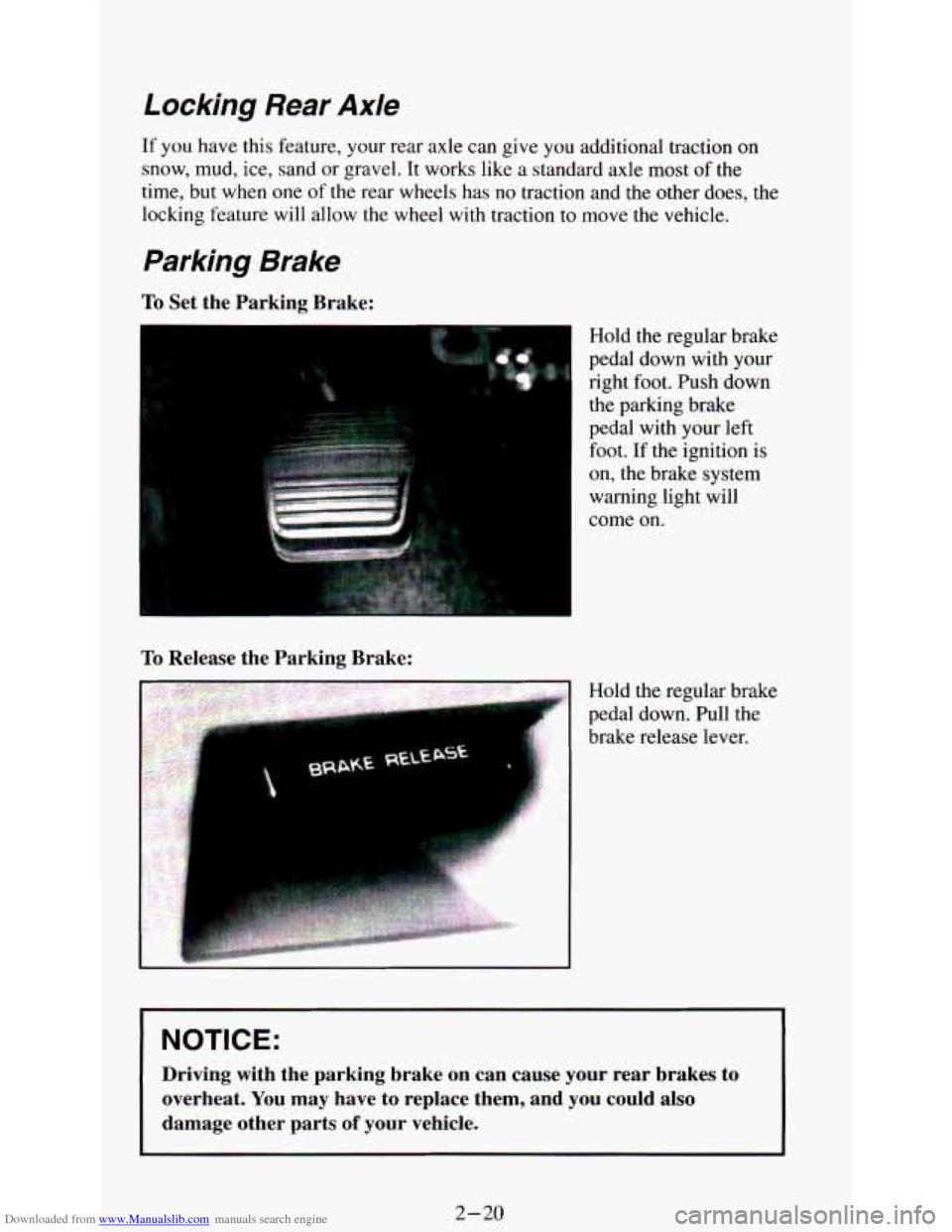
Hold the regular brake
pedal down with your
right foot. Push down
the parking brake
pedal with your left
foot.
If the ignition is
on, the brake system
warning light will
come on.
To Release the Parking Brake:
Hold the regular brake
pedal down. Pull the
brake release lever.
NOTICE:
Driving with the parking brake on can cause your rear brakes \
to
overheat. You may have to replace them, and you could also
damage other parts
of your vehicle.
2-20