heat CHEVROLET BLAZER 1995 2.G User Guide
[x] Cancel search | Manufacturer: CHEVROLET, Model Year: 1995, Model line: BLAZER, Model: CHEVROLET BLAZER 1995 2.GPages: 380, PDF Size: 20.04 MB
Page 135 of 380
Downloaded from www.Manualslib.com manuals search engine Comfort Controls & Audio Systems
Section
U
In this section you'll find out how to operate the comfort control systems
and audio systems offered with your vehicle. Be sure to read about the
particular system supplied with your vehicle.
Comfort Controls
Heater/Air Conditioning Controls
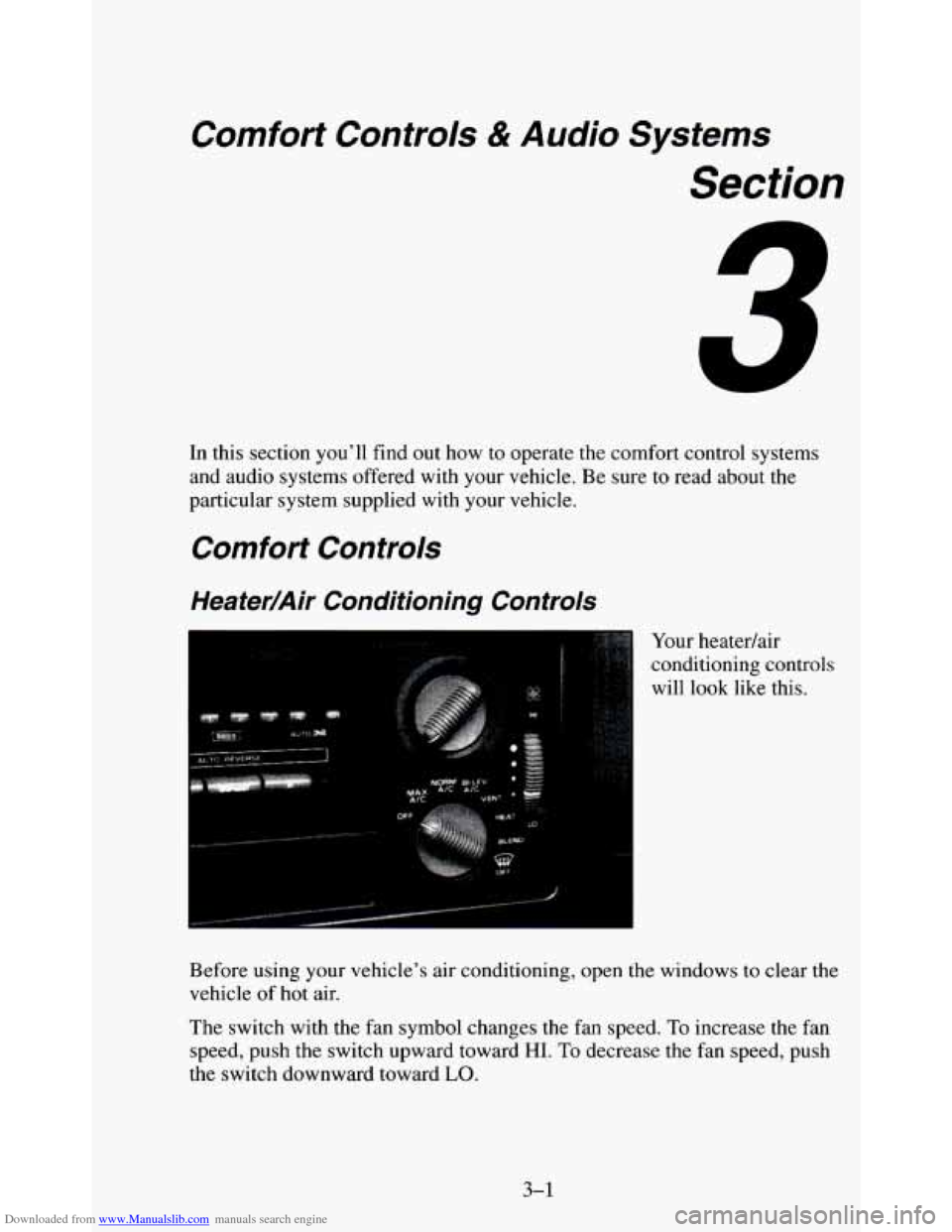
, ..,.. Your heatedair
conditioning controls
will look like this.
Before using your vehicle's air conditioning, open the windows to clear the
vehicle of
hot air.
The switch with the fan symbol changes the fan speed, To increase the fan
speed, push the switch upward toward HI. To decrease the fan speed, push
the switch downward toward
LO.
3-1
Page 136 of 380
Downloaded from www.Manualslib.com manuals search engine The upper knob changes the air temperature. Turn the knob clockwise for
warmer air. Turn the knob counterclockwise for cooler air.
The lower knob selects the heater
or air conditioning function and
determines which outlets the air will flow through (instrument panel,
defroster, heater, etc
.).
OFF - This setting turns off all heating functions. Some outside air will
still come
out of the heater outlet whenever the vehicle is moving forward.
MAX A/C - Air inside your vehicle is recirculated to maximize your air
conditioner’s performance and your vehicle’s fuel economy. This setting
cools the air the fastest and should be used to keep “unwanted odors” and/or
dust from entering the vehicle.
NORM A/C - This setting cools outside air and directs it through the
instrument panel vents. This setting is useful for normal cooling on hot
days.
BI-LEV A/C
- Air is delivered through the heater floor vents as well as
the instrument panel vents. This setting is useful in cool weather with bright
sunlight.
VENT
- Airflow is through the instrument panel vents. Set the upper knob
to the temperature desired. This setting
is useful for mild outside
temperatures, when little heating or cooling is desired. The air conditioner
does not run.
HEAT
- Heated air comes out through the heater floor vents and
windshield defroster vents. This setting is useful for cold weather.
BLEND
- Airflow is divided equally between the heater floor vent and the
windshield defroster vents. This setting is useful in cool weather when you
have fog or ice on the windshield or side windows.
DEF - This setting directs most air through the windshield defroster vents
and some through the heater vents. This setting is useful when you have fog
or ice on the windshield.
Engine Coolant Heater (Option)
If you use the optional engine coolant heater before starting your engine,
your heating system will produce warmer air faster, to heat the passenger
compartment in cold weather. See “Engine Coolant Heater” in the Index.
3-2
Page 137 of 380
Downloaded from www.Manualslib.com manuals search engine Rear Window Defogger (Option)
If your vehicle has this option, the rear window will have lines running
across the glass. These lines heat your window.
For best results, clear the window of as much snow or ice as possible before
using the rear window defogger.
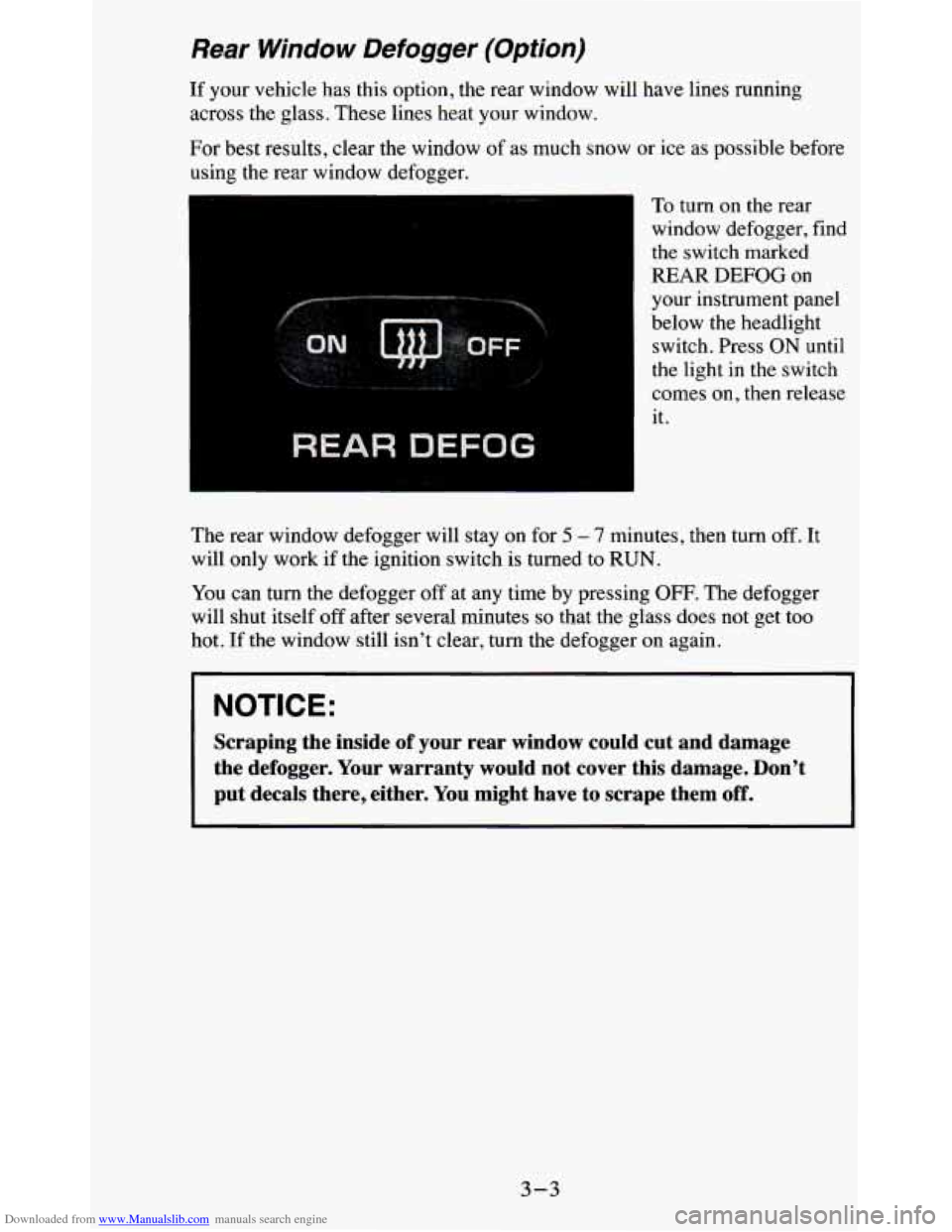
REAR DEFOG
-
To turn on the rear
window defogger, find
the switch marked
REAR
DEFOG on
your instrument panel
below the headlight switch. Press ON until
the light in the switch
comes on, then release
it.
The rear window defogger will stay on for
5 - 7 minutes, then turn off. It
will only work if the ignition switch is turned to RUN.
You can
turn the defogger off at any time by pressing OFF. The defogger
will shut itself off after several minutes
so that the glass does not get too
hot.
If the window still isn’t clear, turn the defogger on again.
NOTICE:
Scraping the inside of your rear window could cut and damage
the defogger. Your warranty would not cover this damage. Don’\
t
put decals there, either. You might have to scrape them
off.
3-3
Page 138 of 380

Downloaded from www.Manualslib.com manuals search engine Ventilation System
L
L
I‘ -a
Your vehicle’s ventilation system supplies outside air to the insi\
de of your
vehicle when it is moving. With the side windows closed, air will flow into
the front air inlet grilles, through the vehicle, and out the rear air exhaust
valve. Outside air will also enter the vehicle when the heater or the
air
conditioning fan is running.
Ventilation Tips
Keep the hood and front air inlet free of ice, snow, or any other
obstruction (such as leaves). The heater and defroster will work far
better, reducing
the chance of fogging the inside of your windows.
0 When you enter a vehicle in cold weather, turn the blower fan to HI for
a
few moments before driving off. This helps clear the intake ducts of
snow and moisture, and reduces the chance of fogging the inside
of
your windows.
0 Keep the air path under the front seats clear of objects. This helps air to
circulate throughout your vehicle.
3-4
Page 152 of 380
Downloaded from www.Manualslib.com manuals search engine To help avoid hearing loss or damage:
1. Adjust the volume control to the lowest setting.
2. Increase volume slowly until you hear comfortably and clearly.
NOTICE:
Before you add any sound equipment to your vehicle - like a
tape player, CB radio, mobile telephone or two-way radio - be
sure you can add what you want.
If you can, it’s very important
to do
it properly. Added sound equipment may interfere with the
operation of your vehicle’s engine, Delco’ radio or other
systems, and even damage them. And, your vehicle’s systems
may interfere with the operation of sound equipment that has
been added improperly.
So, before adding sound equipment, check with your dealer and
be sure to check Federal rules covering mobile radio and
telephone units.
Care of Your Cassette PIayer and Tape
A tape player that is not cleaned regularly is subject to reduce\
d sound
quality, ruining the cassette, or damaging the mechanism. Tape cassettes that
are not properly stored in their plastic cases away from contaminan\
ts, direct
sunlight, and extreme heat, may not operate properly and could cause
premature failure
of the tape player.
Your tape player should be cleaned with every
50 hours of use to provide
optimum performance. Your radio may display “Cln” (Clean) to indicate
that you have used your tape player for
50 hours without re-setting the tape
clean timer.
If you notice a reduction in sound quality, regardless of when
the tape player was last cleaned,
try playing a different cassette to see if the
tape or tape player is at fault. If the second cassette results in no
improvement in sound quality,
try cleaning the tape player.
Proper tape player cleaning should be done with a scrubbing action,
non-abrasive cleaning cassette. This is a wet-type cleaning system that uses
a cleaning cassette with pads which scrub the tape head as the \
hubs of the
cleaner cassette turn.
To properly clean your tape player, follow instructions
with the cleaning cassette. If you use this type of cleaner, the radio may
display an error and eject the cartridge. This is normal and \
is the result
of an
added feature
in the tape player that detects broken tapes. If an error occurs,
you will need to insert the cleaning cassette at least
3 times to thoroughly
clean the tape player.
3-18
Page 174 of 380
Downloaded from www.Manualslib.com manuals search engine Q: Are there some things I should not do when driving down a hill?
A: Yes? These are important because if you ignore them you could lose
control and have a serious accident.
When driving downhill, avoid turns that take you across the incline of
the hill.
A hill that’s not too steep to drive down may be too steep to
drive across. You could roll over if
you don’t drive straight down.
Never go downhill with the transmission in NEUTRAL (N), or with the
clutch pedal depressed in a manual shift. This is called
“free-wheeling.” Your brakes will have to do all the work and could
overheat and fade.
Q: Am I likely to stall when going downhill?
A: It’s much more likely to happen going uphill. But if it happens going
downhill, here’s what to do.
0 Stop your vehicle by applying the regular brakes. Apply the parking
0 Shift to PARK (P) (or to Neutral with the manual transmission) and,
brake.
while still braking, restart the engine.
0 Shift back to a low gear, release the parking brake, and drive straight
down.
0 If the engine won’t start, get out and get help.
Driving Across an Incline
Sooner or later, an off-road trail will probably go across the incline of a hill.
If this happens,
you have to decide whether to try to drive across the incline.
Here are some things to consider:
0 A hill that can be driven straight up or down may be too steep to drive
across. When you
go straight up or down a hill, the length of the wheel
base (the distance from the front wheels to the rear wheels) reduces the
likelihood the vehicle will tumble end over end. But when
you drive
across an incline, the much more narrow track width (the distance
between the left and right wheels) may not prevent the vehicle from
tilting and rolling over. Also, driving across
an incline puts more
weight
on the downhill wheels. This could cause a downhill slide or a
rollover.
0 Surface conditions can be a problem when you drive across a hill.
Loose graveI, muddy
spots, or even wet grass can cause your tires to
slip sideways, downhill.
If the vehicle slips sideways, it can hit
something that will trip it (a rock,
a rut, etc.) and roll over.
4-20
Page 189 of 380

Downloaded from www.Manualslib.com manuals search engine Run your engine only as long as you must. This saves fuel. When you run
the engine, make it go a little faster than just idle. That is, push the
accelerator slightly. This uses less fuel for the heat that you get and it keeps
the battery charged. You will need a well-charged battery to restart the
vehicle, and possibly for signaling later on with your headlights. Let the
heater run for awhile.
Then, shut the engine
off and close the window almost all the way to
preserve the heat. Start the engine again and repeat this only when you feel
really uncomfortable from the cold. But do it as little as possible. Preserve
the
fuel as long as you can. To help keep warm, you can get out of the
vehicle and do some fairly vigorous exercises every half hour
or so until
help comes.
Power Winches
If you wish to use a power winch on your vehicle, only use it when your
vehicle is stationary or anchored.
NOTICE:
Operating a power winch with an automatic transmission in
PARK (P) or a manual transmission in gear may damage the
transmission. Always put the transmission in a Neutral position \
while operating a power winch.
I
Use the regular brakes, set the parking brake or block the wheels to keep
your vehicle from rolling.
If your vehicle is equipped with an airbag, see "Adding Equipment to Your
Air Bag-Equipped Vehicle" in the Index.
4-35
Page 195 of 380
Downloaded from www.Manualslib.com manuals search engine e
0
e
Don’t tow a trailer at all during the first 500 miles (800 km) your new
vehicle is driven. Your engine, axle or other parts could be damaged.
Then, during the first
500 miles (800 km) that you tow a trailer, don’t
drive over
50 mph (80 kdh) and don’t make starts at full throttle. This
helps your engine and other parts of your vehicle wear in
at the heavier
loads,
If you have an automatic transmission, you should use
DRIVE (D) (or,
as you need to, a lower gear) when towing
a trailer. Operating your
vehicle in DRIVE (D) when towing a trailer will minimize heat
build-up and extend the life
of your transmission. If you have a manual
transmission and you are towing a trailer, it’s better not to use FIFTH
(5) gear. Just drive in FOURTH (4) gear (or, as you need to, a lower
gear).
Three important considerations have to do with weight:
Weight of the Traikr
How heavy can a trailer safely be?
It depends on how you plan to use your rig. For example, speed, altitude,
road grades, outside temperature and how much your vehicle is used to pull
a trailer are all important. And, it can also depend on any special equipment
that you have on your vehicle.
You can ask your dealer for our trailering information or advice, or you can
write
us at the address listed in your Warranty and Owner Assistance
Information booklet.
In Canada, write to:
General Motors
of Canada Limited
Customer Assistance Center
1908 Colonel Sam Drive
Oshawa, Ontario
L1H 8W
Weight of the Trailer Tongue
The tongue load (A) of any trailer is an important weight to measure
because it affects the total or gross weight of your vehicle. The gross vehicle
weight (GVW) includes the curb weight of the vehicle, any cargo you may
carry in it, and the people who will be riding in the vehicle. And if you will
tow a trailer, you must add the tongue load to the GVW because your
vehicle will be carrying that weight, too. See “Loading Your Vehicle”
in the
Index for more information about your vehicle’s maximum load capacity.
4-41
Page 199 of 380
Downloaded from www.Manualslib.com manuals search engine Passing
You’ll need more passing distance up ahead when you’re towing a trailer.
And, because you’re a good deal longer, you’ll need to go much farther
beyond the passed vehicle before you can return to your lane.
Backing Up
Hold the bottom of the steering wheel with one hand. Then, to move the
trailer to the left, just move that hand to the left. To move the trailer to the
right, move your hand to the right. Always back up slowly and, if possible,
have someone guide you.
Making Turns
NOTICE:
Making very sharp turns while trailering could cause the traile\
r
to come in contact with the vehicle. Your vehicle could be
damaged. Avoid making very sharp turns while trailering.
When you’re turning with a trailer, make wider turns than normal. Do this
so your trailer won’t strike soft shoulders, curbs, road signs, trees, or other
objects. Avoid jerky or sudden maneuvers. Signal well in advance.
Turn Signals When Towing a Trailer
When you tow a trailer, your vehicle has to have extra wiring and a
heavy-duty
turn signal flasher (included in the optional trailering package).
The green arrows on your instrument panel will flash whenever you signal a
turn or lane change. Properly hooked up, the trailer lamps will also flash,
telling other drivers you’re about to turn, change lanes or stop.
When towing a trailer, the green arrows on your instrument panel will flash
for turns even if the bulbs on the trailer are burned out. Thus, you may think
drivers behind you are seeing your signal when they are not. It’s important
to check occasionally to be sure the trailer bulbs are still working.
Driving On Grades
Reduce speed and shift to a lower gear before you start down a long or steep
downgrade. If you don’t shift down, you might have to use your brakes
so
much that they would get hot and no longer work well.
On a long uphill grade, shift down and reduce your speed to around 45 mph
(70 Wh) to reduce the possibility of engine and transmission overheating.
4-45
Page 200 of 380
Downloaded from www.Manualslib.com manuals search engine When towing at high altitude on steep uphill grades, consider the following:
Engine coolant will boil at a lower temperature than at normal\
altitudes.
If
you turn your engine off immediately after towing at high altitude on steep
uphill grades, your vehicle may show signs similar
to engine overheating.
To avoid this,
let the engine run while parked (preferably on level ground)
with the automatic transmission in PARK
(P) (or the manual transmission
out of gear and the parking brake applied) for a few minutes before turni\
ng
the engine off. If
you do get the overheat warning, see “Engine
Overheating” in the Index.
Parking on Hills
You really should not park your vehicle, with a trailer attached, \
on a hill. If
something goes wrong, your rig could start
to move. People can be injured,
and both your vehicle and the trailer can be damaged.
But if you ever have
to park your rig on a hill, here’s how to do it:
1. Apply your regular brakes, but don’t shift into PARK (P)
yet, or into
gear for a manual transmission. Then turn your wheels into the curb if \
facing downhill or into traffic if facing uphill.
2. Have someone place chocks under the trailer wheels.
3. When the wheel chocks are in place, release the regular brakes\
until the
chocks absorb the load.
4. Reapply the regular brakes. Then apply your parking brake, and \
then
shift into PARK (P), or REVERSE
(R) for a manual transmission.
5. If you have a four-wheel-drive vehicle with a manual transfer case
shift lever, be sure
the transfer case is in a drive gear - not in
NEUTRAL
(N).
6. Release the parking brake.
4-46