height CHEVROLET CAMARO 1967 1.G Chassis User Guide
[x] Cancel search | Manufacturer: CHEVROLET, Model Year: 1967, Model line: CAMARO, Model: CHEVROLET CAMARO 1967 1.GPages: 659, PDF Size: 114.24 MB
Page 198 of 659
REAR SUSPENSION AND DRIVE LINE 4-8
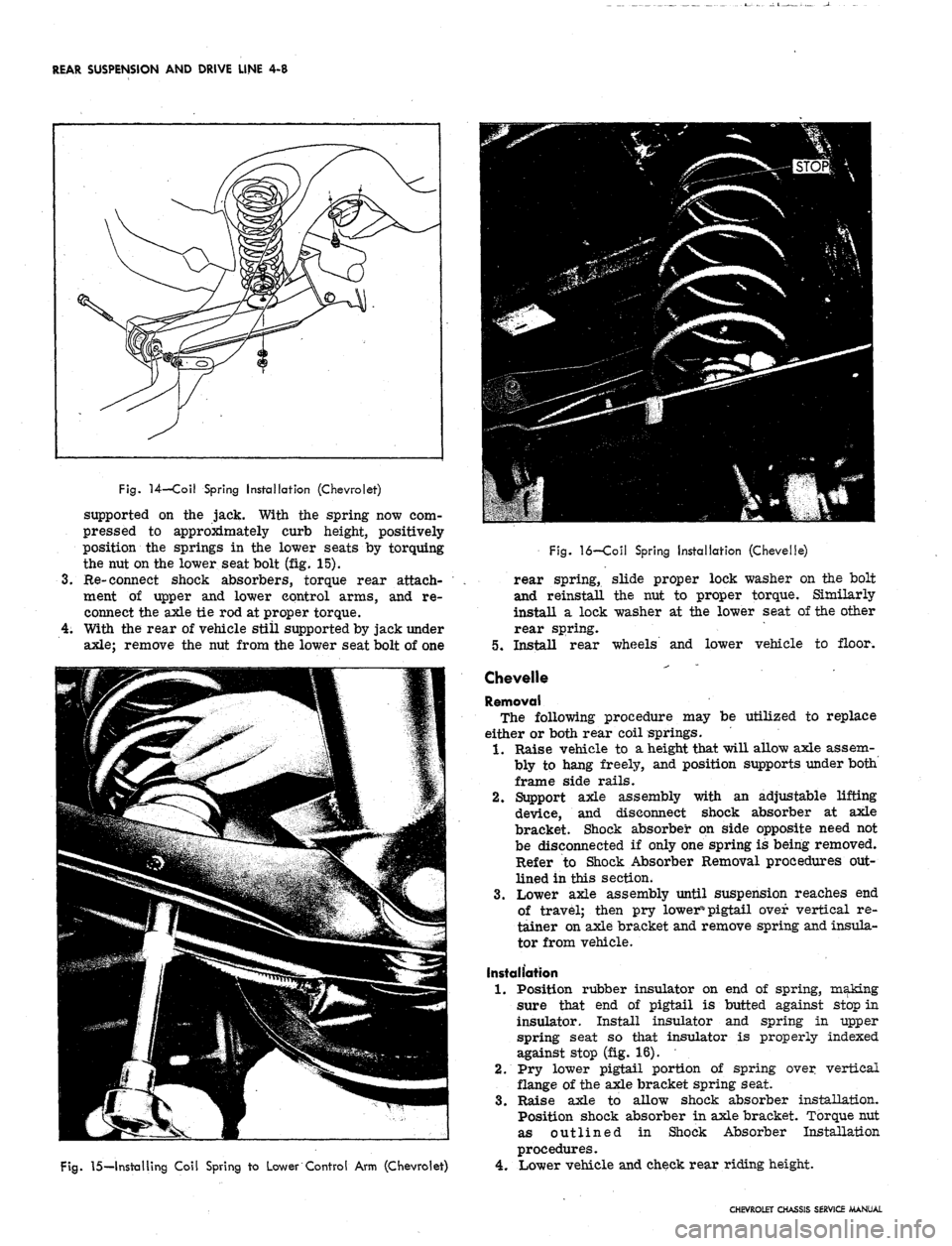
Fig.
14—Coil Spring Installation (Chevrolet)
supported on the jack. With the spring now com-
pressed to approximately curb height, positively
position the springs in the lower seats by torquing
the nut on the lower seat bolt (fig. 15).
Re-connect shock absorbers, torque rear attach-
ment of upper and lower control arms, and re-
connect the axle tie rod at proper torque.
With the rear of vehicle still supported by jack under
axle;
remove the nut from the lower seat bolt of one
Fig.
15—Installing Coil Spring to Lower Control Arm (Chevrolet)
Fig.
16—Coil Spring Installation (Chevelle)
rear spring, slide proper lock washer on the bolt
and reinstall the nut to proper torque. Similarly
install a lock washer at the lower seat of the other
rear spring.
5.
Install rear wheels and lower vehicle to floor.
Chevelle
Removal
The following procedure may be utilized to replace
either or both rear coil springs.
1.
Raise vehicle to a height that will allow axle assem-
bly to hang freely, and position supports under both
frame side rails.
2.
Support axle assembly with an adjustable lifting
device, and disconnect shock absorber at axle
bracket. Shock absorber on side opposite need not
be disconnected if only one spring is being removed.
Refer to Shock Absorber Removal procedures out-
lined in this section.
3.
Lower axle assembly until suspension reaches end
of travel; then pry lower% pigtail over vertical re-
tainer on axle bracket and remove spring and insula-
tor from vehicle.
Installation
1.
Position rubber insulator on end of spring, making
sure that end of pigtail is butted against stop in
insulator. Install insulator and spring in upper
spring seat so that insulator is properly indexed
against stop (fig. 16).
2.
Pry lower pigtail portion of spring over vertical
flange of the axle bracket spring seat.
3.
Raise axle to allow shock absorber installation.
Position shock absorber in axle bracket. Torque nut
as outlined in Shock Absorber Installation
procedures.
4.
Lower vehicle and check rear riding height.
CHEVROLET CHASSIS SERVICE MANUAL
Page 205 of 659
REAR SUSPENSION AND DRIVE LINE 4-15
ship of parts, then install Spacer J-
7574-
3 over
the partially installed bushing and between the
sides of the control arm.
f. Continue to tighten J-
21058-
8
until bushing is
pulled flush against control arm. Do not exert
undue force against control arm after bushing is
installed. Overtightening of J-21058-
8
will cause
damage to walls of control arm.
g. Disassemble tools and inspect bushing for proper
installation.
Replace the rear bushing as follows:
a. Position Puller Screw J-21058-8 through Re-
mover Adapter J-21830-2 so that head of screw
is opposite button end of remover. Install this
assembly, threaded end of sc'rew first, through
bushing to be removed.
b.
Install Receiver J-21830-4 and Bridge J-21830-7
. over screw and against control arm. Position
thrust bearing against J-21830-7 and screw
J-21058-8 snugly against bearing. Install Spacer
J-
2183d-
3
between sides of control arm and over
bushing.
c. Check tool installation for proper alignment and
tighten J-21058-8 to withdraw bushing from con-
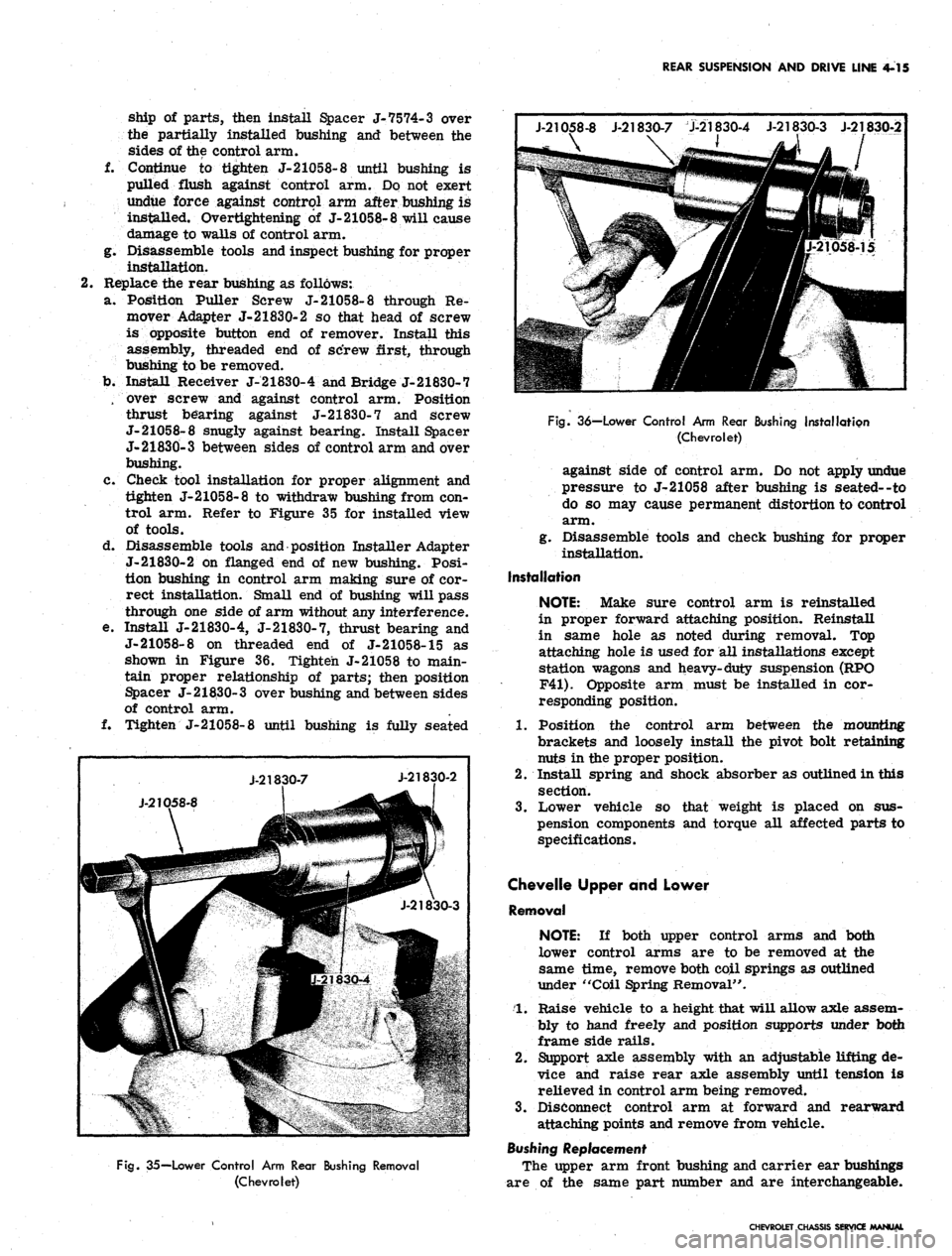
trol arm. Refer to Figure 35 for installed view
of tools.
d. Disassemble tools and position Installer Adapter
J-21830-2 on flanged end of new bushing. Posi-
tion bushing in control arm making sure of cor-
rect installation. Small end of bushing will pass
through one side of arm without any interference.
e. Install J-21830-4, J-21830-7, thrust bearing and
J-21058-8 on threaded end of J-21058-15 as
shown in Figure 36. Tighten J-21058 to main-
tain proper relationship of parts; then position
Spacer J- 21830- 3 over bushing and between sides
of control arm.
f. Tighten J-21058-8 until bushing is fully seated
J-21058-8 J-21830-7 J-21830-4 J-21830-3 J-21830-2
\
J-2K
X
D58-8
J-218
30-7
IP
•he?
21830-4
J-21830-2
JfSir
J-21830-3
Fig.
35—Lower Control Arm Rear Bushing Removal
(Chevrolet)
Fig.
36—Lower Control Arm Rear Bushing Installation
(Chevrolet)
against side of control arm. Do not apply undue
pressure to J-21058 after bushing is seated--to
do so may cause permanent distortion to control
arm.
g. Disassemble tools and check bushing for proper
installation.
Installation
NOTE:
Make sure control arm is reinstalled
in proper forward attaching position. Reinstall
in same hole as noted during removal. Top
attaching hole is used for all installations except
station wagons and heavy-duty suspension (RPO
F41).
Opposite arm must be installed in cor-
responding position.
1.
Position the control arm between the mounting
brackets and loosely install the pivot bolt retaining
nuts in the proper position.
2.
Install spring and shock absorber as outlined in this
section.
3.
Lower vehicle so that weight is placed on sus-
pension components and torque all affected parts to
specifications.
Chevelle Upper and Lower
Removal
NOTE:
If both upper control arms and both
lower control arms are to be removed at the
same time, remove both coil springs as outlined
under "Coil Spring Removal".
1.
Raise vehicle to a height that will allow axle assem-
bly to hand freely and position supports under both
frame side rails.
2.
Support axle assembly with an adjustable lifting de-
vice and raise rear axle assembly until tension is
relieved in control arm being removed.
3.
Disconnect control arm at forward and rearward
attaching points and remove from vehicle.
Bushing Replacement
The upper arm front bushing and carrier ear bushings
are of the same part number and are interchangeable.
CHEVROLET CHASSIS SERVICE MANUAL
Page 220 of 659
REAR SUSPENSION AND DRIVE LINE 4-30
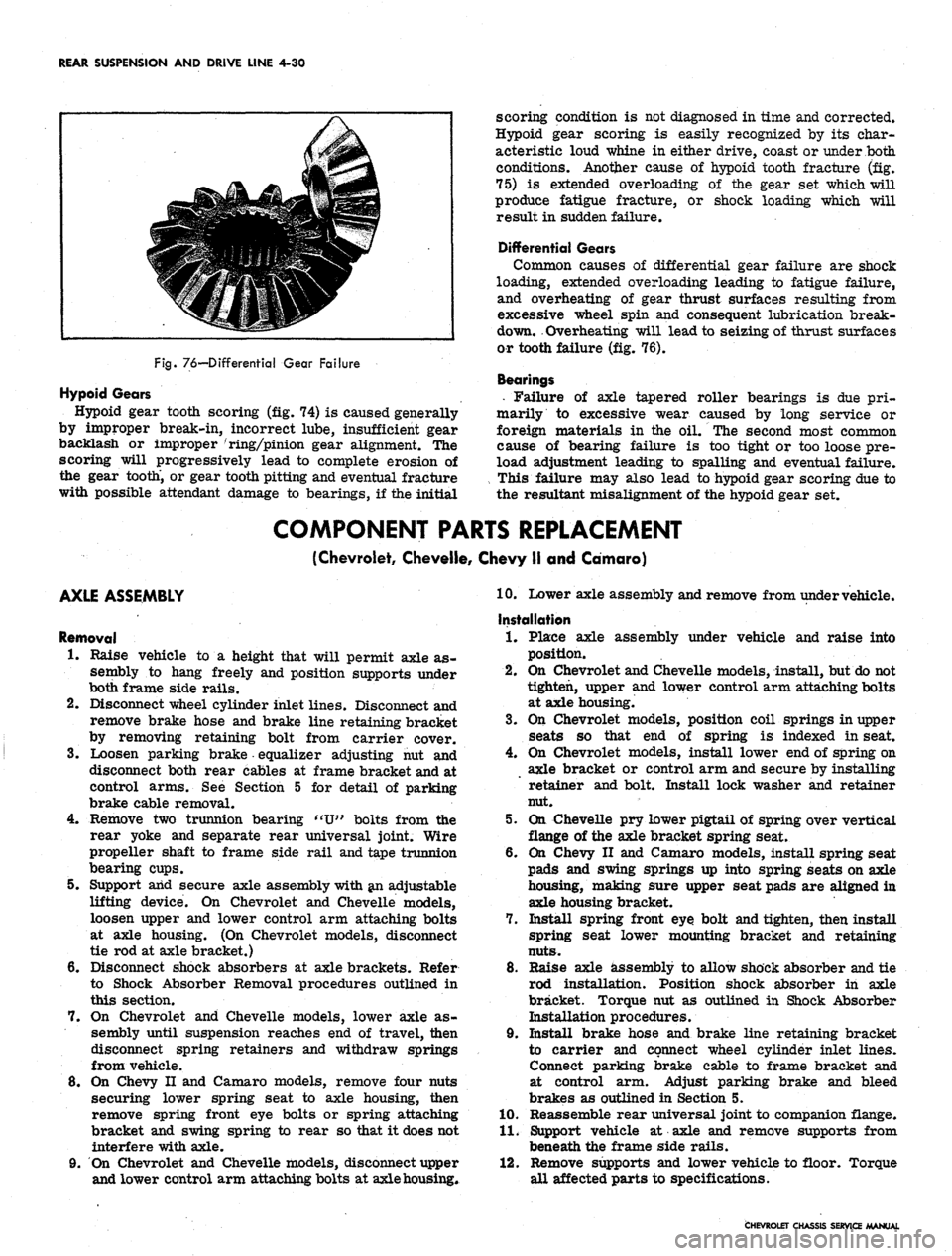
Fig.
76—Differential Gear Failure
Hypoid Gears
Hypoid gear tooth scoring (fig. 74) is caused generally
by improper break-in, incorrect lube, insufficient gear
backlash or improper 'ring/pinion gear alignment. The
scoring will progressively lead to complete erosion of
the gear tooth, or gear tooth pitting and eventual fracture
with possible attendant damage to bearings, if the initial
scoring condition is not diagnosed in time and corrected.
Hypoid gear scoring is easily recognized by its char-
acteristic loud whine in either drive, coast or under both
conditions. Another cause of hypoid tooth fracture (fig.
75) is extended overloading of the gear set which will
produce fatigue fracture, or shock loading which will
result in sudden failure.
Differential Gears
Common causes of differential gear failure are shock
loading, extended overloading leading to fatigue failure,
and overheating of gear thrust surfaces resulting from
excessive wheel spin and consequent lubrication break-
down. Overheating will lead to seizing of thrust surfaces
or tooth failure (fig. 76).
Bearings
• Failure of axle tapered roller bearings is due pri-
marily to excessive wear caused by long service or
foreign materials in the oil. The second most common
cause of bearing failure is too tight or too loose pre-
load adjustment leading to spalling and eventual failure.
This failure may also lead to hypoid gear scoring due to
the resultant misalignment of the hypoid gear set.
COMPONENT PARTS REPLACEMENT
(Chevrolet, Cheveile, Chevy II and Camaro)
AXLE ASSEMBLY
Removal
1.
Raise vehicle to a height that will permit axle as-
sembly to hang freely and position supports under
both frame side rails.
2.
Disconnect wheel cylinder inlet lines. Disconnect and
remove brake hose and brake line retaining bracket
by removing retaining bolt from carrier cover.
3.
Loosen parking brake equalizer adjusting nut and
disconnect both rear cables at frame bracket and at
control arms. See Section 5 for detail of parking
brake cable removal.
4.
Remove two trunnion bearing "U" bolts from the
rear yoke and separate rear universal joint. Wire
propeller shaft to frame side rail and tape trunnion
bearing cups.
5. Support arid secure axle assembly with an adjustable
lifting device. On Chevrolet and Cheveile models,
loosen upper and lower control arm attaching bolts
at axle housing. (On Chevrolet models, disconnect
tie rod at axle bracket.)
6. Disconnect shock absorbers at axle brackets. Refer
to Shock Absorber Removal procedures outlined in
this section.
7. On Chevrolet and Cheveile models, lower axle as-
sembly until suspension reaches end of travel, then
disconnect spring retainers and withdraw springs
from vehicle.
8. On Chevy II and Camaro models, remove four nuts
securing lower spring seat to axle housing, then
remove spring front eye bolts or spring attaching
bracket and swing spring to rear so that it does not
interfere with axle.
9. On Chevrolet and Cheveile models, disconnect upper
and lower control arm attaching bolts at axle housing*
10.
Lower axle assembly and remove from under vehicle.
Installation
1.
Place axle assembly under vehicle and raise into
position.
2.
On Chevrolet and Cheveile models, install, but do not
tighten, upper and lower control arm attaching bolts
at axle housing.
3.
On Chevrolet models, position coil springs in upper
seats so that end of spring is indexed in seat.
4.
On Chevrolet models, install lower end of spring on
axle bracket or control arm and secure by installing
retainer and bolt. Install lock washer and retainer
nut.
5. On Cheveile pry lower pigtail of spring over vertical
flange of the axle bracket spring seat.
6. On Chevy II and Camaro models, install spring seat
pads and swing springs up into spring seats on axle
housing, making sure upper seat pads are aligned in
axle housing bracket.
7. Install spring front eye bolt and tighten, then install
spring seat lower mounting bracket and retaining
nuts.
8. Raise axle assembly to allow shock absorber and tie
rod installation. Position shock absorber in axle
bracket. Torque nut as outlined in Shock Absorber
Installation procedures.
9. Install brake hose and brake line retaining bracket
to carrier and connect wheel cylinder inlet lines.
Connect parking brake cable to frame bracket and
at control arm. Adjust parking brake and bleed
brakes as outlined in Section 5.
10.
Reassemble rear universal joint to companion flange.
11.
Support vehicle at axle and remove supports from
beneath the frame side rails.
12.
Remove supports and lower vehicle to floor. Torque
all affected parts to specifications.
CHEVROLET CHASSIS SERVICE MANUAL
Page 221 of 659
REAR SUSPENSION AND DRIVE LINE 4-31
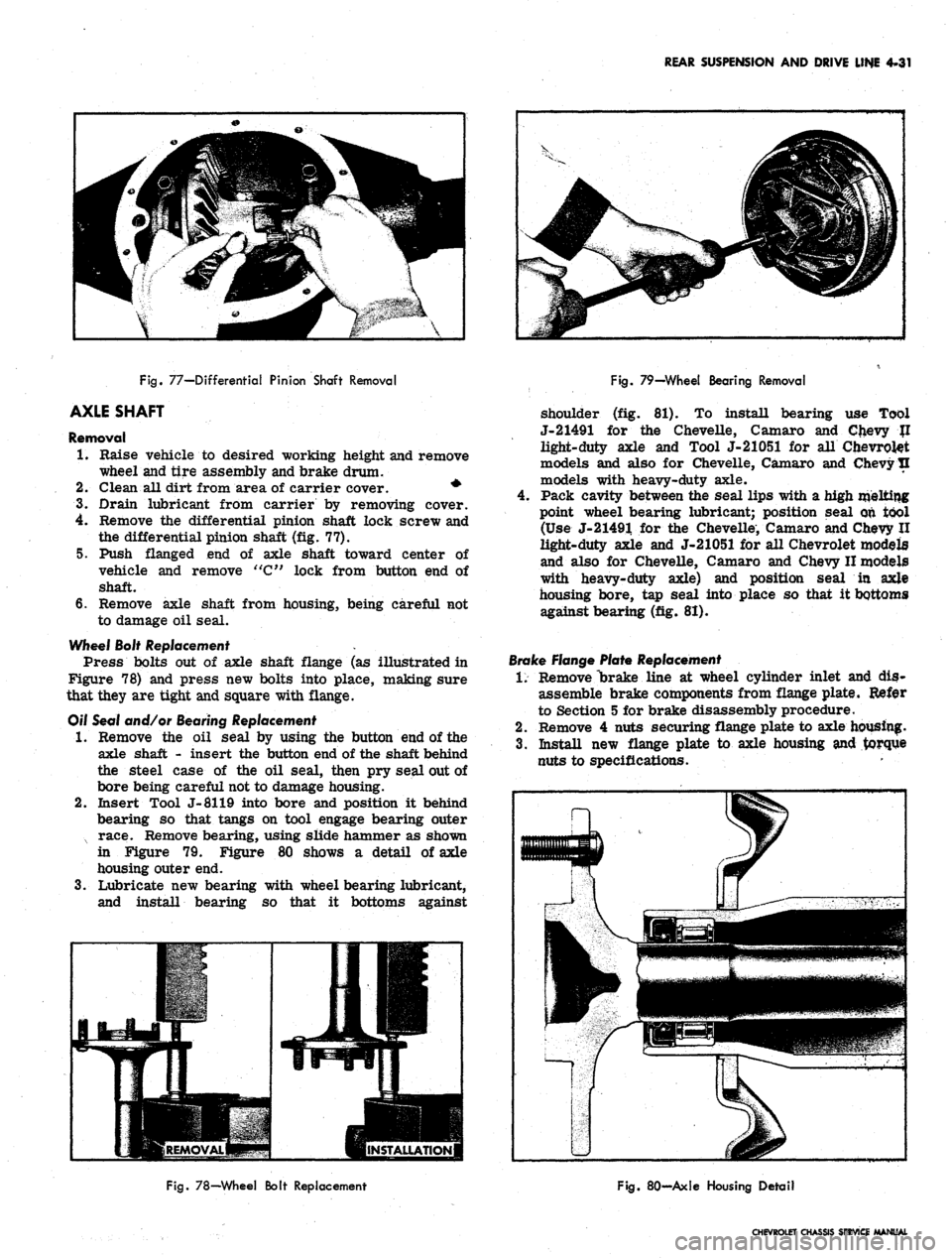
Fig.
77—Differential Pinion Shaft Removal
AXLE SHAFT
Removal
1.
Raise vehicle to desired working height and remove
wheel and tire assembly and brake drum.
2.
Clean all dirt from area of carrier cover. *
3.
Drain lubricant from carrier by removing cover.
4.
Remove the differential pinion shaft lock screw and
the differential pinion shaft (fig. 77).
5. Push flanged end of axle shaft toward center of
vehicle and remove "C" lock from button end of
shaft.
6. Remove axle shaft from housing, being careful not
to damage oil seal.
Wheel Bolt Replacement .
Press bolts out of axle shaft flange (as illustrated in
Figure 78) and press new bolts into place, making sure
that they are tight and square with flange.
Off Seal and/or Bearing Replacement
•1.
Remove the oil seal by using the button end of the
axle shaft - insert the button end of the shaft behind
the steel case of the oil seal, then pry seal out of
bore being careful not to damage housing.
2.
Insert Tool J-8119 into bore and position it behind
bearing so that tangs on tool engage bearing outer
x race. Remove bearing, using slide hammer as shown
in Figure 79. Figure 80 shows a detail of axle
housing outer end.
3.
Lubricate new bearing with wheel bearing lubricant,
and install bearing so that it bottoms against
Fig.
79—Wheel Bearing Removal
shoulder (fig. 81). To install bearing use Tool
J-21491 for the Chevelle, Camaro and Chevy JI
light-duty axle and Tool J-21051 for all Chevrolet
models and also for Chevelle, Camaro and Chevy tl
models with heavy-duty axle.
Pack cavity between the seal lips with a high melting
point wheel bearing lubricant; position seal on tool
(Use J-21491 for the Chevelle, Camaro and Chevy II
light-duty axle and J-21051 for all Chevrolet models
and also for Chevelle, Camaro and Chevy II models
with heavy-duty axle) and position seal in axle
housing bore, tap seal into place so that it bottoms
against bearing (fig. 81).
Brake Flange Plate Replacement
1.
Remove "brake line at wheel cylinder inlet and dis-
assemble brake components from flange plate. Refer
to Section 5 for brake disassembly procedure.
2.
Remove 4 nuts securing flange plate to axle housing.
3.
Install new flange plate to axle housing and torque
nuts to specifications.
Fig.
78—Wheel Bolt Replacement
Fig.
80-Axle Housing Detail
CHEVROLET CHASSIS SERVICE MANUAL
Page 241 of 659
BRAKES 5-8
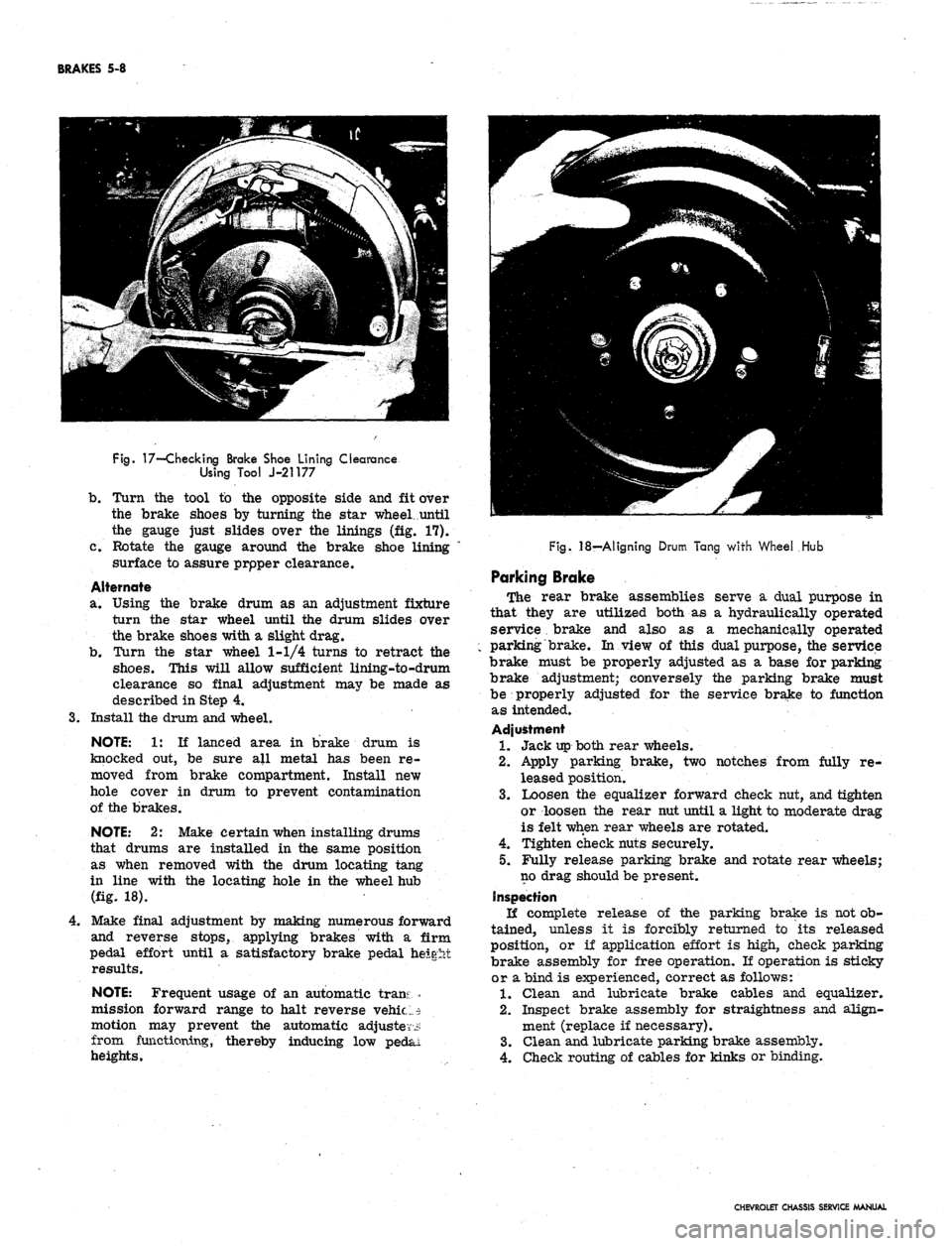
Fig.
17—-Checking Brake Shoe Lining Clearance
Using Tool J-21177
b.
Turn the tool to the opposite side and fit over
the brake shoes by turning the star wheel, until
the gauge just slides over the linings (fig. 17).
c. Rotate the gauge around the brake shoe lining
surface to assure prpper clearance.
Alternate
a. Using the brake drum as an adjustment fixture
turn the star wheel until the drum slides over
the brake shoes with a slight drag.
b.
Turn the star wheel 1-1/4 turns to retract the
shoes.
This will allow sufficient lining-to-drum
clearance so final adjustment may be made as
described in Step 4.
3.
Install the drum and wheel.
NOTE: 1: If lanced area in brake drum is
knocked out, be sure all metal has been re-
moved from brake compartment. Install new
hole cover in drum to prevent contamination
of the brakes.
NOTE: 2: Make certain when installing drums
that drums are installed in the same position
as when removed with the drum locating tang
in line with the locating hole in the wheel hub
(fig. 18).
4.
Make final adjustment by making numerous forward
and reverse stops, applying brakes with a firm
pedal effort until a satisfactory brake pedal height
results.
NOTE: Frequent usage of an automatic trans-
mission forward range to halt reverse vehic;..$
motion may prevent the automatic adjuster.:?
from functioning, thereby inducing low pedal
heights.
Fig.
.18—Aligning Drum Tang with Wheel Hub
Parking Broke
The rear brake assemblies serve a dual purpose in
that they are utilized both as a hydraulically operated
service brake and also as a mechanically operated
parking brake. In view of this dual purpose, the service
brake must be properly adjusted as a base for parking
brake adjustment; conversely the parking brake must
be properly adjusted for the service brake to function
as intended.
Adjustment
1.
Jack up both rear wheels.
2.
Apply parking brake, two notches from fully re-
leased position.
3.
Loosen the equalizer forward check nut, and tighten
or loosen the rear nut until a light to moderate drag
is felt when rear wheels are rotated.
4.
Tighten check nuts securely.
5.
Fully release parking brake and rotate rear wheels;
no drag should be present.
Inspection
If complete release of the parking brake is not ob-
tained, unless it is forcibly returned to its released
position, or if application effort is high, check parking
brake assembly for free operation. If operation is sticky
or a bind is experienced, correct as follows:
1.
Clean and lubricate brake cables and equalizer.
2.
Inspect brake assembly for straightness and align-
ment (replace if necessary).
3.
Clean and lubricate parking brake assembly.
4.
Check routing of cables for kinks or binding.
CHEVROLET CHASSIS SERVICE MANUAL
Page 358 of 659
ENGINE-ELECTRICAL 6Y-33
O
V-8 ENGINE
STARTING MOTOR
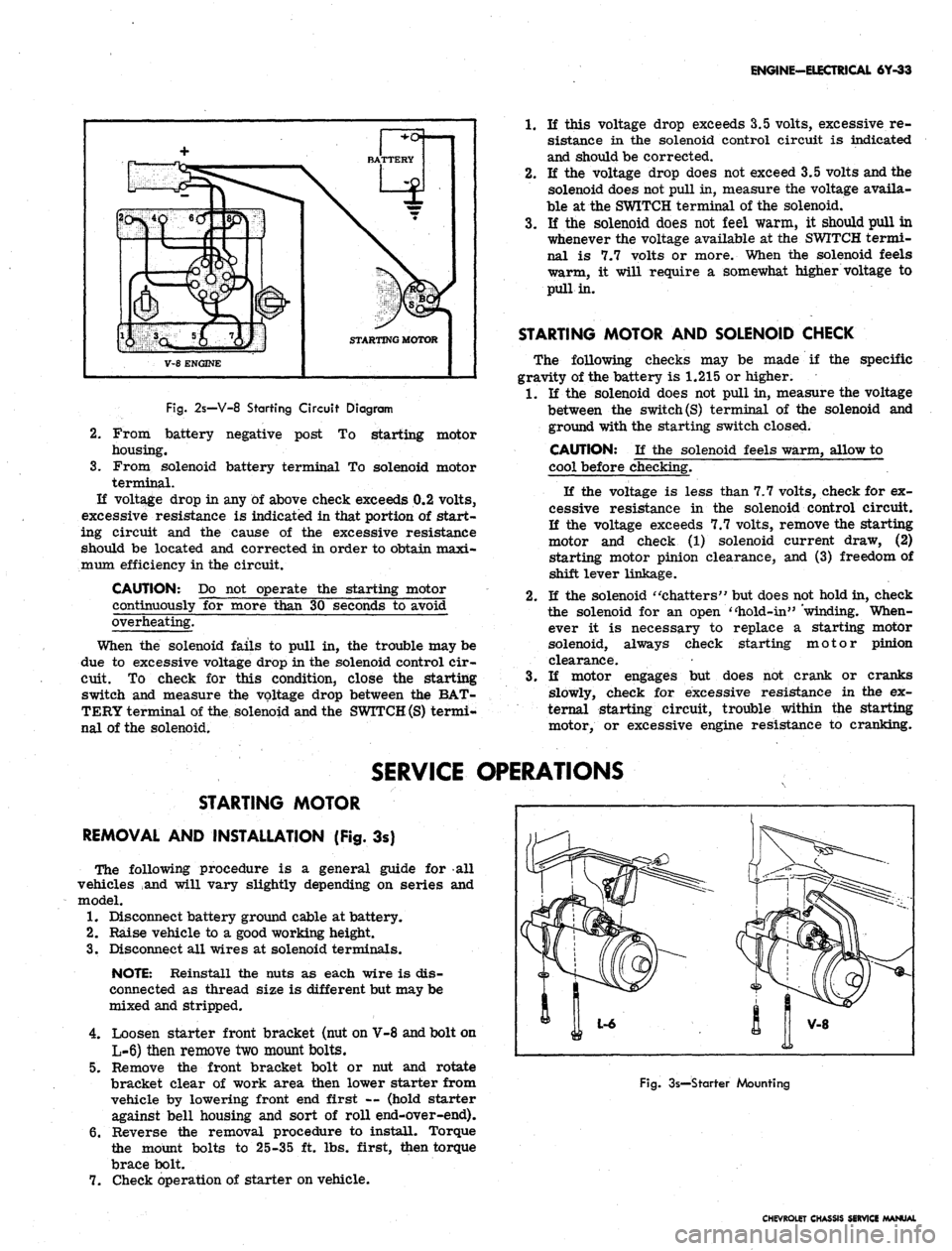
Fig.
2s—V-8 Starting Circuit Diagram
2.
3.
From battery negative post
To
starting motor
housing.
From solenoid battery terminal
To
solenoid motor
terminal.
If voltage drop
in
any
of
above check exceeds 0.2 volts,
excessive resistance
is
indicated in that portion
of
start-
ing circuit
and the
cause
of the
excessive resistance
should
be
located
and
corrected
in
order to obtain maxi-
mum efficiency in the circuit.
CAUTION:
Do not
operate
the
starting motor
continuously
for
more than
30
seconds
to
avoid
overheating.
When
the
solenoid fails
to
pull
in, the
trouble may be
due
to
excessive voltage drop in the solenoid control cir-
cuit.
To
check
for
this condition, close
the
starting
switch
and
measure
the
voltage drop between
the
BAT-
TERY terminal of the solenoid and the
SWITCH (S)
termi-
nal
of
the solenoid.
1.
If
this voltage drop exceeds 3.5 volts, excessive
re-
sistance
in the
solenoid control circuit
is
indicated
and should be corrected.
2.
If the
voltage drop does not exceed 3.5 volts and the
solenoid does not pull in, measure the voltage availa-
ble
at
the SWITCH terminal
of
the solenoid.
3.
If the
solenoid does
not
feel warm,
it
should pull
in
whenever the voltage available
at
the SWITCH termi-
nal
is 7.7
volts
or
more. When
the
solenoid feels
warm,
it
will require
a
somewhat higher voltage
to
pull in.
STARTING MOTOR AND SOLENOID CHECK
The following checks
may be
made
if the
specific
gravity of the battery
is
1.215
or
higher.
1.
If the
solenoid does
not
pull in, measure the voltage
between
the
switch
(S)
terminal
of the
solenoid
and
ground with the starting switch closed.
CAUTION:
If the
solenoid feels warm, allow
to
cool before checking.
If
the
voltage
is
less than 7.7 volts, check for ex-
cessive resistance
in the
solenoid control circuit.
If
the
voltage exceeds 7.7 volts, remove the starting
motor
and
check
(1)
solenoid current draw,
(2)
starting motor pinion clearance,
and (3)
freedom of
shift lever linkage.
2.
If
the solenoid "chatters" but does not hold in, check
the solenoid
for an
open "hold-in" 'winding. When-
ever
it is
necessary
to
replace
a
starting motor
solenoid, always check starting motor pinion
clearance.
3.
If
motor engages
but
does
not
crank
or
cranks
slowly, check
for
excessive resistance
in the ex-
ternal starting circuit, trouble within
the
starting
motor,
or
excessive engine resistance
to
cranking.
SERVICE OPERATIONS
STARTING MOTOR
REMOVAL AND INSTALLATION (Fig.
3s)
The following procedure
is a
general guide
for all
vehicles
and
will vary slightly depending
on
series
and
model.
1.
Disconnect battery ground cable at battery.
2.
Raise vehicle
to a
good working height.
3.
Disconnect all wires
at
solenoid terminals.
NOTE: Reinstall
the
nuts
as
each wire
is
dis-
connected
as
thread size
is
different but may be
mixed and stripped.
4.
Loosen starter front bracket (nut on V-8 and bolt on
L-6) then remove two mount bolts.
5.
Remove
the
front bracket bolt
or nut and
rotate
bracket clear
of
work area then lower starter from
vehicle
by
lowering front end first
—
(hold starter
against bell housing
and
sort
of
roll end-over-end).
6. Reverse
the
removal procedure
to
install. Torque
the mount bolts
to
25-35
ft.
lbs. first, then torque
brace bolt.
7.
Check operation
of
starter on vehicle.
Fig.
3s—Starter Mounting
CHEVROLET CHASSIS SERVICE MANUAL
Page 379 of 659

CLUTCH
AND
TRANSMISSIONS
7-20
COMPONENT PARTS REPLACEMENT
3.
4.
5.
6.
TRANSMISSION REPLACEMENT
(EXC.
CORVETTE)
Removal From Vehicle
1.
Remove shift lever trim plate and dust boot.
Remove shift lever assembly.
Raise vehicle
to
desired working height.
Disconnect
the
speedometer cable from speedometer
driven gear fitting.
.
~
. •
Remove propeller shaft, then support engine
at the
oil
pan
rail with
a
jack
or
other suitable support
capable
of
supporting
the
engine when transmission
is removed.
Disconnect shift lever bracket assembly from exten-
sion
and
remove
all 3
transmission shifter levers
from shifter shafts, (leave linkage connected
to
levers)
and
remove bracket assembly levers
and
linkage.
Remove extension mount7 to-crossmember attaching
bolts.
Loosen transmission crossmember
and
move rear-
ward
or
remove.
Remove
the
transmission-to-clutch housing retaining
bolts
and
install two guide pins, J-1126,
in
top holes.
Slide
the
transmission straight back until
the
input
shaft
is
free
of
splines
in the
clutch disc.
Slide
the
transmission rearward
to
allow sufficient
clearance
of
input shaft
and
clutch housing. Then tilt
input shaft
end of
transmission downward and with-
8.
9.
10.
11.
draw transmission from vehicle.
installation
to
Vehicle
1.
Raise transmission
and
rotate
as
necessary-to start
input shaft into clutch disc
and
slide transmission
forward until
it
bottoms against clutch housing.
Re-
move guide pins.
2.
Install
the
transmission-to-clutch housing retaining
bolts.
Torque
all
four retaining bolts
to 50 ft. lbs.
3.
Raise engine
and
position extension mount
to
cross-
member,
and
loosely install
the
retaining bolts.
Tighten crossmember
to
frame retaining bolts.
4.
Remove temporary support from engine, and torque
the extension mount retaining bolts.
5. Install propeller shaft.
6. Install control lever bracket assembly
to
transmis-
sion extension
and
connect shifter levers
to
shifter
shafts.
7. Fill transmission
to
level
of
filler plug hole with
correct lubricant specified
in
Section
0.
8. Lower vehicle and install shift lever assembly, check
shift pattern and adjust linkage
as
required.
9. Install trim plate and dust boot.
CORVETTE TRANSMISSION REPLACEMENT
Refer
to
similar procedure under 3-Speed Corvette
Transmission.
FOUR-SPEED (SAGINAW) TRANSMISSION
INDEX
Page
General Description
7-20
Maintenance
and
Adjustments
. . 7-21
Shift Linkage Adjustment.
. 7-21
Speedometer Driven Gear
and
Oil Seal ................
(See
Muncie 4-Speed)
Side Cover
7-22
Page
Removal
. . , 7-22
Disassembly
. . 7-22
Assembly
. . . 7-22
Installation
. 7-22
Extension
Oil
Seal
(See
Muncie 4-Speed)
Transmission Replacement (See Muncie 4-Speed)
GENERAL DESCRIPTION
The Saginaw four speed fully synchronized
(all
forward
gears) transmission incorporates helical drive gears
throughout.
The main drive gear
is
supported
by a
ball bearing
at
the front
end of the
transmission case and
is
piloted
at its
front
end in an oil
impregnated bushing mounted
in the
engine crankshaft.
The
front
end of the
mainshaft
is
piloted
in a row of
roller bearings
set
into
the
hollow
end
of
the
main drive gear
and the
rear end
is
carried
by a
ball bearing mounted
in the
front
of the
extension housing.
The countergear
is
carried
on a
single
row of
rollers
at both ends while thrust
is
taken on thrust washers
lo-
cated between
the
ends
of the
gear and
the
thrust bosses
in
the
case. Ah anti-rattle plate assembly
at the
front
of
the countergear provides
a
constant spring tension
be-
tween
the
counter
and
clutch gears
to
reduce torsional
vibrations.
The
sliding reverse idler gear
is
carried
on
a bushing finish bored
in
place.
It
rotates
on a
short
idler shaft retained by
a
woodruff
key.
The synchronizer assemblies consist
of a
clutch
hub,
clutch sleeve,
two
clutch
key
springs and three energizer
clutch keys
and are
retained
as an
assembly on
the
main
shaft
by a
snap ring.
A great deal
of
similarity
and
interchangeability
now
exists between
the new 3 and
4-speed Saginaw trans-
missions.
However,
the
synchronizer assembly
at the
front
of the
mainshaft
is
used
for the
third and fourth rather than
the
second
and
third shift.
The
synchronizer assembly
at
the rear
of the
mainshaft
is
used
for the
first and second
rather than
the
first
and
reverse shift. Gear teeth
cut
in
the
first and second synchronizer sleeve (reverse gear)
distinguish
it
from
the
third
and
fourth synchronizer
sleeve.
Starting from
the
front, gears
on the
mainshaft
are
third, second
and
first rather than second, first and
re-
verse.
A
fourth blocker ring
is
used between
the 1-2
synchronizer assembly
and
first gear
on the
four-speed
transmissions.
The cover
on the new
four-speed transmission
is lo-*
cated
on the
left-hand side
of the
case.
It is
similar
to
the three-speed cover with
the
addition
of a
reverse
shifter shaft assembly, detent ball
and
detent spring.
Disassembly
and
assembly procedures
are
covered
in
this section.
CHEVROLET CHASSIS SERVICE MANUAL
Page 488 of 659
SECTION 11
CHASSIS SHEET METAL
CONTENTS OF THIS SECTION
Chevrolet and Chevelle 11-1
Chevy II . . 11.-11
Camaro 11-19
Corvette (See Section IB)
Special Tools 11-25
CHEVROLET AND CHEVELLE
INDEX
Page
General Description 11-1
Maintenance and Adjustments •. il-1
Hood Adjustment 11-1
Hinges 11-1
Bumpers 11-1
Catch Assembly and Lock 11-1
Fenders 11-4
Sheet Metal 11-4
Component Part Replacement 11-4
Battery Tray 11-4
Page
Radiator Support 11-4
Fender Assembly . . 11-4
Skirt 11-4
Trim 11-5
Hood Assembly 11-6
Lock and Catch 11-7
Trim and Insulation 11-7
Cowl Vent Grille 11-7
Rear Wheel Cover 11-7
Simulated Wood Grain Moulding . . . . 11-7
GENERAL DESCRIPTION
The new front end appearance of the 1967 Chevrolet
and Chevelle passenger cars affects the servicing and
replacement of the chassis sheet metal. Refer to Section
13 for Radiator and Grille service procedures, Section
14 for Bumpers, and Section 1A for Air Conditioning
components. Figures 1 and 2 illustrate the Chevrolet
and Chevelle sheet metal components.
MAINTENANCE AND ADJUSTMENTS
HOOD ADJUSTMENT
The alignment of the hood is controlled by the position
of the hood hinges and the height of the two bumpers lo-
cated one at each side of the radiator support. The ad-
justment at the hood lock must be made after the hinges
and bumpers are properly adjusted. To align the hood
and lock proceed as follows:
HOOD HINGE (Fig. 3)
NOTE:
The body mounted portion of the hood
hinges are slotted to provide up and down move-
ment. The hood mounted end is slotted to pro-
vide forward and rearward movement.
1.
Scribe a line around the entire hinge plate to be re-
positioned.
2.
Loosen the appropriate screws and shift the position
of the hood into correct alignment using the scribe
marks to check amount of movement. Check align-
ment by tightening screws and closing the hood.
HOOD BUMPERS
Adjust hood bumpers so that hood top surface is flush
with the fender and grille top surfaces. Refer to Fig-
ures 4 and 5 for correct sheet metal adjustment dimen-
sions.
HOOD CATCH AND LOCK
The hood catch assembly (fig. 6) mounting holes are
slotted to provide adjustment for the hood lock bolt. Ad-
just the hood lock bolt until hood engages securely when
closed and hood bumpers are slightly compressed.
CHEVROLET CHASSIS SERVICE MANUAL
Page 500 of 659
CHASSIS SHEET METAL 11-13
HOOD ADJUSTMENT
The alignment of the hood in relation
to*
other sheet
metal parts is controlled by the position of the hood
hinges and the height of the two bumpers, located one at
each end of the radiator support. The adjustments at
the hood latch must be made after the hinges and bumpers
are positioned to yield the dimensions shown in Figure
17.
Latch adjustments are made so that effort required
to open and close the hood is reasonable, and hood align-
ment obtained by hinge and bumper adjustment is main-
tained when the hood is closed. Note that the hood latch
is not designed or intended to correct basic hood align-
ment faults.
To align the hood and lock, proceed as follows:
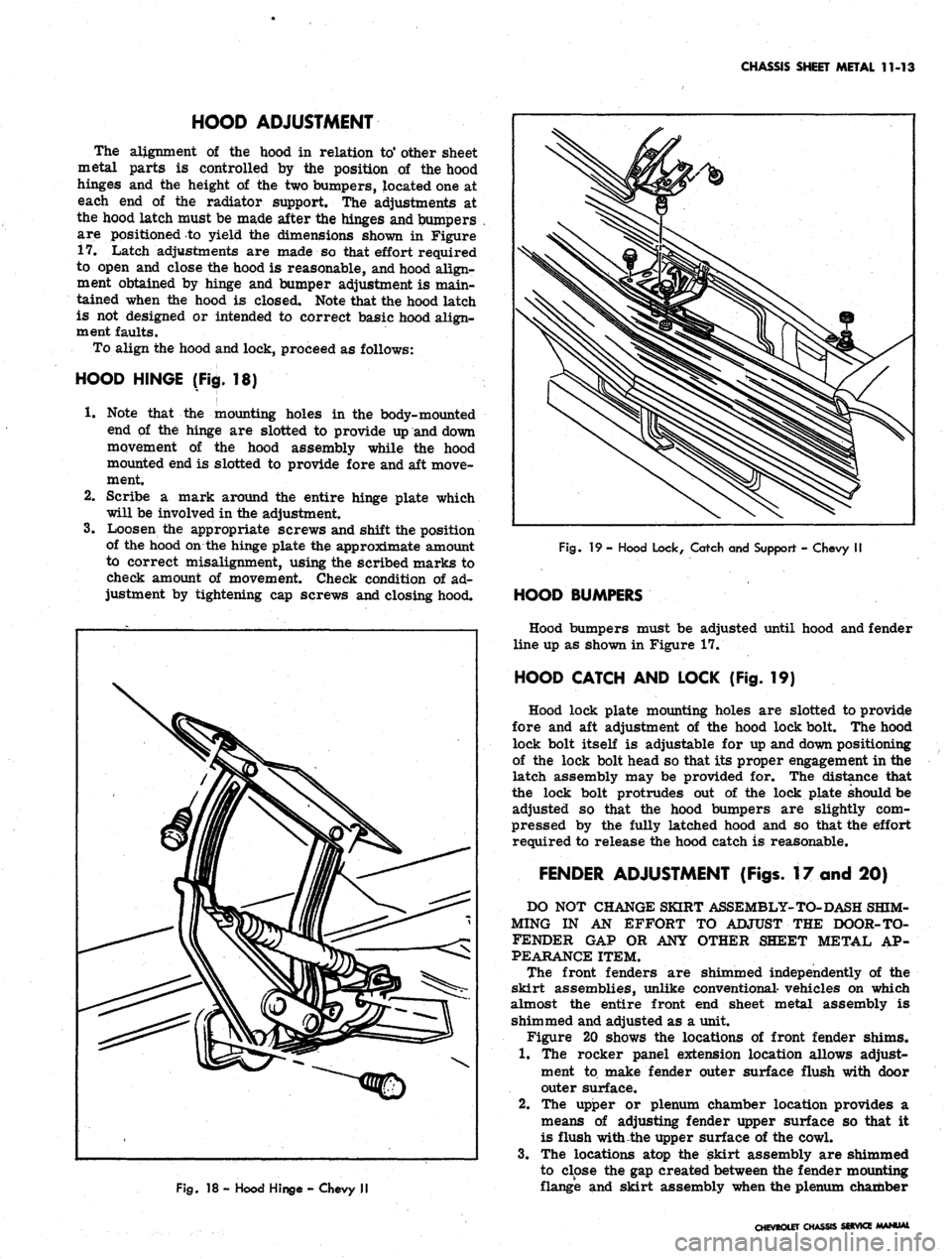
HOOD HINGE (Fig. 18)
1.
Note that the mounting holes in the body-mounted
end of the hinge are slotted to provide up and down
movement of the hood assembly while the hood
mounted end is slotted to provide fore and aft move-
ment.
2.
Scribe a mark around the entire hinge plate which
will be involved in the adjustment.
3.
Loosen the appropriate screws and shift the position
of the hood on the hinge plate the approximate amount
to correct misalignment, using the scribed marks to
check amount of movement. Check condition of ad-
justment by tightening cap screws and closing hood.
Fig.
18 - Hood Hinge - Chevy II
Fig.
19 - Hood Lock, Catch and Support - Chevy II
HOOD BUMPERS
Hood bumpers must be adjusted until hood and fender
line up as shown in Figure 17.
HOOD CATCH AND LOCK (Fig. 19)
Hood lock plate mounting holes are slotted to provide
fore and aft adjustment of the hood lock bolt. The hood
lock bolt itself is adjustable for up and down positioning
of the lock bolt head so that its proper engagement in the
latch assembly may be provided for. The distance that
the lock bolt protrudes out of the lock plate should be
adjusted so that the hood bumpers are slightly com-
pressed by the fully latched hood and so that the effort
required to release the hood catch is reasonable.
FENDER ADJUSTMENT (Figs. 17 and 20)
DO NOT CHANGE SKIRT ASSEMBLY-TO-DASH SHIM-
MING IN AN EFFORT TO ADJUST THE DOOR-TO-
FENDER GAP OR ANY OTHER SHEET METAL AP-
PEARANCE ITEM.
The front fenders are shimmed independently of the
skirt assemblies, unlike conventional- vehicles on which
almost the entire front end sheet metal assembly is
shimmed and adjusted as a unit.
Figure 20 shows the locations of front fender shims.
1.
The rocker panel extension location allows adjust-
ment to make fender outer surface flush with door
outer surface.
2.
The upper or plenum chamber location provides a
means of adjusting fender upper surface so that it
is flush with the upper surface of the cowl.
3.
The locations atop the skirt assembly are shimmed
to close the gap created between the fender mounting
flange and skirt assembly when the plenum chamber
CHEVROLET CHASSIS SWVICE MANUAL
Page 603 of 659
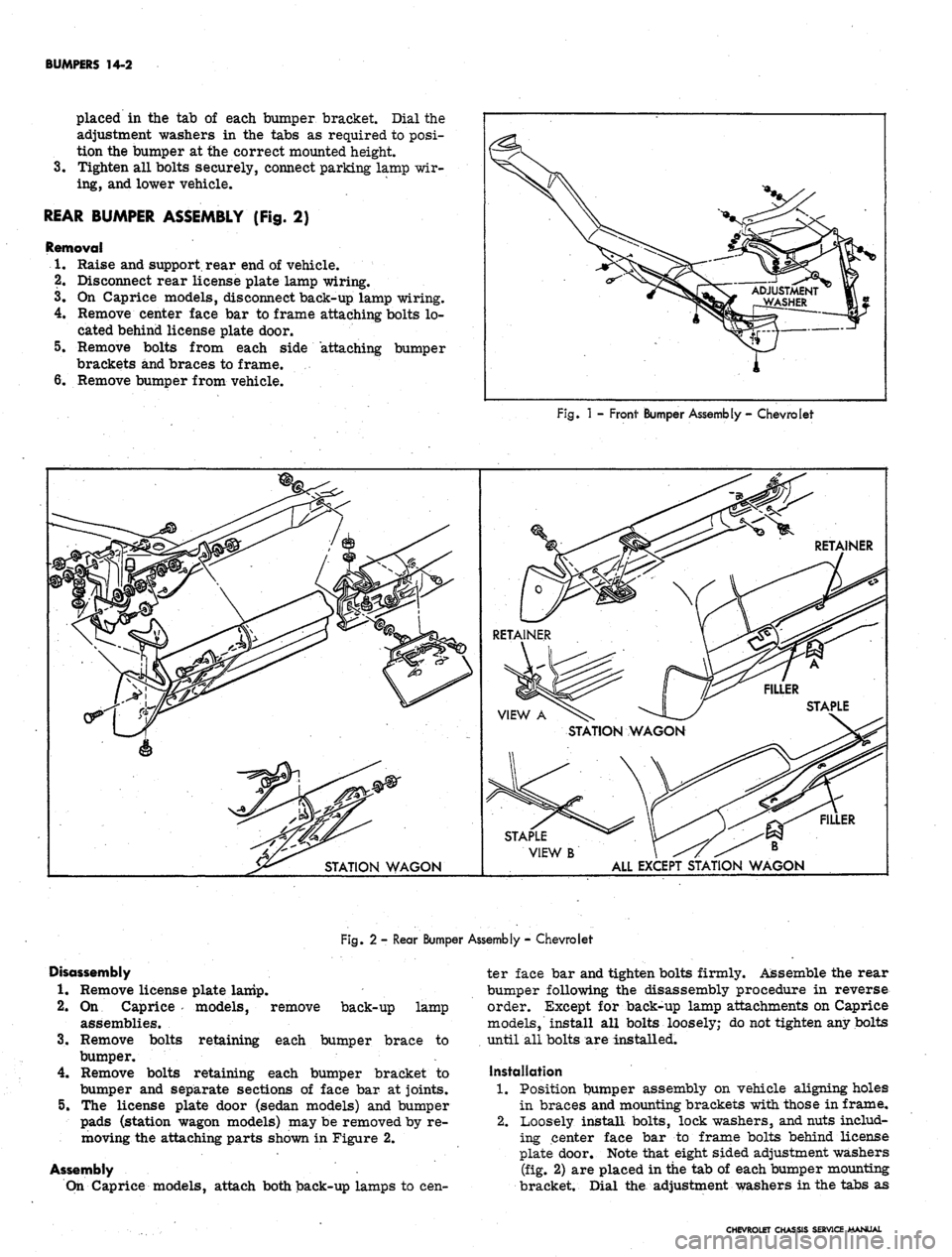
BUMPERS 14-2
placed in the tab of each bumper bracket. Dial the
adjustment washers in the tabs as required to posi-
tion the bumper at the correct mounted height
3.
Tighten all bolts securely, connect parking lamp wir-
ing, and lower vehicle.
REAR BUMPER ASSEMBLY (Fig. 2)
Removal
1.
Raise and support rear end of vehicle.
2.
Disconnect rear license plate lamp wiring.
3.
On Caprice models, disconnect back-up lamp wiring.
4.
Remove center face bar to frame attaching bolts lo-
cated behind license plate door.
5. Remove bolts from each side "attaching bumper
brackets and braces to frame.
6. Remove bumper from vehicle.
Fig.
1 -
Front Bumper Assembly
-
Chevrolet
FILLER
STAPLE
VIEW
B \ ^7 ^^ B
ALL EXCEPT STATION WAGON
Fig. 2 - Rear Bumper Assembly - Chevrolet
Disassembly
1.
Remove license plate lamp.
2.
On Caprice models, remove
assemblies.
Remove bolts
3.
back-up lamp
each bumper brace to
retaining
bumper.
4.
Remove bolts retaining each bumper bracket to
bumper and separate sections of face bar at joints.
5.
The license plate door (sedan models) and bumper
pads (station wagon models) may be removed by re-
moving the attaching parts shown in Figure 2.
Assembly
On Caprice models, attach both back-up lamps to cen-
ter face bar and tighten bolts firmly. Assemble the rear
bumper following the disassembly procedure in reverse
order. Except for back-up lamp attachments on Caprice
models, install all bolts loosely; do not tighten any bolts
until all bolts are installed.
Installation
1.
Position bumper assembly on vehicle aligning holes
in braces and mounting brackets with those in frame,
2.
Loosely install bolts, lock washers, and nuts includ-
ing center face bar to frame bolts behind license
plate door. Note that eight sided adjustment washers
(fig. 2) are placed in the tab of each bumper mounting
bracket. Dial the adjustment washers in the tabs as
CHEVROLET CHASSIS SERVICE MANUAL