manual transmission CHEVROLET CAMARO 1967 1.G Chassis User Guide
[x] Cancel search | Manufacturer: CHEVROLET, Model Year: 1967, Model line: CAMARO, Model: CHEVROLET CAMARO 1967 1.GPages: 659, PDF Size: 114.24 MB
Page 23 of 659
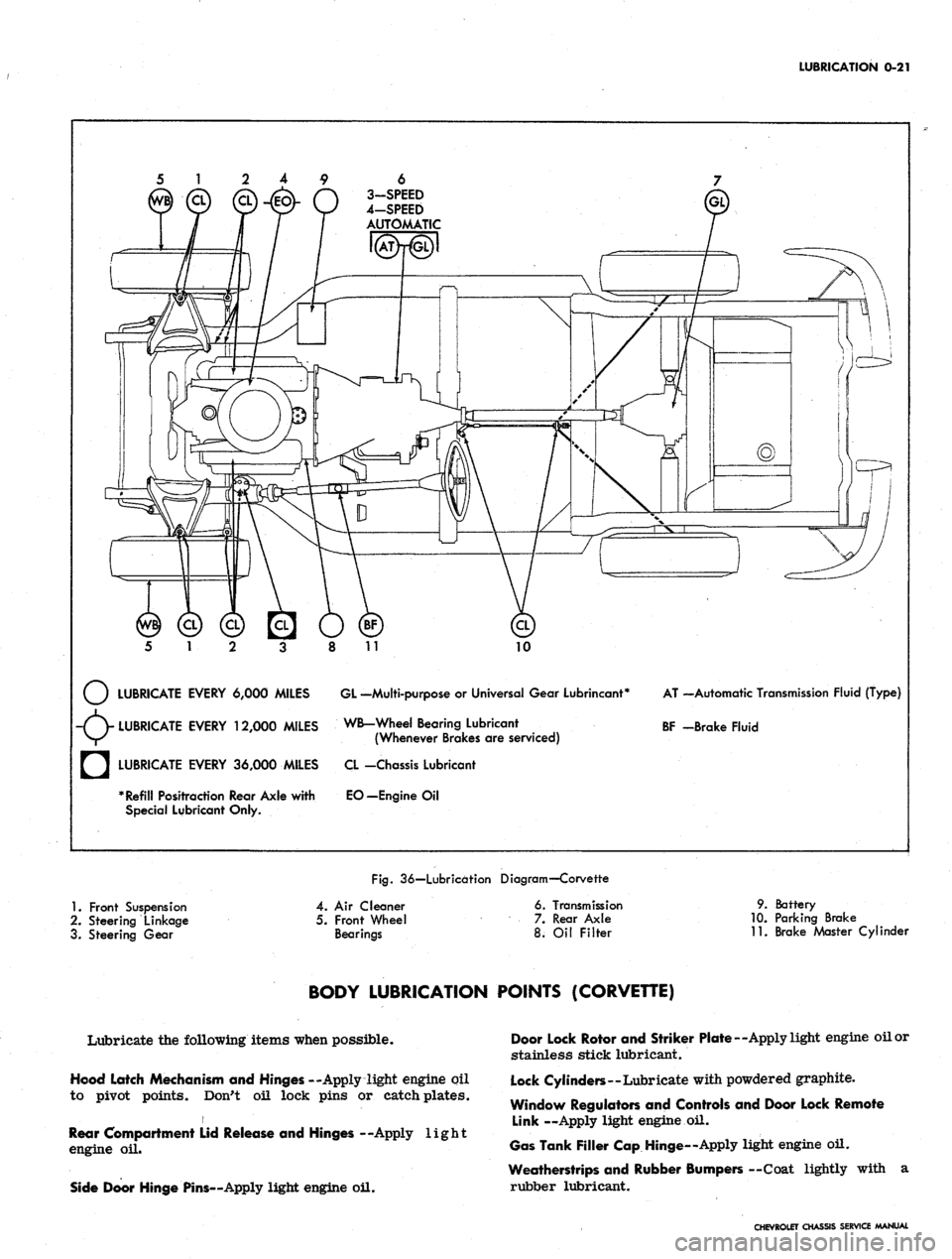
LUBRICATION
0-21
6
3-SPEED
4-SPEED
AUTOMATIC
10
LUBRICATE EVERY 6,000 MILES GL -Multi-purpose
or
Universal Gear Lubrincant*
-(V LUBRICATE EVERY 12,000 MILES WB-Wheel Bearing Lubricant
V/^ (Whenever Brakes
are
serviced)
AT —Automatic Transmission Fluid (Type)
BF -Brake Fluid
a
LUBRICATE EVERY 36,000 MILES
* Refill Positraction Rear Axle with
Special Lubricant Only.
CL -Chassis Lubricant
EO—Engine
Oil
Fig.
36—Lubrication Diagram—Corvette
1.
Front Suspension
2.
Steering Linkage
3. Steering Gear
4.
Air
Cleaner
5. Front Wheel
Bearings
6. Transmission
7. Rear Axle
8.
Oil
Filter
9. Battery
10.
Parking Brake
11.
Brake Master Cylinder
BODY LUBRICATION POINTS (CORVETTE)
Lubricate the following items when possible.
Hood Latch Mechanism and Hinges --Apply light engine oil
to pivot points. Don't oil lock pins or catch plates.
i
Rear Compartment Lid Release and Hinges --Apply light
engine
oil.
Side Door Hinge Pins—Apply light engine oil.
Door Lock Rotor and Striker Plate—Apply light engine oil or
stainless stick lubricant.
Lock Cylinders—Lubricate with powdered graphite.
Window Regulators and Controls and Door Lock Remote
Link —Apply light engine
oil.
Gas Tank Filler Cap Hinge—Apply light engine oil.
Weatherstrips and Rubber Bumpers —Coat lightly with
a
rubber lubricant.
CHEVROLET CHASSIS SERVICE MANUAL
Page 139 of 659
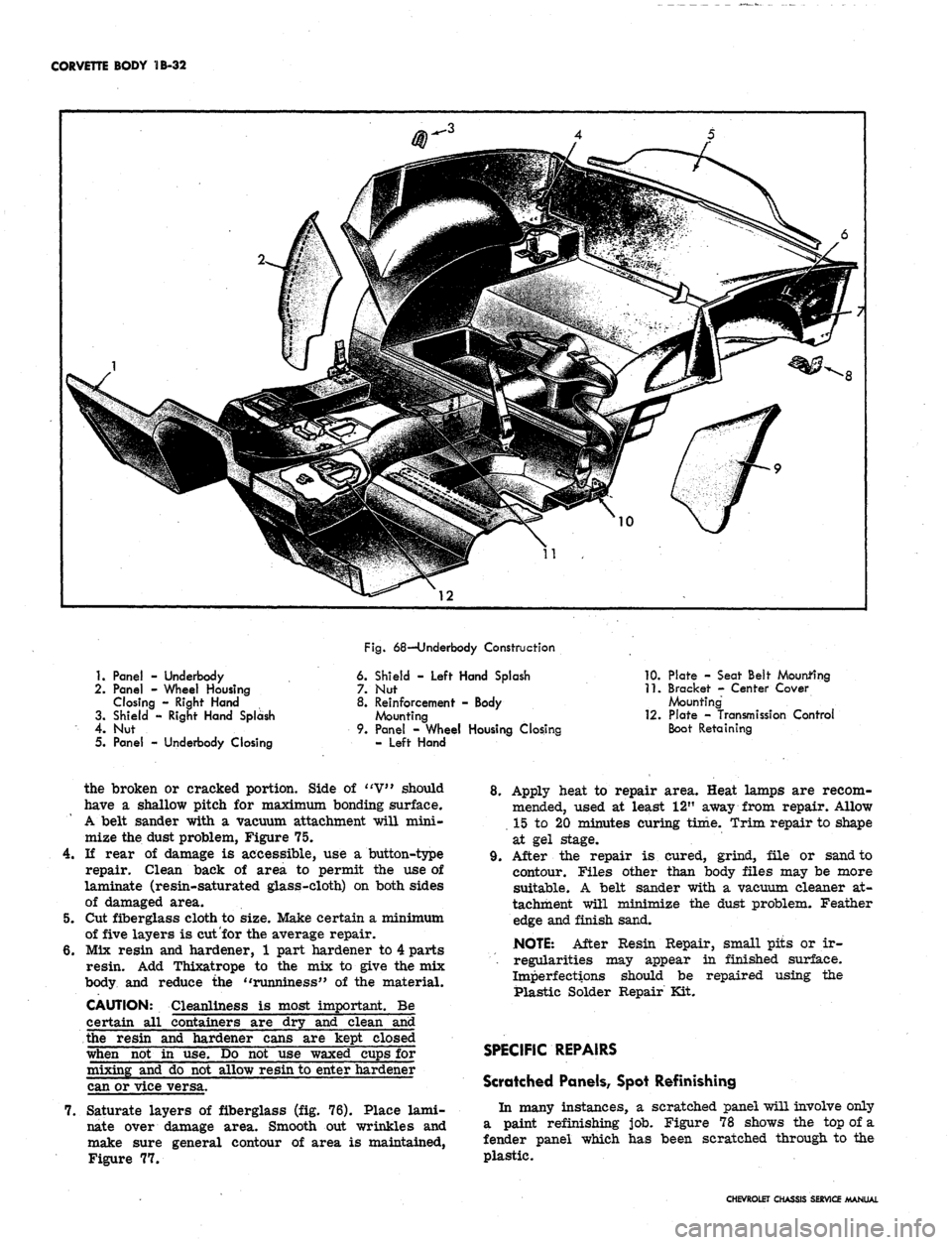
CORVETTE BODY 1B-32
1.
Panel - Underbody
2.
Panel - Wheel Housing
Closing - Right Hand
3. Shield - Right Hand Splash
4.
Nut
5. Panel - Underbody Closing
Fig.
68—Underbody Construction
6. Shield - Left Hand Splash
7. Nut
8. Reinforcement - Body
Mounting
9. Panel - Wheel Housing Closing
- Left Hand
10.
Plate - Seat Belt Mounting
11.
Bracket - Center Cover
Mounting
12.
Plate - Transmission Control
Boot Retaining
the broken or cracked portion. Side of "V" should
have a shallow pitch for maximum bonding surface.
A belt sander with a vacuum attachment will mini-
mize the dust problem, Figure 75.
4.
If rear of damage is accessible, use a button-type
repair. Clean back of area to permit the use of
laminate (resin-saturated glass-cloth) on both sides
of damaged area.
5. Cut fiberglass cloth to size. Make certain a minimum
of five layers is cut for the average repair.
6. Mix resin and hardener, 1 part hardener to 4 parts
resin. Add Thixatrope to the mix to give the mix
body and reduce the "runniness" of the material.
CAUTION: Cleanliness is most important. Be
certain all containers are dry and clean and
the resin and hardener cans are kept closed
when not in use. Do not use waxed cups for
mixing and do not allow resin to enter hardener
can or vice versa.
7. Saturate layers of fiberglass (fig. 76). Place lami-
nate over damage area. Smooth out wrinkles and
make sure general contour of area is maintained,
Figure 77.
8. Apply heat to repair area. Heat lamps are recom-
mended, used at least 12" away from repair. Allow
.15 to 20 minutes curing time. Trim repair to shape
at gel stage.
9. After the repair is cured, grind, file or sand to
contour. Files other than body files may be more
suitable. A belt sander with a vacuum cleaner at-
tachment will minimize the dust problem. Feather
edge and finish sand.
NOTE:
After Resin Repair, small pits or ir-
• regularities may appear in finished surface.
Imperfections should be repaired using the
Plastic Solder Repair Kit.
SPECIFIC REPAIRS
Scratched Panels, Spot Refinishing
In many instances, a scratched panel will involve only
a paint refinishing job. Figure 78 shows the top of a
fender panel which has been scratched through to the
plastic.
CHEVROLET CHASSIS SERVICE MANUAL
Page 219 of 659
REAR SUSPENSION AND DRIVE LINE 4-29
REAR AXLE NOISE DIAGNOSIS
Mechanical failures of the rear axle are relatively
simple to locate and correct. Noise in a rear axle is a
little more difficult to diagnose and repair. One of the
most essential parts of rear axle service is proper
diagnosis.
Ail rear axles are noisy to a certain degree. The
action of transmitting the high engine torque through a
90° turn reducing propeller shaft speed produces noise
in rear axles. This point establishes the need for a line
between normal and abnormal or unacceptable axle
noises.
Slight axle noise heard only at a certain speed or under
remote conditions must be considered normal. Axle noise
tends to "peak" at varying speeds and the noise is in no
way indicative of trouble in the axle.
If noise is present in an objectionable form, loud or at
all speeds, an effort should be made to isolate the noise
as being in one particular unit of the vehicle. Axle noise
is often confused with other noises such as tire noise,
transmission noise, propeller shaft vibration and uni-
versal joint noise. Isolation of the noise as in any one
unit requires skill and experience. An attempt to elimini-
ate a slight noise may baffle even the best of diagnos-
ticians. Such practices as raising tire pressure to
eliminate tire noise, listening for the noise at varying
speeds and on drive, float and coast, and under proper
highway conditions, turning the steering wheel from left
to right to detect wheel bearing noise, will aid even the
beginner in detecting alleged axle noises. Axle noises
fall into two categories: gear noise and bearing noise.
GEAR NOISE
Abnormal gear noise can be recognized since it pro-
duces a cycling pitch and will be very pronounced in the
speed range at which it occurs, appearing under either
"drive," "float" or "coast" conditions. Gear noise
tends to peak in a narrow speed range or ranges, while
bearing noise will tend to remain constant in pitch. Ab-
normal gear noise is rare and usually originates from
the scoring of the ring gear and pinion teeth as a result
of insufficient or improper lubrication in new assemblies.
Side gears seldom give trouble as they are used only
when the rear wheels travel at different speeds.
BEARING NOISE
Defective bearings will always produce a whine that is
constant in pitch and varies with vehicle speed. This fact
will allow you to distinguish between bearing noise and
gear noise.
1.
Pinion bearing noise resulting from a bearing failure
can be identified by a constant rough sound. Pinion
bearings are rotating at a higher speed than differen-
tial side bearings or axle shaft bearings. This
particular noise can be picked up best by testing the
car on a smooth road (black top). However, care
should be taken not to confuse tire noise with bear-
ing or gear noise. If any doubt exists, tire treads
should be examined for irregularities that would
produce such noise.
2.
Wheel bearing noise may be confused with rear axle
noise. To differentiate between wheel bearings and
rear axle, drive the vehicle on a smooth road at
medium-low speed. With traffic permitting, turn
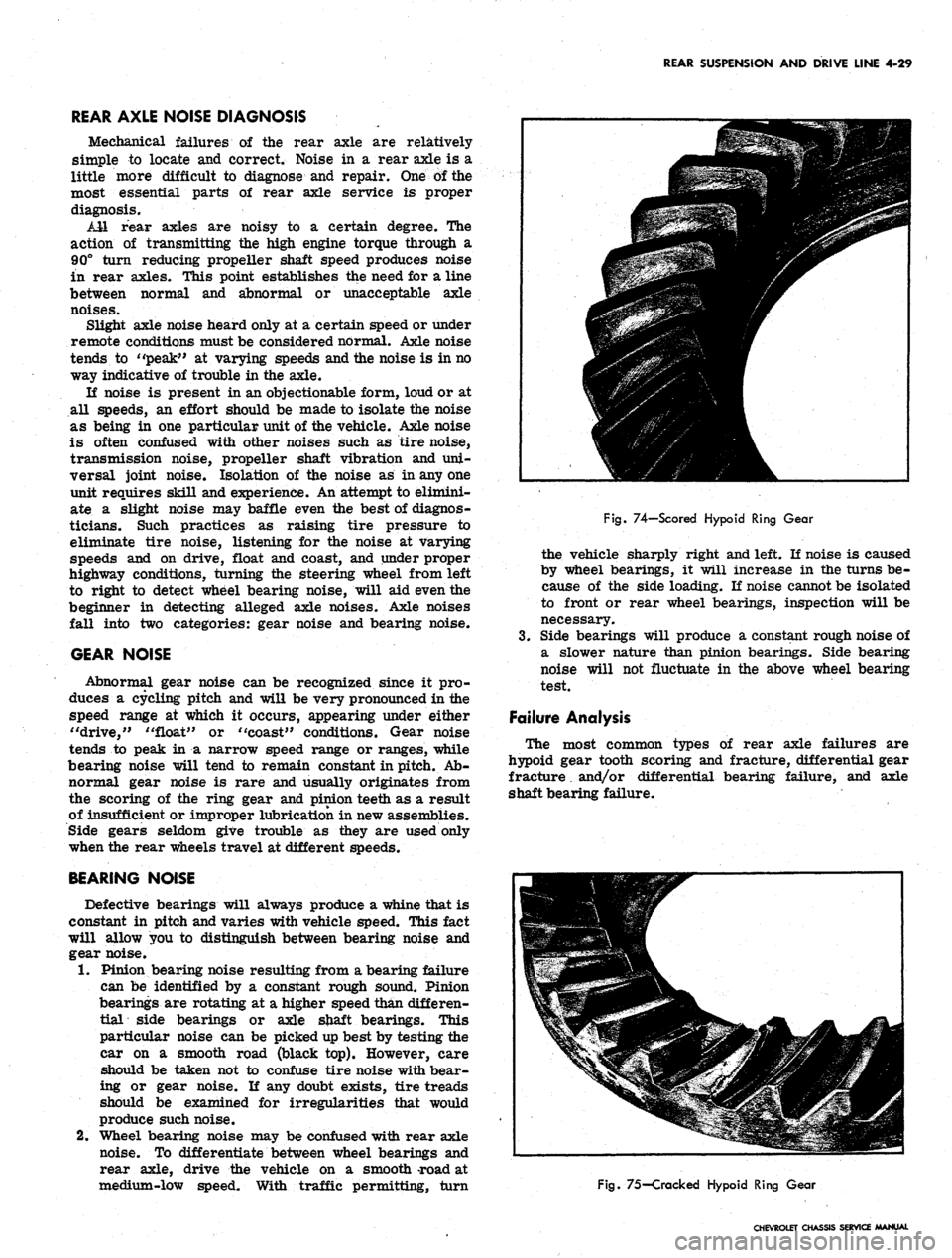
Fig.
74—Scored Hypoid Ring Gear
the vehicle sharply right and left. If noise is caused
by wheel bearings, it will increase in the turns be-
cause of the side loading. If noise cannot be isolated
to front or rear wheel bearings, inspection will be
necessary.
3.
Side bearings will produce a constant rough noise of
a slower nature than pinion bearings. Side bearing
noise will not fluctuate in the above wheel bearing
test.
Failure Analysis
The most common types of rear axle failures are
hypoid gear tooth scoring and fracture, differential gear
fracture. and/or differential bearing failure, and axle
shaft bearing failure.
Fig.
75-Cracked Hypoid Ring Gear
CHEVROLET CHASSIS SERVICE MANUAL
Page 225 of 659
REAR SUSPENSION AND DRIVE LINE 4-35
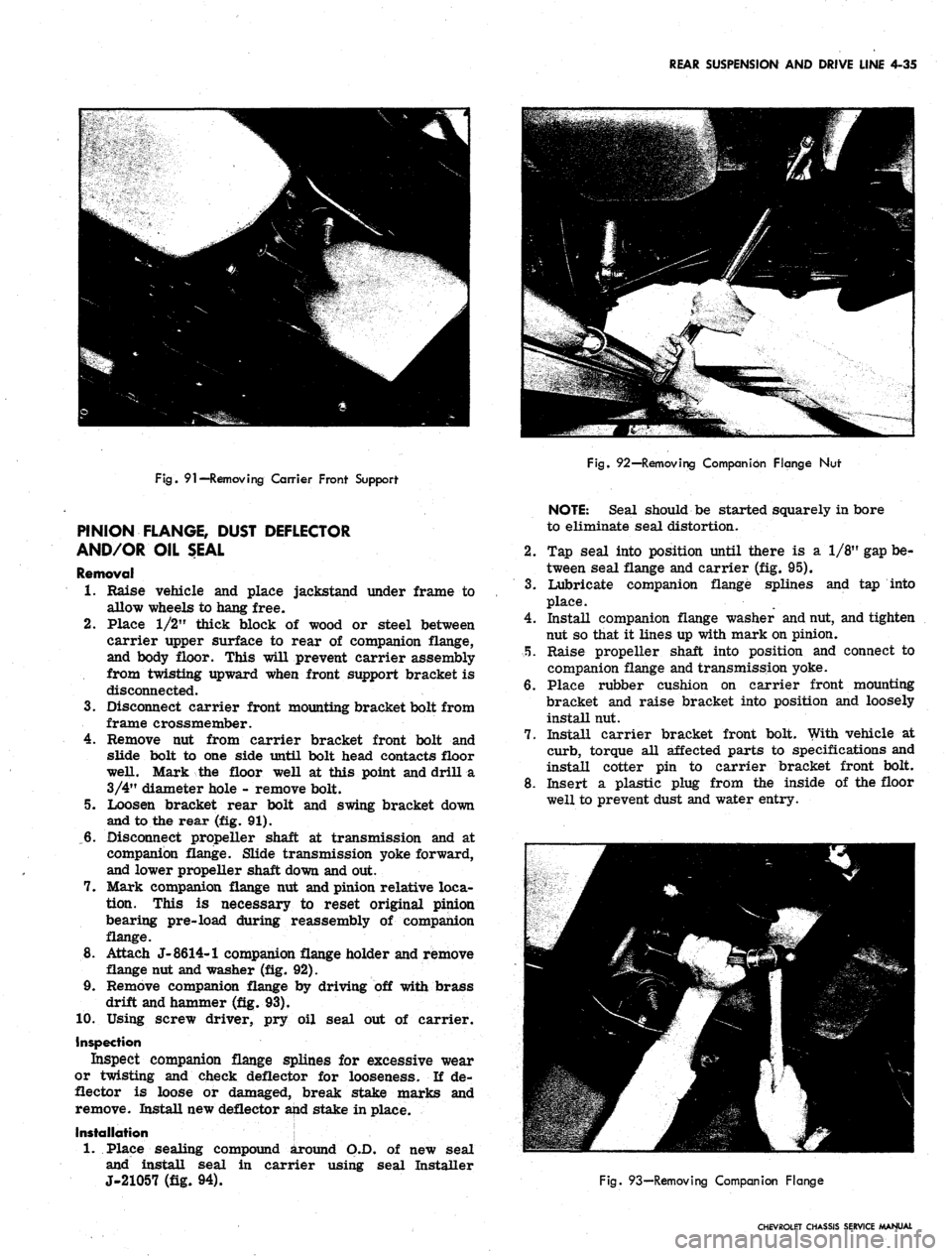
Fig.
91—
Removing Carrier Front Support
PINION FLANGE, DUST DEFLECTOR
AND/OR OIL SEAL
Removal
1.
Raise vehicle and place jackstand under frame to
allow wheels to hang free.
2.
Place 1/2" thick block of wood or steel between
carrier upper surface to rear of companion flange,
and body floor. This will prevent carrier assembly
from twisting upward when front support bracket is
disconnected.
3.
Disconnect carrier front mounting bracket bolt from
frame crossmember.
4.
Remove nut from carrier bracket front bolt and
slide bolt to one side until bolt head contacts floor
well. Mark the floor well at this point and drill a
3/4"
diameter hole - remove bolt.
5. Loosen bracket rear bolt and swing bracket down
and to the rear (fig. 91).
6. Disconnect propeller shaft at transmission and at
companion flange. Slide transmission yoke forward,
and lower propeller shaft down and out.
7. Mark companion flange nut and pinion relative loca-
tion.
This is necessary to reset original pinion
bearing pre-load during reassembly of companion
flange.
8. Attach J-8614-1 companion flange holder and remove
flange nut and washer (fig. 92).
9. Remove companion flange by driving off with brass
drift and hammer (fig. 93).
10.
Using screw driver, pry oil seal out of carrier.
Inspection
Inspect companion flange splines for excessive wear
or twisting and check deflector for looseness. If de-
flector is loose or damaged, break stake marks and
remove. Install new deflector and stake in place.
Installation
1.
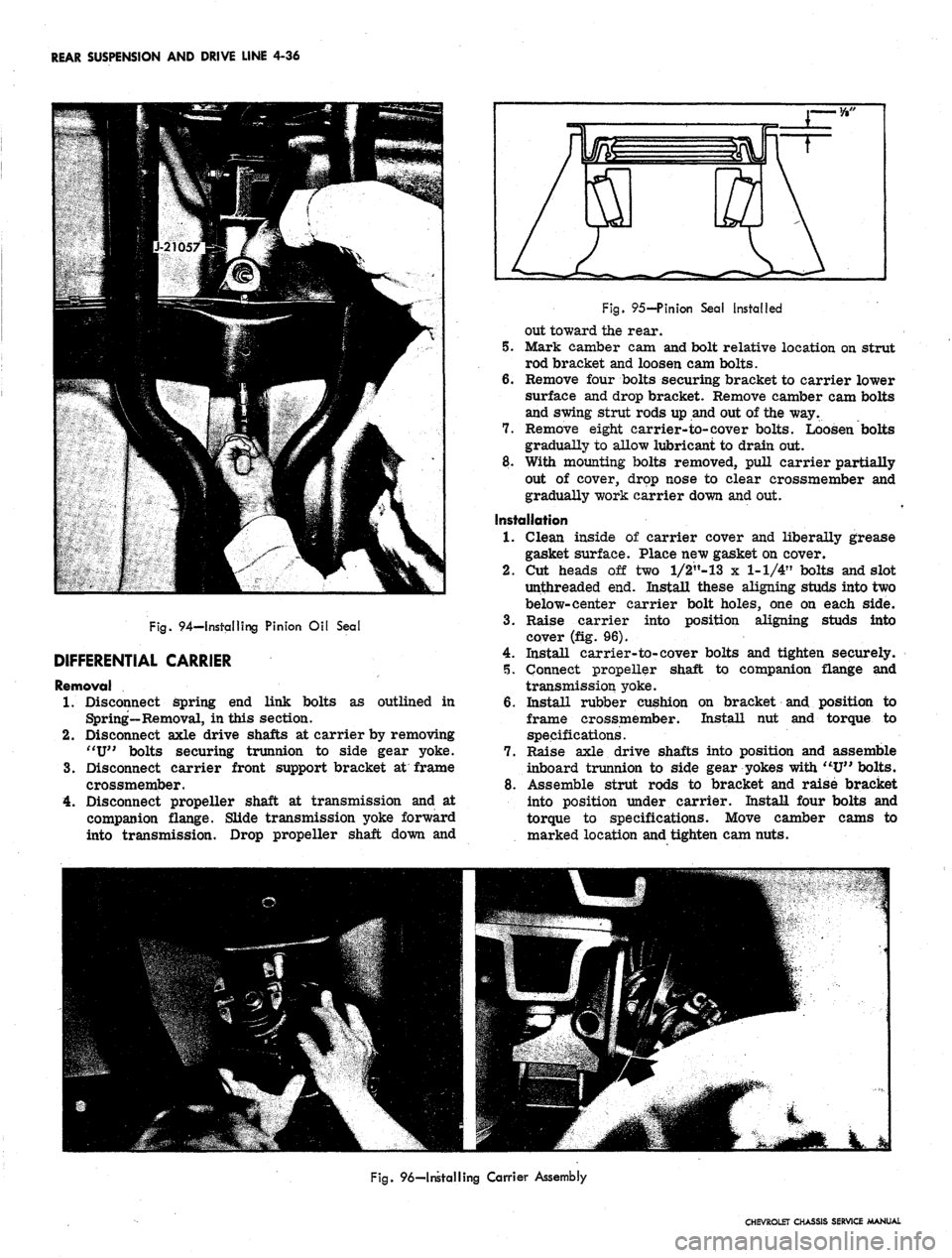
Place sealing compound around O.D. of new seal
and install seal in carrier using seal Installer
J-21057 (fig. 94).
Fig.
92—Removing Companion Flange Nut
NOTE:
Seal should be started squarely in bore
to eliminate seal distortion.
2.
Tap seal into position until there is a 1/8" gap be-
tween seal flange and carrier (fig. 95).
3.
Lubricate companion flange splines and tap into
place.
4.
Install companion flange washer and nut, and tighten
nut so that it lines up with mark on pinion.
5. Raise propeller shaft into position and connect to
companion flange and transmission yoke.
6. Place rubber cushion on carrier front mounting
bracket and raise bracket into position and loosely
install nut.
7. Install carrier bracket front bolt. With vehicle at
curb,
torque all affected parts to specifications and
install cotter pin to carrier bracket front bolt.
8. Insert a plastic plug from the inside of the floor
well to prevent dust and water entry.
Fig.
93—Removing Companion Flange
CHEVROLET CHASSIS SERVICE MANUAL
Page 226 of 659
REAR SUSPENSION AND DRIVE LINE 4-36
Fig.
94—Installing Pinion Oil Seal
DIFFERENTIAL CARRIER
Removal
1.
Disconnect spring end link bolts as outlined in
Spring—Removal, in this section.
2.
Disconnect axle drive shafts at carrier by removing
"U"
bolts securing trunnion to side gear yoke.
3.
Disconnect carrier front support bracket at frame
crossmember.
4.
Disconnect propeller shaft at transmission and at
companion flange. Slide transmission yoke forward
into transmission. Drop propeller shaft down and
Fig.
95-Pinion Sea! Installed
out toward the rear.
5. Mark camber cam and bolt relative location on strut
rod bracket and loosen cam bolts.
6. Remove four bolts securing bracket to carrier lower
surface and drop bracket. Remove camber cam bolts
and swing strut rods up and out of the way.
7. Remove eight carrier-to-cover bolts. Loosen bolts
gradually to allow lubricant to drain out.
8. With mounting bolts removed, pull carrier partially
out of cover, drop nose to clear crossmember and
gradually work carrier down and out.
Installation
1.
Clean inside of carrier cover and liberally grease
gasket surface. Place new gasket on cover.
2.
Cut heads off two l/2"-13 x 1-1/4" bolts and slot
unthreaded end. Install these aligning studs into two
below-center carrier bolt holes, one on each side.
3.
Raise carrier into position aligning studs into
cover (fig. 96).
4.
Install carrier-to-cover bolts and tighten securely.
5. Connect propeller shaft to companion flange and
transmission yoke.
6. Install rubber cushion on bracket and position to
frame crossmember. Install hut and torque to
specifications.
7. Raise axle drive shafts into position and assemble
inboard trunnion to side gear yokes with "U" bolts.
8. Assemble strut rods to bracket and raise bracket
into position under carrier. Install four bolts and
torque to specifications. Move camber cams to
marked location and tighten cam nuts.
Fig.
96—Installing Carrier Assembly
CHEVROLET CHASSIS SERVICE MANUAL
Page 227 of 659
REAR SUSPENSION AND DRIVE LINE 4-37
9. Connect spring end link bolts as outlined under
Spring--Installation, in this section.
10.
Remove filler plug, located on right side of cover,
and fill -with hypoid lubricant to level of filler hole.
11.
Lower vehicle and road test for leaks, noise and
general performance.
POSITRACTION DIFFERENTIAL UNIT
The optionally available Positraction differential unit
is installed in the conventional carrier to replace the
standard differential unit.
Service procedures for the Positraction equipped axle
are the same as on a conventional axle except for the.
operations listed below.
On the Vehicle Check
If vehicle is equipped with a manual transmission, shift
transmission into neutral.
1.
Raise rear of vehicle until wheels are off the ground,
remove one wheel and tire assembly.
2.
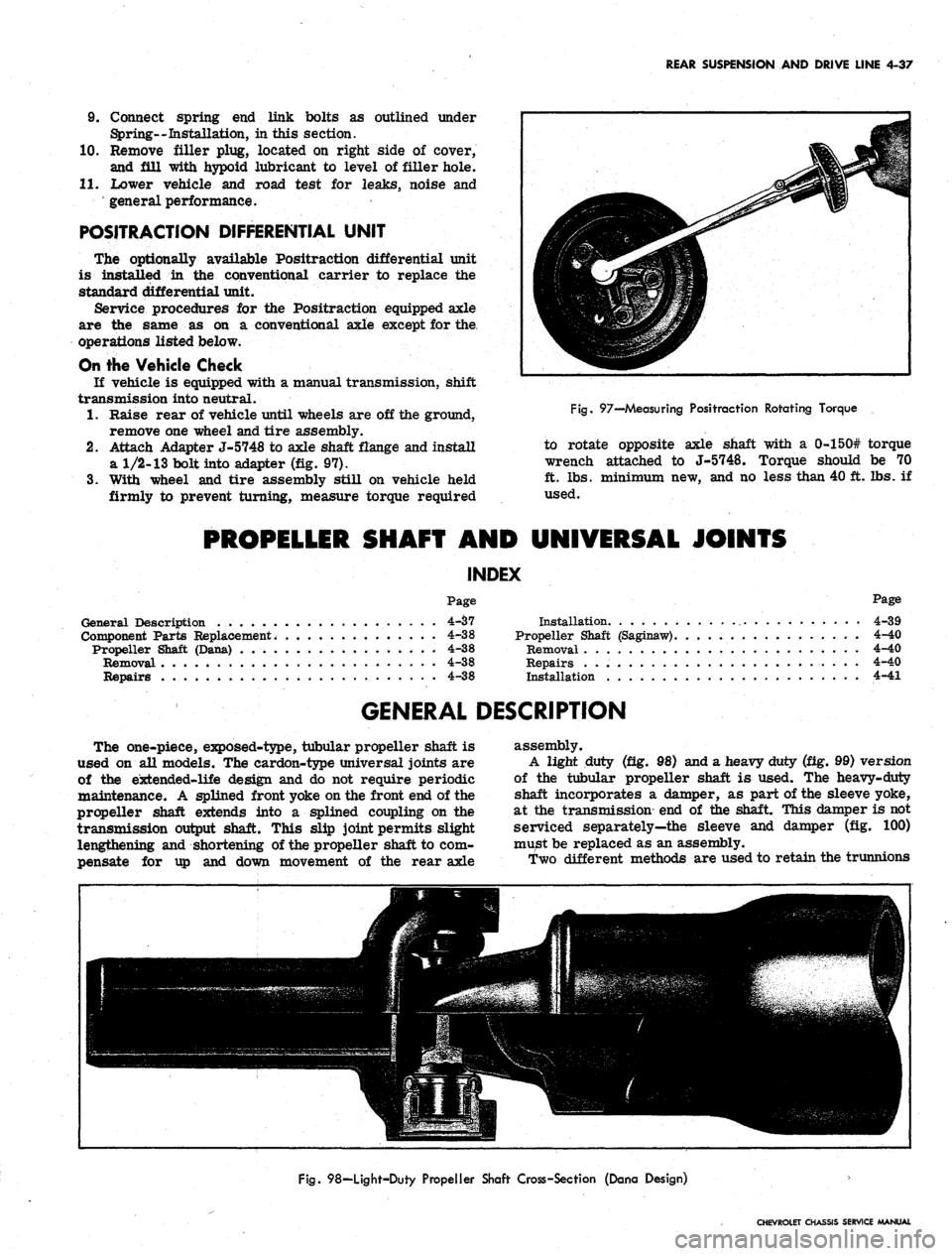
Attach Adapter J-5748 to axle shaft flange and install
a
1/2-13
bolt into adapter (fig. 97).
3.
With wheel and tire assembly still on vehicle held
firmly to prevent turning, measure torque required
Fig.
97—Measuring Positraction Rotating Torque
to rotate opposite axle shaft with a 0-150# torque
wrench attached to J-5748. Torque should be 70
ft.
lbs. minimum new, and no less than 40 ft. lbs. if
used.
PROPELLER SHAFT AND UNIVERSAL JOINTS
INDEX
Page
Page
General Description 4-37
Component Parts Replacement. 4-38
Propeller Shaft (Dana) 4-38
Removal 4-38
Repairs 4-38
Installation 4-39
Propeller Shaft (Saginaw) 4-40
Removal 4-40
Repairs 4-40
Installation 4-41
GENERAL DESCRIPTION
The one-piece, exposed-type, tubular propeller shaft is
used on all models. The cardon-type universal joints are
of the extended-life design and do not require periodic
maintenance. A splined front yoke on the front end of the
propeller shaft extends into a splined coupling on the
transmission output shaft. This slip joint permits slight
lengthening and shortening of the propeller shaft to com-
pensate for up and down movement of the rear axle
assembly.
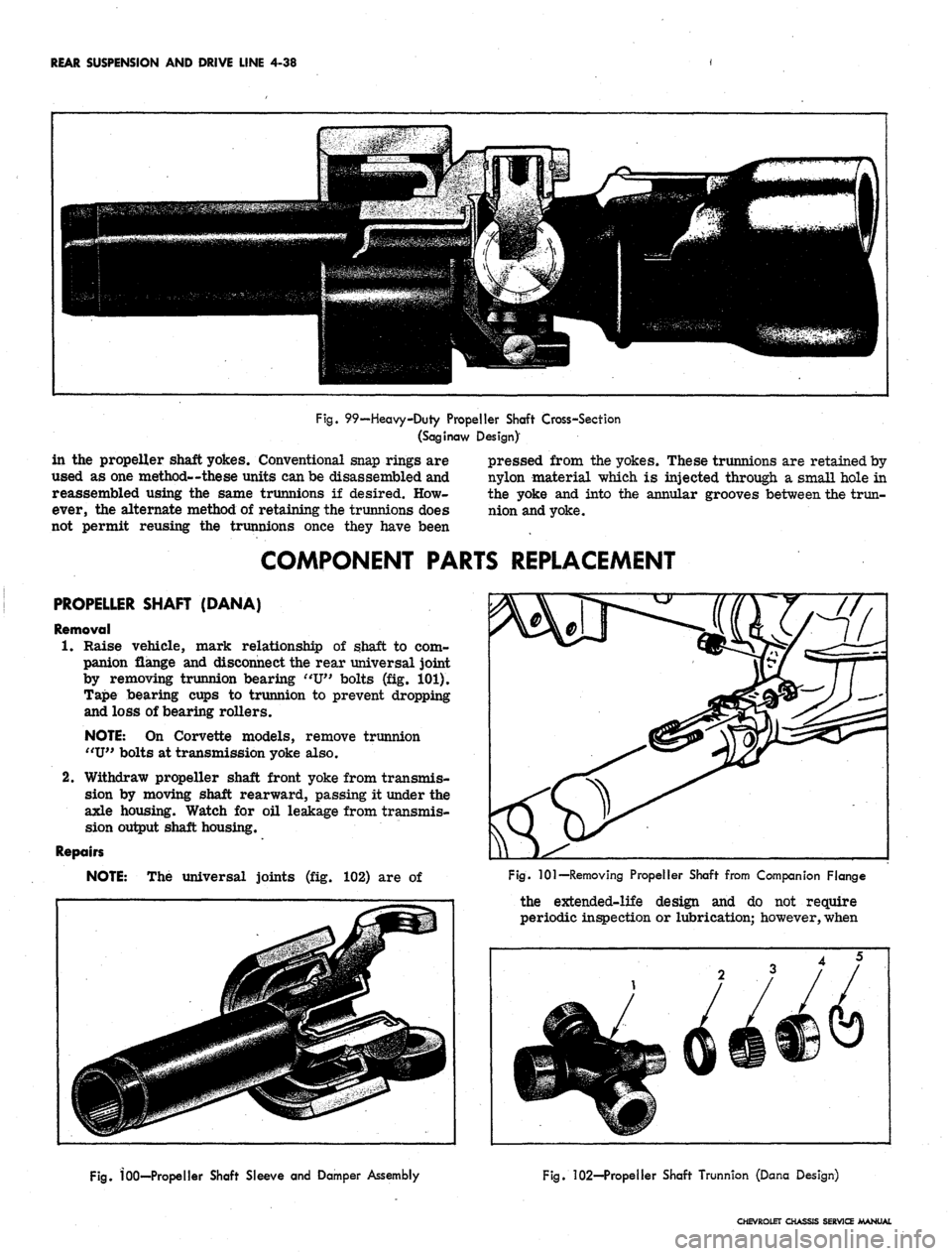
A light duty (fig. 98) and a heavy duty (fig. 99) version
of the tubular propeller shaft is used. The heavy-duty
shaft incorporates a damper, as part of the sleeve yoke,
at the transmission end of the shaft. This damper is not
serviced separately—the sleeve and damper (fig. 100)
must be replaced as an assembly.
Two different methods are used to retain the trunnions
Fig.
98—Light-Duty Propeller Shaft Cross-Section (Dana Design)
CHEVROLET CHASSIS SERVICE MANUAL
Page 228 of 659
REAR SUSPENSION
AND
DRIVE LINE
4-38
•"•f •--..—-.>•,«.-. ^
Fig. 99—Heavy-Duty Propeller Shaft Cross-Section
(Saginaw Design)'
in
the
propeller shaft yokes. Conventional snap rings are
used
as
one method—these units can be disassembled and
reassembled using
the
same trunnions
if
desired.
How-
ever, the alternate method
of
retaining the trunnions does
not permit reusing
the
trunnions once they have been
pressed from the yokes. These trunnions are retained by
nylon material which
is
injected through
a
small hole
in
the yoke and into
the
annular grooves between the trun-
nion and yoke.
COMPONENT PARTS REPLACEMENT
PROPELLER SHAFT (DANA)
Removal
1.
Raise vehicle, mark relationship
of
shaft
to com-
panion flange and disconnect the rear universal joint
by removing trunnion bearing "U" bolts
(fig. 101).
Tape bearing cups
to
trunnion
to
prevent dropping
and loss of bearing rollers.
NOTE:
On
Corvette models, remove trunnion
"U"
bolts at transmission yoke also.
2.
Withdraw propeller shaft front yoke from transmis-
sion
by
moving shaft rearward, passing
it
under the
axle housing. Watch
for oil
leakage from transmis-
sion output shaft housing.
Repairs
NOTE:
The
universal joints
(fig. 102) are of
Fig.
101—
Removing Propeller Shaft from Companion Flange
the extended-life design
and do not
require
periodic inspection or lubrication; however, when
Fig.
100—Propeller Shaft Sleeve
and
Damper Assembly
Fig. 102—Propeller Shaft Trunnion (Dana Design)
CHEVROLET CHASSIS SERVICE MANUAL
Page 229 of 659
REAR SUSPENSION AND DRIVE LINE 4-39
Fig.
103—Removing Bearing Caps
these joints are disassembled, repack bearings
and lubricate reservoir at end of trunnions with
high-melting point wheel bearing lubricant and
replace the dust seals.
1.
Remove bearing lock rings from trunnion yoke.
2.
Support trunnion yoke on a piece of 1-1/4" I.D. pipe
on an arbor bed.
NOTE:
Due to length of the propeller shaft it
may be more convenient to use a bench vise,
for removal and installation, instead of an arbor
press.
In this case, proceed with disassembly
and assembly procedure as with an arbor press.
3.
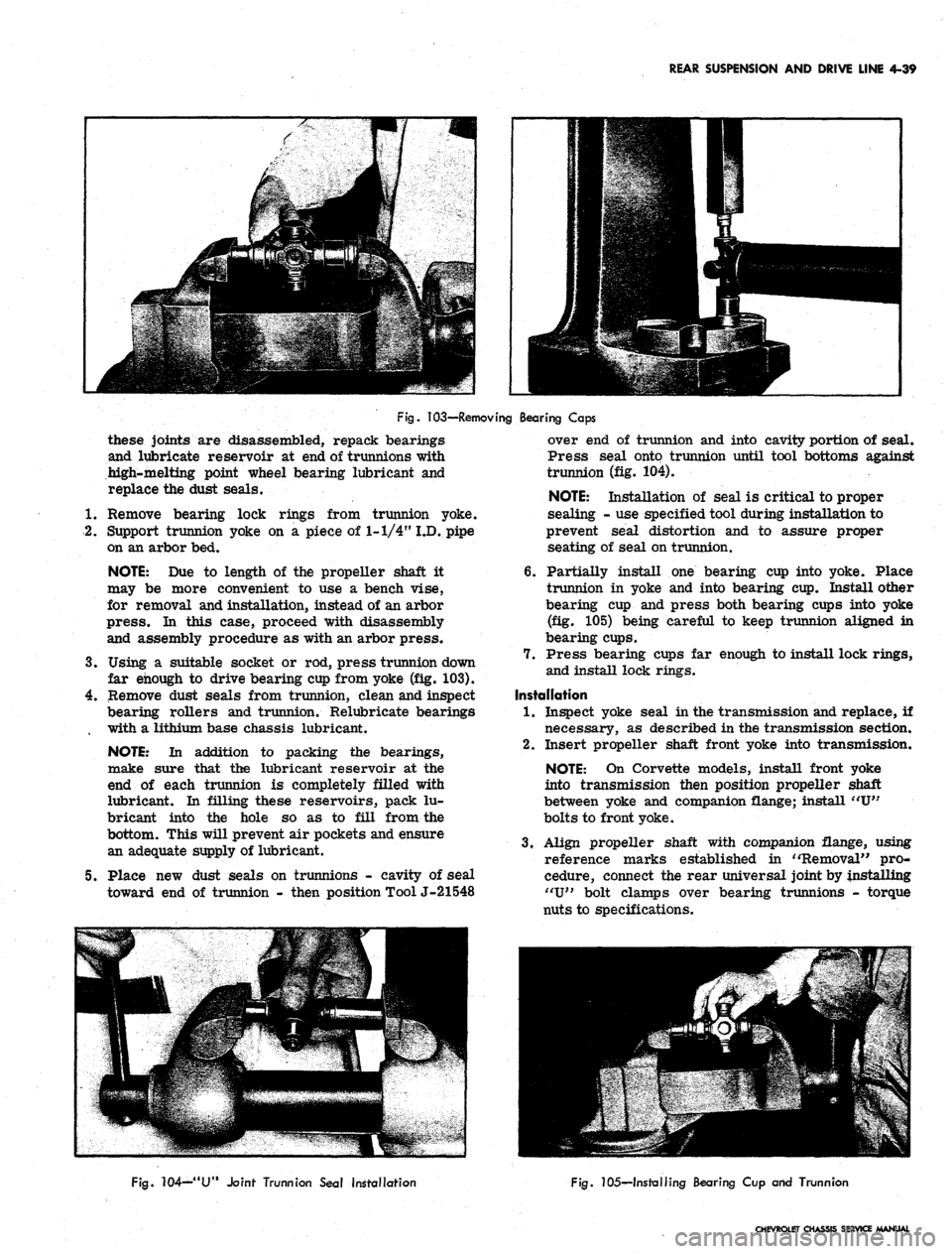
Using a suitable socket or rod, press trunnion down
far enough to drive bearing cup from yoke (fig. 103).
4.
Remove dust seals from trunnion, clean and inspect
bearing rollers and trunnion. Relubricate bearings
with a lithium base chassis lubricant.
NOTE:
In addition to packing the bearings,
make sure that the lubricant reservoir at the
end of each trunnion is completely filled with
lubricant. In filling these reservoirs, pack lu-
bricant into the hole so as to fill from the
bottom. This will prevent air pockets and ensure
an adequate supply of lubricant.
5. Place new dust seals on trunnions - cavity of seal
toward end of trunnion - then position Tool J-21548
over end of trunnion and into cavity portion of seal.
Press seal onto trunnion until tool bottoms against
trunnion (fig. 104). .
NOTE:
Installation of seal is critical to proper
sealing - use specified tool during installation to
prevent seal distortion and to assure proper
seating of seal on trunnion.
6. Partially install one bearing cup into yoke. Place
trunnion in yoke and into bearing cup. Install other
bearing cup and press both bearing cups into yoke
(fig. 105) being careful to keep trunnion aligned in
bearing cups.
7. Press bearing cups far enough to install lock rings,
and install lock rings.
Installation
1.
Inspect yoke seal in the transmission and replace, if
necessary, as described in the transmission section.
2.
Insert propeller shaft front yoke into transmission.
NOTE:
On Corvette models, install front yoke
into transmission then position propeller shaft
between yoke and companion flange; install "U"
bolts to front yoke.
3.
Align propeller shaft with companion flange, using
reference marks established in "Removal" pro-
cedure, connect the rear universal joint by installing
"U"
bolt clamps over bearing trunnions - torque
nuts to specifications.
Fig.
104—"U" Joint Trunnion Seal installation
Fig.
105—Installing Bearing Cup and Trunnion
CHEVROLET CHASSIS SERVICE MANUAL
Page 230 of 659
REAR SUSPENSION AND DRIVE LINE 4-40
Fig.
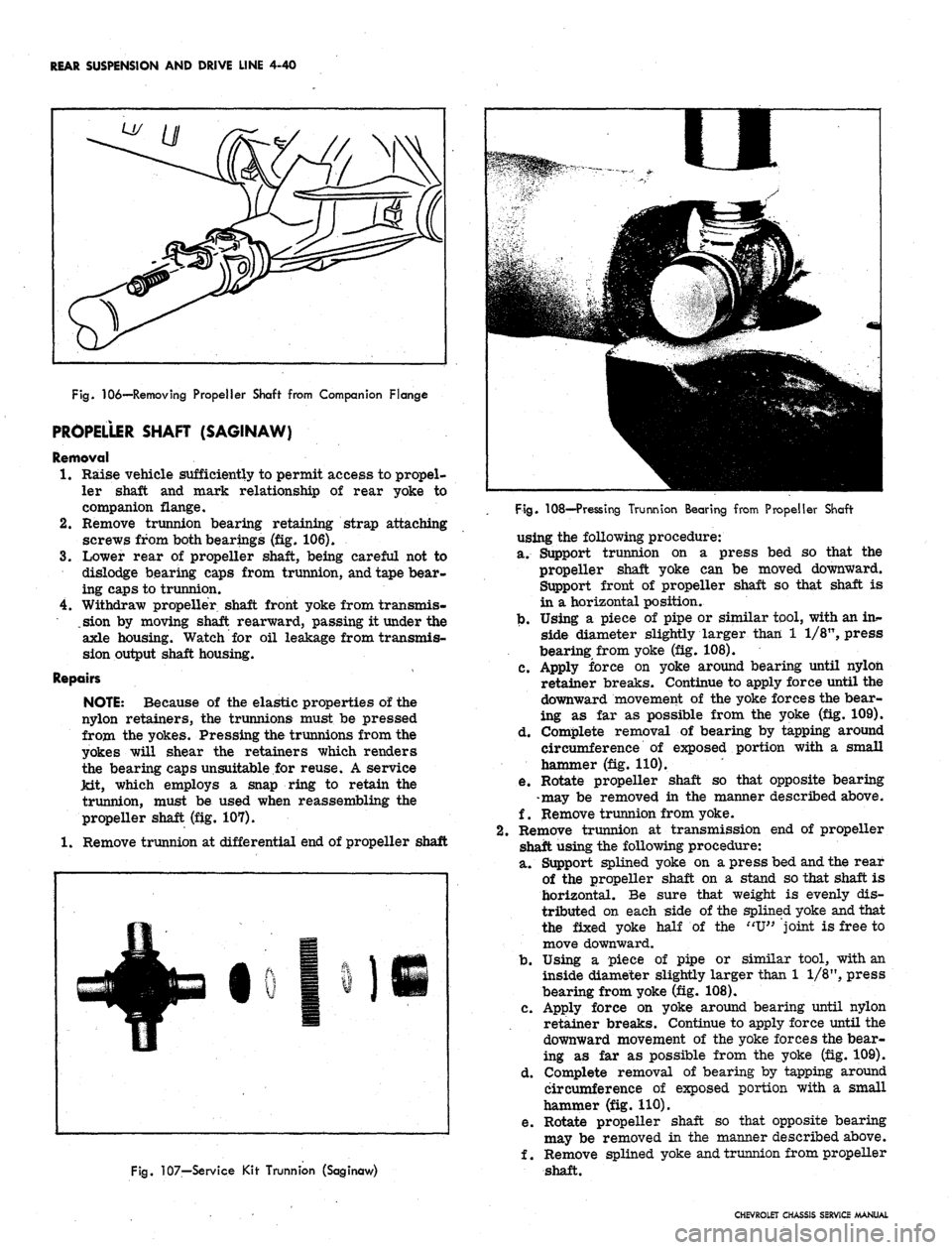
106—Removing Propeller Shaft from Companion Flange
PROPELLER SHAFT (SAGINAW)
Removal
1.
Raise vehicle sufficiently to permit access to propel-
ler shaft and mark relationship of rear yoke to
companion flange.
2.
Remove trunnion bearing retaining strap attaching
screws from both bearings (fig. 106).
3.
Lower rear of propeller shaft, being careful not to
dislodge bearing caps from trunnion, and tape bear-
ing caps to trunnion.
4.
Withdraw propeller shaft front yoke from transmis-
.sion by moving shaft rearward, passing it under the
axle housing. Watch for oil leakage from transmis-
sion output shaft housing.
Repairs
NOTE:
Because of the elastic properties of the
nylon retainers, the trunnions must be pressed
from the yokes. Pressing the trunnions from the
yokes will shear the retainers which renders
the bearing caps unsuitable for reuse. A service
Jdt, which employs a snap ring to retain the
trunnion, must be used when reassembling the
propeller shaft (fig. 107).
1.
Remove trunnion at differential end of propeller shaft
Fig.
107—Service Kir Trunnion (Saginaw)
Fig.
108—Pressing Trunnion Bearing from Propeller Shaft
using the following procedure:
a. Support trunnion on a press bed so that the
propeller shaft yoke can be moved downward.
Support front of propeller shaft so that shaft is
in a horizontal position.
b.
Using a piece of pipe or similar tool, with an ins-
side diameter slightly larger than 1 1/8", press
bearing from yoke (fig. 108).
c. Apply force on yoke around bearing until nylon
retainer breaks. Continue to apply force until the
downward movement of the yoke forces the bear-
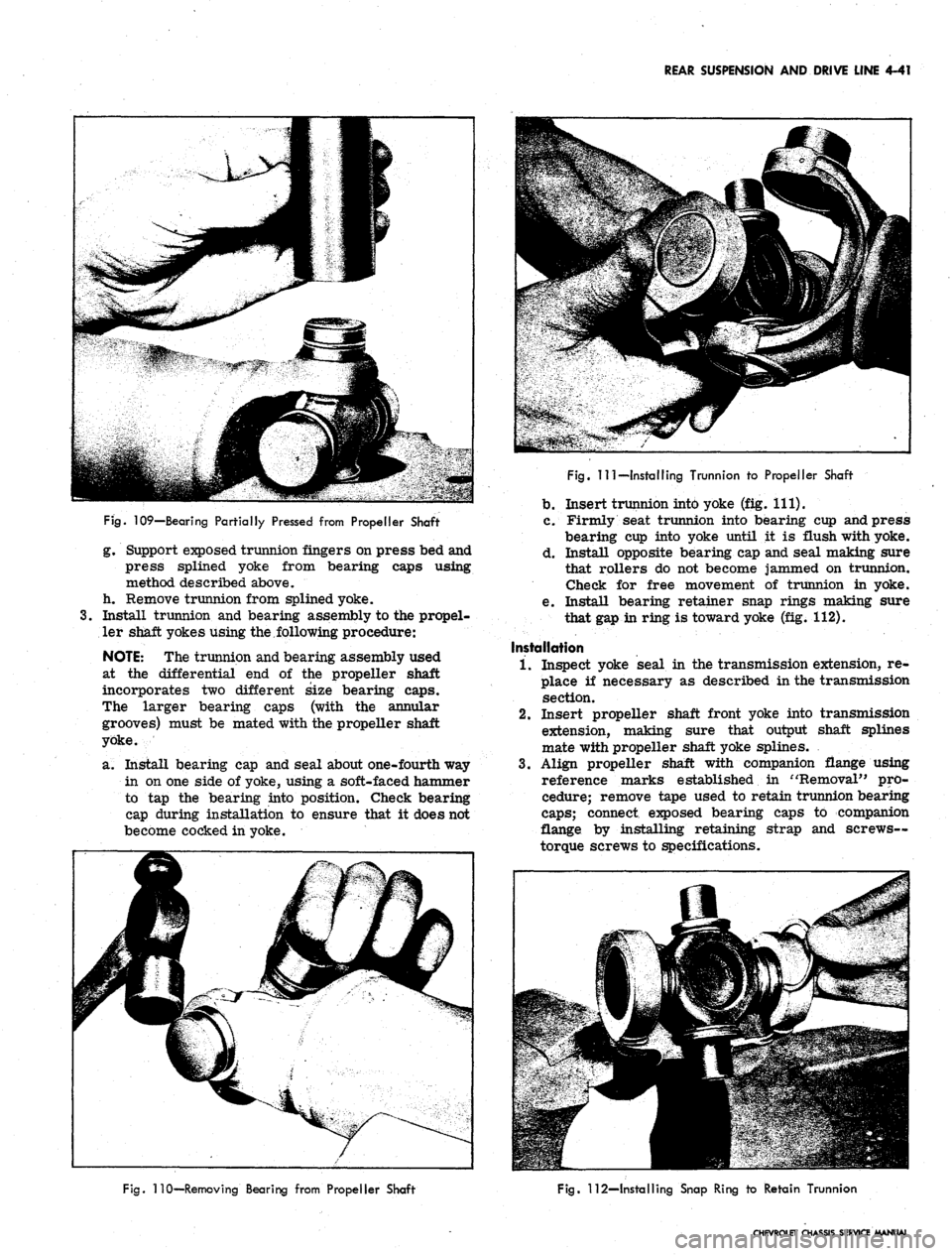
ing as far as possible from the yoke (fig. 109).
d. Complete removal of bearing by tapping around
circumference of exposed portion with a small
hammer (fig. 110).
e. Rotate propeller shaft so that opposite bearing
-may be removed in the manner described above.
f. Remove trunnion from yoke.
Remove trunnion at transmission end of propeller
shaft using the following procedure:
a. Support splined yoke on a press bed and the rear
of the propeller shaft on a stand so that shaft is
horizontal. Be sure that weight is evenly dis-
tributed on each side of the splined yoke and that
the fixed yoke half of the "U" joint is free to
move downward.
b.
Using a piece of pipe or similar tool, with an
inside diameter slightly larger than 1 1/8", press
bearing from yoke (fig. 108).
c. Apply force on yoke around bearing until nylon
retainer breaks. Continue to apply force until the
downward movement of the yoke forces the bear-
ing as far as possible from the yoke (fig. 109).
d. Complete removal of bearing by tapping around
circumference of exposed portion with a small
hammer (fig. 110).
e. Rotate propeller shaft so that opposite bearing
may be removed in the manner described above.
f. Remove splined yoke and trunnion from propeller
shaft.
CHEVROLET CHASSIS SERVICE MANUAL
Page 231 of 659
REAR SUSPENSION AND DRIVE LINE 4-41
Fig.
109—Bearing Partially Pressed from Propeller Shaft
g. Support exposed trunnion fingers on press bed and
press splined yoke from bearing caps using
method described above,
h. Remove trunnion from splined yoke.
3.
Install trunnion and bearing assembly to the propel-
ler shaft yokes using the,following procedure:
NOTE:
The trunnion and bearing assembly used
at the differential end of the propeller shaft
incorporates two different size bearing caps.
The larger bearing caps (with the annular
grooves) must be mated with the propeller shaft
yoke.
a. Install bearing cap and seal about one-fourth way
in on one side of yoke, using a soft-faced hammer
to tap the bearing into position. Check bearing
cap during installation to ensure that it does not
become cocked in yoke.
Fig.
Ill—Installing Trunnion to Propeller Shaft
b.
Insert trunnion into yoke (fig. 111).
c. Firmly seat trunnion into bearing cup and press
bearing cup into yoke until it is flush with yoke.
d. Install opposite bearing cap and seal making sure
that rollers do not become jammed on trunnion.
Check for free movement of trunnion in yoke.
e. Install bearing retainer snap rings making sure
that gap in ring is toward yoke (fig. 112).
Installation
1.
Inspect yoke seal in the transmission extension, re-
place if necessary as described in the transmission
section.
2.
Insert propeller shaft front yoke into transmission
extension, making sure that output shaft splines
mate with propeller shaft yoke splines.
3.
Align propeller shaft with companion flange using
reference marks established in "Removal" pro-
cedure; remove tape used to retain trunnion bearing
caps;
connect exposed bearing caps to companion
flange by installing retaining strap and screws—
torque screws to specifications.
Fig.
110—Removing Bearing from Propeller Shaft
Fig.
112—Installing Snap Ring to Retain Trunnion
CHEVROLET CHASSIS SERVICE MANUAL