manual transmission CHEVROLET CAMARO 1967 1.G Chassis Service Manual
[x] Cancel search | Manufacturer: CHEVROLET, Model Year: 1967, Model line: CAMARO, Model: CHEVROLET CAMARO 1967 1.GPages: 659, PDF Size: 114.24 MB
Page 315 of 659
ENGINE FUEL 6M-7
5. On vehicles equipped with automatic transmission
hold throttle rod in full throttle position, pull TV
rod to full detent position and adjust TV rod to just
enter hole on throttle lever, then connect TV rod at
throttle lever.
NOTE:
If equipped with anti-stall device (dash-
pot),
set carburetor fast idle cam on high step
and adjust dash-pot to just contact throttle
lever.
327
CU.
IN.
427
CU.
IN.
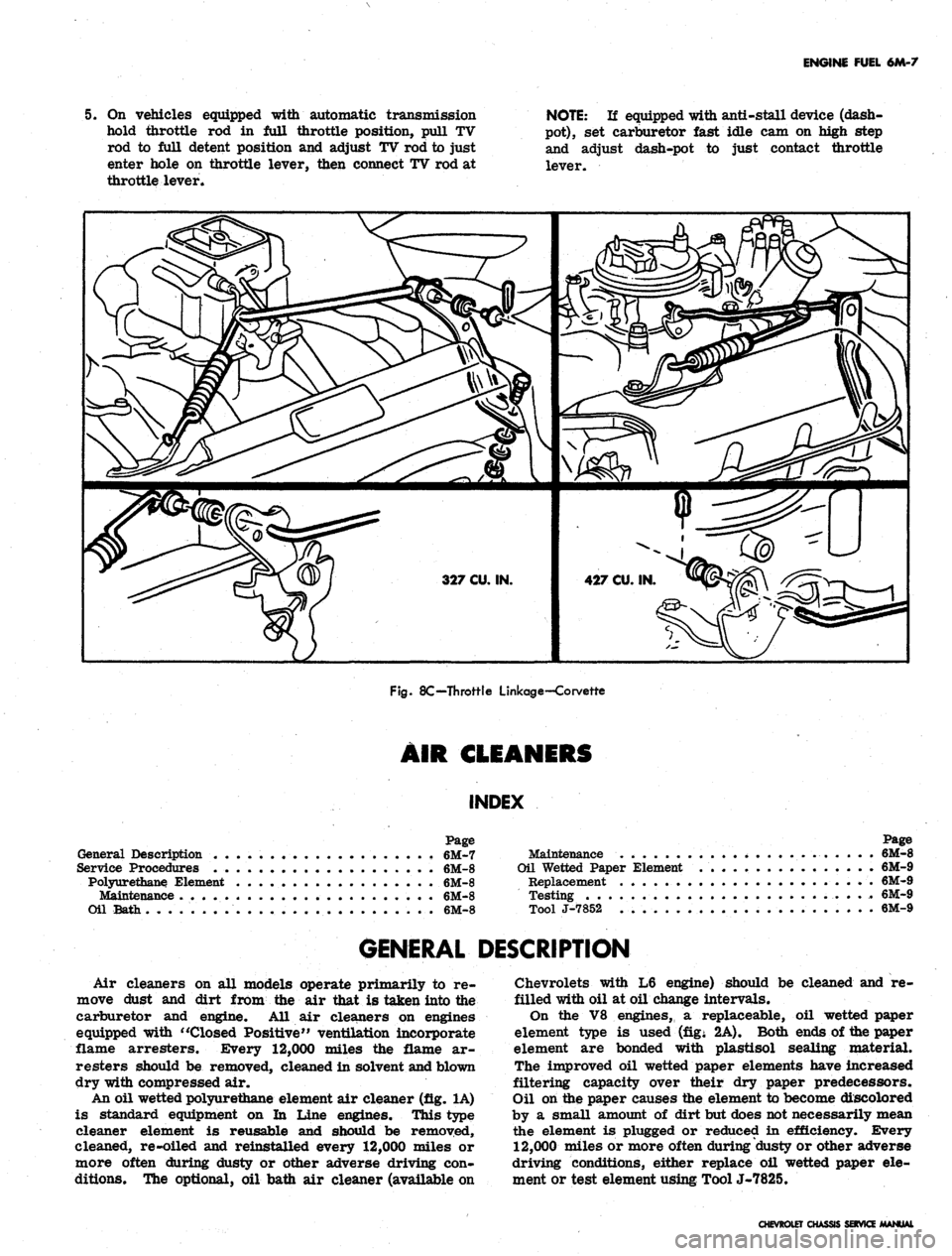
Fig.
8C—Throttle Linkage-Corvette
AIR
CLEANERS
INDEX
Page
General Description 6M-7
Service Procedures . . 6M-8
Polyurethane. Element 6M-8
Maintenance 6M-8
Oil Bath 6M-8
Page
Maintenance
...........* 6M-8
Oil
Wetted
Paper
Element
6M-9
Replacement
* . 6M-9
Testing 6M-9
Tool J-7852 . 6M-9
GENERAL DESCRIPTION
Air cleaners on all models operate primarily to re-
move dust and dirt from the air that is taken into the
carburetor and engine. All air cleaners on engines
equipped with "Closed Positive" ventilation incorporate
flame arresters. Every 12,000 miles the flame ar-
resters should be removed, cleaned in solvent and blown
dry with compressed air.
An oil wetted polyurethane element air cleaner (fig. 1A)
is standard equipment on In Line engines. This type
cleaner element is reusable and should be removed,
cleaned, re-oiled and reinstalled every 12,000 miles or
more often during dusty or other adverse driving con-
ditions. The optional, oil bath air cleaner (available on
Chevrolets with L6 engine) should be cleaned and re-
filled with oil at oil change intervals.
On the V8 engines,, a replaceable, oil wetted paper
element type is used (fig; 2A). Both ends of me paper
element are bonded with plastisol sealing material.
The improved oil wetted paper elements have increased
filtering capacity over their dry paper predecessors.
Oil on the paper causes the element to become diBcolored
by a small amount of dirt but does not necessarily mean
the element is plugged or reduced in efficiency. Every
12,000 miles or more often during dusty or other adverse
driving conditions, either replace oil wetted paper ele-
ment or test element using ToolJ-7825.
CHEVROLET CHASSIS SOVICE/MANUAL
Page 335 of 659
ENGINE-ELECTRICAL 6Y-10
circuit. Make absolutely certain all connections in
the circuit are secure.
5.
Do not short across or ground any of the terminals
on the generator or regulator.
6. Do not attempt to polarize the generator.
7.
Do not disconnect lead at generator without first dis-
connecting battery ground cable.
Trouble in the A.C. charging system will usually be
indicated by one or more of the following conditions:
1.
Faulty indicator lamp or ammeter operation.
2.
An undercharged battery (usually evidenced by slow
cranking speeds).
3.
An overcharged battery (usually evidenced by exces-
sive battery water usage).
4.
Excessive generator noise or vibration.
Described below are a series of on-the-vehicle quick
checks which are designed to assist the service tech-
nician in locating troubles within the various components
of the engine electrical system. Additional checks, ad-
justments and overhaul procedures of these components
are also described in the "Charging Systems—Service
Operations Section" and should be referred to as
necessary.
STATIC CHECKS
Before making any electrical checks, perform the fol-
lowing static checks:
1.
Check for loose fan belt.
2.
Check for defective battery. (Refer to Battery).
3.
Inspect all connections, including the slip-on con-
nectors at the regulator and Delcotron.
NOTE: Do not short field to ground to check if
generator is charging since this will seriously
damage the charging system.
SYSTEM CONDITION TEST
This test is used .to indicate the overall condition of the
charging system (both good and defective) and to isolate
the malfunctioning unit if the system is defective.
NOTE: On Corvette models difficulty may be
encountered -when attempting to make the re-
quired test connections at the voltage regulator.
It is advisable to remove the regulator from its
mounting location to perform the necessary con-
nections at the regulator for the following tests
but make sure unit is grounded.
1.
With ignition off, perform the prescribed Static
Checks outlined in this section. Then set hand brake
and shift transmission
into
neutral.
2.
Connect a voltmeter from junction block relay to
ground at regulator base.
CAUTION: Be sure meter clip does not touch a
resistor or terminal extension under regulator,
3.
Connect a tachometer on engine.
4.
Models equipped with Indicator Lamp: Turn ignition
switch on "ON" position and check indicator lamp.
If lamp fails to glow, perform appropriate tests and
corrections (Indicator Lamp Circuit Tests) before
continuing.
Models equipped with Ammeter: Turn ignition
switch to "ACC" with an accessory on and check
ammeter. If ammeter fails to read discharge, check
ammeter circuit before continuing.
5.
Models equipped with Indicator Lamp: If lamp glows,
start the engine and run' it at 1500 rpm or above.
Check indicator lamp. If lamp fails to go out, per-
form appropriate test and corrections (Indicator
Lamp Circuit Test) before continuing.
Models equipped with Ammeter: If ammeter reads
discharge, start the engine and observe ammeter. If
meter fails to move toward charge (from original
position), perform appropriate test and corrections
(Field Circuit Tests) before continuing.
NOTE: At this point a field circuit has been
established and any other problem will lie in
generator or regulator.
6. Turn on high-beam headlights and heater blower
motor to high speed, run engine at or above 1500
rpm (for a few minutes, if necessary) and read the
voltage on meter.
AIR GAP
ADJUSTING NUT
ONLY
ADJUSTING SCREW
(Turn To Adjust
Voltage Setting)
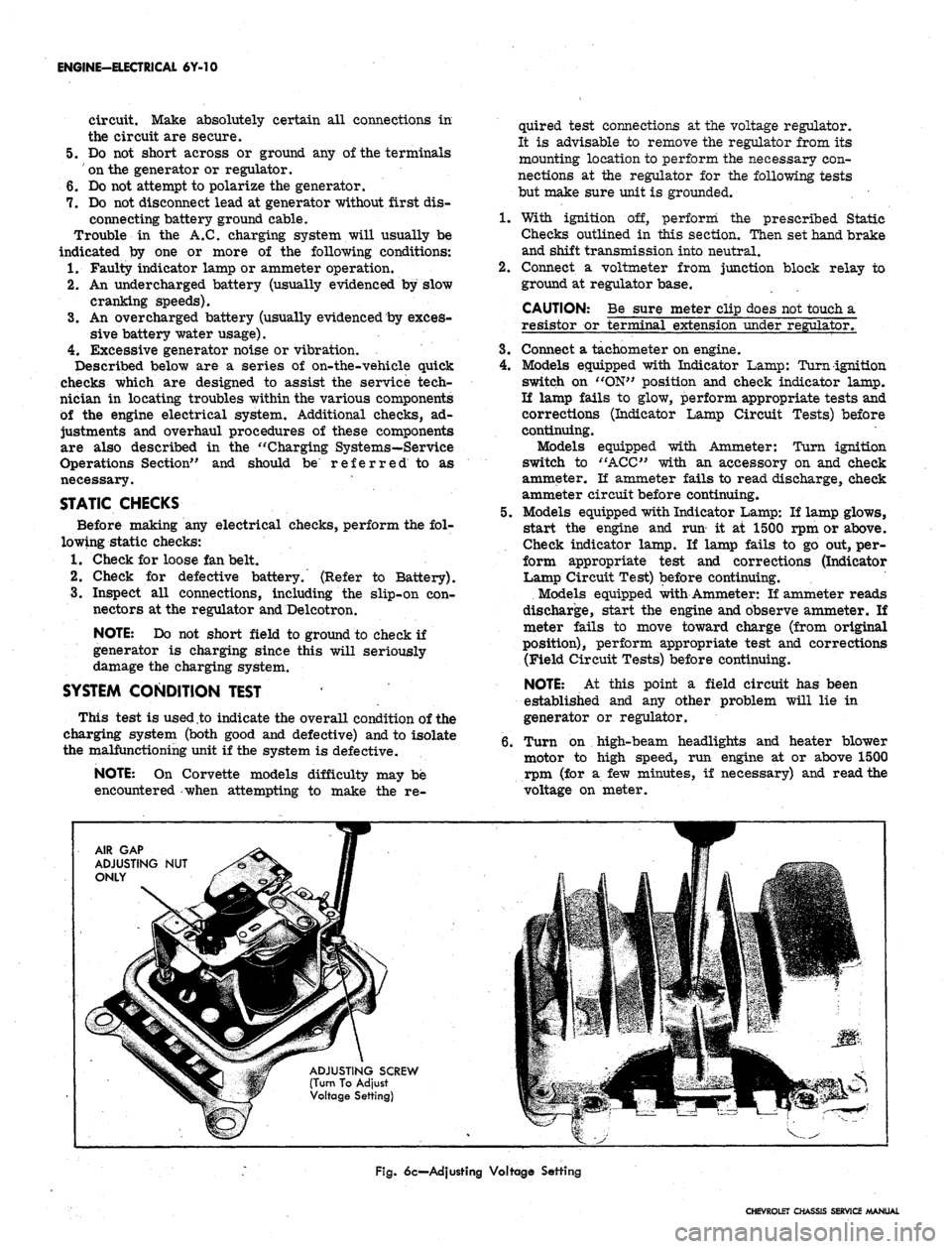
Fig.
6c—Adjusting Voltage Setting
CHEVROLET CHASSIS SERVICE MANUAL
Page 360 of 659
SECTION 7
CLUTCH AND TRANSMISSIONS
CONTENTS OF THIS SECTION
Clutch
Three-Speed . . .
Overdrive
Three-Speed, (Warner T-16)
Four-Speed (Muncie) . . . .
Page
7-1
7-6
7-9
7-14
7-16
CLUTCH
Page
Four-Speed (Saginaw) 7-20
Powerglide 7-23
Turbo Hydra-Matic 7-36
Special Tools 7-43
INDEX
General Description
Maintenance and Adjustments
Linkage Inspection
Clutch Linkage Adjustment
Component Parts Replacement
Clutch Assembly ......
Removal from Vehicle .
Page
7-1
7-1
7-1
7-2
7-3
7-3
7-3
Installation in Vehicle
Clutch Pedal ..'....,
Clutch Cross Shaft . . .
Removal.......
Repairs
Installation .....
Page
7-4
7-4
7-4
7-4
7-4
7-4
GENERAL DESCRIPTION
A diaphragm spring-type clutch assembly is used with
manual transmissions.
The clutch assembly is enclosed in a 360° bell housing
which must be removed to gain access to the clutch.
V-8 engines (equipped with a 4 speed transmission)
use a bent-finger, centrifugal diaphragm type clutch as-
sembly. All its integral release fingers are bent back to
gain a centrifugal boost and to insure quick re engagement
at high engine speeds.
This type of clutch has the advantages of increasing
pressure plate load as the driven plate wears, and of low
pedal effort with high plate loads without requiring over-
center booster springs on the clutch linkage.
The pressure plate is a high tensile strength iron de-
signed for maximum speed conditions.
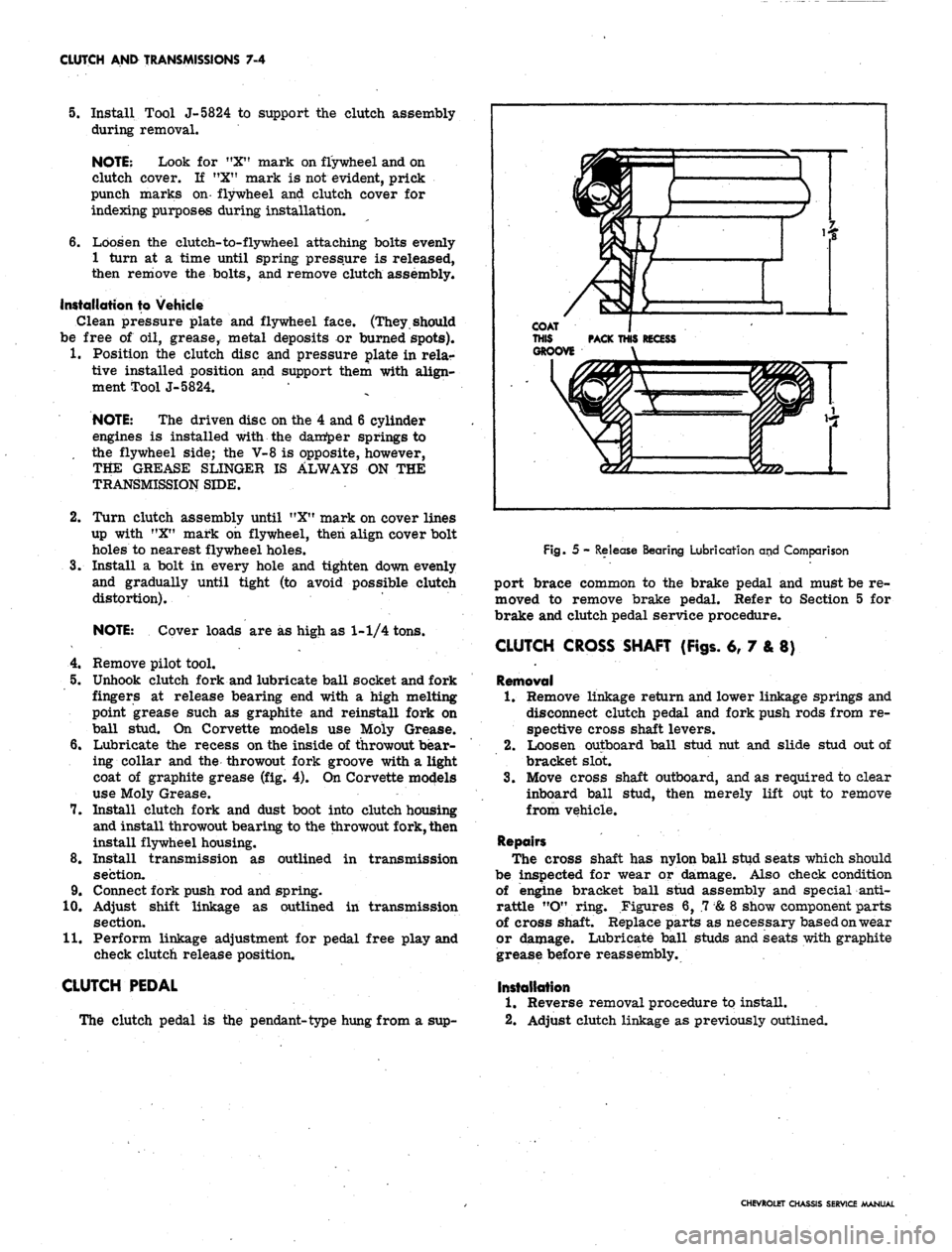
The clutch release bearing (fig. 4), used with the bent
finger diaphragm clutch, has an overall length of approxi-
mately
1-1/4".
The longer bearing, used with the straight
diaphragm, will cause inability to obtain free pedal travel,
especially as the clutch wears, resulting in slippage and
rapid wear.
DO
NOT INTERCHANGE!
The clutch is operated by conventional linkage consist-
ing of two groups, upper linkage and lower linkage.
The return spring pre-loads clutch linkage, removing
looseness due to wear. The clutch free pedal travel,
therefore, will increase with linkage wear and decrease
with driven disc wear, and free travel felt at pedal is
throwout bearing lash.
MAINTENANCE AND ADJUSTMENTS
LINKAGE INSPECTION
There are several things which affect good clutch op-
eration. Therefore, it is necessary, before performing
any major clutch operations, to make preliminary in-
spections to determine whether trouble is actually in the
clutch.
Check the clutch linkage to be sure the clutch releases
fully as follows:
1.
With engine running, hold the clutch pedal approxi-
mately 1/2" from floor mat and move shift lever be-
tween first and reverse several times. If this can be
done smoothly, the clutch is fully releasing. If shift
is not smooth, clutch is not fully releasing and ad-
justment is necessary.
2.
Check clutch pedal bushings for sticking or excessive
wear.
3.
Check fork for proper installation on ball stud. Lack
of lubrication on fork can cause fork to be pulled off
the ball.
4.
Check for bent, cracked or damaged cross shaft
levers or support bracket.
5.
Loose or damaged engine mounts may aUiow the en-
gine to shift its position causing a bind on clutch
linkage at the cross shaft. Check to be sure there is
Fig.
1 - Chevrolet Clutch Pedal Free Travel Adjustment
CHEVROLET CHASSIS SERVICE MANUAL
Page 361 of 659
CLUTCH AND TRANSMISSIONS 7-2
Fig.
2 - Chevelle Clutch Pedal Free Travel Adjustment (V-8 Shown)
some clearance between cross shaft and both its
mounting brackets.
CLUTCH LINKAGE ADJUSTMENT
There is one linkage adjustment (clutch fork push rod
or pedal push rod) to compensate for all normal clutch
wear.
The clutch pedal should have
1-1/4"
free travel (meas-
ured at clutch pedal pad) before the throwout bearing en-
gages the clutch diaphragm spring levers. Lash is re-
quired to prevent clutch slippage which would occur if the
bearing was held against the fingers and to prevent the
bearing from running continually until failure.
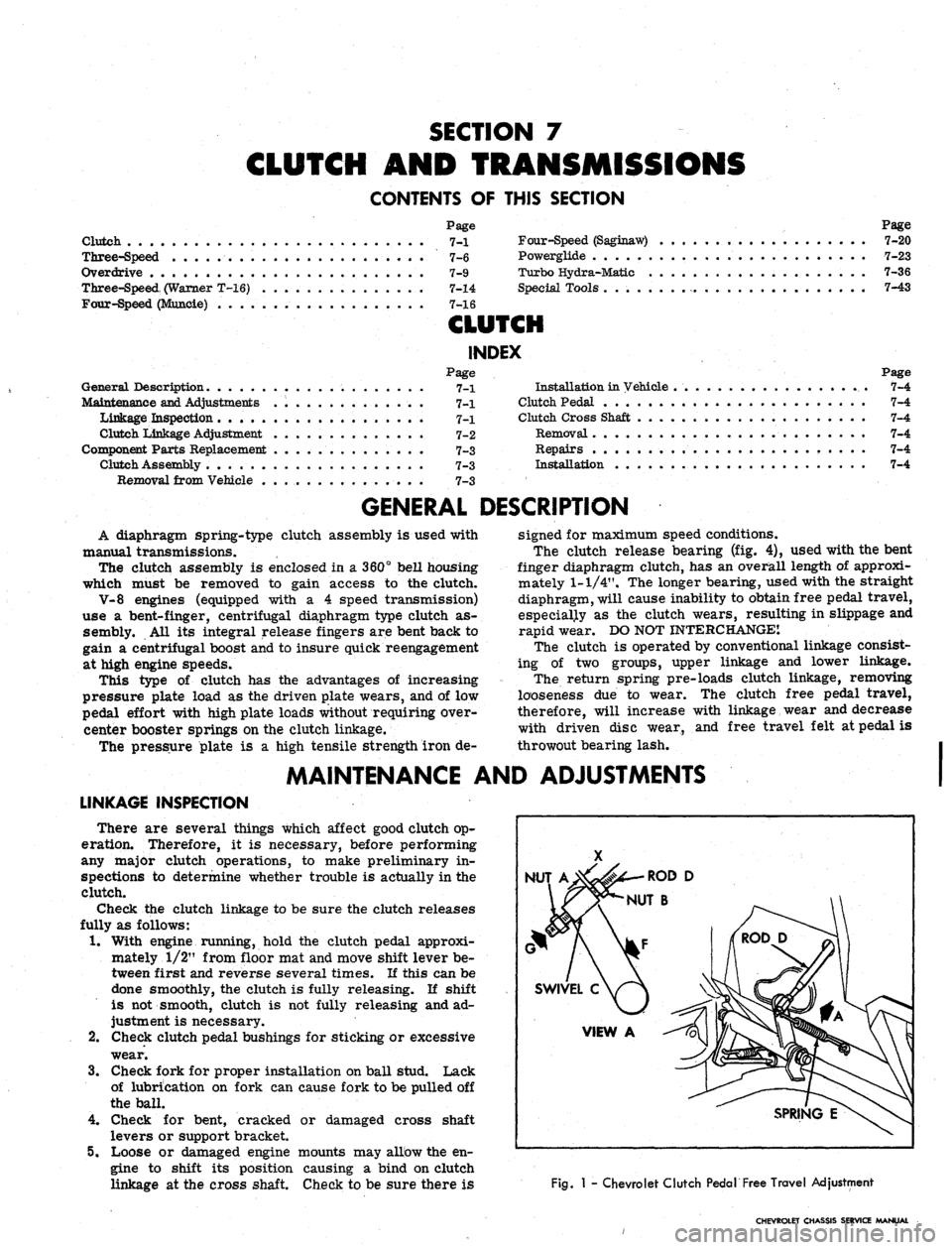
Chevrolet Linkage Adjustment (Fig. 1}
With Nuts (A) & (B) loose on Rod (D)
&
before installa-
tion of Clutch Pedal Return Spring
(E),
apply approximately
5 lbs. load in direction of arrow (F) to eliminate clear-
ance between throwout bearing and clutch fingers. Move
Rod (D) in direction of arrow (G) until Clutch Pedal Arm
makes contact with Bumper Stop on instrument panel
brace. Run Nut (B) toward Swivel until dimension (X) is
9/32". Tighten Nut (A) to lock Swivel (C) against Nut (B).
Install Clutch Pedal Return Spring (E).
The foregoing procedure will provide a free pedal
travel of 1" to
1-1/2"
measured on a perpendicular from
the crown of the, pedal pad to the bare metal toe pan.
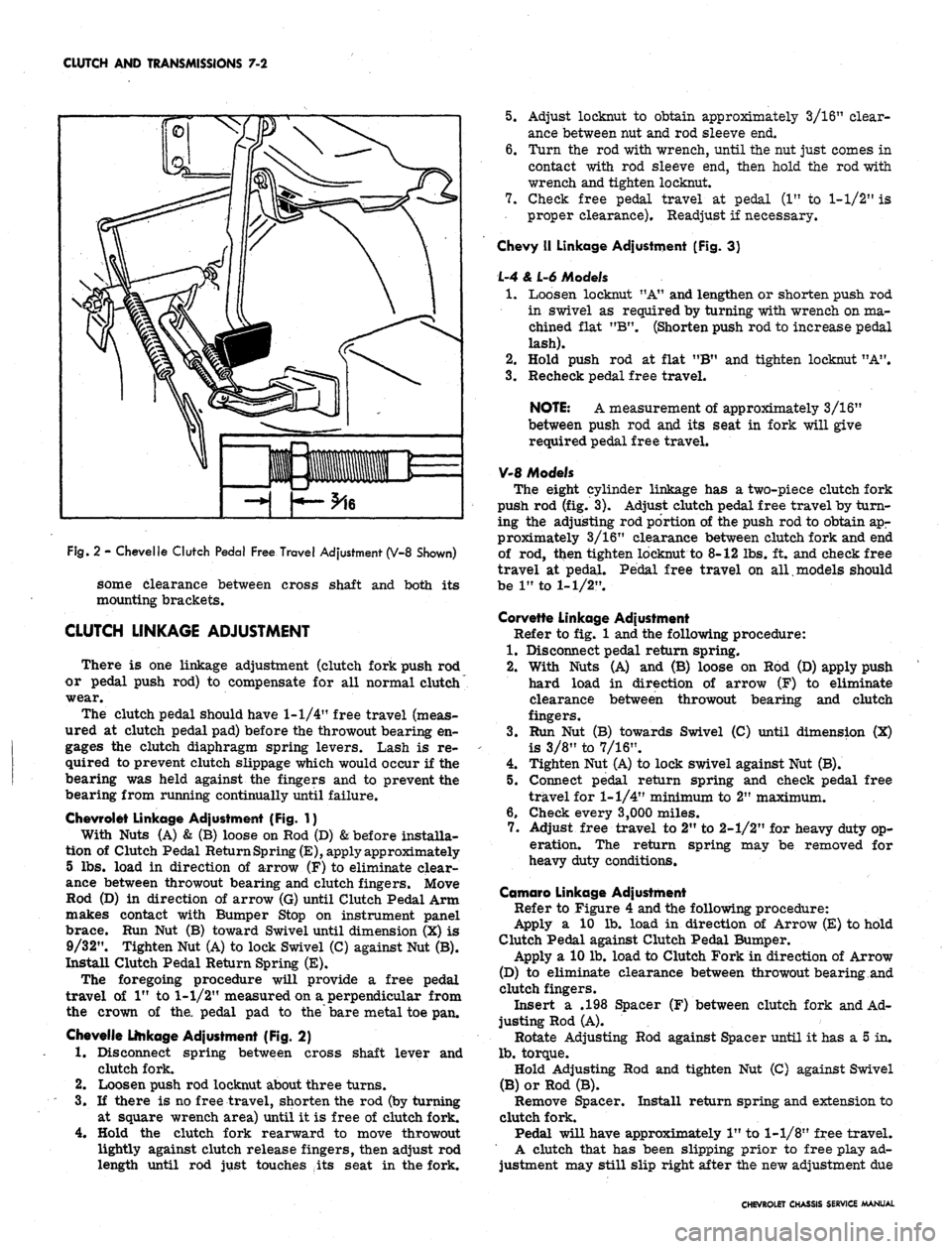
Chevelle Linkage Adjustment (Fig. 2)
1.
Disconnect spring between cross shaft lever and
clutch fork.
2.
Loosen push rod locknut about three turns.
3.
If there is no free travel, shorten the rod (by turning
at square wrench area) until it is free of clutch fork.
4.
Hold the clutch fork rearward to move throwout
lightly against clutch release fingers, then adjust rod
length until rod just touches ,its seat in the fork.
5.
Adjust locknut to obtain approximately 3/16" clear-
ance between nut and rod sleeve end.
6. Turn the rod with wrench, until the nut just comes in
contact with rod sleeve end, then hold the rod with
wrench and tighten locknut.
7.
Check free pedal travel at pedal (1" to
1-1/2"
is
proper clearance). Readjust if necessary.
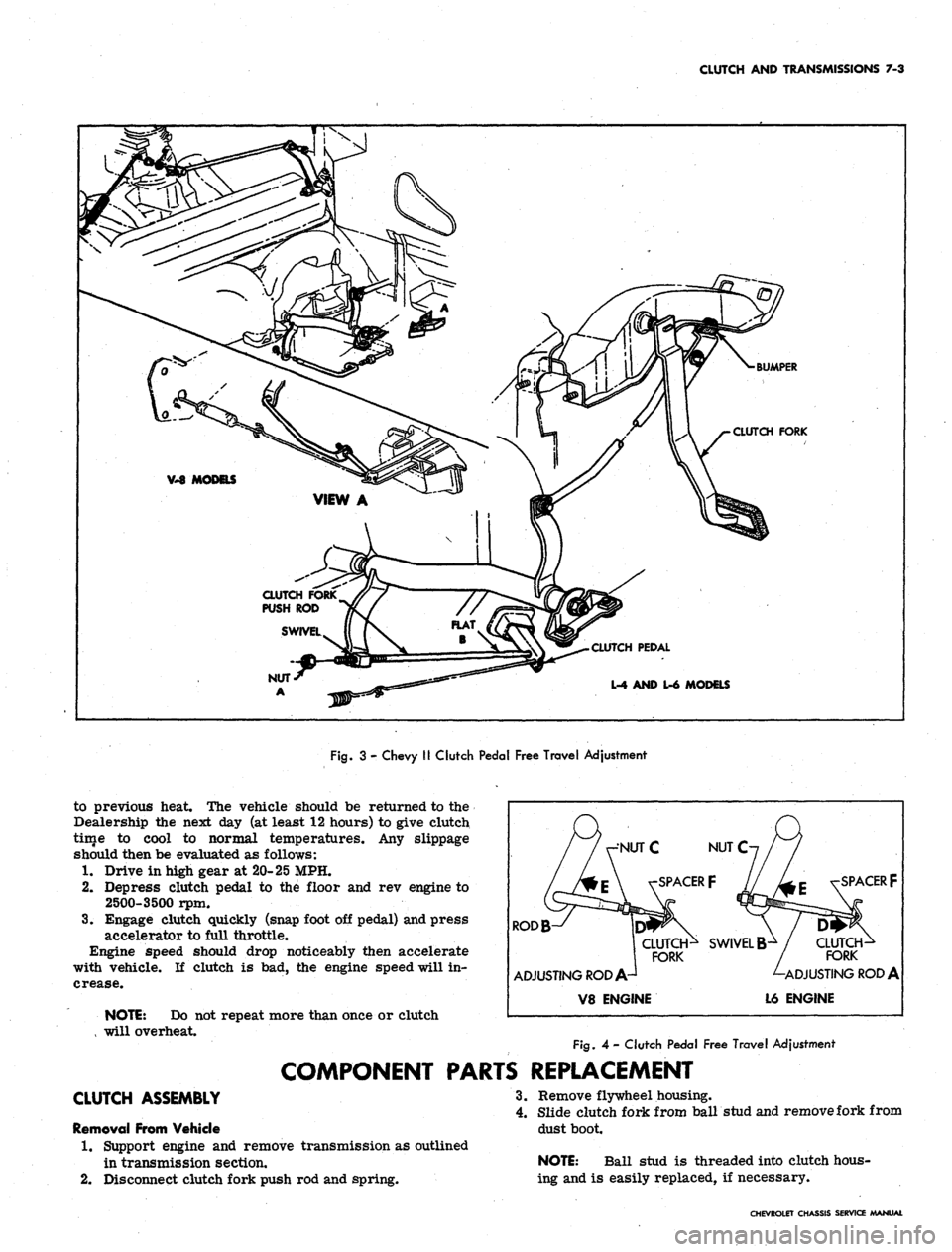
Chevy II Linkage Adjustment (Fig. 3}
L-4 & L-6 Models
1.
Loosen locknut "A" and lengthen or shorten push rod
in swivel as required by turning with wrench on ma-
chined flat "B". (Shorten push rod to increase pedal
lash).
2.
Hold push rod at flat "B" and tighten locknut "A".
3.
Recheck pedal free travel.
NOTE: A measurement of approximately 3/16"
between push rod and its seat in fork will give
required pedal free travel.
V-8 Models
The eight cylinder linkage has a two-piece clutch fork
push rod (fig. 3). Adjust clutch pedal free travel by turn-
ing the adjusting rod portion of the push rod to obtain apr
proximately 3/16" clearance between clutch fork and end
of rod, ttien tighten locknut to 8-12 lbs. ft. and check free
travel at pedal. Pedal free travel on all models should
be 1" to
1-1/2".
Corvette Linkage Adjustment
Refer to fig. 1 and the following procedure:
1.
Disconnect pedal return spring.
2.
With Nuts (A) and (B) loose on Rod (D) apply push
hard load in direction of arrow (F) to eliminate
clearance between throwout bearing and clutch
fingers.
3.
Run Nut (B) towards Swivel (C) until dimension (X)
is 3/8" to 7/16".
4.
Tighten Nut (A) to lock swivel against Nut (B).
5.
Connect pedal return spring and check pedal free
travel for
1-1/4"
minimum to 2" maximum.
6. Check every 3,000 miles.
7.
Adjust free travel to 2" to 2-1/2" for heavy duty op-
eration. The return spring may be removed for
heavy duty conditions.
Camaro Linkage Adjustment
Refer to Figure 4 and the following procedure:
Apply a 10 lb. load in direction of Arrow (E) to hold
Clutch Pedal against Clutch Pedal Bumper.
Apply a 10 lb. load to Clutch Fork in direction of Arrow
(D) to eliminate clearance between throwout bearing and
clutch fingers.
Insert a .198 Spacer (F) between clutch fork and Ad-
justing Rod (A).
Rotate Adjusting Rod against Spacer until it has a 5 in.
lb.
torque.
Hold Adjusting Rod and tighten Nut (C) against Swivel
(B) or Rod (B).
Remove Spacer. Install return spring and extension to
clutch fork.
Pedal will have approximately 1" to
1-1/8"
free travel.
A clutch that has been slipping prior to free play ad-
justment may still slip right after the new adjustment due
CHEVROLET CHASSIS SERVICE MANUAL
Page 362 of 659
CLUTCH AND TRANSMISSIONS 7-3
•BUMPER
CLUTCH FORK
CLUTCH PEDAL
L-4 AND L-6 MODELS
Fig.
3 - Chevy II Clutch Pedal Free Travel Adjustment
to previous heat. The vehicle should be returned to the
Dealership the next day (at least 12 hours) to give clutch
time to cool to normal temperatures. Any slippage
should then be evaluated as follows:
1.
Drive in high gear at 20-25 MPH.
2.
Depress clutch pedal to the floor and rev engine to
2500-3500 rpm.
3.
Engage clutch quickly (snap foot off pedal) and press
accelerator to full throttle.
Engine speed should drop noticeably then accelerate
with vehicle. If clutch is bad, the engine speed will in-
crease.
NOTE: Do not repeat more than once or clutch
, will overheat.
-NUTC NUTC
SPACER F
SPACER F
RODB
' CLUTCH^ SWIVEL B
FORK
ADJUSTING
ROD
A '
V8 ENGINE
ADJUSTING
ROD
A
L6 ENGINE
Fig.
4 - Clutch Pedal Free Travel Adjustment
COMPONENT PARTS REPLACEMENT
CLUTCH ASSEMBLY
Removal From Vehicle
1.
Support engine and remove transmission as outlined
in transmission section.
2.
Disconnect clutch fork push rod and spring.
3.
Remove flywheel housing.
4.
Slide clutch fork from ball stud and remove fork from
dust boot.
NOTE: Ball stud is threaded into clutch hous-
ing and is easily replaced, if necessary.
CHEVROLET CHASSIS SERVICE MANUAL
Page 363 of 659
CLUTCH AND TRANSMISSIONS 7-4
5.
Install Tool J-5824 to support the clutch assembly
during removal.
NOTE: Look for "X" mark on flywheel and on
clutch cover. If MX" mark is not evident, prick
punch marks on flywheel and clutch cover for
indexing purposes during installation.
6. Loosen the clutch-to-flywheel attaching bolts evenly
1 turn at a time until spring pressure is released,
then remove the bolts, and remove clutch assembly.
Installation to Vehicle
Clean pressure plate and flywheel face. (They should
be free of oil, grease, metal deposits or burned spots).
1.
Position the clutch disc and pressure plate in relar
tive installed position and support them with align-
ment Tool J-5824.
NOTE: The driven disc on the 4 and 6 cylinder
engines is installed with the damfper springs to
the flywheel side; the V-8 is opposite, however,
THE GREASE SLINGER IS ALWAYS ON THE
TRANSMISSION SIDE.
2.
Turn clutch assembly until "X" mark on cover lines
up with "X" mark oh flywheel, then align cover bolt
holes to nearest flywheel holes.
3.
Install a bolt in every hole and tighten down evenly
and gradually until tight (to avoid possible clutch
distortion).
NOTE: Cover loads are as high as 1-1/4 tons.
4.
Remove pilot tool.
5.
Unhook clutch fork and lubricate ball socket and fork
fingers at release bearing end with a high melting
point grease such as graphite and reinstall fork on
ball stud. On Corvette models use Moly Grease.
6. Lubricate the recess on the inside of throwout bear-
ing collar and the throwout fork groove with a light
coat of graphite grease (fig. 4). On Corvette models
use Moly Grease.
7.
Install clutch fork and dust boot into clutch housing
and install throwout bearing to the throwout fork, then
install flywheel housing.
8. Install transmission as outlined in transmission
section.
9. Connect fork push rod and spring.
10.
Adjust shift linkage as outlined in transmission
section.
11.
Perform linkage adjustment for pedal free play and
check clutch release position.
CLUTCH PEDAL
The clutch pedal is the pendant-type hung from a sup-
Fig. 5 - Release Bearing Lubrication and Comparison
port brace common to the brake pedal and must be re-
moved to remove brake pedal. Refer to Section 5 for
brake and clutch pedal service procedure.
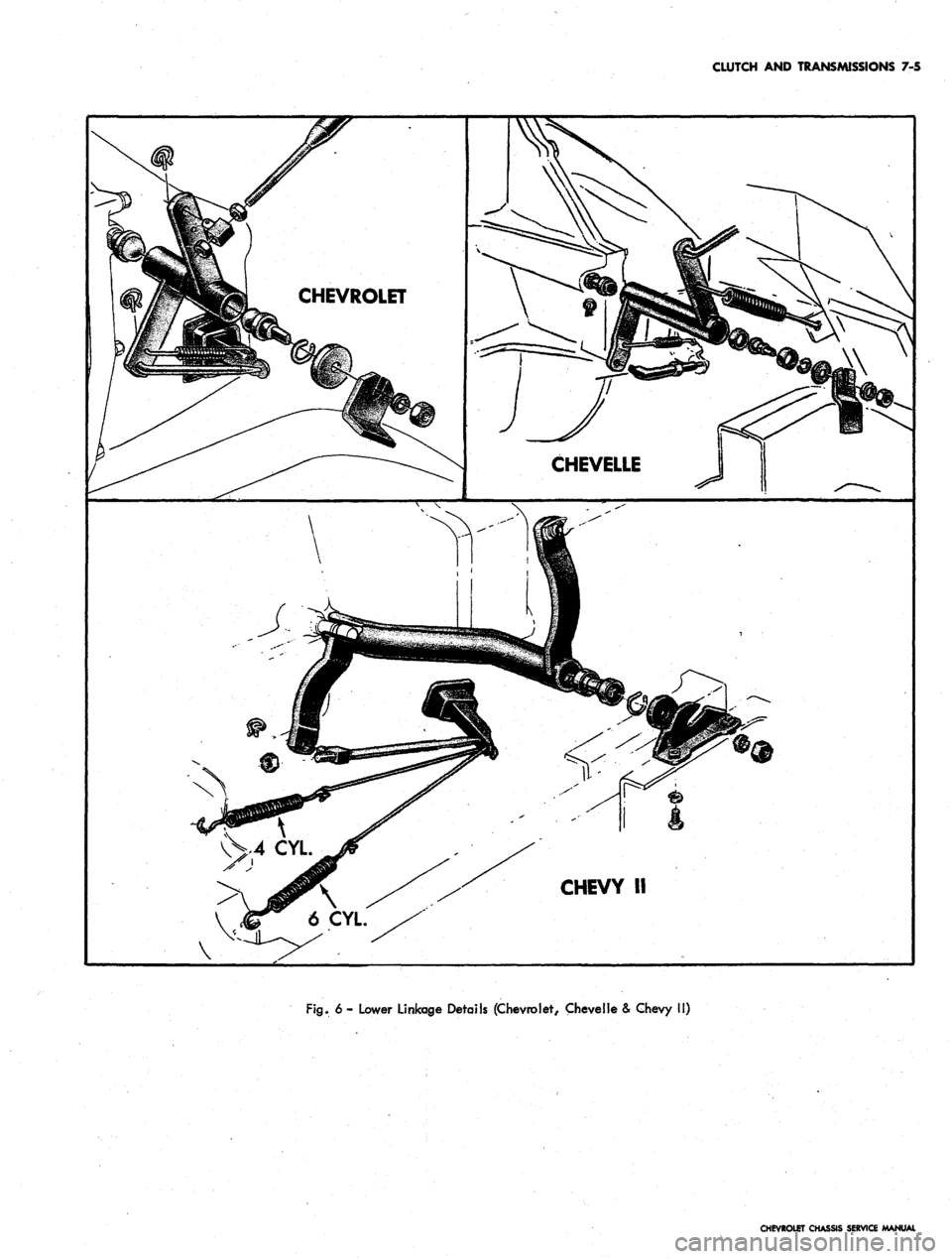
CLUTCH CROSS SHAFT (Figs. 6, 7 & 8)
Removal
1.
Remove linkage return and lower linkage springs and
disconnect clutch pedal and fork push rods from re-
spective cross shaft levers.
2.
Loosen outboard ball stud nut and slide stud out of
bracket slot.
3.
Move cross shaft outboard, and as required to clear
inboard ball stud, then merely lift out to remove
from vehicle.
Repairs
The cross shaft has nylon ball stud seats which should
be inspected for wear or damage. Also check condition
of engine bracket ball stud assembly and special anti-
rattle "O" ring. Figures 6, .7
&
8 show component parts
of cross shaft. Replace parts as necessary based on wear
or damage. Lubricate ball studs and seats with graphite
grease before reassembly.
Installation
1.
Reverse removal procedure to install.
2.
Adjust clutch linkage as previously outlined.
CHEVROLET CHASSIS SERVICE MANUAL
Page 364 of 659
CLUTCH AND TRANSMISSIONS 7-5
CHEVY II
Fig.
6 - Lower Linkage Details (Chevrolet, Chevelle & Chevy II)
CHEVROLET CHASSIS SERVICE MANUAL
Page 365 of 659

CLUTCH AND TRANSMISSIONS 7-6
L6 ENGINE
V8 ENGINE
Fig.
7 - Lower Linkage Details - Camaro
Fig.
8 - Corvette Lower Linkage Details
THREE-SPEED (SA6INAW FULLY SYNCHRONIZED)
TRANSMISSION
General Description . .
Maintenance and Adjustments
Shift Linkage Adjustment
Shift Control Lever
&
Bracket Assembly
Speedometer Driven Gear ..........
INDEX
Page Page
7-6 Extension Oil Seal Replacement 7-7
7-7 Transmission Side Cover 7-8
7-7 Component Part Replacement 7-8
7-7 Transmission Replacement (exc. Corvette) . 7-8
7-7 Corvette Transmission Replacement 7-9
GENERAL DESCRIPTION
The Saginaw three speed fully synchronized (all forward
gears) transmission incorporates helical drive gears
throughout.
The main drive gear is supported by a ball bearing at
the front end of the transmission case and is piloted at
its front end in an oil impregnated bushing mounted in the
engine crankshaft. The front end of the mainshaft is
piloted in a row of roller bearings set into the hollow end
of the main drive gear and the rear end is carried by a
ball bearing mounted in the front of the extension housing.
The countergear is carried on a single row of rollers at
both ends while thrust is taken on thrust washers located
between the ends of the gear and the thrust bosses in the
case.
Ah anti-rattle plate assembly at the front of the
countergear provides a constant spring tension between the
counter and clutch gears to reduce torsional vibrations.
The reverse idler gear is carried on a bushing finish
bored in place. It rotates on a short idler shaft with a
steel thrust washer tanged into the case against the rear
face. Forward movement is stopped by a snap ring on
the idler shaft.
Gear shifting is manual through shift control rods to
the rearward shift lever of the side cover assembly for
first and reverse gear; and through a cross shaft assem-
bly (Chevrolet models) attached to the forward side cover
lever for second and third gear. All three forward gears
are fully synchronized. The synchronizer assemblies
consist of a clutch hub, clutch sleeve, two clutch key
springs and three energizer clutch keys and are retained
as an assembly on the main shaft by a snap ring.
The transmission may be used as an aid in deceleration
by downshifting in sequence without double-clutching or
any gear clashing. Reverse is not- synchronized, how-
ever, it is a helical gear to insure quiet operation.
CHEVROLET CHASSIS SERVICE MANUAL
Page 366 of 659
CLUTCH AND TRANSMISSIONS 7-7
MAINTENANCE AND ADJUSTMENTS
CHEVROLET, CHEVELLE, CHEVY II, CAMARO,
SHIFT LINKAGE ADJUSTMENT
In cases where the gearshift linkage has been discon-
nected, it should be adjusted as follows:
1.
Move both transmission shift levers until transmis-
sion is in neutral. Neutral detents in transmission
cover must both be engaged to make this adjustment
correctly. (To check, start engine with clutch dis-
engaged, and release clutch slowly.)
2.
Move selector lever to neutral position. Align first
and reverse tube lever with the second and third
shifter tube lever on the mast jacket. This may be
done by having an assistant hold the mast .jacket shift
levers aligned in neutral position or use a simple
gauge or pin to align these levers in neutral.
3.
Make necessary adjustment to align shift control
rods and transmission levers in neutral position.
Move selector lever through all positions to check ad-
justment and to insure over-travel in all positions.
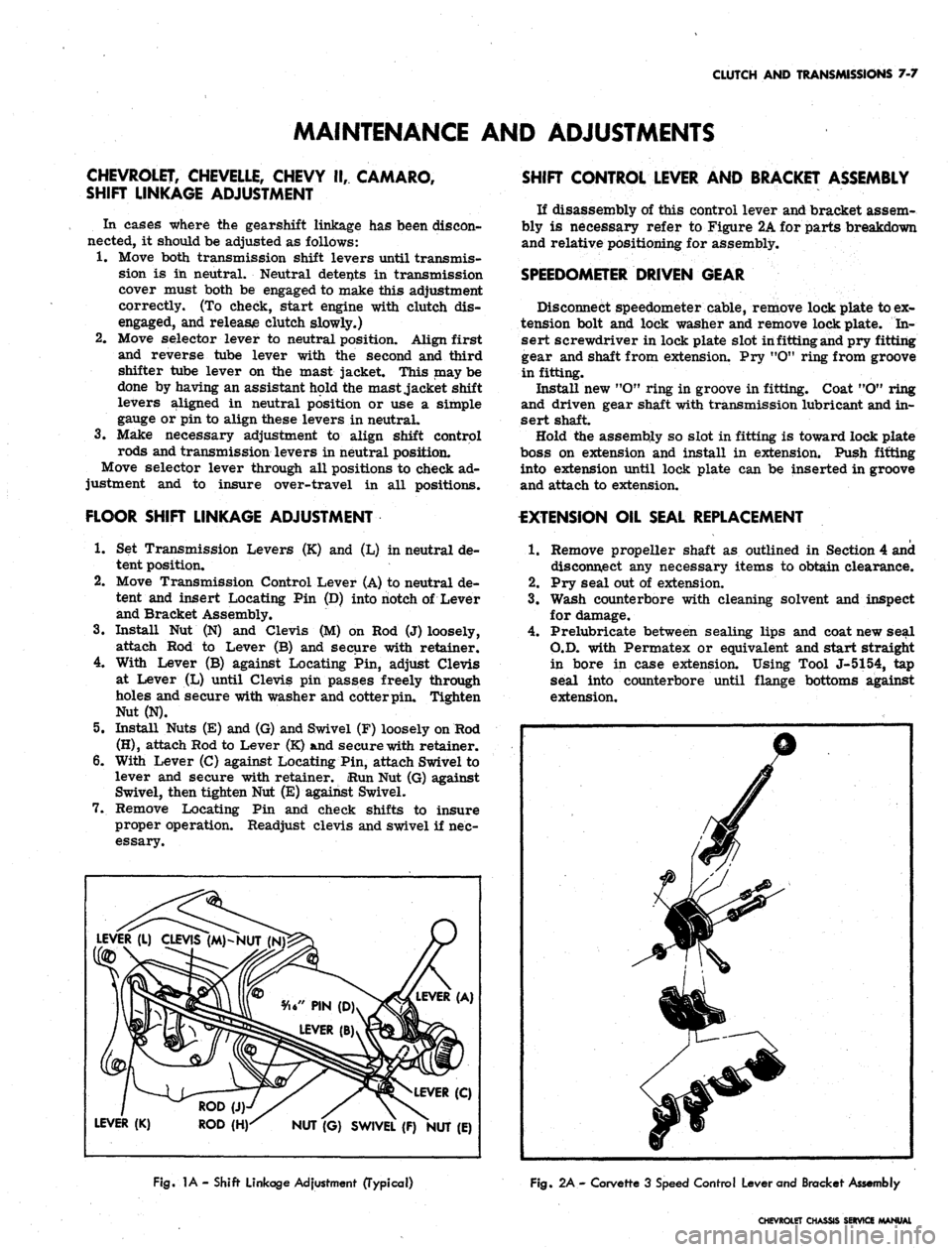
FLOOR SHIFT LINKAGE ADJUSTMENT
1.
Set Transmission Levers (K) and (L) in neutral de-
tent position.
2.
Move Transmission Control Lever (A) to neutral de-
tent and insert Locating Pin (D) into notch of Lever
and Bracket Assembly.
3.
Install Nut (N) and Clevis (M) on Rod (J) loosely,
attach Rod to Lever (B) and secure with retainer.
4.
With Lever (B) against Locating Pin, adjust Clevis
at Lever (L) until Clevis pin passes freely through
holes and secure with washer and cotter pin. Tighten
Nut (N).
5.
Install Nuts (E) and (G) and Swivel (F) loosely on Rod
(H),
attach Rod to Lever (K) and secure with retainer.
6. With Lever (C) against Locating Pin, attach Swivel to
lever and secure with retainer. iRun Nut (G) against
Swivel, then tighten Nut (E) against Swivel.
7.
Remove Locating Pin and check shifts to insure
proper operation. Readjust clevis and swivel if nec-
essary.
LEVER (A)
LEVER (L) CLEVIS (M)-NUT (N
LEVER (C)
ROD(J).
" - -
LEVER (K) ROD (H)^ NUT '(G) SWIVEL (F) ^NUT (E)
SHIFT CONTROL LEVER AND BRACKET ASSEMBLY
If disassembly of this control lever and bracket assem-
bly is necessary refer to Figure 2A for parts breakdown
and relative positioning for assembly.
SPEEDOMETER DRIVEN GEAR
Disconnect speedometer cable, remove lock plate to ex-
tension bolt and lock washer and remove lock plate. In-
sert screwdriver in lock plate slot in fitting and pry fitting
gear and shaft from extension. Pry "O" ring from groove
in fitting.
Install new "OM ring in groove in fitting. Coat "O" ring
and driven gear shaft with transmission lubricant and in-
sert shaft.
Hold the assembly so slot in fitting is toward lock plate
boss on extension and install in extension. Push fitting
into extension until lock plate can be inserted in groove
and attach to extension.
EXTENSION OIL SEAL REPLACEMENT
.1.
Remove propeller shaft as outlined in Section 4 and
disconnect any necessary items to obtain clearance.
2.
Pry seal out of extension.
3.
Wash counterbore with cleaning solvent and inspect
for damage.
4.
Prelubricate between sealing lips and coat new seal
O.D. with Permatex or equivalent and start straight
in bore in case extension. Using Tool J-5154, tap
seal into counterbore until flange bottoms against
extension.
Fig.
1A- Shift Linkage Adjustment (Typical)
Fig.
2A - Corvette 3 Speed Control Lever and Bracket Assembly
CHEVROLET CHASSIS SERVICE MANUAL
Page 367 of 659
CLUTCH AND TRANSMISSIONS 7-3
DETENT CAM
DETENT SPRING
DETENT CAM
2-3 SHIFT
FORK
DETENT CAM
PIVOT PIN
1ST & REV. 1ST& REV.
SHIFTER SHAFT SHIFT FORK
DETENT CAM
RETAINER RING
2-3 SHIFTER SHAFT
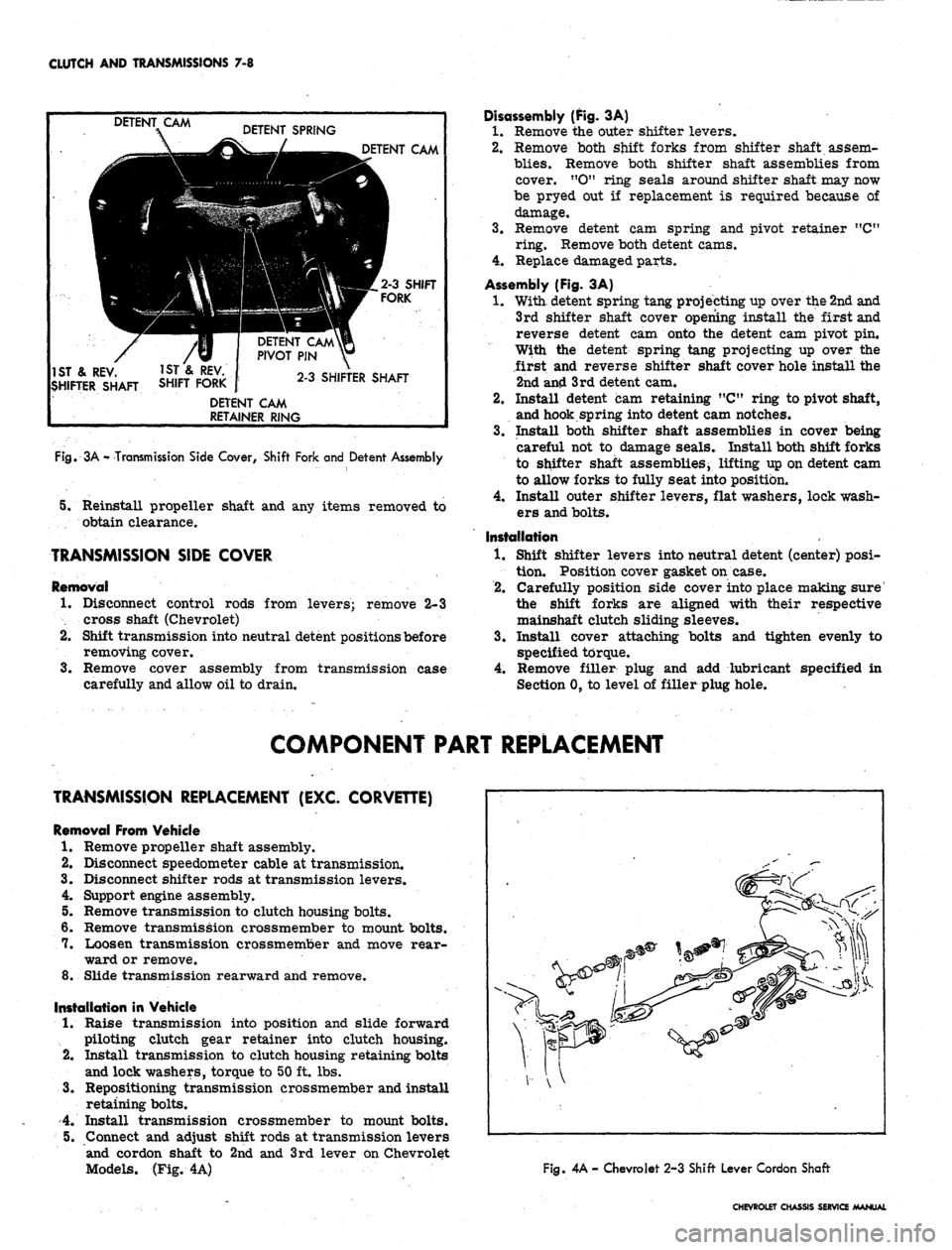
Fig. 3A
•*
Transmission Side Cover, Shift Fork and Detent Assembly
5. Reinstall propeller shaft and any items removed to
obtain clearance.
TRANSMISSION SIDE COVER
Removal •
1.
Disconnect control rods from levers; remove 2-3
cross shaft (Chevrolet)
2.
Shift transmission into neutral detent positions before
removing cover.
3.
Remove cover assembly from transmission case
carefully and allow oil to drain.
Disassembly (Fig. 3A)
1.
Remove the outer shifter levers.
2.
Remove both shift forks from shifter shaft assem-
blies.
Remove both shifter shaft assemblies from
cover. "OM ring seals around shifter shaft may now
be pryed out if replacement is required because of
damage.
3.
Remove detent cam spring and pivot retainer "C"
ring. Remove both detent cams.
4.
Replace damaged parts.
Assembly (Fig. 3A)
1.
With,
detent spring tang projecting up over the
2nd
and
3rd shifter shaft cover opening install the first and
reverse detent cam onto the detent cam pivot pin.
With the detent spring tang projecting up over the
first and reverse shifter shaft cover hole install the
2nd an£ 3rd detent cam.
2.
Install detent cam retaining "C" ring to pivot shaft,
and hook spring into detent cam notches.
3.
Install both shifter shaft assemblies in cover being
careful not to damage seals. Install both shift forks
to shifter shaft assemblies^ lifting up on detent cam
to allow forks to fully seat into position.
4.
Install outer shifter levers, flat washers, lock wash-
ers and bolts.
Installation
1.
Shift shifter levers into neutral detent (center) posi-
tion.
Position cover gasket on case.
2.
Carefully position side cover into place making sure'
the shift forks are aligned with their respective
mainshaft clutch sliding sleeves.
3.
Install cover attaching bolts and tighten evenly to
specified torque.
4.
Remove filler plug and add lubricant specified in
Section 0, to level of filler plug hole.
COMPONENT PART REPLACEMENT
TRANSMISSION REPLACEMENT (EXC. CORVETTE)
Removal From Vehicle
1.
Remove propeller shaft assembly.
2.
Disconnect speedometer cable at transmission.
3.
Disconnect shifter rods at transmission levers.
4.
Support engine assembly.
5. Remove transmission to clutch housing bolts.
6. Remove transmission crossmember to mount bolts.
7. Loosen transmission crossmember and move rear-
ward or remove.
8. Slide transmission rearward and remove.
Installation in Vehicle
1.
Raise transmission into position and slide forward
piloting clutch gear retainer into clutch housing.
2.
Install transmission to clutch housing retaining bolts
and lock washers, torque to 50 ft. lbs.
3.
Repositioning transmission crossmember and install
retaining bolts.
4.
Install transmission crossmember to mount bolts.
5. Connect and adjust shift rods at transmission levers
and cordon shaft to 2nd and 3rd lever on Chevrolet
Models. (Fig. 4A)
Fig. 4A - Chevrolet 2-3 Shift Lever Cordon Shaft
CHEVROLET CHASSIS SERVICE MANUAL