run flat CHEVROLET CAMARO 1967 1.G Chassis User Guide
[x] Cancel search | Manufacturer: CHEVROLET, Model Year: 1967, Model line: CAMARO, Model: CHEVROLET CAMARO 1967 1.GPages: 659, PDF Size: 114.24 MB
Page 481 of 659
SECTION 10
WHEELS AND TIRES
INDEX
Page
General Description
10-1
Maintenance
and
Adjustments
.............. 10—1
Tires
10-1
Pressures . 10-1
Inspection 10-1
Wear 10-1
Rotation 10-4
Noise 10-4
Cleaning 10-4
Change (W/Wheels) 10-4
Wheels 10-5
Static Balancing (w/Tire) 10-5
Page
Dynamic Balancing (w/Tire) . 10-5
Run Out (w/o Tire) 10-5
Cleaning 10-5
Service Operations 10-5
Tires 10-5
Removal 10-5
Installation 10-5
Repair 10^6
Wheels . 10-6
Valve Assembly 10-6
Repair (Rim) 10-7
GENERAL DESCRIPTION
WHEELS
Chevrolet, Chevelle, Camaro, Chevy n, and Corvette
are base equipped with welded steel wheels. Five studs
with nuts fasten each wheel to the front hub or rear axle
flange. Disc brake equipped vehicles (except Chevrolet
and Corvette) require special 14 inch diameter wheels
with a revised design for clearance, Chevrolet disc brake
equipped vehicles have 15 in. diameter wheels as do all
Corvettes.
Chevrolet station wagons, Chevelle Super Sport 396,
Corvette and Camaro Super Sport 350 are base equipped
with 6 in. width wheels. All other vehicles have 5 in.
width wheels, except Chevy n 100, 300 and 500 Series
Sedans, which have 4 in. width wheels.
Do not install 6 inch width wheels or snow chains on
Chevrolets equipped with rear fender skirts.
TIRES
The factory installed tires on Chevrolet passenger
cars are selected to provide the best all around tire
performance for all normal operation. They are de-
signed to operate satisfactorily with loads up to and in-
cluding the specified full rated load capacity of the
automobile when inflated as recommended in the Vehicle
Capacity Rating and Recommended Tire Inflation Pres-
sures Table (see Specifications).
Optional Oversize and 8-Ply Rating Tires
{Chevrolet and Chevelle Only)
Oversize or 8-ply rating tires are not necessary on
passenger cars for normal requirements. However, an
extra margin of tire service is available when these
options are used at loads up to and including full rated
load.
Optional oversize 4-ply rating and/or 8-ply rating
tires are available on models as indicated in the Tire
Usage Chart (see Specifications). On some models (ex-
ample—Station Wagon), space limitations do not permit
the use of a larger size tire; hence, the 8-ply rating
tire is an available option.
In either case, these tires are applicable to extended
operation at or near full rated load or for trailer towing
when an extra margin of tire service is desired. How-
ever, use of a larger tire or an 8-ply rating tire should
not be construed as permitting an increase in the full
rated vehicle load (see Specifications).
MAINTENANCE AND ADJUSTMENTS
TIRES
Inflation Pressures
To ensure the proper tire inflation pressure for the
owners particular requirements follow the recommenda-
tions in the Vehicle Capacity Rating and Recommended
Tire Inflation Pressures Table (seeSpecifications). Keep
tires properly inflated, and check inflation pressures
periodically. This will ensure the best tire life and riding
comfort, over the full range of driving conditions.
Inspection
Every few thousand miles and at each lubrication, tires
should be checked for sharp objects or stones in the
tread. H tire is punctured, it should be repaired using
one of several repair kits available through tire manu-
facturers1 outlets.
Wear
Misalignment
This is wear due to excessive toe-in or toe-out. In
CHEVROLET CHASSIS SERVICE MANUAL
Page 622 of 659
ACCESSORIES 15-13
SYSTEM TEST
CHECKS AND ADJUSTMENTS
Automatic Level Control Test Gauge (Fig. 15)
A complete system test includes on and off-the-car
component tests.. '
On the car tests are:
Quick check of Automatic Level Control System
Compressor output test
Regulator test and adjustment
Control valve test
Time delay test
Line and fitting leak test
Trim adjustment
Off-the-car operations include:
Control valve replacement
Compressor repair
Component leak tests
a. Compressor, reservoir, and regulator
b.
Control valve
c. Superlifts
Quick Check-On Car (Reservoir Pressure at 150 PSI)
1.
Fill the fuel tank or simulate at the rate of 6 lbs./
gal.
- otherwise car should be empty.
2.
Turn engine off.
3.
Add a 2 passenger load to the rear bumper or tail-
gate.
Maintain the load until the -car lifts or AT
LEAST 20 SECONDS.
4.
After car lifts remove the load and observe until the
car lowers.
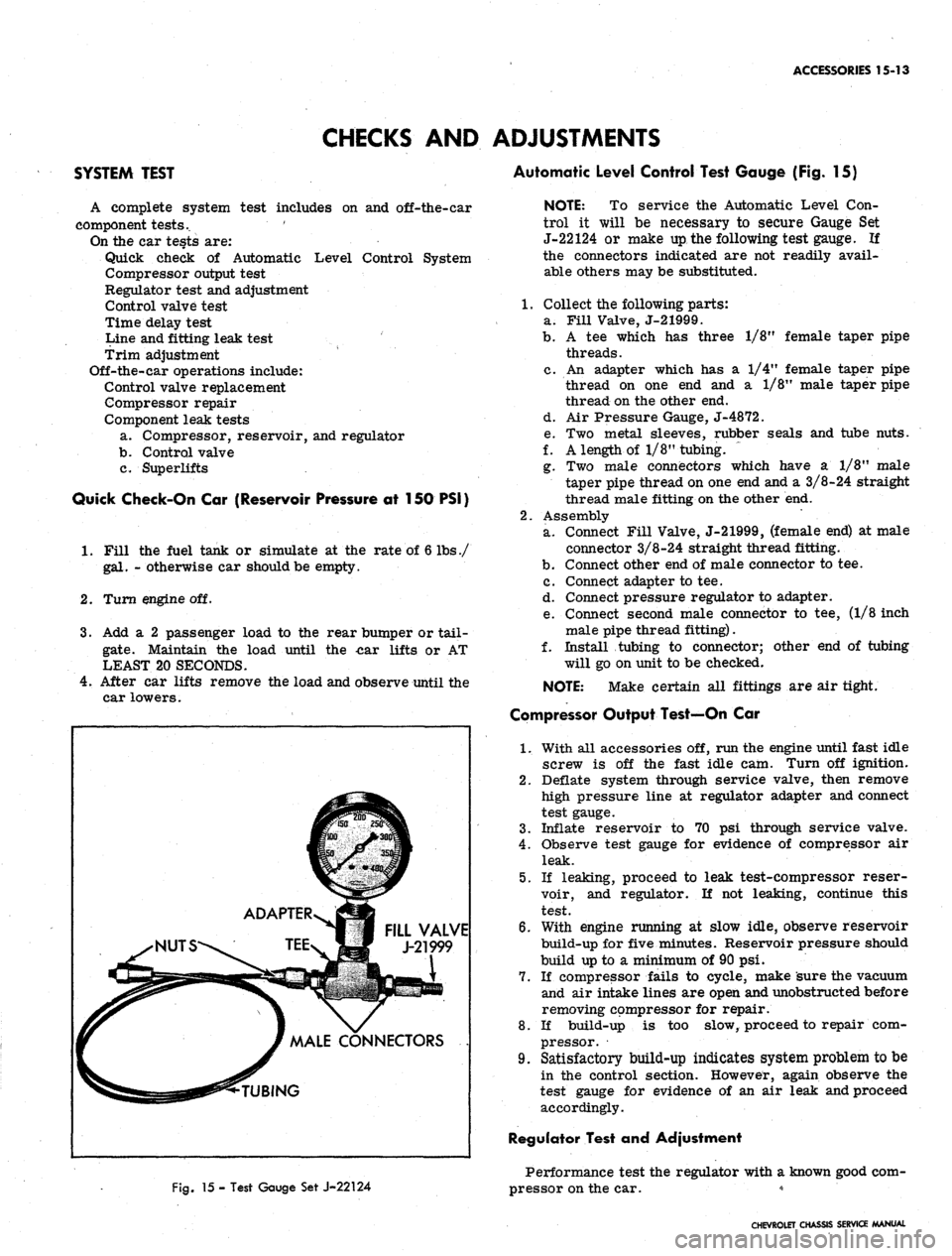
FILL VALVE
J-21999
CONNECTORS
Fig.
15 - Test Gauge Set J-22124
NOTE: To service the Automatic Level Con-
trol it will be necessary to secure Gauge Set
J-22124 or make up the following test gauge. If
the connectors indicated are not readily avail-
able others may be substituted.
1.
Collect the following parts:
a. Fill Valve, J-21999.
b.
A tee which has three 1/8M female taper pipe
threads.
c. An adapter which has a 1/4" female taper pipe
thread on one end and a 1/8" male taper pipe
thread on the other end.
d. Air Pressure Gauge, J-4872.
e. Two metal sleeves, rubber seals and tube nuts.
f. A length of 1/8" tubing. ~
g. Two male connectors which have a 1/8" male
taper pipe thread on one end and a 3/8-24 straight
thread male fitting on the other end.
2.
Assembly
a. Connect Fill Valve, J-21999, (female end) at male
connector 3/8-24 straight thread fitting.
b.
Connect other end of male connector to tee.
c. Connect adapter to tee.
d. Connect pressure regulator to adapter.
e. Connect second male connector to tee, (1/8 inch
male pipe thread fitting).
f. Install tubing to connector; other end of tubing
will go on unit to be checked.
NOTE:
Make certain all fittings are air tight.
Compressor Output Test—On Car
1.
With all accessories off, run the engine until fast idle
screw is off the fast idle cam. Turn off ignition.
2.
Deflate system through service valve, then remove
high pressure line at regulator adapter and connect
test gauge.
3.
Inflate reservoir to 70 psi through service valve.
4.
Observe test gauge for evidence of compressor air
leak.
5.
If leaking, proceed to leak test-compressor reser-
voir, and regulator. If not leaking, continue this
test.
6. With engine running at slow idle, observe reservoir
build-up for five minutes. Reservoir pressure should
build up to a minimum of 90 psi.
7.
If compressor fails to cycle, make sure the vacuum
and air intake lines are open and unobstructed before
removing compressor for repair.
8. If build-up is too slow, proceed to repair com-
pressor.
9. Satisfactory build-up indicates system problem to be
in the control section. However, again observe the
test gauge for evidence of an air leak and proceed
accordingly.
Regulator Test and Adjustment
Performance test the regulator with a known good com-
pressor on the car. *
CHEVROLET CHASSIS SERVICE MANUAL
Page 624 of 659
ACCESSORIES 15-15
Control Valve
1.
Remove control valve unit from car.
2.
Clean exterior of control valve thoroughly.
3.
Connect test gauge and air pressure source to intake
adapter and open air pressure (80-110 psi).
4.
Submerge unit in water. No air should escape if
overtravel lever is in "neutral" position. If bubbles
escape from Superlift port, replace control valve.
5. Shut, off air pressure and detach test gauge from air
intake port. Plug intake port with Fill Valve,
J-21999 (female end).
6. Connect test gauge to Superlift port and open air
pressure.
7. With overtravel lever in "neutral" position no air
should escape. If bubbles escape from exhaust port,
replace control valve.
8. If air escapes around edge of cover plate, tighten
screws on replace gasket.
9. R(emove control valve from water. Actuate over-
travel lever to expel any water from unit.
10.
Sjiut off air pressure and remove line from Superlift
[
Lines and Fittings
1.
Eisconnect overtravel lever from link.
2.
Bold lever up in intake position for maximum Super-
lift inflation and release.
3.
iieak check all connections with a soap and water
splution.
[.
Superlifts
1.
disconnect lines and remove unit from car.
2.
ijiflate individually to 50-60 psi utilizing Fill Valves
jt-21999. Submerge in water and observe unit for
leaks.
3.
Install Superlifts.
SERVICE OPERATIONS
CONTROL VALVE
Removal
1.
Deflate system using service valve.
2.
Disconnect two air lines at leveling valve intake and
Superlift ports.
3.
Disconnect link from overtravel lever by removing
one nut and lock washer.
4.
Remove two screws securing leveling valve to frame
and remove leveling valve.
Installation
1.
Install control valve with two screws, with time delay
mechanism down.
2.
Secure link to overtravel lever with one nut and lock
washer. On all station wagons s'eries the link is se-
cured to the lower hole. On all other series cars
with standard springs, the link is secured to the up-
per hole.
3.
Connect air lines at control valve intake and Super-
lift port.
4.
Inflate reservoir to 140 psi or maximum pressure
available through service valve.
COMPRESSOR, RESERVOIR AND REGULATOR
Removal and Installation
1.
Disconnect air lines (manifold and air cleaner) at
compressor end;
2.
Disconnect pressure line at compressor head.
3.
From wheel side of fender skirt, remove two screws
from bracket on compressor end.
4.
Remove nut and washer from reservoir stud at
bracket and remove assembly from vehicle.
5. Remove compressor end mount bracket.
6. Reverse Steps 1-5 for installation, then leak check
fittings.
COMPRESSOR, RESERVOIR AND REGULATOR
Disassembly Into Major Components (Fig. 17)
The compressor is a precision-built mechanism. All
parts should be carefully handled and assembled. Take
care to prevent entrance of dirt or foreign matter. DO
NOT LUBRICATE as unit is designed to run dry.
1.
Remove compressor as described above.
2.
Remove three flexible mounts and three adapters.
3.
Remove reservoir retaining through bolt, cover re-
taining screw and cover gasket that secure cover and
gasket to first stage housing. Remove cover and
discard gaskets.
4.
Remove two regulator retaining screws, regulator
assembly and O-ring from second stage housing.
Discard O-ring.
5/ Remove three nuts at reservoir flange and two
through bolts that enter from flanged side of res-
ervoir. Separate reservoir and O-ring. Discard
O-ring.
6. Remove three compressor retaining through bolts
that secure second stage housing to first stage
housing.
7. Slide second stage (small diameter) housing straight
off piston.
8. Disconnect arm tension spring from swivel arm.
9. Remove arm pivot screw and actuating arm.
10.
Slide piston assembly straight out of first stage
housing.
Disassembly, Inspection and Assembly of Major
Components (Fig. 17)
Diaphragm
1.
Inspect diaphragm for holes, looseness or other de-
fects and replace if necessary.
2.
Remove diaphragm retainer with diagonal pliers and
discard.
3.
Remove diaphragm plate, diaphragm, second dia-
phragm plate and corprene washer from piston.
4.
Install new corprene washed, old plate, new dia-
phragm with outer lip toward second stage side,
(fig. 17) and second plate. Plates should be installed
so that lip on each plate faces away from diaphragm.
5. Use a 13/16 inch deep socket as a pilot for the new
diaphragm retainer. Press against the piston shoul-
der on first stage side, (fig. 18) to position dia-
phragm retainer. The wood blocks used in the illus-
tration are each 3/4" x 3/4" x 12".
CHEVROLET CHASSIS SERVICE MANUAL