hose CHEVROLET CAMARO 1982 Repair Guide
[x] Cancel search | Manufacturer: CHEVROLET, Model Year: 1982, Model line: CAMARO, Model: CHEVROLET CAMARO 1982Pages: 875, PDF Size: 88.64 MB
Page 760 of 875

GM – CAMARO 1982-1992 – Repair Guide (Checked by WxMax) 760
GENERAL INFORMATION & MAINTENANCE
HOW TO USE THIS INFORMATION
The introductory part of this repair gui de is intended to help you learn more
about the inner workings of your Camaro while saving you money on its upkeep
and operation.
The beginning of the repair guide will likely be referred to the most, since that is
where you will find information for maintenance and tune-up. The other
information deals with the more complex systems of your vehicle. Systems
(from engine through brakes) are covered to the extent that the average do-it-
yourselfer can attempt. This repair guide will not explain such things as
rebuilding a differential because the ex pertise required and the special tools
necessary make this uneconomical. It will, however, give you detailed
instructions to help you change your own brake pads and shoes, replace spark
plugs, and perform many more jobs that can save you money and help avoid
expensive problems.
A secondary purpose of this repair guide is a reference for owners who want to
understand their vehicle and/or their mechanics better.
WHERE TO BEGIN
Before removing any bolts, read through t he entire procedure. This will give you
the overall view of what tools and supplies will be required. So read ahead and
plan ahead. Each operation should be approached logically and all procedures
thoroughly understood before attempting any work.
If repair of a component is not considered practical, we tell you how to remove
the part and then how to insta ll the new or rebuilt replacement. In this way, you
at least save labor costs.
AVOIDING TROUBLE
Many procedures in this repair guide r equire you to "label and disconnect ..." a
group of lines, hoses or wires. Don't be think you can remember where
everything goes - you won't. If you hook up va cuum or fuel lines incorrectly, the
vehicle may run poorly, if at all. If you hook up electrical wiring incorrectly, you
may instantly learn a very expensive lesson.
You don't need to know the proper name for each hose or line. A piece of
masking tape on the hose and a piece on its fitting will allow you to assign your
own label. As long as you remember your own code, the lines can be
reconnected by matching your tags. Re member that tape will dissolve in
gasoline or solvents; if a part is to be washed or cleaned, use another method
of identification. A permanent felt-tipped marker or a metal scribe can be very
handy for marking metal parts. Remove any tape or paper labels after
assembly.
Page 762 of 875

GM – CAMARO 1982-1992 – Repair Guide (Checked by WxMax) 762
Loctite). If you're worried about getting so
mething together tight enough to hold,
but loose enough to avoid mechanical damage during assembly, one of these
products might offer substantial insurance. Before choosing a threadlocking
compound, read the label on the pa ckage and make sure the product is
compatible with the materials, fluids, etc. involved.
3. Crossthreading. This occu rs when a part such as a bolt is screwed into a
nut or casting at the wrong angle and forced. Cr ossthreading is more
likely to occur if access is diffic ult. It helps to clean and lubricate
fasteners, then to start threading the bolt, spark pl ug, etc. with your
fingers. If you encounter resistance, unscrew the part and start over
again at a different angle until it can be inserted and turned several t\
imes
without much effort. Keep in mind t hat many parts have tapered threads,
so that gentle turning will automatica lly bring the part you're threading to
the proper angle. Don't put a wrench on the part until it's been tightened
a couple of turns by hand. If you s uddenly encounter resistance, and the
part has not seated fully, don't force it. Pull it back out to make sure it's
clean and threading properly.
Be sure to take your time and be pati ent, and always plan ahead. Allow yourself
ample time to perform r epairs and maintenance.
TOOLS AND EQUIPMENT
Without the proper tools and equipment it is impossible to properly service your
vehicle. It would be virtually impossible to catalog every tool that you would
need to perform all of the oper ations in this repair guide. It would be unwise for
the amateur to rush out and buy an expens ive set of tools on the theory that
he/she may need one or more of them at some time.
The best approach is to proceed slowly, gathering a good quality set of those
tools that are used most frequently. Don't be misled by the low cost of bargain
tools. It is far better to spend a little more for better quality. Forged wrenches, 6
or 12-point sockets and fine tooth ratc hets are by far preferable to their less
expensive counterparts. As any good me chanic can tell you, there are few
worse experiences than trying to work on a vehicle with bad tools. Your
monetary savings will be far outweighed by frustration and mangled knuckles.
Begin accumulating those tools that are used most frequently: those associated
with routine maintenance and tune-up. In addition to the normal assortment of
screwdrivers and pliers, you should have the following tools:
• Wrenches/sockets and combination o pen end/box end wrenches in sizes 1/83/4 in. and/or 3mm-19mm 13/16 in. or 5/8 in. spark plug socket
(depending on plug type).
If possible, buy various length socket drive extensions. Universal-joint\
and
wobble extensions can be extremely usef ul, but be careful when using them, as
they can change the amount of torque applied to the socket.
Page 766 of 875
GM – CAMARO 1982-1992 – Repair Guide (Checked by WxMax) 766
In addition to the above it
ems there are several others that are not absolutely
necessary, but handy to have around. These include an equivalent oil
absorbent gravel, like cat litter, and the usual supply of lubricants, antifreeze
and fluids. This is a basic list for rout ine maintenance, but only your personal
needs and desire can accurately determine your list of tools.
After performing a few projects on the vehi cle, you'll be amazed at the other
tools and non-tools on your workbench. Some useful household items are: a
large turkey baster or siphon, empty coff ee cans and ice trays (to store parts), a
ball of twine, electrical t ape for wiring, small rolls of colored tape for tagging
lines or hoses, markers and pens, a note pad, golf tees (for plugging vacuum
lines), metal coat hangers or a roll of mechanic's wire (to hold things out of the
way), dental pick or similar long, poi nted probe, a strong magnet, and a small
mirror (to see into rece sses and under manifolds).
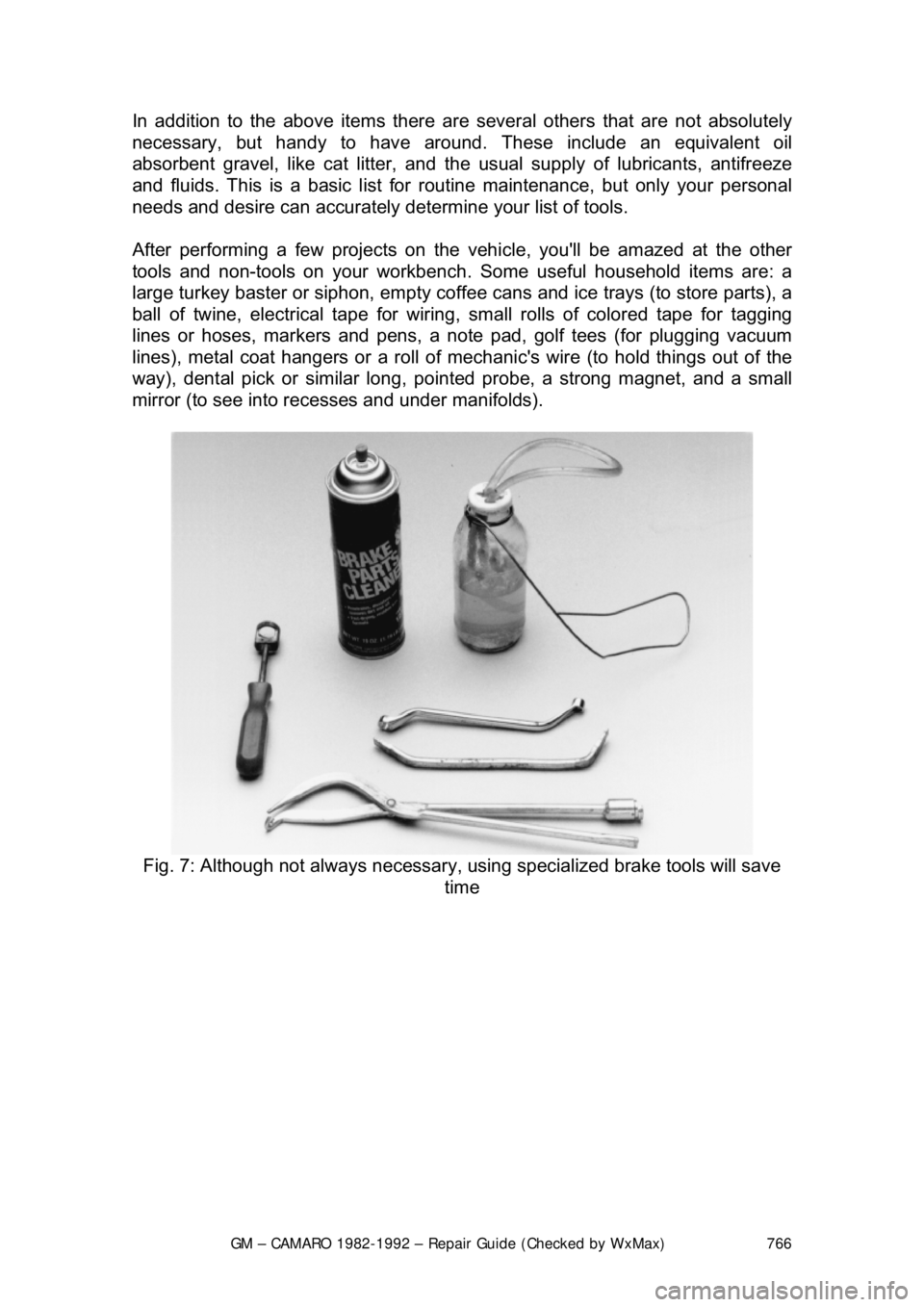
Fig. 7: Although not always necessary, us ing specialized brake tools will save
time
Page 794 of 875
GM – CAMARO 1982-1992 – Repair Guide (Checked by WxMax) 794
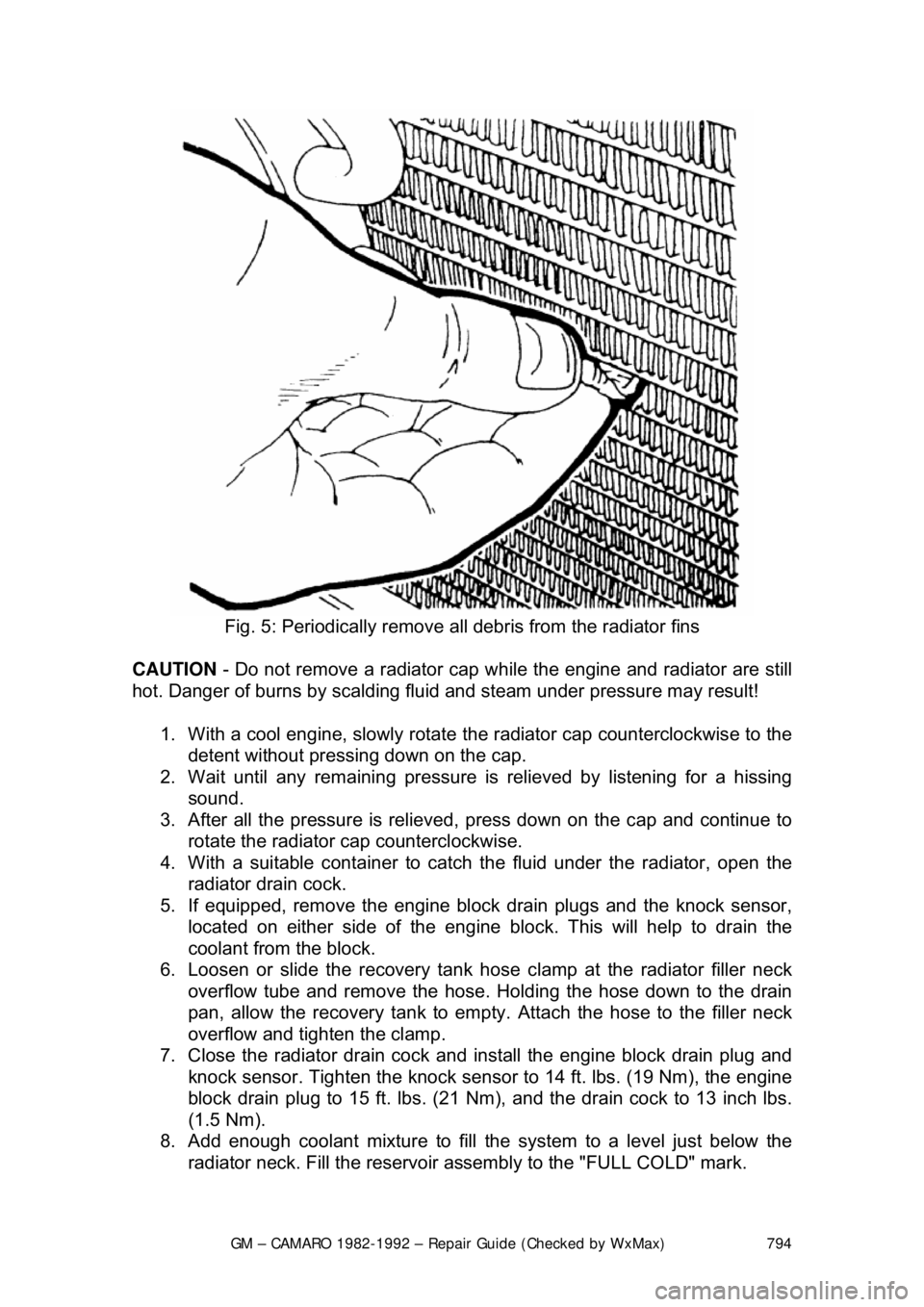
Fig. 5: Periodically remove all debris from the radiator fins
CAUTION - Do not remove a radiator cap wh ile the engine and radiator are still
hot. Danger of burns by scalding fluid and steam under pressure may result!
1. With a cool engine, slowly rotate t he radiator cap counterclockwise to the
detent without pressing down on the cap.
2. Wait until any remaini ng pressure is relieved by listening for a hissing
sound.
3. After all the pressure is relieved, press down on the cap and continue to
rotate the radiator cap counterclockwise.
4. With a suitable container to catc h the fluid under the radiator, open the
radiator drain cock.
5. If equipped, remove the engine blo ck drain plugs and the knock sensor,
located on either side of the engine block. This will help to drain the
coolant from the block.
6. Loosen or slide the recovery tank hos e clamp at the radiator filler neck
overflow tube and remove the hose. Holding the hose down to the drain
pan, allow the recovery tank to empty. Attach the hose to the filler neck
overflow and tighten the clamp.
7. Close the radiator drain cock and install the engine block drain plug and
knock sensor. Tighten the knock sensor to 14 ft. lbs. (19 Nm), the engine
block drain plug to 15 ft. lbs. (21 N m), and the drain cock to 13 inch lbs.
(1.5 Nm).
8. Add enough coolant mixture to fill the system to a level just below the
radiator neck. Fill the reservoir a ssembly to the "FULL COLD" mark.
Page 828 of 875
GM – CAMARO 1982-1992 – Repair Guide (Checked by WxMax) 828
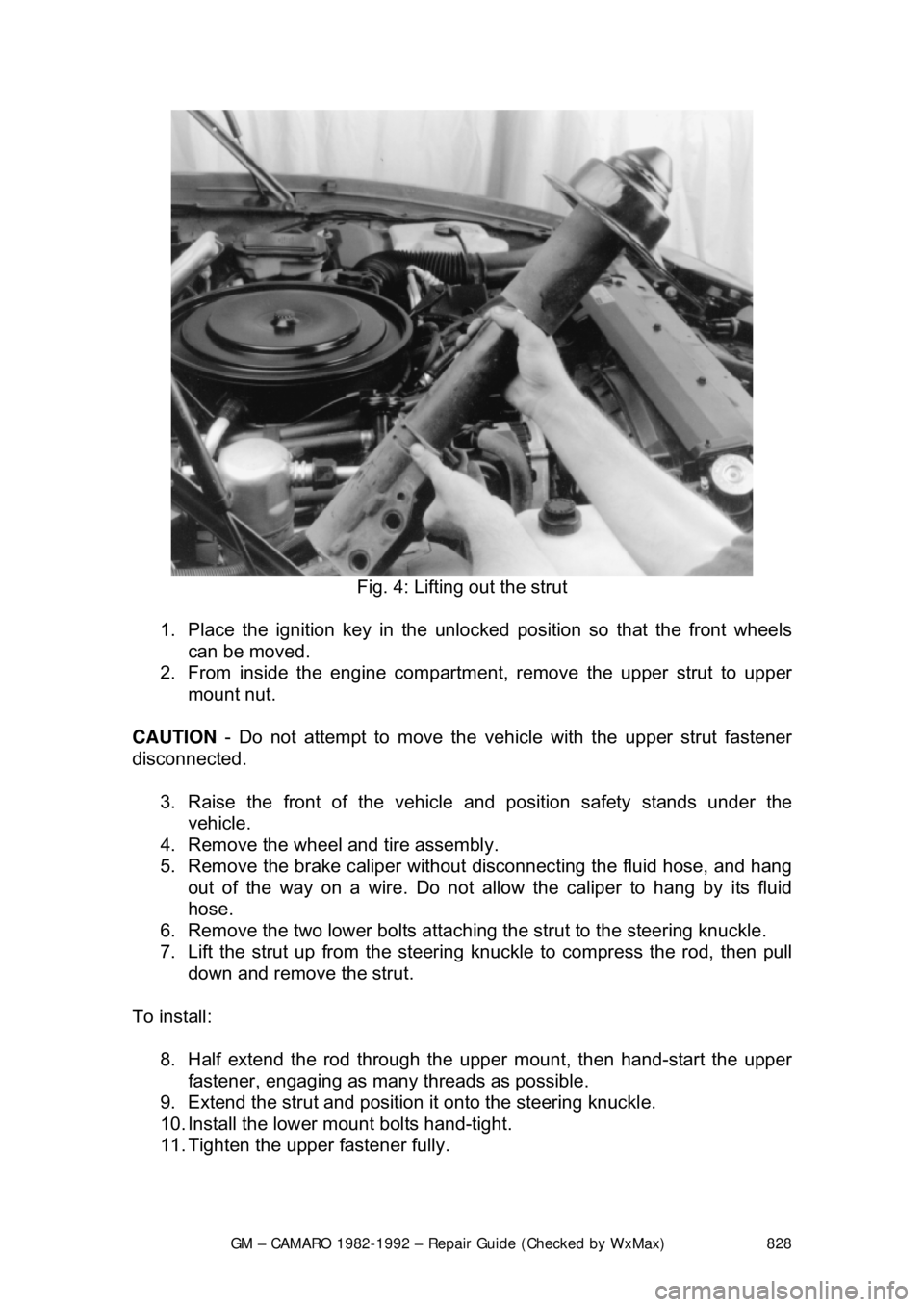
Fig. 4: Lifting out the strut
1. Place the ignition key in the unlock ed position so that the front wheels
can be moved.
2. From inside the engine compartm ent, remove the upper strut to upper
mount nut.
CAUTION - Do not attempt to move the ve hicle with the upper strut fastener
disconnected.
3. Raise the front of the vehicl e and position safety stands under the
vehicle.
4. Remove the wheel and tire assembly.
5. Remove the brake caliper without disconnecting the fluid hose, and hang
out of the way on a wire. Do not allo w the caliper to hang by its fluid
hose.
6. Remove the two lower bolts attachi ng the strut to the steering knuckle.
7. Lift the strut up from the steering k nuckle to compress the rod, then pull
down and remove the strut.
To install: 8. Half extend the rod through th e upper mount, then hand-start the upper
fastener, engaging as many threads as possible.
9. Extend the strut and position it onto the steering knuckle.
10. Install the lower mount bolts hand-tight.
11. Tighten the upper fastener fully.
Page 833 of 875
GM – CAMARO 1982-1992 – Repair Guide (Checked by WxMax) 833
1. Siphon some brake fluid from the ma
ster cylinder. Raise and support the
vehicle.
2. Remove the wheel and tire. Remo ve the brake hose from the strut.
3. Remove the caliper and support on a wire. Refer to Brakes for
procedures, then remove the hub-and-disc.
4. Remove the splash shield. Disc onnect the tie rod from the steering
knuckle.
5. Support the lower control arm and disconnect the ball joint from the
steering knuckle using tool J-24292A.
6. Remove the 2 bolts securing the stru t to the steering knuckle and remove
the steering knuckle.
To install: 7. Place the steering knu ckle into position and install the 2 bolts securing
the strut to the st eering knuckle.
8. Support the lower control arm and c onnect the ball joint to the steering
knuckle.
9. Connect the tie rod to the steering knuckle. Install the splash shield.
10. Install the caliper.
11. Install the brake hose from the strut. Install the wheel and tire.
12. Lower the vehicle and refill the master cylinder with brake fluid.
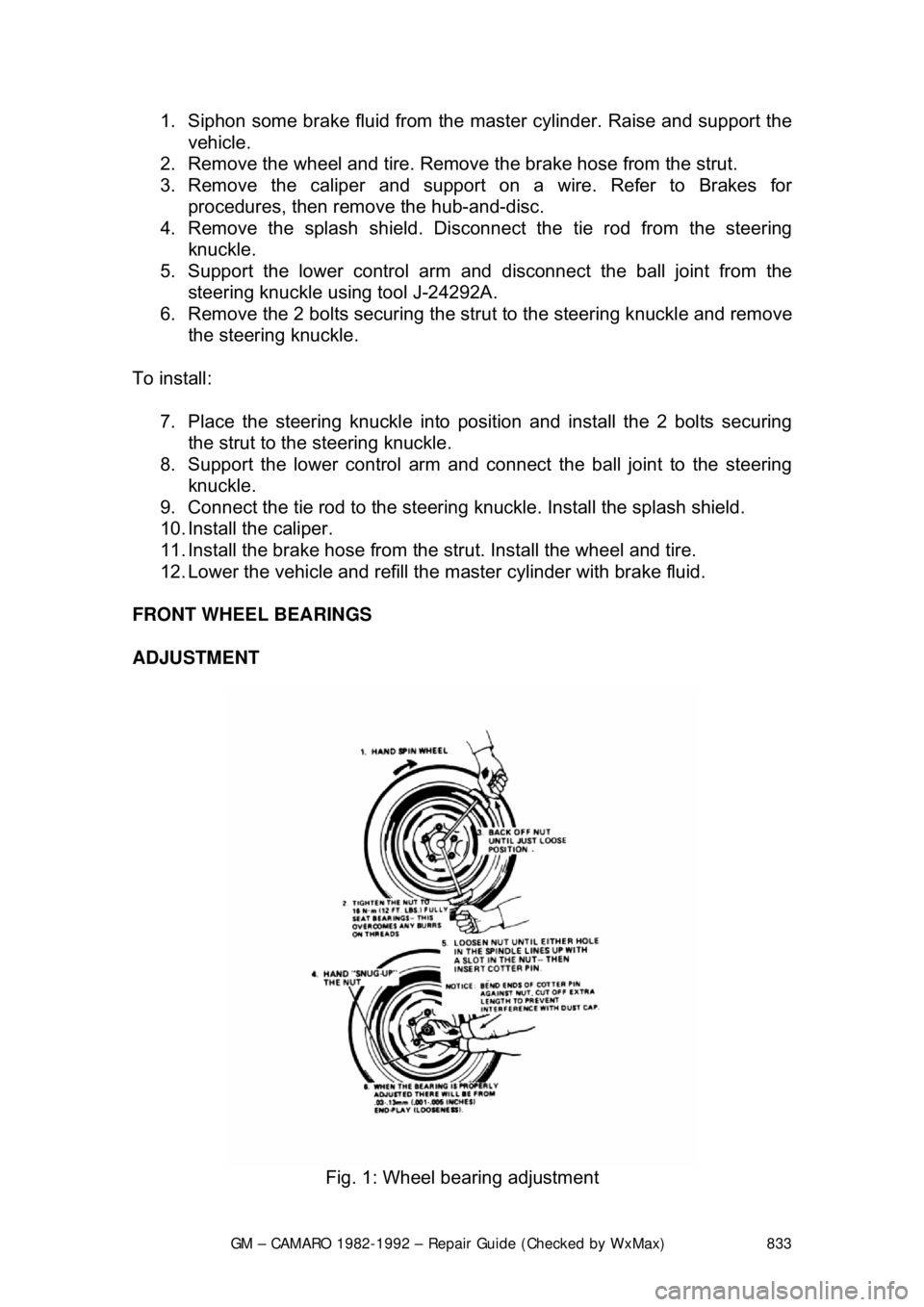
FRONT WHEEL BEARINGS
ADJUSTMENT
Fig. 1: Wheel bearing adjustment
Page 839 of 875

GM – CAMARO 1982-1992 – Repair Guide (Checked by WxMax) 839
COIL SPRINGS
REMOVAL & INSTALLATION
1. Raise the car by the frame so that the rear axle can be independently
raised and lowered.
2. Support the rear axle with a floor jack.
3. If equipped with brake hose attaching brackets, disconnect the brackets
allowing the hoses to hang free. Do not disconnect the hoses. Perform
this step only if the hoses woul d otherwise be stretched and damaged
when the axle is lowered.
4. Disconnect the track bar from the axle.
5. Remove the lower shock absorber bol ts and lower the axle. Make sure
the axle is supported securely on t he floor jack and that there is no
chance of the axle slipping after the shock absorbers are disconnected.
On vehicles equipped with a 4-cylinder engine, remove the driveshaft.
6. Lower the axle and remove the coil spring. Do not lower the axle past th\
e limits of the brake lines or the lines will be damaged.
To install: 7. Position spring with the axle lowered.
8. On vehicles equipped with 4-cylinder engines, install the driveshaft.
9. Raise the axle and install the lower shock absorber bolts.
10. Connect the track bar to the axle.
11. Connect the brake hose attaching brackets, if removed.
12. Remove the support from the rear axle.
13. Lower the vehicle.
Page 843 of 875

GM – CAMARO 1982-1992 – Repair Guide (Checked by WxMax) 843
TRACK BAR BRACE
REMOVAL & INSTALLATION
1. Raise the rear of the vehicle, pl ace jackstands under the rear axle, then
lower the jack so that the stands are supporting all of the weight.
2. Remove the heat shield screw s from the track bar brace.
3. Remove the three track bar brace-to-body brace screws.
4. Remove the track bar-to-body bra cket fasteners and remove the track
bar brace.
To install: 5. Place the track bar brace into position.
6. Install the track bar-to-body bracket fasteners.
7. Install the three track bar brace-to-body brace screws.
8. Install the heat shield scre ws to the track bar brace.
9. Lower the vehicle.
CONTROL ARM
REMOVAL & INSTALLATION
Remove/reinstall only one lower control ar m at a time. If both arms are removed
at the same time, the axle could roll or slip sideways, making reinstallation of
the arms very difficult.
1. Raise the rear of the vehicle, pl ace jackstands under the rear axle, then
lower the jack so that the stands are supporting all of the weight.
2. Remove the control arm attachi ng fasteners, then remove the control
arm.
3. Installation is a simple matter of bol ting the arm into place. Torque the 3
bolts at the body brace bracket to 35 ft. lbs. (47 Nm) and the nut at the
body bracket to 61 ft. lbs. (83 Nm).
TORQUE ARM
REMOVAL & INSTALLATION
The coil springs must be removed BEFORE the torque arm. If the torque arm is
removed first, vehicle damage will result. In order to proceed, the vehicle must
be supported in a manner whic h will allow the rear axle height to be adjusted
independently of the body height.
1. Remove the track bar mounting bolt at the axle assembly, then loosen
the track bar bolt at the body brace.
2. Disconnect the rear brake hose clip at the axle assembly, which will allow
additional drop of the axle.
3. Remove the lower attaching nuts from both rear shock absorbers.
4. Disconnect the shock absorbers from their lower attaching points.
Page 844 of 875

GM – CAMARO 1982-1992 – Repair Guide (Checked by WxMax) 844
5. On models with four cylinder engines, remove the driveshaft.
6. Carefully lower the rear axle asse
mbly and remove the rear coil springs.
CAUTION - DO NOT overstretch the br ake hose when lowering the axle-
damage to the hose will result.
7. Remove the torque arm rear attaching bolts.
8. Remove the front torq ue arm outer bracket.
9. Remove the torque ar m from the vehicle.
To install: 10. Place the torque arm in position and loosely install the rear torque arm
bolts.
11. Install the front torque arm bracket and torque the nuts to 31 ft. lbs. (42
Nm).
12. Torque the rear torque arm nuts to 100 ft. lbs. (135 Nm).
13. Place the rear springs and insulators in position, then raise the rear axle
assembly until all of the weight is supported by the spring.
14. Attach the shock absorbers to the rear axle and torque the fasteners to
70 ft. lbs. (95 Nm).
15. Clean and reinstall the track bar mounting bolt at the axle. Torque the
bolt to 59 ft. lbs. (80 Nm).
16. Clean and reinstall the track bar-t o-body brace nut. Torque the nut to 78
ft. lbs. (105 Nm).
17. Install the brake line clip to the underbody.
18. On four cylinder models, reinstall the driveshaft.
19. Lower the vehicle.
Page 869 of 875
GM – CAMARO 1982-1992 – Repair Guide (Checked by WxMax) 869
4. Remove Pitman arm using spec
ial tool J-6632 or its equal.
5. Remove the steering box to fram e bolts. Remove the steering box.
On vehicles with power steering, remo ve the fluid hoses and cap them to
prevent foreign material from entering the system.
To install:
6. Position the steering box and secure with the steering box-to-frame bolts.
7. Install the Pitman arm to the matchmarks made earlier.
8. Install the Pitman arm nut and washer.
9. Install the retaining bolts at the st eering coupling to steering shaft flange.
10. Install the coupling shield.
11. Connect the negative battery cable.
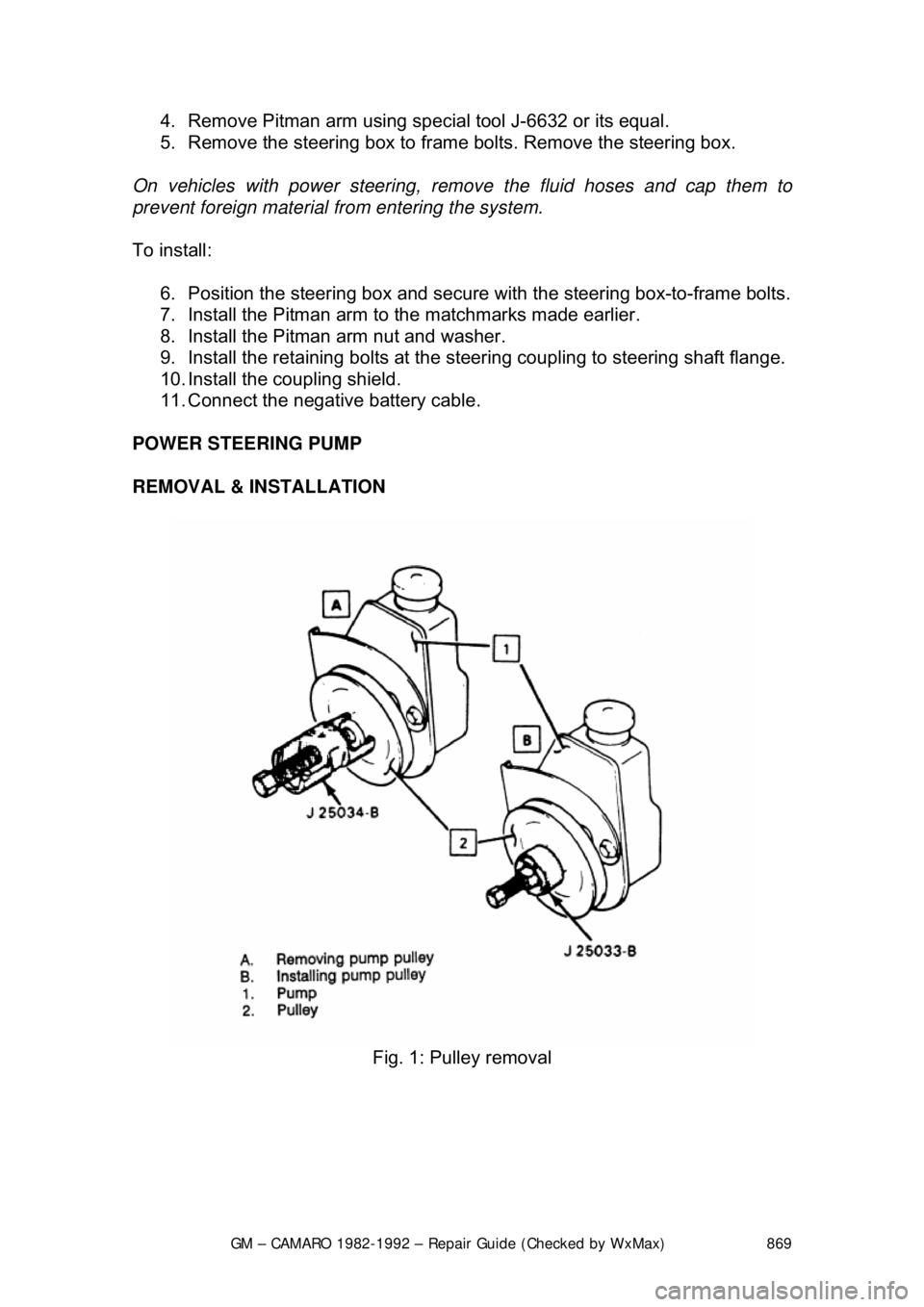
POWER STEERING PUMP
REMOVAL & INSTALLATION
Fig. 1: Pulley removal