service CHEVROLET CAMARO 1982 Repair Guide
[x] Cancel search | Manufacturer: CHEVROLET, Model Year: 1982, Model line: CAMARO, Model: CHEVROLET CAMARO 1982Pages: 875, PDF Size: 88.64 MB
Page 711 of 875

GM – CAMARO 1982-1992 – Repair Guide (Checked by WxMax) 711
THROTTLE BODY INJECTION SYSTEM
SYSTEM DESCRIPTION
The throttle body injection (TBI) system used on 2.5L (VIN 2) and 5.0L (VIN E)
engines is centrally located
on the intake manifold. Its function is to supply the
correct air/fuel mixture to the engine, as directed by the Engine Control Module
(ECM).
The TBI unit consists of two relatively simple casting assemblies: a throttle body
and a fuel metering assembly. Components include, a pressure regulator, idle
air control valve, fuel injector(s), thro ttle position sensor, fuel inlet and a fuel
return fitting.
The Throttle Body Injection identifi cation number is stamped on the lower
mounting flange located near the TPS. Th e number is in alphabetical code and
should be noted before servicing the unit.
An oxygen sensor in the exhaust syst em functions to provide feedback
information to the ECM as to oxygen content in the exhaust. The ECM then
uses this information to modify fuel de livery to achieve as near as possible an
ideal air/fuel ratio of 14.7 :1. This ratio permits the ca talytic converter to become
more effective in reducing emissions wh ile providing acceptable driveability.
Should you encounter any type of engine performance problem, have a
complete CCC system test performed by a qualified, professional technician. If
the fault lies in the injection system, you can use the following procedures to
remove the TBI unit and replace the defective component(s).
RELIEVING FUEL SYSTEM PRESSURE
1. Disconnect the negative battery cable to prevent fuel discharge if the key
is accidentally turned to the RUN position.
2. Loosen the fuel filler cap to relieve fuel tank pressure and do not tighten
until service has been completed.
3. Fuel system pressure is automatic ally relieved when the engine is turned
OFF. No further action is necessary.
When disconnecting fuel lines, there ma y still be a small amount of fuel
released. Cover the fuel line connection wi th a shop cloth to collect the fuel,
then place the cloth in an approved container.
ELECTRIC FUEL PUMP
REMOVAL & INSTALLATION
The fuel pump is part of t he fuel sender assembly located inside the fuel tank.
1. Release the fuel syst em pressure and disconnec t the negative battery
cable.
Page 716 of 875

GM – CAMARO 1982-1992 – Repair Guide (Checked by WxMax) 716
INJECTOR REPLACEMENT
Use care in removing injectors to prev
ent damage to the electrical connector
pins on top of the injector, the fuel injector fuel filter and nozzle. The fuel injector
is serviced as a complete assembly on ly and should never be immersed in any
type of cleaner.
SINGLE INJECTOR UNITS 1. Relieve the fuel system pressure.
2. Remove the air cleaner.
3. Detach the injector connector by squeezing the two tabs together and
pulling straight up.
4. Remove the screws securing the fuel meter cover. Note the location of
any short screws for correct placement during reassembly.
CAUTION - DO NOT remove the four screws se curing the pressure regulator to
the fuel meter cover. The fuel pressure regulator includes a large spring under
heavy tension which could cause personal injury if released.
5. With the old fuel meter gasket in place to prevent damage to the casting,
use a prytool and fulcrum to pry the inje ctor carefully until it is free from
the fuel meter body.
6. Remove the injector.
7. Remove the large O-ring and steel back-up washer at the top of the
injector cavity in the fuel meter body.
8. Remove the small O-ring located at the bottom of the injector cavity.
To Install: 9. Lubricate the new, small O-ring with automatic transmission fluid; then,
push the new O-ring on the nozzle end of the injector up against the
injector fuel filter.
10. Install the steel backup washer in the recess of the fuel meter body.
Lubricate the new large O-ring with automatic transmission fluid, then
install the O-ring directly above t he backup washer, pressing the O-ring
down into the cavity recess. The O-ri ng is properly installed when it is
flush with the casting surface.
WARNING - Do not attempt to reverse this procedure and install the backup
washer and O-ring after the injector is located in the cavity. To do so will
prevent proper seating of the O-ring in th e cavity recess which could result in a
fuel leak and possible fire.
11. Install the injector by using a pushing/twisting mo tion to center the nozzle
O-ring in the bottom of the injector cavity and aligning the raised lug on
the injector base with the notch cast into the fuel meter body. Push down
on the injector making sure it is fully seated in the cavity. Injector
installation is correct when the lug is seated in the notch and the
electrical terminals are parallel to the throttle shaft.
Page 722 of 875
GM – CAMARO 1982-1992 – Repair Guide (Checked by WxMax) 722
FUEL PRESSURE REGULATOR
REMOVAL & INSTALLATION
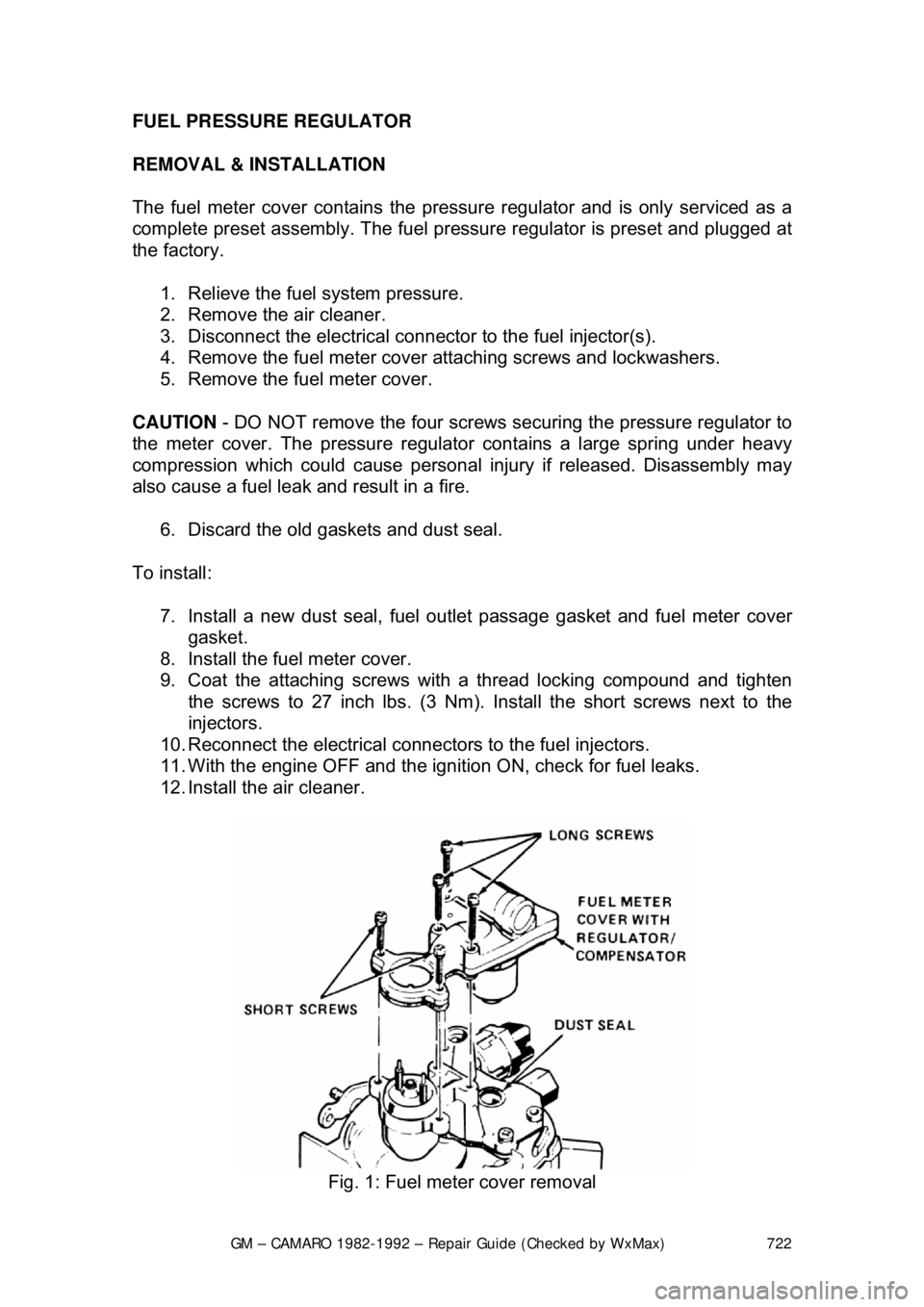
The fuel meter cover contains the pressu
re regulator and is only serviced as a
complete preset assembly. The fuel pressu re regulator is preset and plugged at
the factory.
1. Relieve the fuel system pressure.
2. Remove the air cleaner.
3. Disconnect the electrical connec tor to the fuel injector(s).
4. Remove the fuel meter cover attaching screws and lockwashers.
5. Remove the fuel meter cover.
CAUTION - DO NOT remove the four screws se curing the pressure regulator to
the meter cover. The pressure regulat or contains a large spring under heavy
compression which could cause personal injury if released. Disassembly may
also cause a fuel leak and result in a fire.
6. Discard the old gaskets and dust seal.
To install: 7. Install a new dust seal, fuel outlet passage gasket and fuel meter cover\
gasket.
8. Install the fuel meter cover.
9. Coat the attaching screws with a thread locking compound and tighten the screws to 27 inch lbs. (3 Nm). Install the short screws next to the
injectors.
10. Reconnect the electrical connec tors to the fuel injectors.
11. With the engine OFF and the igniti on ON, check for fuel leaks.
12. Install the air cleaner.
Fig. 1: Fuel meter cover removal
Page 724 of 875
GM – CAMARO 1982-1992 – Repair Guide (Checked by WxMax) 724
•
Type 2: Compress retaining spring from valve while turning valve
in with a clockwise motion. Return spring to original position with
straight portion of spring end aligned with flat surface of valve.
On IAC valves that have already been in service, do not push or pull on the
valve pintle. The force required to move the pintle may damage the threads on
the worm drive.
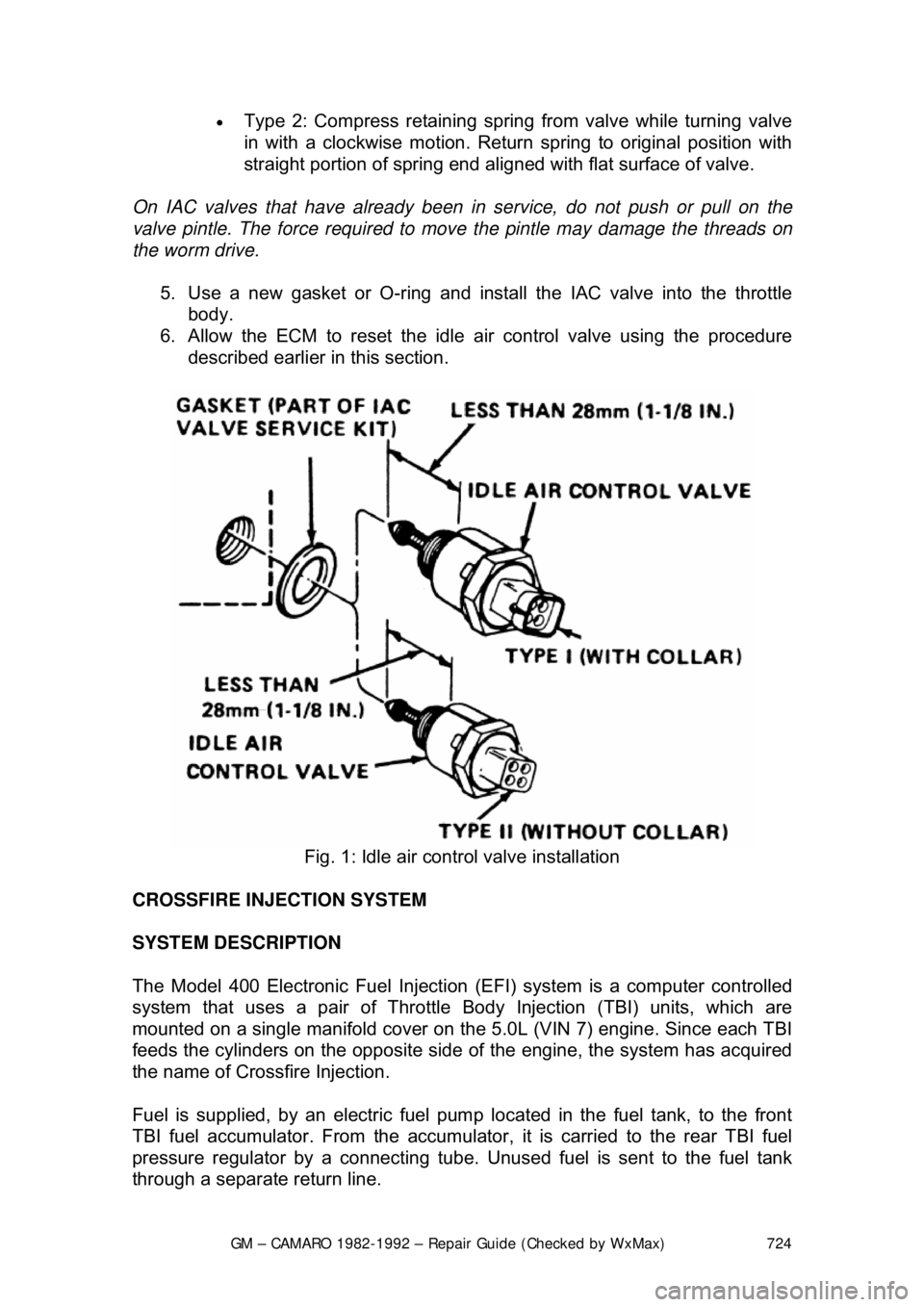
5. Use a new gasket or O-ring and install the IAC valve into the throttle body.
6. Allow the ECM to reset the idle air control valve using the procedure
described earlier in this section.
Fig. 1: Idle air control valve installation
CROSSFIRE INJECTION SYSTEM
SYSTEM DESCRIPTION
The Model 400 Electronic Fuel Injection (EFI) system is a computer controlled
system that uses a pair of Throttle Body Injection (TBI) units, which are
mounted on a single manifold cover on t he 5.0L (VIN 7) engine. Since each TBI
feeds the cylinders on the opposite side of the engine, the system has acquired
the name of Crossf ire Injection.
Fuel is supplied, by an electric fuel pum p located in the fuel tank, to the front
TBI fuel accumulator. From the accumulator, it is carried to the rear TBI fuel
pressure regulator by a c onnecting tube. Unused fuel is sent to the fuel tank
through a separate return line.
Page 736 of 875

GM – CAMARO 1982-1992 – Repair Guide (Checked by WxMax) 736
The mass air flow systems measure the
mass of air that is drawn into the
engine cylinders, rather than just the vo lume. The sensor contains a hot-wire
sensing unit, which is made up of an electronic balanced bridge network.
Whenever current is suppli ed to the sensor, the bridge is energized and the
sensing hot-wire is heated. As the air enter s the mass air flow sensor, it passes
over and cools the hot wire. When the hot wire is cooled, it's resistance changes
and additional current is needed to k eep the bridge network balanced. This
increase in current is sent to the computer as a voltage signal and is used to
calculate the mass of the incoming air. The ECM uses this information to\
determine the duration of fuel injection pulse, ignition timing and EGR operation.
The speed density systems calculate the volume of air moving through the
intake. The ECM establishes the speed fact or through a signal from the ignition
module. The Manifold or Intake Air Temperature (MAT/IAT) and the Engine
Coolant Temperature (ECT) sensors work together to assure that proper
temperature information gets to the ECM wh ile the Manifold Absolute Pressure
(MAP) sensor monitors the changes in m anifold pressure which results from
changes in engine loading. These three se nsors contribute to the density factor.
Together, these inputs (engine speed, coolant temperature sensor, etc ...) are
the major determinants of the air/fuel mixture delivered by the fuel injection
system.
The following engines and fuel managem ent systems are covered in this
section:
• 1985-1989 2.8L MPFI - Mass Air Flow
• 1990-1992 3.1L MPFI - Speed Density
• 1985-1989 5.0L and 5.7L TPI - Mass Air Flow
• 1990-1992 5.0L and 5.7L TPI - Speed Density
Relieving Fuel System Pressure
1. Disconnect the negative battery cable to prevent fuel discharge if the key
is accidentally turned to the RUN position.
2. Loosen the fuel filler cap to reliev e the tank pressure and do not tighten
until service has been completed.
3. Connect J-34730-1 fuel pressure gauge or equivalent, to the fuel
pressure test valve. Wrap a shop towel around the fitting while
connecting the gauge to prevent spillage.
4. Place the end of the bleed hose into a suitable container and open the
valve to relieve the fuel system pressure.
ELECTRIC FUEL PUMP
REMOVAL & INSTALLATION
The fuel pump is part of t he fuel sender assembly located inside the fuel tank.
Page 744 of 875
GM – CAMARO 1982-1992 – Repair Guide (Checked by WxMax) 744
7. Start the engine and che
ck for proper operation.
FUEL INJECTORS
REMOVAL & INSTALLATION
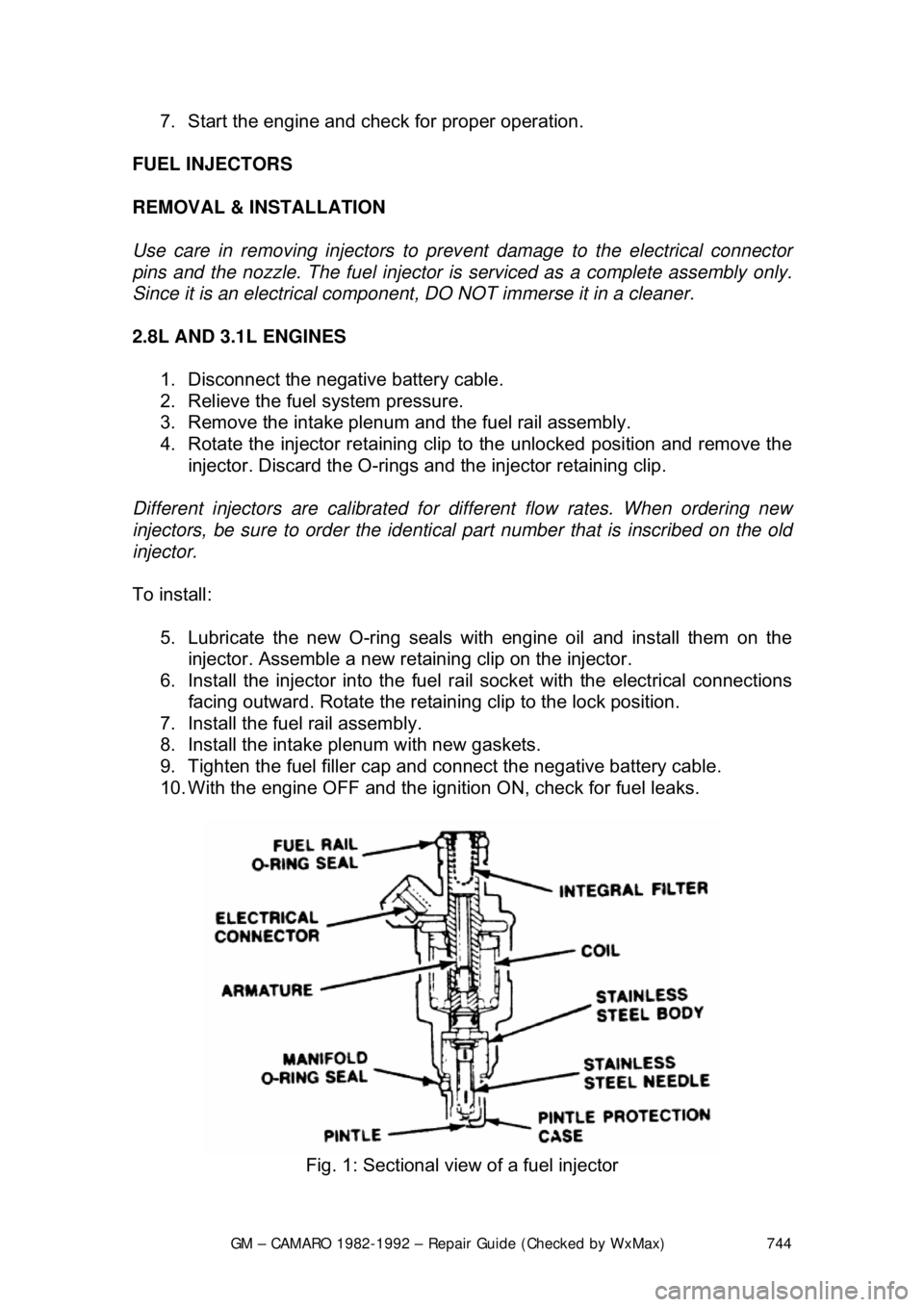
Use care in removing injectors to prev ent damage to the electrical connector
pins and the nozzle. The fuel injector is serviced as a complete assembly only.
Since it is an electrical compon ent, DO NOT immerse it in a cleaner.
2.8L AND 3.1L ENGINES 1. Disconnect the negative battery cable.
2. Relieve the fuel system pressure.
3. Remove the intake plenum and the fuel rail assembly.
4. Rotate the injector retaining clip to the unlocked position and remove the
injector. Discard the O-rings and the injector retaining clip.
Different injectors are calibrated for different flow rates. When ordering new
injectors, be sure to order the identical part number that is inscribed on the old
injector.
To install: 5. Lubricate the new O-ri ng seals with engine oil and install them on the
injector. Assemble a new reta ining clip on the injector.
6. Install the injector into the fuel ra il socket with the electrical connections
facing outward. Rotate the retaini ng clip to the lock position.
7. Install the fuel rail assembly.
8. Install the intake pl enum with new gaskets.
9. Tighten the fuel filler cap and connect the negative battery cable.
10. With the engine OFF and the igniti on ON, check for fuel leaks.
Fig. 1: Sectional view of a fuel injector
Page 750 of 875

GM – CAMARO 1982-1992 – Repair Guide (Checked by WxMax) 750
6. Disconnect the vacuum hose
at the pressure regulator.
7. Unplug the electrical connectors.
8. Loosen and remove the fuel rail attaching bolts.
9. Remove the fuel rail assembly from the intake manifold.
10. Discard all of the O-ring seals t hat are exposed during this procedure.
To install: 11. Lubricate with clean engine oil, then install the injector nozzle O-rings.
12. Install the fuel rail assembly in the intake manifold.
13. Tighten the fuel rail attachi ng bolts to specification.
14. Engage the injector electrical connectors. Rotate each injector as
required to avoid stretching the harness.
15. Connect the vacuum hose to the pressure regulator.
16. Connect the fuel feed and return lines. New O-rings must be used.
17. Temporarily connect the negative battery terminal. a. With the engine OF F and the ignition ON, check for fuel leaks.
Repair as necessary.
b. Disconnect the negative battery cable.
18. Install the intake plenum and runners. Use new gaskets.
19. Connect the negative battery cable.
FUEL PRESSURE REGULATOR
REMOVAL & INSTALLATION
2.8L AND 3.1L ENGINES
The pressure regulator and the fuel rail are serviced as a complete assembly
only. DO NOT attempt to remove the regulator cove r from the fuel rail.
5.0L AND 5.7L TPI ENGINES 1. Disconnect the negative battery cable.
2. Relieve the fuel system pressure.
3. Remove the intake plenum and runners.
4. Remove the fuel rail assembly.
5. Remove the rear crossover re tainer and base attaching screw.
6. Remove the rear crossover tube and O-ring from the regulator base.
Discard the O-ring.
7. Remove the pressure regulator bracket.
8. Remove the pressure r egulator base-to-rail screw.
9. Separate the regulator base from the fuel rail, then disconnect from the
fuel outlet tube.
10. Remove the fuel outle t tube O-ring and discard.
11. Remove the regulator bas e-to-fuel rail connector.
To install: 12. Lubricate and install new regul ator base-to-fuel rail O-rings.
Page 751 of 875

GM – CAMARO 1982-1992 – Repair Guide (Checked by WxMax) 751
13. Lubricate a new outlet tube 0-ring and in
stall it on the end of the tube.
14. Connect the regulator base to the fuel outlet tube, then to the fuel rail.
15. Finger-tighten the base-to-rail screw.
16. Install the pressure regulator br acket. Finger-tighten the screws only.
17. Lubricate a new rear crossover tube O-ring and install it on the end of the
tube.
18. Install the rear crossover tube to the regulator base.
19. Install the crossover tube reta iner and finger-tighten the screw.
20. Tighten all attaching screws to 44 inch lbs. (5 Nm).
21. Install the fuel rail assembly.
22. Temporarily connect the negative battery cable. a. With the engine OFF and the igniti on ON, check for fuel leaks.
b. Disconnect the negative battery cable.
23. Install the intake plenum and runners.
24. Connect the negative battery cable.
IDLE AIR CONTROL VALVE
REMOVAL & INSTALLATION 1. Unplug the electrical connector from idle air control valve.
2. Remove the idle air control valve.
To install: 3. Before installing the idle air contro l valve, measure the distance that the
valve is extended. Measurement s hould be made from the motor housing
to the end of the cone. It should not exceed 28.5mm (1
1/8 in.), or damage
to the valve may occur when installed.
4. On 1985-1992 models, identify the replacement IAC valve as being
either Type 1 (with collar at electric terminal end) or Type 2 (without
collar). If measuring distance is great er than specified above, proceed as
follows:
• Type 1: Use finger pressure to slowly retract the pintle.
• Type 2: Compress retaining spring from valve while turning valve
in with a clockwise motion. Return spring to original position with
straight portion of spring end aligned with flat surface of valve.
On IAC valves that have already been in service, do not push or pull on the
valve pintle. The force required to move the pintle may damage the threads on
the worm drive.
5. Use a new gasket or O-ring and install the IAC valve into the throttle body.
6. Allow the ECM to reset the idle air control valve using the procedure
described earlier in this section.
Page 762 of 875

GM – CAMARO 1982-1992 – Repair Guide (Checked by WxMax) 762
Loctite). If you're worried about getting so
mething together tight enough to hold,
but loose enough to avoid mechanical damage during assembly, one of these
products might offer substantial insurance. Before choosing a threadlocking
compound, read the label on the pa ckage and make sure the product is
compatible with the materials, fluids, etc. involved.
3. Crossthreading. This occu rs when a part such as a bolt is screwed into a
nut or casting at the wrong angle and forced. Cr ossthreading is more
likely to occur if access is diffic ult. It helps to clean and lubricate
fasteners, then to start threading the bolt, spark pl ug, etc. with your
fingers. If you encounter resistance, unscrew the part and start over
again at a different angle until it can be inserted and turned several t\
imes
without much effort. Keep in mind t hat many parts have tapered threads,
so that gentle turning will automatica lly bring the part you're threading to
the proper angle. Don't put a wrench on the part until it's been tightened
a couple of turns by hand. If you s uddenly encounter resistance, and the
part has not seated fully, don't force it. Pull it back out to make sure it's
clean and threading properly.
Be sure to take your time and be pati ent, and always plan ahead. Allow yourself
ample time to perform r epairs and maintenance.
TOOLS AND EQUIPMENT
Without the proper tools and equipment it is impossible to properly service your
vehicle. It would be virtually impossible to catalog every tool that you would
need to perform all of the oper ations in this repair guide. It would be unwise for
the amateur to rush out and buy an expens ive set of tools on the theory that
he/she may need one or more of them at some time.
The best approach is to proceed slowly, gathering a good quality set of those
tools that are used most frequently. Don't be misled by the low cost of bargain
tools. It is far better to spend a little more for better quality. Forged wrenches, 6
or 12-point sockets and fine tooth ratc hets are by far preferable to their less
expensive counterparts. As any good me chanic can tell you, there are few
worse experiences than trying to work on a vehicle with bad tools. Your
monetary savings will be far outweighed by frustration and mangled knuckles.
Begin accumulating those tools that are used most frequently: those associated
with routine maintenance and tune-up. In addition to the normal assortment of
screwdrivers and pliers, you should have the following tools:
• Wrenches/sockets and combination o pen end/box end wrenches in sizes 1/83/4 in. and/or 3mm-19mm 13/16 in. or 5/8 in. spark plug socket
(depending on plug type).
If possible, buy various length socket drive extensions. Universal-joint\
and
wobble extensions can be extremely usef ul, but be careful when using them, as
they can change the amount of torque applied to the socket.
Page 772 of 875
GM – CAMARO 1982-1992 – Repair Guide (Checked by WxMax) 772
Special tools can usually be purchased fr
om an automotive parts store or from
your dealer. In some cases special tools may be available directly from the tool
manufacturer.
SERVICING YOUR VEHICLE SAFELY
It is virtually impossible to anticipate all of the hazards involved with automotive
maintenance and service, but care and common sense will prevent most
accidents.
The rules of safety for mechanics range fr om "don't smoke around gasoline," to
"use the proper tool(s) for the job." The tr ick to avoiding injuries is to develop
safe work habits and to take every possible precaution.
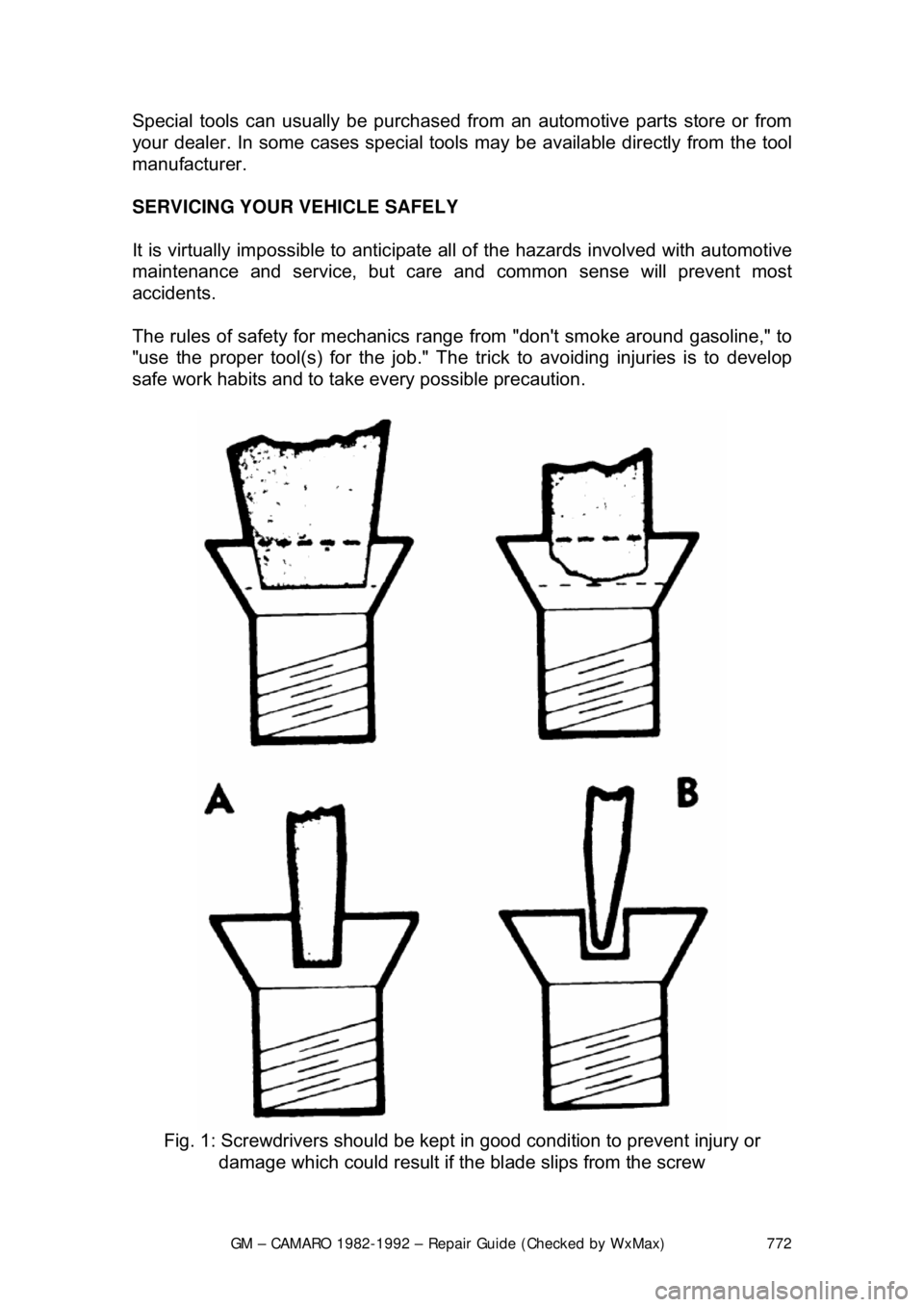
Fig. 1: Screwdrivers should be kept in good condition to prevent injury \
or
damage which could result if t he blade slips from the screw