wheel CHEVROLET CAMARO 1982 Repair Guide
[x] Cancel search | Manufacturer: CHEVROLET, Model Year: 1982, Model line: CAMARO, Model: CHEVROLET CAMARO 1982Pages: 875, PDF Size: 88.64 MB
Page 327 of 875
GM – CAMARO 1982-1992 – Repair Guide (Checked by WxMax) 327
REAR AXLE
IDENTIFICATION
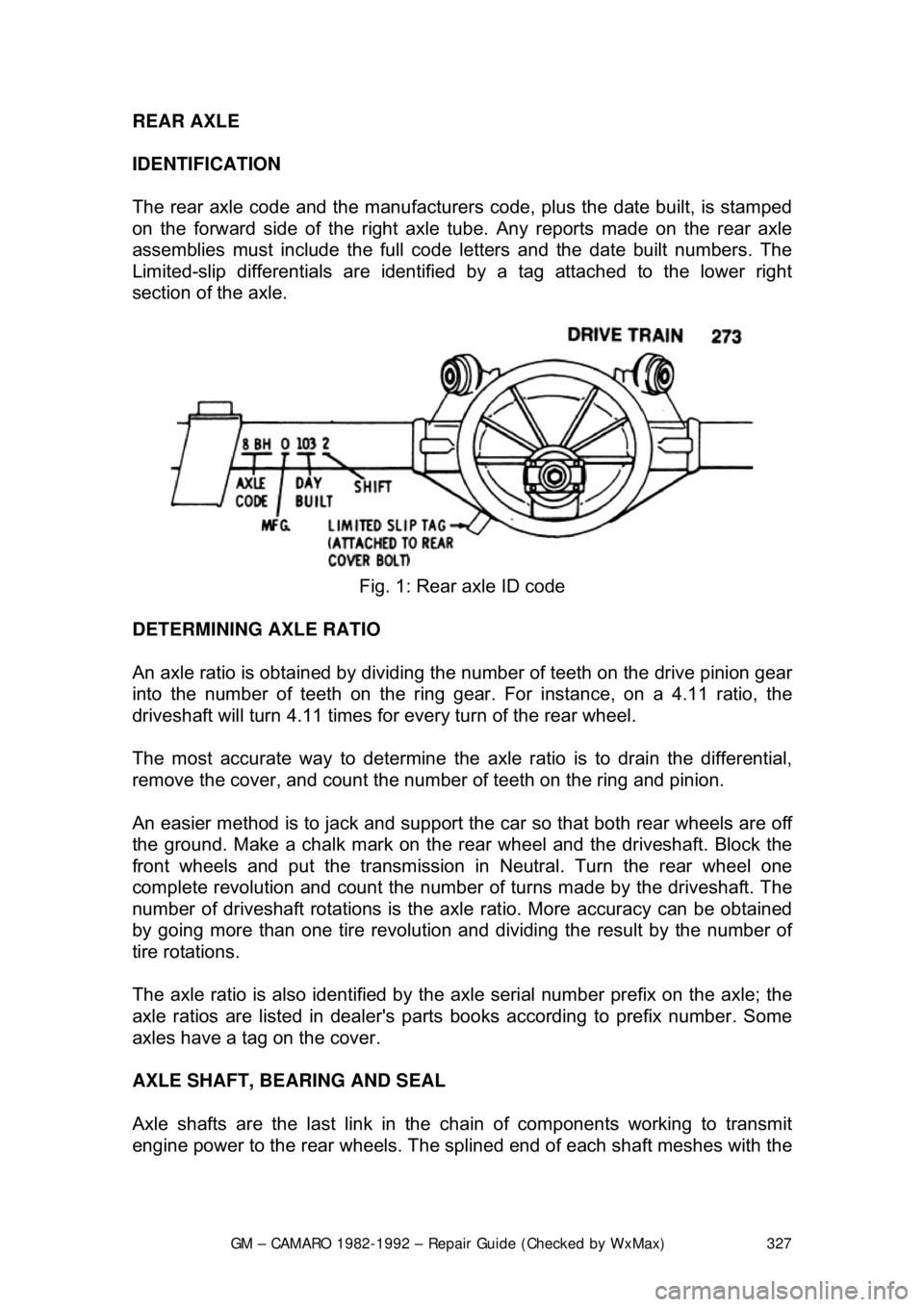
The rear axle code and the
manufacturers code, plus the date built, is stamped
on the forward side of the right axle tube. Any reports made on the rear axle
assemblies must include the full code le tters and the date built numbers. The
Limited-slip differentials are identified by a tag attached to the lower right
section of the axle.
Fig. 1: Rear axle ID code
DETERMINING AXLE RATIO
An axle ratio is obtained by dividing the number of teeth on the drive pinion gear
into the number of teeth on the ring gear. For instance, on a 4.11 ratio, the
driveshaft will turn 4.11 times for every turn of the rear wheel.
The most accurate way to determine the ax le ratio is to drain the differential,
remove the cover, and count the num ber of teeth on the ring and pinion.
An easier method is to jack and support th e car so that both rear wheels are off
the ground. Make a chalk mark on the r ear wheel and the driveshaft. Block the
front wheels and put the transmission in Neutral. Turn the rear wheel one
complete revolution and count the number of turns made by the driveshaft. The
number of driveshaft rotations is the ax le ratio. More accuracy can be obtained
by going more than one tire revolution and dividing the result by the number of
tire rotations.
The axle ratio is also identified by the ax le serial number prefix on the axle; the
axle ratios are listed in dealer's parts books according to prefix number. Some
axles have a tag on the cover.
AXLE SHAFT, BEARING AND SEAL
Axle shafts are the last link in the chain of components working to transmit
engine power to the rear wheels. The sp lined end of each shaft meshes with the
Page 328 of 875
GM – CAMARO 1982-1992 – Repair Guide (Checked by WxMax) 328
internal splines of each differential side
gear. As the side gears turn, so do the
axle shafts, and, since they are also connected, so do the wheels.
Each shaft passes through the side gear and is locked into place by either a C-
lock or flange plate bolted to the end of the axle housing with pressed on
bearings. As the name implies, the C-lock is a flat, C-shaped piece of metal that
fits into a groove at t he end of the shaft. A round pinion shaft is wedged in
between the end of the shafts. This pinion shaft prevents the shafts from sliding
inward and makes the C-locks functional by pushing them tightly against each
side gear. Removing this pini on shaft allows the shafts to slide inward making
the C-locks accessible for removal. Once the C-locks are removed, the axle
shafts can be pulled from the car.
The wheel end of each shaft is flanged and pressed into it are five wheel lug
bolts serving to hold on t he wheel. Each axle shaft is supported by an axle
bearing (wheel bearing) and oil seal located within the axle shaft housing just to
the outside of the br ake backing plate.
REMOVAL & INSTALLATION
EXCEPT BORG-WARNER REAR ASSEMBLY 1. Raise and support the vehicle safe ly. Remove the rear wheels and
drums or rotors.
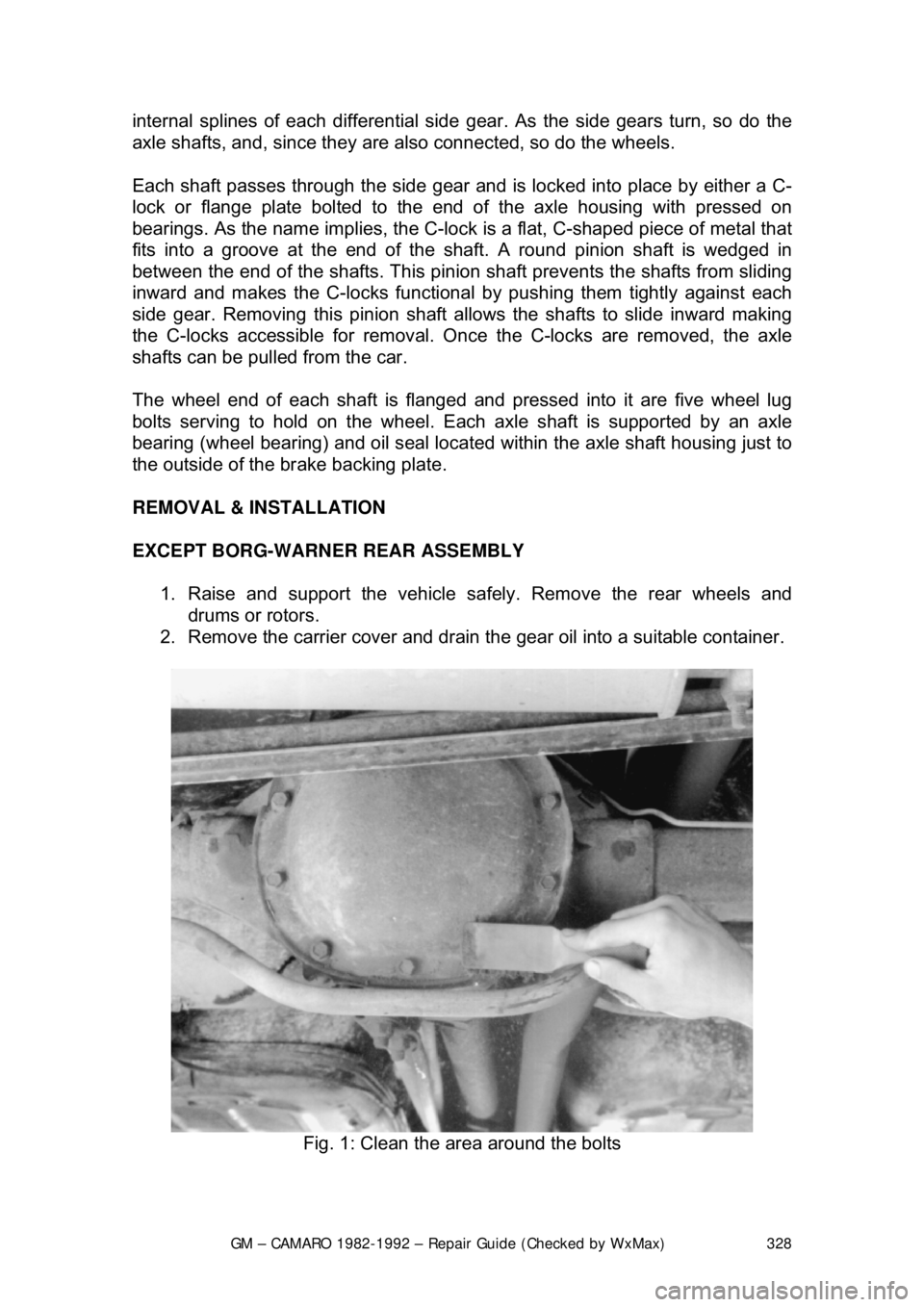
2. Remove the carrier cover and drain t he gear oil into a suitable container.
Fig. 1: Clean the area around the bolts
Page 334 of 875
GM – CAMARO 1982-1992 – Repair Guide (Checked by WxMax) 334
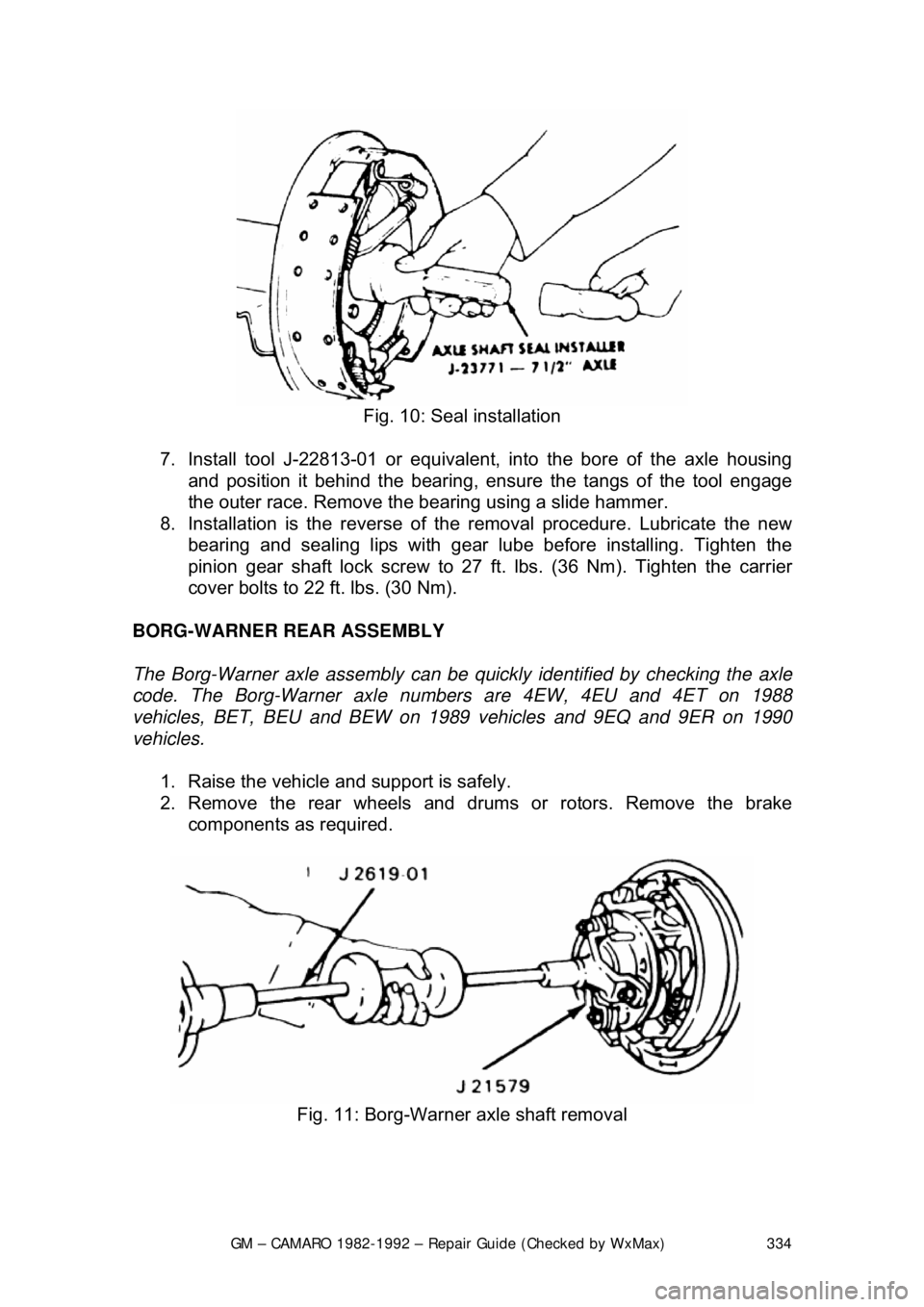
Fig. 10: Seal installation
7. Install tool J-22813-01 or equivalent, into the bore of the axle housing
and position it behind t he bearing, ensure the tangs of the tool engage
the outer race. Remove the bearing using a slide hammer.
8. Installation is the reverse of the removal procedure. Lubricate the new
bearing and sealing lips wi th gear lube before installing. Tighten the
pinion gear shaft lock screw to 27 ft. lbs. (36 Nm). Tighten the carrier
cover bolts to 22 ft. lbs. (30 Nm).
BORG-WARNER REAR ASSEMBLY
The Borg-Warner axle assembly can be quickly identified by checking the axle
code. The Borg-Warner axle num bers are 4EW, 4EU and 4ET on 1988
vehicles, BET, BEU and BEW on 1989 vehicles and 9EQ and 9ER on 1990
vehicles.
1. Raise the vehicle and support is safely.
2. Remove the rear wheels and drums or rotors. Remove the brake components as required.
Fig. 11: Borg-Warner axle shaft removal
Page 335 of 875
GM – CAMARO 1982-1992 – Repair Guide (Checked by WxMax) 335
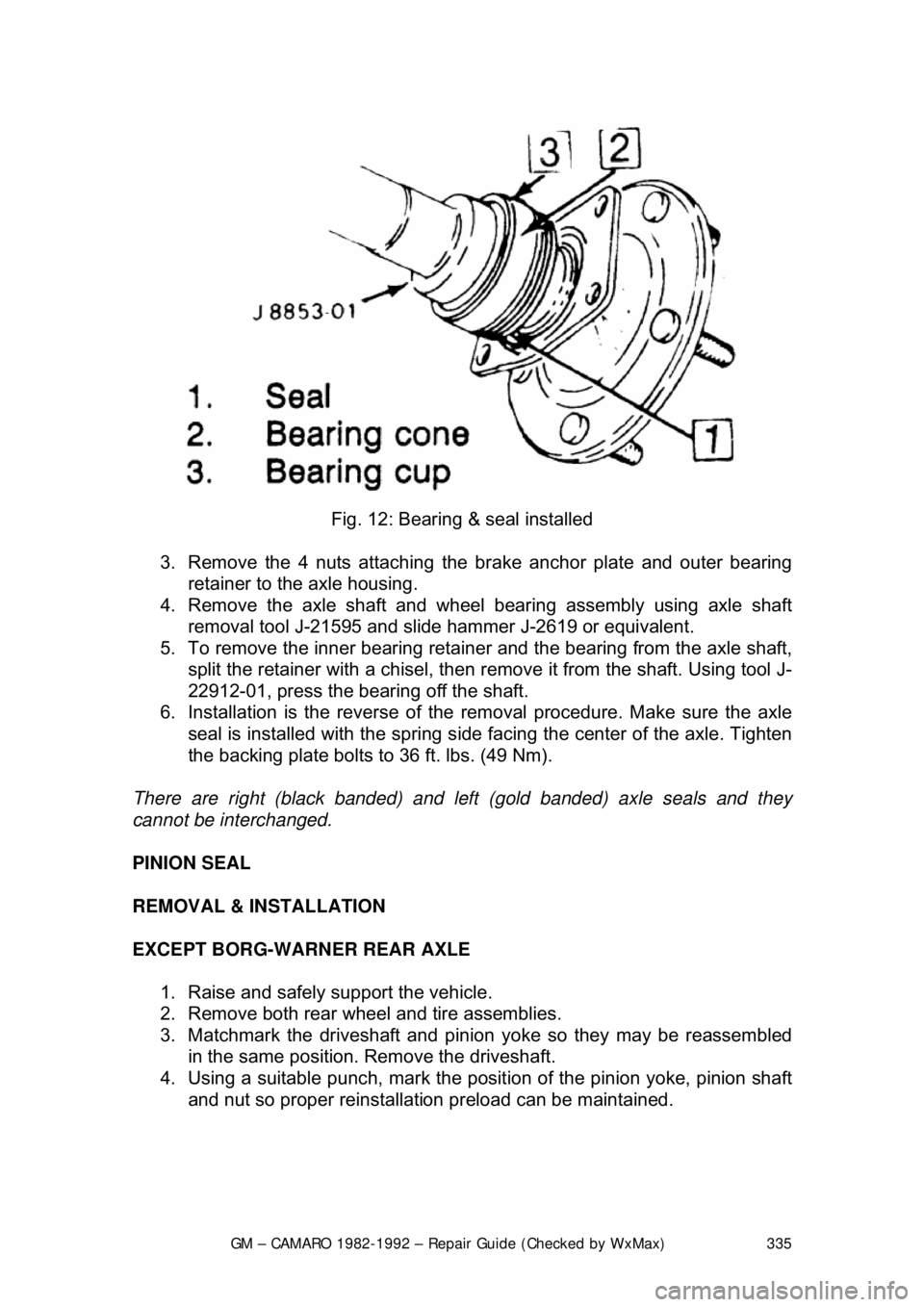
Fig. 12: Bearing & seal installed
3. Remove the 4 nuts attaching the brake anchor plate and outer bearing
retainer to the axle housing.
4. Remove the axle shaft and wheel bearing assembly using axle shaft removal tool J-21595 and slide hammer J-2619 or equivalent.
5. To remove the inner bearing retai ner and the bearing from the axle shaft,
split the retainer with a chisel, then re move it from the shaft. Using tool J-
22912-01, press the bearing off the shaft.
6. Installation is the reverse of the removal procedure. Make sure the axle
seal is installed with the spring side facing the center of the axle. Tighten
the backing plate bolts to 36 ft. lbs. (49 Nm).
There are right (black banded) and left (gold banded) axle seals and they
cannot be interchanged.
PINION SEAL
REMOVAL & INSTALLATION
EXCEPT BORG-WARNER REAR AXLE 1. Raise and safely support the vehicle.
2. Remove both rear wheel and tire assemblies.
3. Matchmark the driveshaft and pinion yoke so they may be reassembled
in the same position. Remove the driveshaft.
4. Using a suitable punch, mark the posit ion of the pinion yoke, pinion shaft
and nut so proper reinstallati on preload can be maintained.
Page 337 of 875
GM – CAMARO 1982-1992 – Repair Guide (Checked by WxMax) 337
7. Use a suitable tool to remove the pinion seal.
To install: 8. Inspect the sealing surfaces of the pinion yoke for nicks or damage and
replace, as necessary. Examine the carrier bore and remove any burrs
that may cause leaks around the outside of the seal.
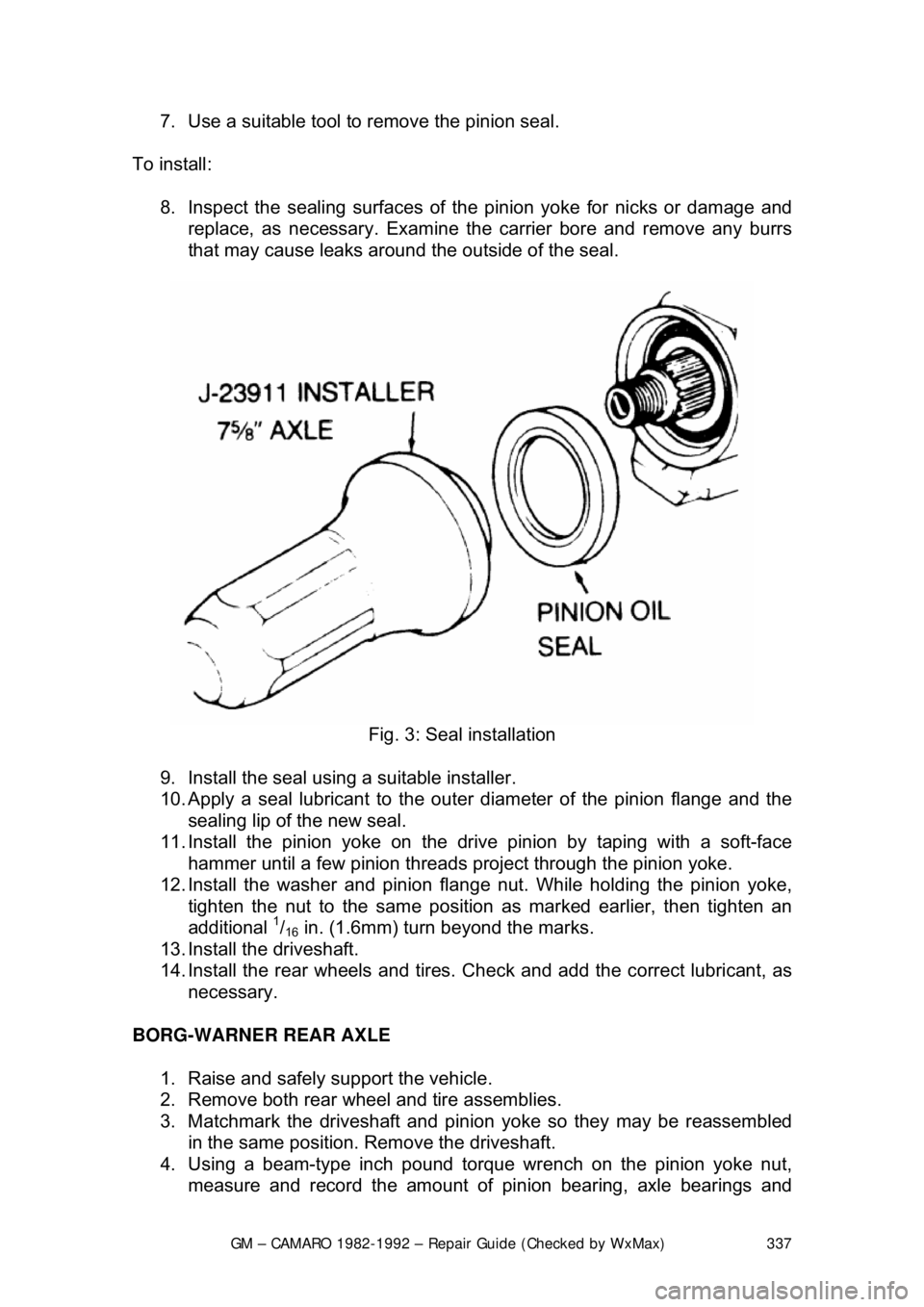
Fig. 3: Seal installation
9. Install the seal using a suitable installer.
10. Apply a seal lubricant to the outer diameter of the pinion flange and the
sealing lip of the new seal.
11. Install the pinion yoke on the drive pinion by taping with a soft-face
hammer until a few pinion threads project through the pinion yoke.
12. Install the washer an d pinion flange nut. While hol ding the pinion yoke,
tighten the nut to the same positi on as marked earlier, then tighten an
additional
1/16 in. (1.6mm) turn beyond the marks.
13. Install the driveshaft.
14. Install the rear wheels and tires. Check and add the correct lubricant, as
necessary.
BORG-WARNER REAR AXLE 1. Raise and safely support the vehicle.
2. Remove both rear wheel and tire assemblies.
3. Matchmark the driveshaft and pinion yoke so they may be reassembled
in the same position. Remove the driveshaft.
4. Using a beam-type inch pound to rque wrench on the pinion yoke nut,
measure and record the amount of pi nion bearing, axle bearings and
Page 338 of 875

GM – CAMARO 1982-1992 – Repair Guide (Checked by WxMax) 338
seal preload. Turn the torque wrenc
h smoothly for several rotations and
record the amount of preload as the a ssembly is turning, not the initial
force required to start the assembly moving.
Preload is measured as the amount of torque required to turn the assembly.
5. Using a suitable tool to hold the pi nion yoke in place, remove the pinion
yoke nut and washer.
6. Place a suitable contai ner under the differential to catch any fluid that
may drain from the rear axle. Using a suitable tool, remove the pinion
flange.
7. Use a suitable tool to remove the pinion seal.
To install: 8. Inspect the seal surface of the pinion flange for tool marks, nicks or
damage and replace, as necessary. Examine the carrier bore and
remove any burrs that might cause leaks around the outside of the seal.
9. Install the seal 0.010 in. (0.2 5mm) below the flange surface using a
suitable seal installer.
10. Apply suitable seal lubricant to t he outer diameter of the pinion flange
and the sealing lip of the new seal.
11. Install the pinion flan ge on the drive pinion by taping with a soft hammer
until a few pinion threads projec t through the pinion flange.
12. Install the washer and pinion fla nge nut. While holding the pinion flange,
tighten the nut a little at a time and turn the drive pinion several
revolutions after each tightening, to set the bearing rollers. Check the
preload each time with a suitable inch pound to rque wrench until the
preload is 5 inch lbs. (0.6 Nm) more then the reading obtained during
disassembly.
13. Install the driveshaft.
14. Install the rear wheels and tires. Check and add the correct lubricant, as
necessary.
AXLE HOUSING
REMOVAL & INSTALLATION 1. Raise the vehicle and support it sa fely. Be sure that the rear axle
assembly is supported safely.
2. Disconnect shock absorbers from ax le. Remove the wheel assemblies.
3. Mark driveshaft and pinion flange, then disconnect driveshaft and support out of the way.
4. Remove brake line junction block bolt at axle housing. If necessary,
disconnect the brake lines at the junction block.
Page 340 of 875

GM – CAMARO 1982-1992 – Repair Guide (Checked by WxMax) 340
10. Install the brake line j
unction block bolt at the ax le housing. Connect any
brake lines that were disconnected.
11. Install and secure the driveshaft a ligning the match marks made earlier.
12. Connect the shock absorbers to the axle and install the wheel
assemblies.
13. Lower the vehicle and replace any lost rear axle fluid.
DIFFERENTIAL ASSEMBLY
REMOVAL & INSTALLATION 1. Raise and safely support the vehicle.
2. Place a suitable contai ner under the differential. Remove the carrier
cover and drain the gear oil.
3. Remove the drive axles.
4. Mark the differential bearing caps L and R to make sure they will be
reassembled in their original location.
5. Using a suitable tool, remove the di fferential carrier. Be careful not to
damage the gasket sealing surface wh en removing the unit. Place the
right and left bearing outer races of the side bearing assemblies and
shims in sets with the marked different ial bearings caps so they can be
reinstalled in their original positions.
To install: 6. Inspect the differential carrier housi ng for foreign material. Check the ring
and pinion for chipped teeth, exce ssive wear and scoring. Check the
carrier bearings visually and by feel . Clean the differential housing and
replace components, as necessary.
7. Install the differential carrier. C heck the carrier bearing preload along
with the ring and pinion backlash, then adjust, as necessary. Tighten the
differential bearing cap bolts to 55 ft. lbs. (75 Nm) except on Borg-
Warner rear axles which are ti ghtened to 40 ft. lbs. (54 Nm).
8. Install the axles.
9. Install the carrier cover using a new gasket. Tighten the carrier cover
bolts to 20 ft. lbs. (27 Nm). Add the proper type and quantity of gear oil to
axle assembly.
Page 344 of 875

GM – CAMARO 1982-1992 – Repair Guide (Checked by WxMax) 344
ENGINE & ENGINE OVERHAUL
ENGINE ELECTRICAL
ENGINE ELECTRICAL
The engine electrical system can be brok en down into three inter-related, but
distinct systems:
1. The starting system.
2. The charging system.
3. The ignition system.
BATTERY AND STARTING SYSTEM
The battery is the first link in the chai n of mechanisms which work together to
provide cranking of the autom obile engine. In most modern cars, the battery is a
lead-acid electrochemical device consis ting of six two-volt (2V) subsections
connected in series so the unit is c apable of producing approximately 12V of
electrical pressure. Each subsection, or ce ll, consists of a series of positive and
negative plates held a short distance apart in a solution of sulfuric acid and
water. The two types of plates are of di ssimilar metals. This causes a chemical
reaction to be set up, and it is this reacti on which produces current flow from the
battery when its positive and negative te rminals are connected to an electrical
appliance such as a lamp or motor.
The continued transfer of electrons would ev entually convert the sulfuric acid in
the electrolyte to water and make t he two plates identical in chemical
composition. As electrical energy is removed from the battery, its voltage output
tends to drop. Thus, measuring batte ry voltage and battery electrolyte
composition are two ways of checking the ability of the unit to supply power.
During the starting of the eng ine, electrical energy is removed from the battery.
However, if the charging circuit is in good condition and the operating conditions
are normal, the power removed from the battery will be replaced by the
generator (or alternator) which will forc e electrons back through the battery,
reversing the normal flow, and restoring the ba ttery to its original chemical state.
The battery and starting motor are linked by very heavy electrical cable\
s
designed to minimize resistance to the flow of current. Generally, the major
power supply cable that leaves the batte ry goes directly to the starter, while
other electrical system needs are supplied by a smaller cable. During the starter
operation, power flows from the battery to the starter and is grounded through
the car's frame and the batte ry's negative ground strap.
The starting motor is a specially designed, direct current electric motor capable
of producing a very great am ount of power for its size. One thing that allows the
motor to produce a great deal of power is its tremendous rotating speed. It
drives the engine through a ti ny pinion gear (attached to the starter's armature),
which drives the very large flywheel ring gear at a greatly reduced speed.
Another factor allowing it to produce so much power is that only intermittent
Page 345 of 875

GM – CAMARO 1982-1992 – Repair Guide (Checked by WxMax) 345
operation is required of it. Thus, little a
llowance for air circulation is required,
and the windings can be built into a very small space.
The starter solenoid is a magnetic dev ice which employs the small current
supplied by the starting switch circuit of the ignition switch. This magnetic action
moves a plunger which mechanically engages the starter and electrically closes
the heavy switch which connects it to t he battery. The starting switch circuit
consists of the starting switch cont ained within the ignition switch, a
transmission neutral safety switch or clutch pedal switch, and the wiring
necessary to connect these with the starter solenoid or relay.
A pinion, which is a small gear, is m ounted to a one-way drive clutch. This
clutch is splined to the starter armature shaft. When the ignition switch is moved
to the start position, the solenoid plunger slides the pinion toward the flywheel
ring gear via a collar and spring. If t he teeth on the pinion and flywheel match
properly, the pinion will engage the flywheel immediately. If the gear teeth butt
one another, the spring will be compressed and will force the gears to mesh as
soon as the starter turns far enough to a llow them to do so. As the solenoid
plunger reaches the end of it s travel, it closes the contacts that connect the
battery and starter and then the engine is cranked.
As soon as the engine star ts, the flywheel ring gear begins turning fast enough
to drive the pinion at an ex tremely high rate of speed. At this point, the one-way
clutch begins allowing the pi nion to spin faster than the starter shaft so that the
starter will not operate at excessive speed. When the i gnition switch is released
from the starter position, the solenoid is de-energized, and a spring contained
within the solenoid assembly pulls the gear out of mesh and interrupts the
current flow to the starter.
Some starters employ a separate relay, mounted away from the starter, to
switch the motor and solenoid current on and off. The relay thus replaces the
solenoid electrical switch, but does not eliminate the need for a solenoid
mounted on the starter used to mechanica lly engage the starter drive gears.
The relay is used to reduce the amount of current the starting switch must carry.
THE CHARGING SYSTEM
The automobile charging system provides electrical power for operation of the
vehicle's ignition and star ting systems and all the electrical accessories. The
battery serves as an electrical surge or storage tank, storing (in chemical form)
the energy originally pr oduced by the engine driven gen erator. The system also
provides a means of regulating alternat or output to protect the battery from
being overcharged and to avoid excess ive voltage to the accessories.
The storage battery is a chemical device in corporating parallel lead plates in a
tank containing a sulfuric acid-water solution. Adjacent plates are slightly
dissimilar, and the chemical reaction of the two dissimilar plates produces
electrical energy when the battery is connected to a load such as the starter
motor. The chemical reaction is reversible, so that when the generator i\
s
producing a voltage (electrical pressure ) greater than that produced by the
Page 359 of 875

GM – CAMARO 1982-1992 – Repair Guide (Checked by WxMax) 359
3. Disconnect all wiring from the star
ter solenoid. Replace each nut as the
connector is removed (as thread sizes differ from connector to
connector). Note or tag the wiring positions for installation.
4. Remove the bracket from the st arter and the two mounting bolts. On
engines with a solenoid heat shield, remove the front bracket upper bolt
and detach the bracket fr om the starter.
5. Remove the front bracket bolt or nut. Lower the starter front end first, and
then remove the unit from the car.
To install: 6. Position the starter into place and se cure it with the front bracket bolt and
nut. Torque the two mounting bolts to 25-35 ft. lbs.
CAUTION - If shims were removed, they must be replaced to ensure proper
pinion-to-flywheel engagement.
7. On engines with a solenoid heat shield, attach the bracket to the starter.
Install the bracket to the starter and the two mounting bolts. Install the
front bracket upper bolt.
8. Connect all wiring to the starte r solenoid and tighten the nuts.
9. Lower the vehicle.
10. Connect the negative battery cable.
SOLENOID REPLACEMENT 1. Remove the screw and washer from the motor connector strap terminal.
2. Remove the two solenoid retaining screws.
3. Twist the solenoid housing clockwis e to remove the flange key from the
keyway in the housing. Then remove the housing.
4. To re-install the unit, place the re turn spring on the plunger and place the
solenoid body on the driv e housing. Turn counterclockwise to engage the
flange key. Place the two retaining screws in position and install the
screw and washer which secures the strap terminal. Install the unit on
the starter.
SENDING UNITS AND SENSORS
For additional information on engine sensors, refer to Engine Performance &
Tune-up and Engine Controls in this repair guide.