battery CHEVROLET CAMARO 1982 Repair Guide
[x] Cancel search | Manufacturer: CHEVROLET, Model Year: 1982, Model line: CAMARO, Model: CHEVROLET CAMARO 1982Pages: 875, PDF Size: 88.64 MB
Page 350 of 875

GM – CAMARO 1982-1992 – Repair Guide (Checked by WxMax) 350
4. Remove the distributor cover and wi
re retainer, if equipped. Turn the
retaining screws counterclockwise and remove the cap.
5. Mark the relationship of the roto r to the distributor housing and the
housing relationship to the engine.
6. Remove the distributor reta ining bolt and hold-down clamp.
7. Pull the distri butor up until the rotor just stops turning counterclockwise
and again note the position of the rotor.
8. Remove the distribut or from the engine.
To install: 9. Insert the distributor into the engine, with the rotor aligned to the last
mark made, then slowly install the dist ributor the rest of the way until all
marks previously made are aligned.
10. Install the distributor hold- down clamp and retaining bolt.
11. If removed, install the wiring harness retainer and secondary wires.
12. Install the distributor cap.
13. Engage the wire connections on t he distributor. Make certain the
connectors are fully seated and latched.
14. Reconnect the negative battery cable.
If the engine was accidentally cranked afte r the distributor was removed, the
following procedure can be used during installation.
15. Remove the No. 1 spark plug.
16. Place a finger over the spark pl ug hole. Have a helper turn the engine
slowly using a wrench on the crankshaft bolt until compression is felt. \
17. Align the timing mark on the pulley to 0 on the engine timing indicator.
18. Turn the rotor to point to the No . 1 spark plug tower on the distributor
cap.
19. Install the distributor assembly in the engine and ensure the rotor is
pointing toward the No. 1 spark plug tower.
20. Install the cap and spark plug wires.
21. Check and adjust engine timing.
ALTERNATOR
DESCRIPTION
An alternator differs from a DC shunt generator in that the armature is
stationary, and is called the stator, while the field rotates and is called the rotor.
The higher current values in the alternator's stator are conducted to the external
circuit through fixed leads and connecti ons, rather than through a rotating
commutator and brushes as in a DC generator. This eliminates a major point of
maintenance.
The rotor assembly is supported in the drive end frame by a ball bearing and at
the other end by a roller bearing. These bearings are lubricated during
assembly and require no main tenance. There are six diodes in the end frame
assembly. These diodes are electrical check valves that also change the
Page 351 of 875

GM – CAMARO 1982-1992 – Repair Guide (Checked by WxMax) 351
alternating current developed
within the stator windings to a direct (DC) current
at the output (BAT) terminal. Three of these diodes are negative and are
mounted flush with the end frame while t he other three are positive and are
mounted into a strip called a heat sink. The positive diodes are easily identified
as the ones within small cavities or depressions.
The alternator charging system is a negative (-) ground system which consists
of an alternator, a regulat or, a charge indicator, a storage battery and wiring
connecting the components, and fuse link wire.
The alternator is belt-driven from t he engine. Energy is supplied from the
alternator/regulator system to the rotati ng field through two brushes to two slip-
rings. The slip-rings are mounted on the rotor shaft and are connected t\
o the
field coil. This energy supplied to the ro tating field from the battery is called
excitation current and is used to init ially energize the field to begin the
generation of electricity. Once the alter nator starts to generate electricity, the
excitation current comes from its ow n output rather than the battery.
The alternator produces power in the form of alternating current. The alternating
current is rectified by 6 diodes into dire ct current. The direct current is used to
charge the battery and power the rest of the electrical system.
When the ignition key is turned ON, current flows from the battery, through the
charging system indicator light on the in strument panel, to the voltage regulator,
and to the alternator. Since the alternat or is not producing any current, the
alternator warning light comes on. When the engine is started, the alternator
begins to produce current and turns the alte rnator light off. As the alternator
turns and produces current, the current is divided in two ways: part to the
battery(to charge the battery and power the electrical components of the
vehicle), and part is returned to the alte rnator (to enable it to increase its
output). In this situation, the alternator is receiving current from the battery and
from itself. A voltage regulat or is wired into the current supply to the alternator
to prevent it from receiving too much cu rrent which would cause it to put out too
much current. Conversely, if the voltage regulator does not allow the alternator
to receive enough current, the battery will not be fully charged and will
eventually go dead.
The battery is connected to the alternator at all times, whether the ignition key is
turned ON or not. If the battery were shorted to ground, the alternator would
also be shorted. This woul d damage the alternator. To prevent this, a fuse link
is installed in the wiring between the battery and the alternator. If the battery is
shorted, the fuse link melts, protecting the alternator.
An alternator is better that a convent ional, DC shunt generator because it is
lighter and more compact, because it is designed to supply the battery and
accessory circuits through a wide range of engine speeds, and because it
eliminates the necessary maintenance of replacing brushes and servicing
commutators.
PRECAUTIONS
Page 352 of 875

GM – CAMARO 1982-1992 – Repair Guide (Checked by WxMax) 352
To prevent serious damage to the alte
rnator and the rest of the charging
system, the following precauti ons must be observed:
• Never reverse the battery connections.
• Booster batteries for starting must be connected properly: positive-to-
positive and negative-to-ground.
• Disconnect the battery cables before using a fast charger; the charger
has a tendency to force current through the diodes in the opposite
direction for which they were designed. This burns out the diodes.
• Never use a fast charger as a booster for starting the vehicle.
• Never disconnect the voltage regulator while the engine is running.
• Avoid long soldering times when replacing diodes or transistors.
Prolonged heat is damaging to AC alternators.
• Do not use test lamps of more t han 12 volts (V) for checking diode
continuity.
• Do not short across or ground any of the terminals on the AC alternator.
• The polarity of the battery, alter nator, and regulator must be matched
and considered before making any elec trical connections within the
system.
• Never operate the alternator on an open circuit. make sure that all
connections within the circ uit are clean and tight.
• Disconnect the battery terminals when performing any service on the
electrical system. This wil l eliminate the possibility of accidental reversal
of polarity.
• Disconnect the battery ground cable if arc welding is to be done on any
part of the car.
CHARGING SYSTEM TROUBLESHOOTING
There are many possible ways in whic h the charging system can malfunction.
Often the source of a problem is diffi cult to diagnose, requiring special
equipment and a good deal of experience. However, when the charging system
fails completely and causes the dash boar d warning light to come on or the
battery to become dead the following items may be checked:
1. The battery is known to be good and fully charged.
2. The alternator belt is in good condition and adjusted to the proper
tension.
3. All connections in t he system are clean and tight.
REMOVAL & INSTALLATION
Page 354 of 875
GM – CAMARO 1982-1992 – Repair Guide (Checked by WxMax) 354
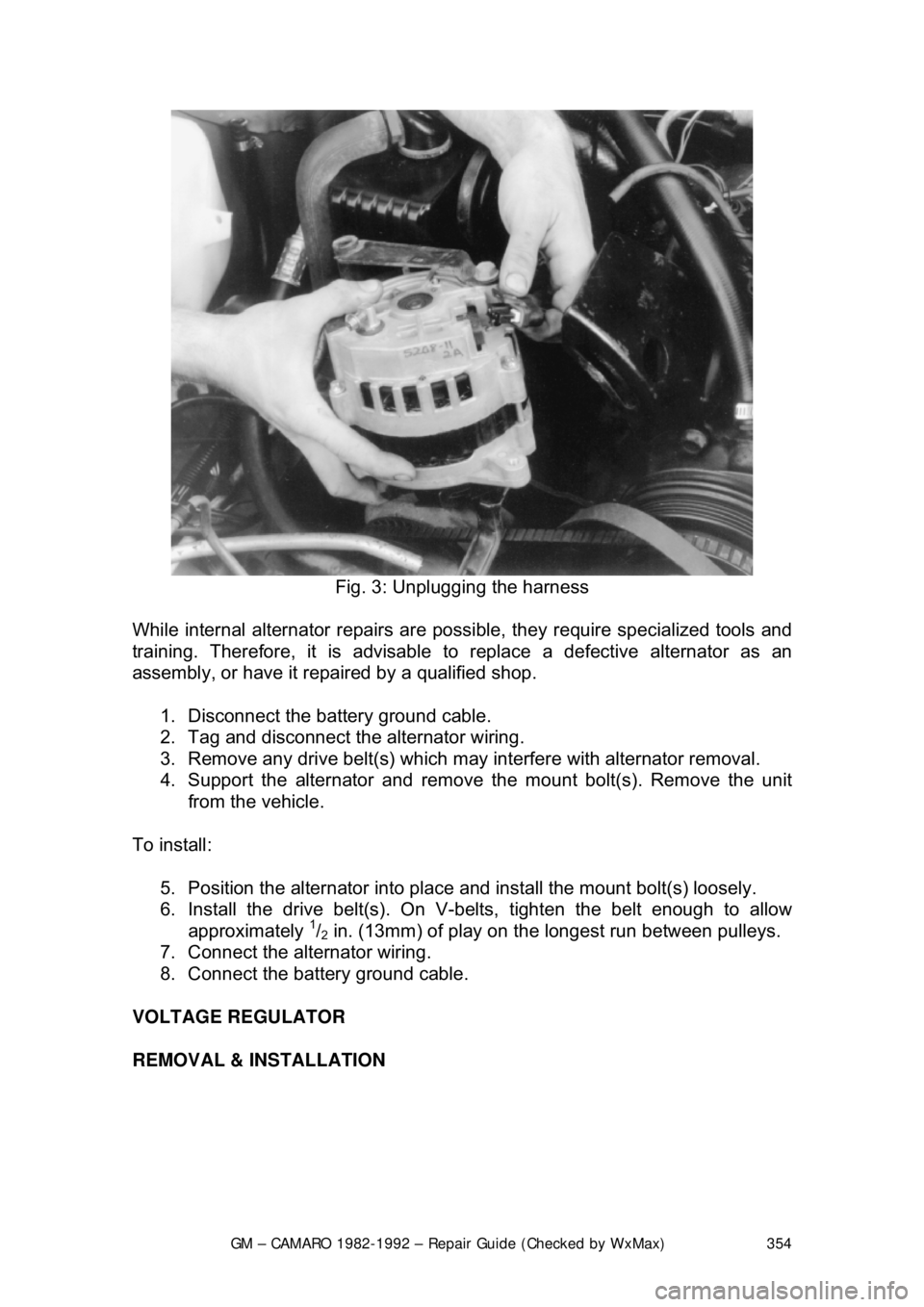
Fig. 3: Unplugging the harness
While internal alternator repairs are possi ble, they require specialized tools and
training. Therefore, it is advisable to replace a defective alternator as an
assembly, or have it repai red by a qualified shop.
1. Disconnect the battery ground cable.
2. Tag and disconnect the alternator wiring.
3. Remove any drive belt(s) which may interfere with alternator removal.
4. Support the alternator and remove the mount bolt(s). Remove the unit
from the vehicle.
To install: 5. Position the alternator into place and install the mount bolt(s) loosely.
6. Install the drive belt(s). On V- belts, tighten the belt enough to allow
approximately
1/2 in. (13mm) of play on the longest run between pulleys.
7. Connect the alternator wiring.
8. Connect the battery ground cable.
VOLTAGE REGULATOR
REMOVAL & INSTALLATION
Page 358 of 875
GM – CAMARO 1982-1992 – Repair Guide (Checked by WxMax) 358
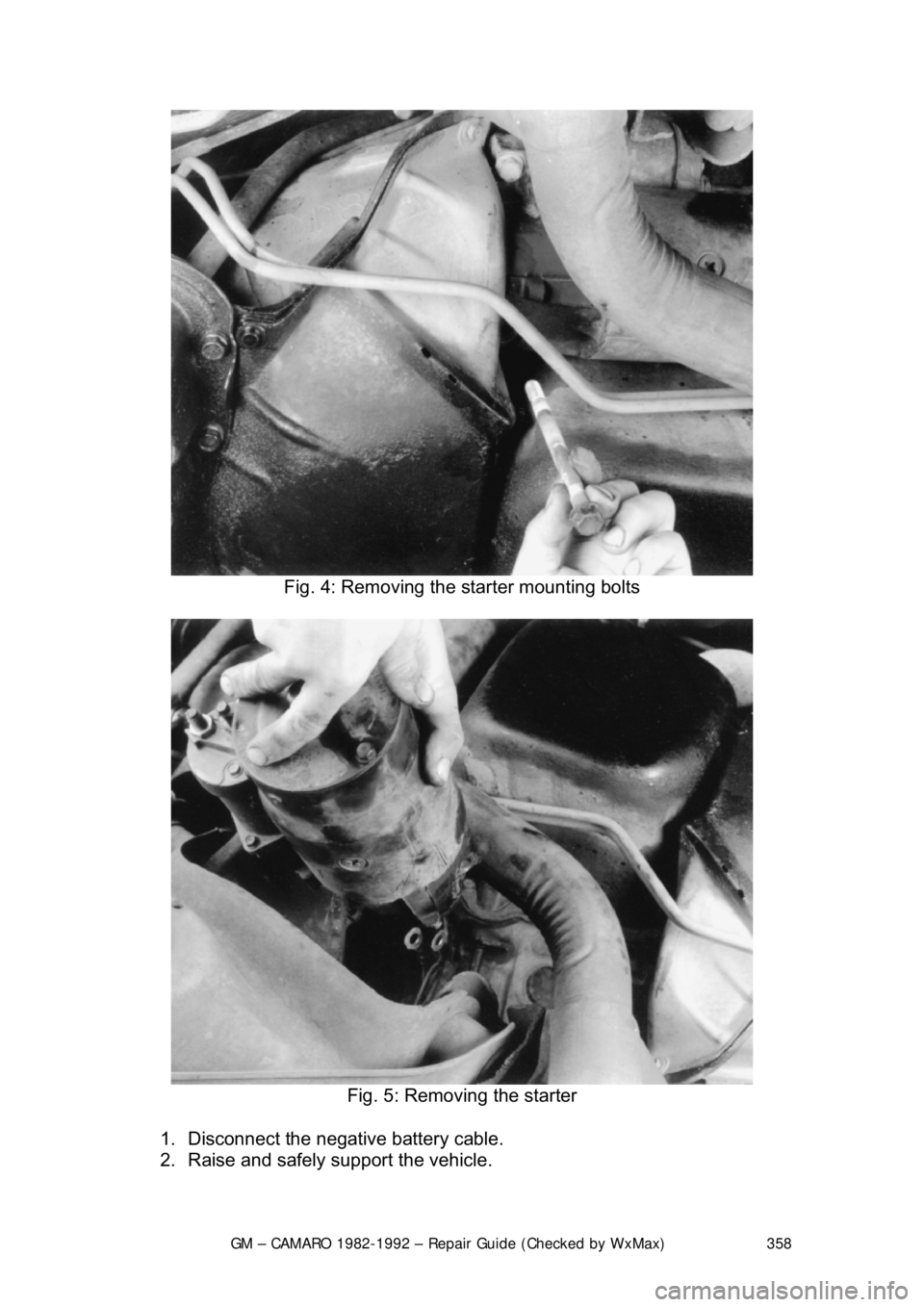
Fig. 4: Removing the starter mounting bolts
Fig. 5: Removing the starter
1. Disconnect the negative battery cable.
2. Raise and safely support the vehicle.
Page 359 of 875

GM – CAMARO 1982-1992 – Repair Guide (Checked by WxMax) 359
3. Disconnect all wiring from the star
ter solenoid. Replace each nut as the
connector is removed (as thread sizes differ from connector to
connector). Note or tag the wiring positions for installation.
4. Remove the bracket from the st arter and the two mounting bolts. On
engines with a solenoid heat shield, remove the front bracket upper bolt
and detach the bracket fr om the starter.
5. Remove the front bracket bolt or nut. Lower the starter front end first, and
then remove the unit from the car.
To install: 6. Position the starter into place and se cure it with the front bracket bolt and
nut. Torque the two mounting bolts to 25-35 ft. lbs.
CAUTION - If shims were removed, they must be replaced to ensure proper
pinion-to-flywheel engagement.
7. On engines with a solenoid heat shield, attach the bracket to the starter.
Install the bracket to the starter and the two mounting bolts. Install the
front bracket upper bolt.
8. Connect all wiring to the starte r solenoid and tighten the nuts.
9. Lower the vehicle.
10. Connect the negative battery cable.
SOLENOID REPLACEMENT 1. Remove the screw and washer from the motor connector strap terminal.
2. Remove the two solenoid retaining screws.
3. Twist the solenoid housing clockwis e to remove the flange key from the
keyway in the housing. Then remove the housing.
4. To re-install the unit, place the re turn spring on the plunger and place the
solenoid body on the driv e housing. Turn counterclockwise to engage the
flange key. Place the two retaining screws in position and install the
screw and washer which secures the strap terminal. Install the unit on
the starter.
SENDING UNITS AND SENSORS
For additional information on engine sensors, refer to Engine Performance &
Tune-up and Engine Controls in this repair guide.
Page 363 of 875
GM – CAMARO 1982-1992 – Repair Guide (Checked by WxMax) 363
2.5L ENGINE
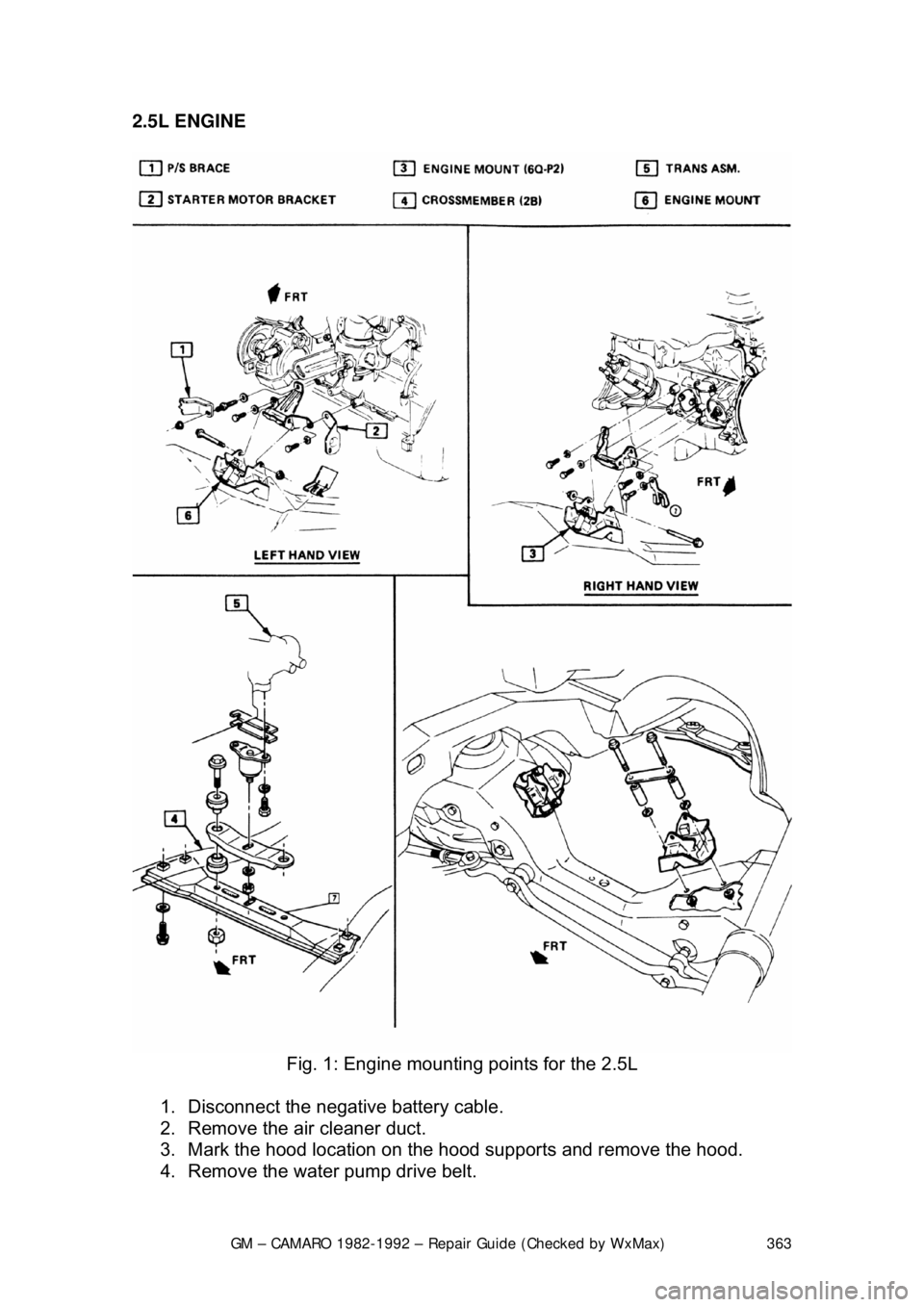
Fig. 1: Engine mountin g points for the 2.5L
1. Disconnect the negative battery cable.
2. Remove the air cleaner duct.
3. Mark the hood location on the hood supports and remove the hood.
4. Remove the water pump drive belt.
Page 365 of 875
GM – CAMARO 1982-1992 – Repair Guide (Checked by WxMax) 365
31. Connect the bulkhead harness connec
tor, wires and hoses. Reroute the
ECM harness in its original location. Install the hush panel and fenderwell
splash panel.
32. Install the radiator, fan and fan sh roud. Connect the radiator and heater
hoses, along with the transmission cooler lines.
33. Connect the vacuum brake booster li ne, the throttle linkage and cruise
control cable. Install the distributor cap.
34. Fill the cooling system with the proper type and amount of coolant and
the crankcase with the proper type of oil to the correct level.
35. Install the water pump drive bel t, the air cleaner duct and the hood.
36. Connect the negative battery cable, st art the engine and check for leaks.
2.8L AND 3.1L ENGINES
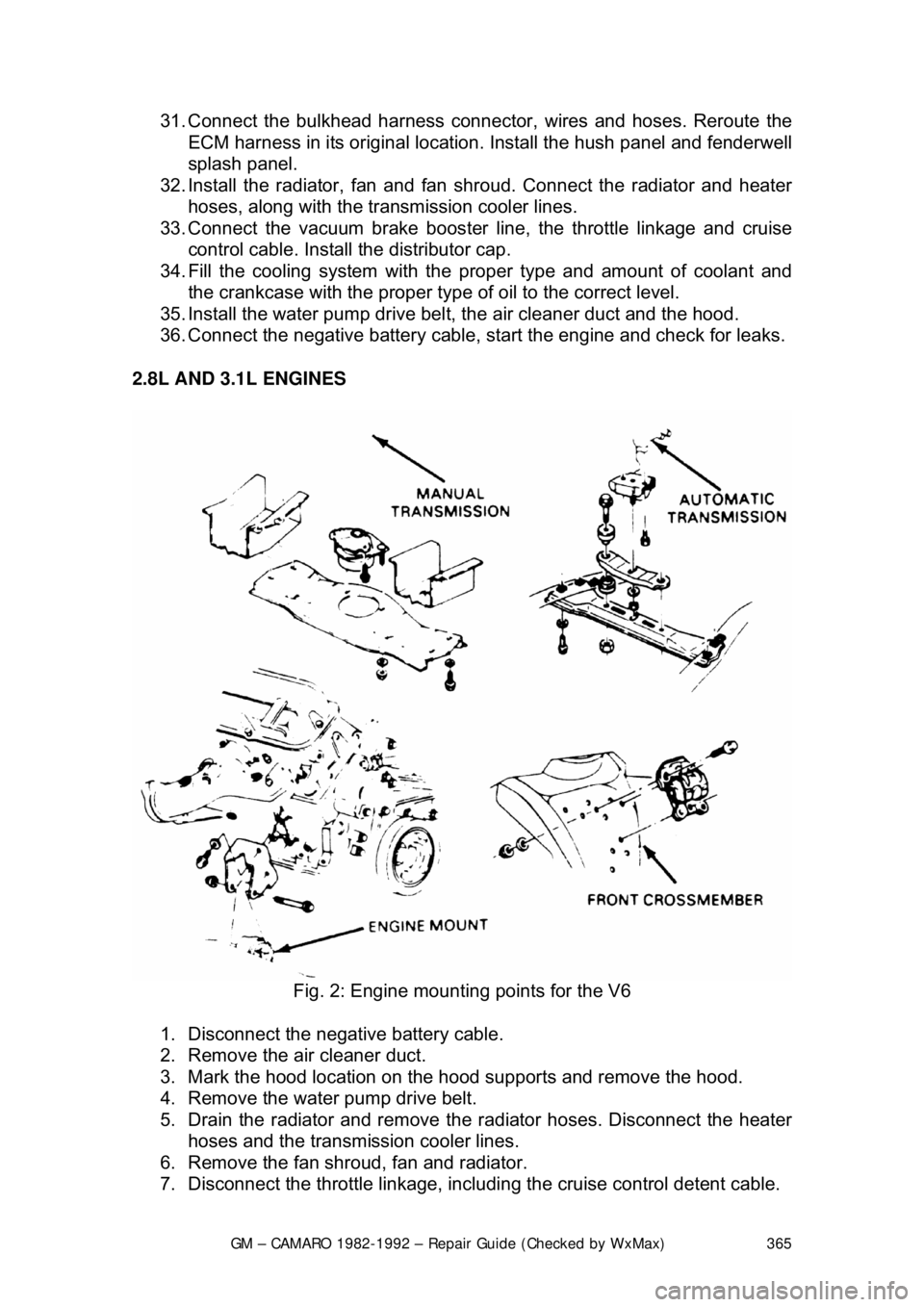
Fig. 2: Engine mountin g points for the V6
1. Disconnect the negative battery cable.
2. Remove the air cleaner duct.
3. Mark the hood location on the hood supports and remove the hood.
4. Remove the water pump drive belt.
5. Drain the radiator and remove t he radiator hoses. Disconnect the heater
hoses and the transmission cooler lines.
6. Remove the fan shroud, fan and radiator.
7. Disconnect the throttle linkage, includi ng the cruise control detent cable.
Page 366 of 875

GM – CAMARO 1982-1992 – Repair Guide (Checked by WxMax) 366
8. Remove the air conditioning co
mpressor and lay aside. Remove the
power steering pump and lay aside.
Do not disconnect the air conditioning or power steering lines.
9. Remove the vacuum brake booster line.
10. Remove the distributor cap and spark plug wires.
11. Disconnect the necessary elec trical connections and hoses.
12. Raise and safely support the vehicle.
13. Disconnect the exhaust pipes at the exhaust manifolds.
14. Remove the flywheel cover and remove the converter bolts.
15. Disconnect the star ter wire connections.
16. Remove the bellhousing and t he motor mount through-bolts.
17. Lower the vehicle.
18. Relieve the fuel system pressu re. Disconnect the fuel lines.
19. Support the transmission with a suit able jack. Attach an engine lifting
device.
20. Remove the engine assembly.
To install: 21. Position the engine assembly in the vehicle.
22. Attach the motor mount to engine br ackets and lower the engine in place.
Remove the engine lifting device and the transmission jack.
23. Raise and support the vehicle safely.
24. Install the motor mount through-bolts and tighten the nuts to 50 ft. lbs. (68 Nm). Install the bellhousing bolts and tighten to 35 ft. lbs. (47 Nm).
25. On vehicles with automatic transmissi on, install the converter to flywheel
attaching bolts to 46 ft. lbs. (63 Nm).
26. Install the flywheel splash shield and tighten to 89 inch lbs. (10 Nm).
27. Connect the starter wires and the fuel lines.
28. Install the exhaust pipe on the exhaust manifold.
29. Lower the vehicle.
30. Install the power steering pump and the air conditioning compressor.
31. Connect the necessary wires and hoses.
32. Install the radiator, fan and fan sh roud. Connect the radiator and heater
hoses and the transmission cooler lines.
33. Connect the vacuum brake booster li ne, the throttle linkage and cruise
control cable. Install the distributor cap.
34. Fill the cooling system with the proper type and amount of coolant and
the crankcase with the proper type of oil to the correct level.
35. Install the water pump drive bel t, the air cleaner duct and the hood.
36. Connect the negative battery cable, st art the engine and check for leaks.
Page 367 of 875
GM – CAMARO 1982-1992 – Repair Guide (Checked by WxMax) 367
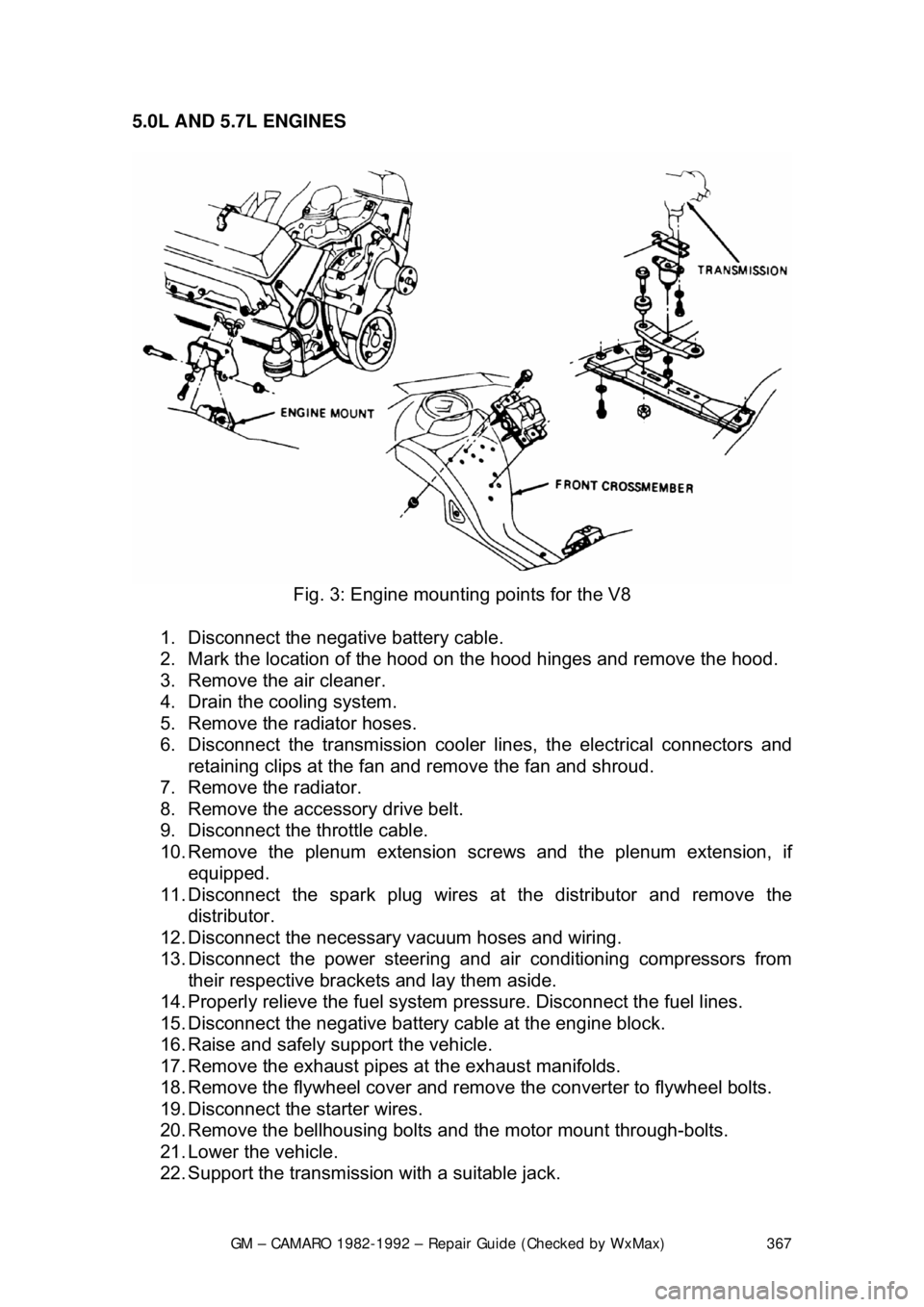
5.0L AND 5.7L ENGINES
Fig. 3: Engine mountin g points for the V8
1. Disconnect the negative battery cable.
2. Mark the location of the hood on the hood hinges and remove the hood.
3. Remove the air cleaner.
4. Drain the cooling system.
5. Remove the radiator hoses.
6. Disconnect the transmission cooler li nes, the electrical connectors and
retaining clips at the fan and remove the fan and shroud.
7. Remove the radiator.
8. Remove the accessory drive belt.
9. Disconnect the throttle cable.
10. Remove the plenum extension scr ews and the plenum extension, if
equipped.
11. Disconnect the spark plug wires at the distributor and remove the
distributor.
12. Disconnect the necessary vacuum hoses and wiring.
13. Disconnect the power steering and air conditioning compressors from
their respective brackets and lay them aside.
14. Properly relieve the fuel system pressure. Disconnect the fuel lines.
15. Disconnect the negative battery cable at the engine block.
16. Raise and safely support the vehicle.
17. Remove the exhaust pipes at the exhaust manifolds.
18. Remove the flywheel cover and remove the converter to flywheel bolts.
19. Disconnect the starter wires.
20. Remove the bellhousing bolts and the motor mount through-bolts.
21. Lower the vehicle.
22. Support the transmission with a suitable jack.