engine oil CHEVROLET CAMARO 1982 Repair Guide
[x] Cancel search | Manufacturer: CHEVROLET, Model Year: 1982, Model line: CAMARO, Model: CHEVROLET CAMARO 1982Pages: 875, PDF Size: 88.64 MB
Page 774 of 875

GM – CAMARO 1982-1992 – Repair Guide (Checked by WxMax) 774
FLUIDS AND LUBRICANTS
FLUID DISPOSAL
Used fluids such as engine
oil, transmission fluid, antifreeze and brake fluid are
hazardous wastes and must be disposed of properly. Befo re draining any fluids,
consult with your local authorities; in many areas waste oil, etc. is being
accepted as a part of recycling programs. A number of service stations and auto
parts stores are also accepti ng waste fluids for recycling.
Be sure of the recycling cent er's policies before draining any fluids, as many will
not accept different fluids that have been mixed together.
FUEL RECOMMENDATIONS
The engine is designed to operate on unleaded gasoline ONLY and is essential
for the proper operation of the emissi on control system. The use of unleaded
fuel will reduce spark plug fouling, exhaust system corrosion and engine oil
deterioration.
In most parts of the United States, f uel with an octane rating of 87 should be
used; in high altitude areas, fuel wit h an octane rating as low as 85 may be
used.
In some areas, fuel consisting of a blen d of alcohol may be used; this blend of
gasoline and alcohol is known as gaso hol. When using gasohol, never use
blends exceeding 10% ethanol (e thyl or grain alcohol) or 5% methanol (methyl
or wood alcohol).
The use of fuel with excessive amounts of alcohol may jeopardize the new car
and emission control system warranties.
Page 775 of 875
GM – CAMARO 1982-1992 – Repair Guide (Checked by WxMax) 775
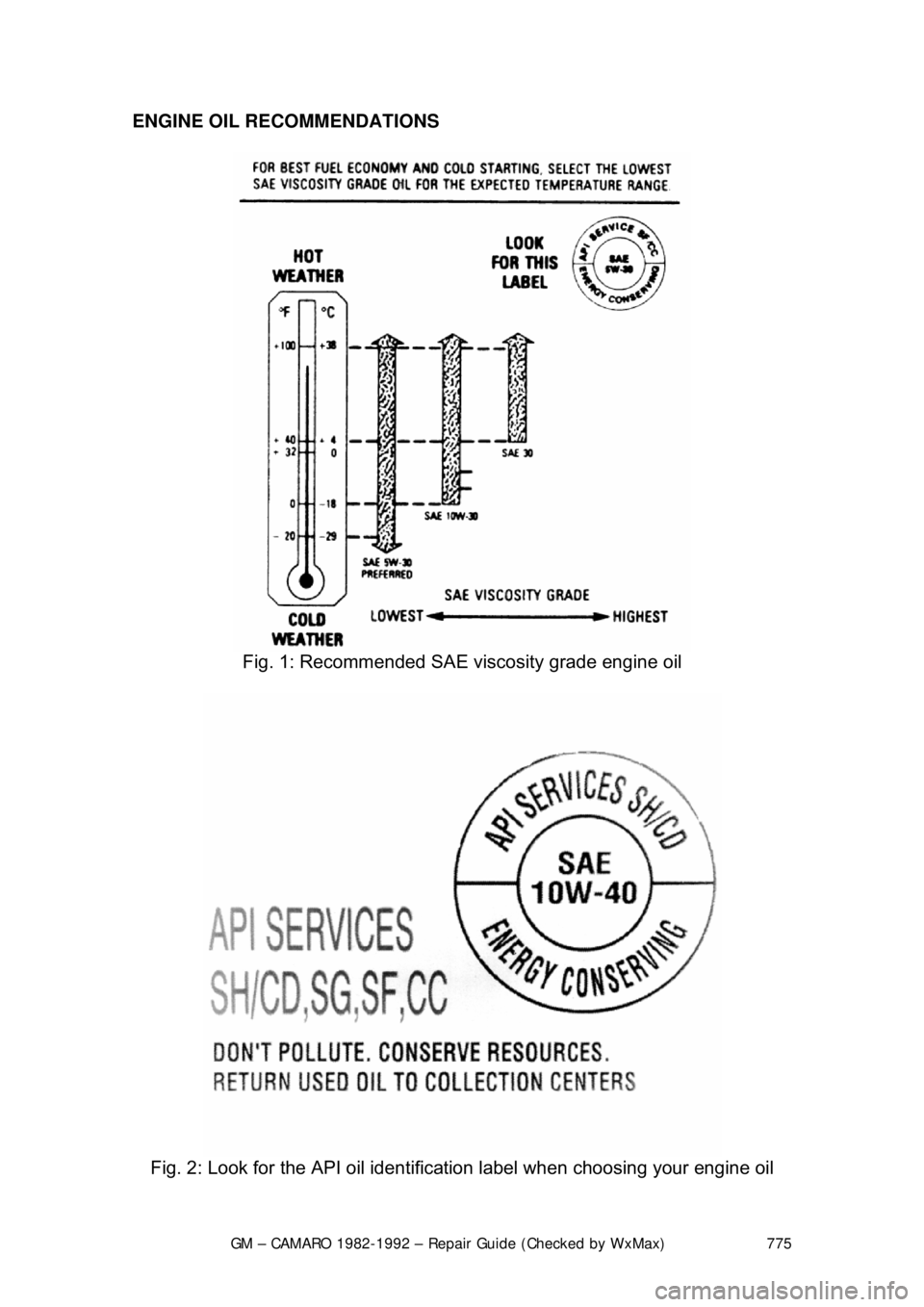
ENGINE OIL RECOMMENDATIONS
Fig. 1: Recommended SAE viscosity grade engine oil
Fig. 2: Look for the API oil identific ation label when choosing your engine oil
Page 776 of 875
GM – CAMARO 1982-1992 – Repair Guide (Checked by WxMax) 776
Use only oil which has the API (Ameri
can Petroleum Institute) designation SG,
CC , CD , SG/CC or SG/CD .
Since fuel economy is effected by the viscosity (thickness) of the engine oil, it is
recommended to select an oil with reference to the outside temperature. For
satisfactory lubrication, us e a lower viscosity oil for colder temperatures and a
higher viscosity oil for warmer temperatures.
ENGINE
OIL LEVEL CHECK
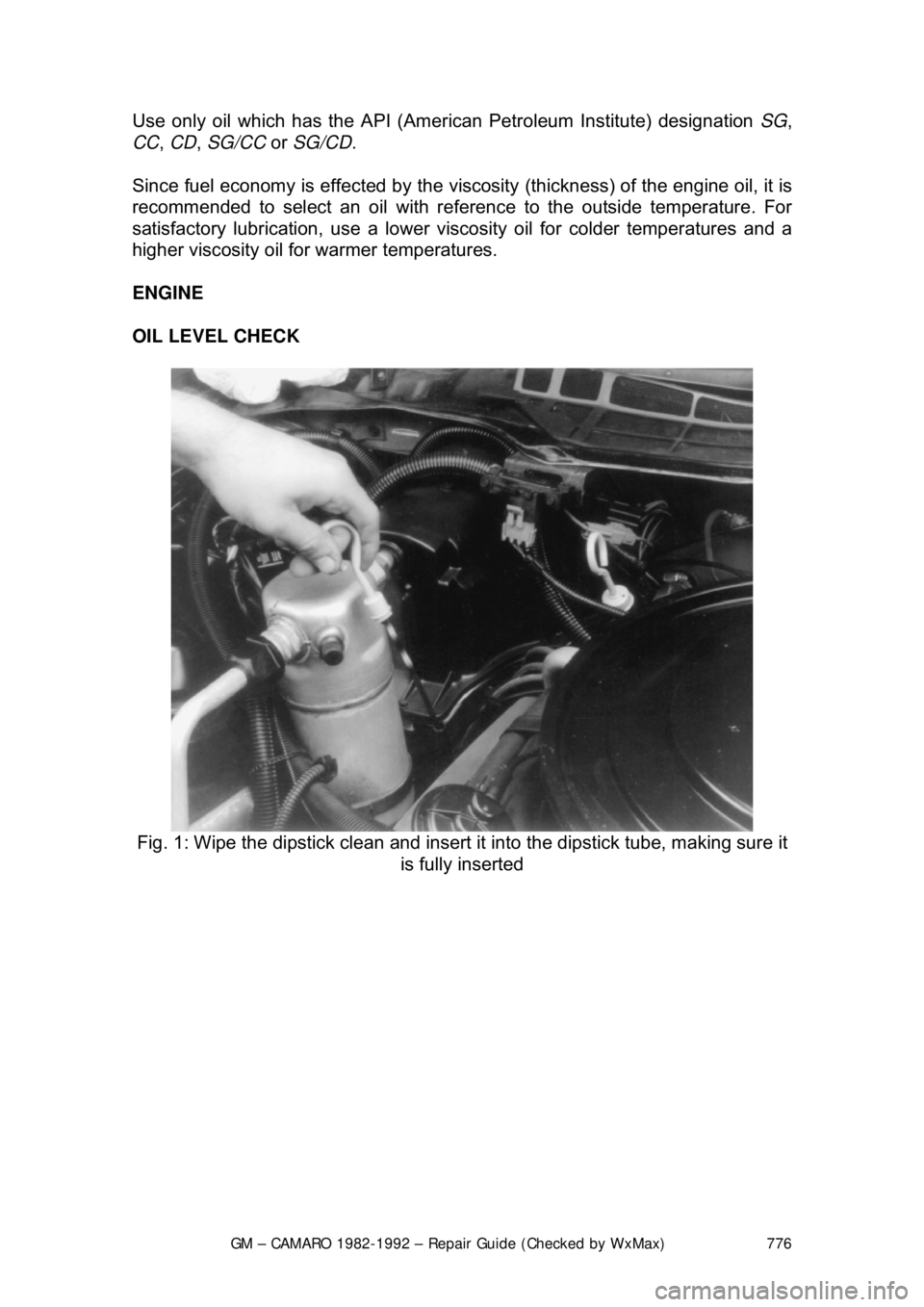
Fig. 1: Wipe the dipstick clean and insert it into the dipstick tube, making sure it
is fully inserted
Page 778 of 875
GM – CAMARO 1982-1992 – Repair Guide (Checked by WxMax) 778
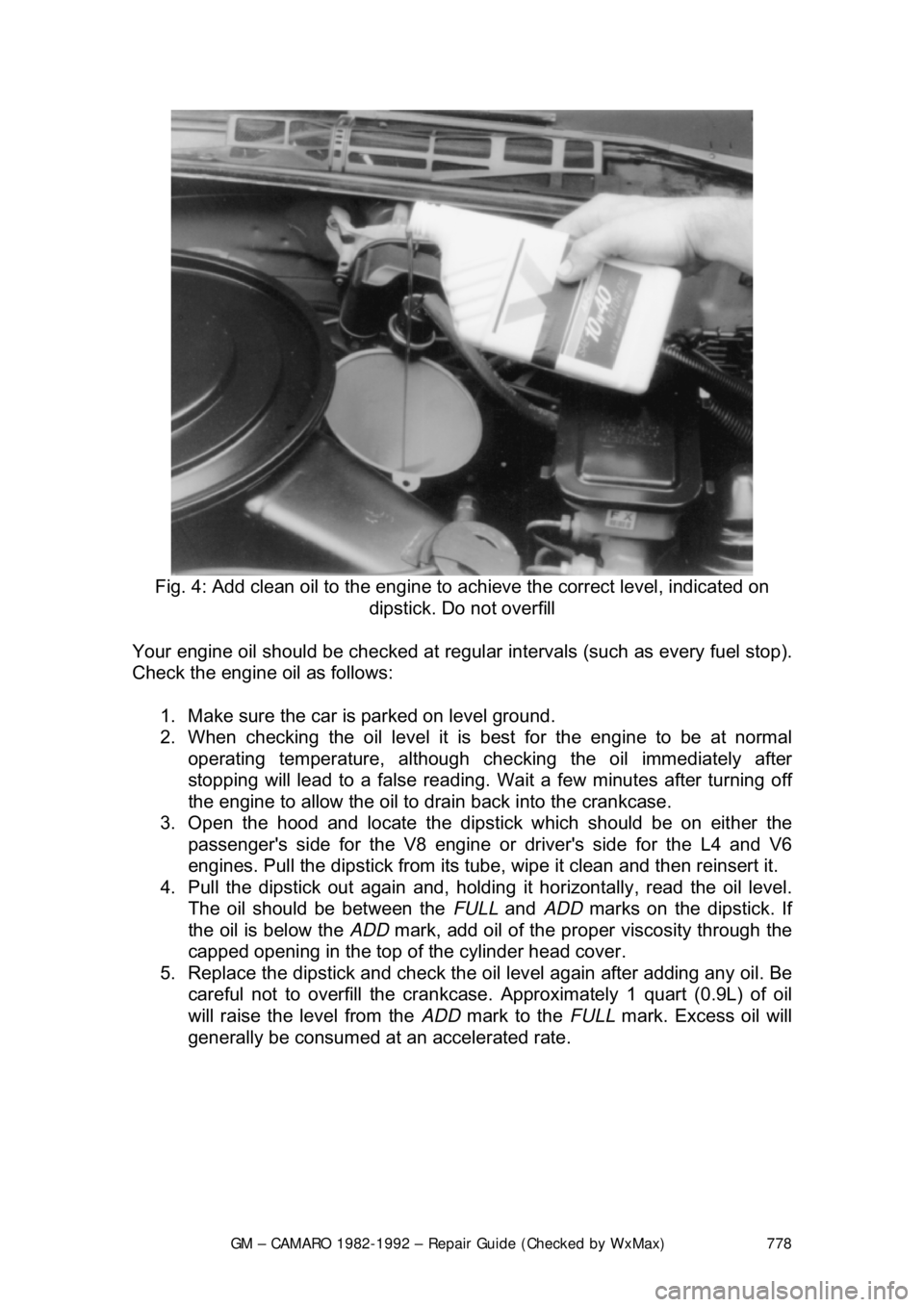
Fig. 4: Add clean oil to the engine to ac hieve the correct level, indicated on
dipstick. Do not overfill
Your engine oil should be checked at regular intervals (such as every fuel stop).
Check the engine oil as follows:
1. Make sure the car is parked on level ground.
2. When checking the oil le vel it is best for the engine to be at normal
operating temperature, although checking the oil immediately after
stopping will lead to a false reading. Wa it a few minutes after turning off
the engine to allow the oil to drain back into the crankcase.
3. Open the hood and locate the dipsti ck which should be on either the
passenger's side for the V8 engine or driver's side for the L4 and V6
engines. Pull the dipstick fr om its tube, wipe it clean and then reinsert it.
4. Pull the dipstick out agai n and, holding it horizontally, read the oil level.
The oil should be between the FULL and ADD marks on the dipstick. If
the oil is below the ADD mark, add oil of the prop er viscosity through the
capped opening in the top of the cylinder head cover.
5. Replace the dipstick and check the o il level again after adding any oil. Be
careful not to overfill the crankcase. Approximately 1 quart (0.9L) of oil
will raise the level from the ADD mark to the FULL mark. Excess oil will
generally be consumed at an accelerated rate.
Page 779 of 875

GM – CAMARO 1982-1992 – Repair Guide (Checked by WxMax) 779
ENGINE OIL AND FILTER CHANGE
Under normal operating conditions, the oi
l is to be changed every 7,500 miles
(12,000km) or 12 months, whichever occurs first.
Although the manufacturer recommends changing the f ilter at the first oil
change and then at every other oil c hange, (unless 12 months pass between
changes), The editors of this informat ion recommend changing the filter with
each service. It is a small price to pay for extra protection.
When driving conditions frequently include dusty or polluted areas, trailer
towing, idling for long periods of ti me, or low speed operation, or when
operating at temperatures below freezing or driving short distances (under 4
miles or 6.4km), change t he oil and filter more frequently. Under these
circumstances, oil has a greater chance of building up sludge and contaminants
which could damage your engine. If your v ehicle use fits into one or more of
these categories, (as it does for most vehicles), it is suggested that the oil and
filter be changed every 3, 000 miles (1361km) or 3 months, whichever comes
first.
The oil should be disposed of properly after it is drained from the vehicle. Store
the oil in a suitable container and take the container to an official oil recycling
station. Most gas stations or oil and lube facilities will take the used oil at little or
no expense to you.
Oil should always be changed after the engine has been running long enough to
bring it up to normal operating temperature. Hot oil will flow more easily and will
carry more contaminants than will cold oi l. The oil drain plug is located on the
bottom of the oil pan (bottom of the engi ne, underneath the car). The oil filter is
located on the left side of most engines covered by this information. To change
the oil and filter:
1. Run the engine until it reaches normal operating temperature.
2. Raise the front of the vehicle and s upport it safely using a suitable pair of
jackstands.
3. Slide a drain pan of a least 6 quar ts capacity under the oil pan. Wipe the
drain plug and surrounding area clean using an old rag.
CAUTION - The EPA warns that prolonged contact with used engine oil may
cause a number of skin disorders, incl uding cancer! You should make every
effort to minimize your exposure to used engine oil. Pr otective gloves should be
worn when changing the oil. Wash y our hands and any other exposed skin
areas as soon as possible after exposure to used engine oil. Soap and water, or
waterless hand cleaner should be used.
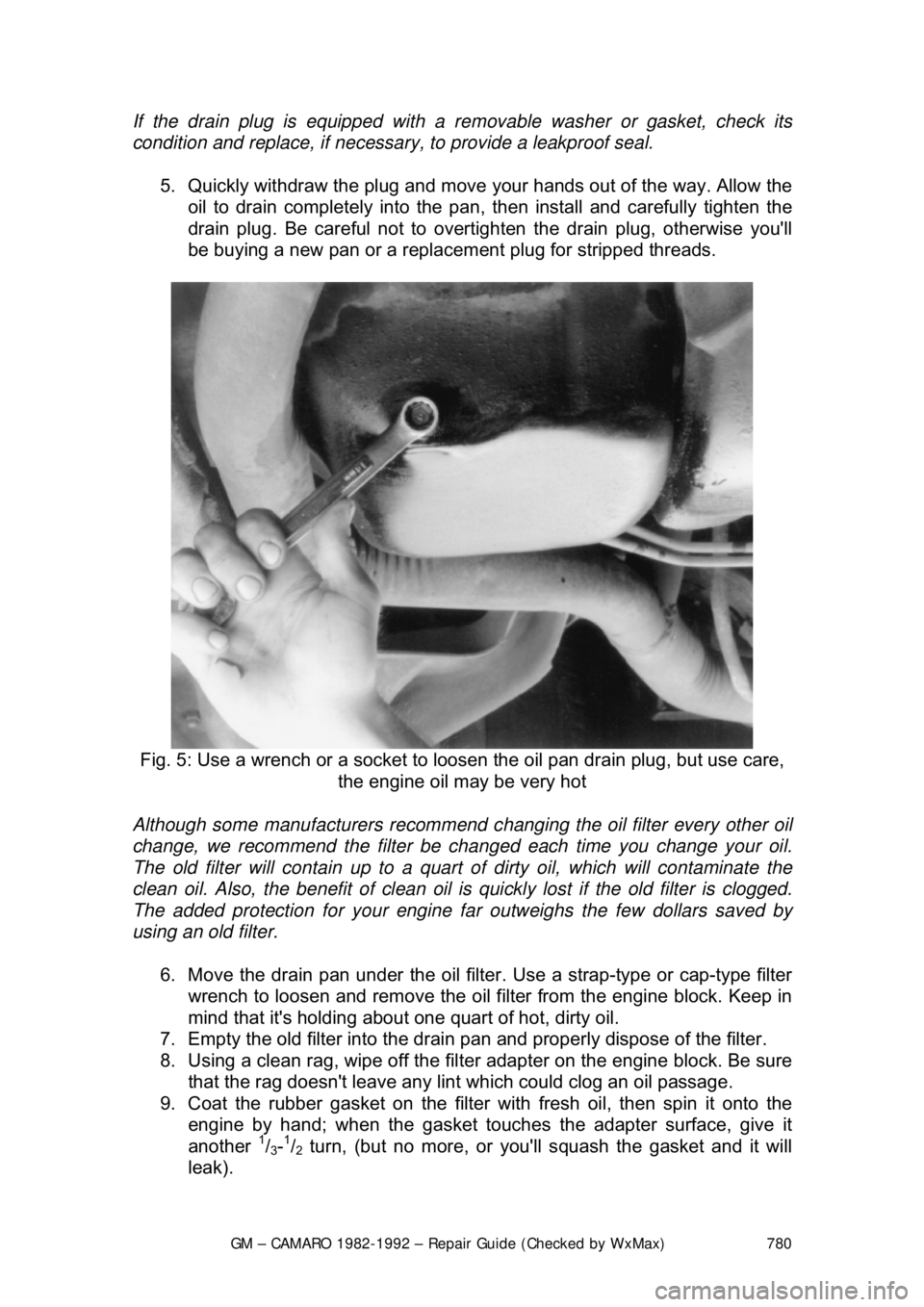
4. Loosen the drain plug using a ratc het, short extension and socket or a
box-wrench. Turn the plug out by hand, using a rag to shield your fingers
from the hot oil. By keeping an in ward pressure on the plug as you
unscrew it, oil won't escape past the threads and you can remove it
without being burned by hot oil.
Page 780 of 875
GM – CAMARO 1982-1992 – Repair Guide (Checked by WxMax) 780
If the drain plug is equipped with a re
movable washer or gasket, check its
condition and replace, if necessary , to provide a leakproof seal.
5. Quickly withdraw the plug and move your hands out of the way. Allow the
oil to drain completely into the pan, then install and carefully tighten the
drain plug. Be careful not to overtighten the drain plug, otherwise you'\
ll
be buying a new pan or a replacem ent plug for stripped threads.
Fig. 5: Use a wrench or a socket to l oosen the oil pan drain plug, but use care,
the engine oil may be very hot
Although some manufacturers recommend c hanging the oil filter every other oil
change, we recommend the filter be chan ged each time you change your oil.
The old filter will contain up to a quart of dirty oil, which will contaminate the
clean oil. Also, the benefit of clean oil is quickly lost if the old filter is clogged.
The added protection for your engine far outweighs the few dollars saved by
using an old filter.
6. Move the drain pan under the oil filter. Use a strap-type or cap-type filter
wrench to loosen and remove the oil f ilter from the engine block. Keep in
mind that it's holding about one quart of hot, dirty oil.
7. Empty the old f ilter into the drain pan and proper ly dispose of the filter.
8. Using a clean rag, wipe off the filt er adapter on the engine block. Be sure
that the rag doesn't leave any lint which could clog an oil passage.
9. Coat the rubber gasket on the filter with fresh oil, then spin it onto the
engine by hand; when the gasket touches the adapter surface, give it
another
1/3-1/2 turn, (but no more, or you'll squash the gasket and it will
leak).
Page 782 of 875

GM – CAMARO 1982-1992 – Repair Guide (Checked by WxMax) 782
10. Refill the engine with the correct amount
of fresh oil. Please refer to the
Capacities chart at the end of this section.
11. Check the oil level on the dipstick. It is normal for the level to be a bit
above the full mark. Start the engine and allow it to idle for a few
minutes.
CAUTION - Do not run the engi ne above idle speed until it has built up oil
pressure, as indicated w hen the oil light goes out
12. Shut off the engine and allow the oil to flow back to the crankcase for a
minute, then recheck the oil level. C heck around the filter and drain plug
for any leaks, and correct as necessary.
MANUAL TRANSMISSIONS
FLUID RECOMMENDATIONS
• 1982-85 4-speed manual transmissi ons - SAE 80W/90 GL-5 gear
lubricant
• 1986-87 4-speed manual transmission - Dexron®®II automatic
transmission fluid
• 1982-84 5-speed manual transmissions - use SAE 80W/90 GL-5 gear
lubricant (SAE 80W GL-5 in Canada)
• 1985-92 5-speed manual transmissi ons - Dexron®II automatic
transmission fluid
LEVEL CHECK
The oil in the manual tr ansmission should be check ed every 12 months or
15,000 miles.
1. Raise the car and support on jackstands as close to level as possible. \
2. Remove the filler plug from the side of the transmission housing.
3. If lubricant begins to trickle out of the hole, there is enough and you need
not go any further. Otherwise, carefully insert your finger (watch out for
sharp threads) and check to see if the oil is up to the edge of the hol\
e.
4. If not, add oil through the hole until the level is at the edge of the hole.
Most lubricants come in a plasti c squeeze bottle with a nozzle; making
additions simple.
5. Install and tighten the filler plug.
DRAIN AND REFILL
The fluid in the manual transmission do es not require changing. If you do
choose to change the transmission fluid, the fluid can be drained out through
the lower drain plug hole on the side of the transmission. Fill the transmission
with the recommended lubricant to the bottom of the filler plug hole and install
the filler plug.
Page 783 of 875
GM – CAMARO 1982-1992 – Repair Guide (Checked by WxMax) 783
AUTOMATIC TRANSMISSION
FLUID RECOMMENDATIONS
Use only Dexron®II Automati
c Transmission Fluid.
LEVEL CHECK
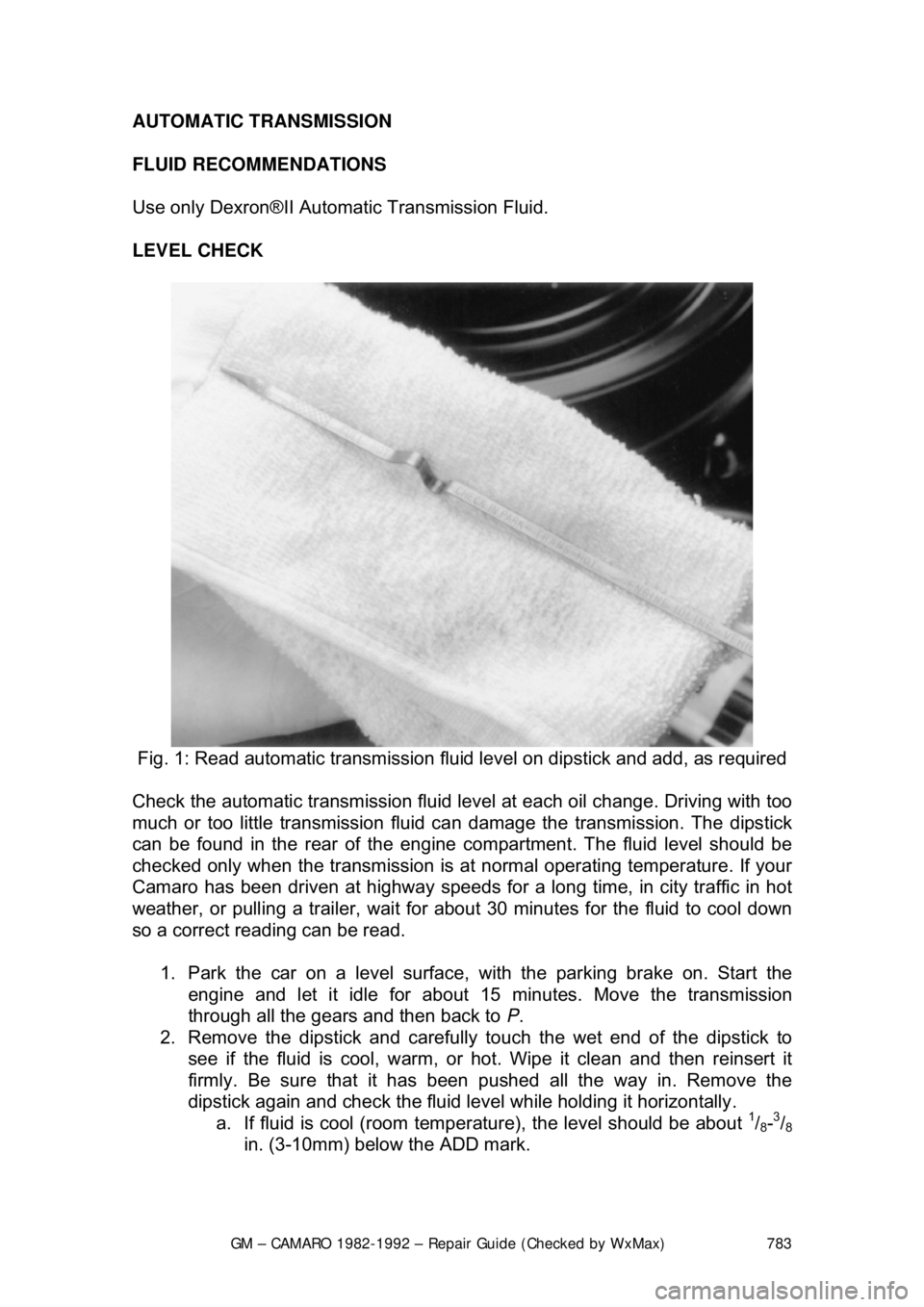
Fig. 1: Read automatic transmission flui d level on dipstick and add, as required
Check the automatic transmission fluid le vel at each oil change. Driving with too
much or too little transmission fluid ca n damage the transmission. The dipstick
can be found in the rear of the engine compartment. The fluid level should be
checked only when the transmission is at normal operating temperature. If your
Camaro has been driven at highway speeds fo r a long time, in city traffic in hot
weather, or pulling a trailer, wait for about 30 minutes for the fluid to cool down
so a correct reading can be read.
1. Park the car on a level surface, with the parking brake on. Start the
engine and let it idle for about 15 minutes. Move the transmission
through all the gears and then back to P.
2. Remove the dipstick and carefully touch the wet end of the dipstick to see if the fluid is cool, warm, or ho t. Wipe it clean and then reinsert it
firmly. Be sure that it has been pushed all the way in. Remove the
dipstick again and check the fluid leve l while holding it horizontally.
a. If fluid is cool (room temper ature), the level should be about
1/8-3/8
in. (3-10mm) below the ADD mark.
Page 802 of 875

GM – CAMARO 1982-1992 – Repair Guide (Checked by WxMax) 802
BODY LUBRICATION
HOOD LATCH AND HINGES
Clean the latch surfaces and
apply clean engine oil to the latch pilot bolts and
the spring anchor. Use the engine oil to l ubricate the hood hinges as well. Use a
chassis grease to lubricate all the pivot points in the latch release mechanism.
DOOR HINGES
The gas tank filler door, car door, and rear hatch or trunk lid hinges should be
wiped clean and lubricated with clean engi ne oil. Silicone spray also works well
on seals, but must be applied more often. Use engine oil to lubricate the trunk
or hatch lock mechanism and the lock bo lt and striker. The door lock cylinders
can be lubricated easily with a shot of silicone spray or one of the many dry
penetrating lubricants commercially available.
PARKING BRAKE LINKAGE
Use chassis grease on the parking brake c able where it contacts the guides,
links, levers, and pulleys. The grease s hould be water resistant for durability.
ACCELERATOR LINKAGE
Lubricate the throttle lever, and the accele rator pedal lever at the support inside
the car with clean engine oil.
TRANSMISSION SHIFT LINKAGE
Lubricate the shift linkage with water re sistant chassis grease which meets GM
Specification 6031M or its equal.
FRONT WHEEL BEARINGS
Once every 30,000 miles, clean and repack wheel bearings with a wheel
bearing packer. Remove any excess grea se from the exposed surface of the
hub and seal.
REMOVAL, REPACKING, INSTA LLATION AND ADJUSTMENT
WARNING - It is important that wheel b earings be properly adjusted after
installation. Improperly adj usted wheel bearings can c ause steering instability,
front end shimmy and wander, and increased tire wear.
1. Raise the car and support it at the lower arm. Remove the tire and wheel
assembly.
2. Remove the brake caliper and support it on a wire.
3. Remove the dust cap, cotter pin, ca stle nut, thrust washer and outside
wheel bearing.
4. Pull the disc/hub assembly from the steering knuckle.
Page 839 of 875

GM – CAMARO 1982-1992 – Repair Guide (Checked by WxMax) 839
COIL SPRINGS
REMOVAL & INSTALLATION
1. Raise the car by the frame so that the rear axle can be independently
raised and lowered.
2. Support the rear axle with a floor jack.
3. If equipped with brake hose attaching brackets, disconnect the brackets
allowing the hoses to hang free. Do not disconnect the hoses. Perform
this step only if the hoses woul d otherwise be stretched and damaged
when the axle is lowered.
4. Disconnect the track bar from the axle.
5. Remove the lower shock absorber bol ts and lower the axle. Make sure
the axle is supported securely on t he floor jack and that there is no
chance of the axle slipping after the shock absorbers are disconnected.
On vehicles equipped with a 4-cylinder engine, remove the driveshaft.
6. Lower the axle and remove the coil spring. Do not lower the axle past th\
e limits of the brake lines or the lines will be damaged.
To install: 7. Position spring with the axle lowered.
8. On vehicles equipped with 4-cylinder engines, install the driveshaft.
9. Raise the axle and install the lower shock absorber bolts.
10. Connect the track bar to the axle.
11. Connect the brake hose attaching brackets, if removed.
12. Remove the support from the rear axle.
13. Lower the vehicle.