engine oil CHEVROLET CAMARO 1982 Repair Guide
[x] Cancel search | Manufacturer: CHEVROLET, Model Year: 1982, Model line: CAMARO, Model: CHEVROLET CAMARO 1982Pages: 875, PDF Size: 88.64 MB
Page 476 of 875

GM – CAMARO 1982-1992 – Repair Guide (Checked by WxMax) 476
Before attempting to repair a threaded
hole, remove any snapped, broken or
damaged bolts or studs. Penetrating oil ca n be used to free frozen threads. The
offending item can usually be removed with locking pliers or using a screw/stud
extractor. After the hole is clear, the thread can be repaired, as shown in the
series of accompanying illustrations and in the kit manufacturer's instructions.
ENGINE PREPARATION
To properly rebuild an engine, you must fi rst remove it from the vehicle, then
disassemble and diagnose it. Ideally you should place your engine on an engine
stand. This affords you the best access to the engine components. Follow the
manufacturer's directions for using the stand with your particular engine.
Remove the flywheel or fl explate before installing the engine to the stand.
Now that you have the engine on a stand, and assuming that you have drained
the oil and coolant from the engine, it's ti me to strip it of all but the necessary
components. Before you start disassembli ng the engine, you may want to take
a moment to draw some pictures, or fabr icate some labels or containers to mark
the locations of various components and the bolts and/or studs which fasten
them. Modern day engines use a lot of littl e brackets and clips which hold wiring
harnesses and such, and these holders are often mounted on studs and/or bolts
that can be easily mixed up. The manufacturer spent a lot of time and money
designing your vehicle, and they wouldn't have wasted any of it by haphazardly
placing brackets, clips or fasteners on t he vehicle. If it's present when you
disassemble it, put it back when you asse mble, you will regret not remembering
that little bracket which holds a wire har ness out of the path of a rotating part.
You should begin by unbolting any accessories still attached to the engine, such
as the water pump, power steering pump, alternator, etc. Then, unfasten any
manifolds (intake or exhaust) which were not removed during the engine
removal procedure. Finally, remove any covers remaining on the engine such
as the rocker arm, front or timing cove r and oil pan. Some front covers may
require the vibration dam per and/or crank pulley to be removed beforehand.
The idea is to reduce the engine to the bar e necessities (cylinder head(s), valve
train, engine block, crankshaft, pistons and connecting rods), plus any other 'in
block' components such as oil pumps, balance shafts and auxiliary shafts.
Finally, remove the cylinder head(s) from the engine block and carefully place
on a bench. Disassembly instructions fo r each component follow later in this
section.
CYLINDER HEAD
There are two basic types of cylinder heads used on today’s automobiles:
the Overhead Valve (OHV) and the Over head Camshaft (OHC). The latter can
also be broken down into two subgr oups: the Single Overhead Camshaft
(SOHC) and the Dual Overhead Camshaft (DO HC). Generally, if there is only a
single camshaft on a head, it is just referred to as an OHC head. Also, an
engine with a OHV cylinder head is also known as a pushrod engine.
Page 477 of 875

GM – CAMARO 1982-1992 – Repair Guide (Checked by WxMax) 477
Most cylinder heads these days are made of
an aluminum alloy due to its light
weight, durability and heat transfer qualit ies. However, cast iron was the
material of choice in the past, and is st ill used on many vehicles today. Whether
made from aluminum or iron, all cylinder heads hav e valves and seats. Some
use two valves per cylinder, while the more hi-tech engines will utilize a multi-
valve configuration using 3, 4 and
even 5 valves per cylinder. When the va lve contacts the seat, it does so on
precision machined surfaces, which seal s the combustion chamber. All cylinder
heads have a valve guide for each valve. The guide centers the valve to the
seat and allows it to move up and down within it. The clearance between the
valve and guide can be critical. Too much clearance and the engine may
consume oil, lose vacuum and/or damage the seat. Too little, and the valve can
stick in the guide causing t he engine to run poorly if at all, and possibly causing
severe damage. The last component all cylinder heads have are valve springs.
The spring holds the valve against its s eat. It also returns the valve to this
position when the valve has been opened by the valve train or camshaft. The
spring is fastened to the valve by a retainer and valve locks (sometime\
s called
keepers). Aluminum heads will also have a valve spring shim to keep the spring
from wearing away the aluminum.
An ideal method of rebuilding the cylin der head would involve replacing all of
the valves, guides, seats, springs, et c. with new ones. However, depending on
how the engine was maintained, often this is not necessary. A major cause of
valve, guide and seat wear is an improperly tuned engine. An engine that is
running too rich, will often wash the lubric ating oil out of the guide with gasoline,
causing it to wear rapidly. Conversely, an engine which is running too lean will
place higher combustion temperatures on the valves and seats allowing them to
wear or even burn. Springs fall victim to the driving habits of the individual. A
driver who often runs the engine rpm to the redline will wear out or break the
springs faster then one that stays well below it. Unfortunately, mileage takes it
toll on all of the parts. G enerally, the valves, guides, springs and seats in a
cylinder head can be machined and re-used, saving you money. However, if a
valve is burnt, it may be wise to replace all of the valves, since they were all
operating in the same environment. The same goes for any other component\
on
the cylinder head. Think of it as an insurance policy against future problems
related to that component.
Unfortunately, the only way to find out wh ich components need replacing, is to
disassemble and carefully check each piece. After the cylinder head(s) are
disassembled, thoroughly clean all of the components.
DISASSEMBLY
Before disassembling the cylinder head, you may want to fabricate some
containers to hold the various parts, as some of them can be quite small (such
as keepers) and easily lost. Also keeping yourself and the components
organized will aid in assembly and reduce confusion. Where possible, try to
maintain a components original location; th is is especially important if there is
not going to be any machine work performed on the components.
Page 489 of 875

GM – CAMARO 1982-1992 – Repair Guide (Checked by WxMax) 489
There is no repair or refinishing possi
ble with the springs, retainers and valve
locks. If they are found to be worn or defective, they must be replaced with new
(or known good) parts.
CYLINDER HEAD
Most refinishing procedures dealing wit h the cylinder head must be performed
by a machine shop. Read the informati on below and review your inspection
data to determine whether or not machining is necessary.
VALVE GUIDE
If any machining or replacements are made to the valve guides, the seats must
be machined.
Unless the valve guides need machining or replacing, the only service to\
perform is to thoroughly clean them of any dirt or oil residue.
There are only two types of valve gu ides used on automobile engines: the
replaceable-type (all alumi num heads) and the cast-in in tegral-type (most cast
iron heads). There are four recommended methods for repairing worn guides.
• Knurling
• Inserts
• Reaming oversize
• Replacing
Knurling is a process in which metal is displaced and raised, thereby reducing
clearance, giving a true center, and providing oil control. It is the least
expensive way of repairing the valve guides . However, it is not necessarily the
best, and in some cases, a knurled valve guide will not stand up for more than a
short time. It requires a special knurle r and precision reaming tools to obtain
proper clearances. It would not be cost effective to purchase these tools, unless
you plan on rebuilding several of the same cylinder head.
Installing a guide insert involves machin ing the guide to accept a bronze insert.
One style is the coil-type wh ich is installed into a threaded guide. Another is the
thin-walled insert where the guide is ream ed oversize to accept a split-sleeve
insert. After the insert is installed, a s pecial tool is then run through the guide to
expand the insert, locking it to the guide. The insert is then reamed to the
standard size for proper valve clearance.
Reaming for oversize valves restores normal clearances and provides a true
valve seat. Most cast-in type guides can be reamed to accept an valve wi\
th an
oversize stem. The cost factor for this can become quite high as you will need
to purchase the reamer and new, oversize stem valves for all guides which
were reamed. Oversizes ar e generally 0.003 to 0.030 in. (0.076 to 0.762mm),
with 0.015 in. (0.381mm) being the most common.
Page 491 of 875

GM – CAMARO 1982-1992 – Repair Guide (Checked by WxMax) 491
The first step for any assembly job is
to have a clean area in which to work.
Next, thoroughly clean all of the parts and components that are to be
assembled. Finally, place all of the co mponents onto a suitable work space and,
if necessary, arrange the parts to their respective positions.
1. Lightly lubricate the valve stems and insert all of the valves into the
cylinder head. If possible, maintain their original locations.
2. If equipped, install any valve spring shims which were removed.
3. If equipped, install the new valve seal s, keeping the following in mind:
• If the valve seal presses over the guide, lightly lubricate the outer
guide surfaces.
• If the seal is an O-ring type, it is installed just after compressing
the spring but before the valve locks.
4. Place the valve spring and retainer over the stem.
5. Position the spring compressor tool and compress the spring.
6. Assemble the valv e locks to the stem.
7. Relieve the spring pressure slowly and insure that neither valve lock
becomes dislodged by the retainer.
8. Remove the spring compressor tool.
9. Repeat Steps 2 through 8 until all of the springs have been installed.
ENGINE BLOCK
GENERAL INFORMATION
A thorough overhaul or rebuild of an engine block would include replacing the
pistons, rings, bearings, timing belt/chai n assembly and oil pump. For OHV
engines also include a new camshaft and lifters. The block would then have the
cylinders bored and honed oversize (or if using removable cylinder sleeves,
new sleeves installed) and the cranksha ft would be cut undersize to provide
new wearing surfaces and per fect clearances. However, your particular engine
may not have everything worn out. What if only the piston rings have worn out
and the clearances on everything else are still within factory specifications?
Well, you could just replace the rings and put it back together, but this would be
a very rare example. Chances are, if one component in your engine is worn,
other components are sure to follow, and soon. At the very least, you should
always replace the rings, bearings and oil pump. This is what is commonly
called a "freshen up".
CYLINDER RIDGE REMOVAL
Because the top piston ring does not travel to the very top of the cylinder, a
ridge is built up between the end of the trav el and the top of the cylinder bore.
Pushing the piston and connecting rod assembly past the ridge can be difficult,
and damage to the piston ring lands could occur. If the ridge is not removed
before installing a new piston or not re moved at all, piston ring breakage and
piston damage may occur.
Page 492 of 875

GM – CAMARO 1982-1992 – Repair Guide (Checked by WxMax) 492
It is always recommended that you remo
ve any cylinder ridges before removing
the piston and connecting rod assemblies . If you know that new pistons are
going to be installed and the engine bl ock will be bored oversize, you may be
able to forego this step. However, some ridges may actually prevent the
assemblies from being remove d, necessitating its removal.
There are several different types of ridge reamers on the market, none of which
are inexpensive. Unless a great deal of engine rebuild ing is anticipated, borrow
or rent a reamer.
1. Turn the crankshaft until the piston is at the bottom of its travel.
2. Cover the head of the piston with a rag.
3. Follow the tool manufacturers in structions and cut away the ridge,
exercising extreme care to avoid cutting too deeply.
4. Remove the ridge reamer, the r ag and as many of the cuttings as
possible. Continue until all of the cylinder ridges have been removed.
DISASSEMBLY
The engine disassembly instructions fo llowing assume that you have the engine
mounted on an engine stand. If not, it is easiest to disassemble the engine on a
bench or the floor with it resting on t he bellhousing or transmission mounting
surface. You must be able to access the connecting rod fasteners and turn the
crankshaft during disassembly. Also, all en gine covers (timing, front, side, oil
pan, whatever) should have already been removed. Engines which are seized
or locked up may not be able to be co mpletely disassembled, and a core
(salvage yard) engine should be purchased.
If not done during the cylinder head removal, remove the pushrods and li\
fters,
keeping them in order for assembly. Remove the timing gears and/or timing
chain assembly, then remove the oil pu mp drive assembly and withdraw the
camshaft from the engine block. Remove the oil pick-up and pump assembly. If
equipped, remove any balanc e or auxiliary shafts. If necessary, remove the
cylinder ridge from the top of the bore. See the cylinder ridge removal
procedure earlier in this section.
Rotate the engine over so that the cr ankshaft is exposed. Use a number punch
or scribe and mark each connecting rod wit h its respective cylinder number. The
cylinder closest to the front of t he engine is always number 1. However,
depending on the engine placemen t, the front of the engine could either be the
flywheel or damper/pulley end. Generally the front of the engine faces the front
of the vehicle. Use a number punch or scribe and also mark the main bearing
caps from front to rear wit h the front most cap being nu mber 1 (if there are five
caps, mark them 1 through 5, front to rear).
Page 500 of 875

GM – CAMARO 1982-1992 – Repair Guide (Checked by WxMax) 500
within specifications, install new bear
ings in the rod and take another
measurement. If the clearance is still out of specifications, and the crankshaft is
not, the rod will need to be reconditioned by a machine shop.
You can also use Plastigage to check the bearing clearances. The assembling
section has complete instructions on its use.
CAMSHAFT
Inspect the camshaft and lifters/followers as described earlier in this section.
BEARINGS
All of the engine bearings should be visua lly inspected for wear and/or damage.
The bearing should look evenly worn a ll around with no deep scores or pits. If
the bearing is severely worn, scored, pi tted or heat blued, then the bearing, and
the components that use it, should be brought to a machine shop for inspection.
Full-circle bearings (used on most camshafts, auxiliary shafts, balance shafts,
etc.) require specialized tools for re moval and installation, and should be
brought to a machine shop for service.
OIL PUMP
The oil pump is responsible for provid ing constant lubrication to the whole
engine and so it is re commended that a new oil pump be installed when
rebuilding the engine.
Completely disassemble the oil pump and thoroughly clean all of the
components. Inspect the oil pump gears and housing for wear and/or damage.
Insure that the pressure relief valve oper ates properly and there is no binding or
sticking due to varnish or debris. If all of the parts are in proper working
condition, lubricate the gears and relie f valve, and assemble the pump.
REFINISHING
Almost all engine block refinishing must be performed by a machine shop. If the
cylinders are not to be rebored, then t he cylinder glaze can be removed with a
ball hone. When removing cylinder glaz e with a ball hone, use a light or
penetrating type oil to lubricate the hone. Do not allow the hone to run dry as
this may cause excessive scoring of t he cylinder bores and wear on the hone. If
new pistons are required, t hey will need to be installed to the connecting rods.
This should be performed by a machine shop as the pistons must be installed in
the correct relationship to the rod or engine damage can occur.
Page 503 of 875

GM – CAMARO 1982-1992 – Repair Guide (Checked by WxMax) 503
Mount the engine block into the engine
stand and wash it one last time using
water and detergent (dishwashing deter gent works well). While washing it,
scrub the cylinder bores with a soft bristl e brush and thoroughly clean all of the
oil passages. Completely dry the engin e and spray the entire assembly down
with an anti-rust solution such as WD-40 or similar product. Take a clean lint-
free rag and wipe up any excess anti-rust solution from the bores, bearing
saddles, etc. Repeat the final cleaning process on the crankshaft. Replace any
freeze or oil galley plugs which we re removed during disassembly.
CRANKSHAFT 1. Remove the main bearing inserts from the block and bearing caps.
2. If the crankshaft main bearing journal s have been refinished to a definite
undersize, install the correct undersize bearing. Be sure that the bearing
inserts and bearing bores are clean. Fo reign material under inserts will
distort bearing and cause failure.
3. Place the upper main bearing inse rts in bores with tang in slot.
The oil holes in the beari ng inserts must be aligned with the oil holes in the
cylinder block.
4. Install the lower main bearing inserts in bearing caps.
5. Clean the mating surfaces of block and rear main bearing cap.
6. Carefully lower the crankshaft into place. Be careful not to damage
bearing surfaces.
7. Check the clearance of each main bearing by using the following
procedure: a. Place a piece of Plastigage® or its equivalent, on bearing surface
across full width of bearing cap and about
1/4 in. off center.
Page 505 of 875
GM – CAMARO 1982-1992 – Repair Guide (Checked by WxMax) 505
b. Install cap and tighten bolts to spec
ifications. Do not turn crankshaft
while Plastigage® is in place.
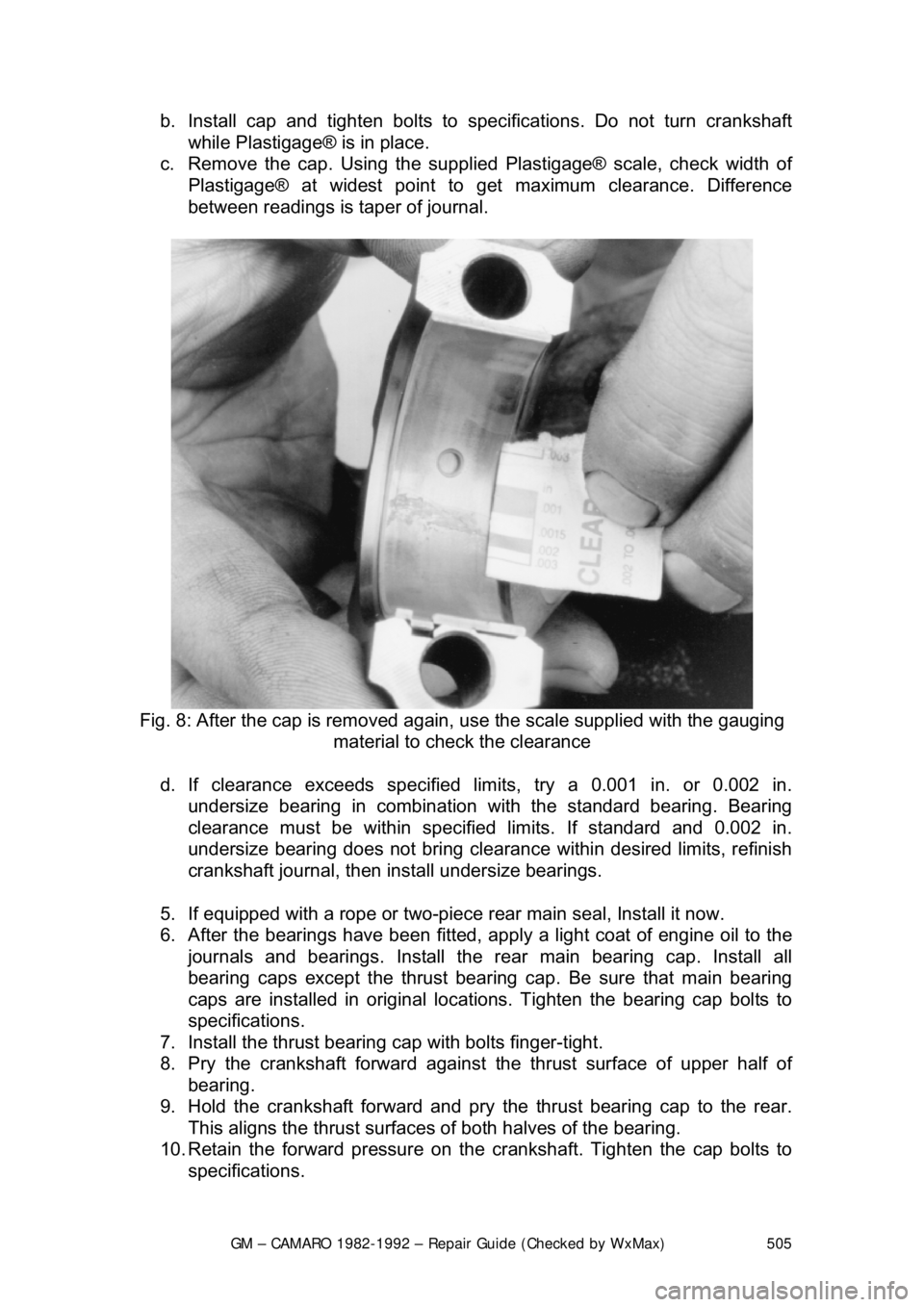
c. Remove the cap. Using the supplie d Plastigage® scale, check width of
Plastigage® at widest point to get maximum clearance. Difference
between readings is ta per of journal.
Fig. 8: After the cap is removed again, use the sca le supplied with the gauging
material to check the clearance
d. If clearance exceeds specified lim its, try a 0.001 in. or 0.002 in.
undersize bearing in combination with the standard bearing. Bearing
clearance must be within specified limits. If standard and 0.002 in.
undersize bearing does not bring clearance within desired limits, refinish
crankshaft journal, then inst all undersize bearings.
5. If equipped with a rope or two-piece r ear main seal, Install it now.
6. After the bearings have been fitted, apply a light coat of engine oil to the
journals and bearings. Install the rear main bearing cap. Install all
bearing caps except the thrust bearing cap. Be sure that main bearing
caps are installed in original locati ons. Tighten the bearing cap bolts to
specifications.
7. Install the thrust bearing cap with bolts finger-tight.
8. Pry the crankshaft forward against the thrust surface of upper half of
bearing.
9. Hold the crankshaft forward and pry the thrust bearing cap to the rear.
This aligns the thrust surfaces of both halves of the bearing.
10. Retain the forward pressure on t he crankshaft. Tighten the cap bolts to
specifications.
Page 508 of 875
GM – CAMARO 1982-1992 – Repair Guide (Checked by WxMax) 508
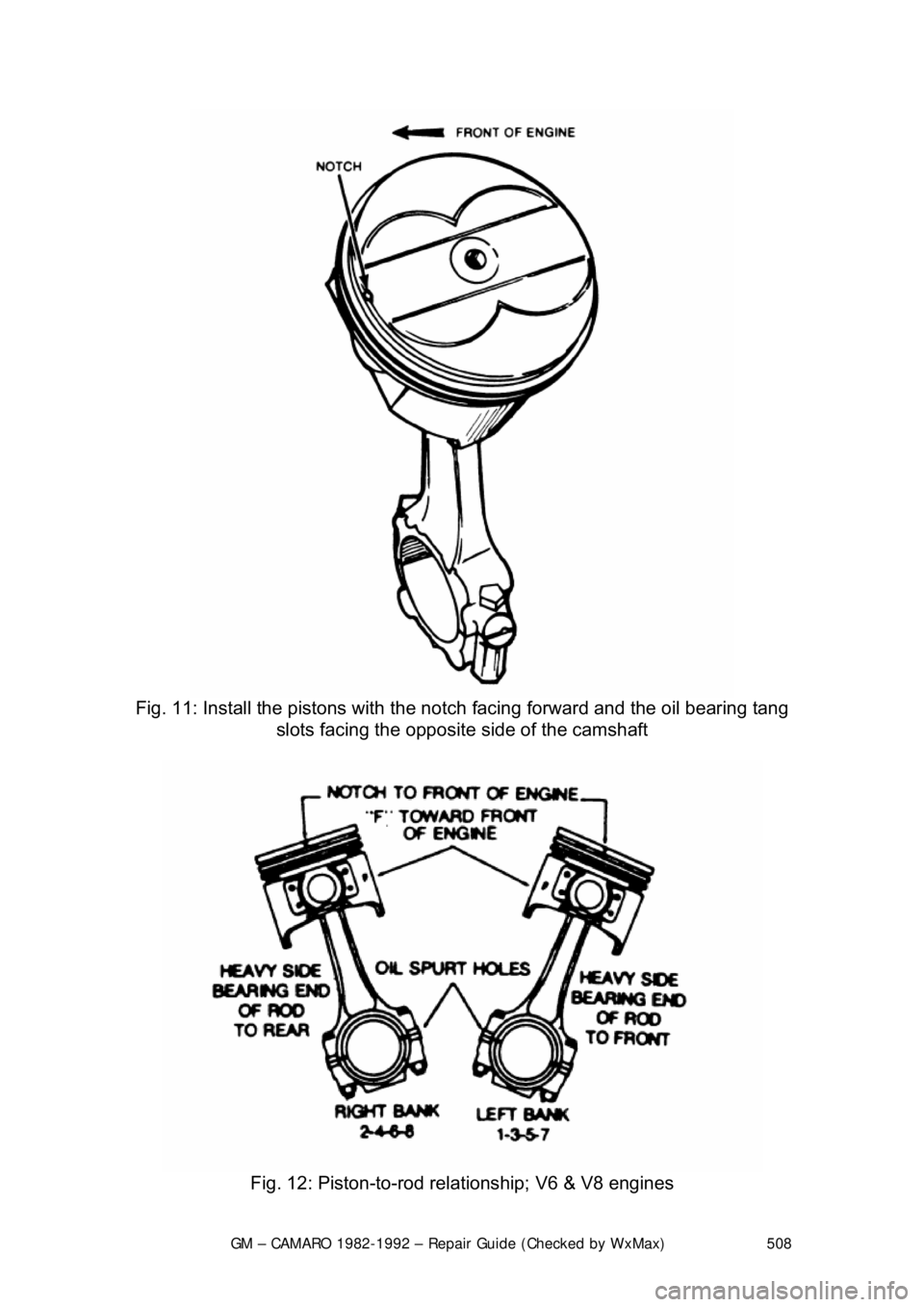
Fig. 11: Install the pistons with the notch facing forward and the oil bearing tang
slots facing the opposite side of the camshaft
Fig. 12: Piston-to-rod relationship; V6 & V8 engines
Page 509 of 875
GM – CAMARO 1982-1992 – Repair Guide (Checked by WxMax) 509
1. Before installing the
piston/connecting rod assembly, oil the pistons,
piston rings and the cylinder walls with light engine oil. Install connecting
rod bolt protectors or rubber hose onto the connecting rod bolts/studs.
Also perform the following: a. Select the proper ring set for the size cylinder bore.
b. Position the ring in the bore in which it is going to be used.
c. Push the ring down into the bor e area where normal ring wear is
not encountered.
d. Use the head of the piston to posi tion the ring in the bore so that
the ring is square with the cyli nder wall. Use caution to avoid
damage to the ring or cylinder bore.
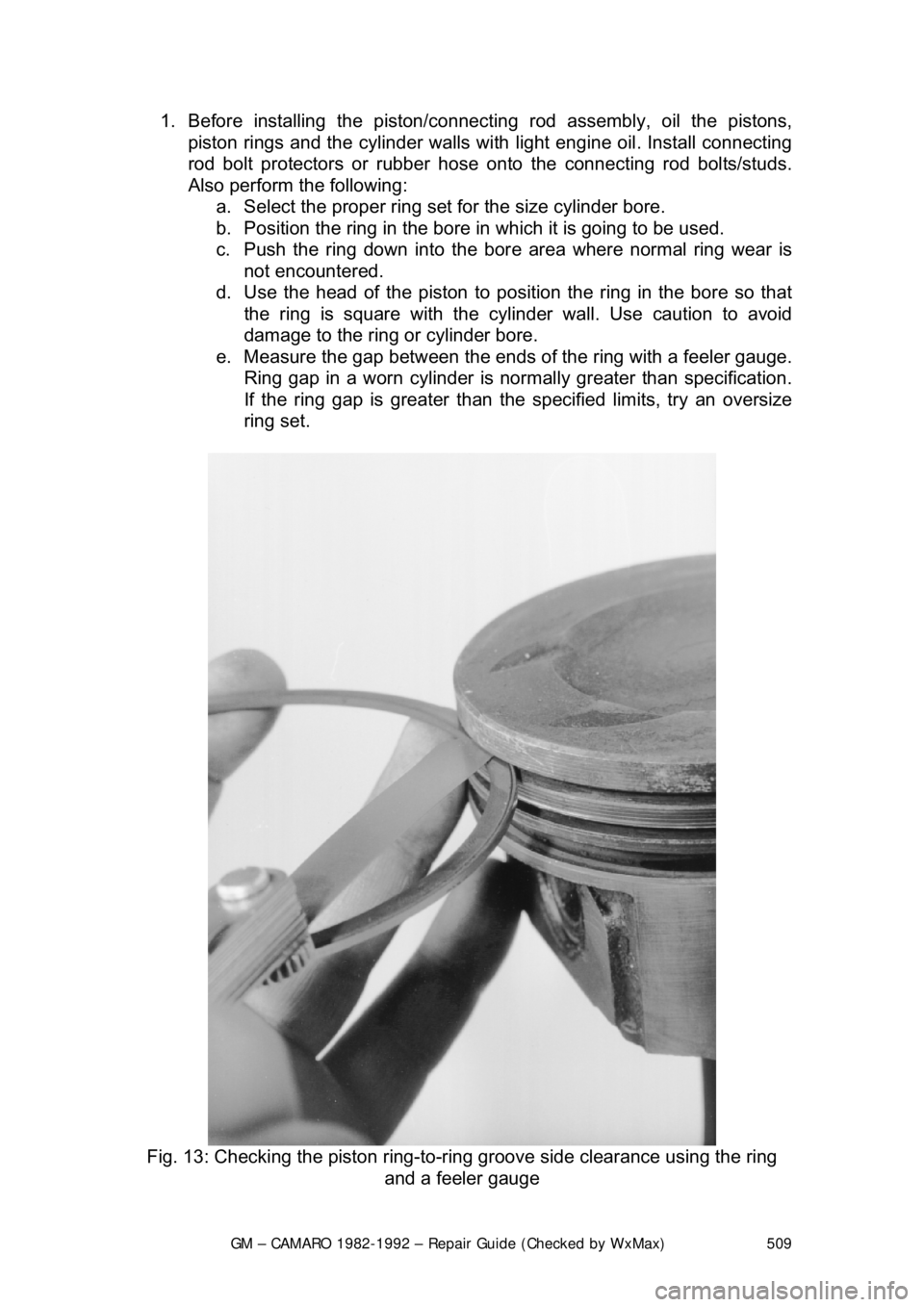
e. Measure the gap betw een the ends of the ring with a feeler gauge.
Ring gap in a worn cylinder is normally greater than specification.
If the ring gap is greater than the specified limits, try an oversize
ring set.
Fig. 13: Checking the piston ring-to-ri ng groove side clearance using the ring
and a feeler gauge