engine oil CHEVROLET CAMARO 1982 Repair Guide
[x] Cancel search | Manufacturer: CHEVROLET, Model Year: 1982, Model line: CAMARO, Model: CHEVROLET CAMARO 1982Pages: 875, PDF Size: 88.64 MB
Page 512 of 875

GM – CAMARO 1982-1992 – Repair Guide (Checked by WxMax) 512
5. Make sure the ring gaps are pr
operly spaced around the circumference
of the piston. Fit a piston ring co mpressor around the piston and slide the
piston and connecting rod assembly do wn into the cylinder bore, pushing
it in with the wooden hammer handle. Pu sh the piston down until it is only
slightly below the top of the cylinder bore. Guide the connecting rod onto
the crankshaft bearing journal carefully, to avoid damaging the
crankshaft.
6. Check the bearing clearance of all the rod bearings, fitting them to the
crankshaft bearing journals. Follow the procedure in the crankshaft
installation above.
7. After the bearings have been fitted, apply a light coating of assembly oil
to the journals and bearings.
8. Turn the crankshaft until the appropria te bearing journal is at the bottom
of its stroke, then push the piston a ssembly all the way down until the
connecting rod bearing seat s on the crankshaft journal. Be careful not to
allow the bearing cap screws to stri ke the crankshaft bearing journals
and damage them.
9. After the piston and connecting rod assemblies have been installed, check the connecting rod side clearance on each crankshaft journal.
10. Prime and install t he oil pump and the oil pump intake tube.
CAMSHAFT, LIFTERS AND TIMING ASSEMBLY 1. Install the camshaft.
2. Install the lifters/followers into their bores.
3. Install the timing gears/chain assembly.
CYLINDER HEAD(S) 1. Install the cylinder head(s) using new gaskets.
2. Assemble the rest of the valve tr ain (pushrods and rocker arms and/or
shafts).
ENGINE COVERS AND COMPONENTS
Install the timing cover(s) and oil pan. Re fer to your notes and drawings made
prior to disassembly and install all of the components that were removed. Install
the engine into the vehicle.
ENGINE START-UP AND BREAK-IN
STARTING THE ENGINE
Now that the engine is inst alled and every wire and hose is properly connected,
go back and double check that all cool ant and vacuum hoses are connected.
Check that you oil drain plug is instal led and properly tightened. If not already
done, install a new oil filt er onto the engine. Fill the crankcase with the proper
amount and grade of engine oil. Fill the cooling system with a 50/50 mixture of
coolant/water.
Page 513 of 875

GM – CAMARO 1982-1992 – Repair Guide (Checked by WxMax) 513
1. Connect the vehicle battery.
2. Start the engine. Keep y
our eye on your oil pressure indicator; if it does
not indicate oil pressure within 10 se conds of starting, turn the vehicle
off.
WARNING - Damage to the engine can result if it is allowed to run with no oil
pressure. Check the engine oil level to make sure that it is full. Check for any
leaks and if found, repair the leaks be fore continuing. If there is still no
indication of oil pressure, y ou may need to prime the system.
3. Confirm that there are no fluid leaks (oil or other).
4. Allow the engine to reach nor mal operating temperature (the upper
radiator hose will be hot to the touch).
5. If necessary, set the ignition timing.
6. Install any remaining components such as the air cleaner (if removed for
ignition timing) or body panels which were removed.
BREAKING IT IN
Make the first miles on the new engine , easy ones. Vary the speed but do not
accelerate hard. Most importantly, do not lug the engine, and avoid sustained
high speeds until at least 100 miles. Ch eck the engine oil and coolant levels
frequently. Expect the engine to use a littl e oil until the rings seat. Change the
oil and filter at 500 miles, 1500 mile s, then every 3000 miles past that.
KEEP IT MAINTAINED
Now that you have just gone through all of that hard work, keep yourself from
doing it all over again by thoroughly maintaining it. Not that you may not have
maintained it before, heck you c ould have had one to two hundred thousand
miles on it before doing this. However, you may have bought the vehicle used,
and the previous owner did not keep up on maintenance. Which is why you just
went through all of that hard work. See?
Page 626 of 875

GM – CAMARO 1982-1992 – Repair Guide (Checked by WxMax) 626
ENGINE PERFORMANCE AND TUNE-UP
TUNE-UP PROCEDURES
In order to extract the full measure of performance and economy from your
engine it is essential that it is properly tuned at regul ar intervals. A regular tune-
up will keep your Camaro's engine running smoothly and will prevent the
annoying breakdowns and poor perform ance associated with an untuned
engine.
A complete tune-up should be performed every 30,000 miles (48,000 km). This
interval should be halved if the car is operated under severe conditions such as
trailer towing, prolonged idling, start-and- stop driving, or if starting or running
problems are noticed. It is assumed that the routine maintenance described in
General Information & Maintenance has been kept up, as this will have a
decided effect on the result s of a tune-up. All of the applicable steps of a tune-
up should be followed in order, as the result is a cumulative one.
If the specifications on the underhoo d tune-up sticker in the engine
compartment of your car disagree with th e "Tune-Up Specifications" chart in this
Section, the figures on the sticker must be used. The sticker often reflects
changes made during t he production run.
SPARK PLUGS
A typical spark plug consists of a metal shell surrounding a ceramic insulator. A
metal electrode extends downward through the center of the insulator and
protrudes a small distance. Located at the end of the plug and attached to the
side of the outer metal shell is the side el ectrode. The side electrode bends in at
a 90 angle so that its tip is just pas t and parallel to the tip of the center
electrode. The distance between these two electrodes (measured in
thousandths of an inch or hundredths of a millimeter) is called the spark plug
gap.
The spark plug does not pr oduce a spark, but instead provides a gap across
which the current can arc. The coil produces anywhere from 20,000 to 50,000
volts (depending on the type and application) which travels through the wires to
the spark plugs. The current passes along the center electrode and jumps the
gap to the side electrode, and in doing so, ignites the air/fuel mixture in the
combustion chamber.
Page 628 of 875
GM – CAMARO 1982-1992 – Repair Guide (Checked by WxMax) 628
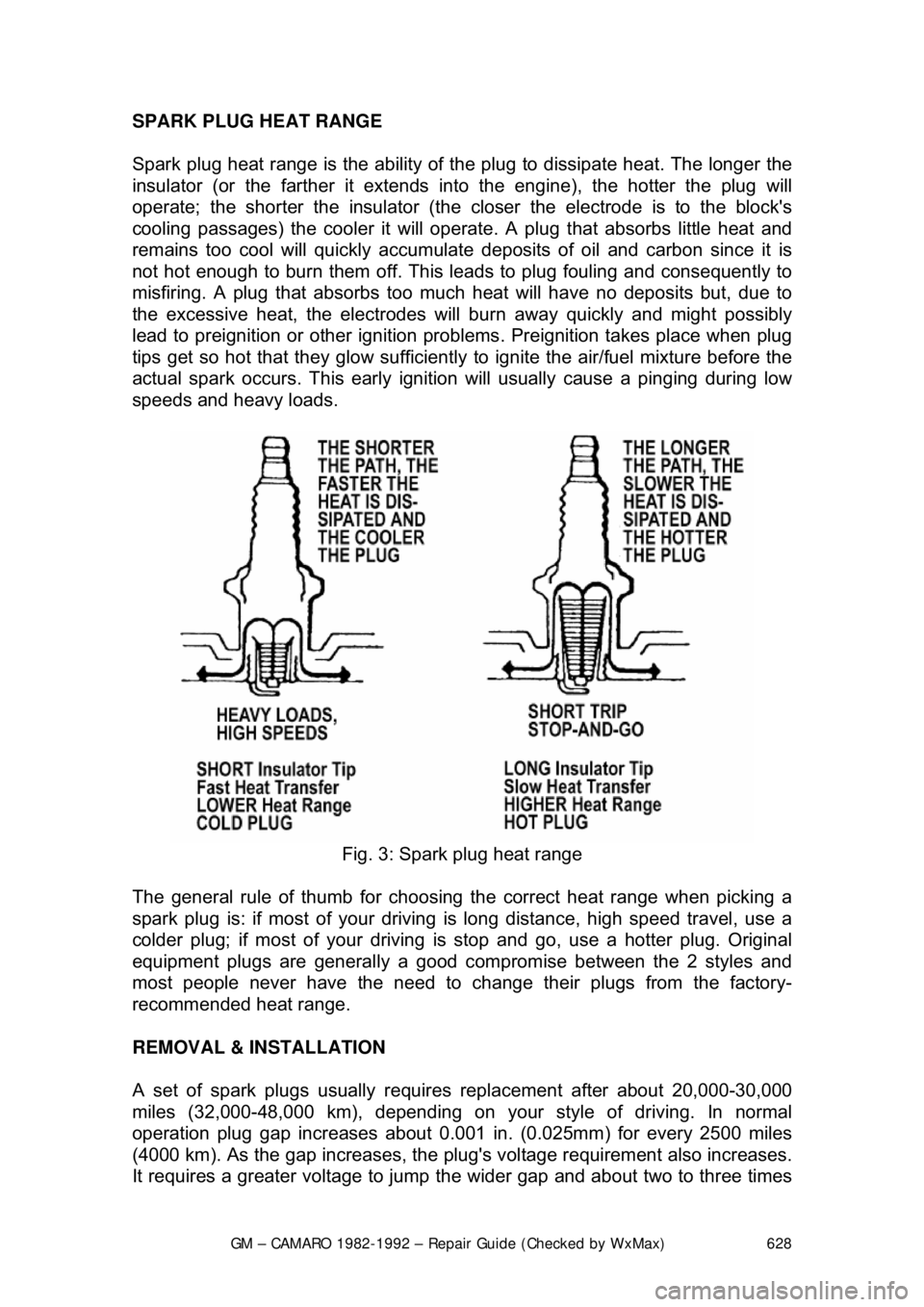
SPARK PLUG HEAT RANGE
Spark plug heat range is
the ability of the plug to dissipate heat. The longer the
insulator (or the farther it extends in to the engine), the hotter the plug will
operate; the shorter the insulator (the cl oser the electrode is to the block's
cooling passages) the cooler it will operate. A plug that absorbs little heat and
remains too cool will quickly accumulate deposits of oil and carbon since it is
not hot enough to burn them off. This leads to plug fouling and consequently to
misfiring. A plug that absorbs too much heat will have no deposits but, due to
the excessive heat, the electrodes will burn away quickly and might possibly
lead to preignition or other ignition probl ems. Preignition takes place when plug
tips get so hot that they gl ow sufficiently to ignite the air/fuel mixture before the
actual spark occurs. This early igniti on will usually cause a pinging during low
speeds and heavy loads.
Fig. 3: Spark plug heat range
The general rule of thumb for choosing the correct heat range when picking a
spark plug is: if most of your driving is long distanc e, high speed travel, use a
colder plug; if most of your driving is stop and go, use a hotter plug. Original
equipment plugs are general ly a good compromise between the 2 styles and
most people never have the need to change their plugs from the factory-
recommended heat range.
REMOVAL & INSTALLATION
A set of spark plugs usually requi res replacement after about 20,000-30,000
miles (32,000-48,000 km), depending on y our style of driving. In normal
operation plug gap increases about 0.001 in. (0.025mm) for every 2500 miles
(4000 km). As the gap increases, the plug' s voltage requirement also increases.
It requires a greater voltage to jump t he wider gap and about two to three times
Page 629 of 875

GM – CAMARO 1982-1992 – Repair Guide (Checked by WxMax) 629
as much voltage to fire the plug at hi
gh speeds than at idle. The improved
air/fuel ratio control of modern fuel injection combin ed with the higher voltage
output of modern ignition systems will often allow an engine to run significantly
longer on a set of standard spark plugs, but keep in mind that efficiency will
drop as the gap widens (along wit h fuel economy and power).
When you're removing spark plugs, work on one at a time. Don't start by
removing the plug wires all at once, because, unless you number them, they
may become mixed up. Take a minute before you begin and number the wires
with tape.
1. Disconnect the negative battery cabl e, and if the vehicle has been run
recently, allow the engine to thoroughly cool.
2. Carefully twist the spark plug wire boot to loosen it, then pull upward and
remove the boot from the plug. Be su re to pull on the boot and not on the
wire, otherwise the connector locat ed inside the boot may become
separated.
3. Using compressed air, blow any water or debris from the spark plug well
to assure that no harmful contam inants are allowed to enter the
combustion chamber when the spark plug is removed. If compressed air
is not available, use a rag or a brush to clean the area.
Remove the spark plugs when the engine is cold, if possible, to prevent damage
to the threads. If removal of the plugs is difficult, apply a few drops of
penetrating oil or silicone spray to t he area around the base of the plug, and
allow it a few minutes to work.
4. Using a spark plug socket that is equipped with a rubber insert to
properly hold the plug, turn the spar k plug counterclockwise to loosen
and remove the spark pl ug from the bore.
WARNING - Be sure not to use a flexible extension on the socket. Use of a
flexible extension may allow a shear fo rce to be applied to the plug. A shear
force could break the plug off in the cylinder head, leading to costly a\
nd
frustrating repairs.
To install:
5. Inspect the spark plug boot for t ears or damage. If a damaged boot is
found, the spark plug wire must be replaced.
6. Using a wire feeler gauge, check and adjust the spark plug gap. When
using a gauge, the proper size shoul d pass between the electrodes with
a slight drag. The next larger size should not be able to pass while the\
next smaller size should pass freely.
7. Carefully thread the plug into the bor e by hand. If resistance is felt before
the plug is almost completely th readed, back the plug out and begin
threading again. In small, hard to r each areas, an old spark plug wire and
boot could be used as a th reading tool. The boot will hold the plug while
you twist the end of the wire and t he wire is supple enough to twist
before it would allow t he plug to crossthread.
Page 637 of 875
GM – CAMARO 1982-1992 – Repair Guide (Checked by WxMax) 637
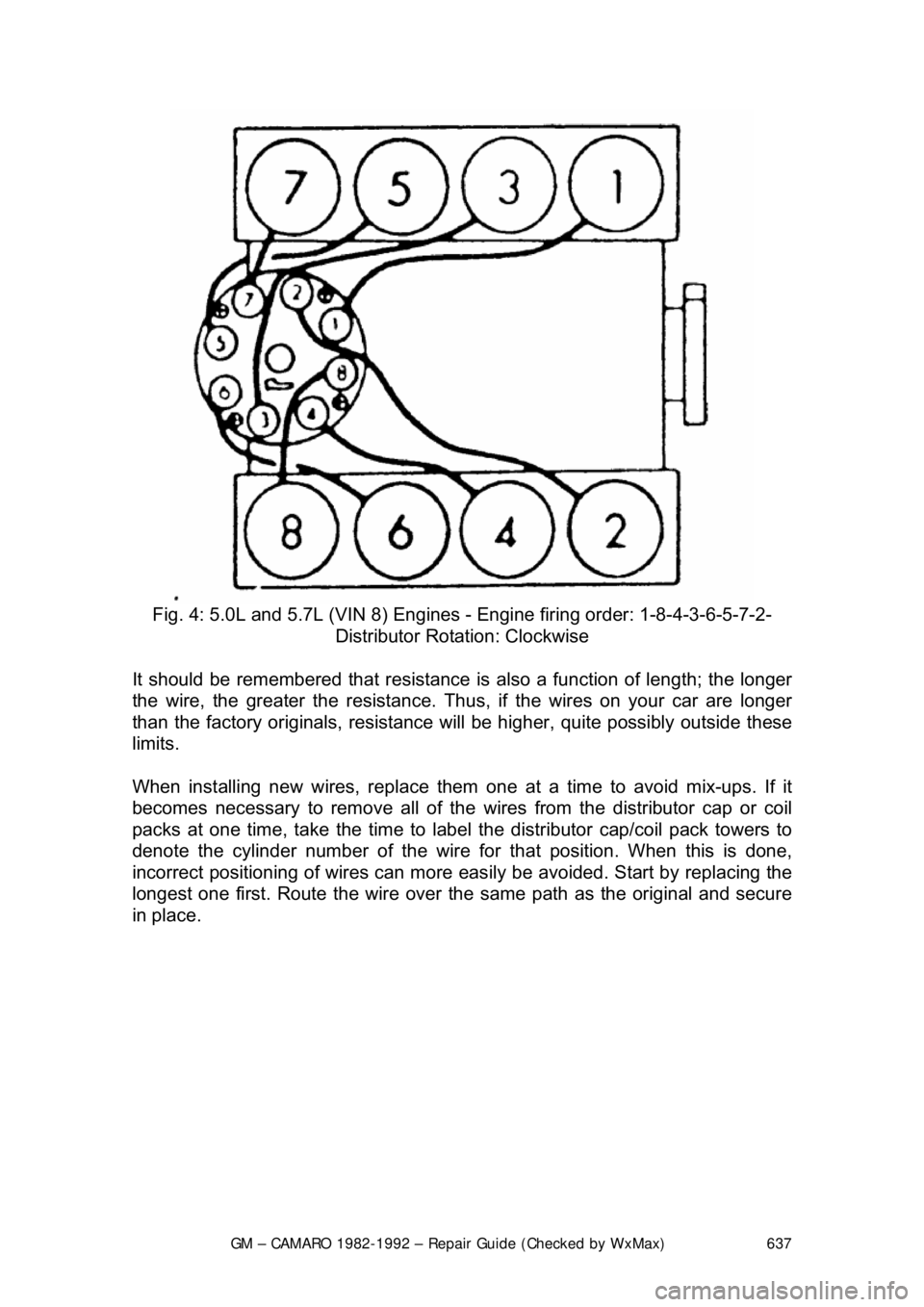
Fig. 4: 5.0L and 5.7L (VIN 8) Engines - Engine firing order: 1-8-4-3-6-5-7-2-
Distributor Rotation: Clockwise
It should be remembered that resistance is also a function of length; the longer
the wire, the greater the re sistance. Thus, if the wires on your car are longer
than the factory originals, resistance will be higher, qui te possibly outside these
limits.
When installing new wires, r eplace them one at a time to avoid mix-ups. If it
becomes necessary to remove all of the wires from the distributor cap or coil
packs at one time, take the time to label the distributor cap/coil pack towers to
denote the cylinder number of the wire fo r that position. When this is done,
incorrect positioning of wires can more eas ily be avoided. Start by replacing the
longest one first. Route the wire over the same path as the original and secure
in place.
Page 638 of 875
GM – CAMARO 1982-1992 – Repair Guide (Checked by WxMax) 638
ELECTRONIC IGNITION SYSTEM
GENERAL INFORMATION
The High Energy Ignition (HEI) system
controls the fuel combustion by
providing a spark to ignite the compress ed air/fuel mixture at the correct time.
To provide improved engine performance, fuel economy, and control of exhaust
emissions, the engine contro l module (ECM) controls distributor spark advance
(timing) with an ignition control system.
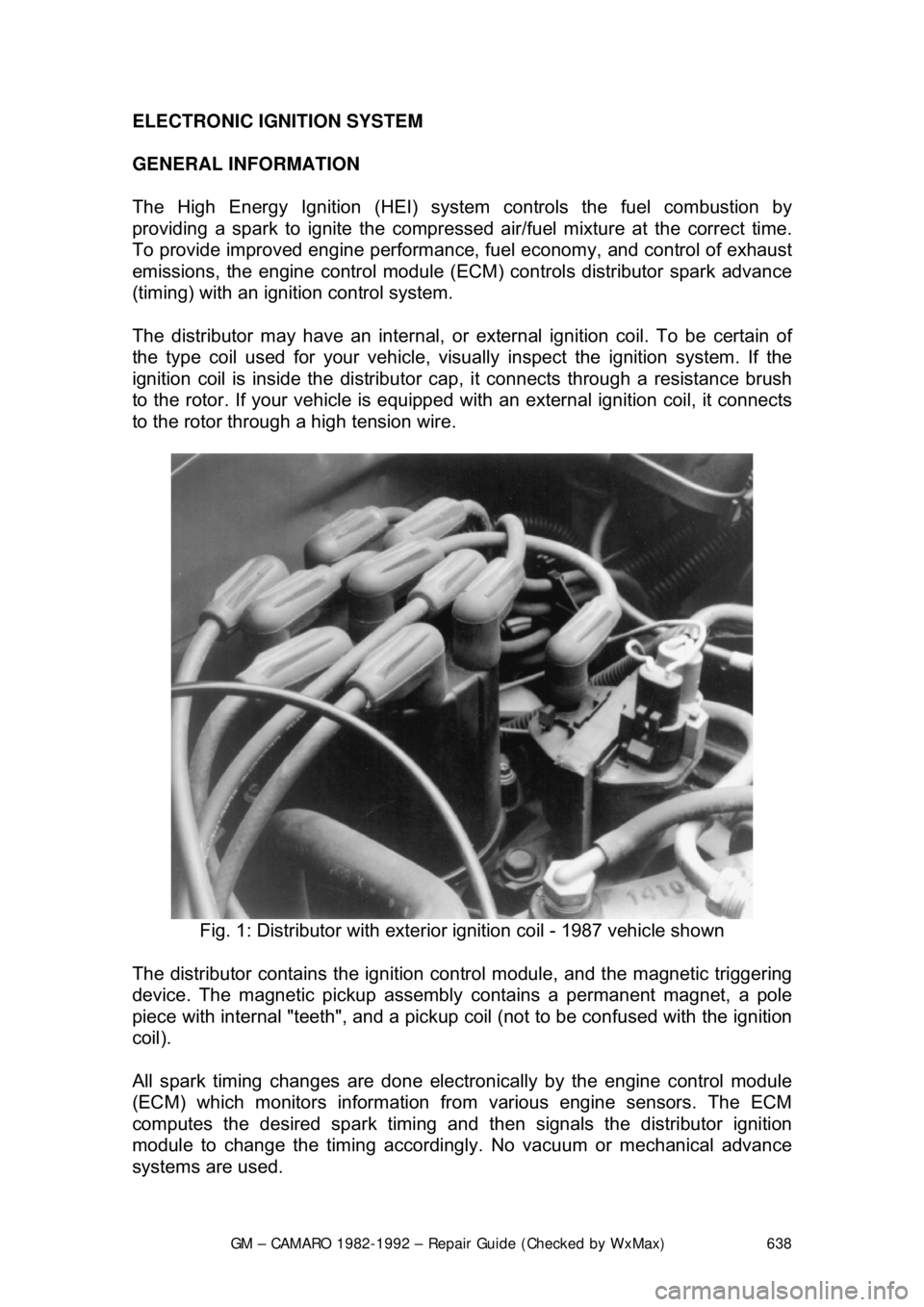
The distributor may have an internal, or ex ternal ignition coil. To be certain of
the type coil used for your vehicle, vis ually inspect the ignition system. If the
ignition coil is inside the distributor c ap, it connects through a resistance brush
to the rotor. If your vehicle is equipped with an external ignition coil, it connects
to the rotor through a high tension wire.
Fig. 1: Distributor with exterior ignition coil - 1987 vehicle shown
The distributor contains the ignition c ontrol module, and the magnetic triggering
device. The magnetic pickup assembly contains a permanent magnet, a pole
piece with internal "teeth", and a pickup co il (not to be confused with the ignition
coil).
All spark timing changes are done electr onically by the engine control module
(ECM) which monitors information from various engine sensors. The ECM
computes the desired spark timing and t hen signals the distributor ignition
module to change the timing accordingly. No vacuum or mechanical advance
systems are used.
Page 640 of 875

GM – CAMARO 1982-1992 – Repair Guide (Checked by WxMax) 640
The tachometer terminal should never
be allowed to touch ground, as damage
to the computer control module and/or ignition coil assembly can result.
CONNECTORS
When disengaging connectors, do not use a screw driver or other tool to release
the locking tab, as this mi ght break the connector.
SYSTEM TESTERS
Instruments designed specific ally for testing HEI or C
3I systems are available
from several tool manufactur ers. Some of these will even test the module itself.
However, the tests given in the followin g section will require only an ohmmeter
and a voltmeter.
TESTING
The symptoms of a defective component within the HEI or C
3I system are
exactly the same as those you woul d encounter in a conventional system.
Some of these symptoms are:
• Hard or no starting
• Rough Idle
• Poor fuel economy
• Engine misses under load or while accelerating
PRELIMINARY CHECKS
If you suspect a problem in your igniti on system, there are certain preliminary
checks which you should carry out befor e you begin to check the electronic
portions of the system. First, it is extrem ely important to make sure the vehicle
battery is in a good state of charge. A defective or poorly charged battery will
cause the various components of the ignition system to read incorrectly when
they are being tested. Second, make su re all wiring connections are clean and
tight, not only at the battery, but also at the distributor cap (if so equipped),
ignition coil, camshaft and/or crankshaft sensors (if so equipped) and at the
control module.
Since the only difference between these ignition systems lies before the spark
plug wiring, it is important to check the secondary ig nition circuit first. If the
secondary circuit checks out properly (ther e is spark), then the engine condition
is probably not the fault of the ignition system. To check the secondary ignition
system, perform a simple spark test. Remove one of the plug wires and insert
some sort of extension in the plug socket. An old spark plug with the ground
electrode removed makes a good extension. Hold the wire and extension using
an insulated tool (NOT BY HAND) about
1/4 in. (6mm) away from the block and
crank the engine. If a normal spark occurs, then the problem is most likely not in
the ignition system. Check for fuel system problems, or fouled spark plugs.
Page 641 of 875

GM – CAMARO 1982-1992 – Repair Guide (Checked by WxMax) 641
If, however, there is no spark or a weak
spark, then further ignition system
testing will have to be done. Troubleshooting techniques fall into various
categories, depending on t he nature of the problem and the system being
tested. Categories will include symptom s such as the engine cranks, but will not
start or the engine runs rough.
HEI SYSTEM
When testing the HEI system, there are 2 major categories of problems, (1)
Engine cranks, but will not star t or (2) Engine runs, but runs rough or cuts out.
If the engine will not start, perform a spar k test as described earlier. This will
narrow the problem area down considerab ly. If no spark occurs, check for the
presence of normal battery voltage at the battery ( BAT) terminal on the ignition
coil. The ignition switch must be in the ON position for this test. Either a
voltmeter or a test light wire may be us ed for this test. Connect the test light
wire to ground and the probe end to the BAT terminal at the coil. If the light
comes on, you have voltage to the distribut or and/or spark plug wires. If the light
fails to come on, this indicates an open circuit in the ignition primary wiring
leading to the distributor. In this case , you will have to check wiring continuity
back to the ignition switch using a test li ght. If there is battery voltage at the BAT
terminal, but no spark at the plugs, t hen the problem probably lies within the
distributor assembly.
If, on the other hand, the engine starts, but runs roughly or cuts out, make sure
the plug wires are in good shape first. There should be no obvious cracks or
breaks. You can check the plug wires with an ohmmeter, but do not pierce the
wires with a probe. Check the chart for th e correct plug wire resistance. If the
plug wires are OK, remove the cap asse mbly and check for moisture, cracks,
chips, or carbon tracks, or any other hi gh voltage leads or failures. Replace the
cap if any defects are found. Make su re the timer wheel rotates when the
engine is cranked.
If the trouble has been narrowed down to t he units within the distributor, the
following tests can help pinpoint the defective component. An ohmmeter with
both high and low ranges shou ld be used. These tests are made with the cap
assembly removed and the battery wir e disconnected. If a tachometer is
connected to the TACH terminal, disconnect it before making these tests.
IGNITION COIL
EXTERNALLY MOUNTED 1. Disconnect the coil wires and se t the ohmmeter on the high scale.
2. Connect the ohmmeter to the ignition co il as illustrated in Step 1 of the
accompanying figure.
3. The ohmmeter should read near infinite or very high.
Page 645 of 875

GM – CAMARO 1982-1992 – Repair Guide (Checked by WxMax) 645
3. If no defects have been found at this
time, and you still have a problem,
then the module will have to be che cked. If you do not have access to a
module tester, the only possible alter native is a substitution test. If the
module fails the substitution test, replace it.
COMPONENT REPLACEMENT
CAUTION - When handling secondar y spark plug leads with the engine running
or starting, insulated pliers must be used and care exercised to prevent a
possible electrical shock.
HEI SYSTEM
IGNITION COIL
EXTERNALLY MOUNTED
1. Disconnect the negative battery cable.
2. Disconnect the ignition coil wire from the coil. Do so by pulling on the
boot of the wire while twisting it.
3. Disconnect the harness connecto r from the ignition coil.
4. Remove the coil mounting screws and the ignition coil. If necessary, drill
out and remove the rivets holding the coil to the bracket.
To install: 5. Place the ignition coil in position on the mounting bracket and install the
mounting screws.
6. Reconnect the harness connectors to the ignition coil. Confirm that the
harness connectors are firmly attached to the coil.
7. Install the secondary coil wire to the coil tower.
8. Connect the negative battery cable.