warning light CHEVROLET CAMARO 1982 Repair Guide
[x] Cancel search | Manufacturer: CHEVROLET, Model Year: 1982, Model line: CAMARO, Model: CHEVROLET CAMARO 1982Pages: 875, PDF Size: 88.64 MB
Page 49 of 875

GM – CAMARO 1982-1992 – Repair Guide (Checked by WxMax) 49
Upon release of the brake pedal, a spri
ng located inside the master cylinder
immediately returns the master cylinder pistons to the normal position. The
pistons contain check valv es and the master cylinder has compensating ports
drilled in it. These are uncovered as the pistons reach their normal position. The
piston check valves allow fluid to flow to ward the wheel cylinders or calipers as
the pistons withdraw. Then, as the return springs force the brake pads or shoes
into the released position, the excess fluid reservoir through the compensating
ports. It is during the time the pedal is in the released position that any fluid that
has leaked out of the syst em will be replaced through the compensating ports.
Dual circuit master cylinders employ tw o pistons, located one behind the other,
in the same cylinder. The primary pist on is actuated directly by mechanical
linkage from the brake peda l through the power booster. The secondary piston
is actuated by fluid tra pped between the two pistons. If a leak develops in front
of the secondary piston, it moves forward until it bottoms against the front of the
master cylinder, and the fluid trapped betw een the pistons will operate the rear
brakes. If the rear brakes develop a l eak, the primary piston will move forward
until direct contact with the secondary pi ston takes place, and it will force the
secondary piston to actuate the front brakes. In either case, the brake pedal
moves farther when the brakes are applied, and less braking power is available.
All dual circuit systems use a switch to wa rn the driver when only half of the
brake system is operational. This switch is usually located in a valve body which
is mounted on the firewall or the frame below the master cylinder. A hydraulic
piston receives pressure from both circui ts, each circuit's pressure being applied
to one end of the piston. When the pressures are in balance, the piston remains
stationary. When one circuit has a leak, however, the greater pressure in that
circuit during application of the brakes will push the piston to one side, closing
the switch and activating the brake warning light.
In disc brake systems, this valve body also contains a metering valve and, in
some cases, a proportioning valve. The metering valve keeps pressure fro\
m
traveling to the disc brakes on the front wheels until the brake shoes on the rear
wheels have contacted the drums, ensuri ng that the front brakes will never be
used alone. The proportioning va lve controls the pressure to the rear brakes to
lessen the chance of rear wheel lo ck-up during very hard braking.
Warning lights may be tested by depressi ng the brake pedal and holding it while
opening one of the wheel cyli nder bleeder screws. If this does not cause the
light to go on, substitute a new lamp , make continuity checks, and, finally,
replace the switch as necessary.
The hydraulic system may be checked for leaks by applying pressure to the
pedal gradually and steadily. If the pedal sinks very slowly to the floor, the
system has a leak. This is not to be conf used with a springy or spongy feel due
to the compression of air within the lin es. If the system leaks, there will be a
gradual change in the position of the pedal with a constant pressure.
Check for leaks along all lines and at wheel cylinders. If no external leaks are
apparent, the problem is inside the master cylinder.
Page 75 of 875

GM – CAMARO 1982-1992 – Repair Guide (Checked by WxMax) 75
5. Have your assistant sl
owly depress the brake pedal. As this is done, open
the bleeder screw 3/4 of a turn and allow the flui d to run through the tube.
Then close the bleeder screw before the pedal reaches the end of its travel.
Have your assistant slo wly release the pedal. Rep eat this process until no
air bubbles appear in the expelled fluid.
6. Repeat the procedure on the other three br akes, checking the level of fluid in
the master cylinder reservoir often.
7. Upon completion, check the brak e pedal for sponginess and the brake
warning light for unbalanced pressure . If necessary, repeat the entire
bleeding procedure.
FRONT DISC BRAKES
CAUTION - Some brake pads contain asbest os, which has been determined to
be a cancer causing agent. Never clean the brake surfaces with compressed
air! Avoid inhaling any dust from any brake surface! When cleaning brake
surfaces, use a commercially available brake cleaning fluid.
BRAKE PADS
CAUTION - Some brake pads contain asbest os, which has been determined to
be a cancer causing agent. Never clean the brake surfaces with compressed
air! Avoid inhaling any dust from any brake surface! When cleaning brake
surfaces, use a commercially available brake cleaning fluid.
INSPECTION
The pad thickness should be inspected ever y time that the tires are removed for
rotation. The outer pad can be checked by looking in each end, which is the
point at which the highest rate of wear occurs. The inner pad can be checked by
looking down through the inspection hole in the top of the caliper. If the
thickness of the pad is worn to within 0.030 in. (0.8mm) of the rivet at either end
of the pad, all the pads should be replaced.
Always replace all pads on both front wheel s at the same time. Failure to do so
will result in uneven braking action and premature wear.
REMOVAL & INSTALLATION
Page 122 of 875
GM – CAMARO 1982-1992 – Repair Guide (Checked by WxMax) 122
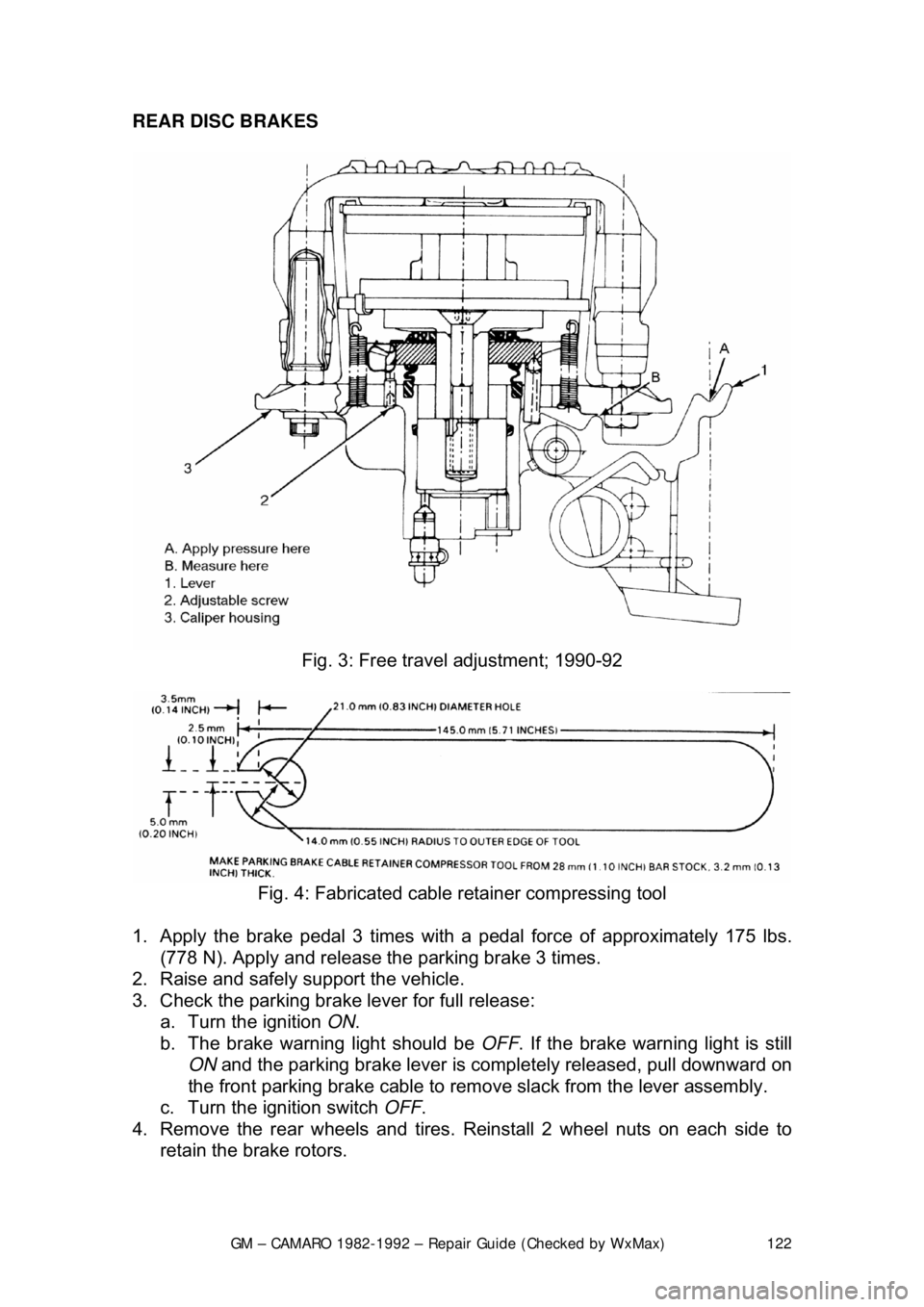
REAR DISC BRAKES
Fig. 3: Free trav el adjustment; 1990-92
Fig. 4: Fabricated cable retainer compressing tool
1. Apply the brake pedal 3 times with a pedal force of approximately 175 lbs.
(778 N). Apply and release t he parking brake 3 times.
2. Raise and safely support the vehicle.
3. Check the parking brake lever for full release: a. Turn the ignition ON.
b. The brake warning light should be OFF. If the brake warning light is still
ON and the parking brake lever is comple tely released, pull downward on
the front parking brake cable to remove slack from the lever assembly.
c. Turn the ignition switch OFF.
4. Remove the rear wheels and tires. Reinstall 2 wheel nuts on each side to
retain the brake rotors.
Page 137 of 875

GM – CAMARO 1982-1992 – Repair Guide (Checked by WxMax) 137
voltage) is present; it only means that so
me voltage is present. It is advisable
before using the test light to touch its ground clip and probe across the battery
posts or terminals to make sure the light is operating properly.
WARNING - Do not use a test light to probe electronic ignition, spark plug or
coil wires. Never use a pick-type test light to probe wiring on computer
controlled systems unless spec ifically instructed to do so. Any wire insulation
that is pierced by the test light pr obe should be taped and sealed with silicone
after testing
Like the jumper wire, the 12 volt test li ght is used to isolate opens in circuits.
But, whereas the jumper wire is used to bypass the open to operate the load,
the 12 volt test light is us ed to locate the presence of voltage in a circuit. If the
test light illuminates, there is power up to t hat point in the circuit; if the test light
does not illuminate, there is an open circui t (no power). Move the test light in
successive steps back toward the power source until the light in the handle
illuminates. The open is between the pr obe and a point which was previously
probed.
The self-powered test light is similar in design to the 12 volt test light, but
contains a 1.5 volt penlight battery in the handle. It is most often used in place
of a multimeter to check for open or shor t circuits when power is isolated from
the circuit (continuity test).
The battery in a self-powered test light does not provide much current. A weak
battery may not provide enough power to illuminate the test light even when a
complete circuit is made (especially if there is high resistance in the circuit).
Always make sure that the test battery is strong. To check the battery, briefly
touch the ground clip to the pr obe; if the light glows brightly, the battery is strong
enough for testing.
A self-powered test light should not be used on any co mputer controlled system
or component. The small amount of electr icity transmitted by the test light is
enough to damage many electr onic automotive components.
MULTIMETERS
Multimeters are an extremely useful tool for troubleshooting electrical problems.
They can be purchased in either analog or digital form and have a price range
to suit any budget. A multimeter is a voltmeter, ammeter and ohmmeter (along
with other features) combined into one instrument. It is often used when testing
solid state circuits because of its hi gh input impedance (usually 10 megaohms
or more). A brief description of the mult imeter main test functions follows:
• Voltmeter - the voltmeter is used to measure voltage at any point in a
circuit, or to measure the voltage drop across any part of a circuit.
Voltmeters usually have various scales and a selector switch to allow the
reading of different volt age ranges. The voltmeter has a positive and a
negative lead. To avoid damage to the meter, always connect the
negative lead to the negative (—) side of the circ uit (to ground or nearest
Page 138 of 875

GM – CAMARO 1982-1992 – Repair Guide (Checked by WxMax) 138
the ground side of the circuit) and
connect the positive lead to the
positive (+) side of the circuit (to t he power source or the nearest power
source). Note that the negative voltme ter lead will always be black and
that the positive voltmeter will alwa ys be some color other than black
(usually red).
• Ohmmeter - the ohmmeter is designed to read resistance (measured in
ohms) in a circuit or component. Mo st ohmmeters will have a selector
switch which permits the measurement of different ranges of resistance
(usually the selector swit ch allows the multiplication of the meter reading
by 10, 100, 1,000 and 10,000). Some ohmmeters are "auto-ranging"
which means the meter itself will dete rmine which scale to use. Since the
meters are powered by an internal battery, the ohmmeter can be used
like a self-powered test light. When the ohmmeter is connected, current
from the ohmmeter flows through the ci rcuit or component being tested.
Since the ohmmeter's internal resi stance and voltage are known values,
the amount of current flow throug h the meter depends on the resistance
of the circuit or component being test ed. The ohmmeter can also be used
to perform a continuity test for suspected open circuits. In using the
meter for making continuity checks, do not be concerned with the actual
resistance readings. Zero resistance, or any ohm reading, indicates
continuity in the circui t. Infinite resistance indi cates an opening in the
circuit. A high resistance reading w here there should be none indicates a
problem in the circuit. Checks for s hort circuits are made in the same
manner as checks for open circuits, ex cept that the circuit must be
isolated from both power and normal gr ound. Infinite resistance indicates
no continuity, while zero resi stance indicates a dead short.
WARNING - Never use an ohmmeter to check the resistance of a component or
wire while there is volt age applied to the circuit
• Ammeter - an ammeter measures the am ount of current flowing through
a circuit in units called amperes or amps. At normal operating voltage,
most circuits have a characteristic amount of amperes, called "current
draw" which can be measured usi ng an ammeter. By referring to a
specified current draw rating, then measuring the amperes and
comparing the two values, one can det ermine what is happening within
the circuit to aid in diagnosis. An open circuit, for example, will not allow
any current to flow, so the amme ter reading will be zero. A damaged
component or circuit will have an incr eased current draw, so the reading
will be high. The ammeter is always connected in series with the circuit\
being tested. All of the current that normally flows through the circuit
must also flow through the ammeter; if there is any other path for the
current to follow, the ammeter readi ng will not be accurate. The ammeter
itself has very little resistance to curr ent flow and, therefore, will not affect
the circuit, but it will measure current draw only when the circuit is closed
and electricity is flowing. Excessive current draw can blow fuses and
drain the battery, while a reduced current draw can cause motors to run \
slowly, lights to dim and other components to not operate properly.
Page 223 of 875

GM – CAMARO 1982-1992 – Repair Guide (Checked by WxMax) 223
FUSIBLE LINKS
In addition to circuit breakers and fuses,
the wiring harness incorporates fusible
links to protect the wiring. Links are used rather than a fuse, in wiring circuits
that are not normally fused, such as th e ignition circuit. The fusible links are
color coded red in the charging and load circuits to match the color coding of
the circuits they protect. Each link is four gauges smaller than the cable it
protects, and is marked on the insulation with the gauge size because the
insulation makes it appear heavier than it really is. The engine compartment
wiring harness has several fusible links. The same size wire with a special
Hypalon insulation must be used w hen replacing a fusible link.
For more details, see the information on fusible links at the beginning of this
section.
The links are located in the following areas:
1. A molded splice at the starter solenoid Bat terminal, a 14 gauge red wire.
2. A 16 gauge red fusible link at the j unction block to protect the unfused
wiring of 12 gauge or larger wire. This link stops at the bulkhead
connector.
3. The alternator warning light and fiel d circuitry is protected by a 20 gauge
red wire fusible link used in the batte ry feed-to-voltage regulator number
3 terminal. The link is installed as a molded splice in the circuit at the
junction block.
4. The ammeter circuit is protected by two 20 gauge fusible links installed
as molded splices in the circuit at t he junction block and battery to starter
circuit.
REPLACEMENT 1. Determine the circuit that is damaged.
2. Disconnect the negative battery terminal.
3. Cut the damaged fuse link from the harness and discard it.
4. Identify and procure the proper fuse link and butt connectors.
5. Strip the wire about
1/2 in. (13mm) on each end.
6. Connect the fusible link and crimp the butt connectors making sure that the wires are secure.
7. Solder each connection with resin core solder, and wrap the connections
with plastic electrical tape.
8. Reinstall the wir e in the harness.
9. Connect the negative battery terminal and test the system for proper
operation.
CIRCUIT BREAKERS
Various circuit breakers are located under the instrument panel. In order to gain
access to these components, it may be ne cessary to first remove the under
dash padding. Most of the circuit breakers are located in the convenience
center or the fuse panel.
Page 351 of 875

GM – CAMARO 1982-1992 – Repair Guide (Checked by WxMax) 351
alternating current developed
within the stator windings to a direct (DC) current
at the output (BAT) terminal. Three of these diodes are negative and are
mounted flush with the end frame while t he other three are positive and are
mounted into a strip called a heat sink. The positive diodes are easily identified
as the ones within small cavities or depressions.
The alternator charging system is a negative (-) ground system which consists
of an alternator, a regulat or, a charge indicator, a storage battery and wiring
connecting the components, and fuse link wire.
The alternator is belt-driven from t he engine. Energy is supplied from the
alternator/regulator system to the rotati ng field through two brushes to two slip-
rings. The slip-rings are mounted on the rotor shaft and are connected t\
o the
field coil. This energy supplied to the ro tating field from the battery is called
excitation current and is used to init ially energize the field to begin the
generation of electricity. Once the alter nator starts to generate electricity, the
excitation current comes from its ow n output rather than the battery.
The alternator produces power in the form of alternating current. The alternating
current is rectified by 6 diodes into dire ct current. The direct current is used to
charge the battery and power the rest of the electrical system.
When the ignition key is turned ON, current flows from the battery, through the
charging system indicator light on the in strument panel, to the voltage regulator,
and to the alternator. Since the alternat or is not producing any current, the
alternator warning light comes on. When the engine is started, the alternator
begins to produce current and turns the alte rnator light off. As the alternator
turns and produces current, the current is divided in two ways: part to the
battery(to charge the battery and power the electrical components of the
vehicle), and part is returned to the alte rnator (to enable it to increase its
output). In this situation, the alternator is receiving current from the battery and
from itself. A voltage regulat or is wired into the current supply to the alternator
to prevent it from receiving too much cu rrent which would cause it to put out too
much current. Conversely, if the voltage regulator does not allow the alternator
to receive enough current, the battery will not be fully charged and will
eventually go dead.
The battery is connected to the alternator at all times, whether the ignition key is
turned ON or not. If the battery were shorted to ground, the alternator would
also be shorted. This woul d damage the alternator. To prevent this, a fuse link
is installed in the wiring between the battery and the alternator. If the battery is
shorted, the fuse link melts, protecting the alternator.
An alternator is better that a convent ional, DC shunt generator because it is
lighter and more compact, because it is designed to supply the battery and
accessory circuits through a wide range of engine speeds, and because it
eliminates the necessary maintenance of replacing brushes and servicing
commutators.
PRECAUTIONS
Page 352 of 875

GM – CAMARO 1982-1992 – Repair Guide (Checked by WxMax) 352
To prevent serious damage to the alte
rnator and the rest of the charging
system, the following precauti ons must be observed:
• Never reverse the battery connections.
• Booster batteries for starting must be connected properly: positive-to-
positive and negative-to-ground.
• Disconnect the battery cables before using a fast charger; the charger
has a tendency to force current through the diodes in the opposite
direction for which they were designed. This burns out the diodes.
• Never use a fast charger as a booster for starting the vehicle.
• Never disconnect the voltage regulator while the engine is running.
• Avoid long soldering times when replacing diodes or transistors.
Prolonged heat is damaging to AC alternators.
• Do not use test lamps of more t han 12 volts (V) for checking diode
continuity.
• Do not short across or ground any of the terminals on the AC alternator.
• The polarity of the battery, alter nator, and regulator must be matched
and considered before making any elec trical connections within the
system.
• Never operate the alternator on an open circuit. make sure that all
connections within the circ uit are clean and tight.
• Disconnect the battery terminals when performing any service on the
electrical system. This wil l eliminate the possibility of accidental reversal
of polarity.
• Disconnect the battery ground cable if arc welding is to be done on any
part of the car.
CHARGING SYSTEM TROUBLESHOOTING
There are many possible ways in whic h the charging system can malfunction.
Often the source of a problem is diffi cult to diagnose, requiring special
equipment and a good deal of experience. However, when the charging system
fails completely and causes the dash boar d warning light to come on or the
battery to become dead the following items may be checked:
1. The battery is known to be good and fully charged.
2. The alternator belt is in good condition and adjusted to the proper
tension.
3. All connections in t he system are clean and tight.
REMOVAL & INSTALLATION
Page 466 of 875
GM – CAMARO 1982-1992 – Repair Guide (Checked by WxMax) 466
wear. Worn piston rings, scored or wo
rn cylinder bores, blown head gaskets,
sticking or burnt valves, and worn valve seats are all possible culprits. A check
of each cylinder's compression will help locate the problem.
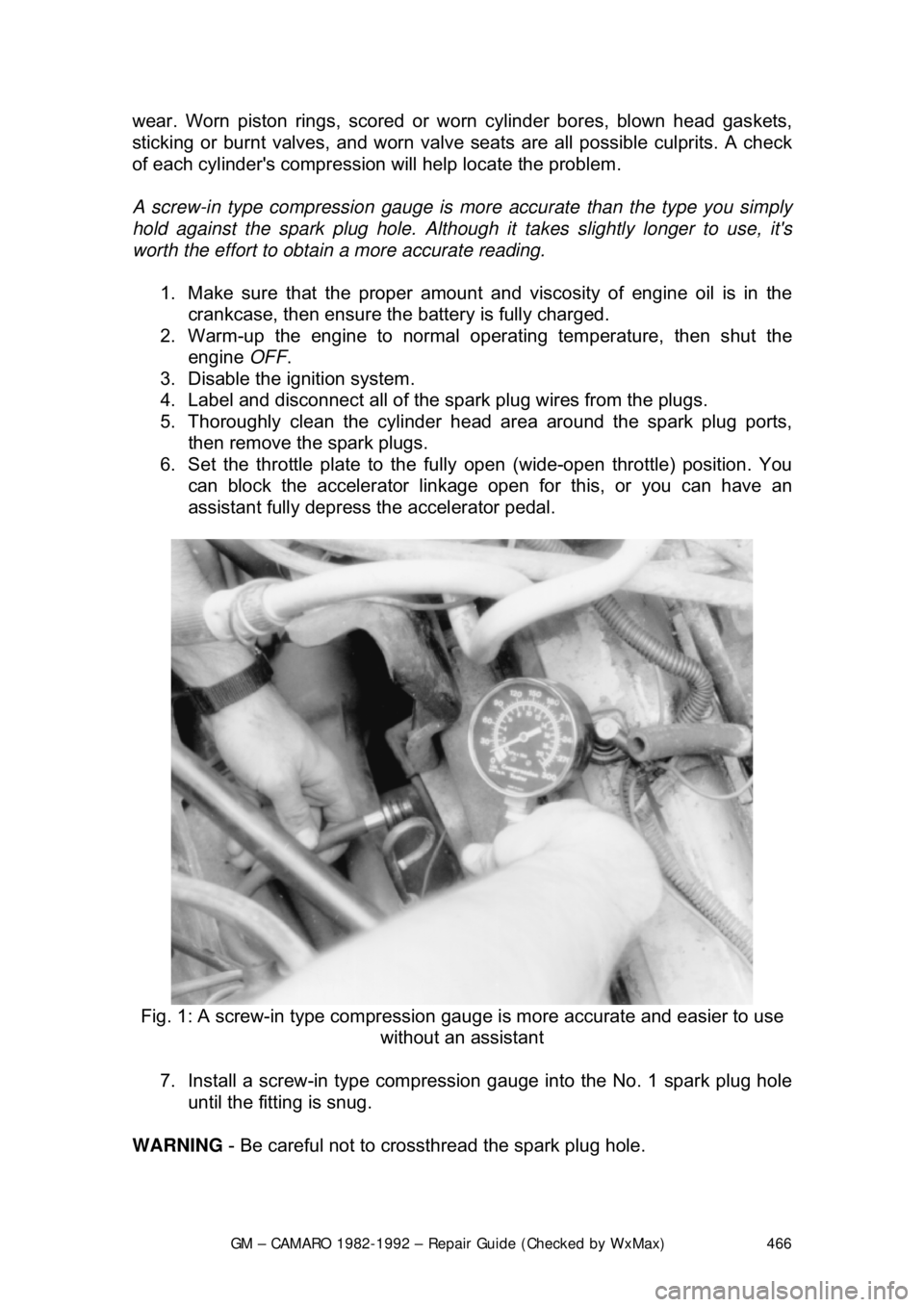
A screw-in type compression gauge is more accurate than the type you simply
hold against the spark plug hole. Although it takes slightly longer to use, it's
worth the effort to obtain a more accurate reading.
1. Make sure that the proper amount and viscosity of engine oil is in the
crankcase, then ensure the battery is fully charged.
2. Warm-up the engine to normal operat ing temperature, then shut the
engine OFF.
3. Disable the ignition system.
4. Label and disconnect all of the spark plug wires from the plugs.
5. Thoroughly clean the cylinder h ead area around the spark plug ports,
then remove the spark plugs.
6. Set the throttle plate to the fully open (wide-open throttle) position. You
can block the accelerator linkage open for this, or you can have an
assistant fully depress the accelerator pedal.
Fig. 1: A screw-in type compression gauge is more accurate and easier to use
without an assistant
7. Install a screw-in type compression gauge into the No. 1 spark plug hole
until the fitting is snug.
WARNING - Be careful not to crossthread the spark plug hole.
Page 629 of 875

GM – CAMARO 1982-1992 – Repair Guide (Checked by WxMax) 629
as much voltage to fire the plug at hi
gh speeds than at idle. The improved
air/fuel ratio control of modern fuel injection combin ed with the higher voltage
output of modern ignition systems will often allow an engine to run significantly
longer on a set of standard spark plugs, but keep in mind that efficiency will
drop as the gap widens (along wit h fuel economy and power).
When you're removing spark plugs, work on one at a time. Don't start by
removing the plug wires all at once, because, unless you number them, they
may become mixed up. Take a minute before you begin and number the wires
with tape.
1. Disconnect the negative battery cabl e, and if the vehicle has been run
recently, allow the engine to thoroughly cool.
2. Carefully twist the spark plug wire boot to loosen it, then pull upward and
remove the boot from the plug. Be su re to pull on the boot and not on the
wire, otherwise the connector locat ed inside the boot may become
separated.
3. Using compressed air, blow any water or debris from the spark plug well
to assure that no harmful contam inants are allowed to enter the
combustion chamber when the spark plug is removed. If compressed air
is not available, use a rag or a brush to clean the area.
Remove the spark plugs when the engine is cold, if possible, to prevent damage
to the threads. If removal of the plugs is difficult, apply a few drops of
penetrating oil or silicone spray to t he area around the base of the plug, and
allow it a few minutes to work.
4. Using a spark plug socket that is equipped with a rubber insert to
properly hold the plug, turn the spar k plug counterclockwise to loosen
and remove the spark pl ug from the bore.
WARNING - Be sure not to use a flexible extension on the socket. Use of a
flexible extension may allow a shear fo rce to be applied to the plug. A shear
force could break the plug off in the cylinder head, leading to costly a\
nd
frustrating repairs.
To install:
5. Inspect the spark plug boot for t ears or damage. If a damaged boot is
found, the spark plug wire must be replaced.
6. Using a wire feeler gauge, check and adjust the spark plug gap. When
using a gauge, the proper size shoul d pass between the electrodes with
a slight drag. The next larger size should not be able to pass while the\
next smaller size should pass freely.
7. Carefully thread the plug into the bor e by hand. If resistance is felt before
the plug is almost completely th readed, back the plug out and begin
threading again. In small, hard to r each areas, an old spark plug wire and
boot could be used as a th reading tool. The boot will hold the plug while
you twist the end of the wire and t he wire is supple enough to twist
before it would allow t he plug to crossthread.