lock CHEVROLET CAMARO 1994 4.G Repair Manual
[x] Cancel search | Manufacturer: CHEVROLET, Model Year: 1994, Model line: CAMARO, Model: CHEVROLET CAMARO 1994 4.GPages: 292, PDF Size: 15.35 MB
Page 175 of 292
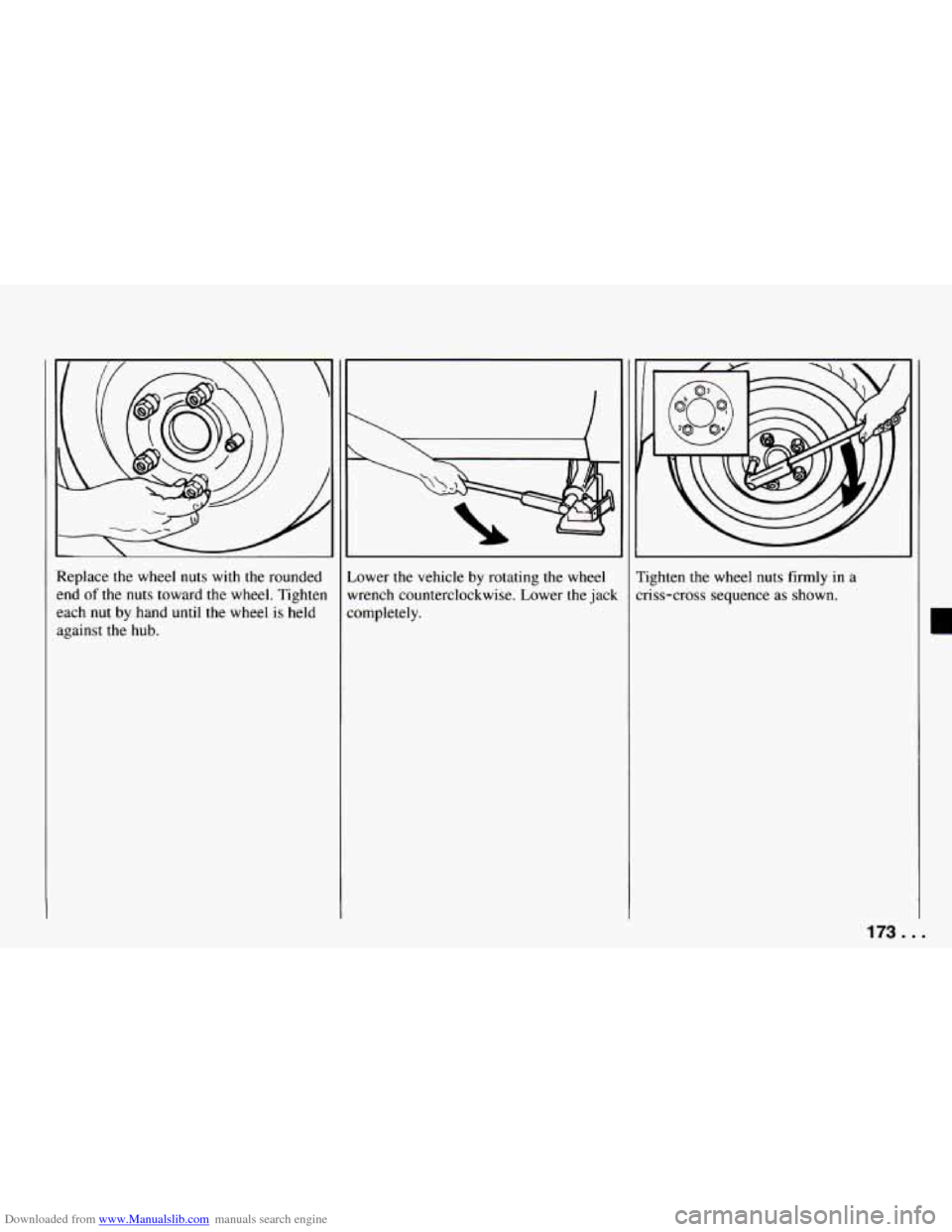
Downloaded from www.Manualslib.com manuals search engine Replace the wheel nuts with the rounded
end
of the nuts toward the wheel. Tighten
each nut by hand until the wheel is held
against the
hub.
Lower the vehicle by rotating the wheel
wrench counterclockwise. Lower the jack
completely. Tighten the wheel nuts
firmly in a
criss-cross sequence as shown.
173..
Page 185 of 292
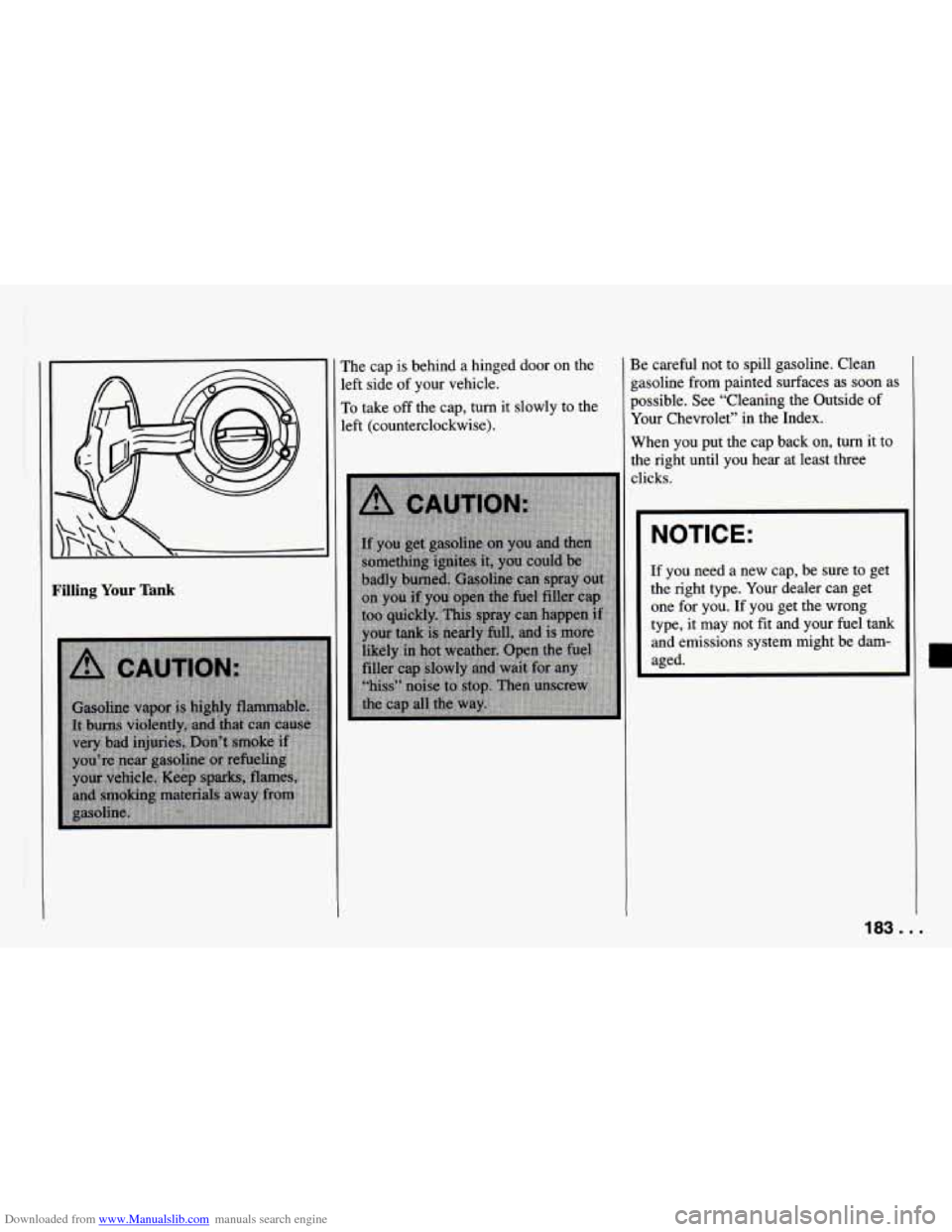
Downloaded from www.Manualslib.com manuals search engine Filling Your Tank
rhe cap is behind a hinged door on the
left side
of your vehicle.
To take off the cap, turn it slowly to the
left (counterclockwise). Be
careful not to spill gasoline. Clean
gasoline from painted surfaces as soon as
?ossible. See “Cleaning the Outside of
Your Chevrolet” in the Index.
When you put the cap back on,
turn it to
the right until you hear at least three
:licks.
NOTICE:
If you need a new cap, be sure to get
the right type. Your dealer can get
one for you. If you get the wrong
type, it may not
fit and your fuel tank
and emissions system might be dam-
aged.
183 ...
Page 193 of 292
Downloaded from www.Manualslib.com manuals search engine When to Change Engine Oil:
See if any one of these is true for you:
0 Most trips are less than 4 miles
(6 km).
It’s below freezing outside and most
trips are less than
10 miles (1 6 km).
The engine is at low speed most of the
time (as in door-to-door delivery, or
in
stop-and-go traffic).
0 You tow a trailer often.
@ Most trips are through dusty places.
If any one
of these is true for your
vehiclej
then you need to change your oil
and filter every 3,000 miles (5 000 km) or
3 months - whichever comes first.
If none of them is true, change the oil
every
7,500 miles (12 500 km) or 12
months - whichever comes first. Change
the filter at the first oil change and at
every other oil change after that.
Engine Coolant Heater (Engine Block
Heater):
An engine coolant heater can be a big
help
if you have to park outside in very
cold weather,
0” F (- 18 “C) or colder. If
your vehicle has this option, see “Engine
Coolant Heater”
in the Index.
What to Do with Used Oil:
Did you know that used engine oil
contains elements that may be unhealthy
for your skin and could even cause
cancer? Don’t let used oil stay on your
skin for very long. Clean your skin and
nails with soap and water, or a good hand
cleaner. Wash or properly throw away
clothing or rags containing used engine
oil. (See the manufacturer’s warnings
about the use and disposal
of oil
products.)
Used oil can be a real threat to the
environment. If
you change your own oil,
be sure to drain all free-flowing oil from
the filter before disposal. Don’t ever
dispose of oil by putting it in the trash,
pouring
it on the ground, into sewers, or
into streams
or bodies of water. Instead,
recycle it by taking it to a place that
collects used oil. If you have a problem
properly disposing of your used oil, ask
your dealer, a service station or a local
recycling center for help.
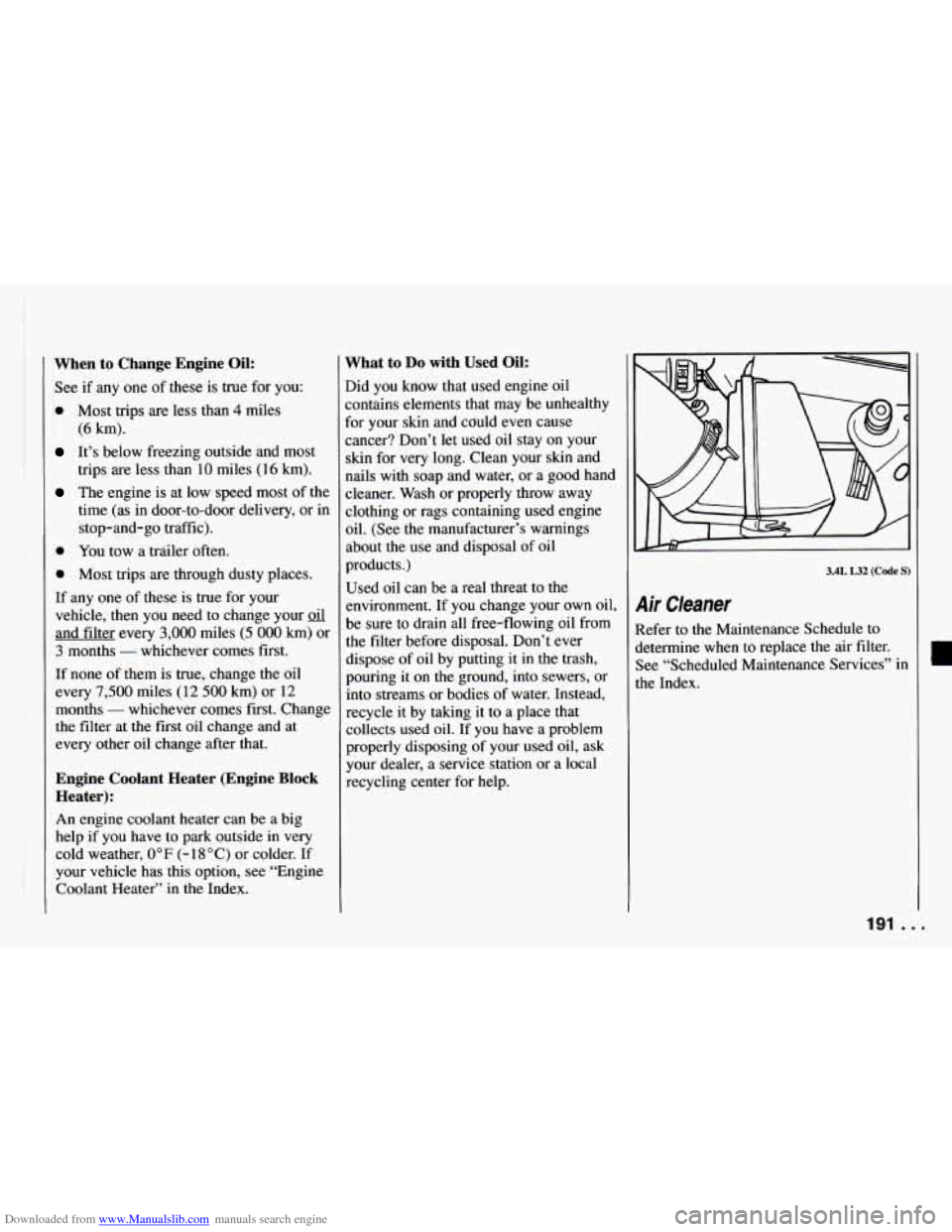
3.4L L32 (Code S
air Cleaner
tefer to the Maintenance Schedule to
letermine when
to replace the air filter.
;ee “Scheduled Maintenance Services” ir
he Index.
191 ...
Page 210 of 292
Downloaded from www.Manualslib.com manuals search engine Service and Appearance Care
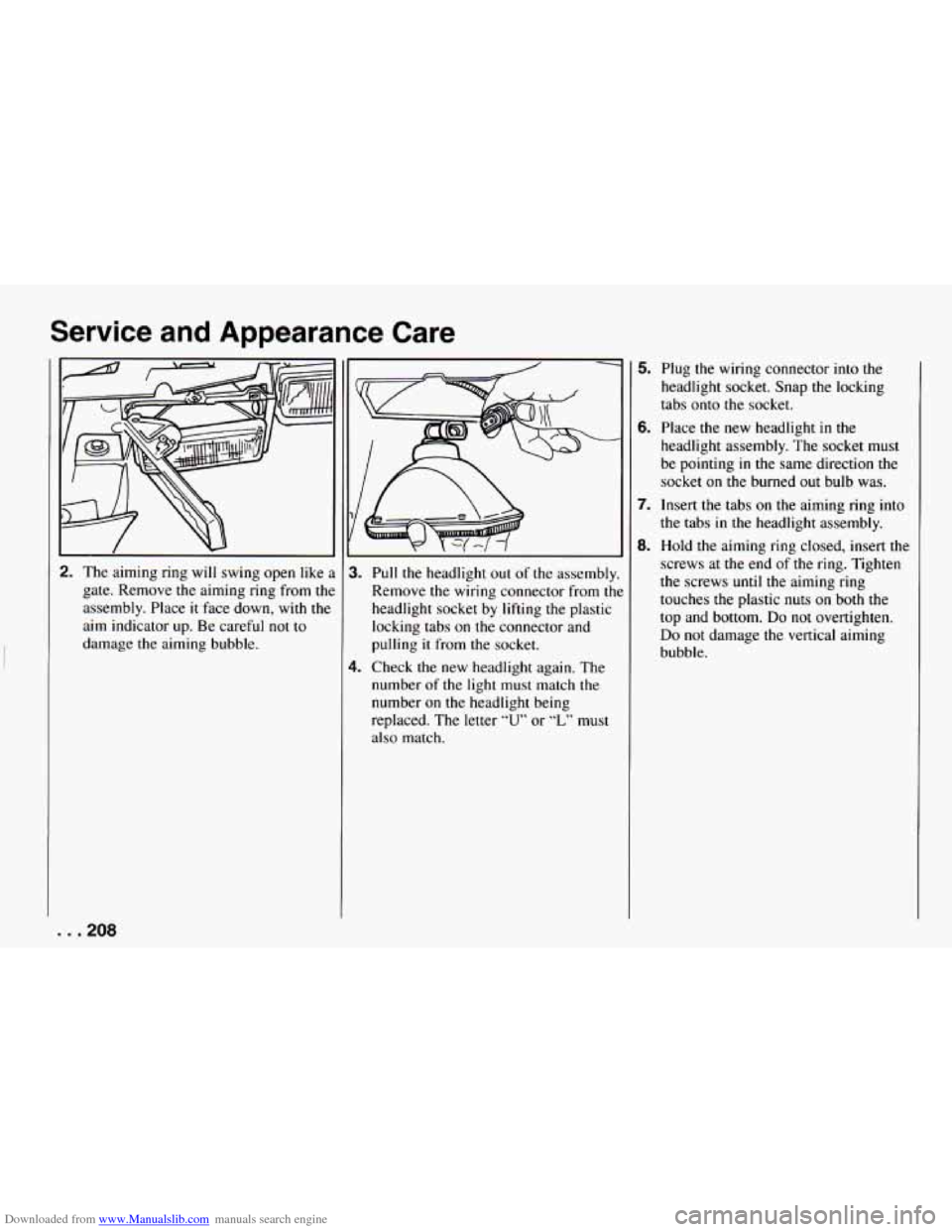
2. The aiming ring will swing open like
gate. Remove the aiming ring from
thl
assembly. Place it face down, with the
aim indicator up. Be careful not to
damage
the aiming bubble.
. . .208
I
-
a3
e
4,
Pull the headlight out of the assembly.
Remove the wiring connector from
thl
headlight socket by lifting the plastic
locking tabs on the connector and
pulling
it from the socket.
Check the new headlight again. The
number
of the light must match the
number on the headlight being
replaced. The letter
“U” or “L” must
also match.
5.
6.
7.
0.
Plug the wiring connector into the
headlight socket. Snap the locking
tabs onto the socket.
Place the new headlight in the
headlight assembly. The socket must
be pointing
in the same direction the
socket on
the burned out bulb was.
Insert the tabs on the aiming ring into
the tabs
in the headlight assembly.
Hold the aiming ring closed, insert the
screws at the end of the ring. Tighten
the screws until the aiming ring
touches the plastic nuts on
both the
top and bottom.
Do not overtighten.
Do not damage the vertical aiming
bubble.
Page 213 of 292
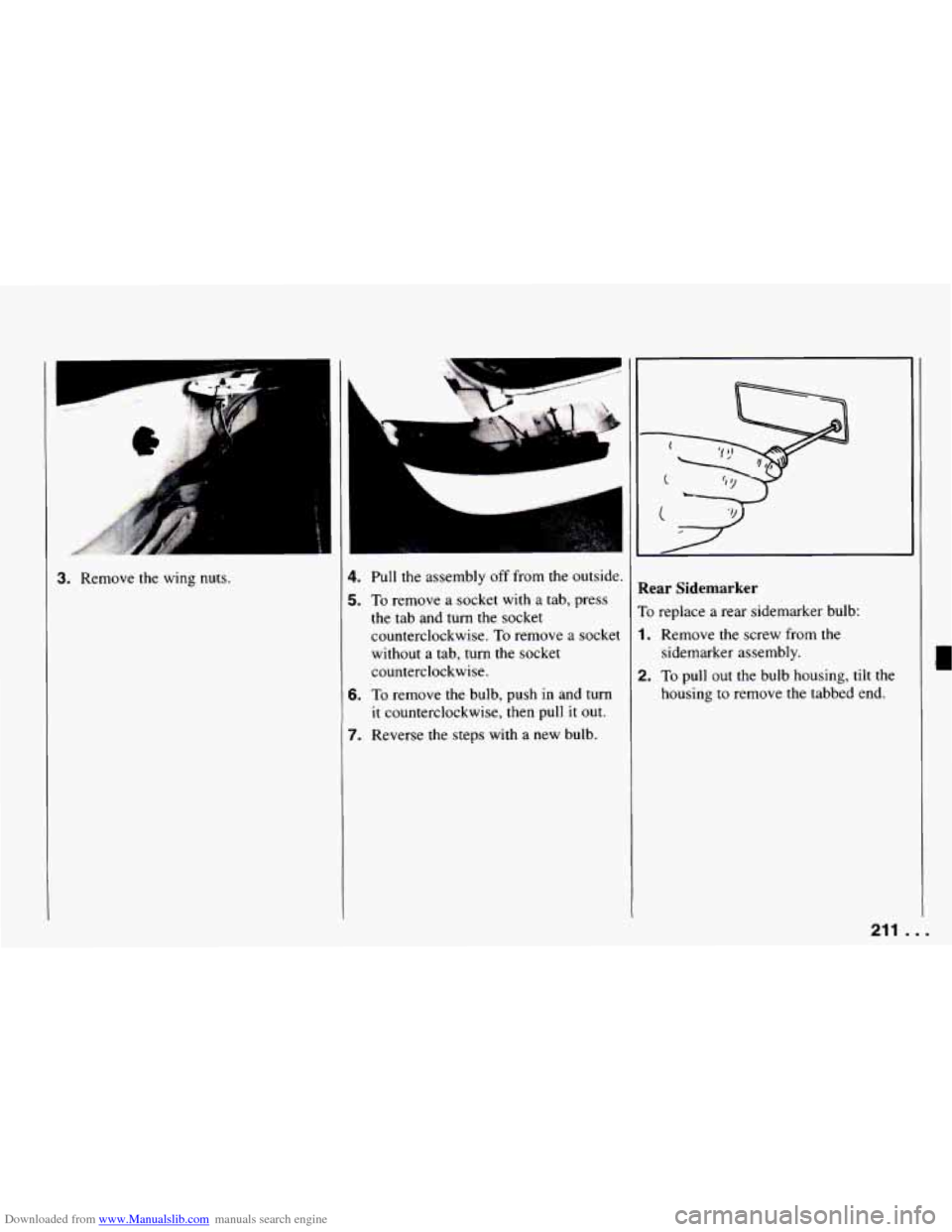
Downloaded from www.Manualslib.com manuals search engine 3. Remove the wing nut S.
L
- I
4. Pull the assembly off from the outside.
5. To remove a socket with a tab, press
the tab and turn the socket
counterclockwise.
To remove a socket
without a tab, turn the socket
counterclockwise.
6. To remove the bulb, push in and turn
7. Reverse the steps with a new bulb.
it counterclockwise, then pull it out.
Rear Sidemarker
To replace a rear sidemarker bulb:
1.
2.
Remove the screw from the
sidemarker assembly.
To pull out the bulb housing, tilt the
housing
to remove the tabbed end.
211 . ..
Page 214 of 292
Downloaded from www.Manualslib.com manuals search engine Service and Appearance Care
I
c i
c
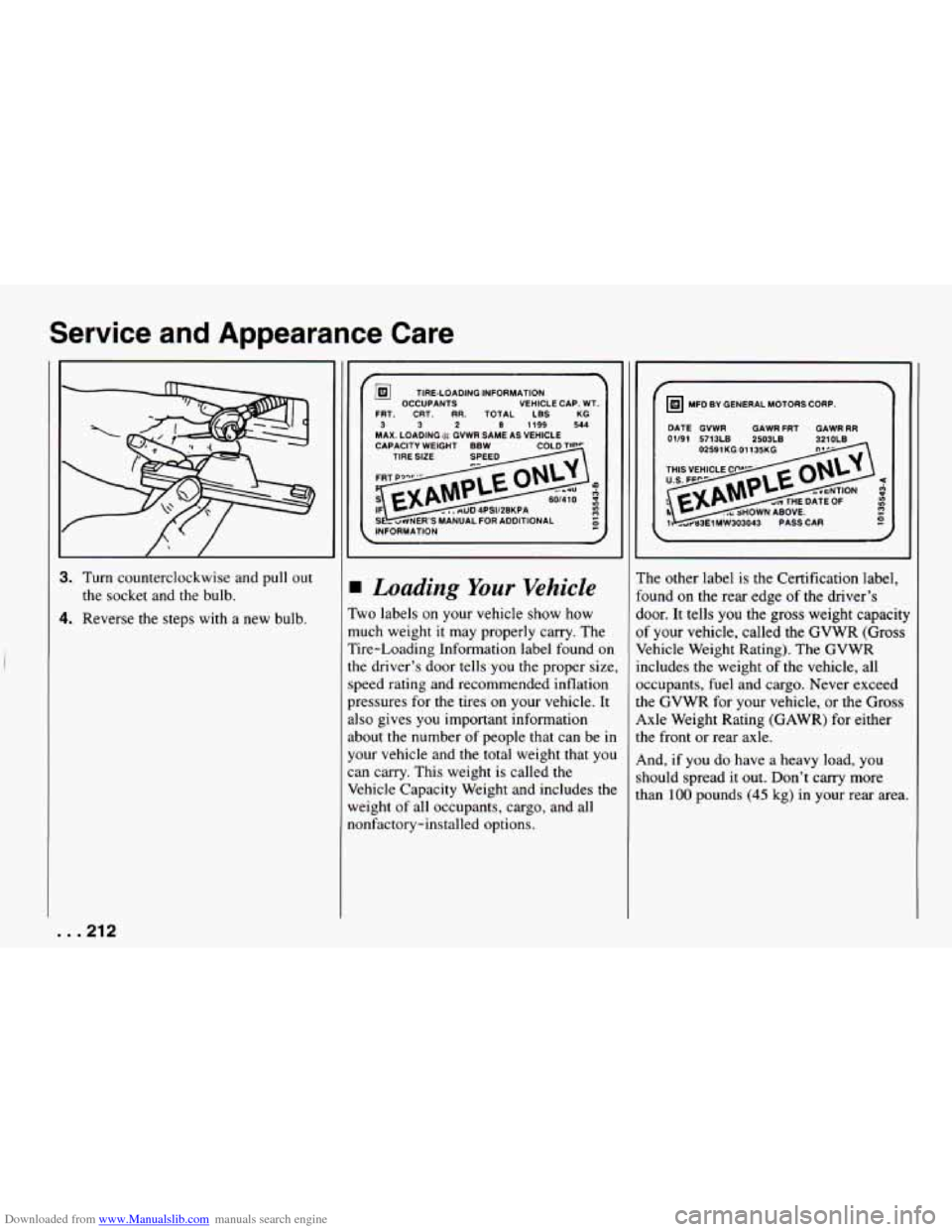
3. Turn counterclockwise and pull out
the socket and the bulb.
1. Reverse the steps with a new bulb.
. .212
r ~~
TIRE-LOADING INFORMATION
FRT. CRT.
RR. TOTAL LBS KG 3 3 2 8 1199 544 MAX. LOADING @ GVWR SAME AS VEHICLE
CAPACITY WEIGHT BBW
OCCUPANTS VEHICLE CAP. WT.
TIRE SIZE
IF
v)
INFORMATION
2
Loading Your Vehicle
Two labels on your vehicle show how
much weight
it may properly carry. The
Tire-Loading Information label found on
the driver’s door tells you the proper size,
speed rating and recommended inflation
pressures for the tires on your vehicle. It
also gives you important information
about the number of people that can be
in
your vehicle and the total weight that you
can carry. This weight is called the
Vehicle Capacity Weight and includes the
weight of all occupants, cargo, and all
nonfactory-installed options.
MFD BY GENERAL MOTORS CORP.
1 DATE GVWR GAWRFRT GAWRRR
7
fl
d
il
tl
P
tl
P
tl
0
0
S.
’he other label is the Certification label,
ound on
the rear edge of the driver’s
.oor. It tells you the gross weight capacity
If your vehicle, called the GVWR (Gross
rehicle Weight Rating). The GVWR
ncludes the weight of the vehicle, all
lccupants, fuel and cargo. Never exceed
le GVWR for your vehicle, or the Gross
ixle Weight Rating (GAWR) for either
ne front or rear axle.
md, if you do have a heavy load, you
hould spread it out. Don’t
carry more
Ian
100 pounds (45 kg) in your rear area.
Page 231 of 292
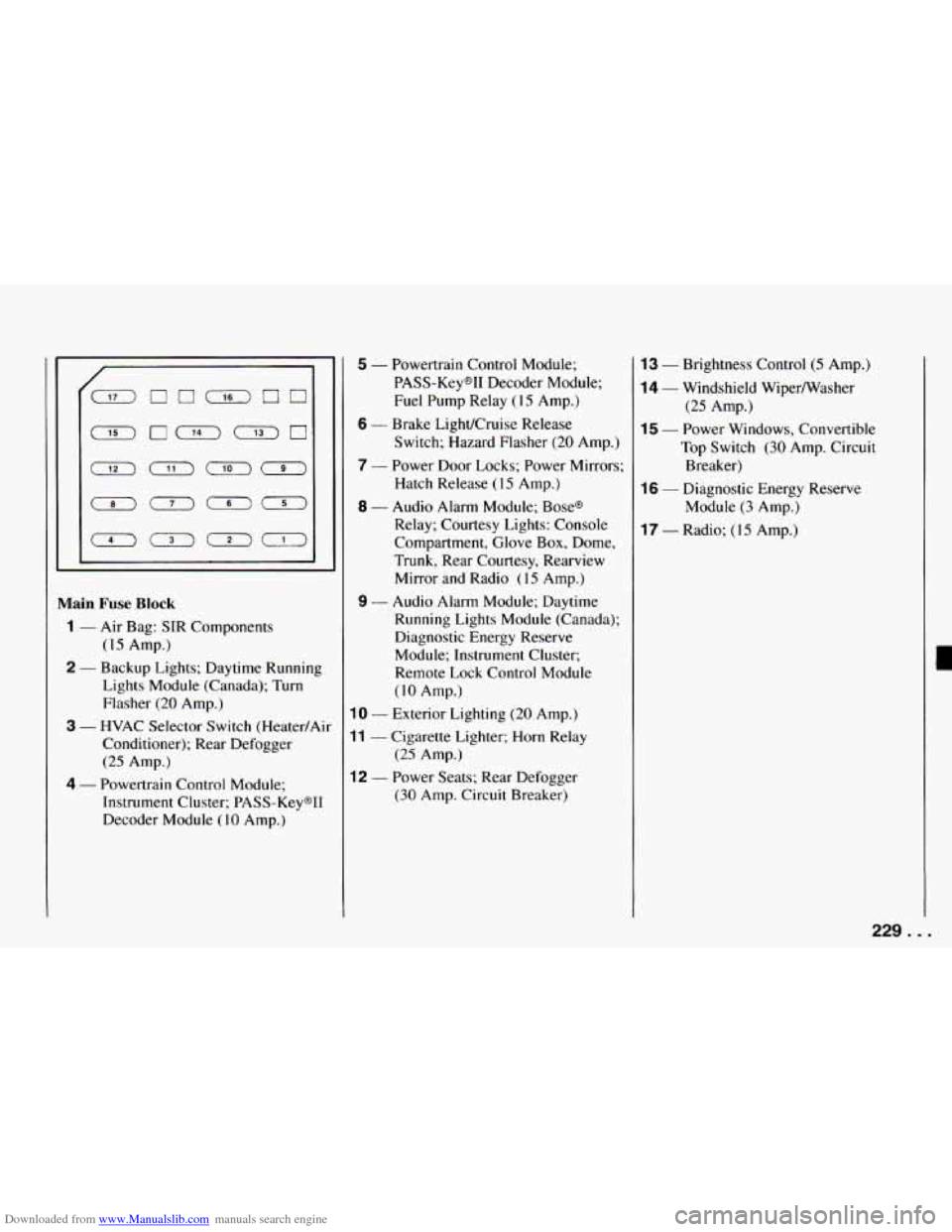
Downloaded from www.Manualslib.com manuals search engine Main Fuse Block
1 - Air Bag: SIR Components
2 - Backup Lights; Daytime Running
(15 Amp.)
Lights Module (Canada); Turn
Flasher
(20 Amp.)
3 - HVAC Selector Switch (Heater/Air
Conditioner); Rear Defogger
(25 Amp.)
4 - Powertrain Control Module;
Instrument Cluster; PASS-Keys11
Decoder Module
(10 Amp.)
5 - Powertrain Control Module;
PASS-Keys11 Decoder Module;
Fuel Pump Relay
(1 5 Amp.)
6 - Brake LighVCruise Release
Switch; Hazard Flasher
(20 Amp.)
7 - Power Door Locks; Power Mirrors;
Hatch Release
(15 Amp.)
8 - Audio Alarm Module; Bases
Relay; Courtesy Lights: Console
Compartment, Glove Box, Dome,
Trunk, Rear Courtesy, Rearview
Mirror and Radio
(1 5 Amp.)
9 - Audio Alarm Module; Daytime
Running Lights Module (Canada);
Diagnostic Energy Reserve
Module; Instrument Cluster;
Remote Lock Control Module
(IO Amp.)
10 - Exterior Lighting (20 Amp.)
11 - Cigarette Lighter; Horn Relay
12 - Power Seats: Rear Defogger
(25 Amp.)
(30 Amp. Circuit Breaker)
13 - Brightness Control (5 Amp.)
14 - Windshield Wipermasher
(25 Amp.)
15 - Power Windows, Convertible
Top Switch
(30 Amp. Circuit
Breaker)
16 - Diagnostic Energy Reserve
Module
(3 Amp.)
17 - Radio; ( 15 Amp.)
229. . .
Page 232 of 292
Downloaded from www.Manualslib.com manuals search engine Service and Appearance Care
E
F
D C B
G H J
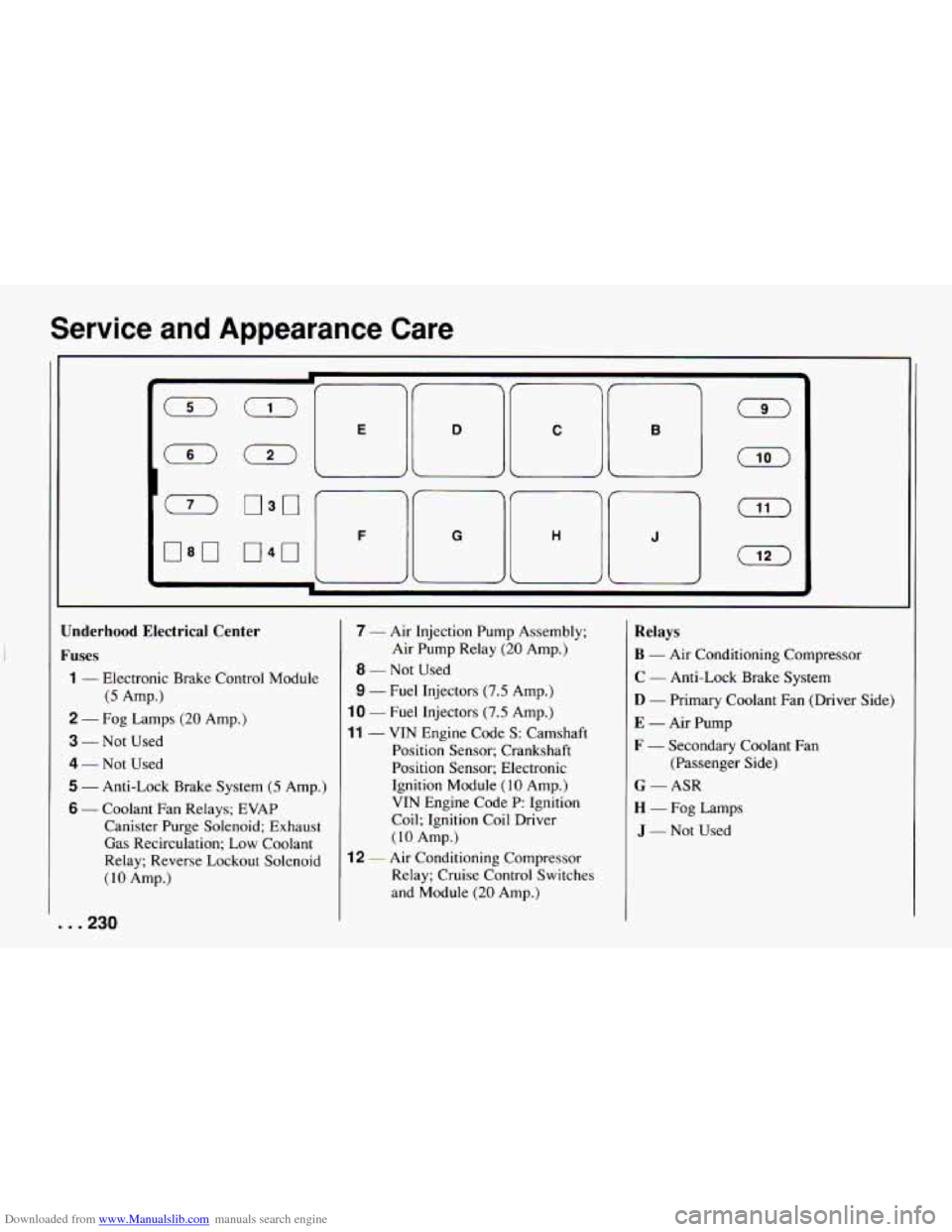
Jnderhood Electrical Center
'uses
1 - Electronic Brake Control Module
2 - Fog Lamps (20 Amp.)
3 - Not Used
4 - Not Used
5 - Anti-Lock Brake System (5 Amp.)
6 - Coolant Fan Relays; EVAP
(5 Amp.)
Canister Purge Solenoid; Exhaust
Gas Recirculation; Low Coolant
Relay; Reverse Lockout Solenoid
( 10 Amp.)
. .230
7 - Air Injection Pump Assembly;
8 - Not Used
9 - Fuel Injectors (7.5 Amp.)
lo - Fuel Injectors (7.5 Amp.)
11 - VIN Engine Code S: Camshaft
Air Pump Relay
(20 Amp.)
Position Sensor; Crankshaft
Position Sensor; Electronic
Ignition Module
(10 Amp.)
VIN Engine Code P: Ignition
Coil; Ignition Coil Driver
(10 Amp.)
12 - Air Conditioning Compressor
Relay; Cruise Control Switches
and Module
(20 Amp.)
Relays
B - Air Conditioning Compressor
C - Anti-Lock Brake System
D - Primary Coolant Fan (Driver Side)
E - Air Pump
F - Secondary Coolant Fan
(Passenger Side)
G - ASR
H - Fog Lamps
J - Not Used
Page 249 of 292
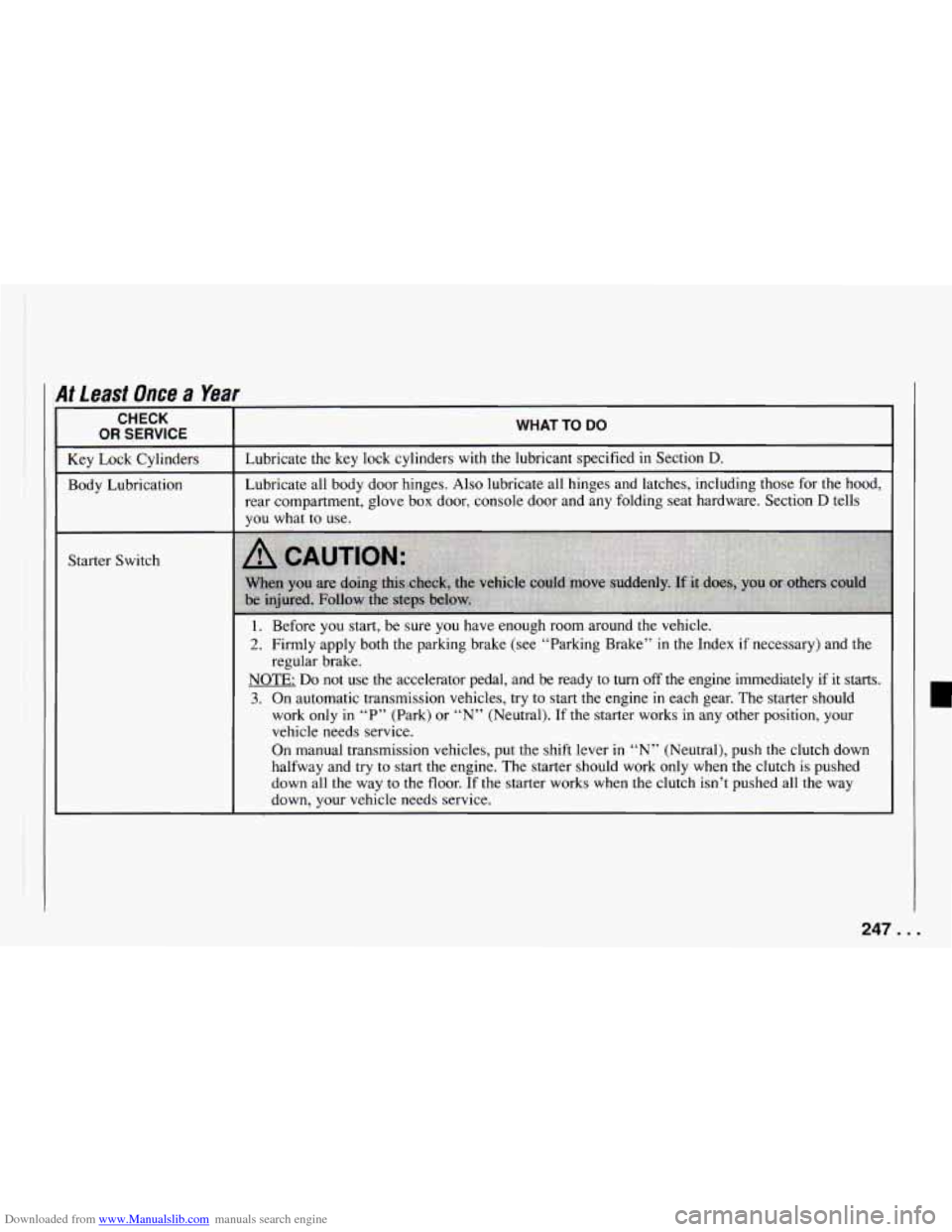
Downloaded from www.Manualslib.com manuals search engine At Least Once a Year
CHECK
OR SERVICE
r
Starter Switch
WHAT TO DO
Lubricate the key lock cylinders with the lubricant specifiedin Section D.
Lubricate all body door hinges. Also lubricate all hinges and latches, including those for the hood,
rear compartment, glove box door, console door and any folding seat hardware. Section
D tells
you what to use.
1. Before you start, be sure you have enough room around the vehicle.
2. Firmly apply both the parking brake (see “Parking Brake” in the Index if necessary) and the
NOTE:
Do not use the accelerator pedal, and be ready to turn off the engine immediately if it starts.
3. On automatic transmission vehicles, try to start the engine in each gear. The starter should
work only in
“P” (Park) or “N” (Neutral). If the starter works in any other position, your
vehicle needs service.
On manual transmission vehicles, put the shift lever
in “N” (Neutral), push the clutch down
halfway and try to start the engine. The starter should work only when the clutch is pushed
down all the way to the floor. If the starter works when the clutch isn’t pushed all the way
down, your vehicle needs service.
regular brake.
247. . .
Page 250 of 292
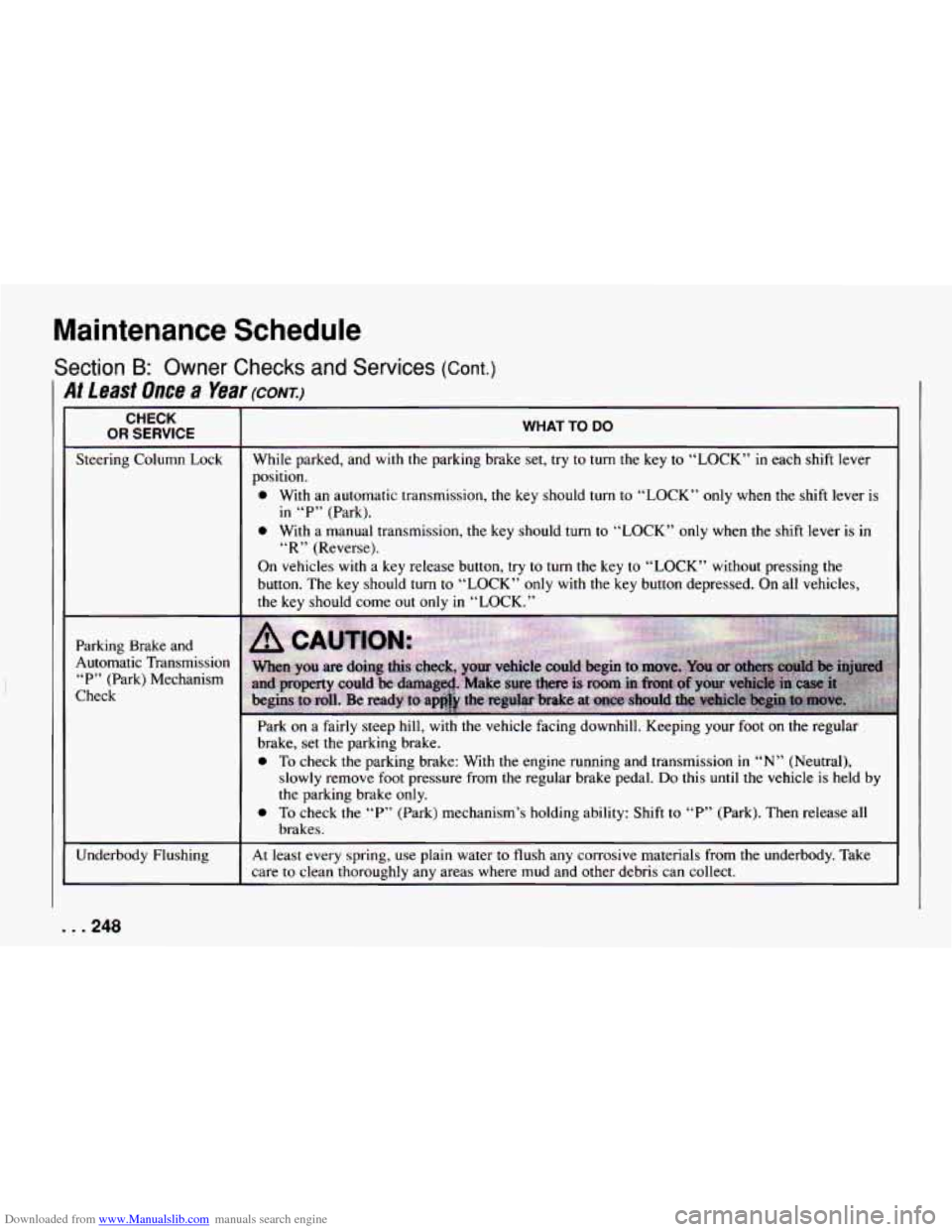
Downloaded from www.Manualslib.com manuals search engine Maintenance Schedule
Section B: Owner Checks and Services (Cont.)
At Least Once a Year (CONT.)
CHECK
OR SERVICE
Steering Column Lock
Parking Brake and
Automatic Transmission “P” (Park) Mechanism
Check
Underbody Flushing
WHAT TO DO
While parked, and with the parking brake set, try to turn the key to “LOCK” in each shift lever
position.
0 With an automatic transmission, the key should turn to “LOCK” only when the shift lever is
0 With a manual transmission, the key should turn to “LOCK” only when the shift lever is in
On vehicles
with a key release button, try to turn the key to “LOCK” without pressing the
button. The key should turn to “LOCK” only with the key button depressed. On all vehicles,
the
key should come out only in “LOCK.”
in “P” (Park).
“R” (Reverse).
Park on a fairly steep hill, with the vehicle facing downhill. Keeping your foot on the regular
brake, set the parking brake.
0 To check the parking brake: With the engine running and transmission in “N” (Neutral),
slowly remove foot pressure from the regular brake pedal.
Do this until the vehicle is held by
the parking brake only.
brakes.
0 To check the “P” (Park) mechanism’s holding ability: Shift to “P” (Park). Then release all
At least every spring, use plain water to flush any corrosive materials from the underbody. Take
care to clean thoroughly any areas where mud and other debris can collect.
. . .248