ignition CHEVROLET CAMARO 1996 4.G Workshop Manual
[x] Cancel search | Manufacturer: CHEVROLET, Model Year: 1996, Model line: CAMARO, Model: CHEVROLET CAMARO 1996 4.GPages: 402, PDF Size: 21.38 MB
Page 162 of 402
Downloaded from www.Manualslib.com manuals search engine Disabling the Theft-Deterrent Feature
1.
2.
3.
4.
5.
6.
7.
8.
9.
Turn the ignition on.
Turn the radio off.
Press the 1 and
4 buttons together. Hold them down
until
SEC shows on the display.
Press
SET and 000 will appear on the display.
Press
SCAN to make the first digit of your code appear.
Press the SEEK right or left arrow to make the
second and third digits
of your code appear.
Press AM-FM and
000 will appear on the display
again. Now you are ready to enter the last three
digits of your code.
Enter the last three digits of your code. The display
will show the numbers as entered.
Press AM-FM after you have confirmed that the
code matches
the secret code you have written down.
The display will show
---, indicating that the radio is
no longer secured.
If the code entered is incorrect,
SEC will appear on the
display. The radio will remain secured until the correct
code is entered.
When battery power is given to a secured radio, the
radio won’t turn on and
LOC will appear on the display.
Understanding Radio Reception
FM Stereo
FM stereo will give you the best sound. But FM signals
will reach only about
10 to 40 miles (16 to 65 km). Tall
buildings or hills can interfere with
FM signals, causing
the sound to come and
go.
AM
The range for most AM stations is greater than for FM,
especially at.night. The longer range, however, can
cause stations to interfere with each other. AM can pick
up noise from things like storms and power lines. Try
reducing the treble to reduce this noise if
you ever get it.
Tips About Your Audio System
Hearing damage from loud noise is almost undetectable
until it is too late. Your hearing can adapt
to higher
volumes
of sound. Sound that seems normal can be loud
and harmful to your hearing. Take precautions by
adjusting the volume control on your radio to a safe
sound level before your hearing adapts
to it.
3-19
Page 189 of 402
Downloaded from www.Manualslib.com manuals search engine 0 Keep your vehicle in good shape. Check all fluid
levels and also the brakes, tires, cooling system and
transmission. These parts can work hard on
mountain roads.
0 Know how to go down hills. The most important
thing
to know is this: let your engine do some of the
slowing down. Shift to
a lower gear when you go
down
a steep or long hill.
A CAUTION:
If you don’t shift down, your brakes could get
so hot that they wouldn’t work well. You would
then have poor braking or even none going
down
a hill. You could crash. Shift down to let
your engine assist your brakes on
a steep
downhill slope.
I
- -
Coasting downhill in NEUTRAL (N) or with the
ignition
off is dangerous. Your brakes will have to
do
all the work of slowing down. They could get so
hot that they wouldn’t work well. You would then
have poor braking or even none going down
a hill.
You could crash. Always have your engine running
and your vehicle
in gear when you go downhill.
Know how to go uphill. You may want to shift down
to a lower gear. The lower gears help cool your engine
and transmission, and you can climb the hill better.
Stay in your own lane when driving on two-lane
roads in hills
or mountains. Don’t swing wide or cut
across the center
of the road. Drive at speeds that let
you stay in your own lane.
could be something in your lane, like
a stalled car or
an accident.
0 As you go over the top of a hill, be alert. There
4-24
Page 210 of 402
Downloaded from www.Manualslib.com manuals search engine NOTICE:
Ignoring these steps could result in costly damage
to your vehicle that wouldn’t be covered by
your warranty.
Trying to start your Chevrolet by pushing or
pulling it could damage your vehicle, even
if you
have
a manual transmission. And if you have an
automatic transmission, it won’t start that way.
1. Check the other vehicle. It must have a 12-volt
battery with a negative ground system.
NOTICE:
If the other system isn’t a 12-volt system with a
negative ground, both vehicles can be damaged.
2.
3.
Get the vehicles close enough so the jumper cables
can reach, but be sure the vehicles aren’t touching
each other.
If they are, it could cause a ground
connection you don’t want. You wouldn’t be able to
start your Chevrolet, and the bad grounding could
damage the electrical systems.
Turn off the ignition on both vehicles. Unplug --
unnecessary accessories plugged into the cigarette
lighter. Turn
off all lamps that aren’t needed as well
as radios. This will avoid sparks and help save both
batteries. And it could save your radio!
~~
NOTICE:
If you leave your radio on, it could be badly
damaged. The repairs wouldn’t be covered by
your warranty.
5-3
Page 216 of 402
Downloaded from www.Manualslib.com manuals search engine A CAUTION:
A vehicle can fall from a car carrier if it isn’t
adequately secured. This can cause a collision,
serious personal injury and vehicle damage. The
vehicle should be tightly secured with chains
or
steel cables before it is transported.
Don’t use substitutes (ropes, leather straps,
canvas webbing, etc.) that can be cut
by sharp
edges underneath the towed vehicle. Always use
T-hooks inserted in the T-hook slots. Never use
J-hooks. They will damage drivetrain and
suspension components.
When your vehicle is being towed, have the ignition key
turned
to the OFF position. The steering wheel should
be clamped in a straight-ahead position, with a clamping
device designed for towing service. Do not use the
vehicle’s steering column lock for this. The transmission
should be in
NEUTRAL (N) and the parking
brake released.
Don’t have your vehicle towed on the drive wheels,
unless you must. If the vehicle must
be towed on the
drive wheels, be sure to follow the speed and distance
restrictions later
in this section or your transmission will
be damaged. If these limitations must be exceeded, then
the drive wheels have
to be supported on a dolly.
5-9
Page 322 of 402
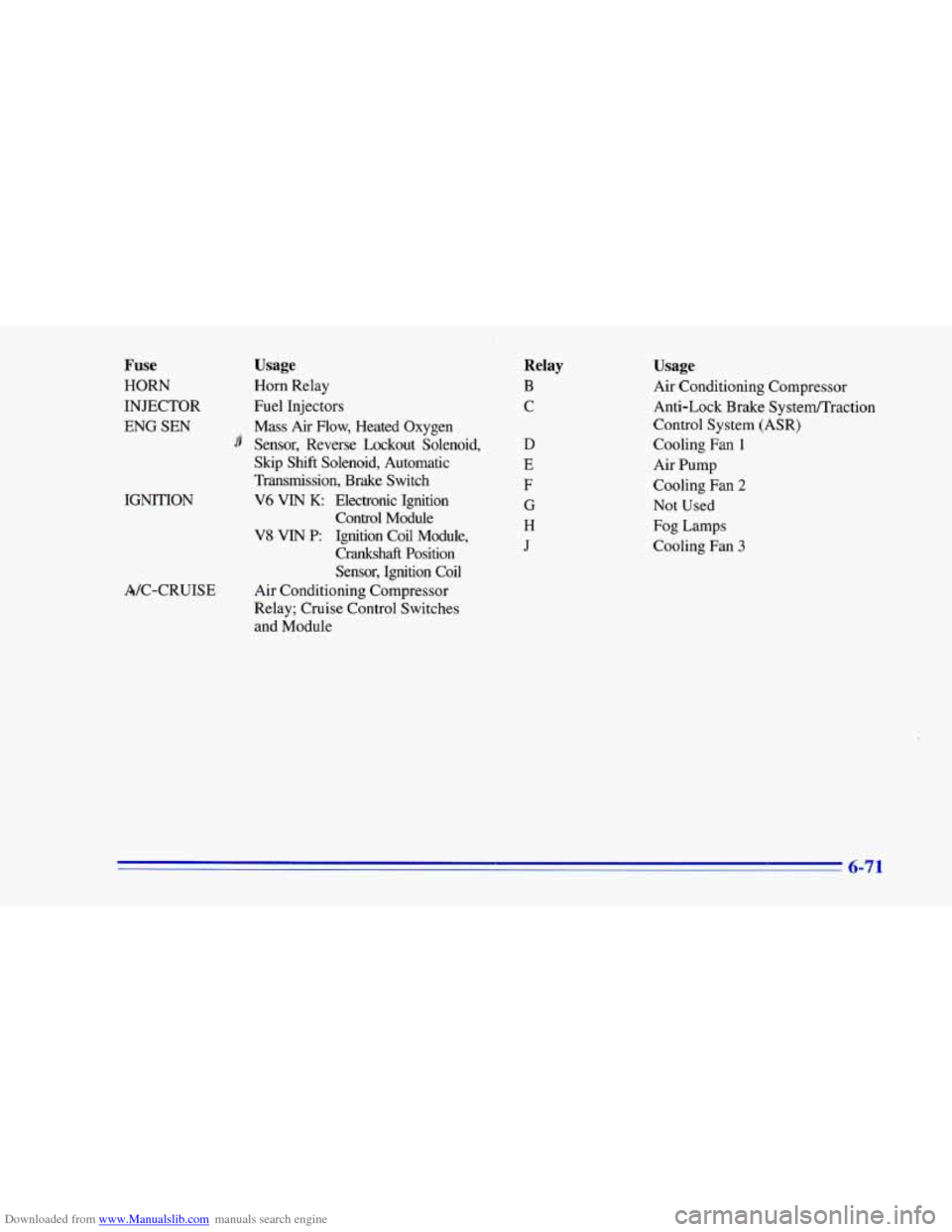
Downloaded from www.Manualslib.com manuals search engine Fuse
HORN INJECTOR
ENG SEN
IGNITION
A/C-CRUISE
Usage
Horn Relay
Fuel Injectors
~ Mass Air Flow, Heated Oxygen
fl Sensor, Reverse Lockout Solenoid.
Skip Shift Solenoid, Automatic
Transmission, Brake Switch
V6 VIN K: Electronic Ignition Control Module
V8 VIN P: Ignition Coil Module,
Crankshaft Position
Sensor, Ignition Coil
Air Conditioning Compressor
Relay; Cruise Control Switches
and Module
Relay
B
C
D
E
F
G
H
J
Usage
Air Conditioning Compressor
Anti-Lock Brake SystedTraction
Control System (ASR)
Cooling Fan
1
Air Pump
Cooling Fan
2
Not Used
Fog Lamps
Cooling Fan
3
6-71
Page 394 of 402
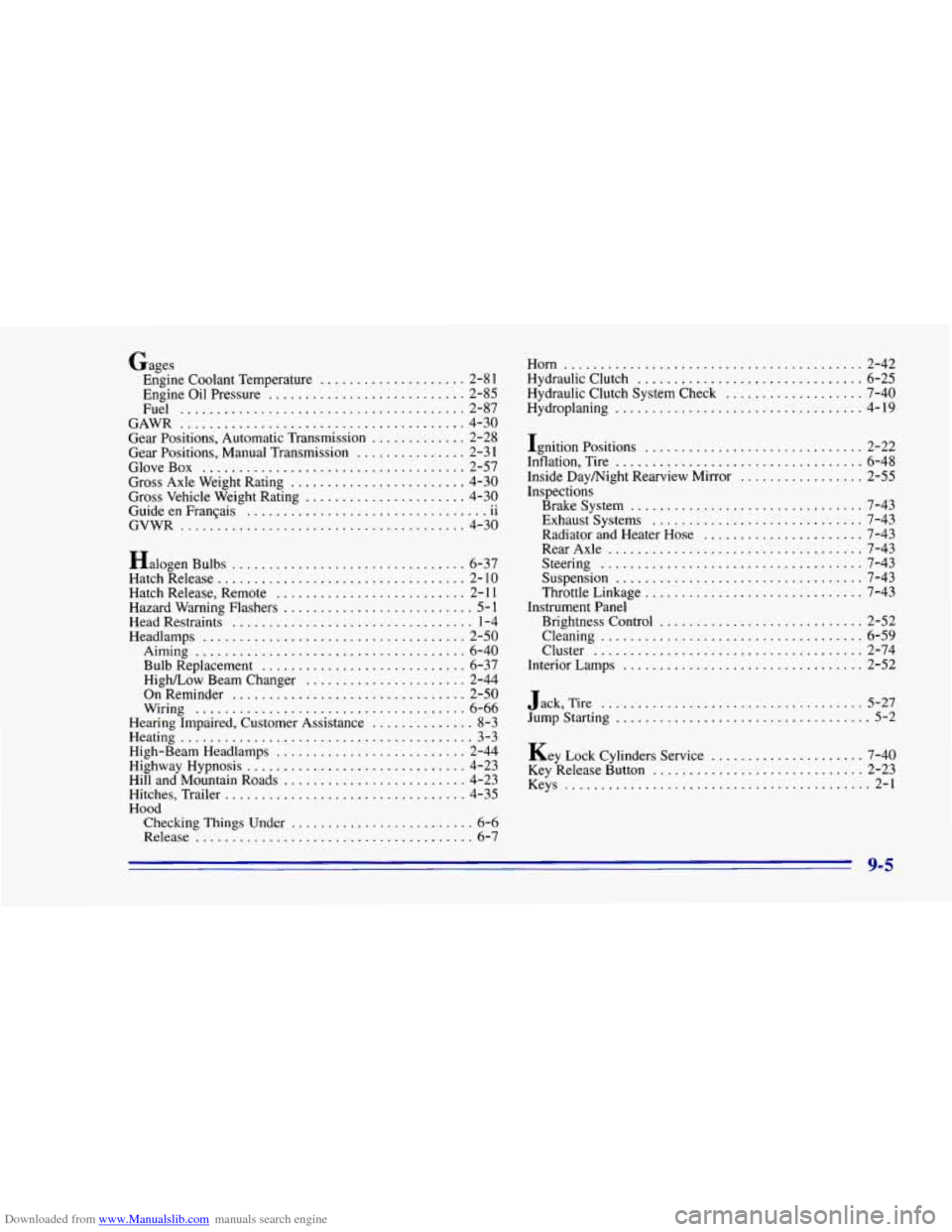
Downloaded from www.Manualslib.com manuals search engine Gages Engine Coolant Temperature
.................... 2-8 1
Engine Oil Pressure ........................... 2-85
Fuel ....................................... 2-87
Gear Positions. Automatic Transmission
............. 2-28
Gear Positions. Manual Transmission
............... 2-3 1
GloveBox .................................... 2-57
Gross Axle Weight Rating ........................ 4-30
Gross Vehicle Weight Rating
...................... 4-30
Guide
en FranCais 11
GAWR ....................................... 4-30
.. .................................
GVWR ....................................... 4-30
Halogen Bulbs
................................ 6-37
Hatch Release
.................................. 2- 10
Hatch Release. Remote .......................... 2- 1 1
Hazard Warning Flashers .......................... 5-1
Head Restraints ................................. 1-4
Headlamps
.................................... 2-50
Aiming
..................................... 6-40
Bulb Replacement
............................ 6-37
HighLow Beam Changer
...................... 2-44
OnReminder
................................ 2-50
Wiring
..................................... 6-66
Hearing Impaired, Customer Assistance .............. 8-3
Heating
........................................ 3-3
High-Beam Headlamps
.......................... 2-44
Highway Hypnosis
.............................. 4-23
Hill and Mountain Roads
......................... 4-23
Hitches, Trailer
................................. 4-35
Hood Checking
Things Under ......................... 6-6
Release ...................................... 6- 7
Horn ......................................... 2-42
Hydraulic Clutch
............................... 6-25
Hydraulic Clutch System Check
................... 7-40
Hydroplaning
.................................. 4-19
Ignition Positions .............................. 2.22
Inflation. Tire
.................................. 6-48
Inside Daymight Rearview Mirror
................. 2-55
Inspections Brakesystem
................................ 7-43
Exhaust Systems
............................. 7-43
Radiator and Heater Hose
...................... 7-43
RearAxle
................................... 7-43
Steering
.................................... 7-43
Suspension
.................................. 7-43
Throttle Linkage
............................ 7-43
Brightness Control
............................ 2-52
Cleaning
.................................... 6-59
Cluster
..................................... 2-74
Interior Lamps
................................. 2-52
Jack. Tire .................................... 5-27
Jump Starting ................................... 5-2
Key Lock Cylinders Service
..................... 7-40
Key Release Button
............................. 2-23
Keys
.......................................... 2-1
Instrument
Panel