ignition CHEVROLET CAMARO 1996 4.G Owners Manual
[x] Cancel search | Manufacturer: CHEVROLET, Model Year: 1996, Model line: CAMARO, Model: CHEVROLET CAMARO 1996 4.GPages: 402, PDF Size: 21.38 MB
Page 36 of 402
Downloaded from www.Manualslib.com manuals search engine 0
e
Your vehicle is equipped with a crash sensing and
diagnostic module, which records information about
the air bag system. The module records information
about the readiness of the system, when the
sensors are activated and driver’s safety belt usage
at deployment.
Let
only qualified technicians work on your air
bag system. Improper service can mean that your
air bag system won’t work properly. See your dealer
for service.
NOTICE:
If you damage the cover for the driver’s or the
right front passenger’s air bag, they may not
work properly. You may have
to replace the air
bag module in the steering wheel or both the air
bag module and the instrument panel for the
right front passenger’s air bag.
Do not open or
break the air bag covers.
Servicing Your Air Bag-Equipped Chevrolet
Air bags affect how your Chevrolet should be serviced.
There are parts of the air bag system in several places
around your vehicle.
You don’t want the system to
inflate while someone is working on your vehicle. Your
Chevrolet dealer and the Camaro Service Manual have
information about servicing your vehicle and the air bag
system.
To purchase a service manual, see “Service and
Owner Publications” in the Index.
I
For up to 10 minutes after the ignition key is
turned off and the battery is disconnected, an air
bag can still inflate during improper service. You
can be injured if you are close to
an air bag when
it inflates. Avoid wires wrapped with yellow tape
or yellow connectors. They are probably part of
the air bag system. Be sure to follow proper
service procedures, and make sure the person
performing work for you is qualified to do
so.
The air bag system does not need regular maintenance.
1-25
Page 56 of 402
Downloaded from www.Manualslib.com manuals search engine 0 Section 2 Features and Controls
Here you can learn about the many standard and
optional features on your Chevrolet, and information on
starting, shifting and braking. Also explained are the
instrument panel and the warning systems that tell
you if
everything
is working properly -- and what to do if you
have a problem.
K-ys
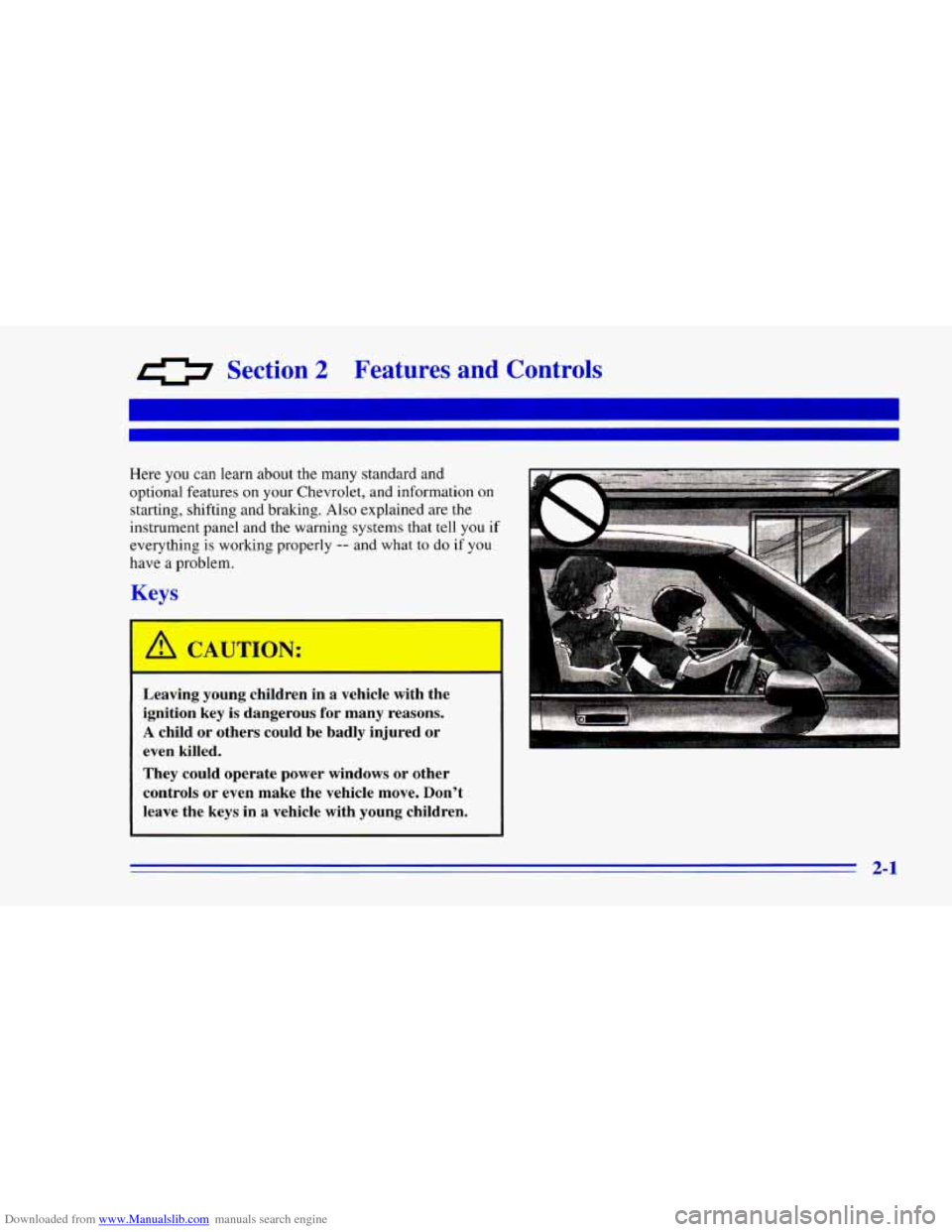
Leaving young children in a vehicle with the
ignition key is dangerous for many reasons.
A child or others could be badly injured or
even killed.
They could operate power windows or other
controls or even make the vehicle move. Don't
leave the keys in a vehicle with young children.
31
Page 57 of 402
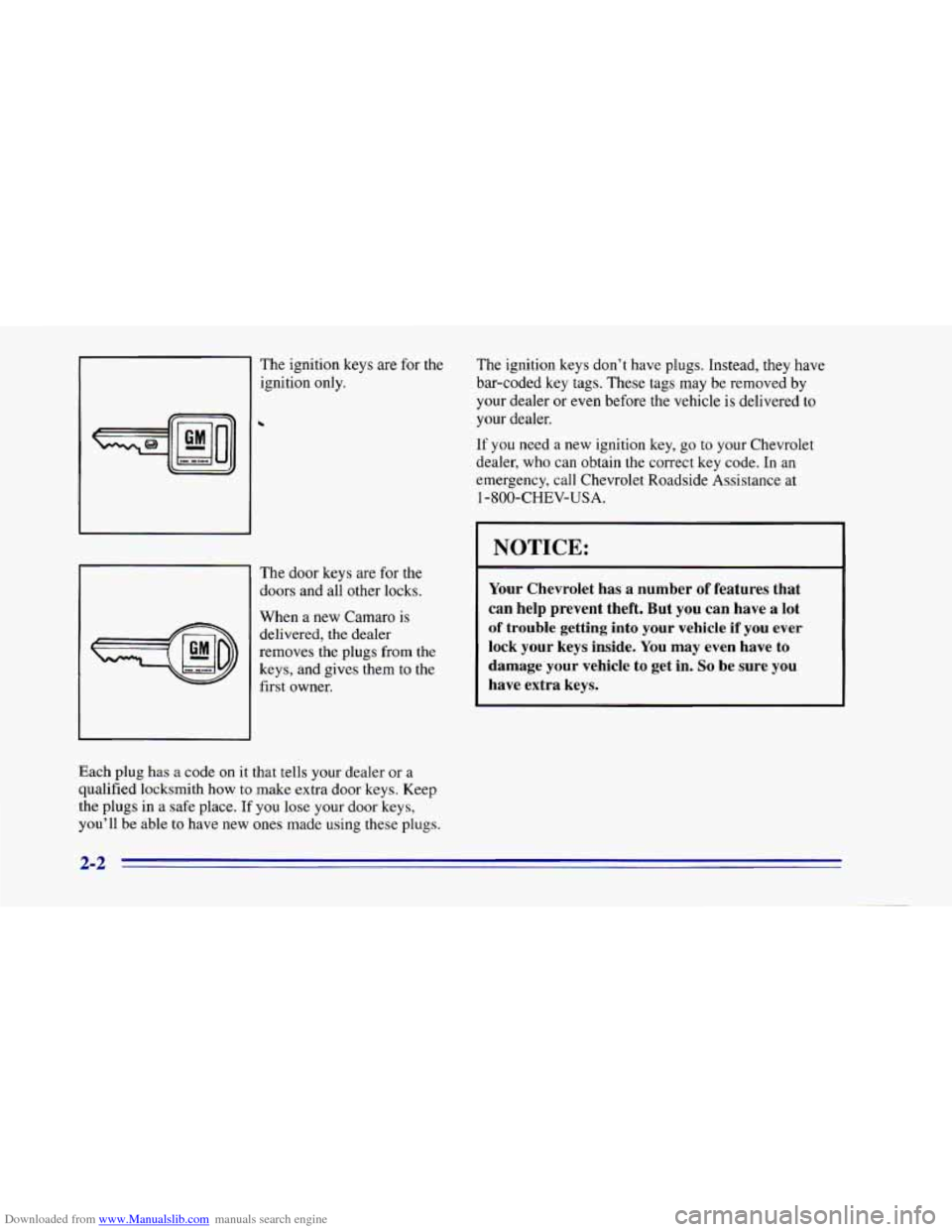
Downloaded from www.Manualslib.com manuals search engine The ignition keys are for the
The ignition keys don’t have plugs. Instead, they have
ignition only. bar-coded
key tags. These tags may be removed by
your dealer or even before the vehicle
is delivered to
k your dealer.
If you need a new ignition key, go to your Chevrolet
dealer, who can obtain the correct key code. In an
emergency, call Chevrolet Roadside Assistance at
1
-800-CHEV-USA.
The door keys are for the
doors and all other locks.
When a new Camaro is
delivered, the dealer
removes the plugs from the
keys, and gives them
to the
first owner.
Each
plug has a code on it that tells your dealer or a
qualified locksmith how to make extra door keys. Keep
the plugs in
a safe place. If you lose your door keys,
you’ll be able
to have new ones made using these plugs.
NOTICE:
Your Chevrolet has a number of features that
can help prevent theft. But you can have a lot
of trouble getting into your vehicle if you ever
lock your keys inside. You may even have to
damage your vehicle to get in.
So be sure you
have extra keys.
2-2
Page 60 of 402
Downloaded from www.Manualslib.com manuals search engine Last Door Closed Locking (Option)
If you have power door locks, you can program a last
door closed locking feature for your vehicle. This feature
allows for
a delayed locking of the doors so that you or
your passengers may exit the vehicle after you’ve pressed
the power door lock switch and still have the doors
locked once everyone has gotten out of the vehicle.
When the power door lock switch is pressed, a chime
will sound three times, indicating that last door closed
locking has been activated. Pressing the LOCK switch
again will lock the doors immediately. Pressing the
UNLOCK switch will cancel a previously requested last
door closed locking.
This feature is shipped from the factory
in the off
position.
To turn this feature on, see “Feature
Customization” in the Index.
Lockout Prevention (Option)
To protect you from locking your keys in the vehicle,
this feature stops the power door locks from locking
when the keys are in the ignition and a door is open.
If the power
lock switch is pressed when a door is open,
a chime will sound five times as a reminder
to take the
keys out of
the ignition before locking the door. This
feature is shipped from the factory in the on position.
If you would like to turn this feature off, see “Feature
Customization”
in the Index.
Leaving Your Vehicle
If you are leaving the vehicle, take your keys, open your
door and
set the locks from inside. Then get out and
close the door.
Remote Lock Control (Option)
If your Chevrolet has this option, you can lock and
unlock your
doors or unlock your trunk from up to
30 feet (9 m) away using the key chain transmitter
supplied with your vehicle.
Page 62 of 402
Downloaded from www.Manualslib.com manuals search engine Operation
The driver’s door will unlock automatically when
UNLOCK is pressed. If UNLOCK is pressed again
within five seconds, the passenger door will also unlock.
All doors will lock when LOCK is pressed.
The hatch will unlock when the button with the trunk
symbol is pressed, as long as the ignition is turned to the
OFF position. If the ignition is on, the trunk button will
only work if the transmission is in PARK
(P) for an
automatic transmission, or if the parking brake is set
on
a manual transmission.
The system will turn
on the interior lamps for about
40 seconds (or until the ignition switch is turned to the
RUN position), when you unlock the doors
or hatch.
The interior lamps will go
off when you lock the doors.
Operating the Remote Lock Control transmitter may
interact with the Vehicle and Content Theft-DeterrentlAlarm
System (if
you have this option). See “Vehicle and Content
Theft-DeterrentlAlarm System” in the Index.
Alarm/Panic Mode
If your vehicle is equipped with the Vehicle and Content
Theft-Deterrent/Alarm System,
you will have a fourth
button on your transmitter. This button is the panic
button.
If you are involved in a panic situation, press this button and
your vehicle’s horn will sound and the
headlamps will flash,
This will draw needed attention to
you and your vehicle. To turn this feature off, either
push the panic button again or turn the ignition to the
RUN position. Note: This feature will
not work if your
ignition
is on or if the transmitter is 30 feet (9 m) or
more away from your vehicle.
Resynchronizing Your Transmitter
If your vehicle does not respond to your transmitter, do
the following to determine what’s wrong:
1. Get closer to the vehicle and try pressing a button
again. Your battery may be low (If
so, see “Battery
Replacement” in the Index).
2. While close to your vehicle, press the LOCK and
UNLOCK buttons
on your transmitter at the same
time and hold for eight seconds. This will attempt to
match your Remote Lock Control transmitter and the
transmitter receiver security
codes.
3. If neither Steps 1 or 2 is successful, your transmitter
may need to be matched to your vehicle. See
“Matching Transmitter(s) to Your Vehicle” in
the Index.
2-7
Page 63 of 402
Downloaded from www.Manualslib.com manuals search engine Transmitter Verification (Option)
This feature provides feedback to the holder of the
Remote Lock Control transmitter that a command has
been received by the Remote Lock Control receiver.
The parking lamps will flash
on every lock and unlock
command and the horn will sound only if the LOCK
button is pushed twice within five seconds. This allows
for silent operation of locking and unlocking, unless a
confirming horn chirp is desired. Other options may be
selected for this feature (see “Feature Customization” in
the Index).
Matching Transmitter@) To Your Vehicle
Each key chain transmitter is coded to prevent another
transmitter from unlocking your vehicle. If
a transmitter is
lost or stolen, a replacement can be purchased through
your dealer. Remember to bring any remaining transmitters
with you when you go
to your dealer. When the dealer
matches the replacement transmitter to your vehicle, any
remaining transmitters must
also be matched. Once the
new transmitter is coded, the lost transmitter will not
unlock your vehicle. Each vehicle can have only four
transmitters matched
to it.
Have each transmitter you intend to match ready for the
next steps. To match transmitters to your vehicle:
0
0
0
0
0
0
0
Turn the ignition switch from the RUN position to
the OFF position. This will disarm the Vehicle and
Content Theft-Deterrent/Alarm System (if your
vehicle has this option).
Remove RADIO fuse. This fuse is located in the
main fuse block, located
on the left side of your
instrument panel. See “Fuses and Circuit Breakers”
in the Index.
Turn the ignition switch from the OFF
to the RUN
position three times quickly (within five seconds.)
The vehicle will respond by locking the doors,
unlocking the driver’s doors and releasing the hatch.
Your transmitter is now ready to match your vehicle.
Press and hold the LOCK and UNLOCK buttons
on
the first transmitter for 15 seconds. The vehicle will
respond as
in Step 3.
Repeat Step 4 for the remaining transmitters.
When you have finished matching all of your
transmitters, replace the RADIO fuse.
Check that all transmitters work by pressing
their buttons.
If the transmitters don’t work, or if you’d rather not match
the transmitters yourself, See your Chevrolet dealer.
2-8
Page 66 of 402
Downloaded from www.Manualslib.com manuals search engine Remote Hatch Release (Option)
L
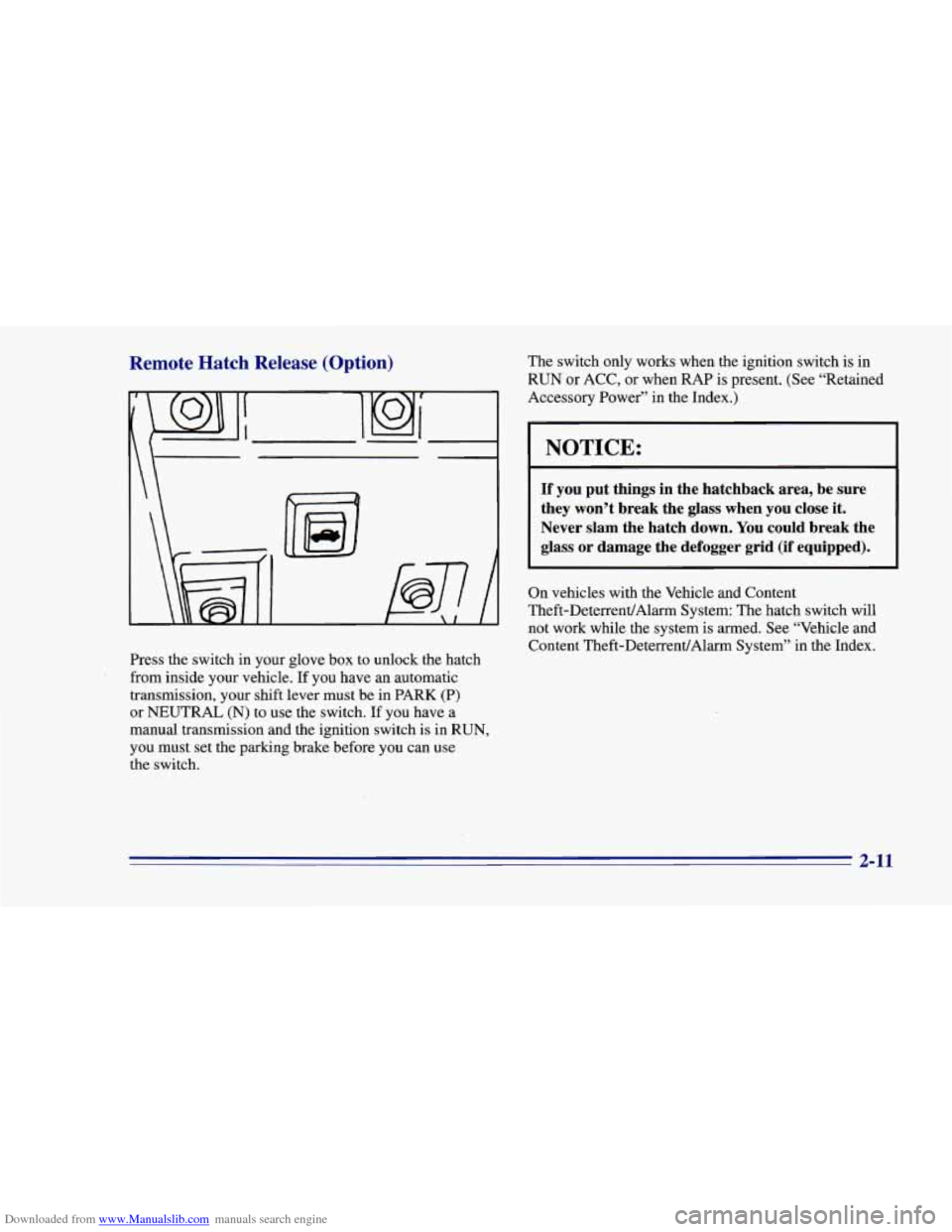
Press the switch in your glove box to unlock the hatch
from inside your vehicle.
If you have an automatic
transmission, your
shift lever must be in PARK (P)
or NEUTRAL (N) to use the switch. If you have a
manual transmission and the ignition switch is in
RUN,
you must set the parking brake before you can use
the switch. The
switch only works when the ignition switch is in
RUN or ACC, or when RAP
is present. (See “Retained
Accessory Power” in the Index.)
NOTICE:
If you put things in the hatchback area, be sure
they won’t break the glass when you close it.
Never slam the hatch down.
You could break the
glass or damage the defogger grid (if equipped).
On vehicles with the Vehicle and Content
Theft-DeterrenvAlarm System: The hatch switch will
not work while the system
is armed. See “Vehicle and
Content Theft-DeterrenUAlarm System” in the Index.
2-11
Page 67 of 402
Downloaded from www.Manualslib.com manuals search engine Theft Parking at Night
Vehicle theft is big business, especially in some cities.
Although your Chevrolet has a number
of theft-deterrent
features, we know that nothing we put on it can make it
impossible to steal. However, there are ways you can help.
Key in the Ignition
If you leave your vehicle with the keys inside, it’s an
easy target for joy riders or professional thieves
-- so
don’t do it.
When you park your Chevrolet and open the driver’s
door, you’ll hear a tone reminding you to remove your
key from the ignition and take
it with you. Always do
this. Your steering wheel will be locked, and so will
your ignition.
If you have an automatic transmission,
taking your key out also locks ,your transmission. And
remember to lock the doors. Park
in
a lighted spot, close all windows and lock your
vehicle. Remember to keep your valuables out of sight.
Put them in a storage area, or take them with you.
Parking Lots
If you park in a lot where someone will be watching
your vehicle, it’s best to lock it up and take your keys.
But what
if you have to leave your ignition key? What if
you have to leave something valuable in your vehicle?
0 Put your valuables in a storage area, like your
glove box.
Lock the glove box.
0 Lock all the doors except the driver’s.
0 Then take the door key with you.
2-12
Page 68 of 402
Downloaded from www.Manualslib.com manuals search engine Vehicle and Content
Theft-DeterrenUAlr m System (Option)
If your vehicle has this option, it has a theft-deterrent
alarm system. Once armed, the system will sound the horn
and flash the parlung lamps if the vehicle is broken into.
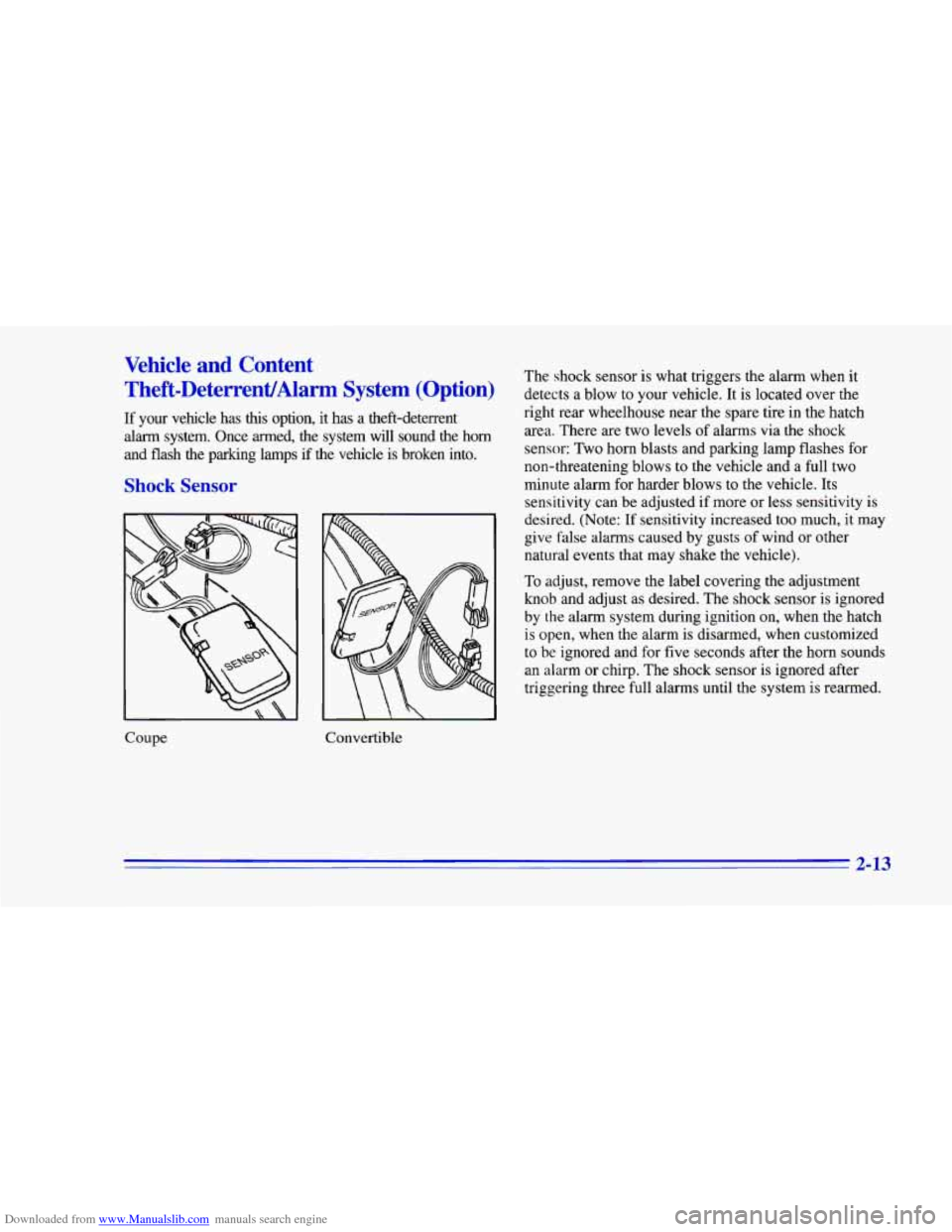
Shock Sensor
Coupe Convertible The
shock sensor is what triggers the alarm when it
detects a blow to your vehicle. It is located over the
right rear wheelhouse near the spare tire in the hatch
area. There are two levels
of alarms via the shock
sensor: Two horn blasts and parking lamp flashes for
non-threatening blows
to the vehicle and a full two
minute alarm for harder blows to the vehicle. Its
sensitivity can be adjusted if more or less sensitivity is
desired. (Note:
If sensitivity increased too much, it may
give false alarms caused by gusts of wind or other
natural events that may shake the vehicle).
To adjust, remove the label covering the adjustment
knob and adjust as desired. The shock sensor is ignored
by the alarm system during ignition on, when the hatch
is open, when the alarm is disarmed, when customized
to be ignored and for five seconds after the horn sounds
an alarm or chirp. The shock sensor is ignored after
triggering
three full alarms until the system is rearmed.
2- 13
Page 69 of 402
Downloaded from www.Manualslib.com manuals search engine Arming the System
The alarm system can be armed to detect break-ins by
locking your vehicle using the Remote Lock Control
transmitter or by locking the doors with the power door
lock switch. Passive arming is also available, if
you
would like the system to arm all by itself after the doors
have been closed for a
short time. When the system is
armed, a red light will flash briefly once every two
seconds. (Note: If you return to your vehicle and the red
light is flashing two brief flashes every two seconds, the
system is armed and the shock sensor had triggered a
two minute alarm. If the red light is flashing three times
every two seconds, the system
is armed and there was an
intrusion that sounded the alarm). Horn chirps and
parking lamp flashes can
be set to your choice.
Remote Lock Control Transmitter Locking
If all the doors are closed, locking the vehicle this way
will immediately arm the system. The horn will chirp
twice and the parking lamps will flash, confirming that
the system is armed.
If any door is open when the
transmitter LOCK button is pressed, the system goes
into an armed wait mode, waiting for the doors
to close.
Once they are closed, the system will arm, chirp the
horns twice and flash the parking lamps.
If the hatch is
open or ajar at the time the system is arming, the horn
will only chirp once.
Power Door Lock Switch Locking
If any door is open when the power door lock switch
is pressed, the system goes into an armed wait mode,
waiting for the doors to close. Once they
are closed, the
system will arm and flash the parking lamps.
If all of the
doors are closed when the lock switch
is pressed, the
system assumes you are inside of the vehicle,
so it will
not arm. Note: Locking the doors by using the manual
door locks will not arm the system.
Passive Arming
If the ignition was just turned off and a door was
opened, the system will arm six seconds after all doors
are closed, whether or not you lock them. In all other
cases, the system will wait
30 seconds after all doors are
closed before arming, allowing you time to get into the
vehicle and the key in the ignition. The parking lamps
will flash when the system arms.
Disarming the System
There are two ways to disarm the system:
1. Press the UNLOCK button on the Remote Lock
Control transmitter,
OR if the horn chirps two or
three times when
you unlock the car, the alarm
sounded in your absence. Two chirps means that
the shock sensor was set
off and three chirps means
2-14