lock CHEVROLET CAMARO SS 2010 Owners Manual
[x] Cancel search | Manufacturer: CHEVROLET, Model Year: 2010, Model line: CAMARO SS, Model: CHEVROLET CAMARO SS 2010Pages: 372, PDF Size: 1.91 MB
Page 310 of 372
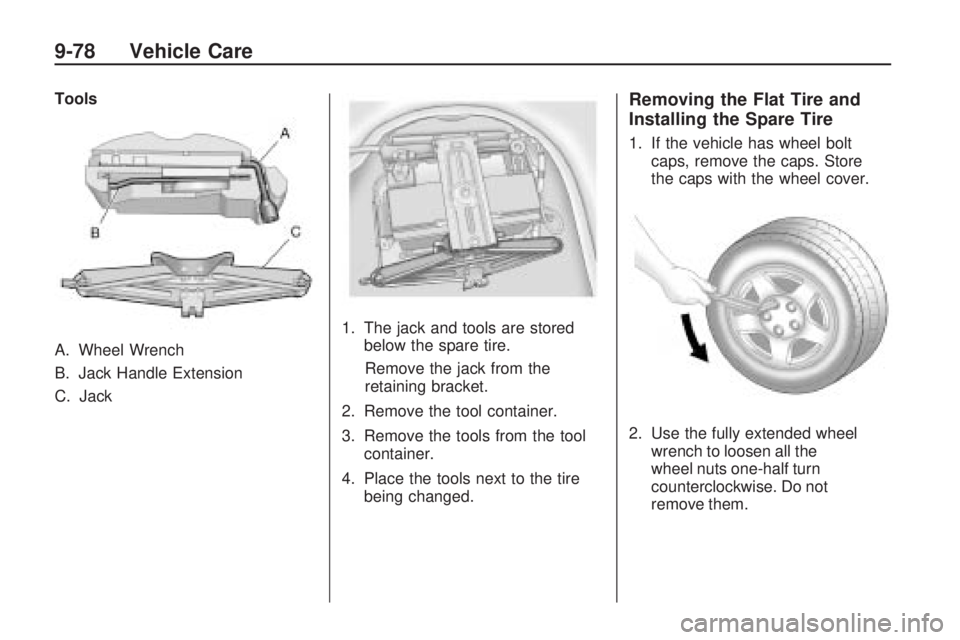
Tools
A. Wheel Wrench
B. Jack Handle Extension
C. Jack1. The jack and tools are stored
below the spare tire.
Remove the jack from the
retaining bracket.
2. Remove the tool container.
3. Remove the tools from the tool
container.
4. Place the tools next to the tire
being changed.Removing the Flat Tire and
Installing the Spare Tire
1. If the vehicle has wheel bolt
caps, remove the caps. Store
the caps with the wheel cover.
2. Use the fully extended wheel
wrench to loosen all the
wheel nuts one-half turn
counterclockwise. Do not
remove them.
9-78 Vehicle Care
Page 312 of 372
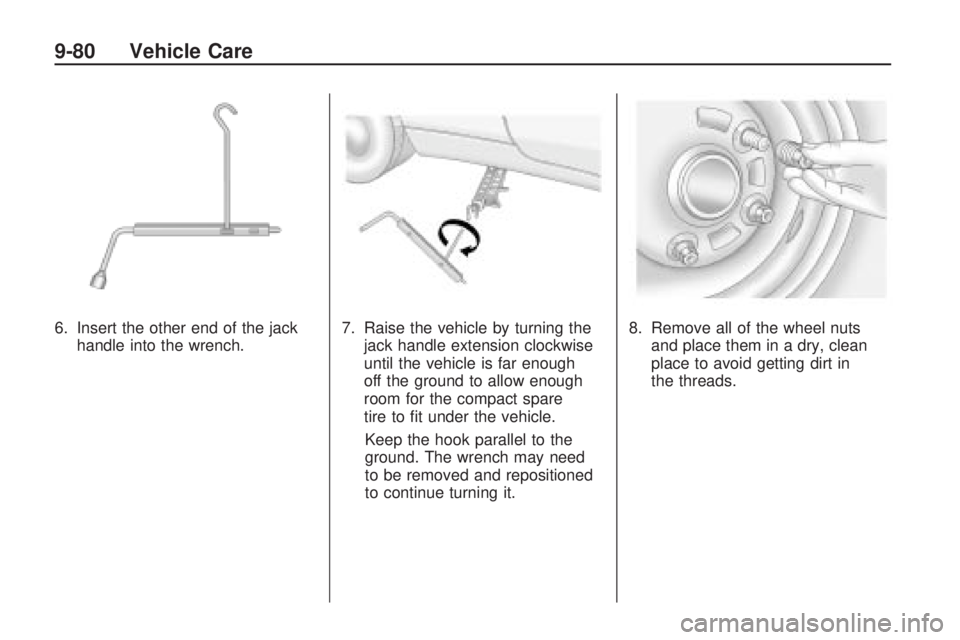
6. Insert the other end of the jack
handle into the wrench.7. Raise the vehicle by turning the
jack handle extension clockwise
until the vehicle is far enough
off the ground to allow enough
room for the compact spare
tire to fit under the vehicle.
Keep the hook parallel to the
ground. The wrench may need
to be removed and repositioned
to continue turning it.8. Remove all of the wheel nuts
and place them in a dry, clean
place to avoid getting dirt in
the threads.
9-80 Vehicle Care
Page 314 of 372
12. Lower the vehicle by turning the
jack handle counterclockwise.
Lower the jack completely.
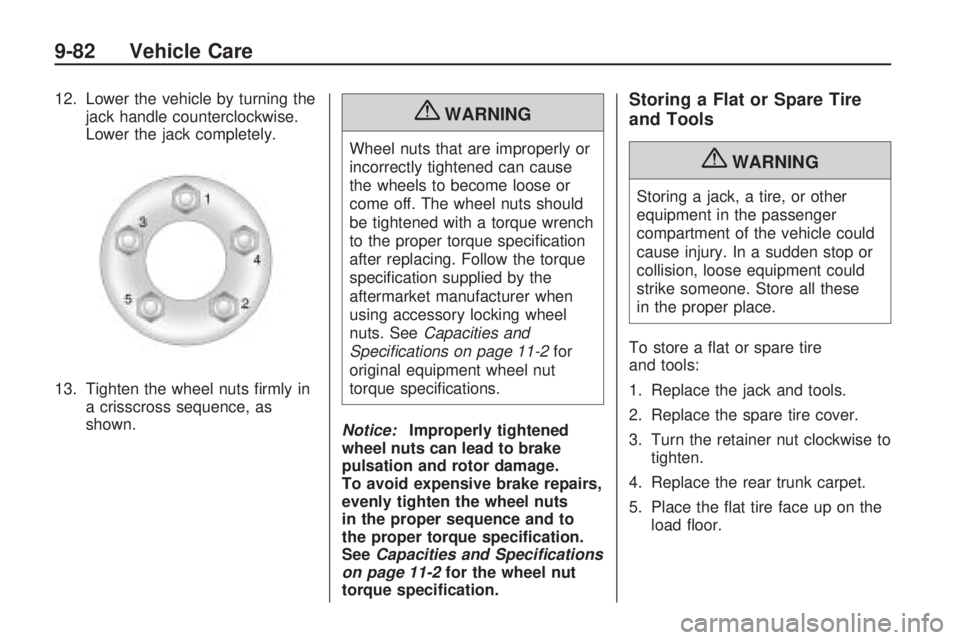
13. Tighten the wheel nuts firmly in
a crisscross sequence, as
shown.{WARNING
Wheel nuts that are improperly or
incorrectly tightened can cause
the wheels to become loose or
come off. The wheel nuts should
be tightened with a torque wrench
to the proper torque specification
after replacing. Follow the torque
specification supplied by the
aftermarket manufacturer when
using accessory locking wheel
nuts. SeeCapacities and
Specications on page 11-2for
original equipment wheel nut
torque specifications.
Notice:Improperly tightened
wheel nuts can lead to brake
pulsation and rotor damage.
To avoid expensive brake repairs,
evenly tighten the wheel nuts
in the proper sequence and to
the proper torque specication.
SeeCapacities and Specifications
on page 11-2for the wheel nut
torque specication.
Storing a Flat or Spare Tire
and Tools
{WARNING
Storing a jack, a tire, or other
equipment in the passenger
compartment of the vehicle could
cause injury. In a sudden stop or
collision, loose equipment could
strike someone. Store all these
in the proper place.
To store a flat or spare tire
and tools:
1. Replace the jack and tools.
2. Replace the spare tire cover.
3. Turn the retainer nut clockwise to
tighten.
4. Replace the rear trunk carpet.
5. Place the flat tire face up on the
load floor.
9-82 Vehicle Care
Page 317 of 372
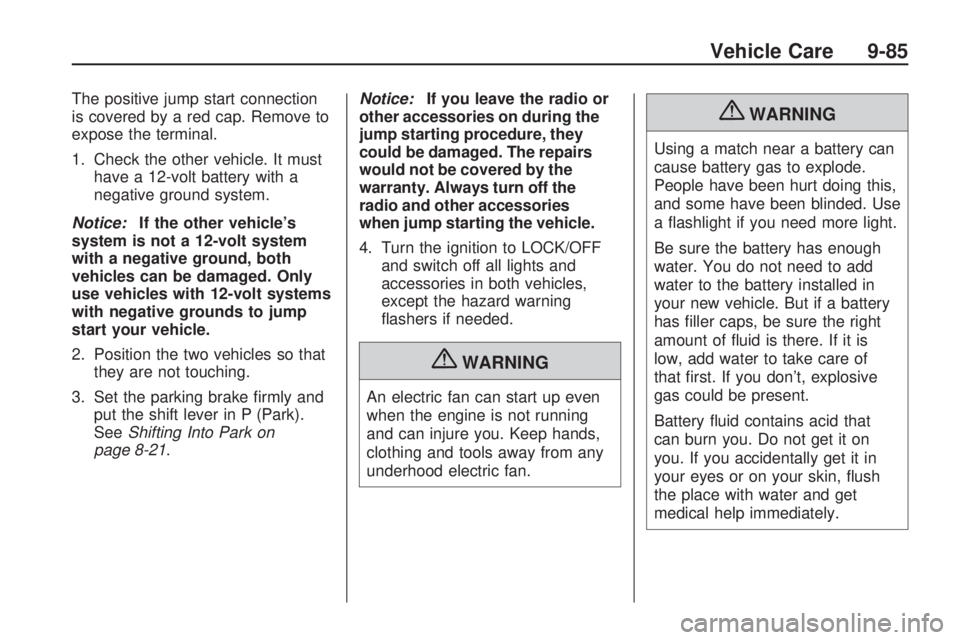
The positive jump start connection
is covered by a red cap. Remove to
expose the terminal.
1. Check the other vehicle. It must
have a 12-volt battery with a
negative ground system.
Notice:If the other vehicle’s
system is not a 12-volt system
with a negative ground, both
vehicles can be damaged. Only
use vehicles with 12-volt systems
with negative grounds to jump
start your vehicle.
2. Position the two vehicles so that
they are not touching.
3. Set the parking brake firmly and
put the shift lever in P (Park).
SeeShifting Into Park on
page 8-21.Notice:If you leave the radio or
other accessories on during the
jump starting procedure, they
could be damaged. The repairs
would not be covered by the
warranty. Always turn off the
radio and other accessories
when jump starting the vehicle.
4. Turn the ignition to LOCK/OFF
and switch off all lights and
accessories in both vehicles,
except the hazard warning
flashers if needed.
{WARNING
An electric fan can start up even
when the engine is not running
and can injure you. Keep hands,
clothing and tools away from any
underhood electric fan.
{WARNING
Using a match near a battery can
cause battery gas to explode.
People have been hurt doing this,
and some have been blinded. Use
a flashlight if you need more light.
Be sure the battery has enough
water. You do not need to add
water to the battery installed in
your new vehicle. But if a battery
has filler caps, be sure the right
amount of fluid is there. If it is
low, add water to take care of
that first. If you don’t, explosive
gas could be present.
Battery fluid contains acid that
can burn you. Do not get it on
you. If you accidentally get it in
your eyes or on your skin, flush
the place with water and get
medical help immediately.
Vehicle Care 9-85
Page 319 of 372
To disconnect the jumper cables
from both vehicles:
1. Disconnect the black negative (−)
cable from the vehicle that had
the dead battery.
2. Disconnect the black negative (−)
cable from the vehicle with the
good battery.
3. Disconnect the red positive (+)
cable from the vehicle with the
good battery.
4. Disconnect the red positive (+)
cable from the other vehicle.
5. Return the caps over the
positive (+) and negative (–)
terminals to their original
positions.Towing
Towing the Vehicle
To avoid damage, the disabled
vehicle should be towed with all four
wheels off the ground. Consult your
dealer/retailer or a professional
towing service if the disabled vehicle
needs to be towed. SeeRoadside
Assistance Program on page 12-6.
If the vehicle has lost battery power,
the shift lever needs to be manually
released to neutral for towing.
See “Shift Lock Manual Release”
underShifting Out of Park on
page 8-22.
To tow the vehicle behind
another vehicle for recreational
purposes — such as behind
a motorhome, see Recreational
Vehicle Towing following.
Recreational Vehicle
Towing
Notice:Dolly towing or dinghy
towing the vehicle may cause
damage because of reduced
ground clearance. Always put
the vehicle on a atbed truck or
trailer.
The vehicle was neither designed
nor intended to be towed with any
of its wheels on the ground. If the
vehicle must be towed, see “Towing
the Vehicle” earlier in this section.
Vehicle Care 9-87
Page 331 of 372
MaintenanceI
•
Change engine oil and filter.
SeeEngine Oil on page 9-10.
An Emission Control Service.
•Engine coolant level check. See
Engine Coolant on page 9-19.
•Windshield washer fluid level
check. SeeWasher Fluid on
page 9-26.
•Tire inflation check. SeeTire
Pressure on page 9-54.
•Tire wear inspection. SeeTire
Inspection on page 9-61.
•If tire rotation is recommended
for the vehicle, rotate tires.
SeeTire Rotation on page 9-61.
•Fluids visual leak check (or every
12 months, whichever occurs
first). A leak in any system must
be repaired and the fluid level
checked.
•Engine air cleaner filter
inspection (vehicles driven
in dusty conditions only).
SeeEngine Air Cleaner/Filter
on page 9-16.
•Brake system inspection (or
every 12 months, whichever
occurs first).
MaintenanceII
•
Perform all services described in
MaintenanceI.
•Steering and suspension
inspection. Visual inspection
for damaged, loose, or missing
parts or signs of wear.
•Engine cooling system
inspection. Visual inspection of
hoses, pipes, fittings, and clamps
and replacement, if needed.
•Windshield wiper blade
inspection for wear, cracking, or
contamination and windshield
and wiper blade cleaning,
if contaminated. SeeExterior
Care on page 9-88. Worn
or damaged wiper blade
replacement. SeeWiper Blade
Replacement on page 9-33.
•Body hinges and latches,
key lock cylinders, folding
seat hardware, and sunroof
(if equipped) lubrication.
SeeRecommended Fluids
and Lubricants on page 10-7.
More frequent lubrication may be
required when vehicle is exposed
to a corrosive environment.
Applying silicone grease on
weatherstrips with a clean cloth
makes them last longer, seal
better, and not stick or squeak.
Service and Maintenance 10-3
Page 332 of 372
•Restraint system component
check. SeeSafety System Check
on page 2-20.
•Automatic transmission fluid level
check and adding fluid, if needed.
SeeAutomatic Transmission
Fluid on page 9-14.
•Rear axle fluid level check and
adding fluid, if needed. SeeRear
Axle on page 9-30.
•Engine air cleaner filter
inspection. SeeEngine Air
Cleaner/Filter on page 9-16.
•Passenger compartment air filter
replacement (or every 12 months,
whichever occurs first). More
frequent replacement may be
required if vehicle is driven
regularly under dusty conditions.
Additional Required Services
At Each Fuel Stop
•Engine oil level check.
SeeEngine Oil on page 9-10.
•Engine coolant level check.
SeeEngine Coolant on
page 9-19.
•Windshield washer fluid level
check. SeeWasher Fluid on
page 9-26.
Once a Month
•Tire inflation check. SeeTire
Pressure on page 9-54.
•Tire wear inspection. SeeTire
Inspection on page 9-61.Once a Year
•SeeStarter Switch Check on
page 9-31.
•SeeAutomatic Transmission
Shift Lock Control System
Check on page 9-32.
•SeeIgnition Transmission Lock
Check on page 9-32.
•SeePark Brake and P (Park)
Mechanism Check on page 9-32.
•Engine cooling system and
pressure cap pressure check.
Radiator and air conditioning
condenser outside cleaning.
SeeCooling System on
page 9-17.
•If the vehicle has a Tire Sealant
and Compressor Kit, check the
sealant expiration date printed
on the instruction label of the
kit. SeeTire Sealant and
Compressor Kit on page 9-71.
10-4 Service and Maintenance
Page 336 of 372
UsageFluid/Lubricant
Manual Transmission (V8 Engine) Manual Transmission Fluid (GM Part No. U.S. 88861800,
in Canada 88861801).
Rear Axle (V6 Engine with Automatic Transmission) Rear Differential Fluid 75W-90 to GM Specification 9986155.
GM Part No. U.S. 89021677, in Canada 89021678.
Rear Axle (V6 Engine with Manual Transmission) Rear Differential Fluid 75W-90 Limited Slip to GM Specification 9986226.
GM Part No. U.S. 89021677 and Friction Modifier 1052358,
in Canada 89021678 and Friction Modifier 992694.
Rear Axle (V8 Engine) Rear Differential Fluid 75W-90 Limited Slip to GM Specification 9986226.
GM Part No. U.S. 89021677 and Friction Modifier 1052358,
in Canada 89021678 and Friction Modifier 992694.
Key Lock Cylinders Multi-Purpose Lubricant, Superlube (GM Part No. U.S. 12346241,
in Canada 10953474).
Hood Latch Assembly, Secondary Latch, Pivots, Spring Anchor, and Release Pawl Lubriplate Lubricant Aerosol (GM Part No. U.S. 12346293,
in Canada 992723) or lubricant meeting requirements of NLGI #2,
Category LB or GC-LB.
Hood, Door, and Folding Seat Hinges Multi-Purpose Lubricant, Superlube (GM Part No. U.S. 12346241,
in Canada 10953474).
Weatherstrip Conditioning Weatherstrip Lubricant (GM Part No. U.S. 3634770, in Canada 10953518)
or Dielectric Silicone Grease (GM Part No. U.S. 12345579,
in Canada 992887).
10-8 Service and Maintenance
Page 350 of 372
General Motors of Canada also
has a Mobility Program.
Call 1-800-GM-DRIVE (463-7483)
for details. TTY users call
1-800-263-3830.
Roadside Assistance
Program
For U.S. purchased vehicles,
call1-800-CHEV-USA
(1-800-243-8872); (Text telephone
(TTY): 1-888-889-2438).
For Canadian purchased vehicles,
call1-800-268-6800.
Service is available 24 hours a day,
365 days a year.
Calling for Assistance
When calling Roadside Assistance,
have the following information ready:
•Your name, home address, and
home telephone number
•Telephone number of your
location
•Location of the vehicle
•Model, year, color, and license
plate number of the vehicle
•Odometer reading, Vehicle
Identification Number (VIN), and
delivery date of the vehicle
•Description of the problem
Coverage
Services are provided up to 5 years/
100,000 miles (160 000 km),
whichever comes first.
In the U.S., anyone driving the
vehicle is covered. In Canada, a
person driving the vehicle without
permission from the owner is
not covered.
Roadside Assistance is not a part of
the New Vehicle Limited Warranty.
Chevrolet and General Motors
of Canada Limited reserve the right
to make any changes or discontinue
the Roadside Assistance program
at any time without notification.
Chevrolet and General Motors of
Canada Limited reserve the right to
limit services or payment to anowner or driver if they decide the
claims are made too often, or
the same type of claim is made
many times.
Services Provided
•
Emergency Fuel Delivery:
Delivery of enough fuel for
the vehicle to get to the nearest
service station.
•Lock-Out Service:Service is
provided to unlock the vehicle
if you are locked out. A remote
unlock may be available if
you have OnStar
®. For security
reasons, the driver must
present identification before this
service is given.
•Emergency Tow From a Public
Road or Highway:Tow to the
nearest Chevrolet dealer for
warranty service, or if the vehicle
was in a crash and cannot be
driven. Assistance is also
given when the vehicle is stuck
in the sand, mud, or snow.
12-6 Customer Information
Page 351 of 372
•Flat Tire Change:Service is
provided to change a flat tire
with the spare tire. The spare tire,
if equipped, must be in good
condition and properly inflated.
It is the owner’s responsibility for
the repair or replacement of
the tire if it is not covered by the
warranty.
•Battery Jump Start:Service is
provided to jump start a dead
battery.
Services Not Included in
Roadside Assistance
•
Impound towing caused by
violation of any laws.
•Legal fines.
•Mounting, dismounting or
changing of snow tires, chains,
or other traction devices.
•Towing or services for vehicles
driven on a non-public road or
highway.
Services Specic to Canadian
Purchased Vehicles
•
Fuel delivery:Reimbursement is
approximately $5 Canadian.
Diesel fuel delivery may
be restricted. Propane and other
fuels are not provided through
this service.
•Lock-Out Service:Vehicle
registration is required.
•Trip Routing Service:Detailed
maps of North America are
provided when requested either
with the most direct route or
the most scenic route. There is a
limit of six requests per year.
Additional travel information
is also available. Allow
three weeks for delivery.
•Trip Interruption Benets
and Assistance:Must be
over 250 kilometres from
where your trip was started to
qualify. General Motors of
Canada Limited requires
pre-authorization, originaldetailed receipts, and a copy
of the repair orders. Once
authorization has been received,
the Roadside Assistance
advisor will help you make
arrangements and explain how to
receive payment.
•Alternative Service:If
assistance cannot be provided
right away, the Roadside
Assistance advisor may give
you permission to get local
emergency road service. You will
receive payment, up to $100,
after sending the original receipt
to Roadside Assistance.
Mechanical failures may be
covered, however any cost for
parts and labor for repairs
not covered by the warranty are
the owner responsibility.
Customer Information 12-7