lock CHEVROLET CAMARO SS 2010 Repair Manual
[x] Cancel search | Manufacturer: CHEVROLET, Model Year: 2010, Model line: CAMARO SS, Model: CHEVROLET CAMARO SS 2010Pages: 372, PDF Size: 1.91 MB
Page 208 of 372
Let us say the road is wet and you
are driving safely. Suddenly, an
animal jumps out in front of you.
You slam on the brakes and
continue braking. Here is what
happens with ABS:
A computer senses that the wheels
are slowing down. If one of the
wheels is about to stop rolling,
the computer will separately work
the brakes at each wheel.
ABS can change the brake pressure
to each wheel, as required, faster
than any driver could. This can
help the driver steer around
the obstacle while braking hard.
As the brakes are applied, the
computer keeps receiving updates
on wheel speed and controls braking
pressure accordingly.Remember: ABS does not change
the time needed to get a foot up to
the brake pedal or always decrease
stopping distance. If you get too
close to the vehicle in front of you,
there will not be enough time to
apply the brakes if that vehicle
suddenly slows or stops. Always
leave enough room up ahead to
stop, even with ABS.
Using ABS
Do not pump the brakes. Just hold
the brake pedal down firmly and let
antilock work. The antilock pump
or motor might be heard operating,
and the brake pedal might be felt to
pulsate, but this is normal.
Braking in Emergencies
ABS allows the driver to steer and
brake at the same time. In many
emergencies, steering can help
more than even the very best
braking.
Parking Brake
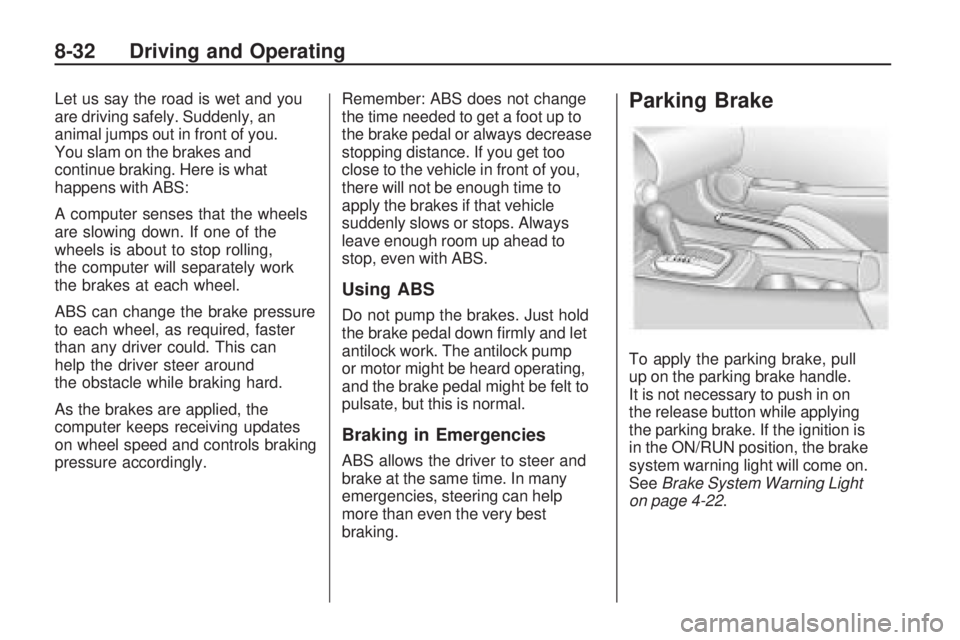
To apply the parking brake, pull
up on the parking brake handle.
It is not necessary to push in on
the release button while applying
the parking brake. If the ignition is
in the ON/RUN position, the brake
system warning light will come on.
SeeBrake System Warning Light
on page 4-22.
8-32 Driving and Operating
Page 223 of 372
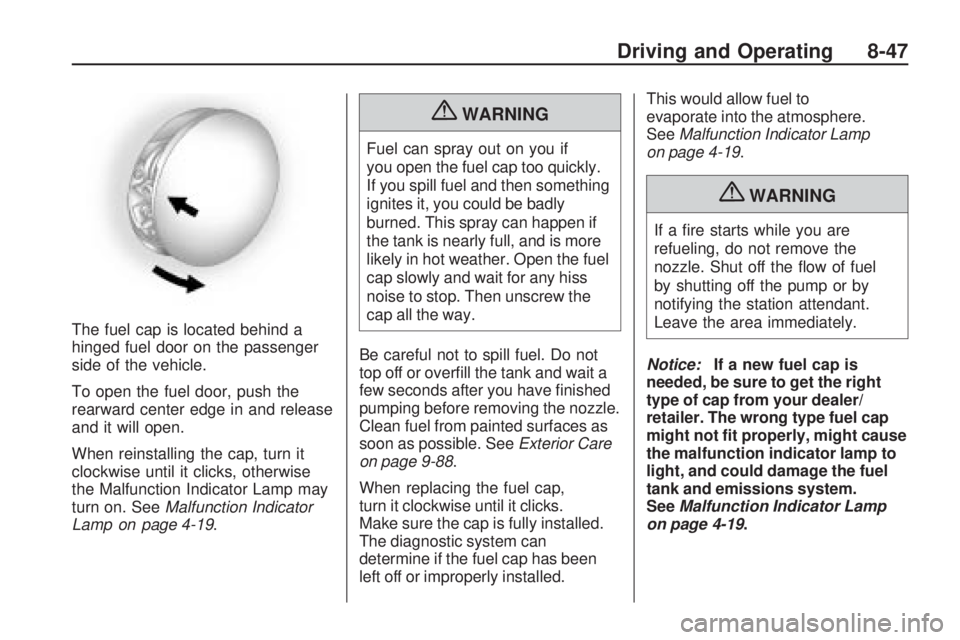
The fuel cap is located behind a
hinged fuel door on the passenger
side of the vehicle.
To open the fuel door, push the
rearward center edge in and release
and it will open.
When reinstalling the cap, turn it
clockwise until it clicks, otherwise
the Malfunction Indicator Lamp may
turn on. SeeMalfunction Indicator
Lamp on page 4-19.
{WARNING
Fuel can spray out on you if
you open the fuel cap too quickly.
If you spill fuel and then something
ignites it, you could be badly
burned. This spray can happen if
the tank is nearly full, and is more
likely in hot weather. Open the fuel
cap slowly and wait for any hiss
noise to stop. Then unscrew the
cap all the way.
Be careful not to spill fuel. Do not
top off or overfill the tank and wait a
few seconds after you have finished
pumping before removing the nozzle.
Clean fuel from painted surfaces as
soon as possible. SeeExterior Care
on page 9-88.
When replacing the fuel cap,
turn it clockwise until it clicks.
Make sure the cap is fully installed.
The diagnostic system can
determine if the fuel cap has been
left off or improperly installed.This would allow fuel to
evaporate into the atmosphere.
SeeMalfunction Indicator Lamp
on page 4-19.
{WARNING
If a fire starts while you are
refueling, do not remove the
nozzle. Shut off the flow of fuel
by shutting off the pump or by
notifying the station attendant.
Leave the area immediately.
Notice:If a new fuel cap is
needed, be sure to get the right
type of cap from your dealer/
retailer. The wrong type fuel cap
might not t properly, might cause
the malfunction indicator lamp to
light, and could damage the fuel
tank and emissions system.
SeeMalfunction Indicator Lamp
on page 4-19.
Driving and Operating 8-47
Page 231 of 372
Towing Equipment
Hitches
Use the correct hitch equipment.
See your dealer/retailer or a
hitch dealer for assistance.
•The rear bumper on the vehicle
is not intended for hitches.
Do not attach rental hitches
or other bumper-type hitches to
it. Use only a frame-mounted
hitch that does not attach to
the bumper.
•Will any holes be made in the
body of the vehicle when the
trailer hitch is installed? If there
are, seal the holes when the hitch
is removed. If the holes are not
sealed, dirt, water, and deadly
carbon monoxide (CO) from the
exhaust can get into the vehicle.
SeeEngine Exhaust on
page 8-25.
Safety Chains
Always attach chains between the
vehicle and the trailer. Cross the
safety chains under the tongue of
the trailer to help prevent the tongue
from contacting the road if it
becomes separated from the hitch.
Leave enough slack so the rig can
turn. Never allow safety chains to
drag on the ground.
Trailer Brakes
Does the trailer have its own
brakes? Be sure to read and follow
the instructions for the trailer brakes
so they are installed, adjusted and
maintained properly.
Because the vehicle has antilock
brakes, do not tap into the vehicle’s
brake system. If this is done,
both brake systems will not work
well, or at all.
Conversions and
Add-Ons
Add-On Electrical
Equipment
Notice:Do not add anything
electrical to the vehicle unless you
check with your dealer/retailer
rst. Some electrical equipment
can damage the vehicle and the
damage would not be covered
by the vehicle’s warranty. Some
add-on electrical equipment can
keep other components from
working as they should.
Add-on equipment can drain the
vehicle battery, even if the vehicle
is not operating.
The vehicle has an airbag system.
Before attempting to add anything
electrical to the vehicle, see
Servicing the Airbag-Equipped
Vehicle on page 2-32andAdding
Equipment to the Airbag-Equipped
Vehicle on page 2-33.
Driving and Operating 8-55
Page 233 of 372
Vehicle Care
General InformationGeneral Information...............9-2
California Proposition 65
Warning.............................9-2
California Perchlorate
Materials Requirements........9-3
Accessories and
Modifications.......................9-3
Vehicle ChecksDoing Your Own
Service Work......................9-4
Hood...................................9-5
Engine Compartment
Overview............................9-6
Engine Cover.......................9-9
Engine Oil..........................9-10
Engine Oil Life System.........9-13
Automatic Transmission
Fluid................................9-14
Manual Transmission Fluid. . . .9-15
Hydraulic Clutch..................9-15
Engine Air Cleaner/Filter.......9-16
Cooling System...................9-17
Engine Coolant...................9-19
Engine Overheating.............9-24
Power Steering Fluid............9-25Washer Fluid......................9-26
Brakes...............................9-27
Brake Fluid.........................9-28
Battery...............................9-29
Rear Axle...........................9-30
Starter Switch Check............9-31
Automatic Transmission
Shift Lock Control
System Check...................9-32
Ignition Transmission
Lock Check.......................9-32
Park Brake and P (Park)
Mechanism Check..............9-32
Wiper Blade Replacement......9-33Headlamp AimingHeadlamp Aiming................9-34
Bulb ReplacementBulb Replacement...............9-37
Halogen Bulbs....................9-37
High Intensity Discharge
(HID) Lighting....................9-37
Headlamps, Front Turn
Signal and Parking Lamps
(Base Vehicle)...................9-37
Headlamps, Front Turn
Signal and Parking Lamps
(Up-Level Vehicle)..............9-38
Daytime Running
Lamps (DRL)....................9-39
Fog Lamps.........................9-40Taillamps, Turn Signal, and
Stoplamps.........................9-40
License Plate Lamp.............9-40
Replacement Bulbs..............9-41
Electrical SystemElectrical System
Overload...........................9-41
Fuses and Circuit
Breakers...........................9-42
Engine Compartment
Fuse Block.......................9-42
Instrument Panel
Fuse Block.......................9-45
Rear Compartment
Fuse Block.......................9-46
Wheels and TiresTires..................................9-48
Winter Tires........................9-48
Tire Sidewall Labeling..........9-49
Tire Designations.................9-51
Tire Terminology and
Definitions.........................9-52
Tire Pressure......................9-54
Tire Pressure for
High-Speed Operation........9-56
Tire Pressure Monitor
System.............................9-56
Tire Pressure Monitor
Operation..........................9-57
Tire Inspection....................9-61
Vehicle Care 9-1
Page 235 of 372
California Perchlorate
Materials Requirements
Certain types of automotive
applications, such as airbag
initiators, seat belt pretensioners,
and lithium batteries contained in
remote keyless transmitters, may
contain perchlorate materials.
Special handling may be necessary.
For additional information, see
www.dtsc.ca.gov/hazardouswaste/
perchlorate.
Accessories and
Modications
Adding non-dealer/non-retailer
accessories to the vehicle can affect
vehicle performance and safety,
including such things as airbags,
braking, stability, ride and handling,
emissions systems, aerodynamics,
durability, and electronic systems
like antilock brakes, traction control,
and stability control. Some of these
accessories could even cause
malfunction or damage not covered
by the vehicle warranty.
Damage to vehicle components
resulting from the installation or use
of non-GM certified parts, including
control module modifications, are
not covered under the terms of the
vehicle warranty and may affect
remaining warranty coverage for
affected parts.GM Accessories are designed to
complement and function with other
systems on the vehicle. Your GM
dealer/retailer can accessorize
the vehicle using genuine GM
Accessories. When you go to your
GM dealer/retailer and ask for GM
Accessories, you will know that
GM-trained and supported service
technicians will perform the work
using genuine GM Accessories.
Also, seeAdding Equipment to
the Airbag-Equipped Vehicle
on page 2-33.
Vehicle Care 9-3
Page 239 of 372
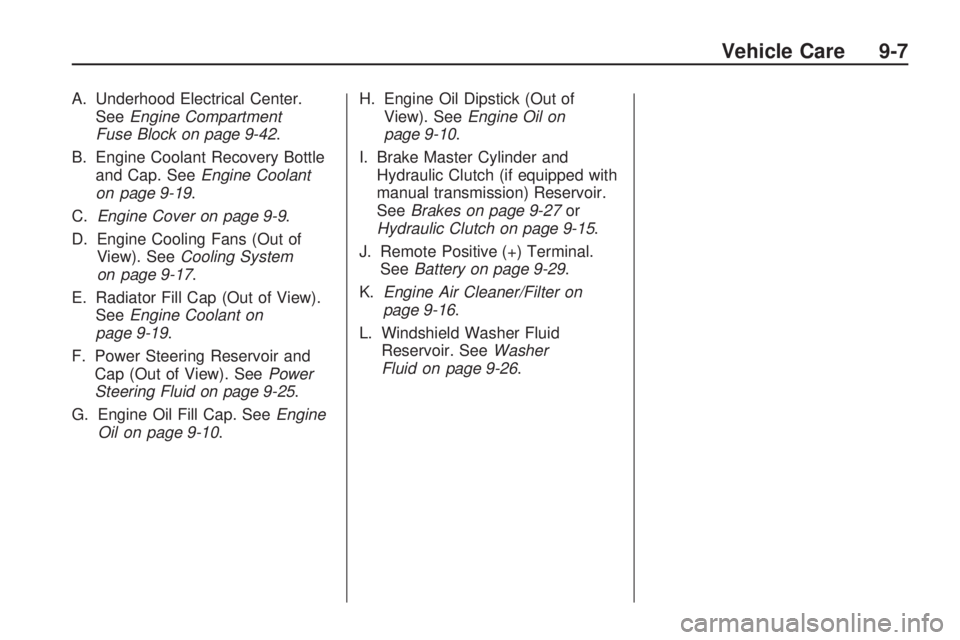
A. Underhood Electrical Center.
SeeEngine Compartment
Fuse Block on page 9-42.
B. Engine Coolant Recovery Bottle
and Cap. SeeEngine Coolant
on page 9-19.
C.Engine Cover on page 9-9.
D. Engine Cooling Fans (Out of
View). SeeCooling System
on page 9-17.
E. Radiator Fill Cap (Out of View).
SeeEngine Coolant on
page 9-19.
F. Power Steering Reservoir and
Cap (Out of View). SeePower
Steering Fluid on page 9-25.
G. Engine Oil Fill Cap. SeeEngine
Oil on page 9-10.H. Engine Oil Dipstick (Out of
View). SeeEngine Oil on
page 9-10.
I. Brake Master Cylinder and
Hydraulic Clutch (if equipped with
manual transmission) Reservoir.
SeeBrakes on page 9-27or
Hydraulic Clutch on page 9-15.
J. Remote Positive (+) Terminal.
SeeBattery on page 9-29.
K.Engine Air Cleaner/Filter on
page 9-16.
L. Windshield Washer Fluid
Reservoir. SeeWasher
Fluid on page 9-26.
Vehicle Care 9-7
Page 241 of 372
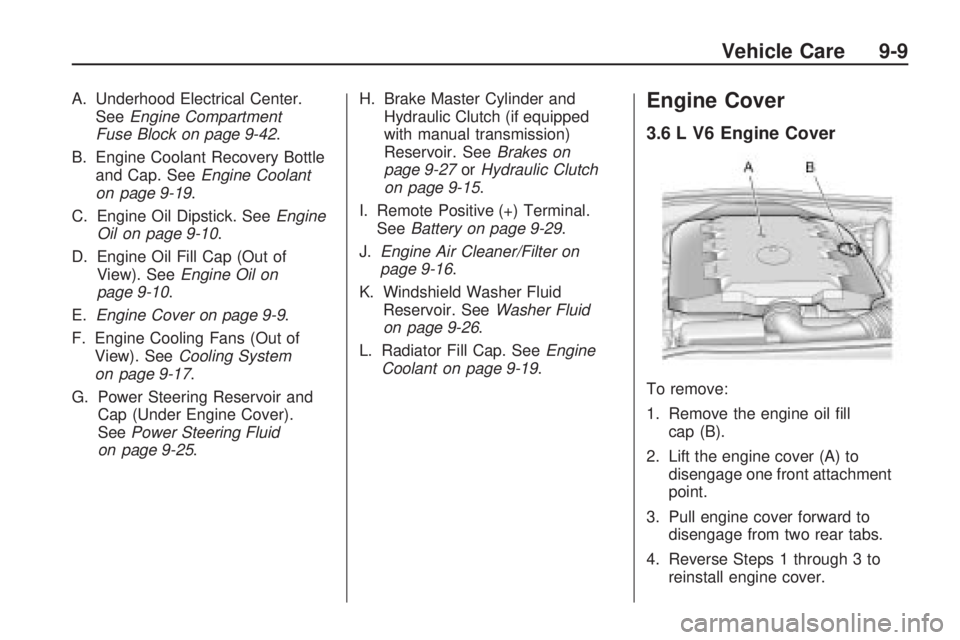
A. Underhood Electrical Center.
SeeEngine Compartment
Fuse Block on page 9-42.
B. Engine Coolant Recovery Bottle
and Cap. SeeEngine Coolant
on page 9-19.
C. Engine Oil Dipstick. SeeEngine
Oil on page 9-10.
D. Engine Oil Fill Cap (Out of
View). SeeEngine Oil on
page 9-10.
E.Engine Cover on page 9-9.
F. Engine Cooling Fans (Out of
View). SeeCooling System
on page 9-17.
G. Power Steering Reservoir and
Cap (Under Engine Cover).
SeePower Steering Fluid
on page 9-25.H. Brake Master Cylinder and
Hydraulic Clutch (if equipped
with manual transmission)
Reservoir. SeeBrakes on
page 9-27orHydraulic Clutch
on page 9-15.
I. Remote Positive (+) Terminal.
SeeBattery on page 9-29.
J.Engine Air Cleaner/Filter on
page 9-16.
K. Windshield Washer Fluid
Reservoir. SeeWasher Fluid
on page 9-26.
L. Radiator Fill Cap. SeeEngine
Coolant on page 9-19.Engine Cover
3.6 L V6 Engine Cover
To remove:
1. Remove the engine oil fill
cap (B).
2. Lift the engine cover (A) to
disengage one front attachment
point.
3. Pull engine cover forward to
disengage from two rear tabs.
4. Reverse Steps 1 through 3 to
reinstall engine cover.
Vehicle Care 9-9
Page 252 of 372
Checking Coolant
The vehicle must be on a level
surface when checking the coolant
level.
Check coolant as follows:
1. Turn the ignition OFF.
2. Locate the coolant recovery
bottle. SeeEngine Compartment
Overview on page 9-6.
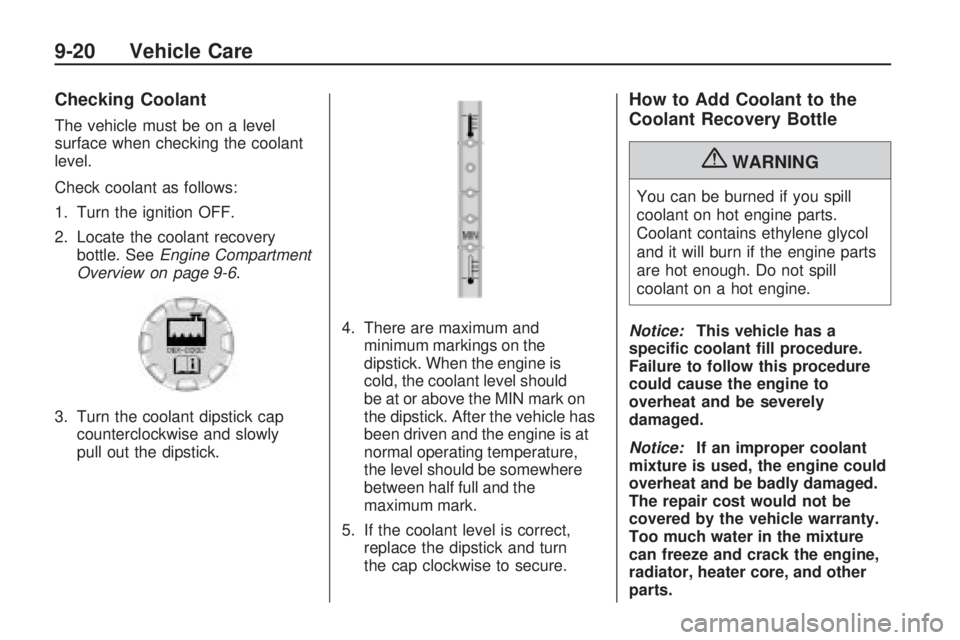
3. Turn the coolant dipstick cap
counterclockwise and slowly
pull out the dipstick.4. There are maximum and
minimum markings on the
dipstick. When the engine is
cold, the coolant level should
be at or above the MIN mark on
the dipstick. After the vehicle has
been driven and the engine is at
normal operating temperature,
the level should be somewhere
between half full and the
maximum mark.
5. If the coolant level is correct,
replace the dipstick and turn
the cap clockwise to secure.
How to Add Coolant to the
Coolant Recovery Bottle
{WARNING
You can be burned if you spill
coolant on hot engine parts.
Coolant contains ethylene glycol
and it will burn if the engine parts
are hot enough. Do not spill
coolant on a hot engine.
Notice:This vehicle has a
specic coolant ll procedure.
Failure to follow this procedure
could cause the engine to
overheat and be severely
damaged.
Notice:If an improper coolant
mixture is used, the engine could
overheat and be badly damaged.
The repair cost would not be
covered by the vehicle warranty.
Too much water in the mixture
can freeze and crack the engine,
radiator, heater core, and other
parts.
9-20 Vehicle Care
Page 253 of 372
Add coolant as follows:
1. Turn the coolant overflow bottle
dipstick cap counterclockwise
and slowly pull out the dipstick.
2. Pour the coolant into the coolant
recovery bottle.
3. When the level is correct,
replace the dipstick and turn
the cap clockwise to secure.
How to Add Coolant to the
Radiator
{WARNING
You can be burned if you spill
coolant on hot engine parts.
Coolant contains ethylene glycol
and it will burn if the engine parts
are hot enough. Do not spill
coolant on a hot engine.Notice:This vehicle has a
specic coolant ll procedure.
Failure to follow this procedure
could cause the engine to
overheat and be severely
damaged.
{WARNING
An electric engine cooling fan
under the hood can start up even
when the engine is not running
and can cause injury. Keep
hands, clothing, and tools away
from any underhood electric fan.
{WARNING
Steam and scalding liquids from
a hot cooling system can blow
out and burn you badly. They are
under pressure, and if you turn the
surge tank pressure cap — even a
little — they can come out at high
speed. Never turn the cap when
the cooling system, including the
surge tank pressure cap, is hot.
Wait for the cooling system and
surge tank pressure cap to cool
if you ever have to turn the
pressure cap.
If coolant is needed, add the proper
mixture directly to the radiator,
but be sure the cooling system
is cool before this is done.
Vehicle Care 9-21
Page 254 of 372
If no coolant is visible in the coolant
overflow bottle, add coolant as
follows:
3.6 L V6 Engine Fill Procedure
1. Locate the radiator cap.
SeeEngine Compartment
Overview on page 9-6.
2. Remove engine cover to access
the radiator cap. SeeEngine
Cover on page 9-9.
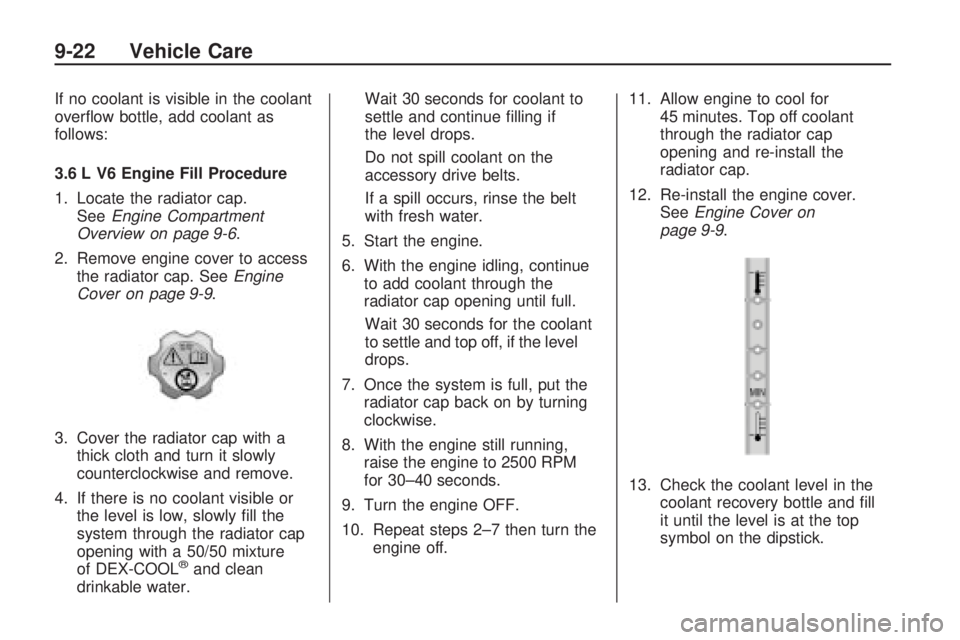
3. Cover the radiator cap with a
thick cloth and turn it slowly
counterclockwise and remove.
4. If there is no coolant visible or
the level is low, slowly fill the
system through the radiator cap
opening with a 50/50 mixture
of DEX-COOL
®and clean
drinkable water.Wait 30 seconds for coolant to
settle and continue filling if
the level drops.
Do not spill coolant on the
accessory drive belts.
If a spill occurs, rinse the belt
with fresh water.
5. Start the engine.
6. With the engine idling, continue
to add coolant through the
radiator cap opening until full.
Wait 30 seconds for the coolant
to settle and top off, if the level
drops.
7. Once the system is full, put the
radiator cap back on by turning
clockwise.
8. With the engine still running,
raise the engine to 2500 RPM
for 30–40 seconds.
9. Turn the engine OFF.
10. Repeat steps 2–7 then turn the
engine off.11. Allow engine to cool for
45 minutes. Top off coolant
through the radiator cap
opening and re-install the
radiator cap.
12. Re-install the engine cover.
SeeEngine Cover on
page 9-9.
13. Check the coolant level in the
coolant recovery bottle and fill
it until the level is at the top
symbol on the dipstick.
9-22 Vehicle Care