warning CHEVROLET CAMARO SS 2010 User Guide
[x] Cancel search | Manufacturer: CHEVROLET, Model Year: 2010, Model line: CAMARO SS, Model: CHEVROLET CAMARO SS 2010Pages: 372, PDF Size: 1.91 MB
Page 21 of 372

Window Indexing
This automatically lowers the
window a small amount when the
door is opened. When the door
is closed, the window will raise fully.
If the vehicle loses power or the
window freezes, this feature may not
work. From outside the vehicle,
close the door and push the window
inward so that the glass goes
under the molding.
If the “Open, Then Close Driver
Window” or “Open, Then Close
Passenger Window” messages are
displayed on the Driver Information
Center (DIC), follow the procedure
for Programming the Power
Windows later in this section.
See alsoDriver Information
Center (DIC) on page 4-27.
Express Window Operation
The front window switches have an
express-up or down feature that
lowers or raises the window without
holding the switch. Pull the switch
up or press it down all the way and
release it. Stop the window by
pressing or pulling the switch.
Express Window Anti-Pinch
Feature
When express-up is active, the
window will auto-reverse if there is
an obstruction or severe icing.
The window returns to normal
operation after the obstruction or
condition is removed.
{WARNING
If express override is activated,
the window will not reverse
automatically. You or others could
be injured and the window could
be damaged. Before you use
express override, make sure that
all people and obstructions are
clear of the window path.
Express Window Anti-Pinch
Override
The anti-pinch feature can be
overridden by holding the window
switch all the way down. The
window will lower for as long as the
switch is held. Once the switch is
released, the express mode is
re-activated. In this mode, the
window can still close on an object
in its path. Use care when using
the override mode.
Keys, Doors and Windows 1-15
Page 26 of 372
Head Restraints
The vehicle’s front seats have
adjustable head restraints in the
outboard seating positions.
{WARNING
With head restraints that are not
installed and adjusted properly,
there is a greater chance that
occupants will suffer a neck/spinal
injury in a crash. Do not drive
until the head restraints for all
occupants are installed and
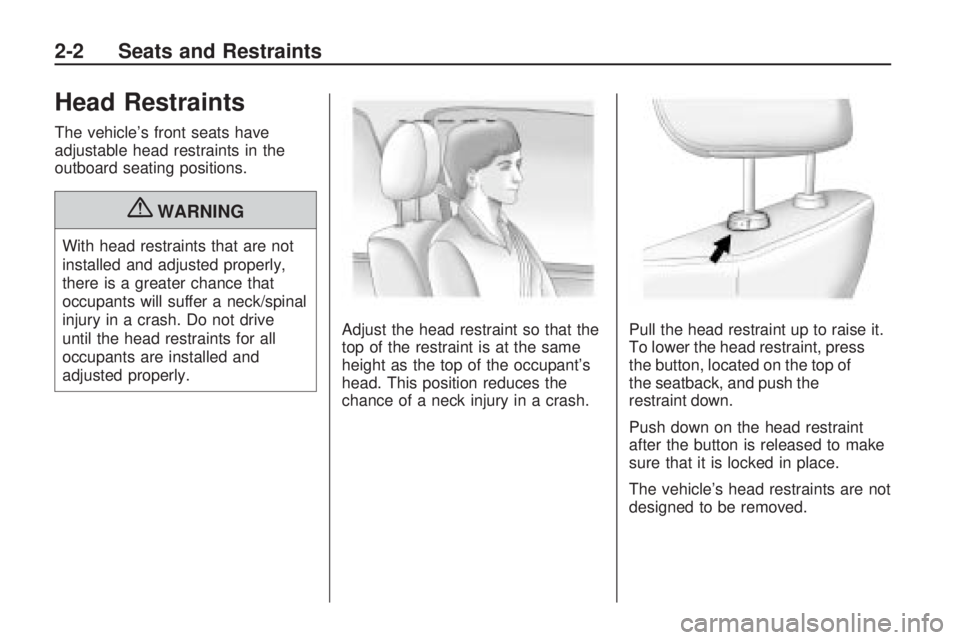
adjusted properly.Adjust the head restraint so that the
top of the restraint is at the same
height as the top of the occupant’s
head. This position reduces the
chance of a neck injury in a crash.Pull the head restraint up to raise it.
To lower the head restraint, press
the button, located on the top of
the seatback, and push the
restraint down.
Push down on the head restraint
after the button is released to make
sure that it is locked in place.
The vehicle’s head restraints are not
designed to be removed.
2-2 Seats and Restraints
Page 27 of 372
Front Seats
Seat Adjustment
{WARNING
You can lose control of the
vehicle if you try to adjust a
manual driver’s seat while the
vehicle is moving. The sudden
movement could startle and
confuse you, or make you push
a pedal when you do not want to.
Adjust the driver’s seat only when
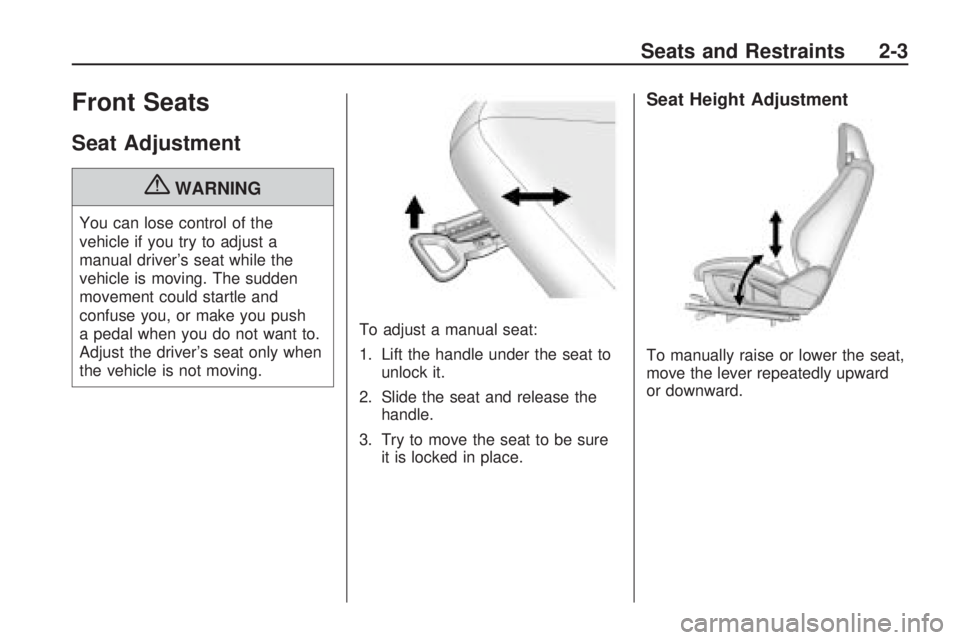
the vehicle is not moving.To adjust a manual seat:
1. Lift the handle under the seat to
unlock it.
2. Slide the seat and release the
handle.
3. Try to move the seat to be sure
it is locked in place.
Seat Height Adjustment
To manually raise or lower the seat,
move the lever repeatedly upward
or downward.
Seats and Restraints 2-3
Page 28 of 372
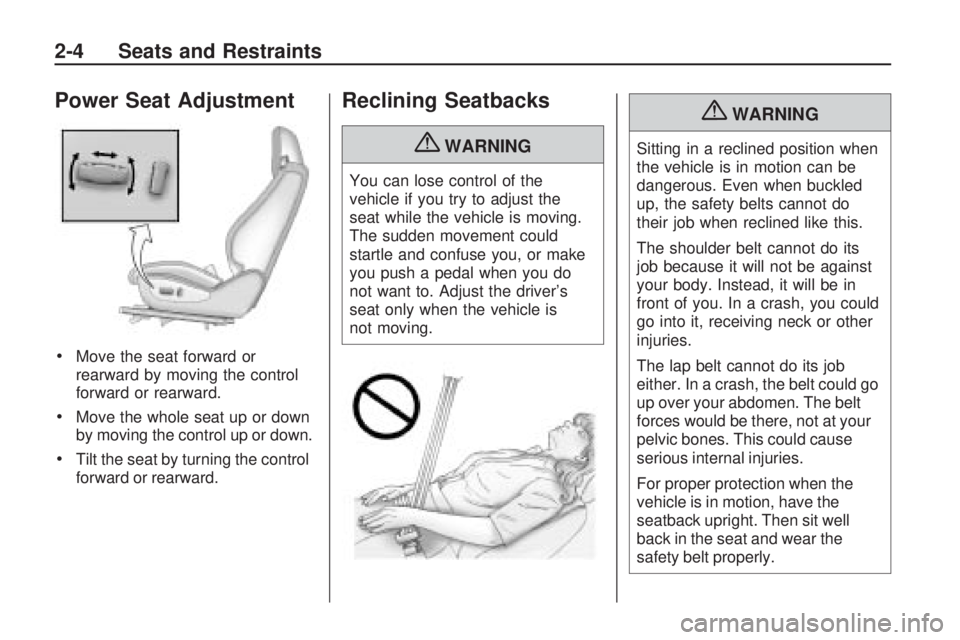
Power Seat Adjustment
•Move the seat forward or
rearward by moving the control
forward or rearward.
•Move the whole seat up or down
by moving the control up or down.
•Tilt the seat by turning the control
forward or rearward.
Reclining Seatbacks
{WARNING
You can lose control of the
vehicle if you try to adjust the
seat while the vehicle is moving.
The sudden movement could
startle and confuse you, or make
you push a pedal when you do
not want to. Adjust the driver’s
seat only when the vehicle is
not moving.
{WARNING
Sitting in a reclined position when
the vehicle is in motion can be
dangerous. Even when buckled
up, the safety belts cannot do
their job when reclined like this.
The shoulder belt cannot do its
job because it will not be against
your body. Instead, it will be in
front of you. In a crash, you could
go into it, receiving neck or other
injuries.
The lap belt cannot do its job
either. In a crash, the belt could go
up over your abdomen. The belt
forces would be there, not at your
pelvic bones. This could cause
serious internal injuries.
For proper protection when the
vehicle is in motion, have the
seatback upright. Then sit well
back in the seat and wear the
safety belt properly.
2-4 Seats and Restraints
Page 29 of 372

Power Reclining Seatbacks
On vehicles with power reclining
seatbacks the control is located
on the outboard side of the seat.
•To recline the seatback,
move the control toward
the rear of the vehicle.
•To raise the seatback, move the
control toward the front of the
vehicle.
Seatback Latches
To access the rear seats pull up on
the latch, located on the rear of the
driver or front passenger seatback.
Fold the seatback forward.
{WARNING
If either seatback is not locked, it
could move forward in a sudden
stop or crash. That could cause
injury to the person sitting there.
Always push and pull on the
seatbacks to be sure they are
locked.
Lift the seatback to return it to the
upright position. Push and pull on the
seatback to make sure it is locked.
Seats and Restraints 2-5
Page 30 of 372
Heated Front Seats
On vehicles with heated front
seats, the controls are on the
center console. The engine
must be running.
L(Heated Seat):Press to turn on
the heated seat.
A light indicates that the feature is
working. The number of lights shows
the level of heat selected: one or
two for a low or high setting. Press
the button to cycle through the
temperature settings and to turn
the heated seat feature off.
Rear Seats
The rear seat has two designated
seating positions and can be folded
for more cargo space. Fold only
when the vehicle is parked.
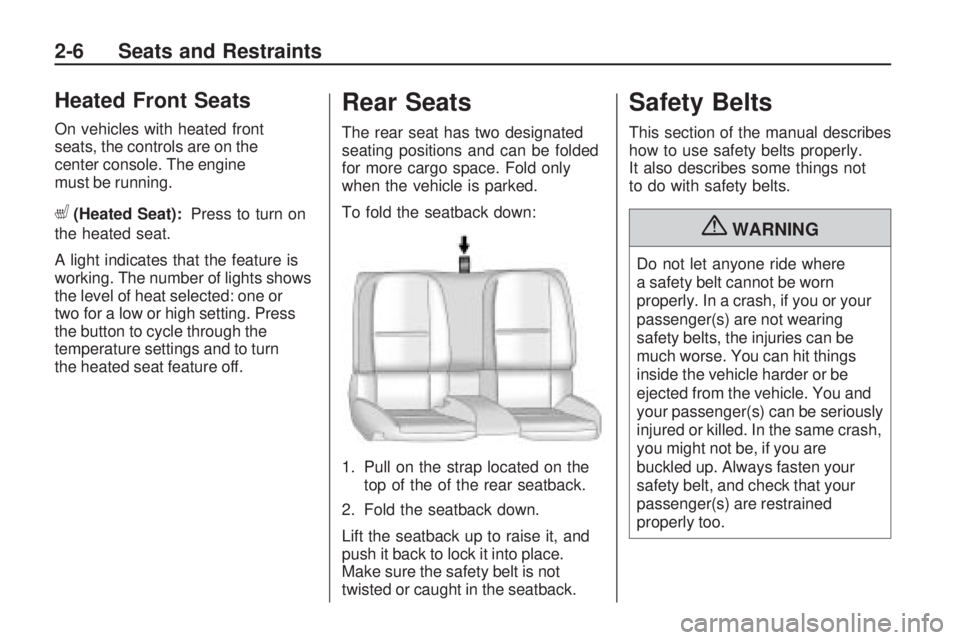
To fold the seatback down:
1. Pull on the strap located on the
top of the of the rear seatback.
2. Fold the seatback down.
Lift the seatback up to raise it, and
push it back to lock it into place.
Make sure the safety belt is not
twisted or caught in the seatback.
Safety Belts
This section of the manual describes
how to use safety belts properly.
It also describes some things not
to do with safety belts.
{WARNING
Do not let anyone ride where
a safety belt cannot be worn
properly. In a crash, if you or your
passenger(s) are not wearing
safety belts, the injuries can be
much worse. You can hit things
inside the vehicle harder or be
ejected from the vehicle. You and
your passenger(s) can be seriously
injured or killed. In the same crash,
you might not be, if you are
buckled up. Always fasten your
safety belt, and check that your
passenger(s) are restrained
properly too.
2-6 Seats and Restraints
Page 31 of 372
{WARNING
It is extremely dangerous to ride
in a cargo area, inside or outside
of a vehicle. In a collision, people
riding in these areas are more
likely to be seriously injured or
killed. Do not allow people to ride
in any area of your vehicle that
is not equipped with seats and
safety belts. Be sure everyone in
your vehicle is in a seat and using
a safety belt properly.
This vehicle has indicators as a
reminder to buckle the safety belts.
SeeSafety Belt Reminders on
page 4-16for additional information.In most states and in all Canadian
provinces, the law requires wearing
safety belts. Here is why:
You never know if you will be in
a crash. If you do have a crash,
you do not know if it will be a
serious one.
A few crashes are mild, and some
crashes can be so serious that even
buckled up, a person would not
survive. But most crashes are in
between. In many of them, people
who buckle up can survive and
sometimes walk away. Without
safety belts they could have been
badly hurt or killed.
After more than 40 years of safety
belts in vehicles, the facts are clear.
In most crashes buckling up does
matter... a lot!
Why Safety Belts Work
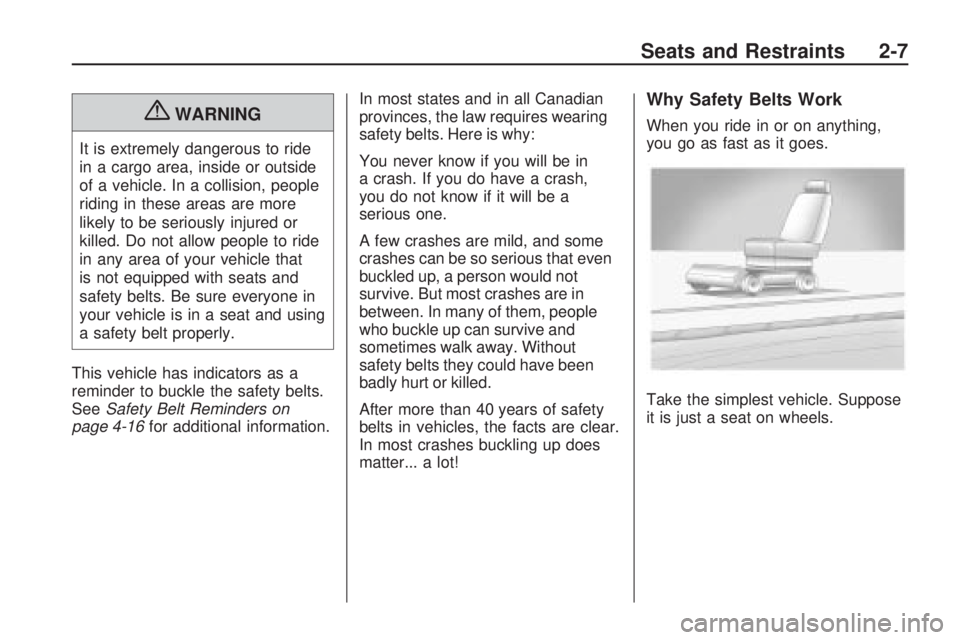
When you ride in or on anything,
you go as fast as it goes.
Take the simplest vehicle. Suppose
it is just a seat on wheels.
Seats and Restraints 2-7
Page 35 of 372
In a crash, this applies force to the
strong pelvic bones and you would
be less likely to slide under the lap
belt. If you slid under it, the belt
would apply force on your abdomen.
This could cause serious or even
fatal injuries. The shoulder belt
should go over the shoulder and
across the chest. These parts of
the body are best able to take belt
restraining forces.
The shoulder belt locks if there is a
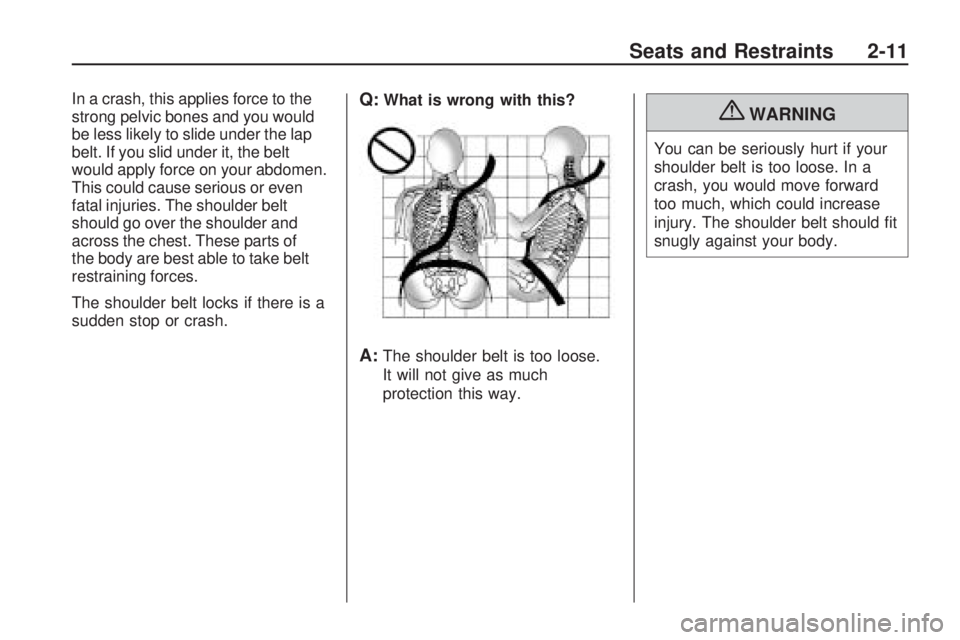
sudden stop or crash.Q:What is wrong with this?
A:The shoulder belt is too loose.
It will not give as much
protection this way.
{WARNING
You can be seriously hurt if your
shoulder belt is too loose. In a
crash, you would move forward
too much, which could increase
injury. The shoulder belt should fit
snugly against your body.
Seats and Restraints 2-11
Page 36 of 372
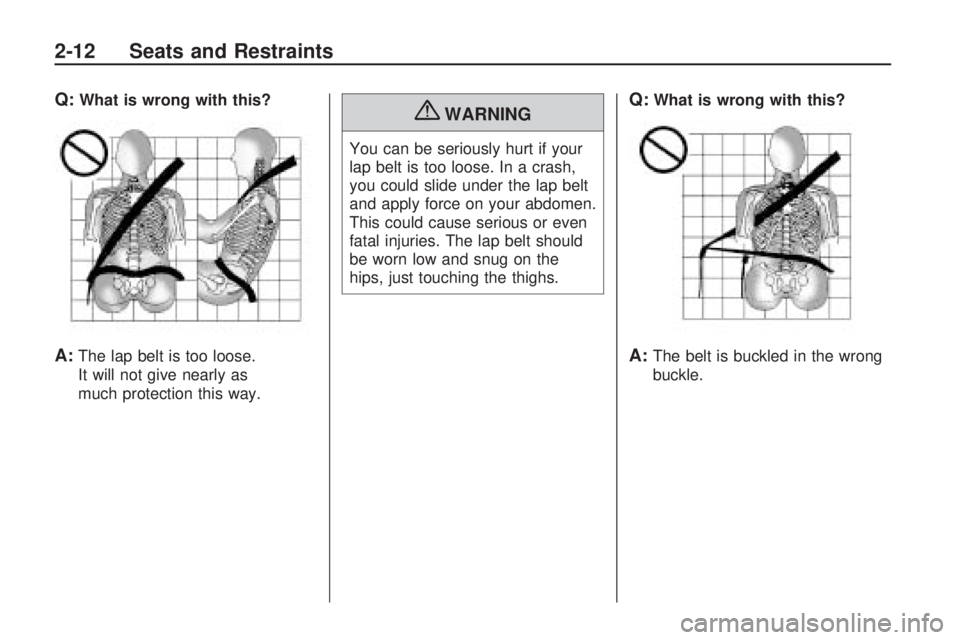
Q:What is wrong with this?
A:The lap belt is too loose.
It will not give nearly as
much protection this way.
{WARNING
You can be seriously hurt if your
lap belt is too loose. In a crash,
you could slide under the lap belt
and apply force on your abdomen.
This could cause serious or even
fatal injuries. The lap belt should
be worn low and snug on the
hips, just touching the thighs.
Q:What is wrong with this?
A:The belt is buckled in the wrong
buckle.
2-12 Seats and Restraints
Page 37 of 372
{WARNING
You can be seriously injured if
your belt is buckled in the wrong
place like this. In a crash, the belt
would go up over your abdomen.
The belt forces would be there, not
on the pelvic bones. This could
cause serious internal injuries.
Always buckle your belt into the
buckle nearest you.
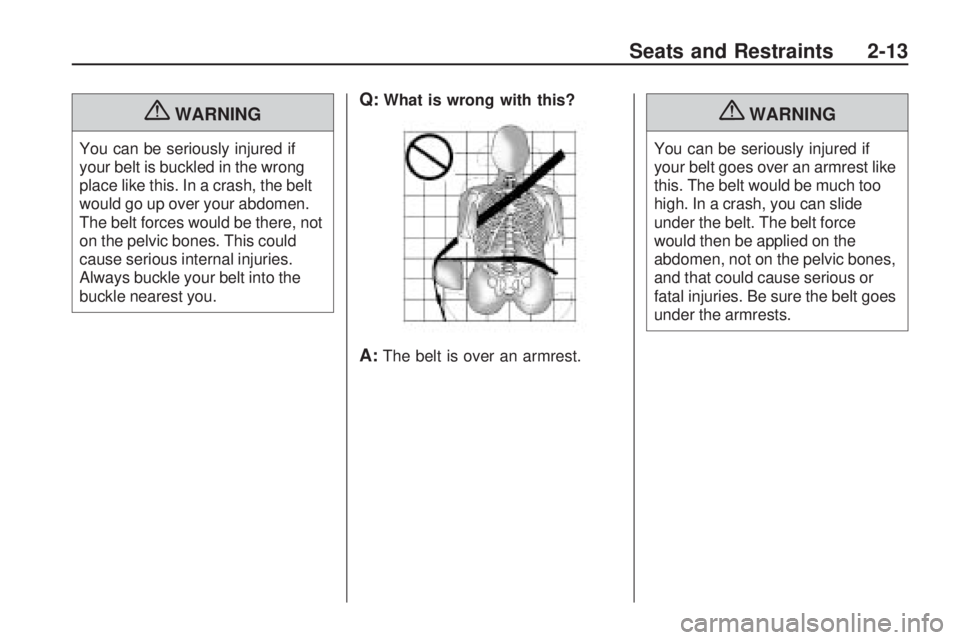
Q:What is wrong with this?
A:The belt is over an armrest.
{WARNING
You can be seriously injured if
your belt goes over an armrest like
this. The belt would be much too
high. In a crash, you can slide
under the belt. The belt force
would then be applied on the
abdomen, not on the pelvic bones,
and that could cause serious or
fatal injuries. Be sure the belt goes
under the armrests.
Seats and Restraints 2-13