heating CHEVROLET CAVALIER 1984 1.G User Guide
[x] Cancel search | Manufacturer: CHEVROLET, Model Year: 1984, Model line: CAVALIER, Model: CHEVROLET CAVALIER 1984 1.GPages: 105, PDF Size: 24.23 MB
Page 52 of 105
Downloaded from www.Manualslib.com manuals search engine • Adjust the heating or cooWng system to force outside air into the cal as
follows :
1. On cars not equipped with air conditioning , set the fan to high speed
and the upper control lever to any position except "Off."
2 . On cars equipped with air condition ing, set the fan to high speed and
the
upper control lever to any position except "Off" or "Max."
• On cars that have outside air vents in or under the instrument panel, open
vents
fully .
"Gate Ajar" Ught
Station wagons have a "GATE AJAR" warning light located in the instrument
cluster . It is designed to come on ~ the liftgate is not lully closed and the
ignition is on , thus warning against driving with the liftgate even partially open.
See "Engine Exhaust Gas Caution (Carbon Monoxide)" at the beginning 01
"Starting and Operating ," Section 2 of this manual . To test that the ight circuit
is working correctly , start the car and check that the light comes on when the liftgate is open or only partially latched.
Electric Trunk, Hatchback , Or Tailgate Release
An electric release permits opening the trunk, hatchback or station wagon tailgate from inside the car by pressing a release bunon in the instrument panel
glove box. The release lor the hatchback and the station wagon tailgate will
function only II the automatic transaxle is in "P" (Park) or "N" (Neutral) or, on
manual transaxle cars, ~ the parking brake is applied .
SUNSHADE (OPTIONAL)
n your hatchback model is equipped with the optional louvered rear window
sunshade, the
sunshade·is hinged at the top and heid down at the boUom by a
one-quarter tum fastener on each end of the sunshade. This method of
attachment
allows you to raise the sunshade lor cleaning the exterior of the
hatchback glass :
To clean the hatchback lid exterior glass:
1. Using a coin or screwdriver , rotate each lastener one-quarter turn until they pop up; the sunshade is now unlocked .
2. Grasp the lower edge 01 the sunshade approximately in the middle and lift
the sunshade away Irom the hatchback lid.
3. Clean the hatchback glass as desired while holding the sunshade in the
open position.
4 . Lower the sunshade to
its original position and locate the one-quarter turn
fasteners over the holes in the lower bracket assemblies; using a coin or
screwdriver, push the one-quarter turn stud downward
until it engages the
wire bail on the bracket and rotate one-quarter turn to lock. (Make sure the
lastener is
locked to the bracket by. lifting each corner 01 the sunshade.)
NOnCE: DO NOT DRIVE when sunshade is not lOcked in position.
To remove the sunshade from the car, ~ desired , release the sunshade as you would lor cleaning. Then, remove the four nuts which secure the sunshade
hinges to the hinge base
plate on the hatchback lid. Wft the sunshade assembly from the car.
2-36
Page 61 of 105
Downloaded from www.Manualslib.com manuals search engine ENGINE COOLING SYSTEM OVERHEATING
If you see or hear escaping steam or have other reason to suspect there is a
serious overheat condition, stop and park the vehicle as soon as it is safe
to do so and turn off the engine immediately and get out of the vehicle.
The cooling system may overheat if the coolant level is too low, if there is a
sudden
loss of coolant (such as a worn hose splitting), or if other problems occur. It may also temporarily overheat during severe operating conditions
such as:
• climbing a long hill on a hot day,
• stopping after high-speed driving,
• idling for long periods in trallic, or
• towing a trailer.
I! the Engine Coolant Temperature light comes on (or if you have an Engine
Coolant Temperature gage and it shows an overheat condition), or you have
any reason to suspect the engine may be overheating:
• tfyour air conditioner is on, turn it off.
• If you are stopped in traffic, shift the transaxle to "N" (Neutral).
If the warning light does not go off (or engine coolant temperature does not
start to drop) within a minute
Or two:
• Pull over, stop and park the vehicle as soon as it is safe to do so.
• Let the engine run at normal idle speed for two or three minutes.
I! the warning light does not go off (or engine coolant temperature does not
start to drop),
turn off the engine and get out of the car, then proceed as
follows:
CAUTION: To help avokt being burned:
• DO NOT OPEN ntE HOOD if you see or hear steam or coolant escaping from the engine compartment. Wait until no steam or coolant can be seen or heard before opening the hood.
• DO NOT REMOVE THE RADIATOR CAP or coolant RECOVERY TANK CAP IF THE COOLANT IN THE RECOVERY TANK IS BOIUNG. Also do not remove the radiator
cap while the engine and radiator are still hot Scalding fluid and steam can be blown out under pressure if eHher cap is taken off too soon.
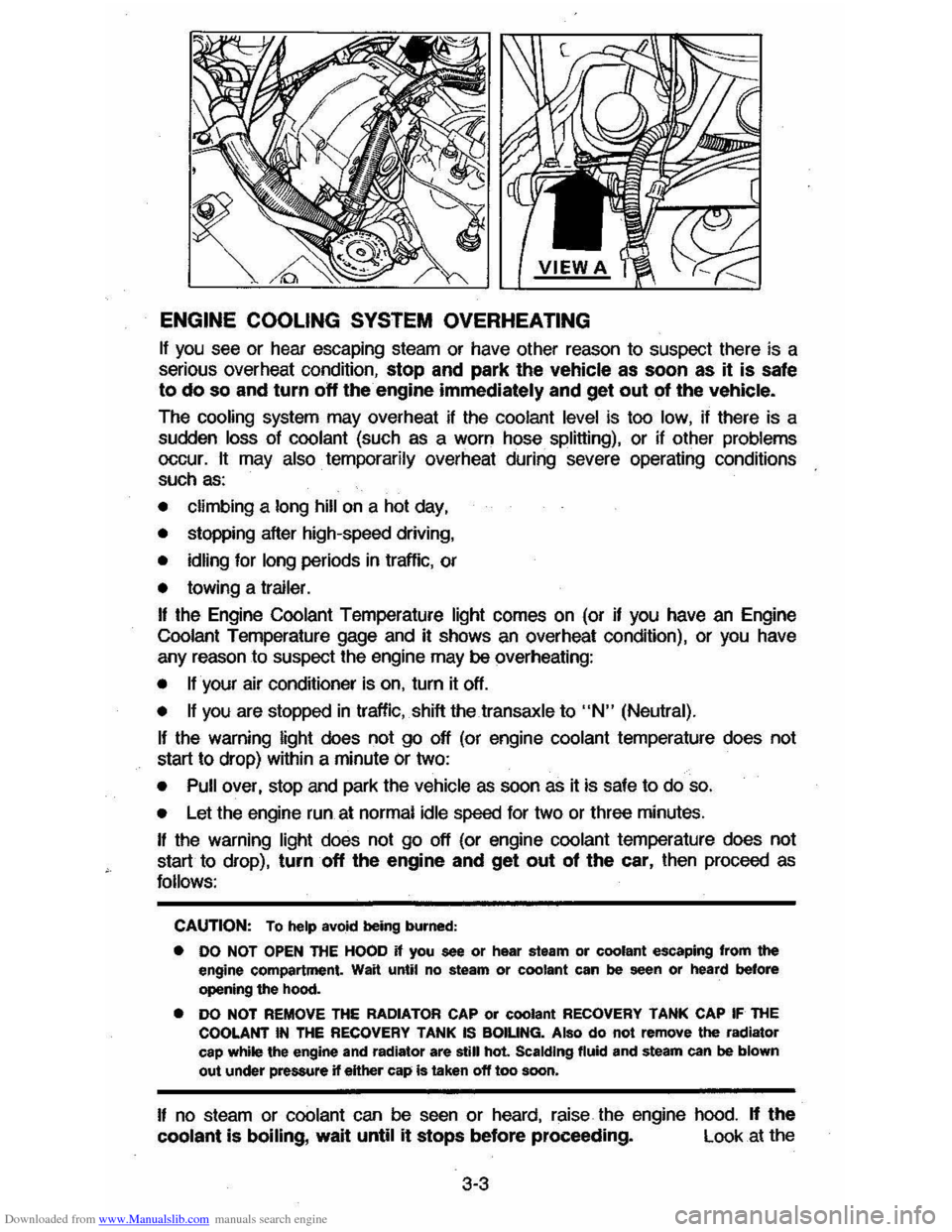
I! no steam or coolant can be seen or heard, raise the engine hood. If the
coolant is boiling, wait until it stops before proceeding. Look at the
3-3
Page 80 of 105
Downloaded from www.Manualslib.com manuals search engine Check the fluid level only when the engine is off, the vehicle is level and the transaxle is cool enough so that you can rest your fingers on the transaxle
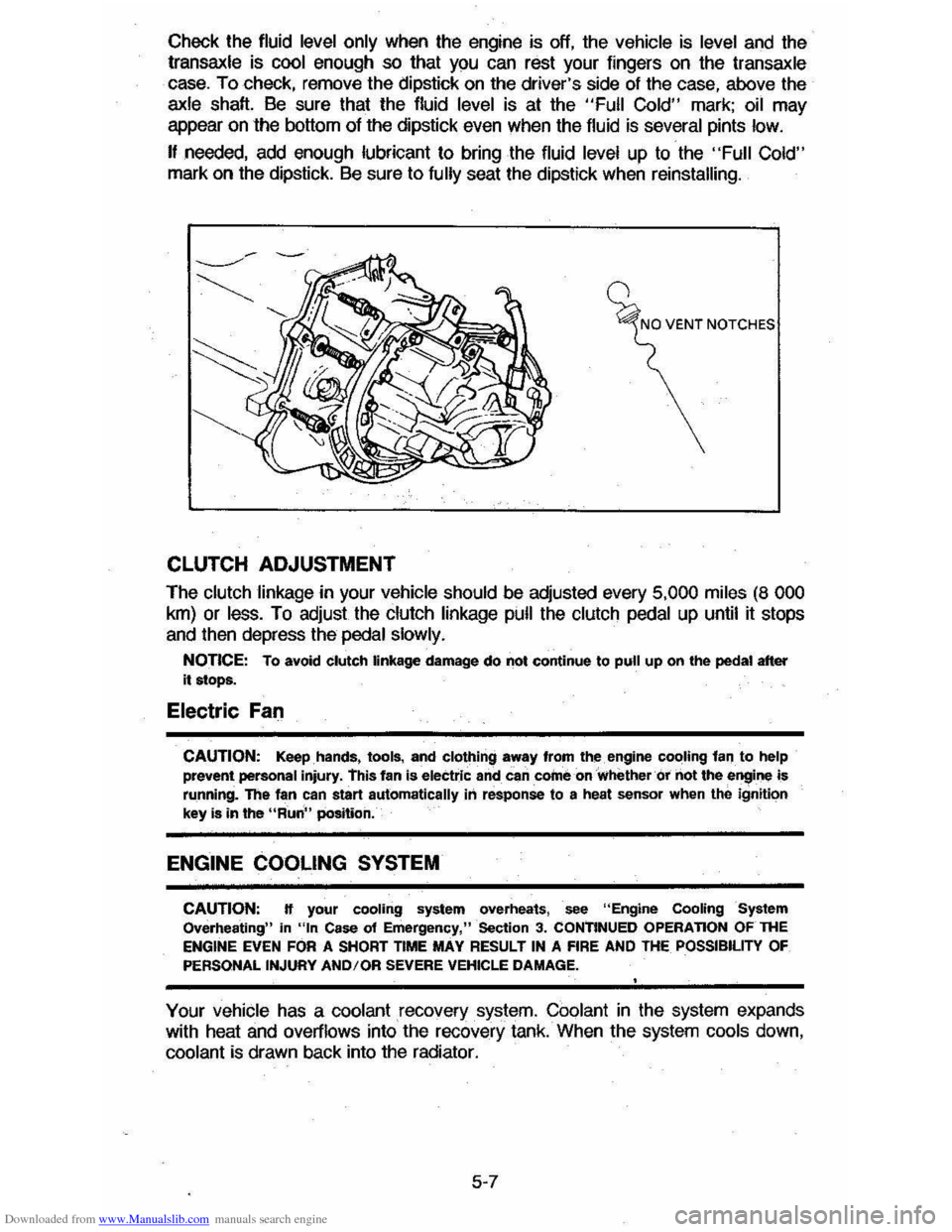
case. To check, remove the dipstick on the driver's side of the case, above the
axle shaft, Be sure that the fluid level is at the "Full Cold" mark; oil may
appear on the bottom of the dipstick even when the fluid is several pints low.
I! needed, add enough lubricant to bring the fluid level up to the "Full Cold" mark on the dipstick. Be sure to fully seat the dipstick when reinstalling.
CLUTCH ADJUSTMENT
The clutch linkage in your vehicle should be adjusted every 5,000 miles (8 000
km) or less. To adjust the clutch linkage pull the clutch pedal up until it stops
and then depress the
pedal slowly.
NOTICE: To avoid clutch linkage damage do not continue to pull up on the pedal after
it stops.
Electric Fan
CAUTION: Keep hands, tools, and clothing away fr,om th~engine cooUng lanto help prevent personal injury. this fan is electric and can corne on whether or not the engine is
running. The fan can start automatically in response to a heat sensor when the ignition
key is in the "Run" position.
ENGINE COOLING SYSTEM
CAUTION: H your cooling system overheats, see "Engine Cooling System Overheating" in "In Case of Emergency," Section 3. CONTINUED OPERATION OFTHE ENGINE EVEN FOR A SHORT TIME MAY RESULT IN A FIRE AND THE POSSIBILITY OF
PERSONAL INJURY ANDIOR SEVERE VEHICLE DAMAGE.
Your vehicle has a coolant recovery.system. Coolant in the system expands with heat and overflows into the recovery tank. When the system cools down,
coolant is drawn back into the radiator.
5-7
Page 82 of 105
Downloaded from www.Manualslib.com manuals search engine If you have to add coolant more than four times a year (either to the recovery
tank or to the radiator), or if
coolant is dirty or discolored, see your dealer for a cooling system check.
NOTICE: rr you use the proper quality antifreeze, there is no need to add extra inhibitors or additives which claim to improve the system. They may be harmful to the proper operation of the system.
Adding Coolant
CAUTION: To help avoid the danger of being burned, do not remove the radiator cap while the engine and radiator are stili hot. Scalding fluid and steam can be blown out under pressure if the cap is taken off too soon.
1. When the engine is cool, remove the radiator cap.
• Turn the cap slowly to the left until it reaches a "stop." Do not press
down
while turning the cap.
• Wait until any remaining pressure (indicated by a hissing sound) is relieved, then press down on the cap and continue turning it to the left.
2. Add enough water and ethylene glycol anmreeze (meeting GM Specification 1825-M) to provide the required cooling, freezing and
corrosion protection. Use a solution that is at least 50 percent antifreeze
but no more than 70 percent antHreeze. Fill the radiator to the base of the
filler neck and fill the coolahUocave,y lank to at or above the "Full Hot" mark. Put the recovery tank cap back on.
3. Run the engine, with the radiator cap removed, until the upper radiator
hose is
hot. With the engine idling, add coolant to the radiator until it
reaches
the bottom of the filler neck. Install the radiator cap, making sure
the arrows on the cap line up with the overflow tube on the radiator filler
neck.
II is Ihe owner's responsibility 10:
• Maintain cooling system freeze protection at -37°G (-34°F) to ensUre
protection against corrosion and loss of coolant from boiling. (A SO/SO mixture of water and ethylene glycol antifreeze will provide freeze
protection to -37°G or -34°F.) You should do this even if you don't
expect freezing temperatures. Periodic
replacement of coolant is needed to replace the anti-corrosion additives that wear out with use. Coolant that
has become dark in color shows that it needs to be changed for this reason.
• Add ethylene glycol base antifreeze that meets GM SpecHication 1825-M
when antifreeze has to be added because of coolant loss or for more
protection against freezing at temperatures less than stated.
NOTICE: Do not use methanol-base antifreeze, or alcohol, . or plain water alone, in your vehicle at anytime. They will boil ata lower point than that at which the "TEMP" light (or temperature gage) will warn of overheating, and they do not provide proper protection against corrosion.
Thermostat
The engine coolant temperature is controlled by a thermostat. It stops coolant
flow through the radiator until a preset temperature is reached. This thermostat
is installed in the engine coolant oullet on the engine block. The same
thermostat is used in both winter and summer. When a replacement is needed, AG-Oelco paris are recommended.
5-9
Page 83 of 105
Downloaded from www.Manualslib.com manuals search engine Radiator Pressure Cap
The radiator cap, a 105 kPa (15 psi) pressure type, must be installed tightly, otherwise coolant may be lost and damage to engine may resuK from
overheating . Radiator pressure cap
should be checked periodically for proper
operation .
If replacement is required, an AC cap is recommencled.
ACCELERATOR LINKAGE
Lubricate all pivot points with .engine oil at the interval shown in the
Maintenance
Schedule. Do not lubricate the accelerator cable.
AIR CLEANER ELEMENT
When replacement of air cleaner fmer element is necessary, an AC air Imer
elemenl
is recornmencled .
See your Maintenance Schedule for change intervals . Operation of vehicle in
dusty areas will necessitate more frequent replacement. Your dealer can be of
assistance
in determining the proper replacement frequency for the conditions
under which you operate your
vehicle.
CAUTION: The air cleaner a* functions ... name arrestor in the event of engine backfire . The -air cleaner ehould be lnstaIIed at an times unit .. III removal is neceaary for repair or maintenance. To help reduce the-risk of pereonal Injury and lor property damage , be sure that no one 18 ne.-the engine comJ*1ment before starting the engine wiU'l the air cleaner removed. If engine backfire occurs with the air cleaner remowd, thwe could be-a burst of flame and posaibly other fnln the engine compartment.
HOOD LATCHES AND HOOD HINGE
SeetHe Maintenance Schedule folder to find out how to lubricate hood.latch ·
and hood hinge assembly .
BRAKE MASTER CYLINDER
Check masler cylinder fluid· level in the reservoir at the interval shown in the Maintenance Schedule . If the fluid is low in the reservoir, it should be filled to
the maximum
level line with Delco Supreme No. 11 or OOT-3 fluids.
POWER STEERING SYSTEM
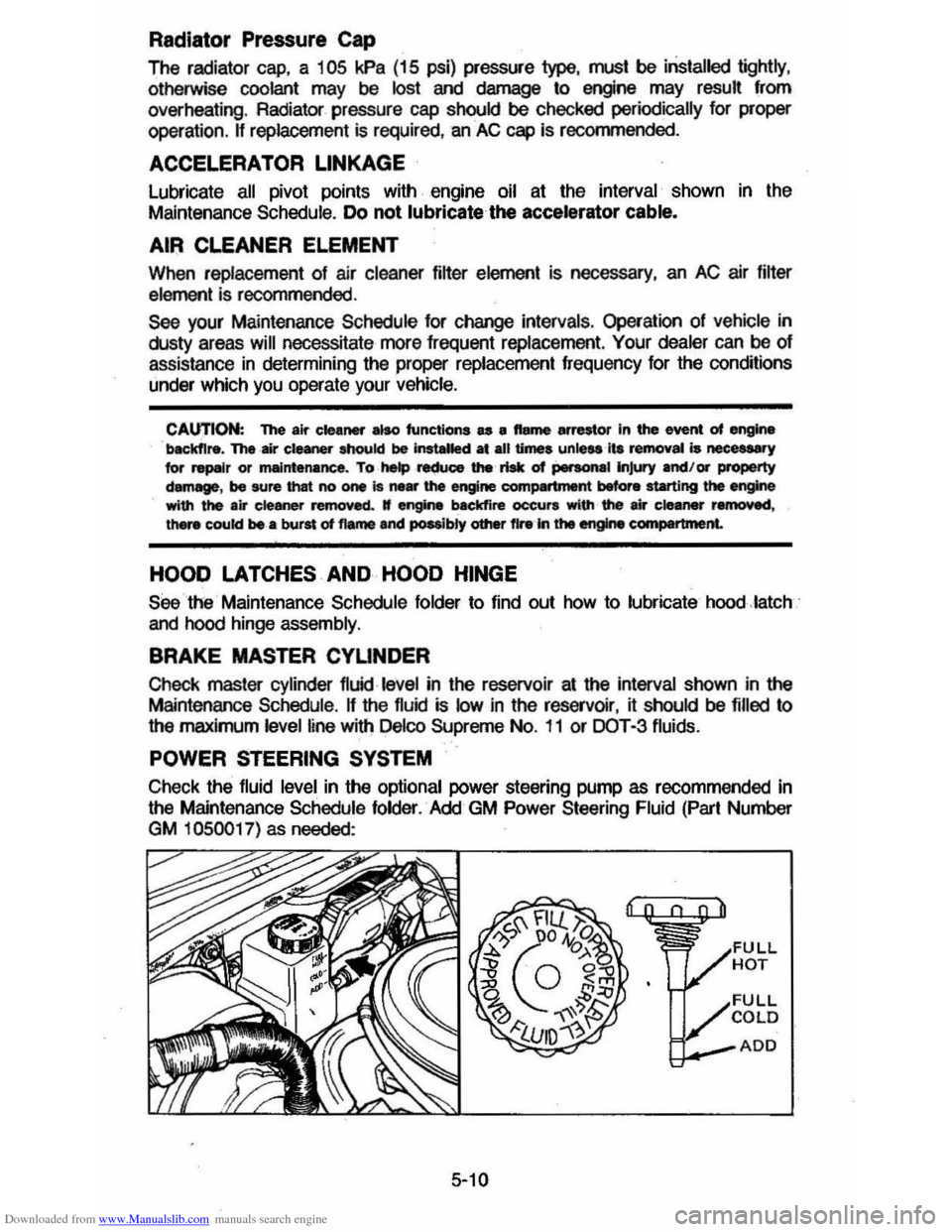
Check the fluid level in the optional power steering pump as recommended in
the Maintenance Schedule folder. Add GM Power Steering Fluid (Part Number
GM 1050017) as needed:
5-10
Page 101 of 105
Downloaded from www.Manualslib.com manuals search engine Exha.Ist SysttIm ChecltS .. 2·1 Parked Witt! Engine Rt.nning .. 2 ·' PulIng A Tr.JiIer '2·2 Flanmable 0ea1ing Sotvents . " . " 4 ·1 -. . Haz«d W.ning .. ... ... ......... .. ........ ... . . .. 3-1 Turn Signal .. 2 ·8 FloOded Engine, Starting.. .." 2'11 Floor Controls ... ................................. " 2~ 1 8 Fluid Capacities .. Drive Axle ..... . Power Steoring .. . Radiatof ..... Transaxle .\uklma tic ..
e ·" , .. . : ..... 5·1 0 .. , 5· 9; 5 ·1 0 5,6
Trensaxle MInJaI ............. .............. 5 ·6 wn:tshIekJ Washer .... . 2·9 F oreign Countries. Operation In.. 2 ·6 Freeing car From Mud and Sand .......... 3 ·8 Fuet . Requirements.. 5·1 Fuel StatiOn Information.. 6 ·7 Flimet . Engine EIChaust.. .. ..... ....... 2·1 ,,'" Chart ..... . ................... 6-5 location ..... -.""","" .. ................. 6·4 . ..... 2 ·22 . 2·24
"""""" -... .. .................................. 6-1 Do No! Usc For Cleaning F~1er cap location .. Fumes ................ ........ .. Gage .. Recommendations .... GIov ... .QQx" .. , ........ ,
.............. , 6-'
GUl¥d AgaInst Theft ................. .......... ..
2·' 2·'" 2 ·5
2 ·23
,.,
H atc hback Coupe .................... ........... .. '2-3 5 3·' Hazwd WarrWng Flasher ..
-Buzz ... FlicKering (Circuit BreMer) Hi!11 Beern Difmler SWitch ug,t S .whch., ....... Hei1Ier Operatioli .. Hitches. Trailer .. Hood
........ 6-4. 6-5 .... 2-9. 2·24
Latch Maintenance.. 5·10 RMese... .. ............................. ......... 6-7 Horn .......................... .............. 2,'8 How To ~ YOOl Gas Mileage TipS ...................................... .. ,' 2-8 IdI!InOOCaIiOn Num:lers Eng;no ........ 6-' VehiCle ......... ... . ....-Indic ator LIgtlI, Upshift ..
.. ............. 6 ·5 1 -2 ,2 ·7 2 -\5 Inflation Pressure, Tires.. 5 -1 3 Inlets. Ventilation System ............ 2-25 . 2·28 Inside RearvloW Mirror .. Instrument Panel .. J"" Caution 3·. Operation.. 3-5
S torage ................................. 3-5, 3-6 Jump Strilg With Booster Bat1ery. 3-1. 3-2 Keys.. 1-1 latches Door.. 1 ·3 Hood.. 5- 10,6·7 Light s.. 6·3
7-2
-.... .. .... ................. ........... 6-3 Brake Wamir'lIiJ.. 2-22 8rigtIt 8Mm IncicaIor .......................... 2-24 Bright Beam Switch ............................... 2-9 Bub Chart 6-3 Courtesy... 6 -3 Engine Tempe!'8ture Indicator.. 2 -21 Generator IndicalOf.. 2-21 Hazard Flasher" .................................. 3-1 Hsadlamp Circu it Breaker.. 6-5 H~.. 6-3 HeadIamp Warning Buzzer.. 2 -2 5 Oil Pr9S5Ufe IndicalOr... 2·21 SidemaIkcr .n................ . ................ 6 ·3 SWitch .. Tail SfId Brake .... Turn Slg\aJ Indicator .. Upshift Indicator LIglt .. Looks Door.. Ignition ..
. ....... .-... 2 ·2 4 . 6·3 2 -8 . 6-3 2-15
'·3 2·' Power Door:... '·3 Steemg Column .. . 2-7 Luggage Carrier.. 2·40. 2,4 1 luggaQe CompartmenI , Orimg wtile Open.. . ...... ........ .. . 2 ,1 Manual T ransaJlle Shift PoinIs .. ...................... ... .. 2·14 2 -1 4 Upshift Irdcator light ........... ... ............ 2-1 5 Mirrors Convex .. Rear View .. Mountainous Torroln Driving Down Grade s .. New car Break-In ..
1-4, 1-5
2-11 2 ·2 Odometer 2-20 Oil Pr9SfUe Gage.. . ........................ 2·24
Oil Pr88SUfe Ugr'II ................. " .......... ... .. 2 ·21 Operation in Foreign GoU'11ries ........... ~" 2--6 orher' c:or.oI!I and Featl.Ke! .. ..... ...... .. 2·35 Overheatad Engine Gage.. 2-24 Indicator light ....... ........................... 2-21 What To Do ....................................... 3-3 Parking Brake ... . . .. .. ... .. .. 2-19 , 2-22 lights.. . ......... .... ........... 6-3 Precautions .. .. .... ............. . "-Brakes ....................... ..... ... ... ... ... ........ 2 '1 8 Door locks.. ' ·3 ....... Steering .. Windows .................. . Pressure, Tire tllflatio'n .. Radiator Coolant .. Coolant Level Inspection .. Overheating ... Pressu-e Cac:I ... ..-
,. , 2 -15 ,..
.. .. 5-13
5·' 5· '
3·3 5·10
NoA ............ ................... ........ ... ... ........ . 2-30 AM/FM
AM /FM Stereo C assette .. Anlerna .....
ContrOls-A I.
Mobile Raol o System s ..
2·30 2-32, 2-33 2 -3 5 2·29 . 2-35