lock CHEVROLET CAVALIER 1993 1.G Workshop Manual
[x] Cancel search | Manufacturer: CHEVROLET, Model Year: 1993, Model line: CAVALIER, Model: CHEVROLET CAVALIER 1993 1.GPages: 308, PDF Size: 15.62 MB
Page 172 of 308
Downloaded from www.Manualslib.com manuals search engine Problems on the Road
bwing Your Chevrolet (CONI)
To help avoid injury to you or
lers:
a Never let passengers ride in a
vehicle that is being towed.
a Never tow faster than safe or
posted speeds.
* Never tow with damaged parts
not fully secured.
* Never get under your vehicle after
it
has been lifted by the tow truck.
* Always use separate safety
chains on each side when towing
a vehicle.
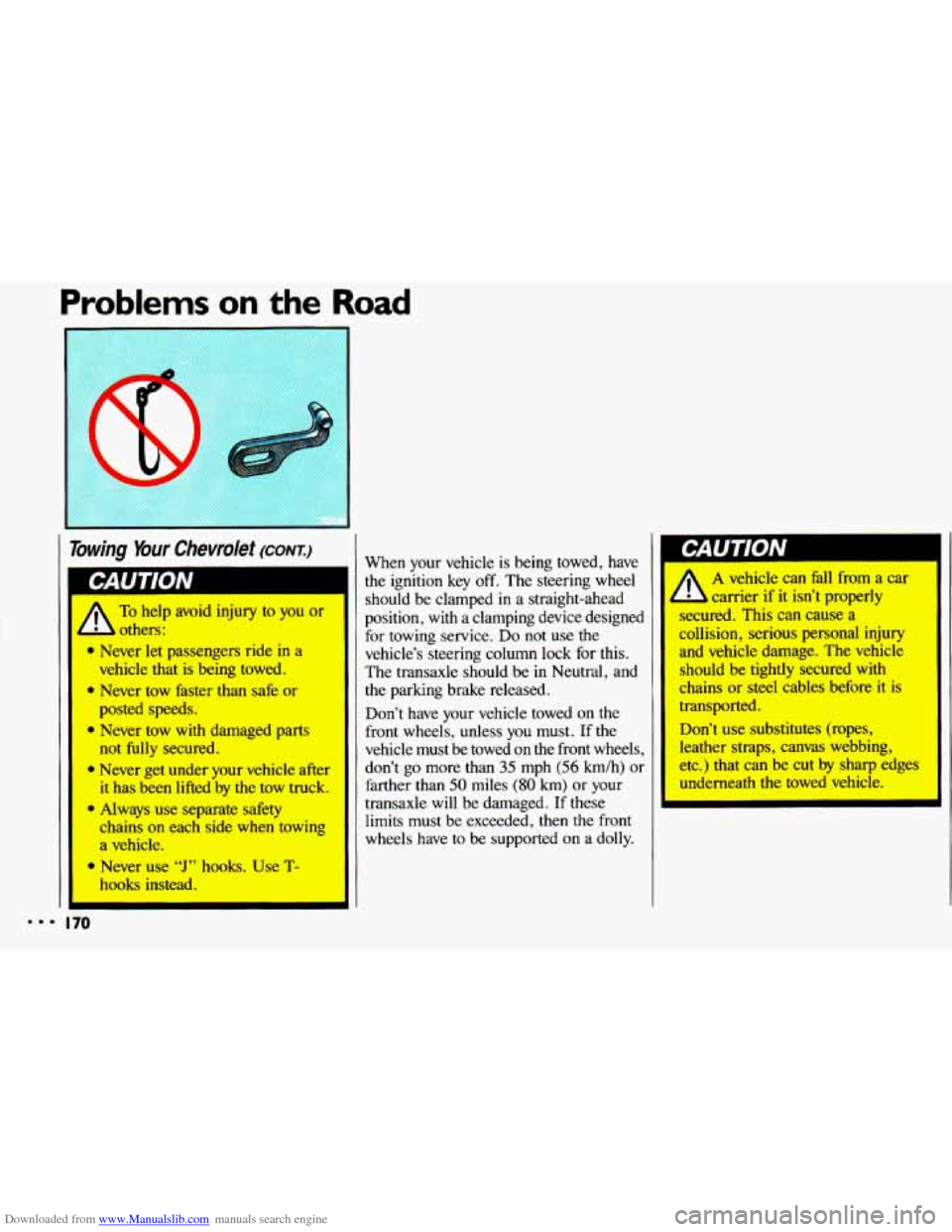
Never use
“J” hooks. Use T-
hooks instead.
the ignition key off. The steering wheel
should be clamped
in a straight-ahead
position,
with a clamping device designed
for towing service. Do not use the
vehicle’s steering column lock for this.
The transaxle should be
in Neutral, and
the parking brake released.
Don’t have your vehicle towed on the
front wheels, unless
you must. If the
vehicle must be towed on the front wheels,
don’t go more than
35 mph (56 km/h) or
farther than
50 miles (80 km) or your
transaxle will be damaged. If these
limits must be exceeded, then
the front
wheels have to be supported on a dolly.
p-AU I IUN I
A vehicle can fall from a car
carrier if it isn’t properly
secured. This can cause a
collision, serious personal injury
and vehicle damage. The vehicle
should be tightly secured with
chains or steel cables before it is
transported.
Don’t use substitutes (ropes,
leather straps, canvas webbing,
etc.) that can be cut
by sharp edges
underneath
the towed vehicle.
A
mmm 170
Page 188 of 308
Downloaded from www.Manualslib.com manuals search engine Problems on the R
Changing a Flat Tire (CONT:)
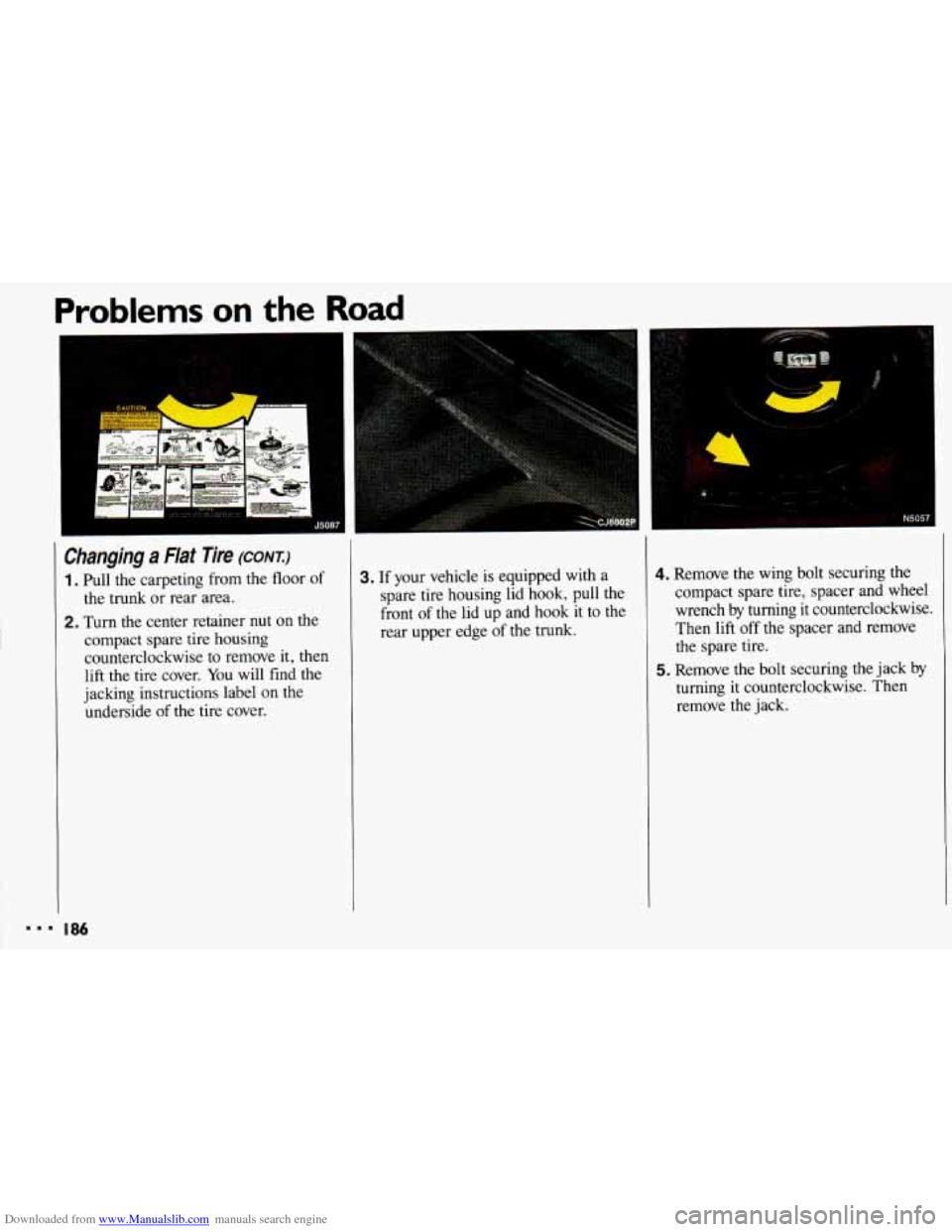
1 . Pull the carpeting from the floor of
2. Turn the center retainer nut on the
the trunk
or rear area.
compact spare tire housing
counterclockwise to remove it, then
lift the tire cover. You will find the
jacking instructions label on the underside
of the tire cover.
3. If your vehicle is equipped with a spare tire housing lid hook, pull the
front
of the lid up and hook it to the
rear upper edge of the trunk.
4. Remove the wing bolt securing the
compact spare tire, spacer and wheel
wrench
by turning it counterclockwise.
Then lift
off the spacer and remove
the spare tire.
5. Remove the bolt securing the jack by
turning it counterclockwise. Then
remove the jack.
... I a6
Page 189 of 308
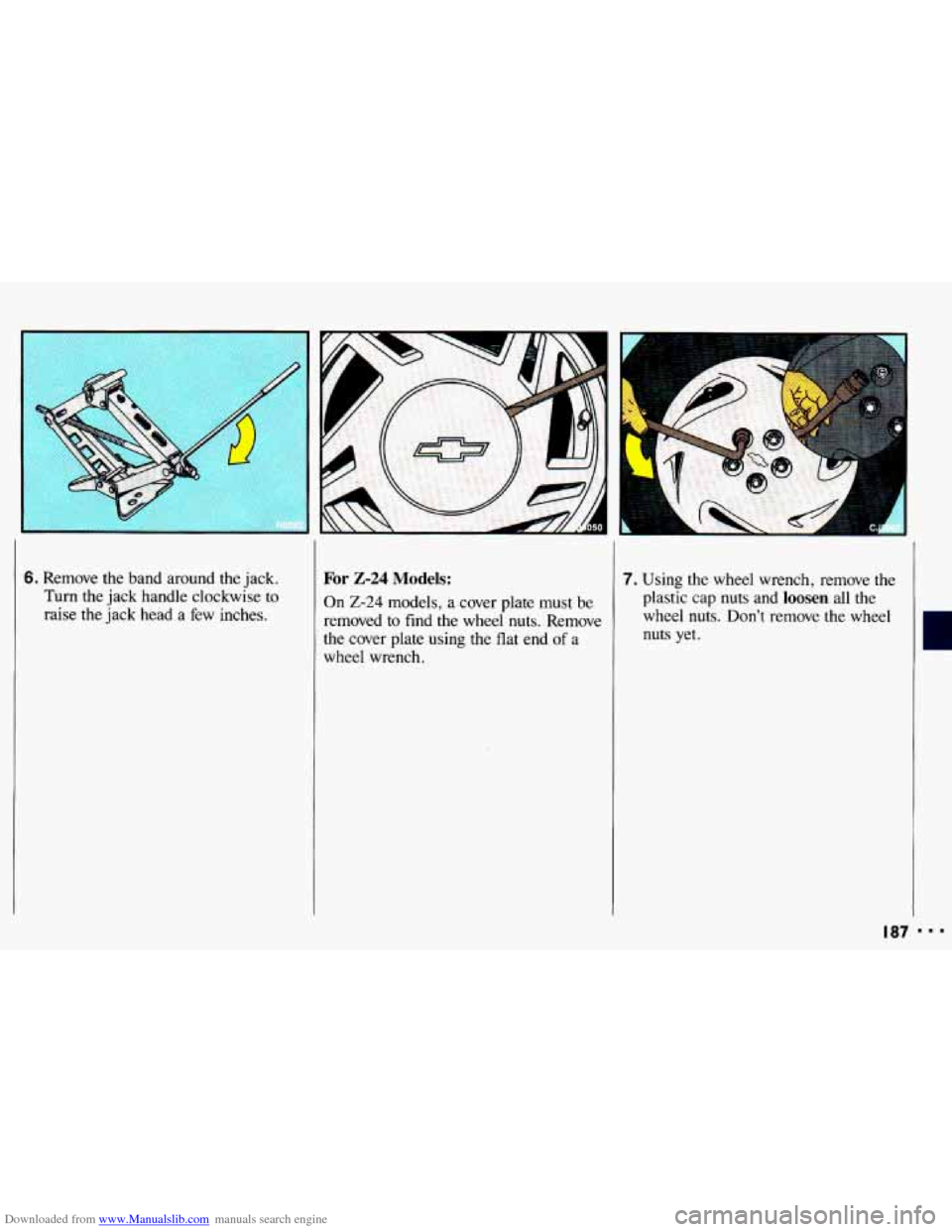
Downloaded from www.Manualslib.com manuals search engine 6. Remove the band around the jack.
Turn the jack handle clockwise
to
raise the jack head a few inches.
7. Using the wheel wrench, remove the
plastic cap nuts and loosen all the
wheel nuts. Don’t remove the wheel
nuts
yet.
For 2-24 Models:
On 2-24 models, a cover plate must be
removed to find the wheel nuts. Remove
the cover plate using
the flat end of a
wheel wrench.
I87
Page 190 of 308
Downloaded from www.Manualslib.com manuals search engine Problems on the Road
Changing a Flat Tire (CONT.)
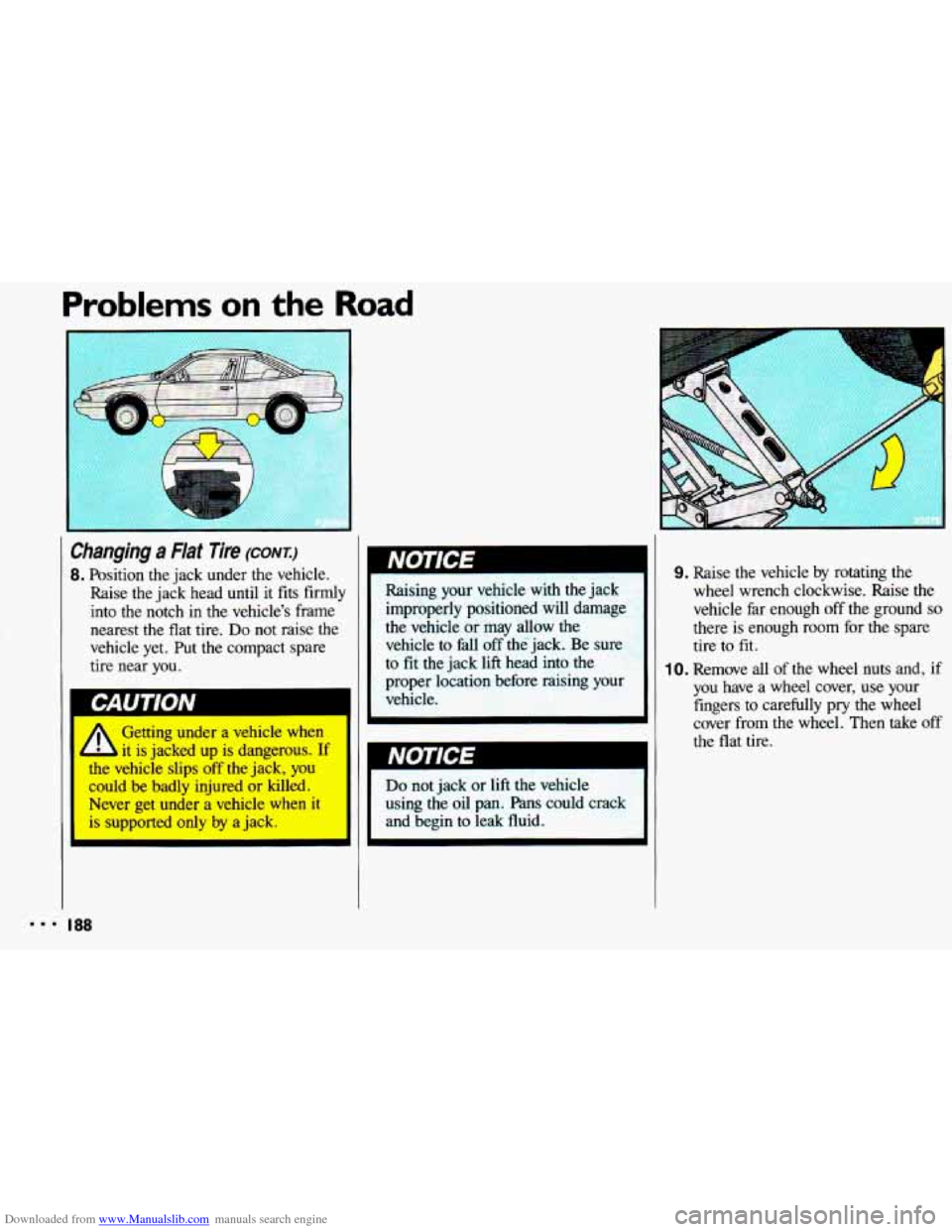
8. Position the jack under the vehicle.
Raise the jack head until it fits firmly
into the notch
in the vehicle’s frame
nearest the flat tire.
Do not raise the
vehicle yet. Put the compact spare
tire near you. Raising your vehicle with
the jack
improperly positioned will damage
the vehicle or may allow the
vehicle to fall off
the jack. Be sure
to fit the jack lift head into the
proper location before raising your
vehicle.
Getting under a vehicle when
it is jacked
up is dangerous. If I II NOTICE the vehicie slips off the jack, you I could be badly injured or killed.
Never get under
a vehicle when it
is supported only by a jack.
I88
9. Raise the vehicle by rotating the
wheel wrench clockwise. Raise the
vehicle far enough off the ground
so
there is enough room for the spare
tire
to fit.
1 0. Remove all of the wheel nuts and, if
you have a wheel cover, use your
fingers to carefully pry the wheel
cover from the wheel. Then
take off
the flat tire.
Page 192 of 308
Downloaded from www.Manualslib.com manuals search engine Problems on the Road
Changing a Flat Tire (CONT)
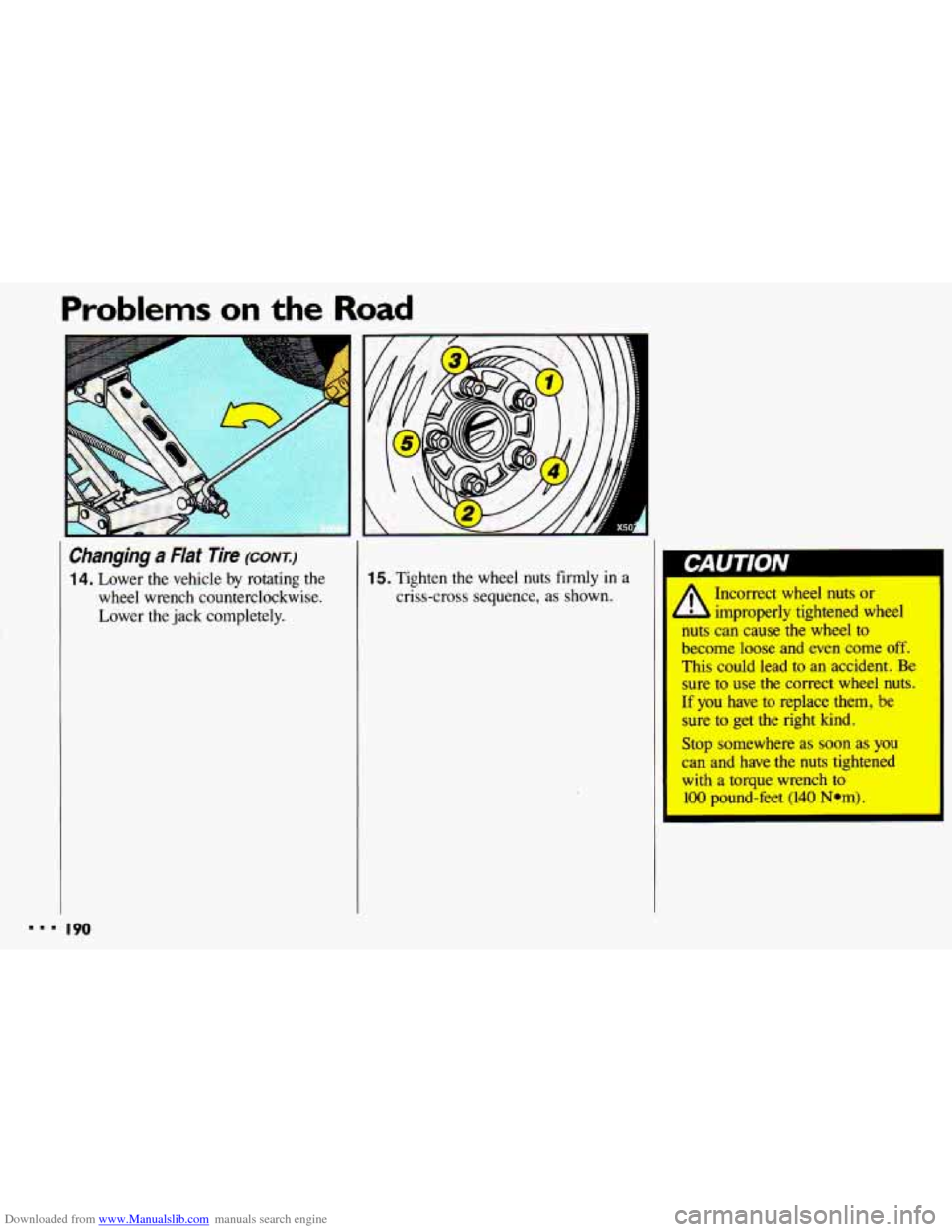
14. Lower the vehicle by rotating the
wheel wrench counterclockwise.
Lower the jack completely. 15. Tighten the wheel nuts firmly in a
criss-cross sequence, as shown.
I
Incorrect wheel nuts or
1 L improperly tightened wheel
nuts can cause the wheel to
become loose and even
come off.
This could lead to an accident. Be
sure to use the correct wheel nuts.
If you have to replace them, be
sure to get the right kind.
Stop somewhere as soon as you
can and
have the nuts tightened
with a torque wrench to
100 pound-feet (140 Nom).
Page 193 of 308
Downloaded from www.Manualslib.com manuals search engine Don’t try to put a wheel cover on your
compact spare tire.
It won’t fit. Store the
wheel cover and plastic cap nuts in the
trunk or rear area until you have the flat
tire repaired or replaced.
16. Store the flat tire in the compact
spare tire compartment, and secure
with the wing bolt and extension.
Store the jack and wheel wrench in
their compartment, also.
MU I IVN 1
Storing a jack, a tire, or other
:quipment in the passenger
compartment
of the vehicle could
cause injury. In a sudden stop
or
collision, loose equipment could
strike someone. Store all these in
the proper place.
The compact spare is for temporary use
only. Replace the compact spare tire
with a full-size tire as soon as you can.
See
Compact Spare Tire next in this
section.
Compact Spare Tire
Although the compact spare was fully
inflated when your vehicle was new, it
can lose air after a time. Check the
inflation pressure regularly.
It should be
60 psi (420 Wa). The compact spare is
made to go up to
3,000 miles (5 000 km),
so you can finish your trip and have
your full-size tire repaired or replaced
where you want.
Of course, it’s best to
replace
your spare with a full-size tire as
soon as you can. Your spare will last
longer and be in good shape in case you
need it again.
Your anti-lock brake system warning
light may come on when you are driving
with a compact spare. See the
Index
under Anti-Lock Brake System Warning
Light.
191
Page 202 of 308
Downloaded from www.Manualslib.com manuals search engine Service & Appearance Care
..I
F
Filling Your lank
I 4Knu l”’”
I
Gasoline vapor is highly
- flammable. It bums violently,
and that can cause very bad
injuries. Don’t smoke if you’re
ar gasoline or refueling your
hicle. Keep sparks, flames, and
loking materials away from
,,soline.
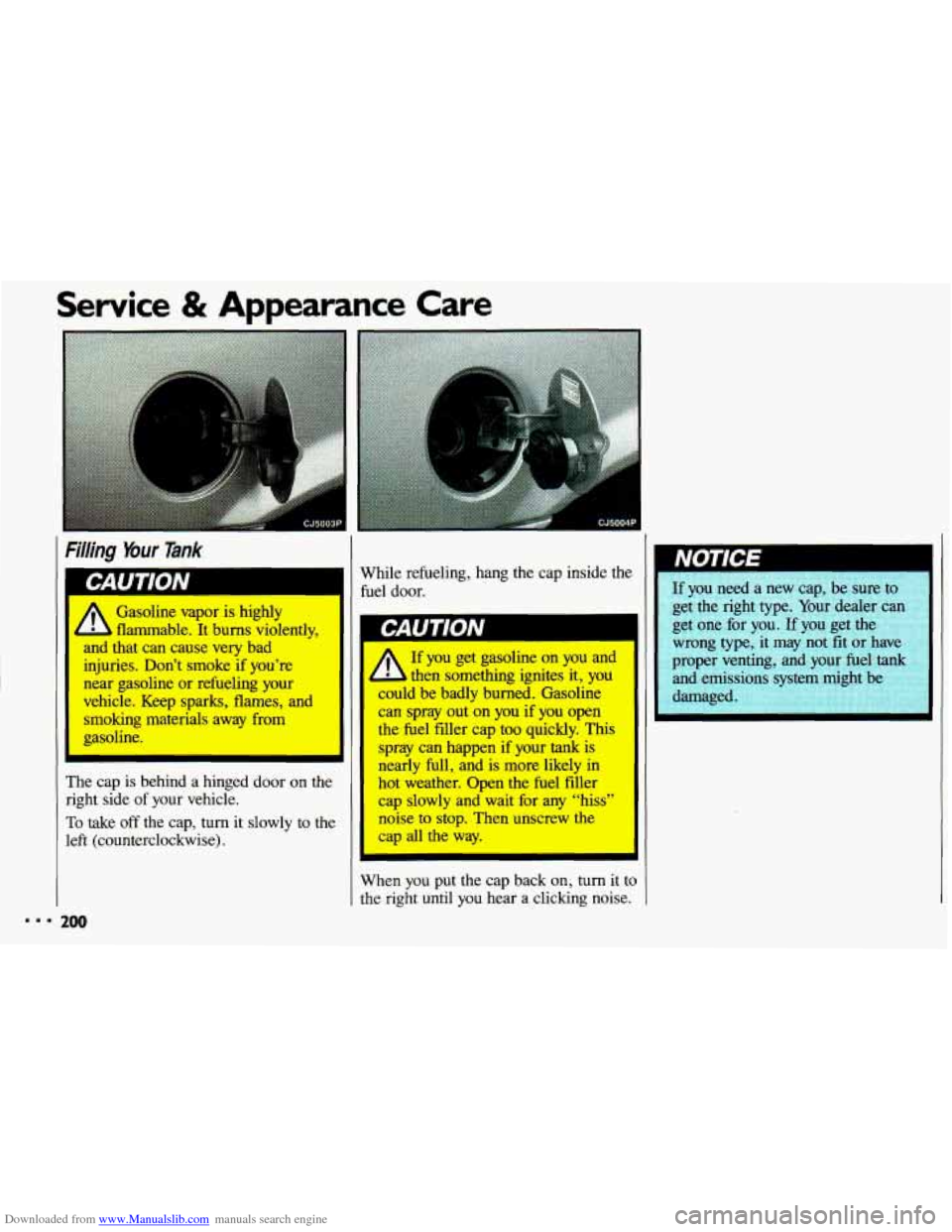
The cap
is behind a hinged door on the
right side of your vehicle.
To take off the cap, turn it slowly to the
left (counterclockwise).
200
rhile refueling, hang the cap inside the
le1 door.
If you get gasoline on you and
then something ignites it, you
could be badly burned. Gasoline
can spray out on you if you open
the fuel filler cap too quickly. This
spray can happen if your
tank is
nearly full, and is more likely in
hot weather. Open the fuel filler
cap slowly and wait for any “hiss”
noise
to stop. Then unscrew the
cap all the way.
{hen you put the cap back on,
turn it to
le right until you hear a clicking noise.
Page 210 of 308
Downloaded from www.Manualslib.com manuals search engine Service & Appearance Care
When to Change Engine Oil
See if any one of these is true for you:
Most trips are less than 4 miles (6 km).
It’s below freezing outside and most
trips are less than 10 miles
(16 km).
The engine is at low speed most of the
time (as in door-to-door delivery,
or in
stop-and-go traffic).
Most trips are through dusty places.
If any one
of these is true for your
vehicle, then you need to change your
oil and filter every 3,000 miles
(5 OOO km) or 3 months-whichever
comes first.
If none of them is true, change the oil
every
7,500 miles (12 500 km) or 12
months-whichever comes first. Change
the filter at the first oil change and at
every other oil change after that.
208
Engine Block Heater
An engine block heater can be a big
help if you have to park outside in very
cold weather,
0°F (-18°C) or colder. If
your vehicle has this option, see the
index under Engine Block Heater.
What to Do with Used Oil
CAUTION
A
Used engine oil contains
things that have caused skin
cancer in laboratory animals. Don’t
let used
oil stay on your skin for
very long. Clean your skin and
nails with soap and water, or a
good hand cleaner. Wash or
properly throw away clothing or
rags containing used engine oil.
Page 226 of 308
Downloaded from www.Manualslib.com manuals search engine Service & Appearance Care
1 Halogen Bulbs Headlight Bulb Replacement
~1 For the type of bulb, see the Index under
Replacement Bulbs.
Halogen bulbs have
bLl3t if you drop or scratch the
bulb.
You or others could be
injured. Take special care when
handling and disposing
of halogen
bulbs.
L: pressurized gas inside and can
3
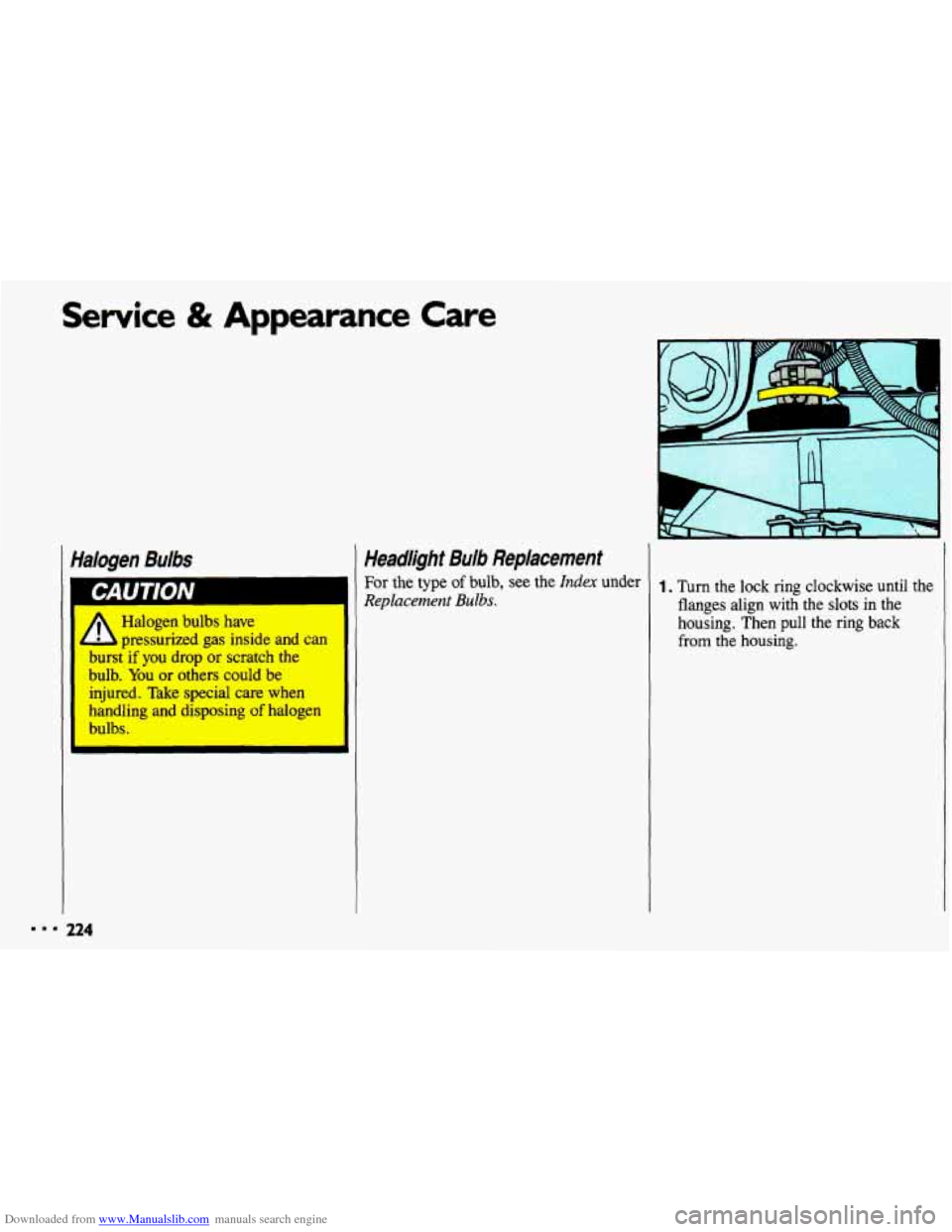
1. Turn the lock ring clockwise until the
flanges align with the slots in the
housing. Then pull the ring back
from the housing.
from the housing.
224
Page 227 of 308
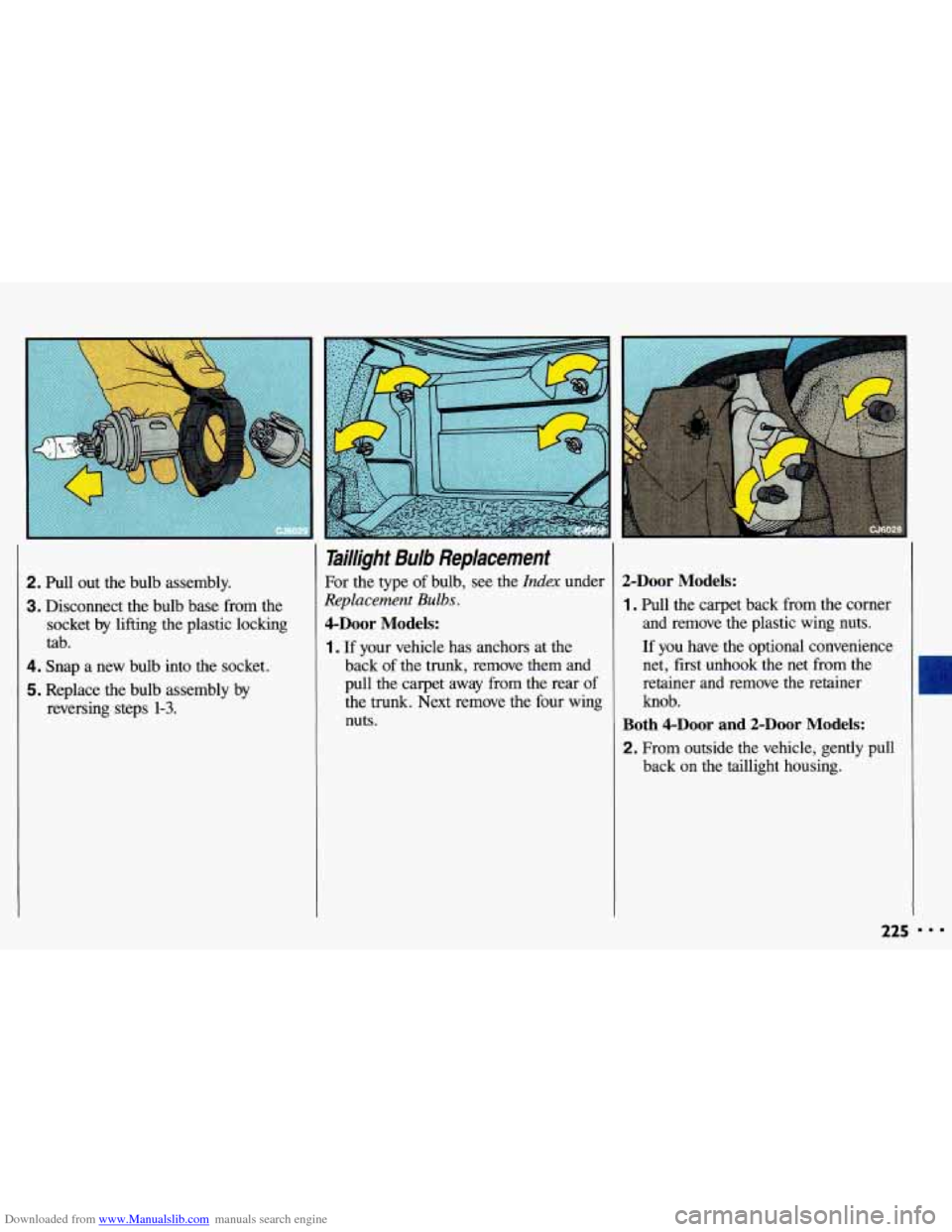
Downloaded from www.Manualslib.com manuals search engine 2. Pull out the bulb assembly.
3. Disconnect the bulb base from the
socket
by lifting the plastic locking
tab.
4. Snap a new bulb into the socket.
5. Replace the bulb assembly by
reversing steps
1-3.
Taillight Bulb Replacement
For the type of bulb, see the Idex under
Replacement Bulbs.
4-Door Models:
1 . If your vehicle has anchors at the
back
of the trunk, remove them and
pull the carpet away from the rear of
the trunk. Next remove the four wing
nuts.
2-Door Models:
1. Pull the carpet back from the comer
and remove the plastic wing nuts.
If you have the optional convenience
net, first unhook the net from the
retainer and remove the retainer
knob.
Both 4-Door and 2-Door Models:
2. From outside the vehicle, gently pull back
on the taillight housing.