wheel CHEVROLET CAVALIER 1996 3.G Service Manual
[x] Cancel search | Manufacturer: CHEVROLET, Model Year: 1996, Model line: CAVALIER, Model: CHEVROLET CAVALIER 1996 3.GPages: 372, PDF Size: 19.73 MB
Page 228 of 372
Downloaded from www.Manualslib.com manuals search engine Removing the Fiat Tire and Installing the
Spare Tire
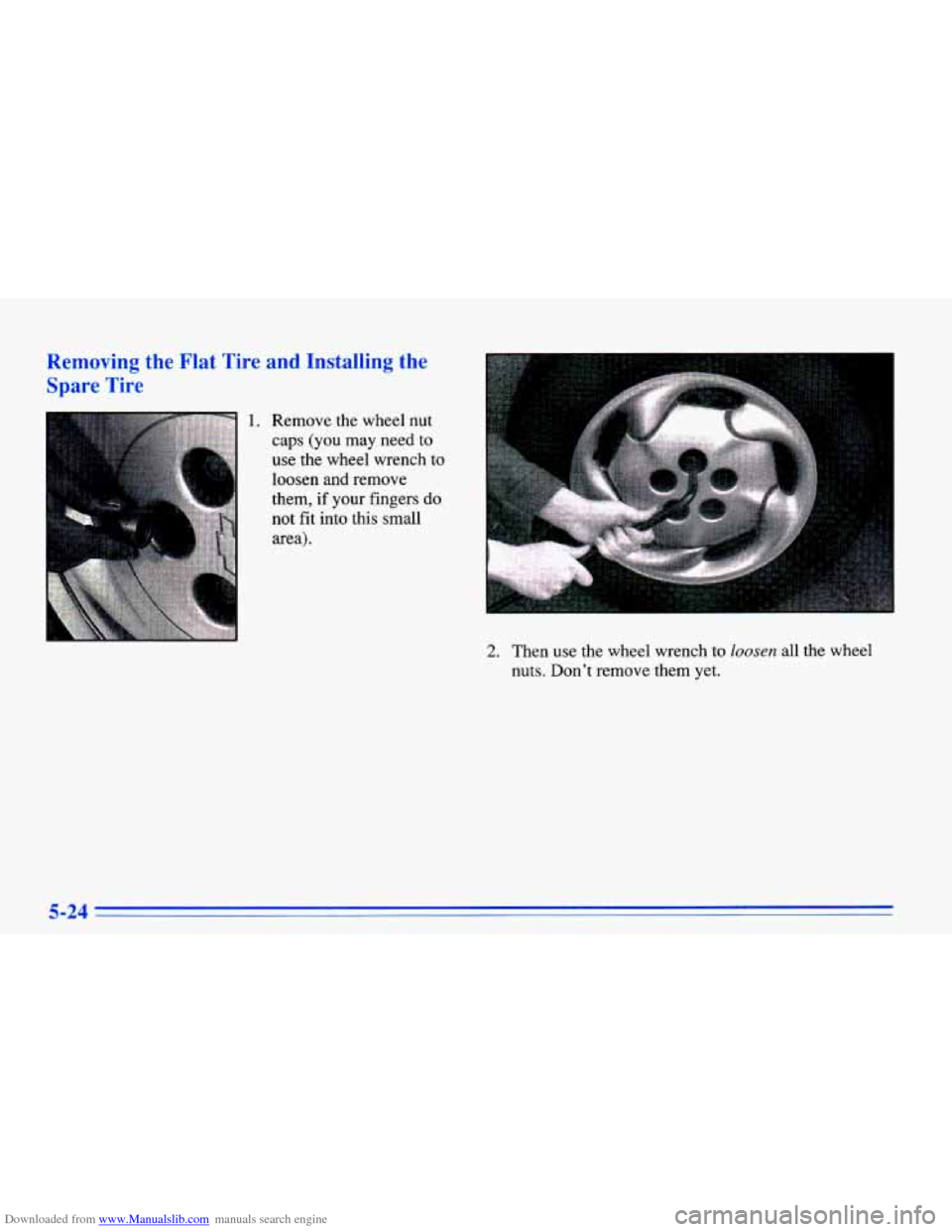
Remove the wheel nut caps (you may need to
use the wheel wrench to
loosen and remove
them,
if your fingers do
not fit into this small
area).
2. Then use the wheel wrench to loosen all the wheel
nuts. Don’t remove them yet.
L 3A
Page 229 of 372
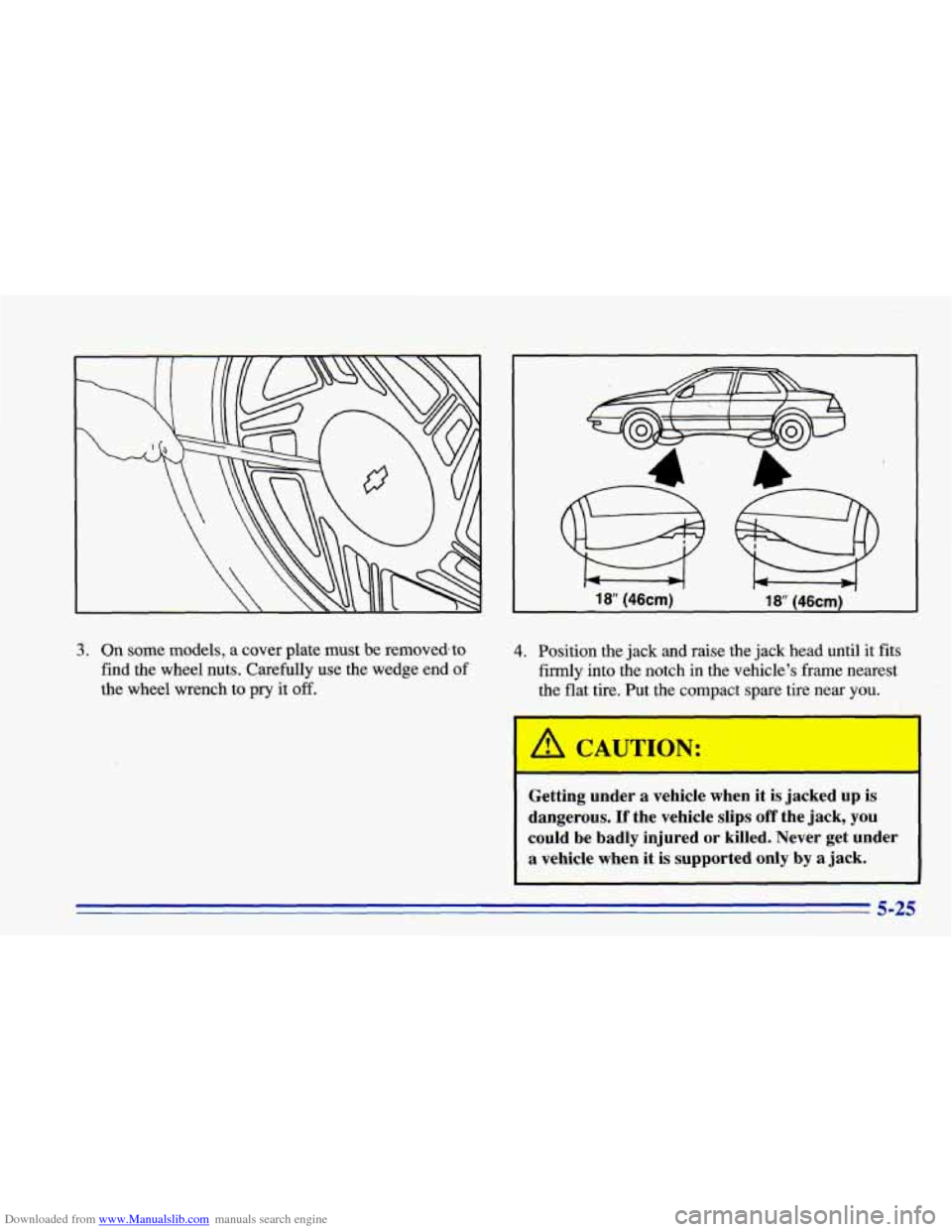
Downloaded from www.Manualslib.com manuals search engine 3. On some models, a cover plate must be removedbto
find the wheel nuts. Carefully use the wedge end of
the wheel wrench to
pry it off.
1-1
18” (46cm) 18” (46cm)
4. Position the jack and raise the jack head until it fits
firmly into the notch in the vehicle’s frame nearest
the flat tire. Put the compact sparc *re
1 LT you.
1
Getting under a vehicle when it is jacked up is
dangerous. If the vehicle slips off the jack, you
could be badly injured or killed. Never get under
a vehicle when it is supported only by a jack.
I I
5-25
Page 230 of 372
Downloaded from www.Manualslib.com manuals search engine I NOTICE:
I I
Raising your vehicle with the jack improperly
positioned will damage the vehicle or may allow
the vehicle to fall off the jack. Be sure to fit the
jack lift head into the proper location before
raising your vehicle.
Do not jack or lift the vehicle using the oil pan.
Pans could crack and begin to leak fluid.
1
A
n
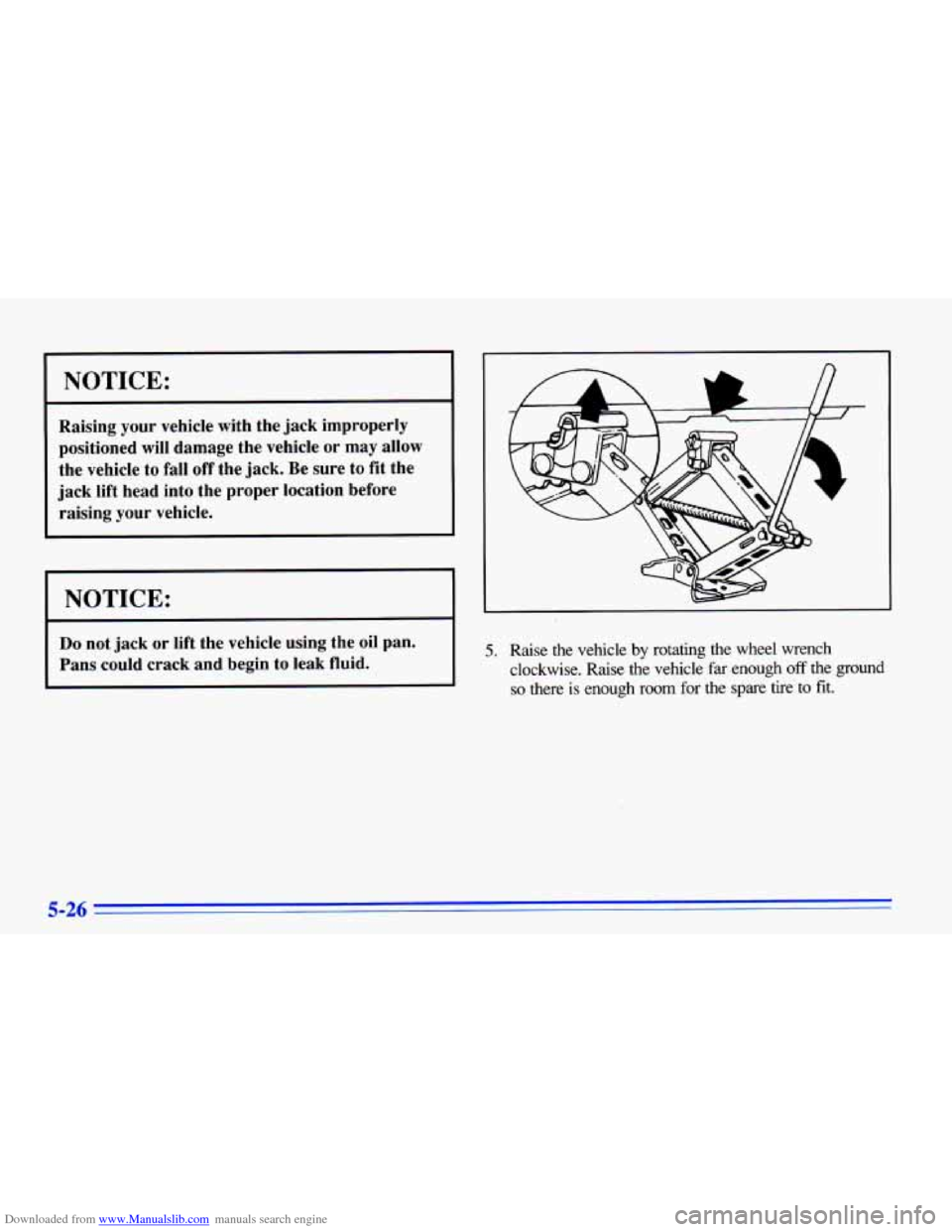
5. Raise the vehicle by rotating the wheel wrench
clockwise. Raise the vehicle far enough
off the ground
so there is enough room for the spare tire to fit.
5-26
Page 231 of 372
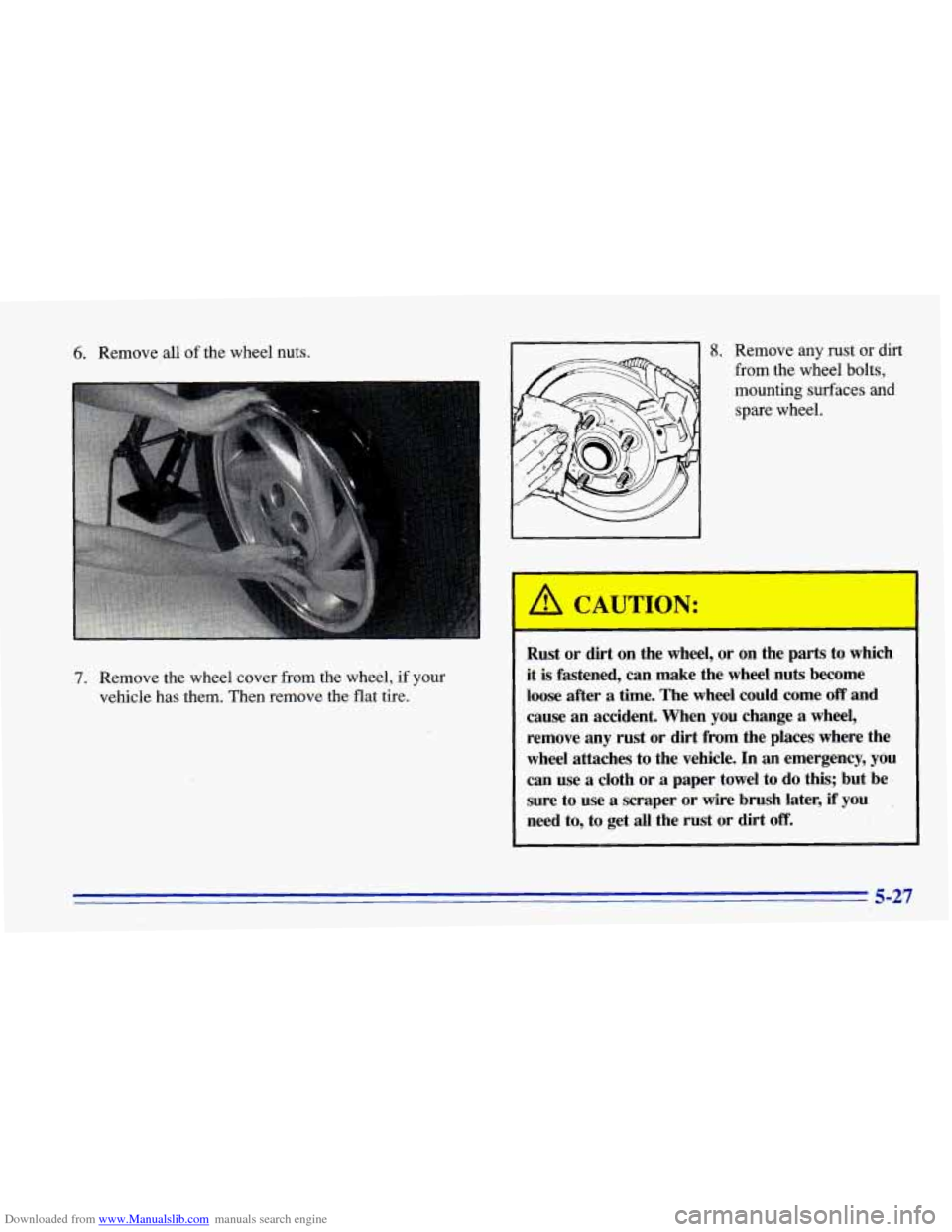
Downloaded from www.Manualslib.com manuals search engine 6. Remove all of the wheel nuts.
7. Remove the wheel cover from the wheel, if your
vehicle has them. Then remove the flat tire.
8. Remove any rust or dirt
from the wheel bolts,
mounting surfaces and spare wheel.
A CAUTION:
I- -
Rust or dirt on the wheel, or on the parts to which
it is fastened, can make the wheel nuts become
loose after
a time. The wheel could come off and
cause an accident. When you change
a wheel,
remove any rust or dirt from the places where the
wheel attaches to the vehicle. In an emergency, you
can use
a cloth or a paper towel to do this; but be
sure to use
a scraper or wire brush later, if you
need to, to get
all the rust or dirt off.
5-27
Page 232 of 372
Downloaded from www.Manualslib.com manuals search engine Never use oil or grease on stud! r nuts. If you
do, the nuts might come loose. Your wheel could
fall off, causing a serious accident.
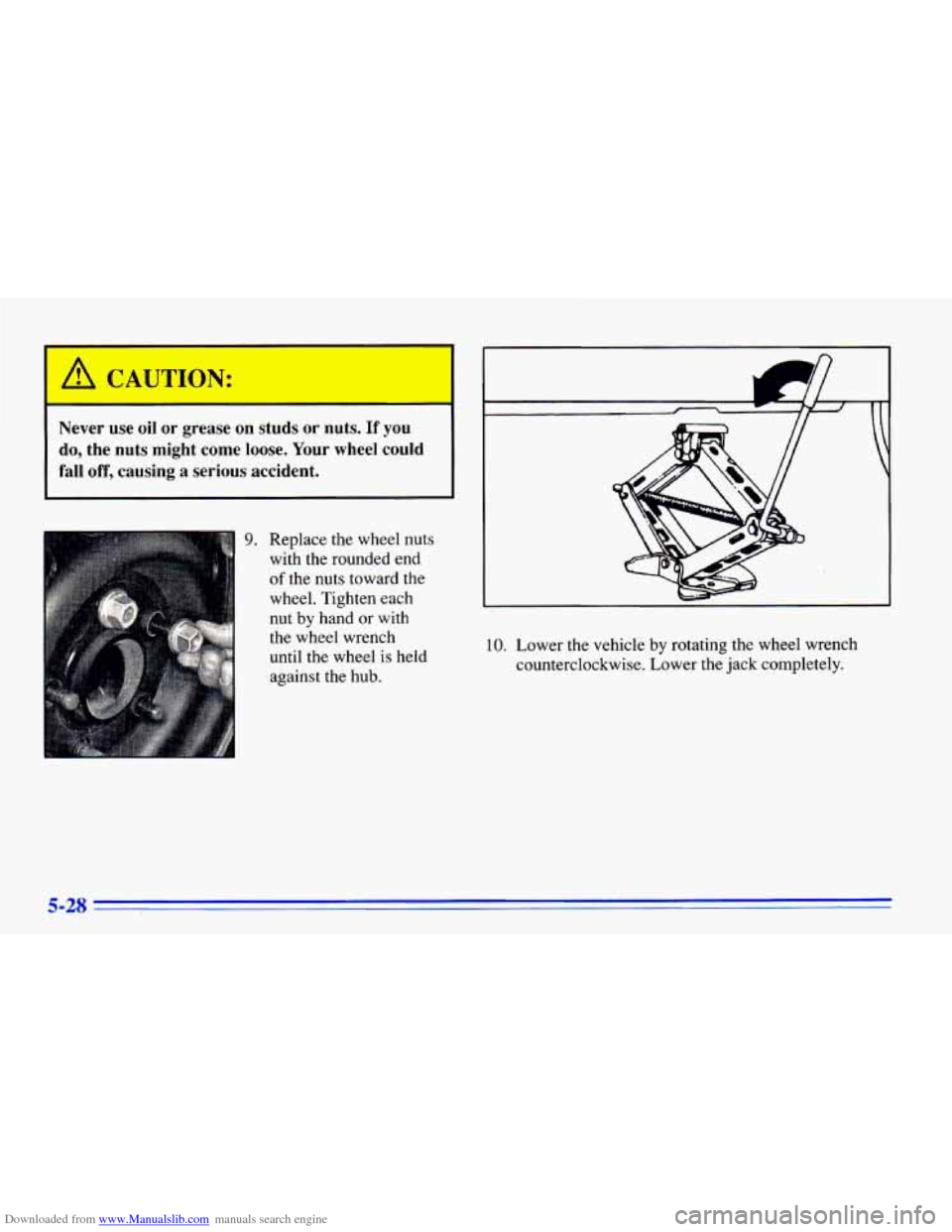
Replace the wheel nuts
with the rounded end
of the nuts toward the
wheel. Tighten each
nut by hand or with
the wheel wrench
until the wheel is held
against the hub.
10. Lower the vehicle by rotating the wheel wrench
counterclockwise. Lower the jack completely.
Page 233 of 372
Downloaded from www.Manualslib.com manuals search engine A CAU [ON:
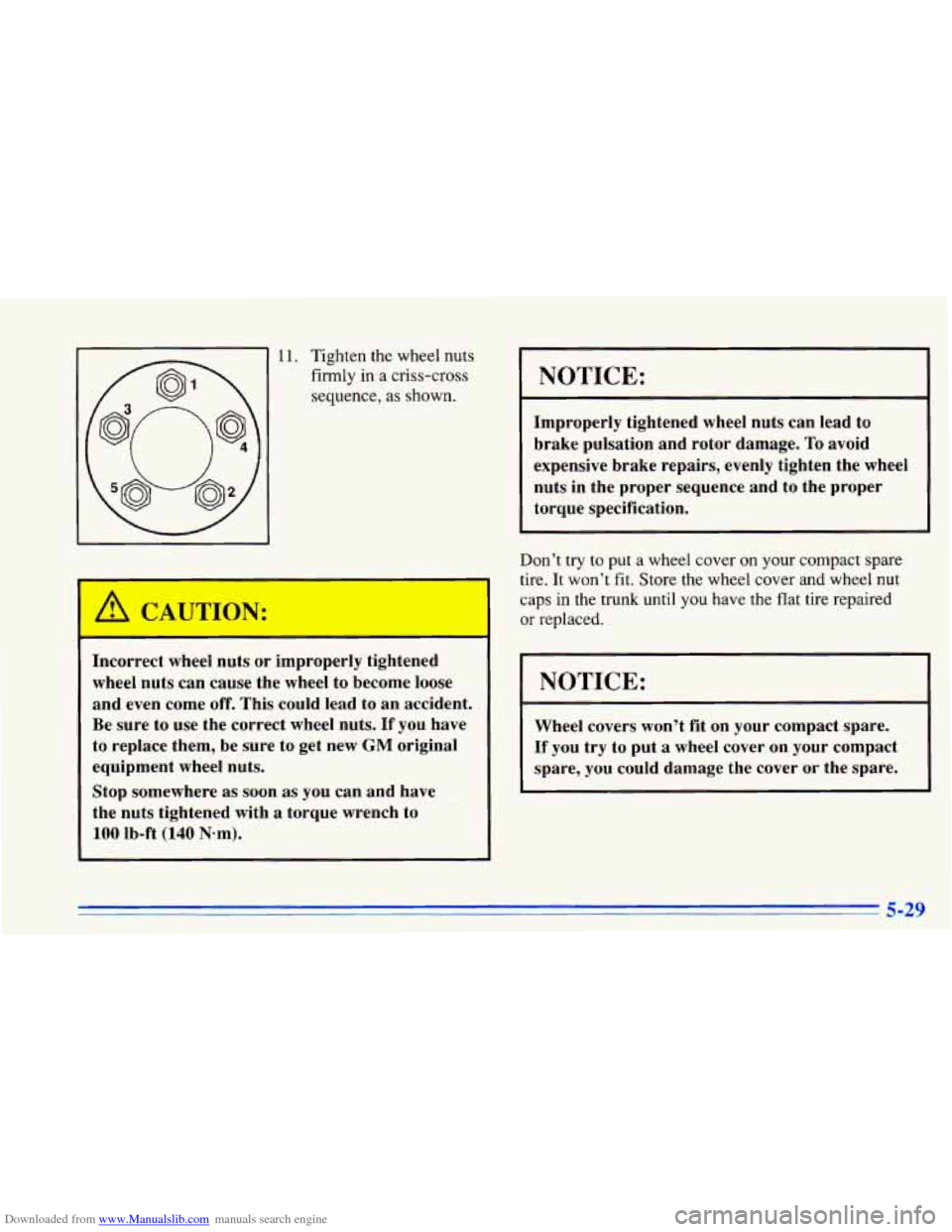
11. Tighten the wheel nuts firmly in a criss-cross
sequence,
as shown.
Incorrect wheel nuts or improperly tightened
wheel nuts can cause the wheel to become loose
and even come off. This could lead to an accident.
Be sure to use the correct wheel nuts. If you have
to replace them, be sure to get new
GM original
equipment wheel nuts.
Stop somewhere as soon
as you can and have
the nuts tightened with
a torque wrench to
100 Ib-ft (140 N-m).
NOTICE:
Improperly tightened wheel nuts can lead to
brake pulsation and rotor damage.
To avoid
expensive brake repairs, evenly tighten the wheel
nuts in the proper sequence and to the proper
torque specification.
Don’t try to put a wheel cover on your compact spare
tire. It won’t fit. Store the wheel cover and wheel
nut
caps in the trunk until you have the flat tire repaired
or replaced.
NOTICE:
Wheel covers won’t fit on your compact spare.
If you try to put a wheel cover on your compact
spare,
you could damage the cover or the spare.
5-29
Page 234 of 372
Downloaded from www.Manualslib.com manuals search engine Storing the Flat Tire and Tools
A CAUTION:
Storing a jack, a tire or other equipment in the
passenger compartment
of the vehicle could
cause injury. In a sudden
stop or colli.sion, loose
equipment could strike someone. Store all these in the proper place.
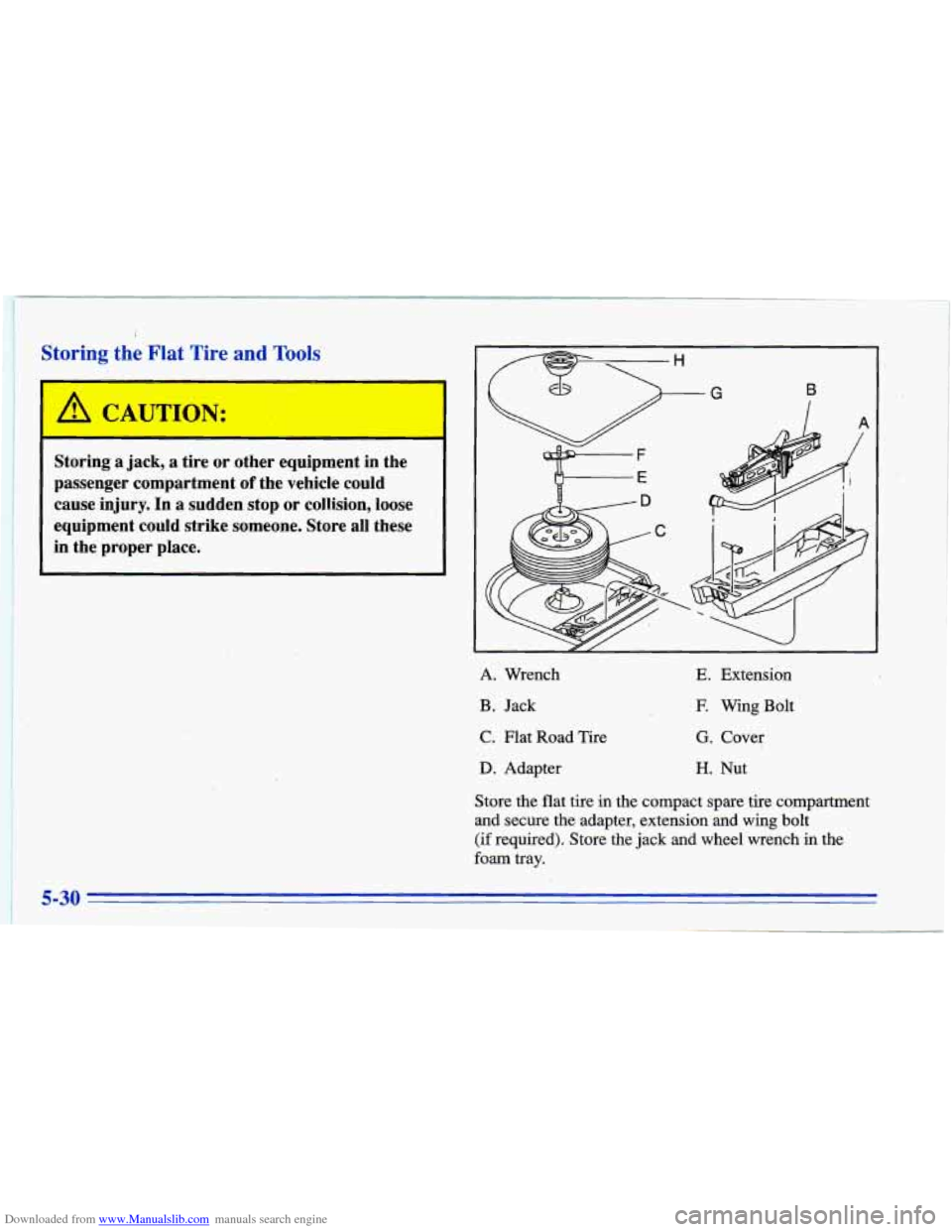
A. Wrench E. Extension
B. Jack E Wing Bolt
C. Flat Road Tire G. Cover
D. Adapter H. Nut
Store the flat tire in the compact spare tire compartment
and secure the adapter, extension and wing bolt
(if required). Store the jack and wheel wrench in the
foam tray.
5-30
Page 236 of 372
Downloaded from www.Manualslib.com manuals search engine Compact Spare Tire
Although the compact spare tire was fully inflated
when your vehicle was new, it can lose air after a time.
Check the inflation pressure regularly.
It should be
60 psi (420 ea).
After installing the compact spare
on your vehicle, you
should stop as soon as possible and make sure your
spare tire is correctly inflated. The compact spare is
made to perform well at posted speed limits for
distances up to
3,000 miles (5 000 km), so you can
finish your trip and have your full-size tire repaired or
replaced where you want.
Of course, it’s best to replace
your spare with a full-size tire
as soon as you can. Your
spare will last longer and be in good shape in case you
need it again.
NOTICE:
When the compact spare is installed, don’t take
your vehicle through an automatic
car wash with
guide rails. The compact spare can get caught on
the rails. That can damage the tire and wheel,
and maybe other parts
of your vehicle.
Don’t use your compact spare
on other vehicles.
And don’t mix your compact spare tire or wheel with
other wheels or tires. They won’t fit. Keep your spare
tire and its wheel together.
I NOTICE:
Tire chains won’t fit your compact spare. Using
them can damage your vehicle and can damage
the chains
too. Don’t use tire chains on your
compact spare.
5-32
Page 237 of 372
Downloaded from www.Manualslib.com manuals search engine If You’re Stuck: In Sand, Mud,
Ice or
Snow
What you don’t want to do when your vehicle is stuck is
to spin your wheels too fast. The method known as
“rocking” can help you get out when you’re
stuck, but
you
rr t use caution.
If you let your tires spin at high speed, they can
explode, and you or others could be injured. And,
the transaxle or other parts
of the vehicle can
overheat.
That could cause an engine
compartment fire or other damage. When you’re
stuck, spin the wheels as little
as possible. Don’t
spin the wheels above
35 mph (55 kdh) as shown
on the speedometer.
NOTICE:
Spinning your wheels can destroy parts of your
vehicle as well
as the tires. If you spin the wheels
too fast while shifting your transaxle back and
forth,
you can destroy your transaxle.
For information about using tire chains on your vehicle,
see “Tire Chains” in the Index.
Rocking your, vehicle to get it out:
First, turn your steering wheel left and right. That will
clear the area around your front wheels. Then shift back
and forth between REVERSE
(R) and a forward gear (or
with a manual transaxle, between
mRST (1) or
SECOND
(2) and REVERSE (R)), spinning the wheels
as little as possible. (If your vehicle has the Enhanced
Traction System, shift back and forth between
REVERSE
(R) and FIRST (1) or SECOND (2),
spinning the wheels as little as possible.) Release the
,accelerator pedal while you shift, and press lightly on
the accelerator pedal when the transaxle is in gear. If
that doesn’t get you out after a few tries, you may need
to be towed out. If you do need to be towed out, see
“Towing
Your Vehicle” in the Index.
5-33
Page 268 of 372
Downloaded from www.Manualslib.com manuals search engine Brake Wear
Your Chevrolet has front disc brakes and rear
drum brakes.
Disc brake pads have built-in wear indicators that make a
high-pitched warning sound when the brake pads are
worn and new pads
are needed. The sound may come and
go or be heard all the time your vehicle is moving (except
when you
are pushing on the brake pedal fiily).
L
The brake wear warning sound means that
sooner or later your brakes won’t work well.
That could lead to an accident. When you hear
the brake wear warning sound, have your
vehicle serviced.
NOTICE:
Continuing to drive with worn-out brake pads
could result in costly brake repair.
Some driving conditions or climates may cause a brake
squeal when the brakes are first applied or lightly
applied. This does not mean something is wrong with
your brakes.
Free movement of brake calipers and properly torqued
wheel nuts are necessary to help prevent brake
pulsation.
When tires are rotated, inspect brake calipers
for movement, brake pads for wear, and evenly torque
wheel nuts in proper sequence to
GM specifications.
Your rear drum brakes don’t have wear indicators, but if
you ever hear a rear brake rubbing noise, have the rear
brake linings inspected. Also, the rear brake drums
should be removed and inspected each time the tires are
removed for rotation
or changing. When you have the
front brakes replaced, have the rear brakes inspected, too.
Brake linings should always be replaced
as complete
axle sets.
6-30