ECU CHEVROLET CITY EXPRESS 2018 Owner's Guide
[x] Cancel search | Manufacturer: CHEVROLET, Model Year: 2018, Model line: CITY EXPRESS, Model: CHEVROLET CITY EXPRESS 2018Pages: 287, PDF Size: 4.19 MB
Page 90 of 287
Chevrolet City Express Owner Manual (GMNA-Localizing-U.S./Canada-
11683523) - 2018 - CRC - 7/10/17
Instruments and Controls 89
Here are four things that some
owners ask about. None of these
show a problem with the fuel gauge:
.At the service station, the gas
pump shuts off before the gauge
reads full.
. It takes a little more or less fuel
to fill up than the gauge
indicated. For example, the
gauge may have indicated the
tank was half full, but it actually
took a little more or less than
half the tank's capacity to fill
the tank.
. The indicator moves a little when
turning a corner or speeding up.
. The gauge goes back to empty
when the ignition is turned off.
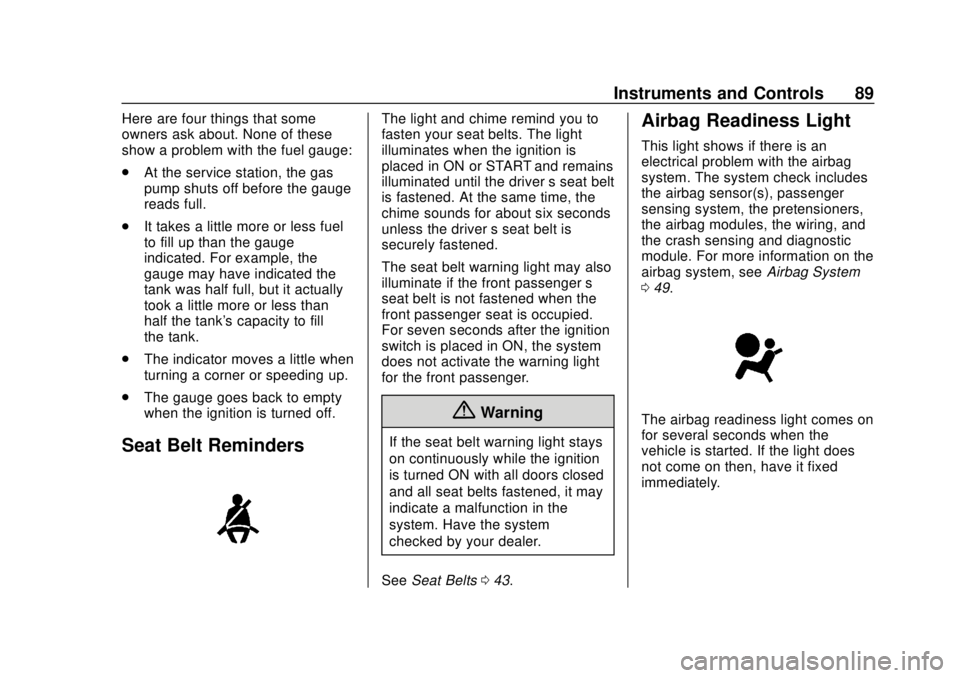
Seat Belt Reminders
The light and chime remind you to
fasten your seat belts. The light
illuminates when the ignition is
placed in ON or START and remains
illuminated until the driver ’s seat belt
is fastened. At the same time, the
chime sounds for about six seconds
unless the driver ’s seat belt is
securely fastened.
The seat belt warning light may also
illuminate if the front passenger ’s
seat belt is not fastened when the
front passenger seat is occupied.
For seven seconds after the ignition
switch is placed in ON, the system
does not activate the warning light
for the front passenger.
{Warning
If the seat belt warning light stays
on continuously while the ignition
is turned ON with all doors closed
and all seat belts fastened, it may
indicate a malfunction in the
system. Have the system
checked by your dealer.
See Seat Belts 043.
Airbag Readiness Light
This light shows if there is an
electrical problem with the airbag
system. The system check includes
the airbag sensor(s), passenger
sensing system, the pretensioners,
the airbag modules, the wiring, and
the crash sensing and diagnostic
module. For more information on the
airbag system, see Airbag System
0 49.
The airbag readiness light comes on
for several seconds when the
vehicle is started. If the light does
not come on then, have it fixed
immediately.
Page 98 of 287
Chevrolet City Express Owner Manual (GMNA-Localizing-U.S./Canada-
11683523) - 2018 - CRC - 7/10/17
Instruments and Controls 97
Stop as soon as possible, and
inflate the tires to the pressure value
shown on the Tire and Loading
Information label. SeeTire Pressure
0 208.
When the Light Flashes First and
Then Is On Steady
If the light flashes for about a minute
and then stays on, there may be a
problem with the TPMS. If the
problem is not corrected, the light
will come on at every ignition cycle.
See Tire Pressure Monitor
Operation 0211.
Engine Oil Pressure Light
Caution
Lack of proper engine oil
maintenance can damage the
engine. Driving with the engine oil
low can also damage the engine.
The repairs would not be covered
by the vehicle warranty. Check
the oil level as soon as possible.
Add oil if required, but if the oil
(Continued)
Caution (Continued)
level is within the operating range
and the oil pressure is still low,
have the vehicle serviced. Always
follow the maintenance schedule
for changing engine oil.
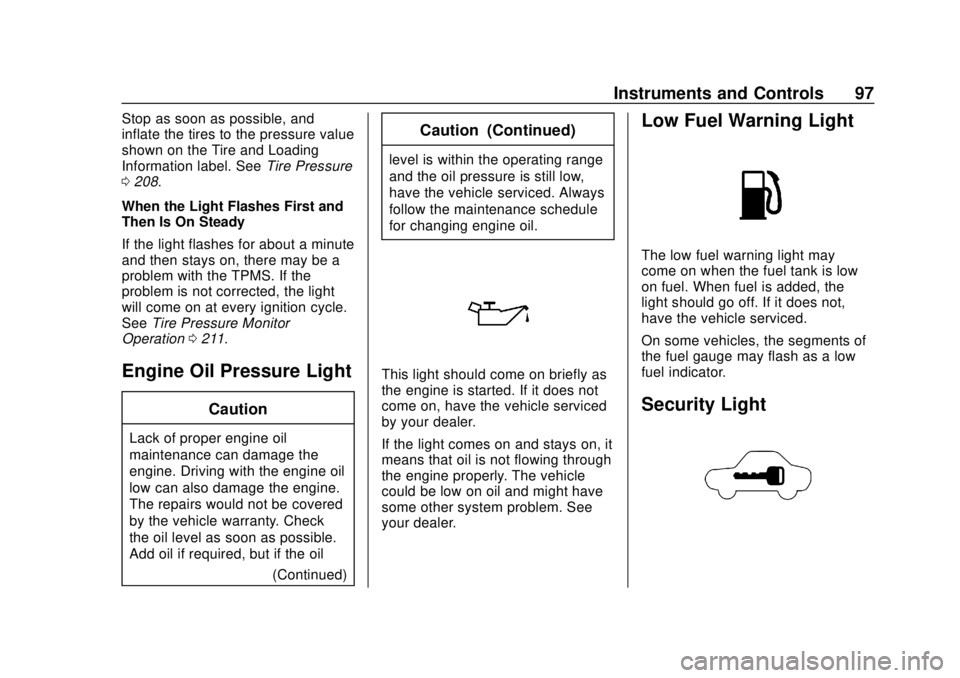
This light should come on briefly as
the engine is started. If it does not
come on, have the vehicle serviced
by your dealer.
If the light comes on and stays on, it
means that oil is not flowing through
the engine properly. The vehicle
could be low on oil and might have
some other system problem. See
your dealer.
Low Fuel Warning Light
The low fuel warning light may
come on when the fuel tank is low
on fuel. When fuel is added, the
light should go off. If it does not,
have the vehicle serviced.
On some vehicles, the segments of
the fuel gauge may flash as a low
fuel indicator.
Security Light
Page 99 of 287
Chevrolet City Express Owner Manual (GMNA-Localizing-U.S./Canada-
11683523) - 2018 - CRC - 7/10/17
98 Instruments and Controls
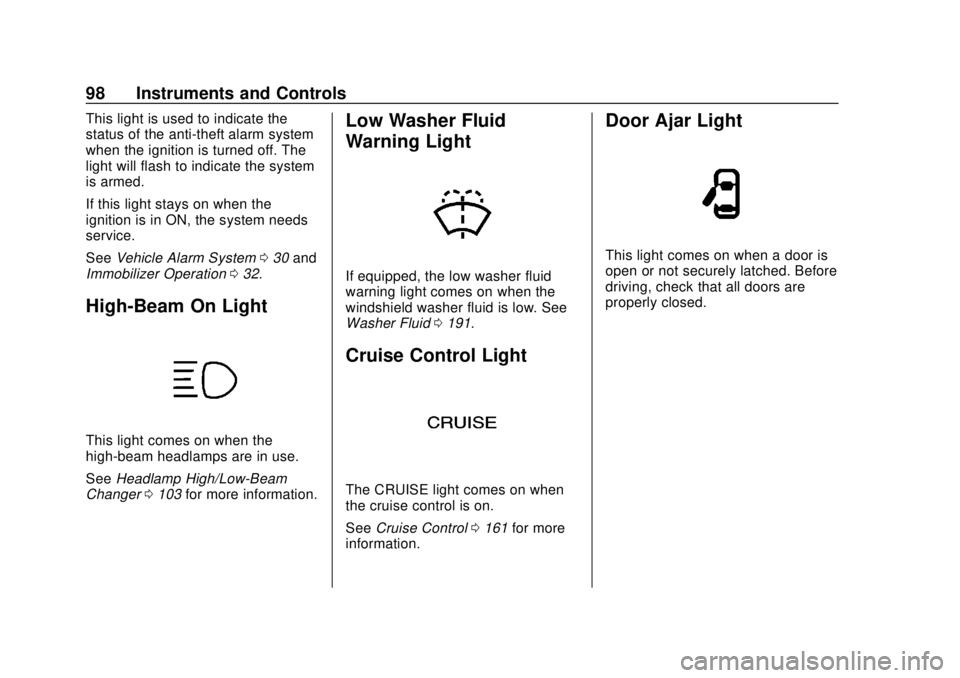
This light is used to indicate the
status of the anti-theft alarm system
when the ignition is turned off. The
light will flash to indicate the system
is armed.
If this light stays on when the
ignition is in ON, the system needs
service.
SeeVehicle Alarm System 030 and
Immobilizer Operation 032.
High-Beam On Light
This light comes on when the
high-beam headlamps are in use.
See Headlamp High/Low-Beam
Changer 0103 for more information.
Low Washer Fluid
Warning Light
If equipped, the low washer fluid
warning light comes on when the
windshield washer fluid is low. See
Washer Fluid 0191.
Cruise Control Light
The CRUISE light comes on when
the cruise control is on.
See Cruise Control 0161 for more
information.
Door Ajar Light
This light comes on when a door is
open or not securely latched. Before
driving, check that all doors are
properly closed.
Page 145 of 287
Chevrolet City Express Owner Manual (GMNA-Localizing-U.S./Canada-
11683523) - 2018 - CRC - 7/10/17
144 Driving and Operating
Using heavier suspension
components to get added
durability might not change the
weight ratings. Ask your dealer
to help load the vehicle properly.
{Warning
Things inside the vehicle can
strike and injure people in a
sudden stop or turn, or in a
crash.
.Put things in the cargo
area of the vehicle. In the
cargo area, put them as
far forward as possible.
Try to spread the weight
evenly.
.Never stack heavier
things, like suitcases,
inside the vehicle so that
some of them are above
the tops of the seats.
(Continued)
Warning (Continued)
.Do not leave an
unsecured child restraint
in the vehicle.
.Secure loose items in the
vehicle.
.Do not leave a seat
folded down unless
needed.
Also, check the tires for proper
inflation pressure. Refer to the Tire
and Loading Information label.
Starting and
Operating
New Vehicle Break-In
Caution
The vehicle does not need an
elaborate break-in. But it will
perform better in the long run if
you follow these guidelines for the
first 2 000 km (1,200 mi): . Do not drive at any one
constant speed, fast or slow.
. Avoid quick starts. Avoid
accelerating at full-throttle in
any gear. Do not exceed
4000 rpm.
. Avoid downshifting to brake
or slow the vehicle.
. Avoid making hard stops.
During this time the new
brake linings are not yet
broken in. Hard stops with
new linings can mean
(Continued)
Page 149 of 287
Chevrolet City Express Owner Manual (GMNA-Localizing-U.S./Canada-
11683523) - 2018 - CRC - 7/10/17
148 Driving and Operating
3. Clean and dry the heater cordand connector ends. Check the
heater cord for damage. If it is
damaged, do not use it. See
your dealer for a replacement.
Inspect the cord for damage
yearly.
4. Plug it into a normal, grounded 110-volt AC outlet.
5. The engine coolant heater must be plugged in for two to
four hours to properly warm the
engine, depending on exterior
temperatures.
{Warning
Improper use of the heater cord
or an extension cord can damage
the cord and may result in
overheating and fire.
. Plug the cord into a
three-prong electrical utility
receptacle that is protected
by a ground fault detection
(Continued)
Warning (Continued)
function. An ungrounded
outlet could cause an
electric shock.
. Use a weatherproof,
heavy-duty, 15 amp-rated
extension cord if needed.
Failure to use the
recommended extension
cord in good operating
condition, or using a
damaged heater or
extension cord, could make
it overheat and cause a fire,
property damage, electric
shock, and injury.
. Do not operate the vehicle
with the heater cord
permanently attached to the
(Continued)
Warning (Continued)
vehicle. Possible heater
cord and thermostat
damage could occur.
. While in use, do not let the
heater cord touch vehicle
parts or sharp edges. Never
close the hood on the
heater cord.
. Before starting the vehicle,
unplug the cord, reattach
the cover to the plug, and
securely fasten the cord.
Keep the cord away from
any moving parts.
6. Before starting the engine, be sure to unplug and store the
cord as it was before to keep it
away from moving engine
parts, and to prevent damage.
Page 165 of 287
Chevrolet City Express Owner Manual (GMNA-Localizing-U.S./Canada-
11683523) - 2018 - CRC - 7/10/17
164 Driving and Operating
Warning (Continued)
.The system is designed as
an aid to the driver in
showing large stationary
objects directly behind the
vehicle, to help avoid
damaging the vehicle.
. The system cannot
completely eliminate blind
spots and may not show
every object.
. Underneath the bumper and
the corner areas of the
bumper cannot be viewed
on the RVC display because
of its monitoring range
limitation. The system will
not show small objects
below the bumper, and may
not show objects close to
the bumper or on the
ground.
(Continued)
Warning (Continued)
.Objects viewed on the RVC
display differ from actual
distance because a
wide-angle lens is used.
. Objects on the RVC display
will appear visually opposite
than when viewed in the
rearview and outside
mirrors.
. Make sure that the back
doors are securely closed
when backing up.
. Do no put anything on the
rearview camera. The
rearview camera is installed
on the back door.
. When washing the vehicle
with high pressure water, be
sure not to spray it around
the camera. Otherwise,
water may enter the camera
unit causing water
(Continued)
Warning (Continued)
condensation on the lens, a
malfunction, fire, or an
electric shock.
. Do not strike the camera.
It is a precision instrument.
Otherwise, it may
malfunction or cause
damage resulting in a fire or
an electric shock.
Caution
There is a plastic cover over the
camera. Do not scratch the cover
when cleaning dirt or snow from
the cover.
Page 173 of 287
Chevrolet City Express Owner Manual (GMNA-Localizing-U.S./Canada-
11683523) - 2018 - CRC - 7/10/17
172 Driving and Operating
Filling the Tank
{Warning
Fuel vapors and fuel fires burn
violently and can cause injury or
death.. To help avoid injuries to you
and others, read and follow
all the instructions on the
fuel pump island.
. Turn off the engine when
refueling.
. Keep sparks, flames, and
smoking materials away
from fuel.
. Do not leave the fuel pump
unattended.
. Do not use a cell phone
while refueling.
. Do not re-enter the vehicle
while pumping fuel.
. Keep children away from
the fuel pump and never let
children pump fuel.
(Continued)
Warning (Continued)
.Fuel can spray out if the fuel
cap is opened too quickly.
This spray can happen if the
tank is nearly full, and is
more likely in hot weather.
Open the fuel cap slowly
and wait for any hiss noise
to stop, then unscrew the
cap all the way.
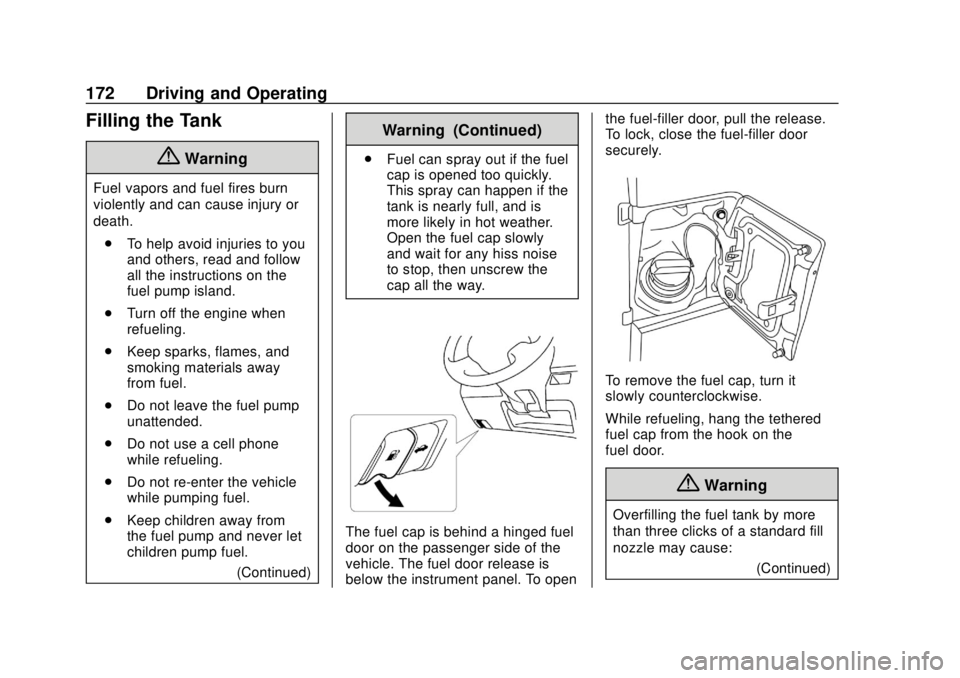
The fuel cap is behind a hinged fuel
door on the passenger side of the
vehicle. The fuel door release is
below the instrument panel. To open the fuel-filler door, pull the release.
To lock, close the fuel-filler door
securely.
To remove the fuel cap, turn it
slowly counterclockwise.
While refueling, hang the tethered
fuel cap from the hook on the
fuel door.
{Warning
Overfilling the fuel tank by more
than three clicks of a standard fill
nozzle may cause:
(Continued)
Page 181 of 287
Chevrolet City Express Owner Manual (GMNA-Localizing-U.S./Canada-
11683523) - 2018 - CRC - 7/10/17
180 Vehicle Care
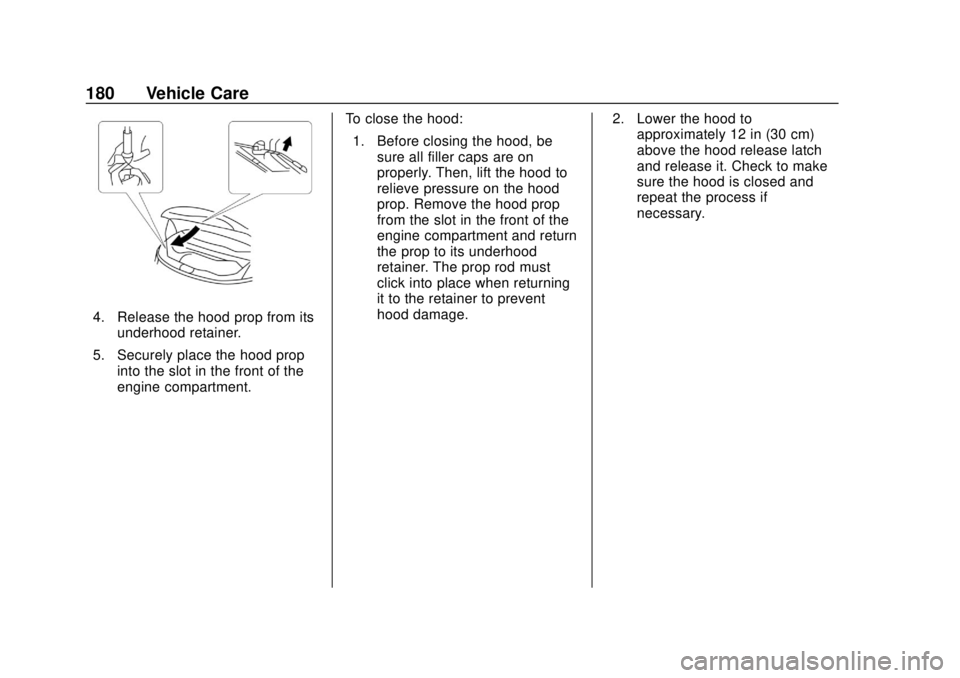
4. Release the hood prop from itsunderhood retainer.
5. Securely place the hood prop into the slot in the front of the
engine compartment. To close the hood:
1. Before closing the hood, be sure all filler caps are on
properly. Then, lift the hood to
relieve pressure on the hood
prop. Remove the hood prop
from the slot in the front of the
engine compartment and return
the prop to its underhood
retainer. The prop rod must
click into place when returning
it to the retainer to prevent
hood damage. 2. Lower the hood to
approximately 12 in (30 cm)
above the hood release latch
and release it. Check to make
sure the hood is closed and
repeat the process if
necessary.
Page 197 of 287
Chevrolet City Express Owner Manual (GMNA-Localizing-U.S./Canada-
11683523) - 2018 - CRC - 7/10/17
196 Vehicle Care
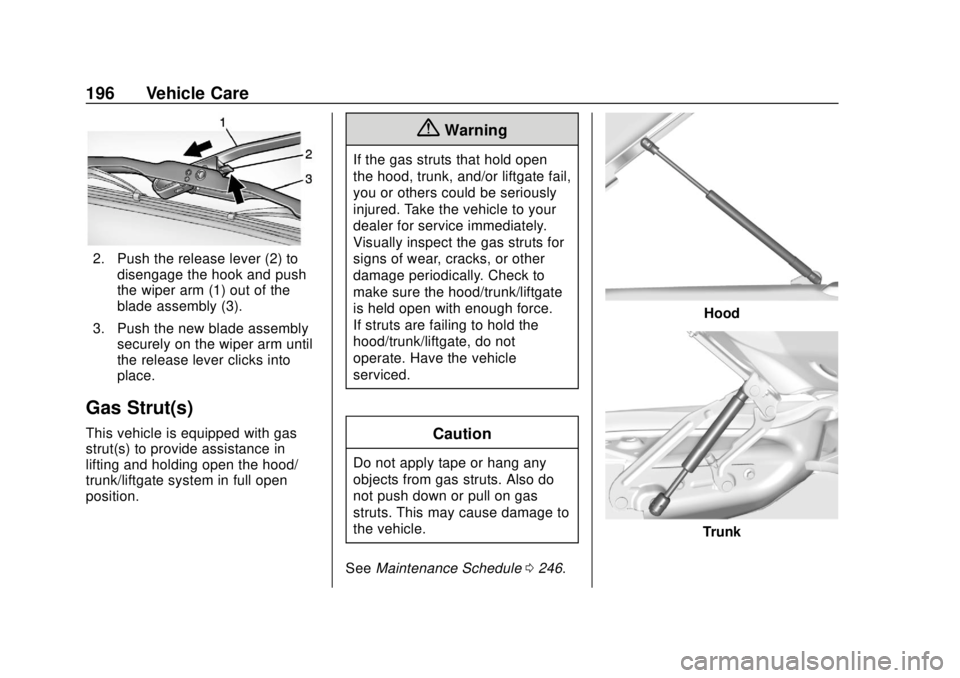
2. Push the release lever (2) todisengage the hook and push
the wiper arm (1) out of the
blade assembly (3).
3. Push the new blade assembly securely on the wiper arm until
the release lever clicks into
place.
Gas Strut(s)
This vehicle is equipped with gas
strut(s) to provide assistance in
lifting and holding open the hood/
trunk/liftgate system in full open
position.
{Warning
If the gas struts that hold open
the hood, trunk, and/or liftgate fail,
you or others could be seriously
injured. Take the vehicle to your
dealer for service immediately.
Visually inspect the gas struts for
signs of wear, cracks, or other
damage periodically. Check to
make sure the hood/trunk/liftgate
is held open with enough force.
If struts are failing to hold the
hood/trunk/liftgate, do not
operate. Have the vehicle
serviced.
Caution
Do not apply tape or hang any
objects from gas struts. Also do
not push down or pull on gas
struts. This may cause damage to
the vehicle.
See Maintenance Schedule 0246.
Hood
Trunk
Page 232 of 287
Chevrolet City Express Owner Manual (GMNA-Localizing-U.S./Canada-
11683523) - 2018 - CRC - 7/10/17
Vehicle Care 231
Push StartingCaution
.Do not push start this
vehicle. The three-way
catalyst may be damaged.
. Continuously Variable
Transmission (CVT) models
cannot be push-started or
tow-started. Attempting to
do so may cause
transmission damage.
Towing the Vehicle
Caution
Incorrectly towing a disabled
vehicle may cause damage. The
damage would not be covered by
the vehicle warranty.
Do not lash or hook to
suspension components. Use the
proper straps around the tires to
secure the vehicle.
Use only a flatbed tow truck for
towing a disabled vehicle. Never
use a sling type lift or damage will
occur. Use ramps to help reduce
approach angles if necessary.
A towed vehicle should have its
drive wheels off the ground.
Consult a professional towing
service if the disabled vehicle must
be towed.
Caution
Improper use of the tow eye can
cause vehicle damage. Use
caution and low speeds to
prevent damage to the vehicle.
If the vehicle is equipped with tow
eye, only use the tow eye to pull the
vehicle onto a flatbed car carrier
from a flat road surface. Do not use
the tow eye to pull the vehicle from
snow, mud or sand.
Recreational Vehicle
Towing
Recreational vehicle towing means
towing the vehicle behind another
vehicle, such as behind a motor
home. The two most common types
of recreational vehicle towing are
known as dinghy towing and dolly
towing. Dinghy towing is towing the
vehicle with all four wheels on the
ground. Dolly towing is towing the
vehicle with two wheels on the
ground and two wheels up on a
device known as a dolly.