engine CHEVROLET CITY EXPRESS 2018 Service Manual
[x] Cancel search | Manufacturer: CHEVROLET, Model Year: 2018, Model line: CITY EXPRESS, Model: CHEVROLET CITY EXPRESS 2018Pages: 287, PDF Size: 4.19 MB
Page 175 of 287

Chevrolet City Express Owner Manual (GMNA-Localizing-U.S./Canada-
11683523) - 2018 - CRC - 7/10/17
174 Driving and Operating
Warning (Continued)
.Fill the container no more
than 95% full to allow for
expansion.
. Do not smoke, light
matches, or use lighters
while pumping fuel.
. Avoid using cell phones or
other electronic devices.
Trailer Towing
General Towing
Information
The vehicle is neither designed nor
intended to tow a trailer.
Conversions and
Add-Ons
Add-On Electrical
Equipment
{Warning
The Data Link Connector (DLC) is
used for vehicle service and
Emission Inspection/Maintenance
testing. See Malfunction Indicator
Lamp (Check Engine Light) 091.
A device connected to the DLC —
such as an aftermarket fleet or
driver-behavior tracking device —
may interfere with vehicle
systems. This could affect vehicle
operation and cause a crash.
Such devices may also access
information stored in the vehicle’s
systems.
Page 177 of 287
Chevrolet City Express Owner Manual (GMNA-Localizing-U.S./Canada-
11683523) - 2018 - CRC - 7/10/17
176 Vehicle Care
Vehicle Care
General Information
General Information . . . . . . . . . . 177
California Proposition65 Warning . . . . . . . . . . . . . . . . . 177
California Perchlorate Materials Requirements . . . . . 178
Accessories and Modifications . . . . . . . . . . . . . . . . 178
Vehicle Checks
Doing Your OwnService Work . . . . . . . . . . . . . . . 178
Hood . . . . . . . . . . . . . . . . . . . . . . . . . 179
Engine Compartment Overview . . . . . . . . . . . . . . . . . . . . 181
Engine Oil . . . . . . . . . . . . . . . . . . . . 182
Engine Air Cleaner/Filter . . . . . . 184
Cooling System . . . . . . . . . . . . . . 186
Engine Overheating . . . . . . . . . . 190
Overheated Engine Protection Operating Mode . . . . . . . . . . . . . 190
Washer Fluid . . . . . . . . . . . . . . . . . 191
Brakes . . . . . . . . . . . . . . . . . . . . . . . 192
Brake Fluid . . . . . . . . . . . . . . . . . . . 193
Battery - North America . . . . . . 194
Wiper Blade Replacement . . . . 195
Gas Strut(s) . . . . . . . . . . . . . . . . . . 196
Headlamp Aiming
Headlamp Aiming . . . . . . . . . . . . 197
Bulb Replacement
Bulb Replacement . . . . . . . . . . . . 197
Halogen Bulbs . . . . . . . . . . . . . . . . 197
Headlamps, Front Turn Signal and Parking Lamps . . . . . . . . . 198
Electrical System
Electrical System Overload . . . 198
Fuses and Circuit Breakers . . . 199
Engine Compartment FuseBlock . . . . . . . . . . . . . . . . . . . . . . . . 199
Instrument Panel Fuse Block . . . . . . . . . . . . . . . . . . . . . . . . 200
Wheels and Tires
Tires . . . . . . . . . . . . . . . . . . . . . . . . . . 200
All-Season Tires . . . . . . . . . . . . . . 201
Winter Tires . . . . . . . . . . . . . . . . . . 201
Summer Tires . . . . . . . . . . . . . . . . 202
All-Terrain Tires . . . . . . . . . . . . . . . 202
Tire Sidewall Labeling . . . . . . . . 202
Tire Designations . . . . . . . . . . . . . 204
Tire Terminology andDefinitions . . . . . . . . . . . . . . . . . . 206
Tire Pressure . . . . . . . . . . . . . . . . . 208
Tire Pressure Monitor System . . . . . . . . . . . . . . . . . . . . . . 210 Tire Pressure Monitor
Operation . . . . . . . . . . . . . . . . . . . 211
Tire Inspection . . . . . . . . . . . . . . . . 213
Tire Rotation . . . . . . . . . . . . . . . . . 213
When It Is Time for New Tires . . . . . . . . . . . . . . . . . . . . . . . . 214
Buying New Tires . . . . . . . . . . . . . 215
Different Size Tires and Wheels . . . . . . . . . . . . . . . . . . . . . . 216
Uniform Tire Quality Grading . . . . . . . . . . . . . . . . . . . . . 217
Wheel Alignment and Tire Balance . . . . . . . . . . . . . . . . . . . . . 218
Wheel Replacement . . . . . . . . . . 219
Tire Chains . . . . . . . . . . . . . . . . . . . 219
If a Tire Goes Flat . . . . . . . . . . . . 220
Tire Changing . . . . . . . . . . . . . . . . 221
Full-Size Spare Tire . . . . . . . . . . 226
Jump Starting
Jump Starting - North America . . . . . . . . . . . . . . . . . . . . . 227
Towing the Vehicle
Towing the Vehicle . . . . . . . . . . . 231
Recreational VehicleTowing . . . . . . . . . . . . . . . . . . . . . . 231
Page 178 of 287

Chevrolet City Express Owner Manual (GMNA-Localizing-U.S./Canada-
11683523) - 2018 - CRC - 7/10/17
Vehicle Care 177
Appearance Care
Exterior Care . . . . . . . . . . . . . . . . . 233
Interior Care . . . . . . . . . . . . . . . . . . 237
Floor Mats . . . . . . . . . . . . . . . . . . . . 240General Information
For service and parts needs, visit
your dealer. You will receive
genuine GM parts and GM-trained
and supported service people.
Genuine GM parts have one of
these marks:
California Proposition
65 Warning
{Warning
Most motor vehicles, including
this one, as well as many of its
service parts and fluids, contain
and/or emit chemicals known to
the State of California to cause
cancer and birth defects or other
reproductive harm. Engine
exhaust, many parts and
systems, many fluids, and some
component wear by-products
contain and/or emit these
chemicals. For more information
go to www.P65Warnings.ca.gov/
passenger-vehicle.
See Battery - North America 0194
and Jump Starting - North America
0 227 and the back cover.
Page 181 of 287
Chevrolet City Express Owner Manual (GMNA-Localizing-U.S./Canada-
11683523) - 2018 - CRC - 7/10/17
180 Vehicle Care
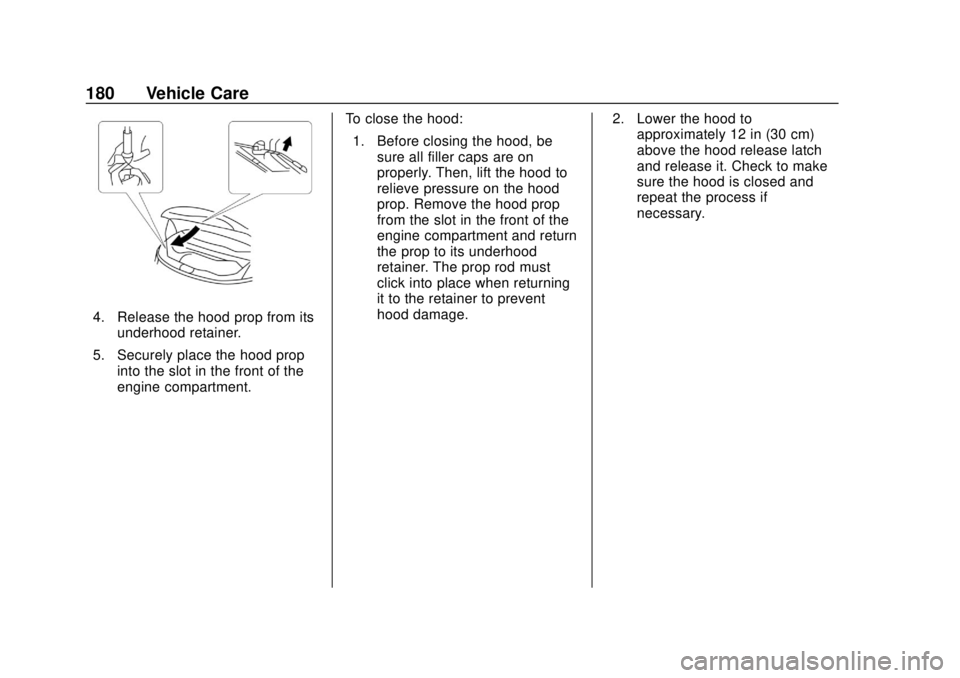
4. Release the hood prop from itsunderhood retainer.
5. Securely place the hood prop into the slot in the front of the
engine compartment. To close the hood:
1. Before closing the hood, be sure all filler caps are on
properly. Then, lift the hood to
relieve pressure on the hood
prop. Remove the hood prop
from the slot in the front of the
engine compartment and return
the prop to its underhood
retainer. The prop rod must
click into place when returning
it to the retainer to prevent
hood damage. 2. Lower the hood to
approximately 12 in (30 cm)
above the hood release latch
and release it. Check to make
sure the hood is closed and
repeat the process if
necessary.
Page 182 of 287
Chevrolet City Express Owner Manual (GMNA-Localizing-U.S./Canada-
11683523) - 2018 - CRC - 7/10/17
Vehicle Care 181
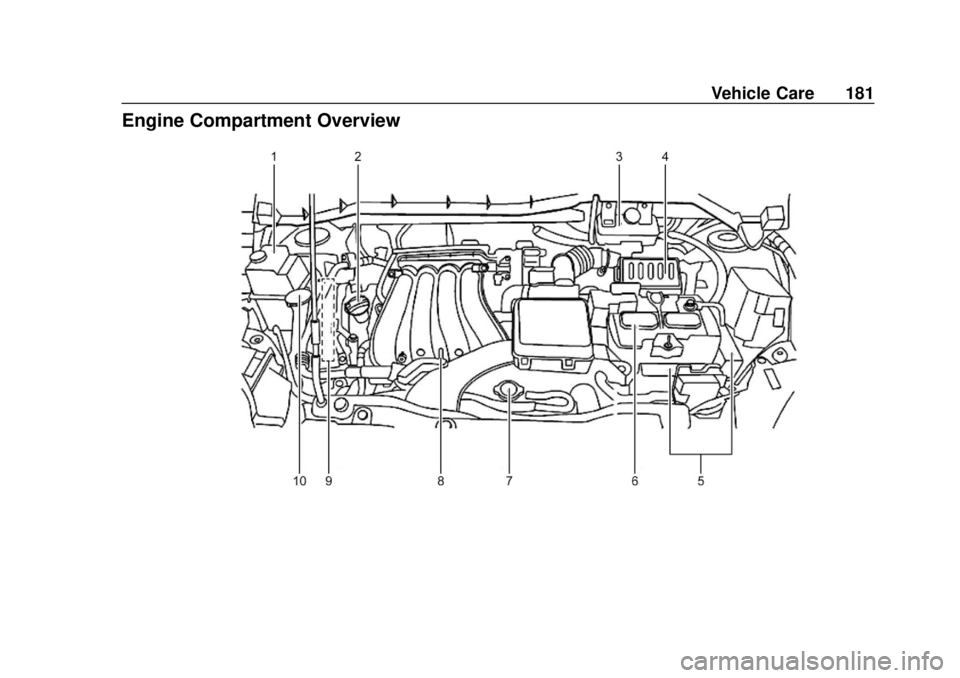
Engine Compartment Overview
Page 183 of 287
Chevrolet City Express Owner Manual (GMNA-Localizing-U.S./Canada-
11683523) - 2018 - CRC - 7/10/17
182 Vehicle Care
1. Coolant Recovery Tank. SeeCooling System 0186.
2. Engine Oil Fill Cap. See “When
to Add Engine Oil” under
Engine Oil 0182.
3. Brake Master Cylinder Reservoir. See Brake Fluid
0 193.
4. Engine Air Cleaner/Filter 0184.
5. Engine Compartment Fuse
Block 0199.
6. Battery - North America 0194.
7. Radiator Pressure Cap. See Cooling System 0186.
8. Engine Oil Dipstick. See “Checking Engine Oil” under
Engine Oil 0182.
9. Drive Belt.
10. Windshield Washer Fluid Reservoir. See “Adding Washer
Fluid” under Washer Fluid
0 191.Engine Oil
To ensure proper engine
performance and long life, careful
attention must be paid to engine oil.
Following these simple, but
important steps will help protect
your investment:
.
Use engine oil approved to the
proper specification and of the
proper viscosity grade. See
“Selecting the Right Engine Oil”
in this section.
. Check the engine oil level
regularly and maintain the
proper oil level. See “Checking
Engine Oil” and“When to Add
Engine Oil” in this section.
. Change the engine oil at the
appropriate time. See
Maintenance Schedule 0246.
. Always dispose of engine oil
properly. See “What to Do with
Used Oil” in this section.
Checking Engine Oil
Check the engine oil level regularly,
every 650 km (400 mi), especially
prior to a long trip. The engine oil
dipstick handle is a loop. See
Engine Compartment Overview
0181 for the location.
{Warning
The engine oil dipstick handle
may be hot; it could burn you.
Use a towel or glove to touch the
dipstick handle.
If a low oil Driver Information Center
(DIC) message displays, check the
oil level.
Follow these guidelines:
. To get an accurate reading, park
the vehicle on level ground.
Check the engine oil level after
the engine has been off for at
least two hours. Checking the
engine oil level on steep grades
or too soon after engine shutoff
can result in incorrect readings.
Accuracy improves when
Page 184 of 287

Chevrolet City Express Owner Manual (GMNA-Localizing-U.S./Canada-
11683523) - 2018 - CRC - 7/10/17
Vehicle Care 183
checking a cold engine prior to
starting. Remove the dipstick
and check the level.
. If unable to wait two hours, the
engine must be off for at least
15 minutes if the engine is
warm, or at least 30 minutes if
the engine is not warm. Pull out
the dipstick, wipe it with a clean
paper towel or cloth, then push it
back in all the way. Remove it
again, keeping the tip down, and
check the level.
When to Add Engine Oil
It should be between the H (High)
and L (Low) marks after the engine
has been off for at least 15 minutes,
This is the normal operating oil level
range. If the oil level is below the L (Low) mark, remove the oil filler
cap and pour recommended oil
through the opening. See
Engine
Compartment Overview 0181 for
the location of the engine oil fill cap.
Add some of the recommended oil
and then recheck the level. See
“Selecting the Right Engine Oil” in
this section for an explanation of
what kind of oil to use. For engine
oil crankcase capacity, see
Capacities and Specifications 0261.
Add enough oil to put the level
somewhere in the proper operating
range. Do not overfill. Push the
dipstick all the way back in when
through.
Caution
Do not add too much oil. Oil
levels above or below the
acceptable operating range
shown on the dipstick are harmful
to the engine. If you find that you
have an oil level above the
operating range, i.e., the engine
(Continued)
Caution (Continued)
has so much oil that the oil level
gets above the cross-hatched
area that shows the proper
operating range, the engine could
be damaged. You should drain
out the excess oil or limit driving
of the vehicle and seek a service
professional to remove the
excess amount of oil.
Selecting the Right Engine Oil
Selecting the right engine oil
depends on both the proper oil
specification and viscosity grade.
SeeRecommended Fluids and
Lubricants 0257.
Specification
Ask for and use engine oils that
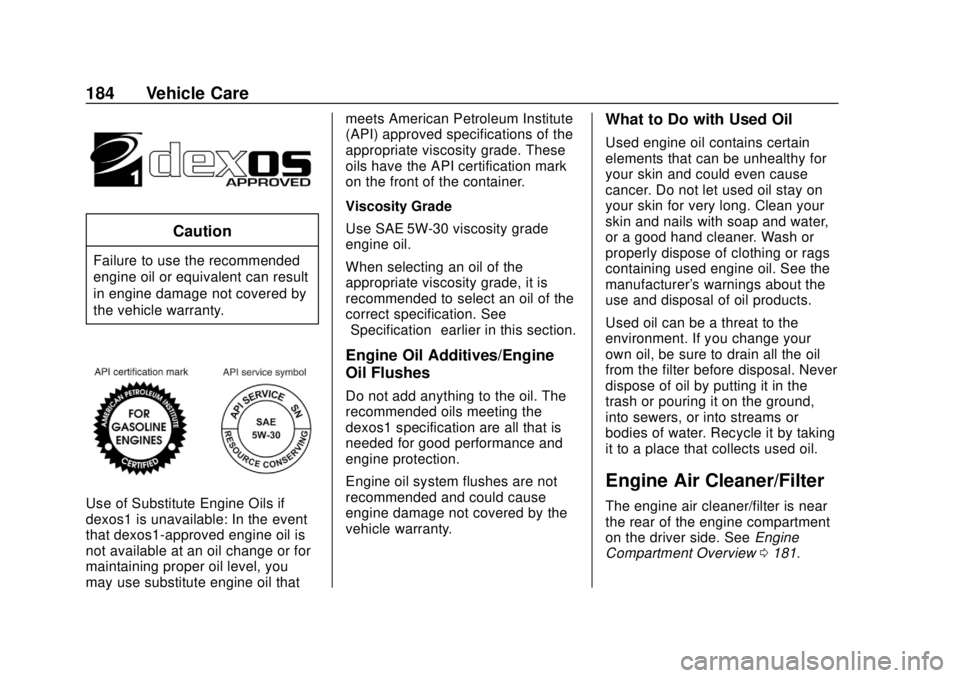
meet the dexos1™ specification.
Engine oils that have been
approved by GM as meeting the
dexos1 specification are marked
with the dexos1 approved logo. See
www.gmdexos.com.
Page 185 of 287
Chevrolet City Express Owner Manual (GMNA-Localizing-U.S./Canada-
11683523) - 2018 - CRC - 7/10/17
184 Vehicle Care
Caution
Failure to use the recommended
engine oil or equivalent can result
in engine damage not covered by
the vehicle warranty.
Use of Substitute Engine Oils if
dexos1 is unavailable: In the event
that dexos1-approved engine oil is
not available at an oil change or for
maintaining proper oil level, you
may use substitute engine oil thatmeets American Petroleum Institute
(API) approved specifications of the
appropriate viscosity grade. These
oils have the API certification mark
on the front of the container.
Viscosity Grade
Use SAE 5W-30 viscosity grade
engine oil.
When selecting an oil of the
appropriate viscosity grade, it is
recommended to select an oil of the
correct specification. See
“Specification”
earlier in this section.
Engine Oil Additives/Engine
Oil Flushes
Do not add anything to the oil. The
recommended oils meeting the
dexos1 specification are all that is
needed for good performance and
engine protection.
Engine oil system flushes are not
recommended and could cause
engine damage not covered by the
vehicle warranty.
What to Do with Used Oil
Used engine oil contains certain
elements that can be unhealthy for
your skin and could even cause
cancer. Do not let used oil stay on
your skin for very long. Clean your
skin and nails with soap and water,
or a good hand cleaner. Wash or
properly dispose of clothing or rags
containing used engine oil. See the
manufacturer's warnings about the
use and disposal of oil products.
Used oil can be a threat to the
environment. If you change your
own oil, be sure to drain all the oil
from the filter before disposal. Never
dispose of oil by putting it in the
trash or pouring it on the ground,
into sewers, or into streams or
bodies of water. Recycle it by taking
it to a place that collects used oil.
Engine Air Cleaner/Filter
The engine air cleaner/filter is near
the rear of the engine compartment
on the driver side. See Engine
Compartment Overview 0181.
Page 186 of 287

Chevrolet City Express Owner Manual (GMNA-Localizing-U.S./Canada-
11683523) - 2018 - CRC - 7/10/17
Vehicle Care 185
When to Inspect the Engine Air
Cleaner/Filter
For intervals on changing and
inspecting the engine air cleaner/
filter, seeMaintenance Schedule
0 246.
How to Inspect the Engine Air
Cleaner/Filter
Do not start the engine or have the
engine running with the engine air
cleaner/filter housing open. Before
removing the engine air cleaner/
filter, make sure that the engine air
cleaner/filter housing and nearby
components are free of dirt and
debris. Remove the engine air
cleaner/filter. Lightly tap and shake
the engine air cleaner/filter (away
from the vehicle), to release loose
dust and dirt. Inspect the engine air
cleaner/filter for damage, and
replace if damaged. Do not clean
the engine air cleaner/filter or
components with water or
compressed air. To inspect or replace the engine air
cleaner/filter:
1. Air Cleaner/Filter Cover
2. Air Cleaner/Filter Tabs (2)
1. Push the tabs (2) in at both
ends of the air cleaner/filter
cover (1).
2. Pull the air cleaner/filter cover (1) up from the air
cleaner/filter assembly.
3. Remove the air cleaner holderand filter from the engine air
cleaner/filter housing. Be
careful to dislodge as little dirt
as possible.
4. Clean the engine air cleaner/ filter housing.
5. Remove the air cleaner/filter from the air cleaner holder.
6. Inspect or replace the engine air cleaner/filter. Make sure that
the filter fits properly into the air
cleaner holder.
Page 187 of 287
Chevrolet City Express Owner Manual (GMNA-Localizing-U.S./Canada-
11683523) - 2018 - CRC - 7/10/17
186 Vehicle Care
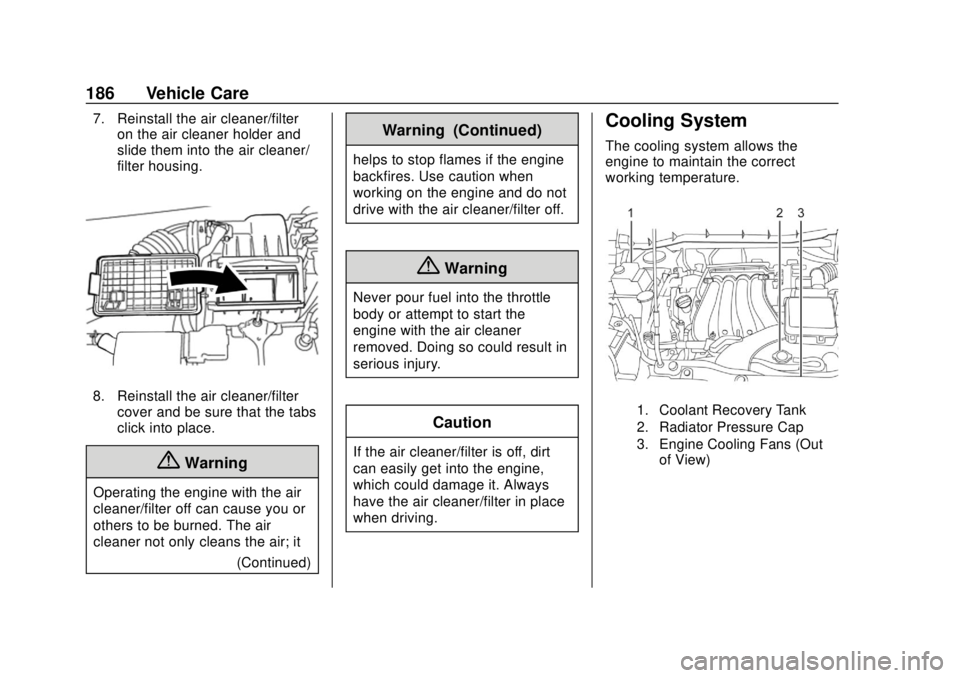
7. Reinstall the air cleaner/filteron the air cleaner holder and
slide them into the air cleaner/
filter housing.
8. Reinstall the air cleaner/filter
cover and be sure that the tabs
click into place.
{Warning
Operating the engine with the air
cleaner/filter off can cause you or
others to be burned. The air
cleaner not only cleans the air; it
(Continued)
Warning (Continued)
helps to stop flames if the engine
backfires. Use caution when
working on the engine and do not
drive with the air cleaner/filter off.
{Warning
Never pour fuel into the throttle
body or attempt to start the
engine with the air cleaner
removed. Doing so could result in
serious injury.
Caution
If the air cleaner/filter is off, dirt
can easily get into the engine,
which could damage it. Always
have the air cleaner/filter in place
when driving.
Cooling System
The cooling system allows the
engine to maintain the correct
working temperature.
1. Coolant Recovery Tank
2. Radiator Pressure Cap
3. Engine Cooling Fans (Outof View)