engine CHEVROLET CITY EXPRESS 2018 Workshop Manual
[x] Cancel search | Manufacturer: CHEVROLET, Model Year: 2018, Model line: CITY EXPRESS, Model: CHEVROLET CITY EXPRESS 2018Pages: 287, PDF Size: 4.19 MB
Page 188 of 287
Chevrolet City Express Owner Manual (GMNA-Localizing-U.S./Canada-
11683523) - 2018 - CRC - 7/10/17
Vehicle Care 187
{Warning
An electric engine cooling fan can
start even when the engine is not
running. To avoid injury, always
keep hands, clothing, and tools
away from any engine
cooling fan.
{Warning
Heater and radiator hoses, and
other engine parts, can be very
hot. Do not touch them. If you do,
you can be burned.
Do not run the engine if there is a
leak. If you run the engine, it
could lose all coolant. That could
cause an engine fire, and you
could be burned. Get any leak
fixed before you drive the vehicle.
Caution
Using coolant other than the
recommended engine coolant can
cause premature engine, heater
core, or radiator corrosion. In
addition, the engine coolant could
require changing sooner. Any
repairs would not be covered by
the vehicle warranty. Always use
the recommended engine coolant.
SeeRecommended Fluids and
Lubricants 0257.
Engine Coolant
The cooling system in the vehicle is
filled with long life antifreeze
coolant. See Recommended Fluids
and Lubricants 0257.
The following explains the cooling
system and how to check and add
coolant when it is low. If there is a
problem with engine overheating,
see Engine Overheating 0190.
What to Use
{Warning
Adding water or some other liquid
to the cooling system can be
dangerous. Water and other
liquids can boil before the proper
coolant mixture will. The coolant
warning system is set for the
proper coolant mixture. With
water or the wrong mixture, the
engine could get too hot but you
would not get the overheat
warning. The engine could catch
fire and you or others could be
burned. Use the recommended
engine coolant. See
Recommended Fluids and
Lubricants 0257.
Use the recommended engine
coolant. See Recommended Fluids
and Lubricants 0257. If using this
coolant, nothing else needs to be
added. This coolant:
Page 189 of 287
Chevrolet City Express Owner Manual (GMNA-Localizing-U.S./Canada-
11683523) - 2018 - CRC - 7/10/17
188 Vehicle Care
.Gives freezing protection down
to−37 °C (−34 °F), outside
temperature
. Gives boiling protection up to
129 °C (265 °F), engine
temperature
. Protects against rust and
corrosion
. Will not damage aluminum parts
. Helps keep the proper engine
temperature
Caution
If the improper coolant mixture,
inhibitors, or additives are used in
the vehicle cooling system, the
engine could overheat and be
damaged. Too much water in the
mixture can freeze and crack
engine cooling parts. The repairs
would not be covered by the
vehicle warranty. Use only the
recommended engine coolant for
the cooling system. See
Recommended Fluids and
Lubricants 0257. Never dispose of engine coolant by
putting it in the trash, by pouring it
on the ground, or by pouring into
sewers, streams, or bodies of water.
Have the coolant changed by an
authorized service center, familiar
with legal requirements regarding
used coolant disposal. This will help
protect the environment and your
health.
Checking Engine Coolant
Level
{Warning
You can be burned if you spill
coolant on hot engine parts.
Coolant contains ethylene glycol
and it will burn if the engine parts
are hot enough. Do not spill
coolant on a hot engine.
Caution
This vehicle has a specific
coolant fill procedure. Failure to
follow this procedure could cause
the engine to overheat and be
severely damaged.
{Warning
Steam and scalding liquids from a
hot cooling system can blow out
and burn you badly. Never turn
the cap when the cooling system,
including the surge tank pressure
cap, is hot. Wait for the cooling
system and surge tank pressure
cap to cool.
The vehicle must be on a level
surface when checking the coolant
level.
Page 190 of 287
Chevrolet City Express Owner Manual (GMNA-Localizing-U.S./Canada-
11683523) - 2018 - CRC - 7/10/17
Vehicle Care 189
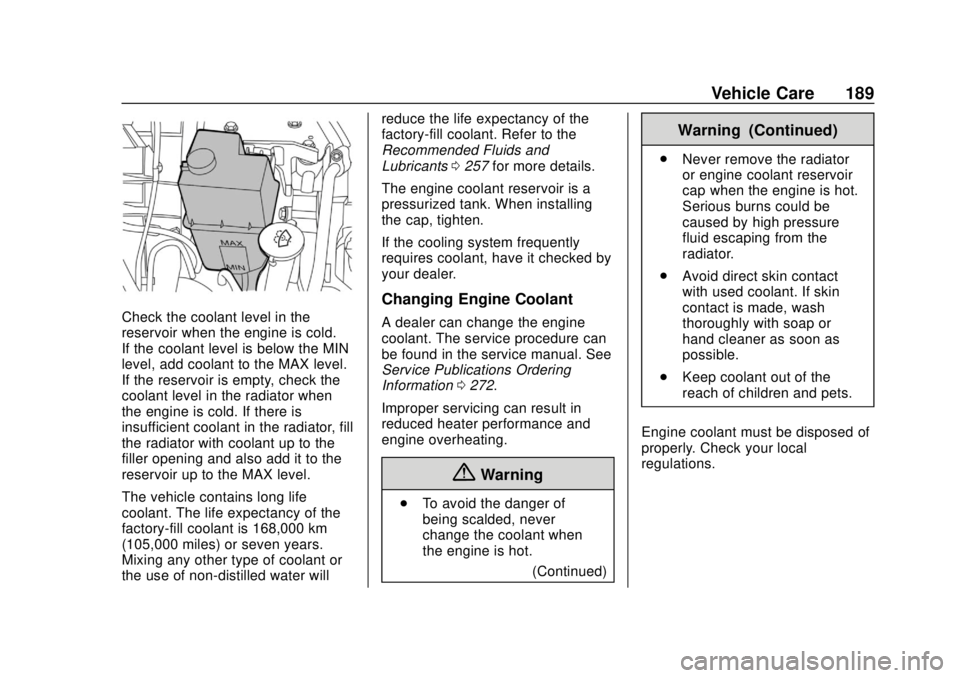
Check the coolant level in the
reservoir when the engine is cold.
If the coolant level is below the MIN
level, add coolant to the MAX level.
If the reservoir is empty, check the
coolant level in the radiator when
the engine is cold. If there is
insufficient coolant in the radiator, fill
the radiator with coolant up to the
filler opening and also add it to the
reservoir up to the MAX level.
The vehicle contains long life
coolant. The life expectancy of the
factory-fill coolant is 168,000 km
(105,000 miles) or seven years.
Mixing any other type of coolant or
the use of non-distilled water willreduce the life expectancy of the
factory-fill coolant. Refer to the
Recommended Fluids and
Lubricants
0257 for more details.
The engine coolant reservoir is a
pressurized tank. When installing
the cap, tighten.
If the cooling system frequently
requires coolant, have it checked by
your dealer.
Changing Engine Coolant
A dealer can change the engine
coolant. The service procedure can
be found in the service manual. See
Service Publications Ordering
Information 0272.
Improper servicing can result in
reduced heater performance and
engine overheating.
{Warning
. To avoid the danger of
being scalded, never
change the coolant when
the engine is hot.
(Continued)
Warning (Continued)
.Never remove the radiator
or engine coolant reservoir
cap when the engine is hot.
Serious burns could be
caused by high pressure
fluid escaping from the
radiator.
. Avoid direct skin contact
with used coolant. If skin
contact is made, wash
thoroughly with soap or
hand cleaner as soon as
possible.
. Keep coolant out of the
reach of children and pets.
Engine coolant must be disposed of
properly. Check your local
regulations.
Page 191 of 287
Chevrolet City Express Owner Manual (GMNA-Localizing-U.S./Canada-
11683523) - 2018 - CRC - 7/10/17
190 Vehicle Care
Engine Overheating
The vehicle has an engine coolant
temperature warning light on the
instrument cluster to warn of engine
overheating. SeeEngine Coolant
Temperature Warning Light 096.
If the decision is made not to lift the
hood when this warning appears,
but instead get service help right
away, see Roadside Assistance
Program 0267.
If the decision is made to lift the
hood, make sure the vehicle is
parked on a level surface.
Then check to see if the engine
cooling fans are running. If the
engine is overheating, the fans
should be running. If they are not,
do not continue to run the engine
and have the vehicle serviced.
See if the engine cooling fan speed
increases when idle speed is
doubled by pushing the accelerator
pedal down. If it does not, the
vehicle needs service. Turn off the
engine.Caution
Running the engine without
coolant may cause damage or a
fire. Vehicle damage would not be
covered by the vehicle warranty.
If Steam is Coming from the
Engine Compartment
{Warning
Steam from an overheated engine
can burn you badly, even if you
just open the hood. Stay away
from the engine if you see or hear
steam coming from it. Just turn it
off and get everyone away from
the vehicle until it cools down.
Wait until there is no sign of
steam or coolant before you open
the hood.
If you keep driving when the
engine is overheated, the liquids
in it can catch fire. You or others
could be badly burned. Stop the (Continued)
Warning (Continued)
engine if it overheats, and get out
of the vehicle until the engine
is cool.
Overheated Engine
Protection
Operating Mode
The engine has an engine
protection mode to reduce the
chance of damage if the coolant
temperature goes too high (for
example, when climbing steep
grades in high temperature with
heavy loads, such as when towing a
trailer). When the engine
temperature reaches a certain level:
.The engine coolant temperature
warning light will illuminate.
. Engine power may be reduced.
. The air conditioning cooling
function may be automatically
turned OFF for a short time (the
blower will continue to operate).
Page 192 of 287
Chevrolet City Express Owner Manual (GMNA-Localizing-U.S./Canada-
11683523) - 2018 - CRC - 7/10/17
Vehicle Care 191
Engine power and under certain
conditions, vehicle speed will
decrease. Vehicle speed can be
controlled with the accelerator
pedal, but the vehicle may not
accelerate at the desired speed.
The transmission will downshift or
upshift as it reaches prescribed shift
points. You can also shift manually.
As driving conditions change and
engine coolant temperature is
reduced, vehicle speed can be
increased using the accelerator
pedal, and air conditioning cooling
function will automatically be turned
back ON.
If:1. The engine coolant temperature is not reduced.
2. The air conditioning cooling function does not turn
back ON.
3. The engine oil pressure low/ engine coolant temperature
high warning light illuminates,
this may indicate a malfunction.
Move the vehicle off the road in
a safe area and allow the engine to cool. If after checking
the oil and coolant, the oil
pressure low/engine coolant
temperature high warning light
remains on, do not continue to
drive. Call your dealer.
The malfunction indicator light may
also come on. If only it remains on,
you do not need to have the vehicle
towed, but have it inspected soon
by your dealer. For additional
information, see Malfunction
Indicator Lamp (Check Engine
Light) 091.
Washer Fluid
What to Use
When the vehicle needs windshield
washer fluid, read the
manufacturer's instructions before
use. If operating the vehicle in an
area where the temperature may fall
below freezing, use a fluid that has
sufficient protection against
freezing.
Adding Washer Fluid
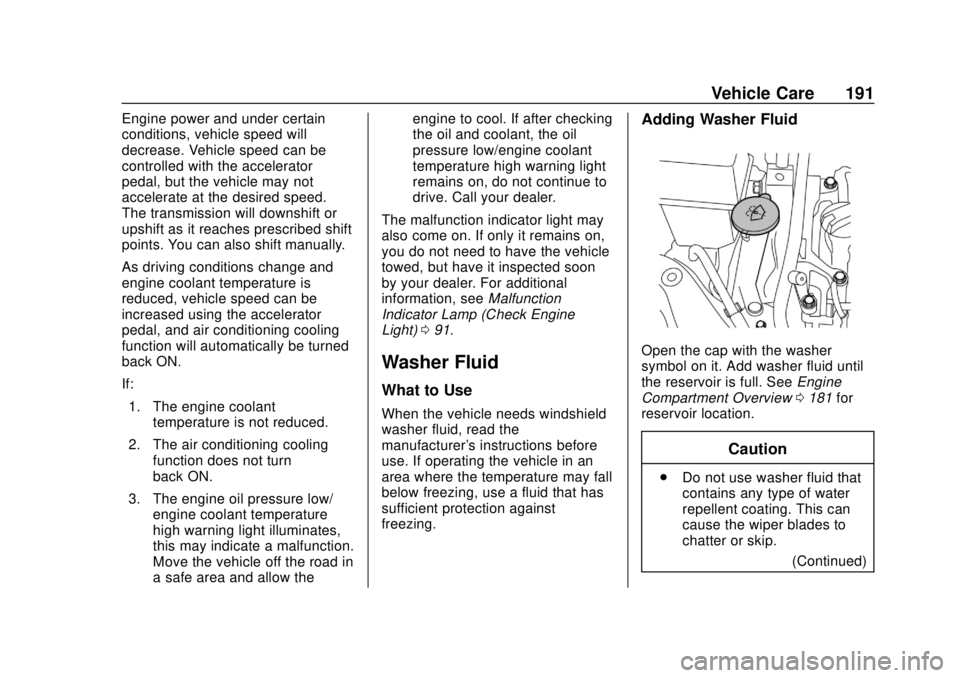
Open the cap with the washer
symbol on it. Add washer fluid until
the reservoir is full. See Engine
Compartment Overview 0181 for
reservoir location.
Caution
. Do not use washer fluid that
contains any type of water
repellent coating. This can
cause the wiper blades to
chatter or skip.
(Continued)
Page 193 of 287

Chevrolet City Express Owner Manual (GMNA-Localizing-U.S./Canada-
11683523) - 2018 - CRC - 7/10/17
192 Vehicle Care
Caution (Continued)
.Do not use engine coolant
(antifreeze) in the
windshield washer. It can
damage the windshield
washer system and paint.
. Do not mix water with
ready-to-use washer fluid.
Water can cause the
solution to freeze and
damage the washer fluid
tank and other parts of the
washer system.
. When using concentrated
washer fluid, follow the
manufacturer instructions for
adding water.
. Fill the washer fluid tank
only three-quarters full when
it is very cold. This allows
for fluid expansion if
freezing occurs, which could
damage the tank if it is
completely full.
Brakes
Disc brake pads have built-in wear
indicators that make a high-pitched
warning sound when the brake pads
are worn and new pads are needed.
The sound can come and go or can
be heard all the time when the
vehicle is moving, except when
applying the brake pedal firmly.
{Warning
The brake wear warning sound
means that soon the brakes will
not work well. That could lead to
a crash. When the brake wear
warning sound is heard, have the
vehicle serviced.
Caution
Continuing to drive with worn-out
brake pads could result in costly
brake repair. Some driving conditions or climates
can cause a brake squeal when the
brakes are first applied or lightly
applied. This does not mean
something is wrong with the brakes.
Properly torqued wheel nuts are
necessary to help prevent brake
pulsation. When tires are rotated,
inspect brake pads for wear and
evenly tighten wheel nuts in the
proper sequence to torque
specifications. See
Capacities and
Specifications 0261.
Brake pads should be replaced as
complete sets.
Brake Pedal Travel
See your dealer if the brake pedal
does not return to normal height,
or if there is a rapid increase in
pedal travel. This could be a sign
that brake service may be required.
Replacing Brake System Parts
Always replace brake system parts
with new, approved replacement
parts. If this is not done, the brakes
may not work properly. The braking
performance expected can change
Page 194 of 287

Chevrolet City Express Owner Manual (GMNA-Localizing-U.S./Canada-
11683523) - 2018 - CRC - 7/10/17
Vehicle Care 193
in many other ways if the wrong
replacement brake parts are
installed or if parts are improperly
installed.
Brake Fluid
The brake master cylinder reservoir
is filled with DOT 3 brake fluid. See
Engine Compartment Overview
0181 for the location of the
reservoir.
There are only two reasons why the
brake fluid level in the reservoir
might go down:
. The brake fluid level goes down
because of normal brake lining
wear. When new linings are
installed, the fluid level goes
back up. .
A fluid leak in the brake
hydraulic system can also cause
a low fluid level. Have the brake
hydraulic system fixed, since a
leak means that sooner or later
the brakes will not work well.
Do not top off the brake fluid.
Adding fluid does not correct a leak.
If fluid is added when the linings are
worn, there will be too much fluid
when new brake linings are
installed. Add or remove brake fluid,
as necessary, only when work is
done on the brake hydraulic system.
{Warning
If too much brake fluid is added, it
can spill on the engine and burn,
if the engine is hot enough. You
or others could be burned, and
the vehicle could be damaged.
Add brake fluid only when work is
done on the brake hydraulic
system. See “Checking Brake
Fluid” in this section. Refer to the Maintenance Schedule
to determine when to check the
brake fluid. See
Maintenance
Schedule 0246.
Checking Brake Fluid
Check brake fluid by looking at the
brake fluid reservoir. See Engine
Compartment Overview 0181.
The fluid level should be above
MIN. If it is not, have the brake
hydraulic system checked to see if
there is a leak.
Page 195 of 287
Chevrolet City Express Owner Manual (GMNA-Localizing-U.S./Canada-
11683523) - 2018 - CRC - 7/10/17
194 Vehicle Care
After work is done on the brake
hydraulic system, make sure the
level is above the MIN but not over
the MAX mark.
If the brake fluid is below the MIN
line, the brake warning light will
illuminate. Add brake fluid up to the
MAX line.
What to Add
Use only new DOT 3 brake fluid
from a sealed container. See
Recommended Fluids and
Lubricants0257.
Always clean the brake fluid
reservoir cap and the area around
the cap before removing it. This
helps keep dirt from entering the
reservoir.
{Warning
With the wrong kind of fluid in the
brake hydraulic system, the
brakes might not work well. This
could cause a crash. Always use
the proper brake fluid.
Caution
. Using the wrong fluid can
badly damage brake
hydraulic system parts. For
example, just a few drops of
mineral-based oil, such as
engine oil, in the brake
hydraulic system can
damage brake hydraulic
system parts so badly that
they will have to be
replaced. Do not let
someone put in the wrong
kind of fluid.
. If brake fluid is spilled on
the vehicle's painted
surfaces, the paint finish
can be damaged. Be careful
not to spill brake fluid on the
vehicle. If you do, wash it off
immediately.
Battery - North America
The original equipment battery is
maintenance free. Do not remove
the cap and do not add fluid. Refer to the replacement number
shown on the original battery label
when a new battery is needed. See
Engine Compartment Overview
0
181 for battery location.
{Warning
WARNING: Battery posts,
terminals, and related
accessories contain lead and lead
compounds, chemicals known to
the State of California to cause
cancer and birth defects or other
reproductive harm. Batteries also
contain other chemicals known to
the State of California to cause
cancer. WASH HANDS AFTER
HANDLING. For more information
go to www.P65Warnings.ca.gov/
passenger-vehicle.
See California Proposition
65 Warning 0177 and the back
cover.
Page 200 of 287

Chevrolet City Express Owner Manual (GMNA-Localizing-U.S./Canada-
11683523) - 2018 - CRC - 7/10/17
Vehicle Care 199
Fuses and Circuit
Breakers
{Danger
Fuses and circuit breakers are
marked with their ampere rating.
Do not exceed the
specified amperage rating when
replacing fuses and circuit
breakers. Use of an oversized
fuse or circuit breaker can result
in a vehicle fire. You and others
could be seriously injured or
killed.
The wiring circuits in the vehicle are
protected from short circuits by a
combination of fuses and circuit
breakers. This greatly reduces the
chance of fires caused by electrical
problems.
Look at the silver-colored band
inside the fuse. If the band is broken
or melted, replace the fuse. Be sure
you replace a bad fuse with a new
one of the identical size and rating. Spare fuses are provided and can
be found in the passenger
compartment fuse box.
Engine Compartment
Fuse Block
The fuse block is in the engine
compartment of the vehicle.
Remove the cover by pushing the
tab and lifting the cover up.
Fusible Links
If the electrical equipment does not
operate and fuses are in good
condition, check the fusible links.
If any of these fusible links are
melted, replace with only Genuine
GM parts.
Caution
Spilling liquid on any electrical
component on the vehicle may
damage it. Always keep the
covers on any electrical
component.
Page 206 of 287
Chevrolet City Express Owner Manual (GMNA-Localizing-U.S./Canada-
11683523) - 2018 - CRC - 7/10/17
Vehicle Care 205
vehicle tire engineered to
standards set by the U.S. Tire
and Rim Association.
(2) Tire Width
:The three-digit
number indicates the tire section
width in millimeters from
sidewall to sidewall.
(3) Aspect Ratio
:A two-digit
number that indicates the tire
height-to-width measurements.
For example, if the tire size
aspect ratio is 75, as shown in
item 3 of the illustration, it would
mean that the tire's sidewall is
75 percent as high as it is wide.
(4) Construction Code
:A letter
code is used to indicate the type
of ply construction in the tire.
The letter R means radial ply
construction; the letter D means
diagonal or bias ply
construction; and the letter B
means belted-bias ply
construction.
(5) Rim Diameter
:Diameter of
the wheel in inches. (6) Service Description
:These
characters represent the load
index and speed rating of the
tire. The load index represents
the load carrying capacity a tire
is certified to carry. The speed
rating is the maximum speed a
tire is certified to carry a load.
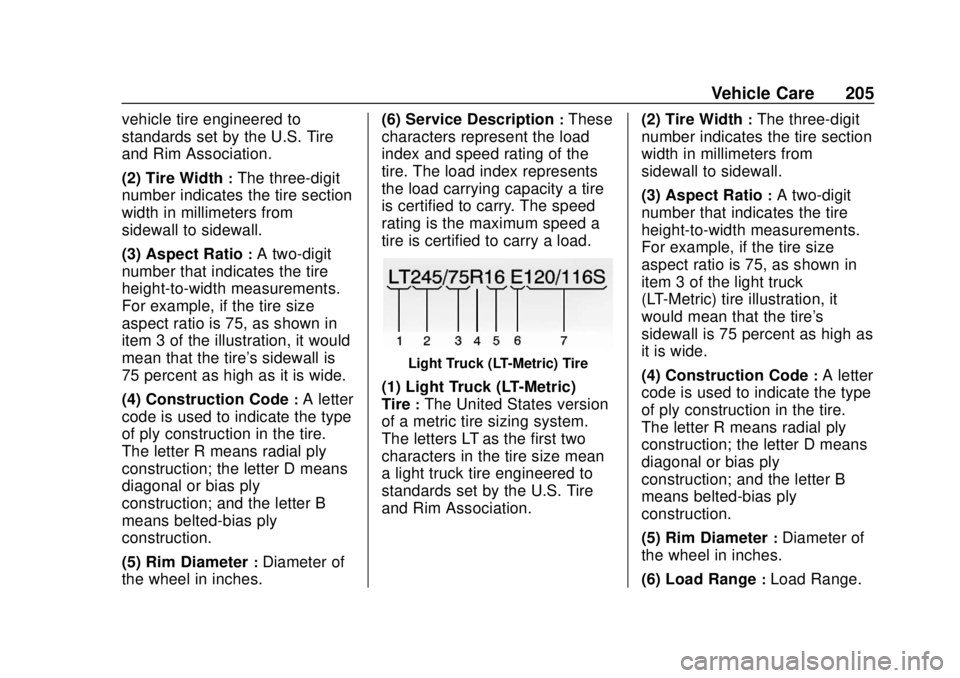
Light Truck (LT-Metric) Tire
(1) Light Truck (LT-Metric)
Tire
:The United States version
of a metric tire sizing system.
The letters LT as the first two
characters in the tire size mean
a light truck tire engineered to
standards set by the U.S. Tire
and Rim Association. (2) Tire Width
:The three-digit
number indicates the tire section
width in millimeters from
sidewall to sidewall.
(3) Aspect Ratio
:A two-digit
number that indicates the tire
height-to-width measurements.
For example, if the tire size
aspect ratio is 75, as shown in
item 3 of the light truck
(LT-Metric) tire illustration, it
would mean that the tire's
sidewall is 75 percent as high as
it is wide.
(4) Construction Code
:A letter
code is used to indicate the type
of ply construction in the tire.
The letter R means radial ply
construction; the letter D means
diagonal or bias ply
construction; and the letter B
means belted-bias ply
construction.
(5) Rim Diameter
:Diameter of
the wheel in inches.
(6) Load Range
:Load Range.