engine CHEVROLET CITY EXPRESS 2018 Repair Manual
[x] Cancel search | Manufacturer: CHEVROLET, Model Year: 2018, Model line: CITY EXPRESS, Model: CHEVROLET CITY EXPRESS 2018Pages: 287, PDF Size: 4.19 MB
Page 222 of 287
Chevrolet City Express Owner Manual (GMNA-Localizing-U.S./Canada-
11683523) - 2018 - CRC - 7/10/17
Vehicle Care 221
Warning (Continued)
2. Put an automatictransmission in P (Park) or a
manual transmission in
1 (First) or R (Reverse).
3. Turn off the engine and do not restart while the vehicle
is raised.
4. Do not allow passengers to remain in the vehicle.
5. Place wheel blocks, if equipped, on both sides of
the tire at the opposite
corner of the tire being
changed.
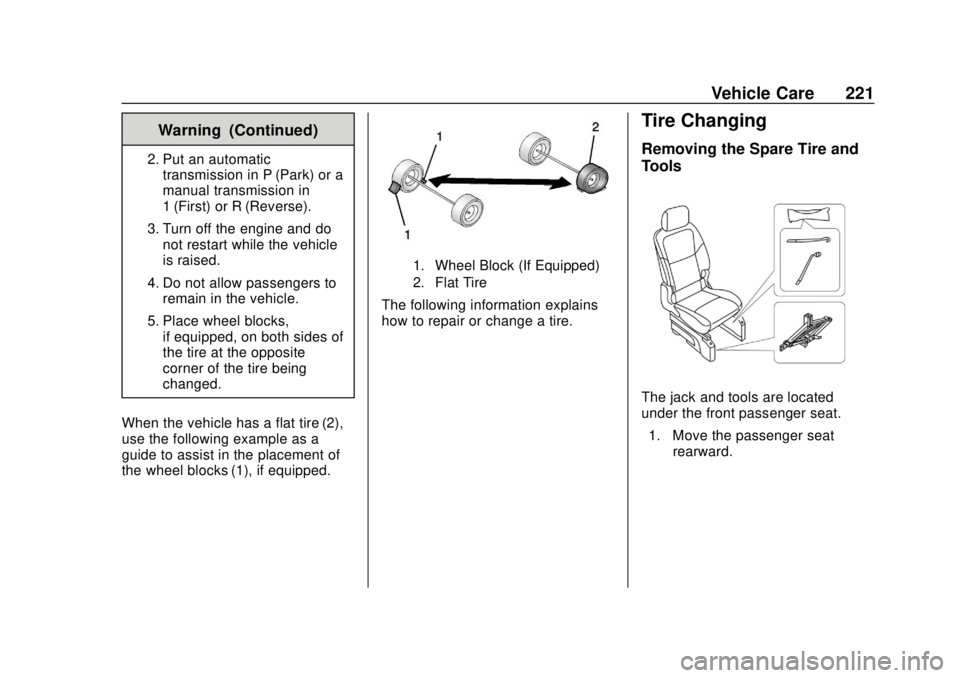
When the vehicle has a flat tire (2),
use the following example as a
guide to assist in the placement of
the wheel blocks (1), if equipped.
1. Wheel Block (If Equipped)
2. Flat Tire
The following information explains
how to repair or change a tire.
Tire Changing
Removing the Spare Tire and
Tools
The jack and tools are located
under the front passenger seat. 1. Move the passenger seat rearward.
Page 230 of 287
Chevrolet City Express Owner Manual (GMNA-Localizing-U.S./Canada-
11683523) - 2018 - CRC - 7/10/17
Vehicle Care 229
Caution
If any accessories are left on or
plugged in during the jump
starting procedure, they could be
damaged. The repairs would not
be covered by the vehicle
warranty. Whenever possible, turn
off or unplug all accessories on
either vehicle when jump starting.
3. Turn off the ignition on both vehicles. Unplug unnecessary
accessories from the cigarette
lighter or the accessory power
outlet. Turn off the radio and all
lamps that are not needed.
This will avoid sparks and help
save both batteries. And it
could save the radio!
4. Open the hoods and locate the positive (+) and negative (−)
terminal locations of the other
vehicle.
{Warning
Using a match near a battery can
cause battery gas to explode.
People have been hurt doing this,
and some have been blinded.
Use a flashlight if you need more
light.
Battery fluid contains acid that
can burn you. Do not get it on
you. If you accidentally get it in
your eyes or on your skin, flush
the place with water and get
medical help immediately.
{Warning
Fans or other moving engine
parts can injure you badly. Keep
your hands away from moving
parts once the engine is running. 5. Check that the jumper cables
do not have loose or missing
insulation. If they do, you could
get a shock. The vehicles
could be damaged too.
Before you connect the cables,
here are some basic things you
should know. Positive (+) will
go to positive (+) or to a remote
positive (+) terminal if
equipped. Negative (−) will go
to an unpainted metal part or to
a remote negative (−) terminal
if equipped.
Do not connect positive (+) to
negative (−) or you will get a
short that would damage the
battery and possibly other parts
too. Do not connect the
negative (−) cable to the
negative (−) terminal on the
dead battery because this can
cause sparks.
6. Connect the red positive (+) cable to the positive (+)
terminal (1) of the dead battery.
Use a remote positive (+)
terminal if equipped. Do not let
the other end touch metal.
Page 231 of 287
Chevrolet City Express Owner Manual (GMNA-Localizing-U.S./Canada-
11683523) - 2018 - CRC - 7/10/17
230 Vehicle Care
Connect it to the positive (+)
terminal (4) of the good battery.
Use a remote positive (+)
terminal if equipped.
7. Connect the black negative (−) cable to the negative (−)
terminal (3) of the good battery.
Use a remote negative (−)
terminal if equipped.
Do not let the other end touch
anything until the next step.
The other end of the
negative (−) cable does not go
to the dead battery. It goes to
the shock tower, or to a remote
negative (−) terminal on the
vehicle with the dead battery.
8. Connect the other end of the negative (−) cable to the
negative (−) grounding point (2)
on the shock tower of the
vehicle with the dead battery.Caution
Make sure the jumper cables do
not touch moving parts in the
engine compartment and that the
cable clamps do not contact any
other metal.
9. Start the vehicle with the good battery and run the engine for a
few minutes.
10. Keep the engine speed of the booster vehicle at about 2,000
rpm, and start the engine of the
vehicle being jump started.
Caution
Do not keep the starter motor
engaged for more than
10 seconds. If the engine does
not start right away, turn the key
off and wait three to four seconds
before trying again. 11. After starting the engine,
disconnect jumper cables as
directed below.
12. If it will not start after a few tries, it probably needs service.
Caution
If the jumper cables are
connected or removed in the
wrong order, electrical shorting
may occur and damage the
vehicle. The repairs would not be
covered by the vehicle warranty.
Always connect and remove the
jumper cables in the correct order,
making sure that the cables do
not touch each other or other
metal.
Jumper Cable Removal
Reverse the sequence exactly when
removing the jumper cables.
After starting the disabled vehicle
and removing the jumper cables,
allow it to idle for several minutes.
Page 243 of 287
Chevrolet City Express Owner Manual (GMNA-Localizing-U.S./Canada-
11683523) - 2018 - CRC - 7/10/17
242 Service and Maintenance
Service and
Maintenance
General Information
General Information . . . . . . . . . . 242
Maintenance Schedule
Maintenance Schedule . . . . . . . 246
Special Application Services
Special ApplicationServices . . . . . . . . . . . . . . . . . . . . 254
Additional Maintenance
and Care
Additional Maintenanceand Care . . . . . . . . . . . . . . . . . . . . 254
Recommended Fluids,
Lubricants, and Parts
Recommended Fluids andLubricants . . . . . . . . . . . . . . . . . . . 257
Maintenance Replacement Parts . . . . . . . . . . . . . . . . . . . . . . . . 258
Maintenance Records
Maintenance Records . . . . . . . . 259
General Information
Maintenance Requirements
Some regular maintenance is
essential to maintain the vehicle’s
mechanical condition, as well as its
emissions and engine performance.
It is the owner ’s responsibility to
make sure that the scheduled
maintenance, as well as general
maintenance, is performed.
As the vehicle owner, you are the
only one who can ensure that your
vehicle receives proper
maintenance. You are a vital link in
the maintenance chain.
General Maintenance
General maintenance includes
those items that should be checked
during normal day-to-day operation.
They are essential for proper
vehicle operation. It is your
responsibility to perform these
procedures regularly as prescribed. Performing general maintenance
checks requires minimal mechanical
skill and only a few general
automotive tools.
These checks or inspections can be
done by yourself, a qualified
technician, or, if you prefer, your
dealer.
Scheduled Maintenance
The maintenance items listed in this
section are required to be serviced
at regular intervals. However, under
severe driving conditions, additional
or more frequent maintenance will
be required.
Where to go for Service
If maintenance service is required or
your vehicle appears to malfunction,
have the systems checked and
serviced. It is recommended that
you visit your dealer for this service.
Chevrolet technicians are
well-trained specialists and are kept
up to date with the latest service
information through technical
bulletins, service tips, and training
programs.
Page 244 of 287
Chevrolet City Express Owner Manual (GMNA-Localizing-U.S./Canada-
11683523) - 2018 - CRC - 7/10/17
Service and Maintenance 243
You can be confident that your
dealer’s service department can
perform the service needed to meet
the maintenance requirements on
your vehicle.
General Maintenance
During the normal day-to-day
operation of the vehicle, general
maintenance should be performed
regularly as prescribed in this
section. If you detect any unusual
sounds, vibrations, or smells, be
sure to check for the cause or have
your dealer do it promptly. In
addition, it is recommended that you
visit your dealer if you think that
repairs are required.
When performing any checks or
maintenance work, see Doing Your
Own Service Work 0178.
Explanation of General
Maintenance Items
Additional information on the
following items with * is found under
“Vehicle Checks” in the Vehicle
Care section of this manual. Outside the Vehicle
The maintenance items listed here
should be performed from time to
time, unless otherwise specified.
Doors and engine hood* :
Check
that the doors and engine hood
operate properly. Also ensure that
all latches lock securely. Lubricate
hinges, latches, latch pins, rollers,
and links if necessary.
Make sure that the secondary latch
keeps the hood from opening when
the primary latch is released.
When driving in areas using road
salt or other corrosive materials,
check lubrication frequently.
Lamps* : Clean the headllamps on
a regular basis. Make sure that the
headlamps, stoplamps, taillamps,
turn signal lamps, and other lights
are all operating properly and
installed securely. Also check
headlamp aim. Road wheel nuts (lug nuts) :
When checking the tires, make sure
no wheel nuts are missing, and
check for any loose wheel nuts.
Tighten if necessary.
Tire rotation* :
Tires should be
rotated every 8 000 km (5,000 mi).
Tires* : Check the pressure with a
gauge often and always prior to long
distance trips. If necessary, adjust
the pressure in all tires, including
the spare, to the pressure specified.
Check carefully for damage, cuts,
or excessive wear.
Tire Pressure Monitoring System
(TPMS) transmitter components :
Replace the TPMS transmitter
grommet seal, valve core, and cap
when the tires are replaced due to
wear or age.
Wheel alignment and balance : If
the vehicle pulls to either side while
driving on a straight and level road,
or if you detect uneven or abnormal
tire wear, there may be a need for
wheel alignment. If the steering
Page 246 of 287

Chevrolet City Express Owner Manual (GMNA-Localizing-U.S./Canada-
11683523) - 2018 - CRC - 7/10/17
Service and Maintenance 245
Windshield wiper and washer* :
Check that the wipers and washer
operate properly and that the wipers
do not streak.
Under the Hood and Vehicle
The maintenance items listed here
should be checked periodically (for
example, each time you check the
engine oil or refuel).
Battery* :Check the fluid level in
each cell. The fluid should be at the
bottom of the filler opening. Vehicles
operated in high temperatures or
under severe conditions require
frequent checks of the battery fluid
level.
Care should be taken to avoid
situations that can lead to potential
battery discharge and potential
no-start conditions such as:
. Installation or extended use of
electronic accessories that
consume battery power when
the engine is not running (phone
chargers, GPS, DVD
players, etc.). .
Vehicle is not driven regularly
and/or only driven short
distances.
In these cases, the battery may
need to be charged to maintain
battery health.
Brake fluid level* : Make sure that
the brake fluid level is between the
MAX and MIN lines on the reservoir.
Engine coolant level* : Check the
coolant level when the engine
is cold.
Engine drive belts : Make sure the
drive belts are not frayed, worn,
cracked, or oily.
Engine oil level* : Check the level
after parking the vehicle on a level
spot and turning off the engine. Wait
more than 15 minutes for the oil to
drain back into the oil pan.
Exhaust system : Make sure there
are no loose supports, cracks,
or holes. If the sound of the exhaust
seems unusual or there is a smell of
exhaust fumes, immediately have
the exhaust system inspected. It is
recommended that you see your dealer for this service. For additional
information, see
Engine Exhaust
0 149.
Fluid leaks : Check under the
vehicle for fuel, oil, water, or other
fluid leaks after the vehicle has
been parked for a while. Water
dripping from the air conditioner
after use is normal. If you notice any
leaks or if fuel fumes are evident,
check for the cause and have it
corrected immediately.
Radiator and hoses : Check the
front of the radiator and clean off
any dirt, insects, leaves, etc., that
may have accumulated. Make sure
the hoses have no cracks,
deformation, rot, or loose
connections.
Underbody : The underbody is
frequently exposed to corrosive
substances such as those used on
icy roads or to control dust. It is very
important to remove these
substances, otherwise rust may
form on the floor pan, frame, fuel
lines, and around the exhaust
system. At the end of winter, the
underbody should be thoroughly
Page 247 of 287
Chevrolet City Express Owner Manual (GMNA-Localizing-U.S./Canada-
11683523) - 2018 - CRC - 7/10/17
246 Service and Maintenance
flushed with plain water, being
careful to clean those areas where
mud and dirt may accumulate. For
additional information,Exterior Care
0 233.
Windshield washer fluid* : Check
that there is adequate fluid in the
reservoir.Maintenance
Schedule
Explanation of Scheduled
Maintenance Items
The following descriptions are
provided to give you a better
understanding of the scheduled
maintenance items that should be
regularly checked or replaced. The
maintenance schedule indicates at
which mileage/time intervals each
item requires service.
In addition to scheduled
maintenance, your vehicle requires
that some items be checked during
normal day-to-day operation. For
additional information, refer to
“General Maintenance” in this
section.
Items marked with * are
recommended for reliable vehicle
operation. You are not required to
perform maintenance on these
items in order to maintain the
warranties that come with your
vehicle. Other maintenance items
and intervals are required. When applicable, additional
information can be found under
“Vehicle Checks”
in the Vehicle
Care section of this manual.
Chevrolet does not advocate the
use of non-OEM approved
aftermarket flushing systems and
strongly advises against performing
these services on a Chevrolet
product. Many of the aftermarket
flushing systems use non-OEM
approved chemicals or solvents, the
use of which has not been validated
by Chevrolet.
For recommended fuel, lubricants,
fluids, grease, and refrigerant, refer
to Recommended Fluids and
Lubricants 0257.
Emission Control System
Maintenance
Drive belts* : Check engine drive
belts for wear, fraying, or cracking
and for proper tension. Replace any
damaged drive belts.
Page 248 of 287
Chevrolet City Express Owner Manual (GMNA-Localizing-U.S./Canada-
11683523) - 2018 - CRC - 7/10/17
Service and Maintenance 247
Engine air filter :Replace at
specified intervals. When driving for
prolonged periods in dusty
conditions, check/replace the filter
more frequently.
Engine coolant* : Replace coolant
at the specified interval. When
adding or replacing coolant, be sure
to use only prediluted ACDelco CE
Long Life Antifreeze Coolant (blue)
or equivalent. See Recommended
Fluids and Lubricants 0257.
Mixing any other type of coolant or
using non-distilled water may
reduce the recommended service
interval of the coolant.
Engine oil and oil filter : Replace
engine oil and oil filter at the
specified intervals. For
recommended oil grade and
viscosity, see Recommended Fluids
and Lubricants 0257.
Engine valve clearance* : Inspect
only if valve noise increases. Adjust
valve clearance if necessary. Evaporative emissions control
vapor lines :
Check vapor lines for
leaks or looseness. Tighten
connections or replace parts as
necessary.
Fuel lines* : Check the fuel hoses,
piping, and connections for leaks,
looseness, or deterioration. Tighten
connections or replace parts as
necessary.
Spark plugs : Replace at specified
intervals. Install new plugs of the
same type as originally equipped.
Chassis and Body Maintenance
Brake lines and cables : Visually
inspect for proper installation.
Check for chafing, cracks,
deterioration, and signs of leaking.
Replace any deteriorated or
damaged parts immediately.
Brake pads, rotors, drums, and
linings : Check for wear,
deterioration, and fluid leaks.
Replace any deteriorated or
damaged parts immediately. Exhaust system :
Visually inspect
the exhaust pipes, muffler, and
hangers for leaks, cracks,
deterioration, and damage. Tighten
connections or replace parts as
necessary.
Steering gear and linkage, axle
and suspension parts, drive shaft
boots : Check for damage,
looseness, and leakage of oil or
grease. Under severe driving
conditions, inspect more frequently.
Tire rotation : Tires should be
rotated every 8 000 km (5,000 mi).
When rotating tires, check for
damage and uneven wear. Replace
if necessary.
Transmission fluid/oil : Visually
inspect for signs of leakage at
specified intervals.
If towing a trailer, using a camper or
car-top carrier, or driving on rough
or muddy roads, replace the CVT
fluid every 96 000 km (60,000 mi) or
request the dealer to inspect the
fluid.
Page 250 of 287
Chevrolet City Express Owner Manual (GMNA-Localizing-U.S./Canada-
11683523) - 2018 - CRC - 7/10/17
Service and Maintenance 249
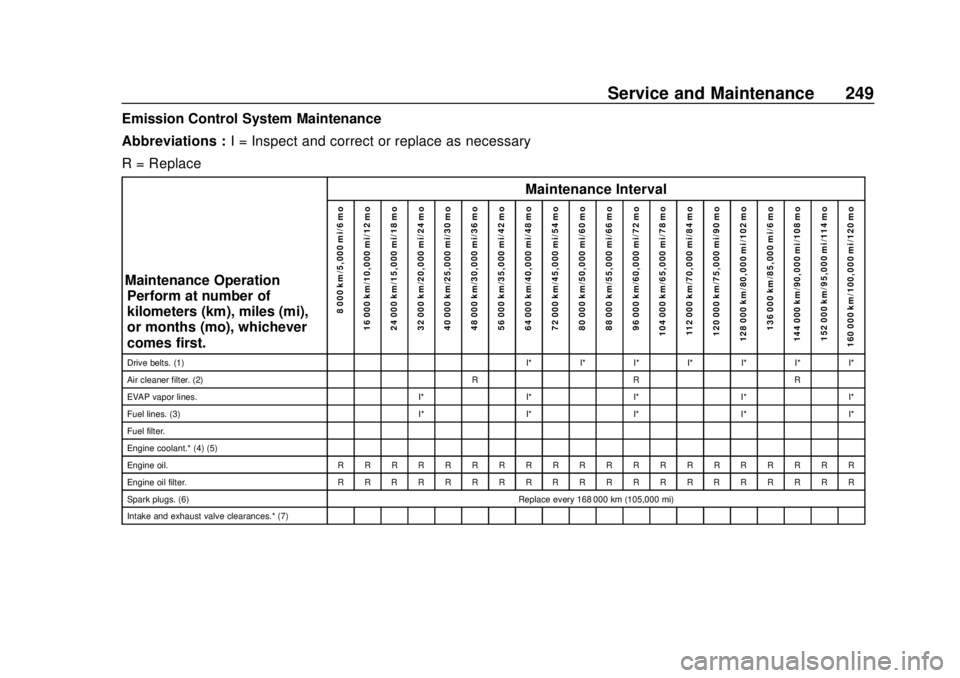
Emission Control System Maintenance
Abbreviations :I = Inspect and correct or replace as necessary
R = Replace
Maintenance OperationPerform at number of
kilometers (km), miles (mi),
or months (mo), whichever
comes first. Maintenance Interval
8 000 km/5,000 mi/6 mo
16 000 km/10,000 mi/12 mo
24 000 km/15,000 mi/18 mo
32 000 km/20,000 mi/24 mo
40 000 km/25,000 mi/30 mo
48 000 km/30,000 mi/36 mo
56 000 km/35,000 mi/42 mo
64 000 km/40,000 mi/48 mo
72 000 km/45,000 mi/54 mo
80 000 km/50,000 mi/60 mo
88 000 km/55,000 mi/66 mo
96 000 km/60,000 mi/72 mo
104 000 km/65,000 mi/78 mo 112 000 km/70,000 mi/84 mo
120 000 km/75,000 mi/90 mo
128 000 km/80,000 mi/102 mo 136 000 km/85,000 mi/6 mo
144 000 km/90,000 mi/108 mo 152 000 km/95,000 mi/114 mo
160 000 km/100,000 mi/120 mo
Drive belts. (1) I* I* I* I* I* I* I*
Air cleaner filter. (2) R R R
EVAP vapor lines. I* I* I* I* I*
Fuel lines. (3) I* I* I* I* I*
Fuel filter.
Engine coolant.* (4) (5)
Engine oil. R R R R R R R R R R R R R R R R R R R R
Engine oil filter. R R R R R R R R R R R R R R R R R R R R
Spark plugs. (6) Replace every 168 000 km (105,000 mi)
Intake and exhaust valve clearances.* (7)
Page 255 of 287
Chevrolet City Express Owner Manual (GMNA-Localizing-U.S./Canada-
11683523) - 2018 - CRC - 7/10/17
254 Service and Maintenance
Special Application
Services
.Severe Commercial Use
Vehicles Only: Lubricate chassis
components every oil change.
. Have underbody flushing service
performed. See “Underbody
Maintenance” inExterior Care
0 233.
Additional
Maintenance and Care
Your vehicle is an important
investment and caring for it properly
may help to avoid future costly
repairs. To maintain vehicle
performance, additional
maintenance services may be
required.
It is recommended that your dealer
perform these services —their
trained dealer technicians know
your vehicle best. Your dealer can
also perform a thorough
assessment with a multi-point
inspection to recommend when your
vehicle may need attention.
The following list is intended to
explain the services and conditions
to look for that may indicate
services are required. Battery
The 12-volt battery supplies power
to start the engine and operate any
additional electrical accessories.
.
To avoid break-down or failure to
start the vehicle, maintain a
battery with full cranking power.
. Trained dealer technicians have
the diagnostic equipment to test
the battery and ensure that the
connections and cables are
corrosion-free.
Belts
. Belts may need replacing if they
squeak or show signs of
cracking or splitting.
. Trained dealer technicians have
access to tools and equipment
to inspect the belts and
recommend adjustment or
replacement when necessary.