trailer CHEVROLET CITY EXPRESS 2018 Owner's Manual
[x] Cancel search | Manufacturer: CHEVROLET, Model Year: 2018, Model line: CITY EXPRESS, Model: CHEVROLET CITY EXPRESS 2018Pages: 287, PDF Size: 4.19 MB
Page 134 of 287
Chevrolet City Express Owner Manual (GMNA-Localizing-U.S./Canada-
11683523) - 2018 - CRC - 7/10/17
Driving and Operating 133
Driving and
Operating
Driving Information
Distracted Driving . . . . . . . . . . . . 134
Defensive Driving . . . . . . . . . . . . . 134
Drunk Driving . . . . . . . . . . . . . . . . . 135
Control of a Vehicle . . . . . . . . . . . 135
Braking . . . . . . . . . . . . . . . . . . . . . . . 135
Steering . . . . . . . . . . . . . . . . . . . . . . 135
Off-Road Recovery . . . . . . . . . . . 136
Loss of Control . . . . . . . . . . . . . . . 136
Driving on Wet Roads . . . . . . . . 137
Hill and Mountain Roads . . . . . 138
Winter Driving . . . . . . . . . . . . . . . . 138
If the Vehicle Is Stuck . . . . . . . . 140
Vehicle Load Limits . . . . . . . . . . . 140
Starting and Operating
New Vehicle Break-In . . . . . . . . . 144
Ignition Positions . . . . . . . . . . . . . 145
Starting the Engine . . . . . . . . . . . 146
Engine Heater . . . . . . . . . . . . . . . . 147
Parking over ThingsThat Burn . . . . . . . . . . . . . . . . . . . 149
Engine Exhaust
Engine Exhaust . . . . . . . . . . . . . . 149 Running the Vehicle While
Parked . . . . . . . . . . . . . . . . . . . . . . 150
Automatic Transmission
Continuously VariableTransmission (CVT) . . . . . . . . . 150
Brakes
Antilock BrakeSystem (ABS) . . . . . . . . . . . . . . . 155
Parking Brake . . . . . . . . . . . . . . . . 156
Hill Start Assist (HSA) . . . . . . . . 157
Ride Control Systems
Traction Control/Electronic Stability Control . . . . . . . . . . . . . 158
Cruise Control
Cruise Control . . . . . . . . . . . . . . . . 161
Driver Assistance Systems
Rear Vision Camera (RVC) . . . 163
Parking Assist . . . . . . . . . . . . . . . . 169
Fuel
Fuel . . . . . . . . . . . . . . . . . . . . . . . . . . 170
California FuelRequirements . . . . . . . . . . . . . . . 171
Fuels in Foreign Countries . . . 171
Fuel Additives . . . . . . . . . . . . . . . . 171
Filling the Tank . . . . . . . . . . . . . . . 172 Filling a Portable Fuel
Container . . . . . . . . . . . . . . . . . . . 173
Trailer Towing
General TowingInformation . . . . . . . . . . . . . . . . . . 174
Conversions and Add-Ons
Add-On ElectricalEquipment . . . . . . . . . . . . . . . . . . 174
Page 143 of 287
Chevrolet City Express Owner Manual (GMNA-Localizing-U.S./Canada-
11683523) - 2018 - CRC - 7/10/17
142 Driving and Operating
2.Determine the combined
weight of the driver and
passengers that will be
riding in your vehicle.
3.Subtract the combined
weight of the driver and
passengers from XXX kg or
XXX lbs.
4.The resulting figure equals
the available amount of
cargo and luggage load
capacity. For example, if the
"XXX" amount equals
1400 lbs. and there will be
five 150 lb passengers in
your vehicle, the amount of
available cargo and luggage
load capacity is 650 lbs.
(1400-750 (5 x 150) =
650 lbs.)
5.Determine the combined
weight of luggage and cargo
being loaded on the vehicle.
That weight may not safelyexceed the available cargo
and luggage load capacity
calculated in Step 4.
6.If your vehicle will be towing
a trailer, load from your
trailer will be transferred to
your vehicle. Consult this
manual to determine how
this reduces the available
cargo and luggage load
capacity of your vehicle.”
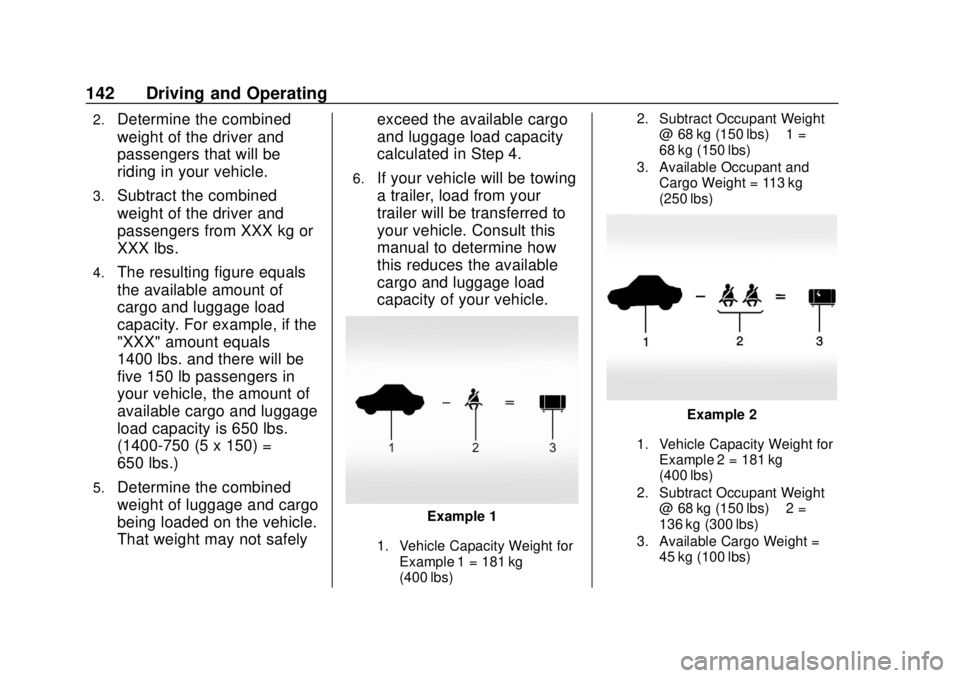
Example 1
1. Vehicle Capacity Weight for
Example 1 = 181 kg
(400 lbs) 2. Subtract Occupant Weight
@ 68 kg (150 lbs) × 1 =
68 kg (150 lbs)
3. Available Occupant and Cargo Weight = 113 kg
(250 lbs)
Example 2
1. Vehicle Capacity Weight forExample 2 = 181 kg
(400 lbs)
2. Subtract Occupant Weight @ 68 kg (150 lbs) × 2 =
136 kg (300 lbs)
3. Available Cargo Weight = 45 kg (100 lbs)
Page 155 of 287
Chevrolet City Express Owner Manual (GMNA-Localizing-U.S./Canada-
11683523) - 2018 - CRC - 7/10/17
154 Driving and Operating
Each time the engine is started,
or when the shift lever is shifted to
any position other than D (Drive),
the Overdrive off mode will be
automatically turned off.
Accelerator Downshift in D
Position
For passing or hill climbing, press
the accelerator pedal to the floor.
This shifts the transmission down
into a lower gear, depending on the
vehicle speed.
High Fluid Temperature
Protection Mode
If the fluid temperature becomes too
high from climbing a steep grade in
high temperatures, such as towing a
trailer. Engine power and vehicle
speed will be decreased
automatically to reduce the chance
of transmission damage. Vehicle
speed can be controlled with the
accelerator pedal but the engine
and vehicle speed may be limited.Fail Safe
When the fail-safe operation occurs,
the CVT will not be shifted into the
selected driving position.
If the vehicle is driven under
extreme conditions, such as
excessive wheel spinning and
subsequent hard braking, the
fail-safe system may be activated.
The malfunction indicator lamp may
come on to indicate the fail-safe
mode is activated. See
Malfunction
Indicator Lamp (Check Engine
Light) 091. This will occur even if all
electrical circuits are functioning
properly. In this case, place the
ignition switch in the OFF position
and wait for 10 seconds. Then place
the ignition switch back in the ON
position. The vehicle should return
to its normal operating condition. If it
does not return to its normal
operating condition, have a dealer
check the transmission and repair if
necessary.
{Warning
When the high fluid temperature
protection mode or fail-safe
operation occurs, vehicle speed
may be gradually reduced. The
reduced speed may be lower than
other traffic, which could increase
the chance of a collision. Be
especially careful when driving.
If necessary, pull to the side of
the road at a safe place and allow
the transmission to return to
normal operation, or have it
repaired if necessary.
Page 175 of 287

Chevrolet City Express Owner Manual (GMNA-Localizing-U.S./Canada-
11683523) - 2018 - CRC - 7/10/17
174 Driving and Operating
Warning (Continued)
.Fill the container no more
than 95% full to allow for
expansion.
. Do not smoke, light
matches, or use lighters
while pumping fuel.
. Avoid using cell phones or
other electronic devices.
Trailer Towing
General Towing
Information
The vehicle is neither designed nor
intended to tow a trailer.
Conversions and
Add-Ons
Add-On Electrical
Equipment
{Warning
The Data Link Connector (DLC) is
used for vehicle service and
Emission Inspection/Maintenance
testing. See Malfunction Indicator
Lamp (Check Engine Light) 091.
A device connected to the DLC —
such as an aftermarket fleet or
driver-behavior tracking device —
may interfere with vehicle
systems. This could affect vehicle
operation and cause a crash.
Such devices may also access
information stored in the vehicle’s
systems.
Page 191 of 287
Chevrolet City Express Owner Manual (GMNA-Localizing-U.S./Canada-
11683523) - 2018 - CRC - 7/10/17
190 Vehicle Care
Engine Overheating
The vehicle has an engine coolant
temperature warning light on the
instrument cluster to warn of engine
overheating. SeeEngine Coolant
Temperature Warning Light 096.
If the decision is made not to lift the
hood when this warning appears,
but instead get service help right
away, see Roadside Assistance
Program 0267.
If the decision is made to lift the
hood, make sure the vehicle is
parked on a level surface.
Then check to see if the engine
cooling fans are running. If the
engine is overheating, the fans
should be running. If they are not,
do not continue to run the engine
and have the vehicle serviced.
See if the engine cooling fan speed
increases when idle speed is
doubled by pushing the accelerator
pedal down. If it does not, the
vehicle needs service. Turn off the
engine.Caution
Running the engine without
coolant may cause damage or a
fire. Vehicle damage would not be
covered by the vehicle warranty.
If Steam is Coming from the
Engine Compartment
{Warning
Steam from an overheated engine
can burn you badly, even if you
just open the hood. Stay away
from the engine if you see or hear
steam coming from it. Just turn it
off and get everyone away from
the vehicle until it cools down.
Wait until there is no sign of
steam or coolant before you open
the hood.
If you keep driving when the
engine is overheated, the liquids
in it can catch fire. You or others
could be badly burned. Stop the (Continued)
Warning (Continued)
engine if it overheats, and get out
of the vehicle until the engine
is cool.
Overheated Engine
Protection
Operating Mode
The engine has an engine
protection mode to reduce the
chance of damage if the coolant
temperature goes too high (for
example, when climbing steep
grades in high temperature with
heavy loads, such as when towing a
trailer). When the engine
temperature reaches a certain level:
.The engine coolant temperature
warning light will illuminate.
. Engine power may be reduced.
. The air conditioning cooling
function may be automatically
turned OFF for a short time (the
blower will continue to operate).
Page 233 of 287
Chevrolet City Express Owner Manual (GMNA-Localizing-U.S./Canada-
11683523) - 2018 - CRC - 7/10/17
232 Vehicle Care
Here are some important things to
consider before recreational vehicle
towing:
.What is the towing capacity of
the towing vehicle? Be sure to
read the tow vehicle
manufacturer's
recommendations.
. What is the distance that will be
traveled? Some vehicles have
restrictions on how far and how
long they can tow.
. Is the proper towing equipment
going to be used? See your
dealer or trailering professional
for additional advice and
equipment recommendations.
. Is the vehicle ready to be
towed? Just as preparing the
vehicle for a long trip, make sure
the vehicle is prepared to be
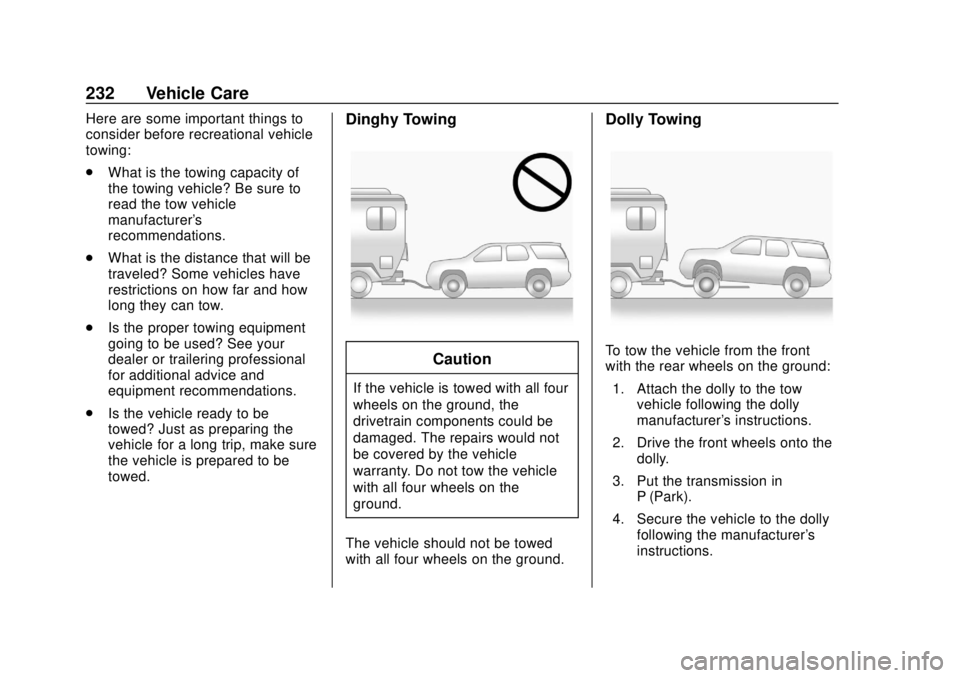
towed.Dinghy Towing
Caution
If the vehicle is towed with all four
wheels on the ground, the
drivetrain components could be
damaged. The repairs would not
be covered by the vehicle
warranty. Do not tow the vehicle
with all four wheels on the
ground.
The vehicle should not be towed
with all four wheels on the ground.
Dolly Towing
To tow the vehicle from the front
with the rear wheels on the ground: 1. Attach the dolly to the tow vehicle following the dolly
manufacturer's instructions.
2. Drive the front wheels onto the dolly.
3. Put the transmission in P (Park).
4. Secure the vehicle to the dolly following the manufacturer's
instructions.
Page 248 of 287
Chevrolet City Express Owner Manual (GMNA-Localizing-U.S./Canada-
11683523) - 2018 - CRC - 7/10/17
Service and Maintenance 247
Engine air filter :Replace at
specified intervals. When driving for
prolonged periods in dusty
conditions, check/replace the filter
more frequently.
Engine coolant* : Replace coolant
at the specified interval. When
adding or replacing coolant, be sure
to use only prediluted ACDelco CE
Long Life Antifreeze Coolant (blue)
or equivalent. See Recommended
Fluids and Lubricants 0257.
Mixing any other type of coolant or
using non-distilled water may
reduce the recommended service
interval of the coolant.
Engine oil and oil filter : Replace
engine oil and oil filter at the
specified intervals. For
recommended oil grade and
viscosity, see Recommended Fluids
and Lubricants 0257.
Engine valve clearance* : Inspect
only if valve noise increases. Adjust
valve clearance if necessary. Evaporative emissions control
vapor lines :
Check vapor lines for
leaks or looseness. Tighten
connections or replace parts as
necessary.
Fuel lines* : Check the fuel hoses,
piping, and connections for leaks,
looseness, or deterioration. Tighten
connections or replace parts as
necessary.
Spark plugs : Replace at specified
intervals. Install new plugs of the
same type as originally equipped.
Chassis and Body Maintenance
Brake lines and cables : Visually
inspect for proper installation.
Check for chafing, cracks,
deterioration, and signs of leaking.
Replace any deteriorated or
damaged parts immediately.
Brake pads, rotors, drums, and
linings : Check for wear,
deterioration, and fluid leaks.
Replace any deteriorated or
damaged parts immediately. Exhaust system :
Visually inspect
the exhaust pipes, muffler, and
hangers for leaks, cracks,
deterioration, and damage. Tighten
connections or replace parts as
necessary.
Steering gear and linkage, axle
and suspension parts, drive shaft
boots : Check for damage,
looseness, and leakage of oil or
grease. Under severe driving
conditions, inspect more frequently.
Tire rotation : Tires should be
rotated every 8 000 km (5,000 mi).
When rotating tires, check for
damage and uneven wear. Replace
if necessary.
Transmission fluid/oil : Visually
inspect for signs of leakage at
specified intervals.
If towing a trailer, using a camper or
car-top carrier, or driving on rough
or muddy roads, replace the CVT
fluid every 96 000 km (60,000 mi) or
request the dealer to inspect the
fluid.
Page 253 of 287
Chevrolet City Express Owner Manual (GMNA-Localizing-U.S./Canada-
11683523) - 2018 - CRC - 7/10/17
252 Service and Maintenance
Footnotes—Chassis and Body
Maintenance
Maintenance items with ∞should be
performed more frequently
according to “Maintenance Under
Severe Operating Conditions”.
(1) If towing a trailer, using a
camper or a car-top carrier,
or driving on rough or muddy roads,
inspect CVT fluid deterioration at
your dealer every 96 000 km
(60,000 mi), then change CVT fluid
if necessary. And if the inspection is
not performed, change (not just
inspect) CVT fluid every 96 000 km
(60,000 mi).
(2) Refer to “Tire Rotation” under
“Explanation of Scheduled
Maintenance Items” earlier in this
section.Maintenance Under Severe
Operating Conditions
The maintenance intervals shown
on the preceding pages are for
normal operating conditions. If the
vehicle is mainly operated under
severe driving conditions as shown
below, more frequent maintenance
must be performed on the following
items as shown in the table.
Severe Driving Conditions
. Repeated short trips of less than
8 km (5 mi).
. Repeated short trips of less than
16 km (10 mi) with outside
temperatures remaining below
freezing. .
Operating in hot weather in
stop-and-go “rush hour”traffic.
. Extensive idling and/or low
speed driving for long distances,
such as police, taxi,
or door-to-door delivery use.
. Driving in dusty conditions.
. Driving on rough, muddy, or salt
spread roads.
. Using a car-top carrier.