key CHEVROLET CLASSIC 2004 Owner's Guide
[x] Cancel search | Manufacturer: CHEVROLET, Model Year: 2004, Model line: CLASSIC, Model: CHEVROLET CLASSIC 2004Pages: 348, PDF Size: 5.32 MB
Page 190 of 348
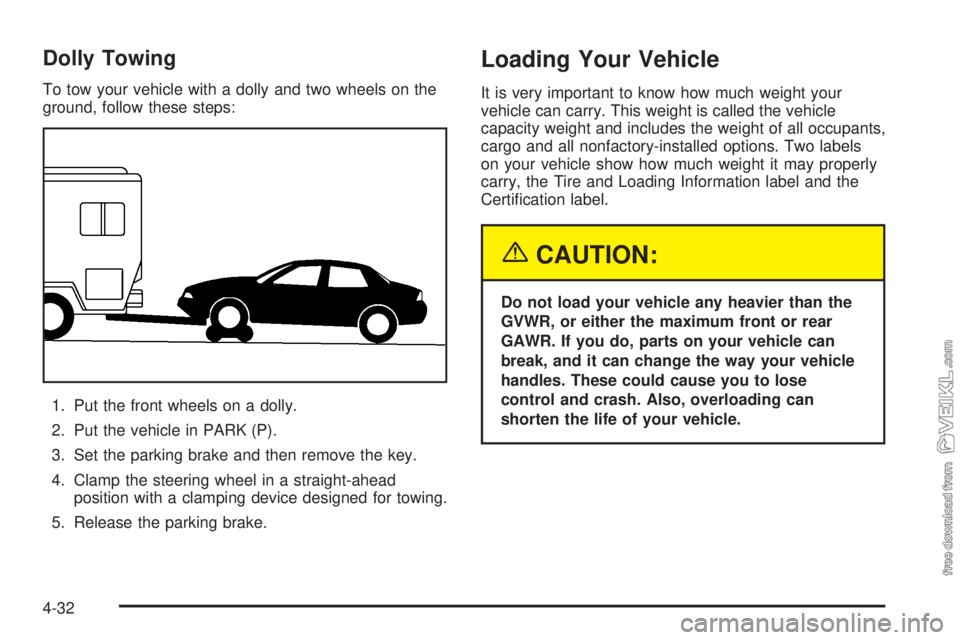
Dolly Towing
To tow your vehicle with a dolly and two wheels on the
ground, follow these steps:
1. Put the front wheels on a dolly.
2. Put the vehicle in PARK (P).
3. Set the parking brake and then remove the key.
4. Clamp the steering wheel in a straight-ahead
position with a clamping device designed for towing.
5. Release the parking brake.
Loading Your Vehicle
It is very important to know how much weight your
vehicle can carry. This weight is called the vehicle
capacity weight and includes the weight of all occupants,
cargo and all nonfactory-installed options. Two labels
on your vehicle show how much weight it may properly
carry, the Tire and Loading Information label and the
Certification label.
{CAUTION:
Do not load your vehicle any heavier than the
GVWR, or either the maximum front or rear
GAWR. If you do, parts on your vehicle can
break, and it can change the way your vehicle
handles. These could cause you to lose
control and crash. Also, overloading can
shorten the life of your vehicle.
4-32
Page 234 of 348
When to Check Power Steering Fluid
SeeEngine Compartment Overview on page 5-12
for reservoir location.
It is not necessary to regularly check power steering
fluid unless you suspect there is a leak in the system or
you hear an unusual noise. A fluid loss in this system
could indicate a problem. Have the system inspected
and repaired.
How to Check Power Steering Fluid
Turn the key off, let the engine compartment cool down,
wipe the cap and the top of the reservoir clean, then
unscrew the cap and wipe the dipstick with a clean rag.
Replace the cap and completely tighten it. Then
remove the cap again and look at the fluid level on the
dipstick.
The level should be at the FULL COLD mark. If
necessary, add only enough fluid to bring the level up to
the mark.
What to Use
To determine what kind of fluid to use, seePart D:
Recommended Fluids and Lubricants on page 6-22.
Always use the proper fluid. Failure to use the proper
fluid can cause leaks and damage hoses and seals.
Windshield Washer Fluid
What to Use
When you need windshield washer fluid, be sure to read
the manufacturer’s instructions before use. If you will
be operating your vehicle in an area where the
temperature may fall below freezing, use a fluid that has
sufficient protection against freezing.
5-32
Page 293 of 348
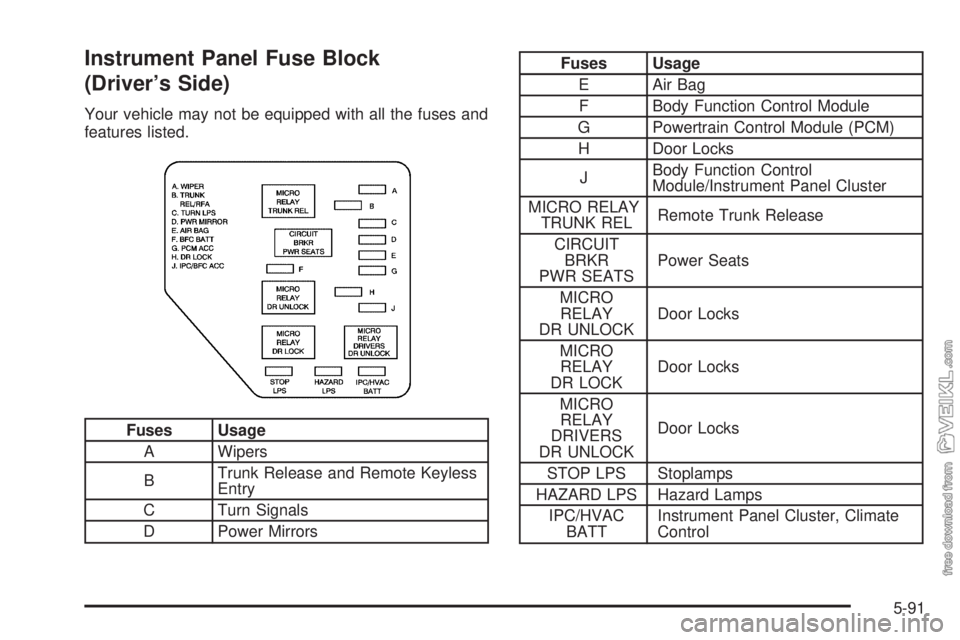
Instrument Panel Fuse Block
(Driver’s Side)
Your vehicle may not be equipped with all the fuses and
features listed.
Fuses Usage
A Wipers
BTrunk Release and Remote Keyless
Entry
C Turn Signals
D Power Mirrors
Fuses Usage
E Air Bag
F Body Function Control Module
G Powertrain Control Module (PCM)
H Door Locks
JBody Function Control
Module/Instrument Panel Cluster
MICRO RELAY
TRUNK RELRemote Trunk Release
CIRCUIT
BRKR
PWR SEATSPower Seats
MICRO
RELAY
DR UNLOCKDoor Locks
MICRO
RELAY
DR LOCKDoor Locks
MICRO
RELAY
DRIVERS
DR UNLOCKDoor Locks
STOP LPS Stoplamps
HAZARD LPS Hazard Lamps
IPC/HVAC
BATTInstrument Panel Cluster, Climate
Control
5-91
Page 315 of 348
At Least Twice a Year
Restraint System Check
Make sure the safety belt reminder light and all your
belts, buckles, latch plates, retractors and anchorages
are working properly. Look for any other loose or
damaged safety belt system parts. If you see anything
that might keep a safety belt system from doing its
job, have it repaired. Have any torn or frayed safety belts
replaced.
Also look for any opened or broken air bag coverings,
and have them repaired or replaced. (The air bag
system does not need regular maintenance.)
Wiper Blade Check
Inspect wiper blades for wear or cracking. Replace
blade inserts that appear worn or damaged or that
streak or miss areas of the windshield. Also see
Cleaning the Outside of Your Vehicle on page 5-83.
Weatherstrip Lubrication
Silicone grease on weatherstrips will make them last
longer, seal better, and not stick or squeak. Apply
silicone grease with a clean cloth. During very cold,
damp weather more frequent application may be
required. SeePart D: Recommended Fluids and
Lubricants on page 6-22.
Automatic Transaxle Inspection
It is not necessary to check the transaxle fluid level. A
transaxle fluid leak is the only reason for fluid loss.
Check for leaks. If a leak occurs, take the vehicle to your
dealer and have it repaired as soon as possible.
At Least Once a Year
Key Lock Cylinders Service
Lubricate the key lock cylinders with the lubricant
specified in Part D.
Body Lubrication Service
Lubricate all the body door hinges and latches, including
those for the hood and trunk lid. Part D tells you what
to use. More frequent lubrication may be required when
exposed to a corrosive environment.
6-17
Page 316 of 348
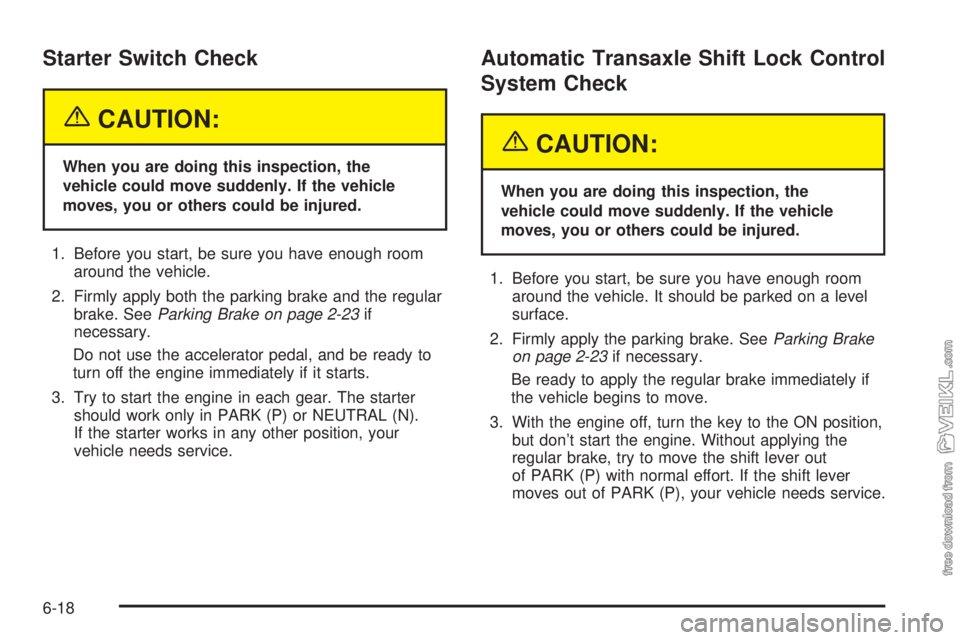
Starter Switch Check
{CAUTION:
When you are doing this inspection, the
vehicle could move suddenly. If the vehicle
moves, you or others could be injured.
1. Before you start, be sure you have enough room
around the vehicle.
2. Firmly apply both the parking brake and the regular
brake. SeeParking Brake on page 2-23if
necessary.
Do not use the accelerator pedal, and be ready to
turn off the engine immediately if it starts.
3. Try to start the engine in each gear. The starter
should work only in PARK (P) or NEUTRAL (N).
If the starter works in any other position, your
vehicle needs service.
Automatic Transaxle Shift Lock Control
System Check
{CAUTION:
When you are doing this inspection, the
vehicle could move suddenly. If the vehicle
moves, you or others could be injured.
1. Before you start, be sure you have enough room
around the vehicle. It should be parked on a level
surface.
2. Firmly apply the parking brake. SeeParking Brake
on page 2-23if necessary.
Be ready to apply the regular brake immediately if
the vehicle begins to move.
3. With the engine off, turn the key to the ON position,
but don’t start the engine. Without applying the
regular brake, try to move the shift lever out
of PARK (P) with normal effort. If the shift lever
moves out of PARK (P), your vehicle needs service.
6-18
Page 317 of 348

Ignition Transaxle Lock Check
While parked, and with the parking brake set, try to turn
the ignition key to OFF in each shift lever position.
The key should turn to OFF only when the shift lever is
in PARK (P).
On all vehicles, the key should come out only in OFF.
Parking Brake and Automatic
Transaxle Park (P) Mechanism Check
{CAUTION:
When you are doing this check, your vehicle
could begin to move. You or others could be
injured and property could be damaged. Make
sure there is room in front of your vehicle in
case it begins to roll. Be ready to apply the
regular brake at once should the vehicle begin
to move.Park on a fairly steep hill, with the vehicle facing
downhill. Keeping your foot on the regular brake, set the
parking brake.
•To check the parking brake’s holding ability: With
the engine running and transaxle in NEUTRAL
(N), slowly remove foot pressure from the regular
brake pedal. Do this until the vehicle is held by the
parking brake only.
•To check the PARK (P) mechanism’s holding
ability: With the engine running, shift to PARK (P).
Then release the parking brake followed by the
regular brake.
Underbody Flushing Service
At least every spring, use plain water to flush any
corrosive materials from the underbody. Take care to
clean thoroughly any areas where mud and other debris
can collect.
6-19
Page 320 of 348
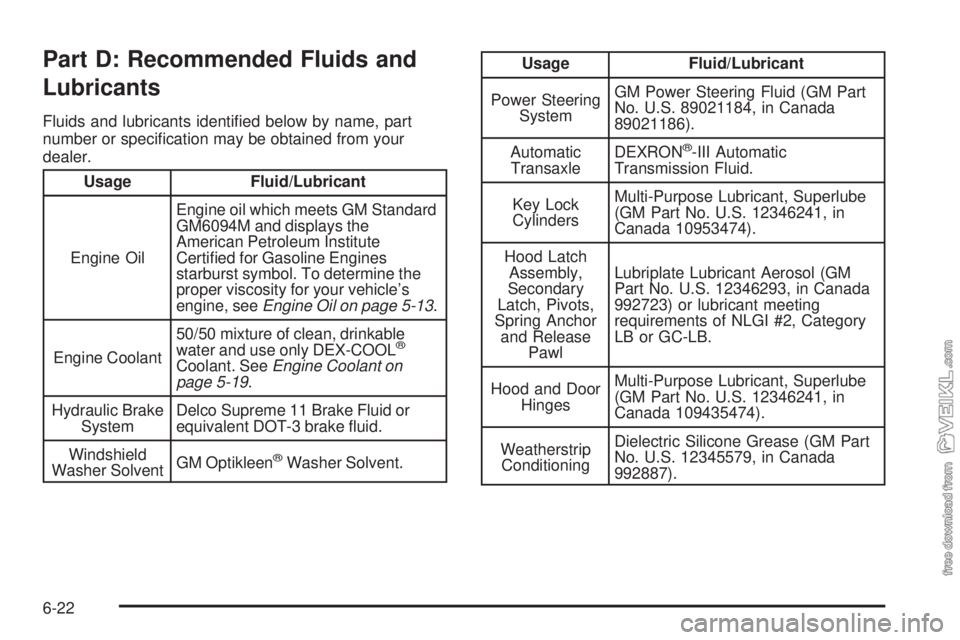
Part D: Recommended Fluids and
Lubricants
Fluids and lubricants identified below by name, part
number or specification may be obtained from your
dealer.
Usage Fluid/Lubricant
Engine OilEngine oil which meets GM Standard
GM6094M and displays the
American Petroleum Institute
Certified for Gasoline Engines
starburst symbol. To determine the
proper viscosity for your vehicle’s
engine, seeEngine Oil on page 5-13.
Engine Coolant50/50 mixture of clean, drinkable
water and use only DEX-COOL
®
Coolant. SeeEngine Coolant on
page 5-19.
Hydraulic Brake
SystemDelco Supreme 11 Brake Fluid or
equivalent DOT-3 brake fluid.
Windshield
Washer SolventGM Optikleen
®Washer Solvent.
Usage Fluid/Lubricant
Power Steering
SystemGM Power Steering Fluid (GM Part
No. U.S. 89021184, in Canada
89021186).
Automatic
TransaxleDEXRON
®-III Automatic
Transmission Fluid.
Key Lock
CylindersMulti-Purpose Lubricant, Superlube
(GM Part No. U.S. 12346241, in
Canada 10953474).
Hood Latch
Assembly,
Secondary
Latch, Pivots,
Spring Anchor
and Release
PawlLubriplate Lubricant Aerosol (GM
Part No. U.S. 12346293, in Canada
992723) or lubricant meeting
requirements of NLGI #2, Category
LB or GC-LB.
Hood and Door
HingesMulti-Purpose Lubricant, Superlube
(GM Part No. U.S. 12346241, in
Canada 109435474).
Weatherstrip
ConditioningDielectric Silicone Grease (GM Part
No. U.S. 12345579, in Canada
992887).
6-22
Page 328 of 348
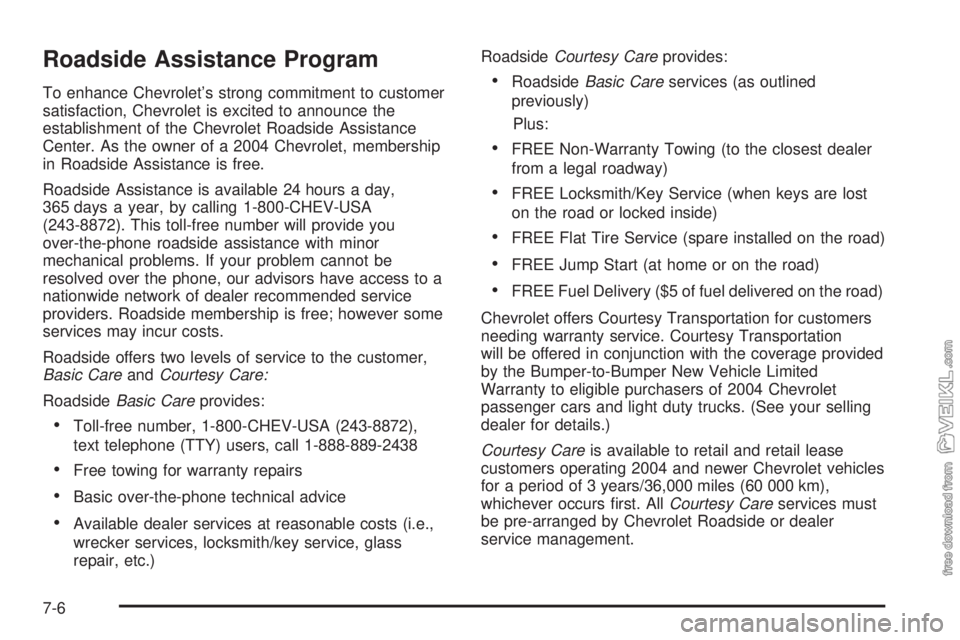
Roadside Assistance Program
To enhance Chevrolet’s strong commitment to customer
satisfaction, Chevrolet is excited to announce the
establishment of the Chevrolet Roadside Assistance
Center. As the owner of a 2004 Chevrolet, membership
in Roadside Assistance is free.
Roadside Assistance is available 24 hours a day,
365 days a year, by calling 1-800-CHEV-USA
(243-8872). This toll-free number will provide you
over-the-phone roadside assistance with minor
mechanical problems. If your problem cannot be
resolved over the phone, our advisors have access to a
nationwide network of dealer recommended service
providers. Roadside membership is free; however some
services may incur costs.
Roadside offers two levels of service to the customer,
Basic CareandCourtesy Care:
RoadsideBasic Careprovides:
•Toll-free number, 1-800-CHEV-USA (243-8872),
text telephone (TTY) users, call 1-888-889-2438
•Free towing for warranty repairs
•Basic over-the-phone technical advice
•Available dealer services at reasonable costs (i.e.,
wrecker services, locksmith/key service, glass
repair, etc.)RoadsideCourtesy Careprovides:
•RoadsideBasic Careservices (as outlined
previously)
Plus:
•FREE Non-Warranty Towing (to the closest dealer
from a legal roadway)
•FREE Locksmith/Key Service (when keys are lost
on the road or locked inside)
•FREE Flat Tire Service (spare installed on the road)
•FREE Jump Start (at home or on the road)
•FREE Fuel Delivery ($5 of fuel delivered on the road)
Chevrolet offers Courtesy Transportation for customers
needing warranty service. Courtesy Transportation
will be offered in conjunction with the coverage provided
by the Bumper-to-Bumper New Vehicle Limited
Warranty to eligible purchasers of 2004 Chevrolet
passenger cars and light duty trucks. (See your selling
dealer for details.)
Courtesy Careis available to retail and retail lease
customers operating 2004 and newer Chevrolet vehicles
for a period of 3 years/36,000 miles (60 000 km),
whichever occurs first. AllCourtesy Careservices must
be pre-arranged by Chevrolet Roadside or dealer
service management.
7-6
Page 341 of 348
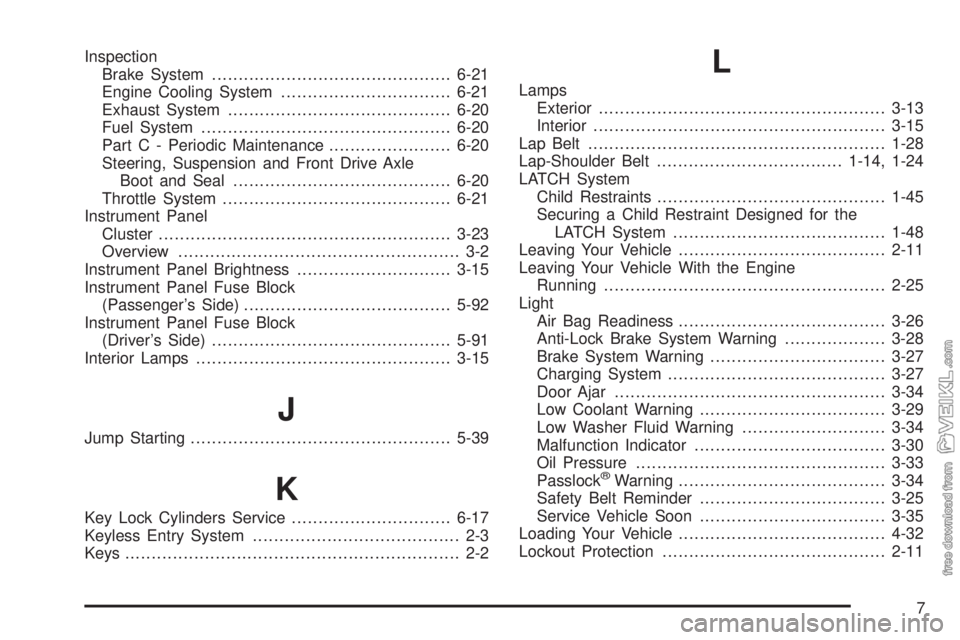
Inspection
Brake System.............................................6-21
Engine Cooling System................................6-21
Exhaust System..........................................6-20
Fuel System...............................................6-20
Part C - Periodic Maintenance.......................6-20
Steering, Suspension and Front Drive Axle
Boot and Seal.........................................6-20
Throttle System...........................................6-21
Instrument Panel
Cluster.......................................................3-23
Overview..................................................... 3-2
Instrument Panel Brightness.............................3-15
Instrument Panel Fuse Block
(Passenger’s Side).......................................5-92
Instrument Panel Fuse Block
(Driver’s Side).............................................5-91
Interior Lamps................................................3-15
J
Jump Starting.................................................5-39
K
Key Lock Cylinders Service..............................6-17
Keyless Entry System....................................... 2-3
Keys............................................................... 2-2
L
Lamps
Exterior......................................................3-13
Interior.......................................................3-15
Lap Belt........................................................1-28
Lap-Shoulder Belt...................................1-14, 1-24
LATCH System
Child Restraints...........................................1-45
Securing a Child Restraint Designed for the
LATCH System........................................1-48
Leaving Your Vehicle.......................................2-11
Leaving Your Vehicle With the Engine
Running.....................................................2-25
Light
Air Bag Readiness.......................................3-26
Anti-Lock Brake System Warning...................3-28
Brake System Warning.................................3-27
Charging System.........................................3-27
Door Ajar...................................................3-34
Low Coolant Warning...................................3-29
Low Washer Fluid Warning...........................3-34
Malfunction Indicator....................................3-30
Oil Pressure...............................................3-33
Passlock
®Warning.......................................3-34
Safety Belt Reminder...................................3-25
Service Vehicle Soon...................................3-35
Loading Your Vehicle.......................................4-32
Lockout Protection..........................................2-11
7
Page 344 of 348
Plan Ahead When Possible................................ 7-8
Playing a Cassette Tape..................................3-48
Playing a CD.........................................3-40, 3-51
Playing the Radio...................................3-38, 3-43
Power............................................................. 1-3
Accessory Outlets........................................3-16
Door Locks.................................................. 2-8
Electrical System.........................................5-89
Steering Fluid.............................................5-31
Windows....................................................2-15
Power Steering................................................ 4-9
Programmable Automatic Door Locks.................. 2-9
Q
Questions and Answers About Safety Belts.........1-12
R
Radio Messages.....................................3-40, 3-48
Radios..........................................................3-36
Care of Your Cassette Tape Player................3-55
Care of Your CD Player...............................3-56
Care of Your CDs........................................3-56
Radio with Cassette and CD.........................3-43
Radio with CD............................................3-38Radios (cont.)
Setting the Time for Radios with Radio Data
Systems (RDS)........................................3-37
Setting the Time for Radios without Radio
Data Systems (RDS)................................3-37
Theft-Deterrent............................................3-54
Understanding Reception..............................3-54
RDS Messages..............................................3-47
Rear Safety Belt Comfort Guides......................1-29
Rear Seat Operation......................................... 1-6
Rear Seat Outside Passenger Positions.............1-24
Rear Seat Passengers, Safety Belts..................1-23
Rear Window Defogger....................................3-20
Rearview Mirrors.............................................2-29
Reclining Seatbacks.......................................... 1-4
Recreational Vehicle Towing.............................4-30
Remote Keyless Entry System............................ 2-3
Remote Keyless Entry System, Operation............ 2-4
Remote Trunk Release....................................2-12
Removing the Flat Tire and Installing the
Spare Tire..................................................5-70
Removing the Spare Tire and Tools...................5-69
Replacement Bulbs.........................................5-50
Replacing Brake System Parts..........................5-37
Replacing Restraint System Parts After
a Crash.....................................................1-63
10