check engine CHEVROLET COLORADO 2021 Duramax Diesel Supplement
[x] Cancel search | Manufacturer: CHEVROLET, Model Year: 2021, Model line: COLORADO, Model: CHEVROLET COLORADO 2021Pages: 89, PDF Size: 1.9 MB
Page 40 of 89
Chevrolet/GMC 2.8L Duramax Diesel Engine Supplement (GMNA-Localizing-
U.S./Canada-14465442) - 2021 - CRC - 2/3/20
Driving and Operating 39
3. Press and release the PTO in-cab switchbelow the climate controls in the center
stack. The PTO indicator light will blink
rapidly until the PTO load relay becomes
engaged and will then be on steady. The
engine will advance to the PTO Standby
Speed.
4. Once the PTO Standby Speed is reached, use SET− and +RES on the cruise control
to reach the Set 1 or Set 2 PTO engine
speeds.
The accelerator pedal is disabled and
cannot be used to override the PTO
preset speeds.
Factory Default PTO Engine Speeds
Standby 900 rpm
Set 1 (SET−) 1200 rpm
Set 2 (+RES) 1900 rpm
The first time a vehicle is used for PTO: 1. The PTO Control setting on the GM Service Tool is programmed to Interior
Mode PTO Switch.
2. Check the correct operation of the default PTO preset stationary mode to
observe the three idle up speeds. The
PTO function should be confirmed before any wiring modifications are done or any
reprogramming is attempted. See your
dealer if the default presets are not
functioning properly.
3. The PTO indicator light will not initially reflect the status of the PTO load until
the PTO load relay is wired into the
system. The PTO load relay output is
enabled as a factory default. When the
PTO indicator light is either blinking or
on solid, the PTO relay output will be
activated.
Preset Enable Conditions –Remote
Operation
This requires programming with the GM
Service Tool and remote switch panel
provided by GM Upfitter.
1. Confirm that cruise control is off.
2. Set the parking brake and shift the transmission into P (Park).
3. Turn the engine off. Remove or place the key in the ignition off position. Lock the
vehicle, if desired.
4. Confirm the hood is closed.
5. From outside the vehicle, press and release the Remote PTO Arm switch. 6. Within five seconds, open and close the
Remote PTO Engine Start/Shutdown
switch.
7. The horn will chirp, and then engine starting will be automatically initiated.
The PTO system will then elevate engine
rpm to PTO Standby Speed and engage
the PTO load relay.
8. The Remote PTO Set switch can now be used to accomplish the PTO Set 1 and
Set 2 engine speeds.
The accelerator pedal is disabled when
Remote PTO operation is selected.
Preset Enable Conditions –Remote
Operation In-Cab Enable
This requires programming with the GM
Service Tool and remote switch panel
provided by GM Upfitter.
Starting remote operation in-cab:
1. With the engine running, shift the vehicle into P (Park), release the brake
pedal, and set the parking brake.
2. Confirm that cruise control is off.
3. Confirm the hood is closed.
4. Press and release the in-cab PTO switch.
Page 53 of 89
Chevrolet/GMC 2.8L Duramax Diesel Engine Supplement (GMNA-Localizing-
U.S./Canada-14465442) - 2021 - CRC - 2/3/20
52 Vehicle Care
Vehicle Care
General Information
Accessories and Modifications . . . . . . . . . . 52
Vehicle Checks
Engine Compartment Overview . . . . . . . . . 53
Engine Oil . . . . . . . . . . . . . . . . . . . . . . . . . . . . . . 55
Engine Oil Life System . . . . . . . . . . . . . . . . . 58
Automatic Transmission Fluid . . . . . . . . . . 58
Engine Air Cleaner/Filter . . . . . . . . . . . . . . . . 58
Cooling System . . . . . . . . . . . . . . . . . . . . . . . . 60
Engine Overheating . . . . . . . . . . . . . . . . . . . . 62
Battery (4-Cylinder Pickup Only) . . . . . . . . 63
Electrical System
Engine Compartment Fuse Block . . . . . . . 64
Appearance Care
Exterior Care . . . . . . . . . . . . . . . . . . . . . . . . . . . . 71
General Information
Accessories and Modifications
Adding non-dealer accessories or making
modifications to the vehicle can affect
vehicle performance and safety, including
such things as airbags, braking, stability,
ride and handling, emissions systems,
aerodynamics, durability, and electronic
systems like antilock brakes, traction control,
and stability control. These accessories or
modifications could even cause malfunction
or damage not covered by the vehicle
warranty.
Damage to vehicle components resulting
from modifications or the installation or use
of non-GM certified parts, including control
module or software modifications, is not
covered under the terms of the vehicle
warranty and may affect remaining
warranty coverage for affected parts.
GM Accessories are designed to complement
and function with other systems on the
vehicle. See your dealer to accessorize the
vehicle using genuine GM Accessories
installed by a dealer technician.
See the warranty manual.
Aftermarket Engine Performance
Enhancement Products and Modifications
Some aftermarket engine performance
products and modifications promise a way
to increase the horsepower and torque
levels of the vehicle's powertrain. You should
be aware that these products could have
harmful effects on the performance and life
of the engine, exhaust emission system,
transmission, and drivetrain. The engine,
transmission, and drivetrain have been
designed and built to offer industry leading
durability and performance in the most
demanding applications. Engine power
enhancement products may enable the
engine to operate at horsepower and torque
levels that could damage, create failure,
or reduce the life of the engine, engine
emission system, transmission, and
drivetrain. Damage, failure, or reduced life of
the engine, transmission, emission system,
drivetrain, or other vehicle components
caused by aftermarket engine performance
enhancement products or modifications
might not be covered under the vehicle
warranty.
Page 54 of 89
Chevrolet/GMC 2.8L Duramax Diesel Engine Supplement (GMNA-Localizing-
U.S./Canada-14465442) - 2021 - CRC - 2/3/20
Vehicle Care 53
Vehicle Checks
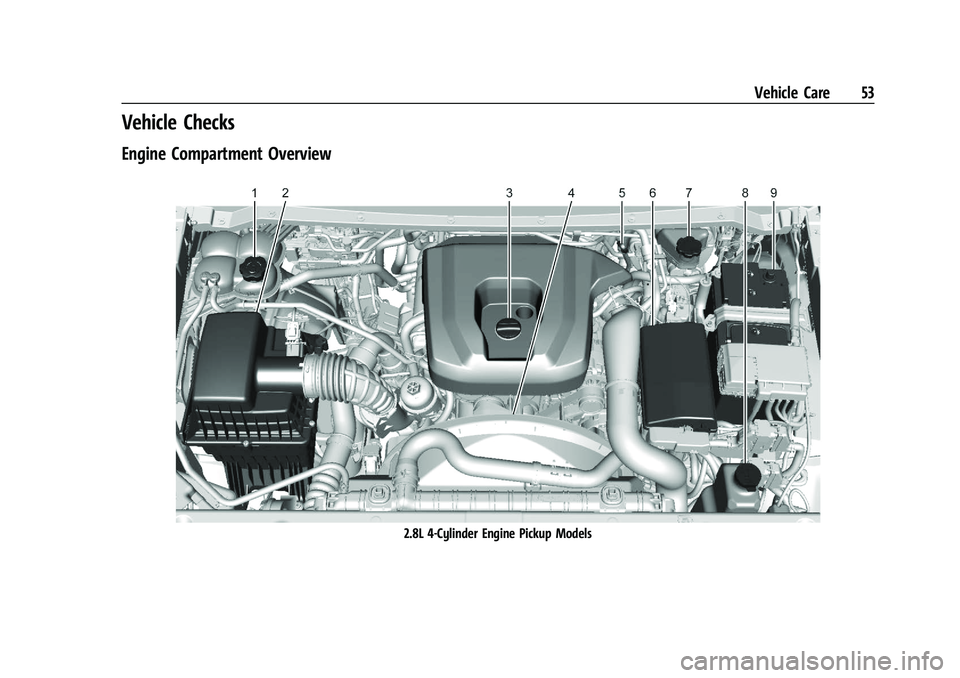
Engine Compartment Overview
2.8L 4-Cylinder Engine Pickup Models
Page 57 of 89
Chevrolet/GMC 2.8L Duramax Diesel Engine Supplement (GMNA-Localizing-
U.S./Canada-14465442) - 2021 - CRC - 2/3/20
56 Vehicle Care
.Use engine oil approved to the proper
specification and of the proper viscosity
grade. See“Selecting the Right Engine
Oil” in this section.
.Check the engine oil level regularly and
maintain the proper oil level. See
“Checking Engine Oil” and“When to Add
Engine Oil” in this section.
.Change the engine oil at the appropriate
time. See“Engine Oil Life System” in the
owner’s manual.
.Always dispose of engine oil properly. See
“What to Do with Used Oil” in this
section.
Checking Engine Oil
Check the engine oil level regularly, every
650 km (400 mi), especially prior to a long
trip. The engine oil dipstick handle is a loop.
See Engine Compartment Overview 053 for
the location.
{Warning
The engine oil dipstick handle may be
hot; it could burn you. Use a towel or
glove to touch the dipstick handle.
If a low oil Driver Information Center (DIC)
message displays, check the oil level. Follow these guidelines:
.To get an accurate reading, park the
vehicle on level ground. Check the engine
oil level after the engine has been off for
at least two hours. Checking the engine
oil level on steep grades or too soon after
engine shutoff can result in incorrect
readings. Accuracy improves when
checking a cold engine prior to starting.
Remove the dipstick and check the level.
.If unable to wait two hours, the engine
must be off for at least 15 minutes if the
engine is warm, or at least 30 minutes if
the engine is not warm. Pull out the
dipstick, wipe it with a clean paper towel
or cloth, then push it back in all the way.
Remove it again, keeping the tip down,
and check the level.
When to Add Engine Oil
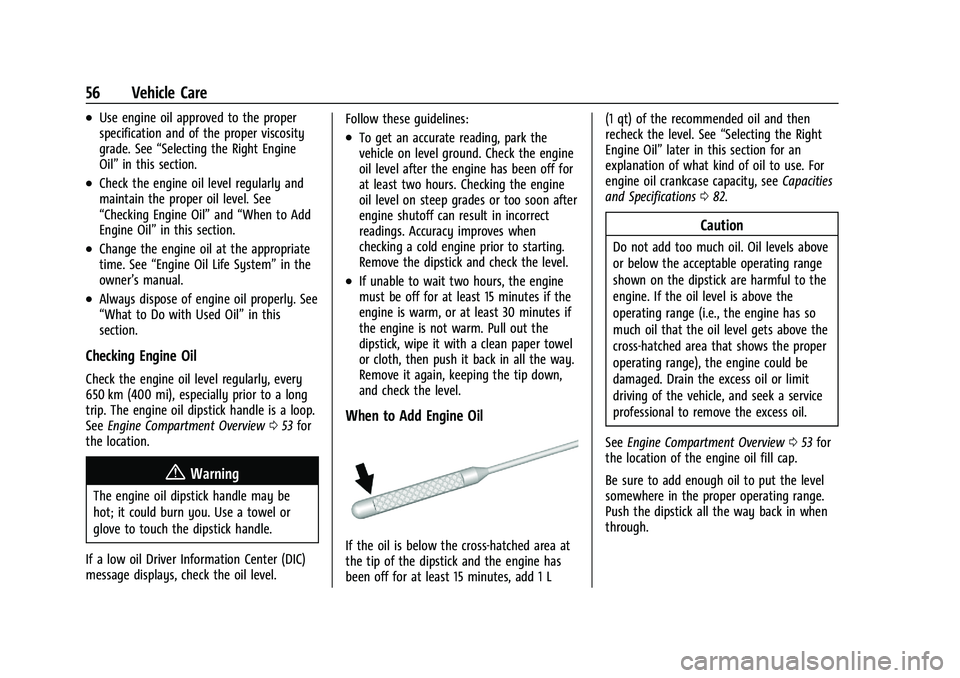
If the oil is below the cross-hatched area at
the tip of the dipstick and the engine has
been off for at least 15 minutes, add 1 L(1 qt) of the recommended oil and then
recheck the level. See
“Selecting the Right
Engine Oil” later in this section for an
explanation of what kind of oil to use. For
engine oil crankcase capacity, see Capacities
and Specifications 082.
Caution
Do not add too much oil. Oil levels above
or below the acceptable operating range
shown on the dipstick are harmful to the
engine. If the oil level is above the
operating range (i.e., the engine has so
much oil that the oil level gets above the
cross-hatched area that shows the proper
operating range), the engine could be
damaged. Drain the excess oil or limit
driving of the vehicle, and seek a service
professional to remove the excess oil.
See Engine Compartment Overview 053 for
the location of the engine oil fill cap.
Be sure to add enough oil to put the level
somewhere in the proper operating range.
Push the dipstick all the way back in when
through.
Page 59 of 89
Chevrolet/GMC 2.8L Duramax Diesel Engine Supplement (GMNA-Localizing-
U.S./Canada-14465442) - 2021 - CRC - 2/3/20
58 Vehicle Care
engine at extremely low temperatures.
When selecting an oil of the appropriate
viscosity grade, it is recommended to select
an oil of the correct specification. See
“Specification”earlier in this section.
Engine Oil Additives/Engine Oil Flushes
Do not add anything to the oil. The
recommended oils meeting the dexos2
specification are all that is needed for good
performance and engine protection.
Engine oil system flushes are not
recommended and could cause engine
damage not covered by the vehicle
warranty.
What to Do with Used Oil
Used engine oil contains certain elements
that can be unhealthy for your skin and
could even cause cancer. Do not let used oil
stay on your skin for very long. Clean your
skin and nails with soap and water, or a
good hand cleaner. Wash or properly
dispose of clothing or rags containing used
engine oil. See the manufacturer's warnings
about the use and disposal of oil products.
Used oil can be a threat to the environment.
If you change your own oil, be sure to drain
all the oil from the filter before disposal. Never dispose of oil by putting it in the
trash or pouring it on the ground, into
sewers, or into streams or bodies of water.
Recycle it by taking it to a place that
collects used oil.
Engine Oil Life System
The engine oil life system calculates engine
oil life based on vehicle use and displays the
CHANGE ENGINE OIL SOON message when it
is time to change the engine oil and filter.
The oil life system should be reset to 100%
only following an oil change. See
“Engine Oil
Life System” in the owner’s manual.
Automatic Transmission Fluid
When to Check and Change (2.8L
4-Cylinder Engine Pickup Models)
See“Automatic Transmission Fluid” in the
owner’s manual.
When to Check and Change (2.8L
4-Cylinder Engine Van Models)
It is not necessary to check the transmission
fluid level. A transmission fluid leak is the
only reason for fluid loss. If a leak occurs,
take the vehicle to your dealer and have it
repaired as soon as possible. There is a special procedure for checking and
changing the transmission fluid. Because this
procedure is difficult, this should be done at
your dealer. Contact your dealer for
additional information.
Change the fluid and filter at the intervals
listed in
Maintenance Schedule 073 or
Maintenance Schedule 077, and be sure to
use the fluid listed in Recommended Fluids
and Lubricants 078.
Engine Air Cleaner/Filter
2.8L 4-Cylinder Engine Pickup Models
See “Engine Air Cleaner/Filter” in the
owner’s manual.
2.8L 4-Cylinder Engine Van Models
The air cleaner/filter assembly is on the
front of the engine compartment on the
driver side of the vehicle. See Engine
Compartment Overview 053.
When to Inspect/Replace the Engine Air
Cleaner/Filter
For intervals on changing and inspecting the
engine air filter, see Maintenance Schedule
0 73 or
Maintenance Schedule 077.
Page 62 of 89
Chevrolet/GMC 2.8L Duramax Diesel Engine Supplement (GMNA-Localizing-
U.S./Canada-14465442) - 2021 - CRC - 2/3/20
Vehicle Care 61
Use a 50/50 mixture of clean, drinkable
water and DEX-COOL coolant which will not
damage aluminum parts. If using this
mixture, nothing else needs to be added.
If coolant has to be added more than four
times a year, have your dealer check the
vehicle cooling system.
Caution
Do not use anything other than a mix of
DEX-COOL coolant that meets GM
Standard GMW3420 and clean, drinkable
water. Anything else can cause damage
to the engine cooling system and the
vehicle, which would not be covered by
the vehicle warranty.
Never dispose of engine coolant by putting
it in the trash, or by pouring it on the
ground or into sewers, streams, or bodies of
water. Have the coolant changed by an
authorized service center, familiar with legal
requirements regarding used coolant
disposal. This will help protect the
environment and your health.
Checking Coolant (2.8L 4-Cylinder Engine
Pickup Models)
See “Engine Coolant” in the owner’s manual. Checking Coolant (2.8L 4-Cylinder Engine Van
Models)
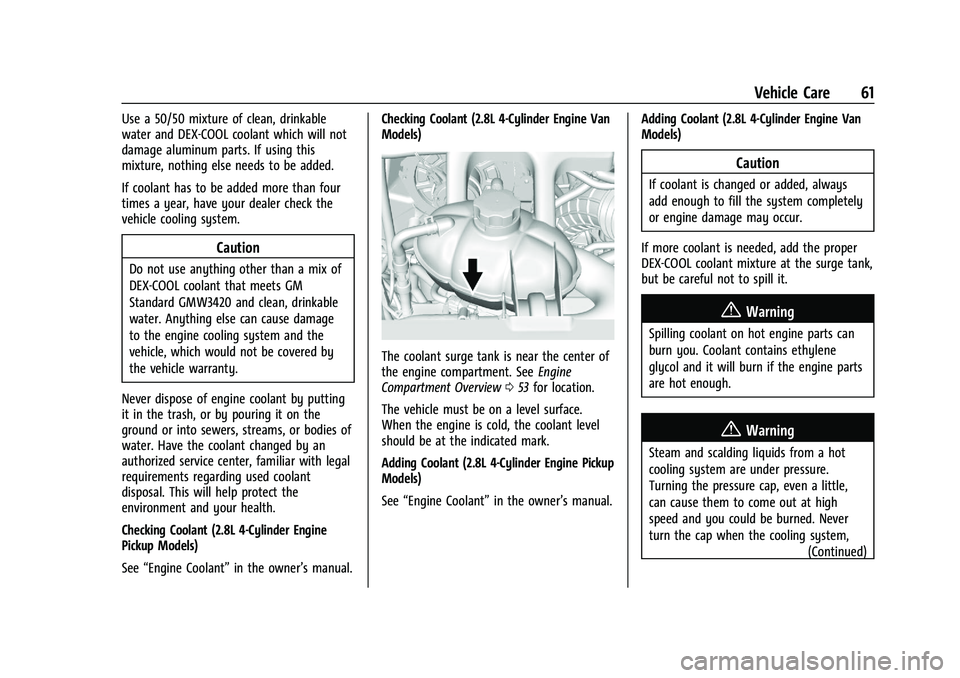
The coolant surge tank is near the center of
the engine compartment. See
Engine
Compartment Overview 053 for location.
The vehicle must be on a level surface.
When the engine is cold, the coolant level
should be at the indicated mark.
Adding Coolant (2.8L 4-Cylinder Engine Pickup
Models)
See “Engine Coolant” in the owner’s manual. Adding Coolant (2.8L 4-Cylinder Engine Van
Models)
Caution
If coolant is changed or added, always
add enough to fill the system completely
or engine damage may occur.
If more coolant is needed, add the proper
DEX-COOL coolant mixture at the surge tank,
but be careful not to spill it.
{Warning
Spilling coolant on hot engine parts can
burn you. Coolant contains ethylene
glycol and it will burn if the engine parts
are hot enough.
{Warning
Steam and scalding liquids from a hot
cooling system are under pressure.
Turning the pressure cap, even a little,
can cause them to come out at high
speed and you could be burned. Never
turn the cap when the cooling system, (Continued)
Page 63 of 89
Chevrolet/GMC 2.8L Duramax Diesel Engine Supplement (GMNA-Localizing-
U.S./Canada-14465442) - 2021 - CRC - 2/3/20
62 Vehicle Care
Warning (Continued)
including the pressure cap, is hot. Wait
for the cooling system and pressure cap
to cool.
If no coolant is visible in the surge tank, add
coolant as follows:
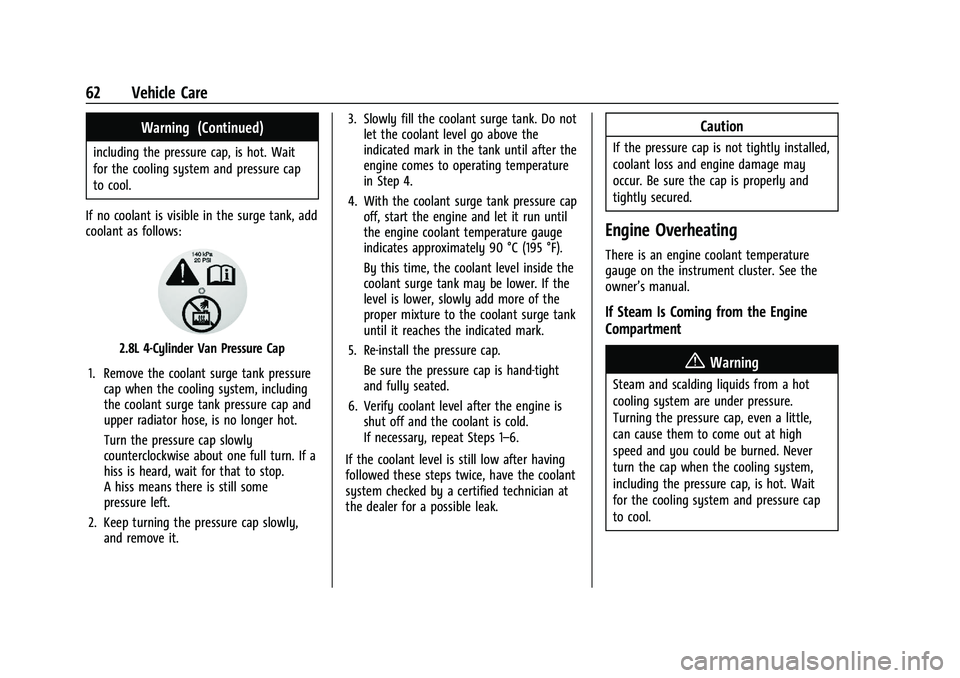
2.8L 4-Cylinder Van Pressure Cap
1. Remove the coolant surge tank pressure cap when the cooling system, including
the coolant surge tank pressure cap and
upper radiator hose, is no longer hot.
Turn the pressure cap slowly
counterclockwise about one full turn. If a
hiss is heard, wait for that to stop.
A hiss means there is still some
pressure left.
2. Keep turning the pressure cap slowly, and remove it. 3. Slowly fill the coolant surge tank. Do not
let the coolant level go above the
indicated mark in the tank until after the
engine comes to operating temperature
in Step 4.
4. With the coolant surge tank pressure cap off, start the engine and let it run until
the engine coolant temperature gauge
indicates approximately 90 °C (195 °F).
By this time, the coolant level inside the
coolant surge tank may be lower. If the
level is lower, slowly add more of the
proper mixture to the coolant surge tank
until it reaches the indicated mark.
5. Re-install the pressure cap. Be sure the pressure cap is hand-tight
and fully seated.
6. Verify coolant level after the engine is shut off and the coolant is cold.
If necessary, repeat Steps 1–6.
If the coolant level is still low after having
followed these steps twice, have the coolant
system checked by a certified technician at
the dealer for a possible leak.
Caution
If the pressure cap is not tightly installed,
coolant loss and engine damage may
occur. Be sure the cap is properly and
tightly secured.
Engine Overheating
There is an engine coolant temperature
gauge on the instrument cluster. See the
owner’s manual.
If Steam Is Coming from the Engine
Compartment
{Warning
Steam and scalding liquids from a hot
cooling system are under pressure.
Turning the pressure cap, even a little,
can cause them to come out at high
speed and you could be burned. Never
turn the cap when the cooling system,
including the pressure cap, is hot. Wait
for the cooling system and pressure cap
to cool.
Page 64 of 89
Chevrolet/GMC 2.8L Duramax Diesel Engine Supplement (GMNA-Localizing-
U.S./Canada-14465442) - 2021 - CRC - 2/3/20
Vehicle Care 63
Caution
Do not run the engine if there is a leak
in the engine cooling system. This can
cause a loss of all coolant and can
damage the system and vehicle. Have
any leaks fixed right away.
If No Steam Is Coming from the Engine
Compartment
A Driver Information Center (DIC) message,
along with a low coolant condition, can
indicate a serious problem.
If there is an engine overheat warning and
the vehicle does not have a low coolant
condition, and no steam is heard or seen,
the problem may not be too serious.
Sometimes the engine can get a little too
hot when the vehicle:
.Climbs a long hill on a hot day.
.Stops after high-speed driving.
.Idles for long periods in traffic.
.Tows a trailer. See“Driving on Grades”
under “Driving Characteristics and Towing
Tips” in the owner’s manual. If the DIC message comes on with no sign
of steam, try this for a minute or so:
1. In heavy traffic, let the engine idle in N (Neutral) while stopped. If it is safe to
do so, pull off the road, shift to P (Park)
or N (Neutral), and let the engine idle.
2. Turn on the heater to full hot at the highest fan speed and open the window
as necessary.
If the vehicle no longer has the overheat
warning, the vehicle can be driven. Just to
be safe, drive slower for about 10 minutes.
If the warning does not come back on, drive
normally and have the cooling system
checked for proper fill and function.
If the warning continues, pull over, stop, and
park the vehicle right away.
If there is still no sign of steam and the
vehicle is equipped with an engine driven
cooling fan, push down the accelerator until
the engine speed is about twice as fast as
normal idle speed for at least five minutes
while the vehicle is parked. If the warning is
still there, turn off the engine and get
everyone out of the vehicle until it
cools down.
Battery (4-Cylinder Pickup Only)
Pickups with a 4-cylinder diesel engine are
equipped with an AGM (Absorbing Glass
Mat) 12-volt battery. Installation of a
standard 12-volt battery will result in
reduced cold cranking performance. When
using a battery charger on the AGM battery,
use the AGM setting on the charger,
if available, to limit charge voltage to
14.8 volts. Follow the charger manufacturer's
instructions. See “Battery - North America”
in the owner’s manual.
Page 72 of 89
Chevrolet/GMC 2.8L Duramax Diesel Engine Supplement (GMNA-Localizing-
U.S./Canada-14465442) - 2021 - CRC - 2/3/20
Vehicle Care 71
FusesUsage
MR-1 Fuel filter heater
MR-2 Diesel exhaust fluid power
MR-3 Diesel exhaust fluid wake up
Relays Usage
MR Rel 1 Fuel filter heater
MR Rel 2 Diesel exhaust fluid power/Wake up
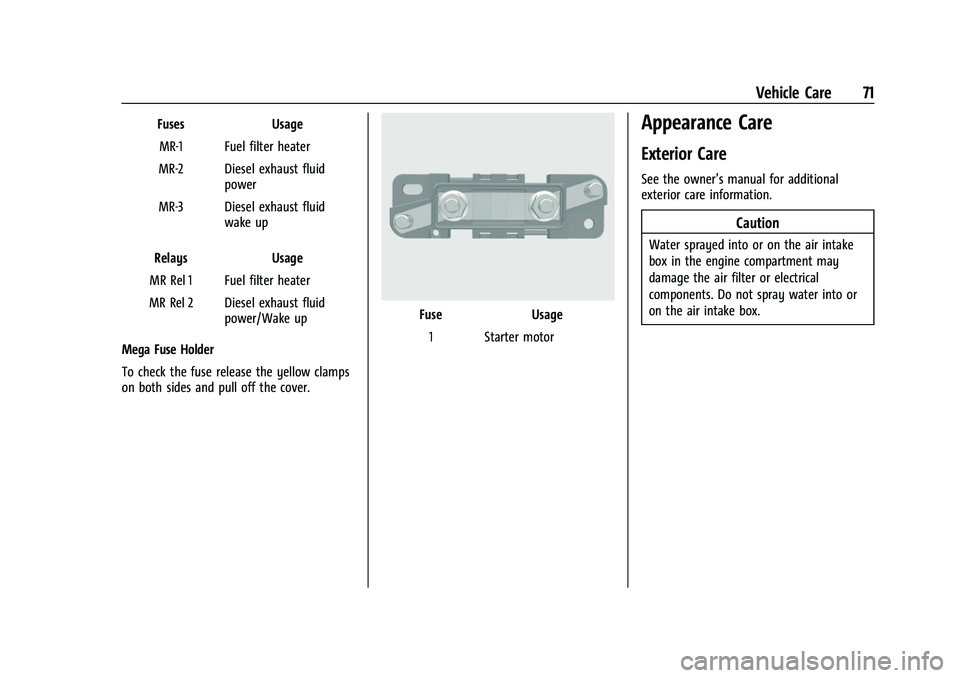
Mega Fuse Holder
To check the fuse release the yellow clamps
on both sides and pull off the cover.
Fuse Usage
1 Starter motor
Appearance Care
Exterior Care
See the owner’s manual for additional
exterior care information.
Caution
Water sprayed into or on the air intake
box in the engine compartment may
damage the air filter or electrical
components. Do not spray water into or
on the air intake box.
Page 73 of 89
Chevrolet/GMC 2.8L Duramax Diesel Engine Supplement (GMNA-Localizing-
U.S./Canada-14465442) - 2021 - CRC - 2/3/20
72 Service and Maintenance
Service and Maintenance
General Information
General Information . . . . . . . . . . . . . . . . . . . . 72
Maintenance Schedule
Maintenance Schedule . . . . . . . . . . . . . . . . . . 73
Maintenance Schedule . . . . . . . . . . . . . . . . . . 77
Recommended Fluids, Lubricants, and
Parts
Recommended Fluids and Lubricants . . . 78
Maintenance Replacement Parts . . . . . . . . 79
Maintenance Records
Maintenance Records . . . . . . . . . . . . . . . . . . . 80
General Information
This maintenance section applies to vehicles
with a diesel engine. For gasoline engine
vehicles, see the maintenance schedule
section in the owner’s manual.
Your vehicle is an important investment.
This section describes the required
maintenance for the vehicle. Follow this
schedule to help protect against major repair
expenses resulting from neglect or
inadequate maintenance. It may also help to
maintain the value of the vehicle if it is
sold. It is the responsibility of the owner to
have all required maintenance performed.
Your dealer has trained technicians who can
perform required maintenance using genuine
replacement parts. They have up-to-date
tools and equipment for fast and accurate
diagnostics. Many dealers have extended
evening and Saturday hours, courtesy
transportation, and online scheduling to
assist with service needs.Your dealer recognizes the importance of
providing competitively priced maintenance
and repair services. With trained technicians,
your dealer is the place for routine
maintenance such as oil changes and tire
rotations and additional maintenance items
like tires, brakes, batteries, and wiper blades.
Caution
Damage caused by improper maintenance
can lead to costly repairs and may not be
covered by the vehicle warranty.
Maintenance intervals, checks,
inspections, recommended fluids, and
lubricants are important to keep the
vehicle in good working condition.
Do not have chemical flushes that are not
approved by GM performed on the
vehicle. The use of flushes, solvents,
cleaners, or lubricants that are not
approved by GM could damage the
vehicle, requiring expensive repairs that
are not covered by the vehicle warranty.