battery CHEVROLET CORVETTE 1996 4.G User Guide
[x] Cancel search | Manufacturer: CHEVROLET, Model Year: 1996, Model line: CORVETTE, Model: CHEVROLET CORVETTE 1996 4.GPages: 386, PDF Size: 20.12 MB
Page 95 of 386
Downloaded from www.Manualslib.com manuals search engine Accessory Plug
This plug is under the trim panel in the front part of the
center console. The plug can be used to connect
electrical equipment such as a cellular phone or
CB
radio. Be sure to follow the installation instructions
included with the equipment.
To use the accessory plug:
1. Open the center console and carefully pull the carpet
away from the coinholder to uncover the screws on
either side.
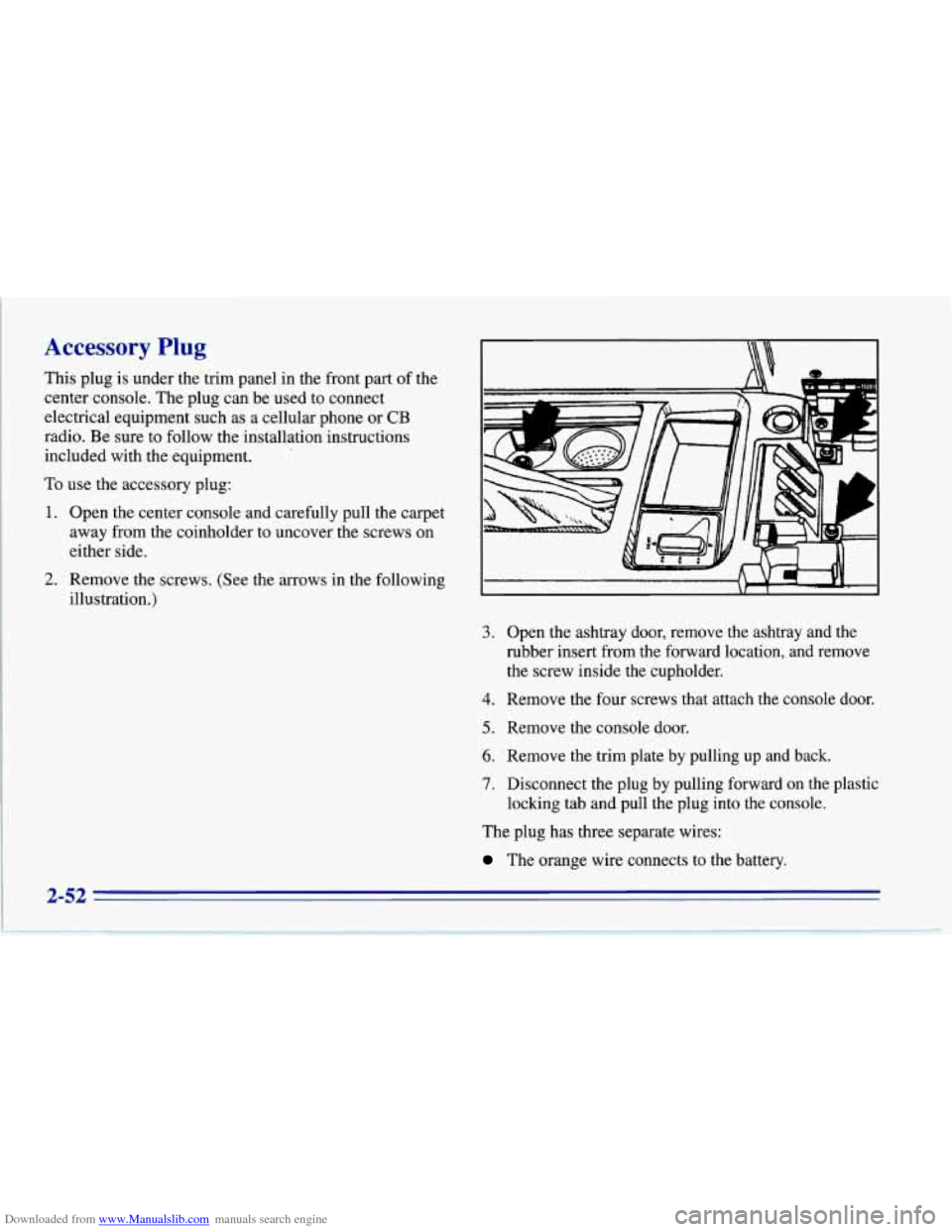
2. Remove the screws. (See the arrows in the following
illustration.)
3. Open the ashtray door, remove the ashtray and the
rubber insert from the forward location, and remove
the screw inside the cupholder.
4. Remove the four screws that attach the console door.
5. Remove the console door.
6. ' Remove the trim plate by pulling up and back.
7. Disconnect the plug by pulling forward on the plastic
The plug has three separate wires:
locking
tab and pull the plug into the console.
The orange wire connects to the battery.
Page 96 of 386
Downloaded from www.Manualslib.com manuals search engine The pink wire connects to the ignition. Power is only
available in the RUN position.
The black wire connects to the ground.
NOTICE:
When using the accessory plug:
Don’t splice wires directly into the accessory
plug
wire. If done incorrectly, splicing might
cause damage to your electrical system.
The maximum load of any electrical
equipment should not exceed
10 amps.
0 Be sure to turn off any electrical equipment
when not in use. Leaving electrical
equipment on for extended periods can
drain your battery.
0 Do not use this plug if the electrical
equipment requires frequent connecting
and disconnecting. This may cause
excessive wear on the accessory plug and
damage your electrical system.
After you’ve installed the electrical equipment, put the trim
panel and console lid back in place and install the screws.
Roof Panel (Coupe)
Until you are sure you can remove the panel alone, have
someone help you.
Removing the Roof Panel
A CAUTION:
Don’t try to remove the roof panel while the
vehicle is moving. Trying to remove the roof
panel while the vehicle
is moving could cause an
accident. The panel could fall into the vehicle and
cause you to lose control, or it could
fly off and
strike another vehicle. You or others could be
injured. Remove the roof panel only when the
vehicle is parked.
1. Park on a level surface, set the parking brake firmly
and shift an automatic transmission into PARK (P).
Shift a manual transmission into REVERSE
(R).
Lower both windows, turn the ignition key to LOCK
and move both sunshades to the side.
2-53
Page 104 of 386
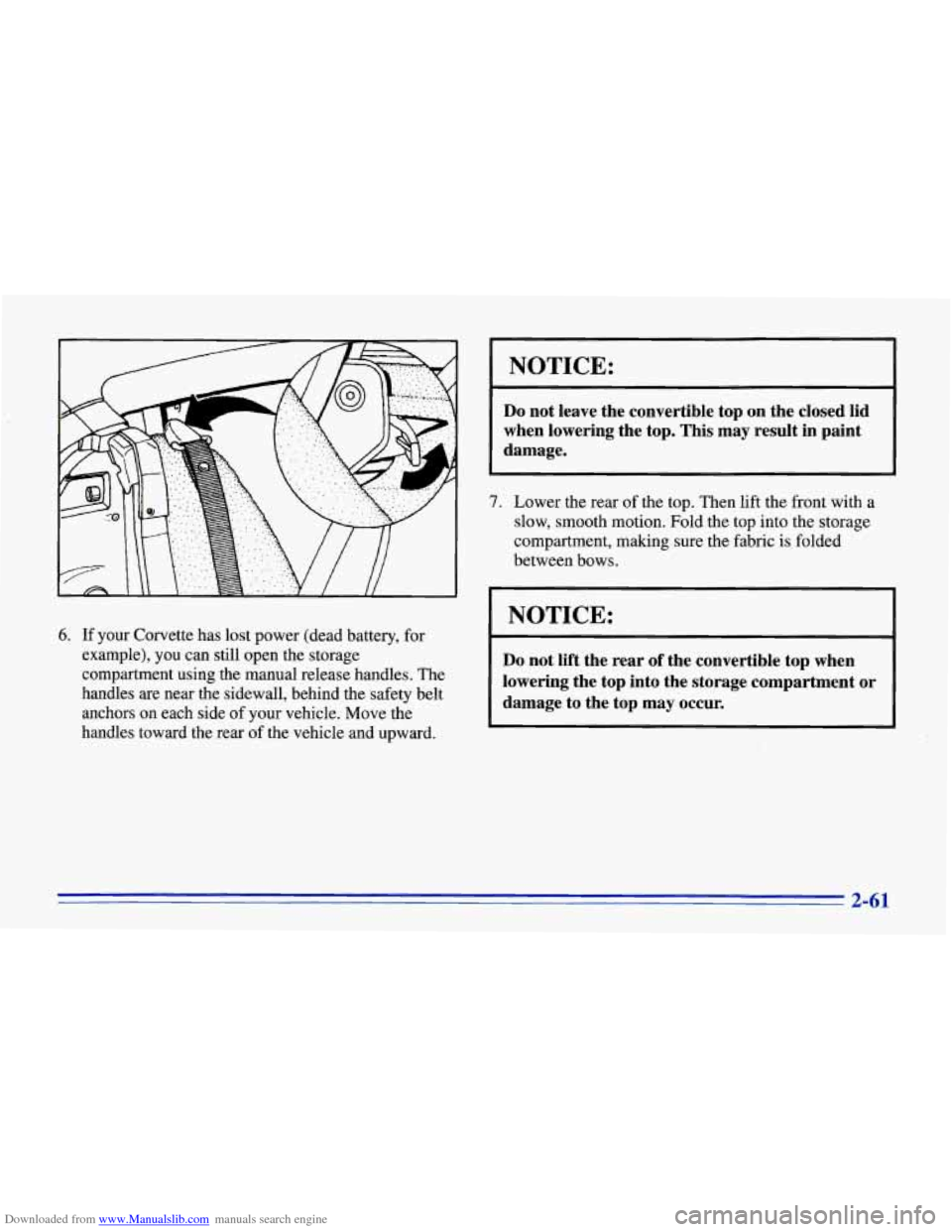
Downloaded from www.Manualslib.com manuals search engine 6. If your Corvette has lost power (dead battery, for
example), you can still open the storage
compartment using the manual release handles. The
handles are near the sidewall, behind the safety belt
anchors on each side of your vehicle. Move the
handles toward the rear of the vehicle and upward.
1
NOTICE:
Do not leave the convertible top on the closed lid
when lowering the top. This may result in paint
damage.
7. Lower the rear of the top. Then lift the front with a
slow, smooth motion. Fold the top into the storage
compartment, making sure the fabric is folded
between bows.
NOTICE:
r
Do not lift the rear of the convertible top when
lowering the top into the storage compartment
or
damage to the top may occur.
2-61
Page 119 of 386
Downloaded from www.Manualslib.com manuals search engine Air Bag Readiness Light
There is an air bag readiness light on the instrument
panel, which shows AIR BAG. The system checks the
air bag’s electrical system for malfunctions. The light
tells you if there is an electrical problem. The system
check includes the air bag sensors, the air bag modules,
the wiring
and the diagnostic module. For more
information on the air bag system, see “Air Bag” in
the Index.
AIR
BAG
You will see this light flash
for a few seconds when you
turn your ignition to RUN
or START. Then the light
should go out. This means
the system is ready.
If the air bag readiness light doesn’t come on when you
start your vehicle, or stays on,
or comes on when you
are driving, your air bag system may not work properly.
Have your vehicle serviced right away.
Charging System Indicator Light
-+I
This light will come on
when you turn on the
ignition, but the engine is
not running, as a check to
show you it is working. It
should go out when the
engine starts.
If it stays on or comes on while you are driving, you
may have a problem with the electrical charging system.
It could indicate that you have a loose or broken drive
belt or another electrical problem. Have it checked
right away. Driving while this light is on could drain
your battery.
If you must drive a short distance with the light on, be
certain to turn
off all your accessories, such as the radio
and air conditioner.
2-76
Page 120 of 386
Downloaded from www.Manualslib.com manuals search engine Voltmeter
El
VOLTS
18
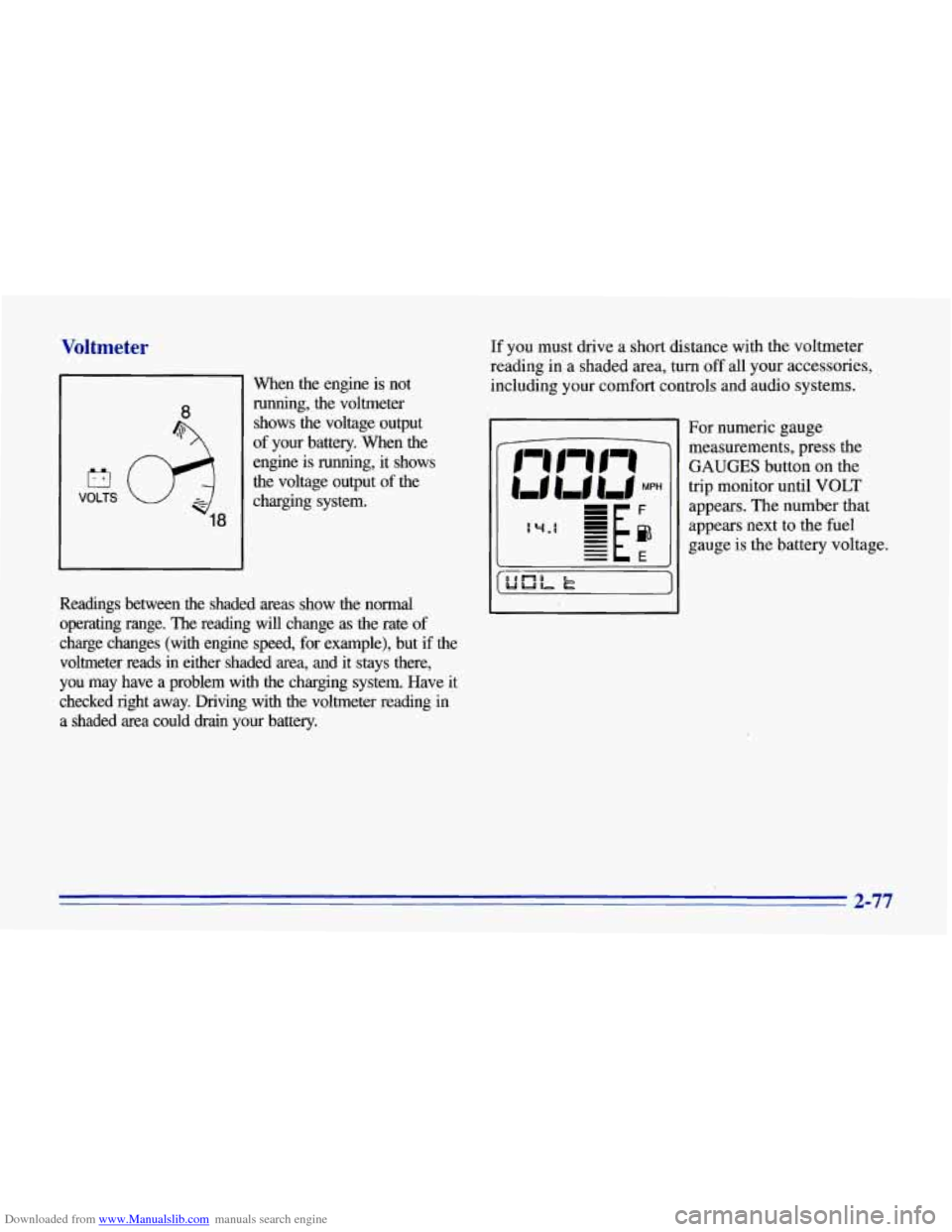
When the engine is not running, the voltmeter
shows the voltage output
of your battery.
When the
engine is running, it shows
the voltage output of the
charging system.
Readings between the shaded areas show the normal
operating range. The reading will change as the rate of
charge changes (with engine speed, for example), but
if the
voltmeter reads in either shaded area, and it stays there,
you may have a problem with the charging system. Have it
checked right away. Driving with the voltmeter reading
in
a shaded area could drain your battery. If you
must drive a short distance with the voltmeter
reading in a shaded area, turn
off all your accessories,
including your comfort controls and audio systems.
For numeric gauge
measurements, press the
GAUGES button on the
trip monitor until
VOLT
appears. The number that
appears next to the fuel
gauge is the battery voltage.
2-77
Page 136 of 386
Downloaded from www.Manualslib.com manuals search engine Security Light Check Gauges Light
SECURITY
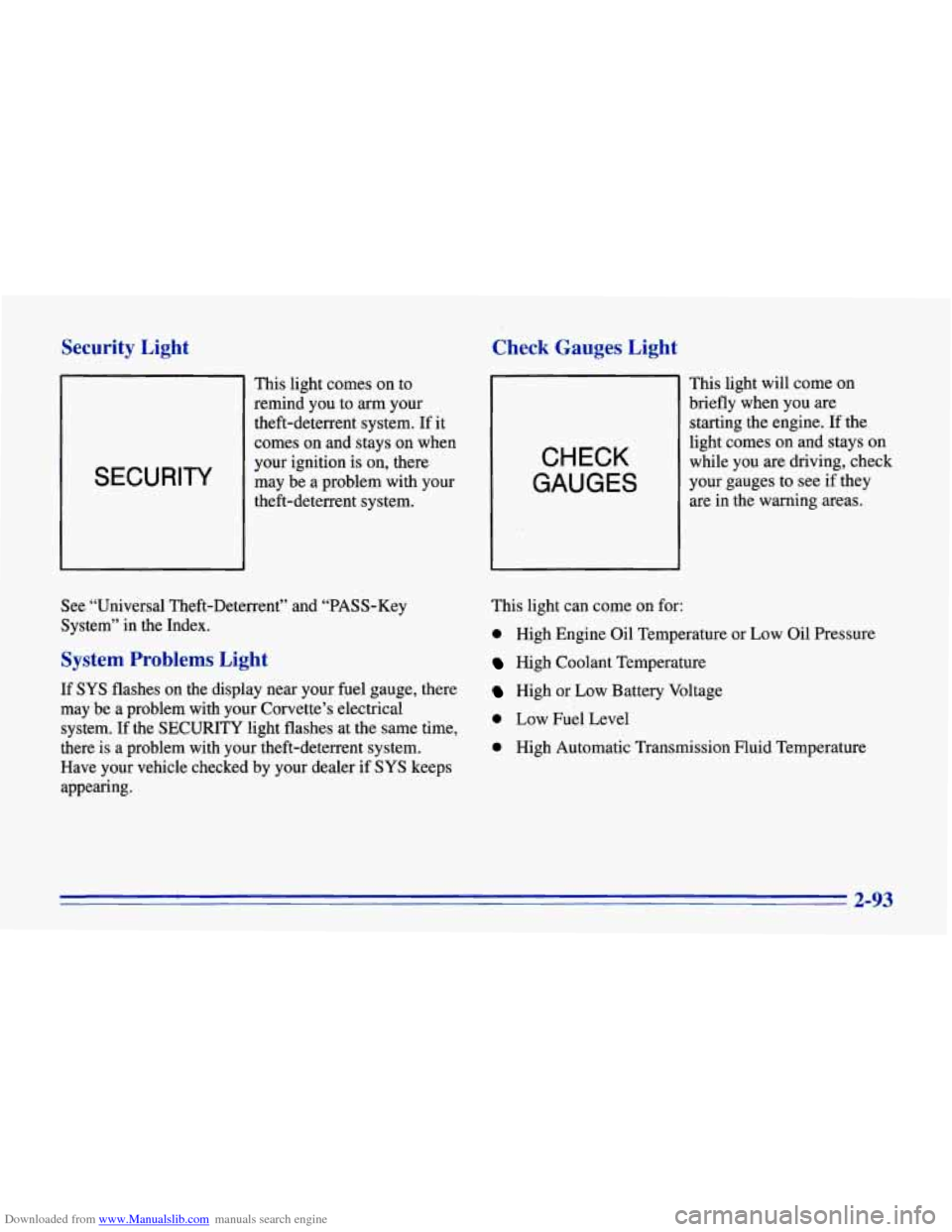
This light comes on to
remind you to
arm your
theft-deterrent system. If it
comes on and stays on when
your ignition is on, there
may be a problem with your
theft-deterrent system.
CHECK
GAUGES
This light will come on
briefly when you are
starting the engine.
If the
light comes on and stays on
while you are driving, check
your gauges to see if they
are in the warning areas.
See “Universal Theft-Deterrent” and “PASS-Key
System” in the Index.
System Problems Light
If SYS flashes on the display near your fuel gauge, there
may be a problem with your Corvette’s electrical
system. If the
SECURITY light flashes at the same time,
there is
a problem with your theft-deterrent system.
Have your vehicle checked by your dealer
if SYS keeps
appearing. This
light can come on for:
0 High Engine Oil Temperature or Low oil Pressure
High Coolant Temperature
High or Low Battery Voltage
0 Low Fuel Level
0 High Automatic Transmission Fluid Temperature
2-93
Page 188 of 386
Downloaded from www.Manualslib.com manuals search engine Snow can trap exhaust gases under your vehicle.
This can cause deadly
CO (carbon monoxide) gas
to get inside. CO could overcome you and kill
you. You can’t see it or smell
it, so you might not
know it
is in your vehicle. Clear away snow from
around the base of your vehicle, especially any
that is blocking your exhaust pipe. And check
around again from time to time to be sure snow
doesn’t collect there.
Open a window just
a little on the side of the
vehicle that’s away from the wind. This will help
keep
CO out.
Run your engine only as long as you must. This saves
fuel. When you run the engine, make it go a little faster
than just idle. That is, push the accelerator slightly. This
uses less fuel for the heat that you get and it keeps the
battery charged. You will need a well-charged battery to
restart the vehicle, and possibly for signaling later on
with your headlamps. Let the heater run for awhile.
Then, shut the engine
off and close the window almost
all the way to preserve the heat. Start the engine again
and repeat this only when you feel really uncomfortable
from the cold. But do it as little as possible. Preserve the
fuel as long as you can. To help keep warm, you can get
out of the vehicle and do some fairly vigorous exercises
every half hour or
so until help comes.
4-27
Page 193 of 386
Downloaded from www.Manualslib.com manuals search engine Your hazard warning flashers work no matter what
position your key is in, and even if the key isn’t in.
To turn off the flashers, pull out on the collar.
When the hazard warning flashers
are on, your turn
signals won’t work.
Other Warning Devices
If you carry reflective triangles, you can set one up at the sid\
e
of the road about
300 feet (100 m) behind your vehicle.
Jump Starting
If your battery has run down, you may want to use another
vehicle and some jumper cables to start your Corvette.
But please use the following steps to do it safely.
NOTICE:
Ignoring these steps could result in costly damage
to your vehicle that wouldn’t be covered by
your warranty.
Trying to start your Corvette by pushing or
pulling
it could damage your vehicle, even if you
have
a manual transmission. And if you have an
automatic transmission, it won’t
start that way.
Batteries can hurt you. They can be dangerous
because:
They contain acid that can burn you.
They contain gas that can explode or ignite.
They contain enough electricity to
If you don’t follow these steps exactly, some or all
of these things can hurt you.
burn
you.
1. Check the other vehicle. It must have a 12-volt
battery with a negative ground system.
NOTICE:
If the other system isn’t a 12-volt system with a
negative ground, both vehicles can be damaged.
5-2
I
Page 194 of 386
Downloaded from www.Manualslib.com manuals search engine 2. Get the vehicles close enough so the jumper cables
can reach, but be sure the vehicles aren’t touching
each other.
If they are, it could cause a ground
connection you don’t want.
You wouldn’t be able to
start your Corvette, and the bad grounding could
damage the electrical systems.
3. Turn off the ignition on both vehicles. Unplug
unnecessary accessories plugged into the cigarette
lighter or accessory plug. Turn
off all lamps that
aren’t needed as well as radios. This will avoid
sparks and help save both batteries.
In addition,
it could save your radio!
I NOTICE:
4. Open the hoods and locate the batteries. Find the
positive
(+) and negative (-) terminals on each.
An electric fan can start up even when the engine
is not running and can injure you. Keep hands,
clothing and tools away from any underhood
electric fan.
I
If you leave your radio on, it could be badly
damaged. The repairs wouldn’t be covered by
your warranty. Using
a match near a battery can cause battery
gas to explode. People have been hurt doing this,
and some have been blinded. Use a flashlight
if
you need more light.
CAUTION: (Continued)
5-3
Page 195 of 386
Downloaded from www.Manualslib.com manuals search engine Be sure the battery has enough water. You don’t
need to add water to the Delco Freedom@ battery
installed in every new
GM vehicle. But if a battery
has filler caps, be sure the right amount of fluid
is
there. If it is low, add water to take care of that
first.
If you don’t, explosive gas could be present.
Battery fluid contains acid that can burn you.
Don’t get
it on you. If you accidentally get it in
your eyes
or on your skin, flush the place with
water and get medical help immediately.
5. Check that the jumper cables don’t have loose or
missing insulation. If they do,
you could get a shock.
The vehicles could be damaged, too.
Fans or other moving engine parts can injure you
badly. Keep your hands away from moving parts
once the engines are running.
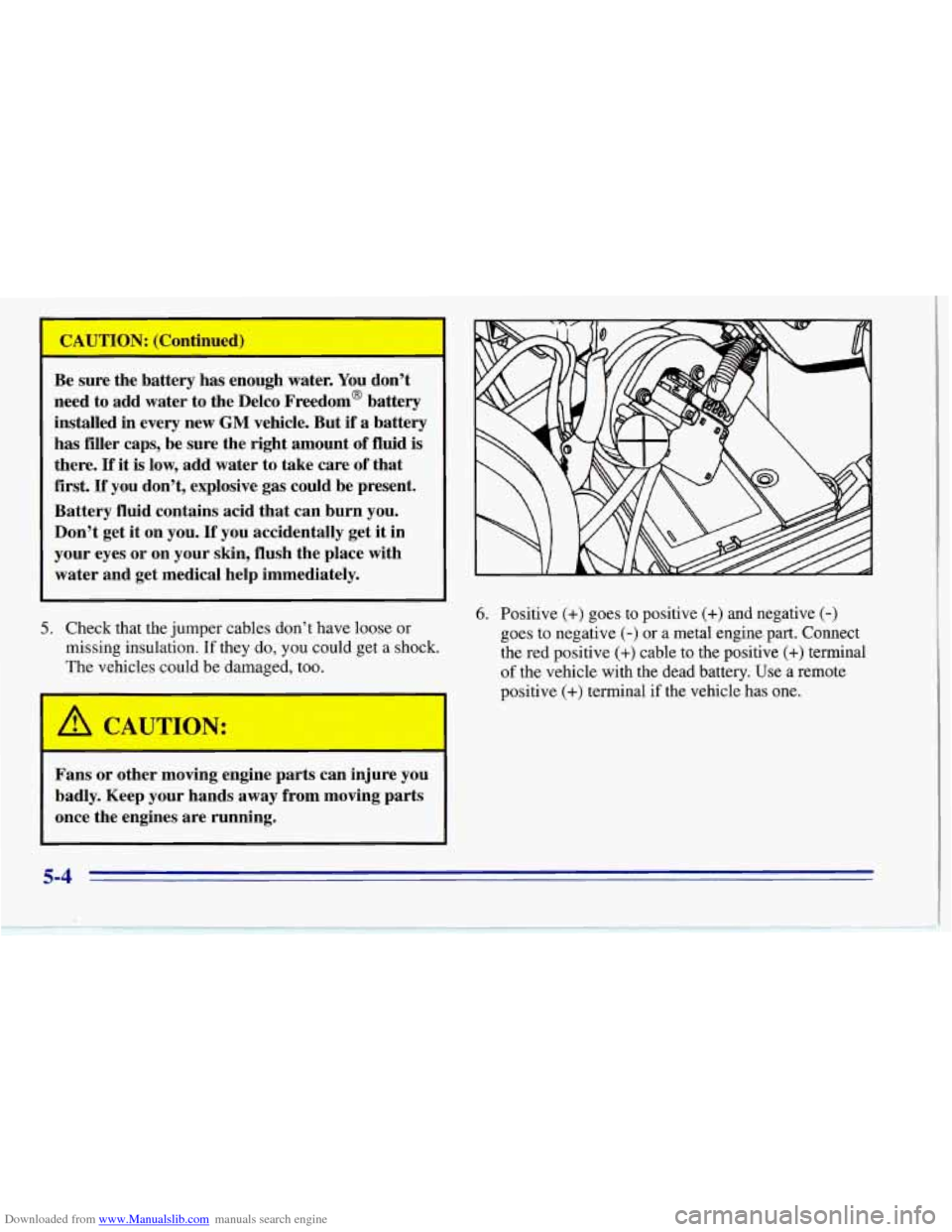
6. Positive (+) goes to positive (+) and negative (-)
goes to negative (-) or a metal engine part. Connect
the red positive
(+) cable to the positive (+) terminal
of the vehicle with the dead battery. Use a remote
positive
(+) terminal if the vehicle has one.