service CHEVROLET CORVETTE 2008 6.G Repair Manual
[x] Cancel search | Manufacturer: CHEVROLET, Model Year: 2008, Model line: CORVETTE, Model: CHEVROLET CORVETTE 2008 6.GPages: 432, PDF Size: 2.4 MB
Page 324 of 432
Bulb Replacement
For the proper type of replacement bulbs, see
Replacement Bulbs on page 5-55.
For any bulb changing procedure not listed in this
section, contact your dealer/retailer.
High Intensity Discharge (HID)
Lighting
{CAUTION:
The low beam high intensity discharge lighting
system operates at a very high voltage. If you
try to service any of the system components,
you could be seriously injured. Have your
dealer/retailer or a qualied technician
service them.Your vehicle has HID headlamps. After your vehicle’s
HID headlamp bulb has been replaced, you may notice
that the beam is a slightly different shade than it was
originally. This is normal.
Halogen Bulbs
{CAUTION:
Halogen bulbs have pressurized gas inside
and can burst if you drop or scratch the bulb.
You or others could be injured. Be sure to read
and follow the instructions on the bulb package.
5-52
Page 330 of 432
Tires
Your new vehicle comes with high-quality tires
made by a leading tire manufacturer. If you ever
have questions about your tire warranty and where
to obtain service, see your vehicle Warranty
booklet for details.
{CAUTION:
Poorly maintained and improperly
used tires are dangerous.
Overloading your tires can cause
overheating as a result of too much
exing. You could have an air-out and
a serious accident. SeeLoading the
Vehicle on page 4-24.
CAUTION: (Continued)
CAUTION: (Continued)
Underinated tires pose the same
danger as overloaded tires. The
resulting accident could cause serious
injury. Check all tires frequently to
maintain the recommended pressure.
Tire pressure should be checked when
your tires are cold. SeeInflation - Tire
Pressure on page 5-66.
Overinated tires are more likely to
be cut, punctured, or broken by a
sudden impact — such as when you
hit a pothole. Keep tires at the
recommended pressure.
Worn, old tires can cause accidents. If
your tread is badly worn, or if your tires
have been damaged, replace them.
SeeHigh-Speed Operation on page 5-68for
ination pressure adjustment for high
speed driving.
5-58
Page 332 of 432
Tire Sidewall Labeling
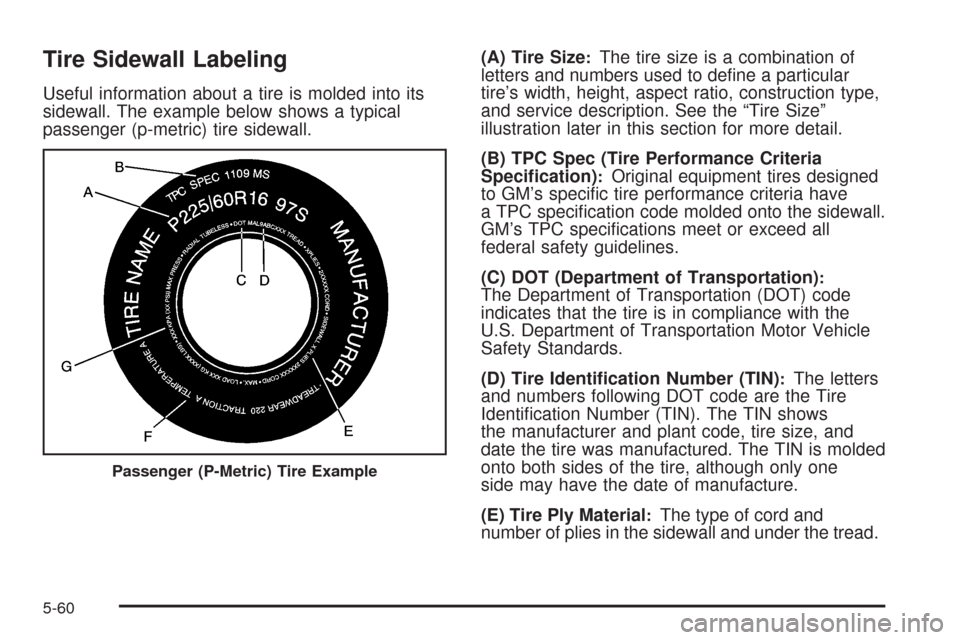
Useful information about a tire is molded into its
sidewall. The example below shows a typical
passenger (p-metric) tire sidewall.(A) Tire Size
:The tire size is a combination of
letters and numbers used to dene a particular
tire’s width, height, aspect ratio, construction type,
and service description. See the “Tire Size”
illustration later in this section for more detail.
(B) TPC Spec (Tire Performance Criteria
Specication)
:Original equipment tires designed
to GM’s specic tire performance criteria have
a TPC specication code molded onto the sidewall.
GM’s TPC specications meet or exceed all
federal safety guidelines.
(C) DOT (Department of Transportation)
:The Department of Transportation (DOT) code
indicates that the tire is in compliance with the
U.S. Department of Transportation Motor Vehicle
Safety Standards.
(D) Tire Identication Number (TIN)
:The letters
and numbers following DOT code are the Tire
Identication Number (TIN). The TIN shows
the manufacturer and plant code, tire size, and
date the tire was manufactured. The TIN is molded
onto both sides of the tire, although only one
side may have the date of manufacture.
(E) Tire Ply Material
:The type of cord and
number of plies in the sidewall and under the tread.
Passenger (P-Metric) Tire Example
5-60
Page 333 of 432
(F) Uniform Tire Quality Grading (UTQG):Tire
manufacturers are required to grade tires
based on three performance factors: treadwear,
traction and temperature resistance. For more
information seeUniform Tire Quality Grading on
page 5-76.
(G) Maximum Cold Ination Load Limit
:Maximum load that can be carried and the
maximum pressure needed to support that load.
Tire Size
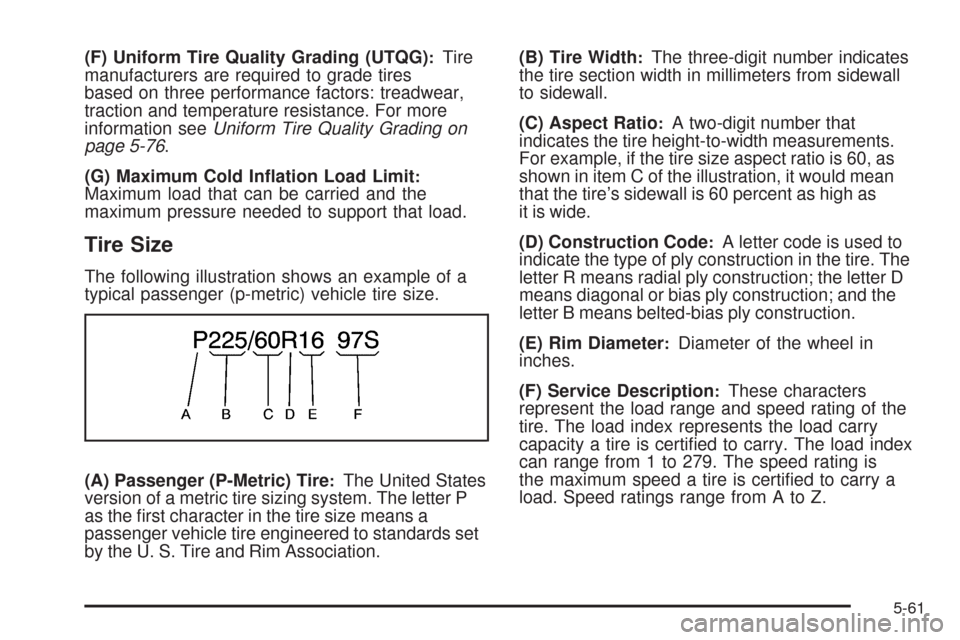
The following illustration shows an example of a
typical passenger (p-metric) vehicle tire size.
(A) Passenger (P-Metric) Tire
:The United States
version of a metric tire sizing system. The letter P
as the rst character in the tire size means a
passenger vehicle tire engineered to standards set
by the U. S. Tire and Rim Association.(B) Tire Width
:The three-digit number indicates
the tire section width in millimeters from sidewall
to sidewall.
(C) Aspect Ratio
:A two-digit number that
indicates the tire height-to-width measurements.
For example, if the tire size aspect ratio is 60, as
shown in item C of the illustration, it would mean
that the tire’s sidewall is 60 percent as high as
it is wide.
(D) Construction Code
:A letter code is used to
indicate the type of ply construction in the tire. The
letter R means radial ply construction; the letter D
means diagonal or bias ply construction; and the
letter B means belted-bias ply construction.
(E) Rim Diameter
:Diameter of the wheel in
inches.
(F) Service Description
:These characters
represent the load range and speed rating of the
tire. The load index represents the load carry
capacity a tire is certied to carry. The load index
can range from 1 to 279. The speed rating is
the maximum speed a tire is certied to carry a
load. Speed ratings range from A to Z.
5-61
Page 337 of 432
If a tire goes at, you will not need to stop on the
side of the road to change the tire. You can just
keep on driving. The shorter the distance you drive
and the slower the speed, the greater the chance
that the tire will not have to be replaced. If you drive on
a deated run-at tire for 25 miles (40 km) or less
and at speeds of 55 mph (90 km/h) or less, there is a
good chance that the tire can be repaired. The tire can
operate effectively with no air pressure for up to
100 miles (160 km) at speeds up to 55 mph (90 km/h),
but the tire would then have to be replaced. When
a tire is lled with air, it provides a cushion between the
road and the wheel. Because you will not have this
cushion when driving on a deated tire, try to avoid
potholes that could damage your wheel and require
replacement of it.
Some road hazards can damage a tire beyond repair.
This damage could occur even before you have
driven on the tire in a deated condition. When a tire
has been damaged, or if you have driven any distance
on a run-at tire, check with an authorized run-at
tire service center to determine whether the tire can be
repaired or should be replaced. To maintain your
vehicle’s run-at feature, all replacement tires must be
self-supporting tires. As soon as possible, contact
the nearest authorized GM or run-at servicing
facility for inspection and repair or replacement.To locate the nearest GM or run-at servicing facility,
call Roadside Assistance. For phone numbers and
Roadside Service details seeRoadside Assistance
Program on page 7-8.
{CAUTION:
Run-at tires are constructed differently than
other tires and could explode during improper
service. You or others could be injured or
killed if you attempt to repair, replace,
dismount, or mount a run-at tire. Let only an
authorized run-at service center repair,
replace, dismount, and mount run-at tires.
The valve stems on your run-at tires have sensors that
are part of the Tire Pressure Monitor System (TPMS).
SeeTire Pressure Monitor System on page 5-68. These
sensors contain batteries which are designed to last
for 10 years under normal driving conditions. See your
dealer/retailer if you ever need to have a wheel
replaced, or if the sensors ever need replacement.
5-65
Page 342 of 432
The TPMS operates on a radio frequency and complies
with RSS-210 of Industry and Science Canada.
Operation is subject to the following two conditions:
1. This device may not cause interference.
2. This device must accept any interference received,
including interference that may cause undesired
operation of the device.
Changes or modications to this system by other than
an authorized service facility could void authorization to
use this equipment.
Tire Pressure Monitor Operation
The Tire Pressure Monitor System (TPMS) is designed
to warn the driver when a low tire pressure condition
exists. TPMS sensors are mounted onto each tire
and wheel assembly on your vehicle. The TPMS
sensors monitor the air pressure in the vehicle’s tires
and transmits the tire pressure readings to a receiver
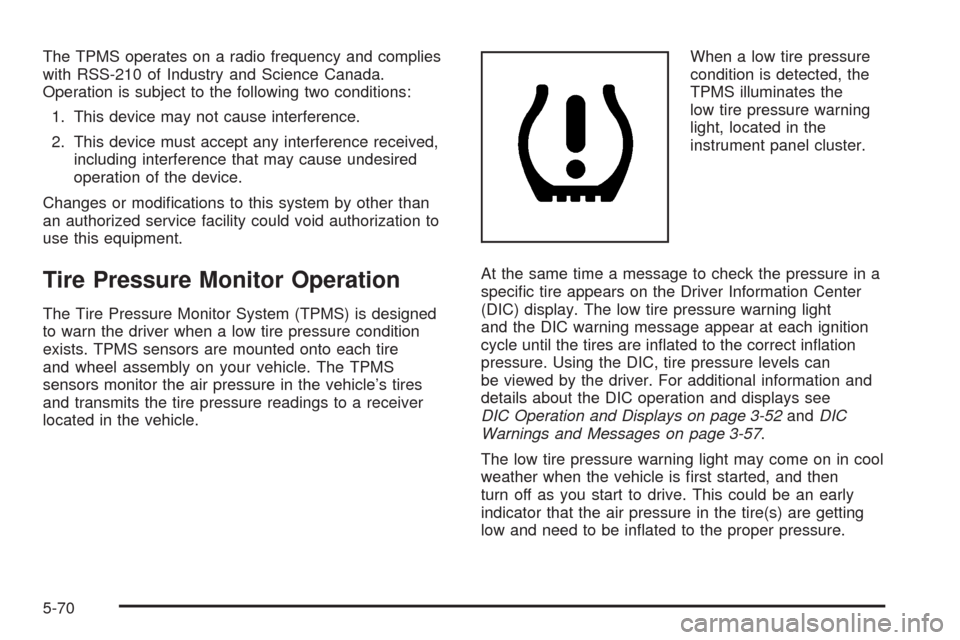
located in the vehicle.When a low tire pressure
condition is detected, the
TPMS illuminates the
low tire pressure warning
light, located in the
instrument panel cluster.
At the same time a message to check the pressure in a
specic tire appears on the Driver Information Center
(DIC) display. The low tire pressure warning light
and the DIC warning message appear at each ignition
cycle until the tires are inated to the correct ination
pressure. Using the DIC, tire pressure levels can
be viewed by the driver. For additional information and
details about the DIC operation and displays see
DIC Operation and Displays on page 3-52andDIC
Warnings and Messages on page 3-57.
The low tire pressure warning light may come on in cool
weather when the vehicle is rst started, and then
turn off as you start to drive. This could be an early
indicator that the air pressure in the tire(s) are getting
low and need to be inated to the proper pressure.
5-70
Page 344 of 432
Replacement tires or wheels do not match your
vehicle’s original equipment tires or wheels. Tires
and wheels other than those recommended for your
vehicle could prevent the TPMS from functioning
properly. SeeBuying New Tires on page 5-74.
Operating electronic devices or being near facilities
using radio wave frequencies similar to the TPMS
could cause the TPMS sensors to malfunction.
If the TPMS is not functioning it cannot detect or signal a
low tire condition. See your dealer/retailer for service if
the TPMS malfunction light and DIC message comes on
and stays on.
TPMS Sensor Matching Process
Each TPMS sensor has a unique identication code.
Any time you replace one or more of the TPMS sensors
or rotate your vehicle’s tires, the identication codes
will need to be matched to the new tire/wheel position.
The sensors are matched to the tire/wheel positions
in the following order: driver side front tire, passenger
side front tire, passenger side rear tire, and driver
side rear tire using a TPMS diagnostic tool. See your
dealer/retailer for service.
Tire Inspection and Rotation
We recommend that you regularly inspect your
vehicle’s tires for signs of wear or damage
Also check for damaged wheels. SeeWhen It Is
Time for New Tires on page 5-73andWheel
Replacement on page 5-78.
The tires on your vehicle are different sizes front
to rear. Due to this, the tires should not be rotated.
Each tire and wheel should be used only in the
position it is in.
5-72
Page 348 of 432
Uniform Tire Quality Grading
Quality grades can be found where applicable on
the tire sidewall between tread shoulder and
maximum section width. For example:
Treadwear 200 Traction AA
Temperature A
The following information relates to the system
developed by the United States National Highway
Traffic Safety Administration (NHTSA), which
grades tires by treadwear, traction, and
temperature performance. This applies only to
vehicles sold in the United States. The grades are
molded on the sidewalls of most passenger car
tires. The Uniform Tire Quality Grading (UTQG)
system does not apply to deep tread, winter-type
snow tires, space-saver, or temporary use
spare tires, tires with nominal rim diameters of
10 to 12 inches (25 to 30 cm), or to some
limited-production tires.While the tires available on General Motors
passenger cars and light trucks may vary with
respect to these grades, they must also conform
to federal safety requirements and additional
General Motors Tire Performance Criteria (TPC)
standards.
Treadwear
The treadwear grade is a comparative rating based
on the wear rate of the tire when tested under
controlled conditions on a specied government
test course. For example, a tire graded 150 would
wear one and a half (1.5) times as well on the
government course as a tire graded 100. The
relative performance of tires depends upon the
actual conditions of their use, however, and may
depart signicantly from the norm due to variations
in driving habits, service practices, and differences
in road characteristics and climate.
5-76
Page 354 of 432
{CAUTION:
Getting under a vehicle when it is jacked up is
dangerous. If the vehicle slips off the jack, you
could be badly injured or killed. Never get under
a vehicle when it is supported only by a jack.
{CAUTION:
Raising your vehicle with the jack improperly
positioned can damage the vehicle or the
vehicle may fall and cause your or others
injury.If you ever use a jack to lift your vehicle, follow the
instructions that came with the jack, and be sure to use
the correct lifting points to avoid damaging your vehicle.
Notice:Lifting your vehicle improperly can damage
your vehicle and result in costly repairs not
covered by your warranty. To lift your vehicle
properly, follow the advice in this part.
To help prevent vehicle damage:
Be sure to place a block or pad between the
jack and the vehicle.
Make sure the jack you are using spans at least
two crossmember ribs.
Lift only in the areas shown in the following
pictures.
For additional information, see your dealer/retailer
and the Chevrolet Corvette service manual.
5-82
Page 357 of 432
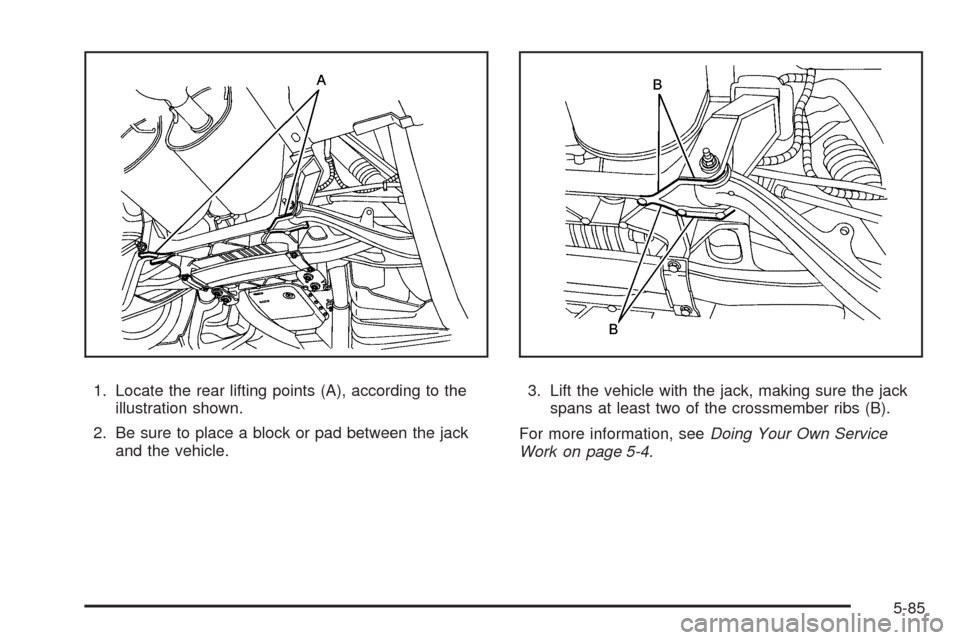
1. Locate the rear lifting points (A), according to the
illustration shown.
2. Be sure to place a block or pad between the jack
and the vehicle.3. Lift the vehicle with the jack, making sure the jack
spans at least two of the crossmember ribs (B).
For more information, seeDoing Your Own Service
Work on page 5-4.
5-85